
… (paraphrasing Frank Zappa), back in the days rock was new enough that the record company execs had no idea how to handle it. They didn’t know what the kids would like, and they knew they didn’t know, so they used the plate of spaghetti approach — just throw it all at the wall and see what sticks.
Fast forward a few years, though, and now they’ve got a pretty good idea of what “rock” is. More importantly, they’ve got a pretty good handle on what the market for rock is. At that point, they do what execs in any industry do. Why bother trying to find the hot new thing, when you can just make it yourself?
And that’s why two guys you’ve never heard of, Max Martin and a dude calling himself “Dr. Luke”, have written every #1 pop hit for the last 15 years. I’m sure they don’t work cheap, but it’s a lot cheaper than scouting every bar band in America for a sound / look / stage act that might or might not pan out. Much easier to focus group a few traits, call up central casting, have them send over a made-to-order bimbo, and have him / her / xzhem front Dr. Luke’s latest computer-generated ditty.
And if everything on the radio all sounds exactly the same, that’s because it is exactly the same. Max Martin and Dr. Luke, and their zillion Mini-Mes at every level of the record biz, sometimes write songs for specific people — hey, guys, Katy Perry needs another ballad for her new album, hop to it! But mostly they write on spec, and shop it around. Different singers, different bands, different genres, doesn’t matter — this time it’s the two generic prettyboys in the “country” band Florida-Georgia Line singing it, but last time it was Katy Perry, the next time it’ll be the Backstreet Boys on their triumphant comeback tour, feat. Jay-Z and MC Funetik Spelyn. Same exact song, literally — it’s just that Kenny Chesney needed one more track on his album this time, and Taylor Swift didn’t, so now it’s #5 with a bullet on the “country” chart.
Severian, “Own Goals”, Rotten Chestnuts, 2021-07-21.
August 8, 2024
QotD: The real reason modern music sounds the same
August 7, 2024
Unleashing the Atom: The Bombing of Hiroshima and Nagasaki – War Against Humanity 139

This video is only available on YouTube itself – click the image above or click here.
World War Two
Published 6 Aug 2024In August 1945, the United States became the first, and to this day only, nation ever to employ nuclear weapons in war. After The fledgling technology proves itself on the testing ground, it is ready for immediate use. The price for this innovation is paid by hundreds of thousands of Japanese civilians who are blinded, burned, crushed, irradiated, and finally burned in a humanitarian crisis never seen before and never since. Join us to hear the gut-wrenching accounts of survivors and understand the motivations behind this tragic outcome to ensure that the horrors of nuclear war are never forgotten and never again unleashed upon the world and its people.
August 6, 2024
The CrowdStrike outage and regulatory capture
Peter Jacobsen discusses the July technical and financial fiasco as a faulty software patch from CrowdStrike took down huge segments of the online economy and how regulatory capture may explain why the outage was so widespread:



On July 19th, something peculiar struck workers and consumers around the world. A global computer outage brought many industries to a sudden halt. Employees at airports, financial institutions, and other businesses showed up to work only to find that they had no access to company systems. The fallout of the outage was huge. Experts estimate that it totaled businesses $5 billion in direct costs.
The company responsible, CrowdStrike, was also severely impacted. Shareholders lost about $25 billion in value, and some are suing the company. The outage has led to expectations of, and calls for, stricter regulations in the industry.
But how did the blunder of one company lead to such a massive outage? It turns out that the supposed solution of “regulation” may have been one of the primary culprits.
Regulatory Compliance
CrowdStrike, ironically, is a cybersecurity firm. In theory, they protect business networks and provide “cloud security” for online cloud computing systems.
Cloud security, in and of itself, is likely a service that businesses would demand on the market, but the benefit of increased security isn’t the only reason that businesses go to CrowdStrike. On their own website, the company boasts about one of its most important features: regulatory compliance.
[…]
When experts who have relationships with companies are called in to help write regulations, they may do so in a way favorable to industry insiders rather than outsiders. Thus, regulation is “captured” by the subjects of regulation.
We can’t say with certainty that this particular outage is the result of an intentional regulatory capture by CrowdStrike, but it seems clear that CrowdStrike’s dominance is, at least in part, a result of the regulatory environment, and, like most large tech companies, they’re not afraid to spend money lobbying.
In any case, without cumbersome regulations, it’s unlikely that cybersecurity would take on such a centralized form. Despite this, as is often the case, issues caused by regulation often lead to more calls for regulation. As economist Ludwig von Mises pointed out:
Popular opinion ascribes all these evils to the capitalistic system. As a remedy for the undesirable effects of interventionism they ask for still more interventionism. They blame capitalism for the effects of the actions of governments which pursue an anti-capitalistic policy.
So despite the reflexive call for regulation that happens after any disaster, perhaps the best way to avoid problems like this would be to argue that in terms of regulation, less is more.
August 5, 2024
Short-term technological forecast – “If I were a commercial pilot, I’d tell you to return to your seats and buckle up”
Most of this Ted Gioia post is behind the paywall (and if you can afford it, I’m sure you’d get your money’s worth for a subscription):
I anticipate extreme turbulence on every front for the remaining five months in 2024. You will see it in politics, business, economics, culture, world affairs, the stock market, and maybe even your own neighborhood.
That’s one of the themes of my latest arts and culture update below.
What happened to the AI business model last week?
After almost two years of hype, the media changed its opinion on AI last week.
The hype disappeared almost overnight
All of a sudden, news articles about AI went sour like reheated 7-Eleven coffee. The next generation AI chips are delayed, and 70% of companies are behind in their AI plans. There are good reasons for this — most workers now say AI makes them less productive.
People are also noticing that AI businesses want to use the entire electricity grid to run their money-losing bots. Meanwhile AI companies are burning through cash at historic levels. Even under the best case scenario, this all feels unsustainable.
But the worst disclosure, in my opinion, came on July 24 — just eleven days ago.
A study published in Nature showed that when AI inputs are used to train AI, the results collapse into gibberish.
This is a huge issue. AI garbage is now everywhere in the culture, and most of it undisclosed. So there’s no way that AI companies can remove it from future training inputs.
They are caught in the doom loop I described last week.
That same day, the Chief Investment Officer at Morgan Stanley warned investors that AI “hasn’t really driven revenues and earnings anywhere”. One day later, Goldman Sachs quietly released a report admitting that the AI business model was in serious trouble.
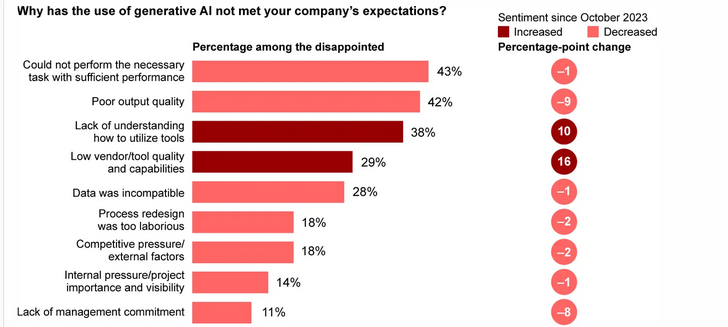
Even consulting firms, who make a bundle hyping this tech, are backtracking. Bain recently shared the following chart (hidden away at the end of a report) which explains why AI projects have failed.
These findings are revealing. They show that management is absolutely committed to AI, but the tools just don’t deliver.
And, finally, last week the media noticed all this.
They published dozens of panic-stricken articles. Investors got spooked too — shifting from greed to fear in a New York minute. Over the course of just two days, Nvidia’s stock lost around $400 billion in market capitalization.
In this environment, true believers quickly turn into skeptics. The whole AI business model gets scrutinized — and if it doesn’t hold up, investment cash flow dries up very quickly.
This is exactly what I predicted 6 months ago. Or even a year ago.
I expect that the next few weeks — or maybe even the next few days — will be extremely turbulent in the AI world.
Buckle up!
The dominant AI music company just admitted that it trained its bot on “essentially all music files on the Internet”.
Suno is a huge player in AI music — it tells investors it will generate $120 billion per year. Microsoft is already using its technology.
But there’s a tiny catch.
The company now admits in a court filing:
Suno’s training data includes essentially all music files of reasonable quality that are accessible on the open internet, abiding by paywalls, password protections, and the like, combined with similarly available text descriptions
Hey, this is totally illegal — it’s like Napster all over again.
Suno will need to prove that all these copyrighted songs are “fair use” in AI training. I doubt that any court will take that claim seriously.
If the music industry is smart, they will use this violation to shut down AI regurgitation of copyrighted songs.
If the music industry is stupid — run according to my “idiot nephew theory” — they will drop charges in exchange for some quick cash.


Current culture is failing teenage girls very badly
In The Free Press, Kat Rosenfield contrasts her own teenage years with the situation faced by teenage girls today:

The Genius of Judy, a new book by Rachelle Bergstein, suggests that I was not alone in believing that Judy Blume was the ultimate source of knowledge on all things teenage girl. “Her characters and stories were more than just entertainment,” Bergstein writes. “They were a road map.”
Blume’s stories offered a powerful counterpoint to a culture that sought to limit women’s choices by surrounding their bodies and sexuality with shame and stigma — a culture that treated the lives of teenage girls as frivolous and insignificant. She spoke frankly and authentically not only of girls’ struggles but also, crucially, of their survival. She offered a glimpse of how beautiful life could be on the other side.
Are You There God? It’s Me, Margaret at once demystifies the bodily changes associated with the onset of puberty, and approaches the idea of becoming a woman with a sense of wonder. Her 1981 novel Tiger Eyes tackles loss, grief, and family upheaval — all of which shape its main character’s identity, but do not shatter her. Forever (1975) dares to tell a story about two teenagers who fall in love and have sex — responsibly, and without dire consequences.
Blume “taught young readers”, writes Bergstein, “that we were allowed to expect more from our lives than the women who came before us”.
I was struck, reading Bergstein’s book, that today’s youth may need Blume even more desperately than my cohort did. If the path to womanhood was once too taboo to talk about, today’s cultural landscape is flooded with narratives that make the entire enterprise seem like an unmitigated horror.
Puberty, rather than the exciting sign of maturity experienced by Margaret and her friends, has become a battleground for a gender ideology whose first response to a pubescent girl’s anxiety about her changing body is to suggest that perhaps she’s not really a girl. Meanwhile, the one-two punch of #MeToo followed by the fall of Roe v. Wade has fueled a consensus that to be a woman is to exist in a nightmarish state of perpetual physical vulnerability — if not to the torments of pregnancy and childbirth, then to the predations of men, who are of course written off en masse as “trash” by the pop-feminist commentariat. Dating and sex, in particular, are positioned as a minefield of traumas best avoided in favor of celibacy, which has been rebranded by Zoomers as a trendy new practice known as going “boy sober“.
The result is an entire generation of girls who are not just terrified of becoming women, but actively distressed by narratives that depict the process in a realistic way. One of the more interesting observations from The Genius of Judy is that Gen Z seems to have particular trouble with Blume’s Forever, in which the protagonist, Katherine, is wrestling with the question of when and whether to have sex, while her boyfriend Michael, who is not a virgin, is extremely and vocally in favor. Bergstein describes watching a TikTok in which the young female poster rants that “Michael is like a predator. This man pressures her so many times into sexual intercourse that I feel like she eventually just gave in.”
Bergstein sees this as a sign Forever hasn’t aged well. To me, it is a sign of how poorly today’s teenagers have been served by contemporary sexual discourse, and how badly they need Blume’s countervailing narrative. Forever articulates an important set of truths: that every girl approaches sexual readiness on her own timeline, that the desires of two individual people are rarely in perfect alignment, and that many, if not most couples have to negotiate that misalignment in the normal course of a relationship. In Forever, as in the real world, a girl can be at once desirous of sex but not yet ready for it — until, one day, she decides she is.
Having been a teenage boy in the 1970s, while I thought it was a bad suite of experiences (afterwards, with a bit of life perspective: at the time I thought it was hellish), it seems that teenage girls today are even worse off.
What the First Astronauts Ate – Food in Space
Tasting History with Max Miller
Published Apr 23, 2024Smooth, sweet, and sour Tang pie in a graham cracker crust
City/Region: United States of America
Time Period: 1960sContrary to popular belief, NASA did not invent Tang, but the company that did, General Foods, used the association in a lot of their marketing. They even developed this recipe for Tang pie, also called astronaut pie.
The texture of the pie is smooth and very nice, but it had too much of a sour zip in it, or “tang” if you will, for me. If you like sour notes like in lemon meringue or key lime pies, or if you just like Tang, then I think you’ll like this. You can use a ready-made graham cracker crust to make this pie even easier to put together.
Tang Pie. It’s the pie of the future. Here it goes space boys and girls:
TANG Pie
1 can sweetened condensed milk
3/4 C. Tang® powder drink mix
1/2 C. sour cream
1 (9 oz.) tub Cool Whip®
1 graham cracker pie crust.
Mix condensed milk and Tang. Add in sour cream until well blended. Then fold in tub of Cool Whip. Pour into pie crust and refrigerate for 4 hours or until set and cold.
August 4, 2024
The rise and (rapid) fall of the Levittown model
Virginia Postrel linked to this interesting post at Construction Physics which traces the brief heyday of William Levitt’s “Levittown” model for mass-producing modern housing:

Prefabbed components and appliances for a Levittown home.
Image from Construction Physics.
For decades, people have tried to bring mass production methods to housing: to build houses the way we build cars. While no one has succeeded, arguably the man that came closest to becoming “the Henry Ford of homebuilding” was William Levitt, with his company Levitt and Sons. Levitt is most famous for building “Levittowns”, developments of thousands of homes built rapidly in the 1940s, ’50s, and ’60s. By optimizing the construction process with improvements like standardized products and reverse assembly line techniques, Levitt and Sons was able to complete dozens of homes a day at what it claimed was a far lower cost than its competitors. William Levitt styled his company as the General Motors of housing, and both he and it became famous. Levitt graced the cover of Time magazine in 1950, and Levittowns became a household name.
For a time, it appeared that Levitt might actually sweep away the old way of building and become the Henry Ford of housing through modern mass production techniques. Levitt boasted that he could build more cheaply than anyone else, and for decades Levitt and Sons was the largest homebuilder in the U.S., and probably the world.1 But Levitt’s success unraveled. By the late 1970s, Levitt and Sons had barely escaped bankruptcy, and it emerged as a small, conventional homebuilder, which it would remain until it went out of business for good in 2018. Levitt himself would leave Levitt and Sons in the early 1970s, lose his fortune after a series of failed development projects in the U.S. and abroad, and die penniless in 1994.
Levitt’s model of large-scale, efficient homebuilding using mass production-style methods worked for a brief window in the 1950s, but by the end of the 1960s a changing housing market and increasingly strict land use controls meant that such methods were no longer feasible. And even at its peak, Levitt likely pushed large-scale building beyond what could be justified on pure economic terms. Levittown was ultimately a response to a temporary set of housing market conditions, not the herald of a new, better way of building.
[…]
First Levitt homes at Levittown.
Image from Construction Physics.At Levittown, the construction process was broken down into 26 separate steps, each performed by a separate crew. Crews would go to a house, perform their required task (using material that had been pre-delivered), then move on to the next house. Within the crew, work was further specialized: on the washing machine installation crew, William Levitt noted that “one man did nothing but fix bolts into the floor, another followed to attach the machine”, and so on. By breaking down the process into repetitive, well-defined steps, workers didn’t have to spend time figuring out what they should do (what Levitt described as “fumbling and figuring”).
In addition to task and product standardization, Levitt and Sons took advantage of machines and mechanization wherever possible. It had its own cement trucks, and operated its own foundation-digging machinery and cinder block-making machinery. Levitt and Sons was an early user of power tools like paint sprayers, power saws, routers, and nailers. The company also made extensive use of what at the time were relatively novel factory-produced materials, like plywood and drywall.
Like any mass production process, the ultimate enemy of building Levittown was delay: keeping construction on track meant a steady, uninterrupted stream of material that arrived at the jobsite exactly when needed. On a typical construction site, as much as half the time was wasted while workers wandered around looking for needed material. In Levitt’s operation, wasted time was close to zero. To ensure timely material deliveries (and to cut out middlemen), Levitt and Sons had its own distribution company, the North Shore Supply Company, which stretched for half a mile along a railroad stop near the jobsite. To avoid delays, North Shore Supply kept a sufficient supply of material on-hand to build 75 houses, and pre-assembled items like plumbing trees, stairs, and cabinets. North Shore was also where lumber was pre-cut to the correct size. By using standardized designs, planned work sequences, and carefully controlled precutting, Levitt and Sons was able to almost entirely eliminate rework during the construction process.
But assuring an uninterrupted flow of material required far more than just owning a distribution company. William Levitt described some of the extreme measures the company went to avoid delays or slowdowns:
We wouldn’t let ourselves be stopped by shortages. When cement was unavailable in this country we chartered a boat and brought it in from Europe. When lumber was in short supply, we bought a forest in California and built a mill. When nails were hard to come by, we set up a factory in our backyard and made them ourselves.
At its peak Levitt and Sons was completing 36 homes in Levittown a day. And the huge backlog of demand meant that housing was sold quickly. Months before the first Levittown homes were completed, families stood in line for the opportunity to rent one (roughly the first 2,000 Levittown homes were built as rentals). On a single day in 1949, Levitt and Sons sold 1400 homes, some to families who had been waiting in line for days. At $7,990 for a 800 square foot home, Levitt boasted that he could sell his houses for $1,500 less than the competition and still make $1,000 in profit.2
[…]
William Levitt tried harder than anyone else to make housing mass producing happen, and for a brief moment it looked like he might succeed. But Levitt’s dreams were predicated on a particular set of housing market conditions — a huge backlog of demand, relatively few competitors, compliant building jurisdictions and little public opposition — that quickly dissipated. In The Merchant Builders, Ned Eichler notes that as early as the mid-1950s, the Levitt model of a single, enormous project built rapidly with mass production-style methods no longer made sense. Says Eichler, “There simply was no market in which an appropriate site could be bought cheaply enough or in which demand was great enough to sustain such a pace”. Many of Levitt’s innovations — slabs instead of basements, power tools, drywall and plywood — did not require large volume production, and were adopted by other, smaller builders (and have since become standard). The enormous increase in land use controls starting in the late 1960s only further inhibited the sort of large-scale developments that Levitt favored.
1. Levitt and Sons was at least the largest in the U.S. in 1950, and was in 1968 when it was acquired by ITT, and probably for some years after that.
2. The first Levittown demonstration homes were sold for $6,990.

Mokusatsu! – WW2 – Week 310 – August 3, 1945
World War Two
Published 3 Aug 2024The Japanese reaction to the Allied ultimatum for unconditional surrender is … mokusatsu. This can be translated several ways, but all involve not giving a response. Meanwhile, materials for atomic bombs to be dropped on Japan are delivered to Tinian, though the ship making the delivery is sunk by a Japanese submarine days afterward. The active war continues in Burma and China, and the Potsdam Conference ends in Germany with the map of Poland very much re-drawn.
00:00 Intro
00:56 Mokusatsu
05:47 Delivering Atomic Material
07:22 Sinking The Indianapolis
09:26 Bombing Japan
12:22 The War In Burma And China
14:07 Potsdam Confernece Ends
17:02 Conclusion
(more…)
August 3, 2024
The Rise, Fall, And Revival Of Art Deco | A Style Is Born W/ @KazRowe
Wayfair
Published Jun 15, 2023Welcome to A Style is Born, hosted by YouTuber, cartoonist, and champion of under-represented history, Kaz Rowe!
Join us as we go down the rabbit hole and uncover the unique histories and origin stories behind your favorite design styles. In this first episode of Season 2, we delve into the history-rich Art Deco movement.
Chapters
Intro – 00:00
History – 00:45
Influences, Elements, & Materials – 04:58
1980s Art Deco Revival Via Memphis Group – 07:46
Conclusion – 09:13
(more…)
August 2, 2024
Trudeau won’t – can’t – go voluntarily
In The Line, Michael Den Tandt explains why the Biden option isn’t a viable one for Justin Trudeau at this stage of the Canadian electoral cycle:

US President Joe Biden talks to Canadian Prime Minister Justin Trudeau, March 2023.
It’s a tough time to be a backbench Liberal MP in Canada, yes? The tone, emerging in anonymous leaks to reporters, is grumpy, surly, unhappy. This is unsurprising. We’re in year ten of a ten-year political cycle that feels stretched and road-beaten, by any standard.
Plus, to our south, there’s this shining model now of the transformative power of change. One day President Joe Biden is clinging by his fingernails to his party’s nomination, with the convicted felon Donald Trump seemingly headed for a big win in November. The next, Biden’s out, new hope Kamala Harris is raising tens of millions in campaign donations, and reporters are lasering in on Trump’s highly quotable running mate, J.D. Vance.
All in a week. So, couldn’t something similar happen in Ottawa? Couldn’t Prime Minister Justin Trudeau take a step back, hit the beach or the lecture circuit, make way for fresh blood, and at least give the Liberals a shot at survival in 2025? What’s he waiting for?
Anything is possible. But this scenario is unlikely. That’s because Justin Trudeau isn’t Joe Biden; Chrystia Freeland isn’t Kamala Harris, and Canada isn’t the United States.
Most obviously, the cycle: The cycle is everything. Individuals are all but powerless in its clutches. As it nears a decade it adds lead weights, like those a deep-sea diver might wear, to the feet of Canadian incumbents. Even the most promising of change agents — former prime minister and justice minister Kim Campbell is Exhibit A — will be brought low by its power.
The argument can be made made that the Progressive Conservative party’s obliteration in 1993 (reduced from majority status to two seats) was not just due to late-cycle fatigue, that Campbell herself had run a wobbly campaign. Some will note the deep weariness with the constitutional wrangling that dominated Canadian discourse during the Brian Mulroney years, or the hangover of Mulroney’s, at the time, keen personal unpopularity. Fair points.
But underlying those events was still the implacable cycle — as in 2006, when prime minister Paul Martin, having seen that Liberal government reduced to a minority in 2004 (despite his personal popularity at the time), lost power to a rising Stephen Harper. In the throes of the federal sponsorship scandal (I will spare you the details, but you can find them here if you’re interested in the arcana), Martin was described by gifted wordsmith Scott Reid, then his communications director, as “the wire brush” who would scrape away the stain of sponsorship. It was a bold attempt to rhetorically seize the change wave. But the wave was strong and Martin lost.
QotD: The essential target of ideological propaganda
The Third Reich didn’t last long enough to figure it out, but in their 70-odd years the Soviets learned that “the masses” can be more or less ignored. They’re no threat to the regime. Your average Soviet “citizen” — Ivan Sixpack — would follow pretty much any rule, so long as he had a steady and predictable life course. That’s no slander on Ivan; it’s just the way people are. If you want proof, go look around — if I’d told you, back in the summer of 2019, about all the masks and the social distancing and the lockdowns and everything else, you’d have laughed at me. “There will be blood in the streets! No one will stand for it!”
The reaction of “the masses” (a term I hate; it’s patronizing, but it’ll have to do) to COVID was instructive: They either did as they were told, with nary a peep of complaint, or they simply ignored it … with nary a peep of complaint. From the rulers’ perspective, either one was fine, because they’re functionally the same thing. We all know that whatever the ruling class thought they were going to get out of the Kung Flu panic — and it’s not at all clear; we’ll get there — “public health”, as in the actual health of real members of the public, was nowhere on the list. As with “climate change” and all their other “crises”, their highly visible behavior showed how seriously they took it — which was, of course, not at all.
Indeed, from the rulers’ perspective, it was actually better that some large fraction of the underclass didn’t comply — that way, the mental energy of the Karens was channeled down, not up. Karen could start complaining about Whitmer, Newsom, and the rest not living by their own rules, and had she done so, that might’ve posed a problem for the rulers. But thanks to the maskless proles (and, of course, asshole class traitors like me), Karen always had a bunch of much softer targets to hector.
That’s the function of “propaganda” in my sense. It’s designed to create a narrative, the purpose of which is to channel dissatisfaction down the social scale.
What the Soviets learned, and their SJWs successors have internalized, is that you really only need a small cadre of “middle class” (for lack of a better term) producers to keep things running. Those are the targets of narrative-reinforcing propaganda.
Indeed, it’s only a subset of that already small fraction that needs to be propagandized. As the Soviets quickly learned, true technical experts are more or less ideology-proof. That’s because their technical expertise takes up all their time; they’ve oriented their personalities around it. You could read a novel like Red Plenty to get the sense of it (Z Man has a review somewhere if you want it), but I suggest a much easier path: Watch the fun old movie Boiler Room, with Giovanni Ribisi, Vin Diesel, and in a brief but memorable scene, Ben Affleck. I’m sure that seems odd — it’s a movie about sell-at-all-costs stockbrokers, based loosely on Jordan Belfort’s Stratton Oakmont scam; what could be more explicitly capitalist?
But note how they live: They own ludicrous cars and live in huge mansions, but the cars hardly get driven, and the mansions are unfurnished. There’s a scene where they all get together in Vin Diesel’s living room to watch a movie (Wall Street, natch). There’s a huge tv and a couch, but everything else is boxed up, and they’re eating takeout pizza. Giovanni Ribisi says something like “did you just move in this weekend?” and the other guys say no, he’s been living here for years, he just never got around to unpacking his stuff. That’s the mindset of the true technical intelligentsia. Those stockbrokers think they’re doing it for the money, and so they have the outward trappings of rich people, but they’re really doing it because that’s who they are — they’d be just as deliriously happy competing for subway tokens or scraps of confetti, so long as they had one more scrap than the guy on the next phone.
Given that, the only group that really needs to be propagandized is — you guessed it — Karen. The entire narrative of COVID was very obviously designed by hormonal cat ladies, for hormonal cat ladies. Cards on the table: Though I thought Kung Flu was overblown and ridiculous from the beginning, since I know a little history, I didn’t base my conclusions on my reading in the medical journals. I didn’t read medical journals, and unless you’re a doctor I bet you didn’t, either. My opposition to the Kung Flu panic was entirely visceral: THIS IS MEAN GIRL SHIT.
Severian, “Narrative Collapse III: Magic Masks”, Rotten Chestnuts, 2021-07-07.
August 1, 2024
“There is nothing more worn out in natsec discussions coming from the Imperial City than ‘all elements of national power'”
CDR Salamander reads through a recent RAND report on the US National Defense Strategy and has thoughts:

[Click to open PDF document]
Were you aware this tasker was working its way through the system?
Congress established the Commission on the National Defense Strategy by statute to examine and make recommendations with respect to the National Defense Strategy.
Well, RAND has the goods,
As part of the Commission’s role, it conducted a review of the “assumptions, strategic objectives, priority missions, major investments in defense capabilities, force posture and structure, operational concepts, and strategic and military risks” associated with the 2022 National Defense Strategy (PDF). The Commission called on RAND to provide administrative and analytic support.
Did you catch this yummy little morsel?
The current National Defense Strategy (NDS), written in 2022, does not account for ongoing wars in Europe and the Middle East and the possibility of a larger war in Asia. Continuing with the current strategy, bureaucratic approach, and level of resources will weaken the United States’ relative position against the gathering, and partnering, threats it faces.
Remember this tasty nougat center for later:
… does not account for ongoing wars in Europe and the Middle East and the possibility of a larger war in Asia.
Basically, they’re reminding us that we have a nation’s security running on an obsolete autopilot. Bravo Zulu for putting that marker out early. In a fashion, the report could have ended there. Probably should have ended there, but alas … no.
As Noah Robertson noted in his reporting, this report was not due until the end of the year. However, the commissioners decided to deliver it early so it could be part of the election conversation.
This election cycle has different plans.
While I appreciate the move — one I would have encouraged — I’m not sure either party wants to engage on the topic as there is only so much bandwidth in an election year … and … will you look at what happened in the last month?
However, there is a mission to complete … and they completed it early. There is praise due for that.
[…]
I have … concerns in other foundational issues as well.
There is plenty to chew on and it is a meaty document, so I am just going to touch on a few things in the Summary that I hope will encourage you to dive in for yourself for the details. No one wants me to fisk a 100+ page report.
My primary concern came early when the Balrog of Beltway natsec theory appeared;
In its report, the Commission on the National Defense Strategy recommends a sharp break with the way the U.S. Department of Defense (DoD) does business and embraces an “all elements of national power” approach to national security. It recommends spending smarter and spending more across the national security agencies of government.
In the name of all that is holy. There is nothing more worn out in natsec discussions coming from the Imperial City than “all elements of national power“. The “whole of government” mating with the “interagency”. Yes, yes, yes, we know — the four walls of the food trough. This is not an insight, this is rice bowl protection.
Yawn.
That is just a tell that people were invited inside the tent were very concerned that DOD might get more money and the civilian part of the natsec bureaucracy wouldn’t get an equal plus up of funds. Requirements be damned, we have budget-pie ego issues that need to be addressed.
As the kids would say, “basic“.
Buddha forbid that DOD get $1 and at the same time we don’t give $1 to every other kid at the table. It really is one of the most unimaginative instincts of the established natsec nomenklatura.
As we’ll see again, this DC habit of holding defense spending hostage for “less icky” levers of power or petty domestic programs making everything unaffordable. People tasked with “hard decisions” decide the “hard decision” is to decide to say “yes” to every good-idea fairy that threatens to heavily pout if their #1 goal is not your #1 goal.
If your shields don’t go up, your wallet pushed deeper in your pocket, your eye twitch start, your children hidden, and you don’t instinctively reach for your side-arm when you see a Beltway entity mention, “spending smarter and spending more across the national security agencies of the government” then you have not paid attention the last quarter century.
“Donald Trump isn’t a real man, because Hulk Hogan”
It’s always appropriate to criticize public figures — it goes with the job — but you actually should find things to criticize when you do it, otherwise it comes across as lazy bitching:
I’m a charter member of the “no one is above criticism” club. Everyone is fair game. People who run for office are really fair game. So I think it’s just fine to criticize Donald Trump, and to criticize JD Vance, and to criticize Trump/Vance 2024.
But what’s so obvious, over and over again, is that the people writing the most insistent criticism are playing critic. They know that they’re supposed to say that Donald Trump is very very very bad, so they … do that? A lot? But the substance of the criticism tends, with remarkable frequency, to be a set of non-sequiturs and self-refuting rhetorical dead-ends. They’re criticizing because they’re supposed to, not because they have criticisms to offer.
Take David French. Please. Here’s his latest: Donald Trump isn’t a real man, because Hulk Hogan.
The I-didn’t-think-this-through flavor of this piece can’t be exaggerated. It makes so little sense, so poorly, with such odd structure and framing, that it nears the level of Thomas Friedmanism. David French doesn’t know anything, or understand anything, but he really throws himself into it.
So.
Hulk Hogan, Kid Rock, and Dana White were at the Republican National Convention, French writes, so the Republicans are being macho, unlike Democrats, who are demonstrating a style of manhood that focuses on being kind, decent, and nurturing. Republican manhood is about complaints and empty rage; Democratic manhood is about building things and caring for others. Making the comparison concrete, French explicitly compares the macho grievance artist Trump to precisely four wonderfully gentle and caring men: Admiral William McRaven, the US Senator and former astronaut and fighter pilot Mark Kelly, “Mark Hertling, my former division commander in Iraq”, and the former Marine Corps General and Secretary of Defense James Mattis. Those four men are the model of a masculinity that nurtures, loves, and builds; Trump is the model of a masculinity that only destroys and tears down. David French hates machismo, so the list of men he admires is made up entirely of combat arms officers.
Do you … see the problem? Because David French doesn’t. At all. Donald Trump is a real estate developer, someone who spent his entire adult life actually building things:
It’s just fine to criticize Trump as a businessman, if you feel inclined to do that. But he’s a builder and a developer; that’s his actual background. He makes things. He spent his life making things. And his political message is about making things and protecting people who make things, whether you agree with the specifics of his policy arguments or not


The Rarest 1911: North American Arms Co
Forgotten Weapons
Published Apr 22, 2024In the summer of 1918, the US government wanted to increase production of M1911 pistols, but all current manufacturers were working at capacity. So they looked to issue new contracts, and someone realized that the Ross rifle factory was a potential option. Now, the Ross Rifle Company was bankrupt by this time, and its factory lay essentially abandoned. So in June of 1918, two Canadian lawyers by the names of James Denison and Edmond Ryckman incorporated the North American Arms Company Ltd in Quebec, signed a contract to manufacture 500,000 1911 pistols for the US, and then leased the Ross factory for a term of 18 months. Whether they would have been successful in producing pistols at scale is unknown, because their contract was cancelled on December 4, 1918 before any deliveries were made. With the end of the war, arms requirements plummeted, and pretty much all ongoing weapons contracts were cancelled, not just this one. However, parts for 100 pistols had been produced, and these were assembled and sold commercially after the contract was cancelled.
(more…)
July 31, 2024
The Korean War Week 006 – Stand or Die! – July 30, 1950
The Korean War by Indy Neidell
Published 30 Jul 2024The UN Forces have been pushed back ever further, but this week, US 8th Army Commander Walton Walker issues the order to “stand or die”; he sees no other options. American reinforcements are finally getting into the actual fight, though, and Britain has decided they will send in ground troops, so things might turn around … if they can hold out long enough for those troops to arrive, because a brilliant North Korean strategy might win the war and soon.
(more…)


