Quotulatiousness

September 23, 2010

Not that they’re getting too confident, or anything

Filed under: History, Humour, Politics, USA — Tags: — Nicholas @ 16:11

Tweet of the day, from Jim Geraghty:

September 21, 2010

Canadian women more free than American women

Filed under: Cancon, Law, Liberty, USA — Tags: , , , — Nicholas @ 07:56

. . . if only in the right to bare their breasts in public:

A court has ruled that women’s nipples do not enjoy freedom of expression under the US Constitution.

The case was brought by a 16 year old girl, who was one of three women accused of exposing their breasts to passing traffic on an Indianapolis street last year.

She would have faced a misdemeanour charge of public nudity if she had been 18 or over.

She took issue with the fact that exposure of male nips would not have been covered by the law, as Indiana law specifically prohibits exposure of female nipples.

She decided to take the issue, and presumably the breasts in question, to the State Appeals Court. Her argument was that the equal protection afforded by the 14th Amendment meant her breasts should be treated the same as male breasts. The amendment holds that States may not “deny to any person within its jurisdiction the equal protection of the laws.” It has been a feature of civil rights cases since the 19th century — not always in the ways you’d expect.

Of course, having established that right several years ago, very few Canadian women actually exercised that right . . .

September 20, 2010

“I can do whatever I want”

Filed under: Law, Liberty, Media, USA — Tags: , , , , — Nicholas @ 12:11

H/T to LibertyIdeals for the link.

The first debate in the Delaware Senate race

Filed under: Humour, Politics, USA — Tags: , — Nicholas @ 09:08

I haven’t been following the Christine O’Donnell campaign, but this is quite funny:

[George Stephanopoulos] Good evening, ladies and gentlemen, and welcome to the first official debate of this election cycle. I’m George Stephanopoulos, and with me tonight are two candidates for the United States Senate, Delaware Democrat Chris Coons, and Republican Christine O’Donnell.

[Chris Coons] Hello George, it’s a pleasure to be here.

[Christine O’Donnell] YOUR VOICE IS THE PITIFUL WHINE OF GNATS, AND YOU REEK WITH THE STINK OF FEAR.

[George Stephanopoulos] Outstanding. The format tonight will be as follows: I’ll ask each of you a question, and you will have two minutes to respond. Your opponent will then have one minute in which to offer a rebuttal. Christine O’Donnell, the first question goes to you: The economic stimulus bill passed last year has been the topic of much discussion. Some argue that it gave the American economy a much-needed shot in the arm, while others claim that it’s effects have been marginal or even harmful. What is your opinion on this, and what, if anything, should we have done differently?

[Christine O’Donnell] JUST AS THE GODDESS CIRCE DID DECEIVE THE COMPANIONS OF ODYSSEUS INTO DRINKING OF THE ENCHANTED WINE, SO DID PRESIDENT OBAMA THROUGH HIS CUNNING DECEIVE THE AMERICAN PEOPLE. HE HAS BOUND OUR ECONOMY TO THE YOKE OF PUBLIC SPENDING, MUCH AS THE TRICKSTER GOD LOKI WAS BOUND BY ODIN TO THE ENTRAILS OF HIS SON, NARI, WHOSE SCREAMS WERE AS THE CRIES OF A THOUSAND DYING EAGLES.

It gets better from there. As they say, read the whole thing. H/T to Ace.

September 17, 2010

Duelling camo patterns

Filed under: Military, USA — Tags: , , — Nicholas @ 09:38

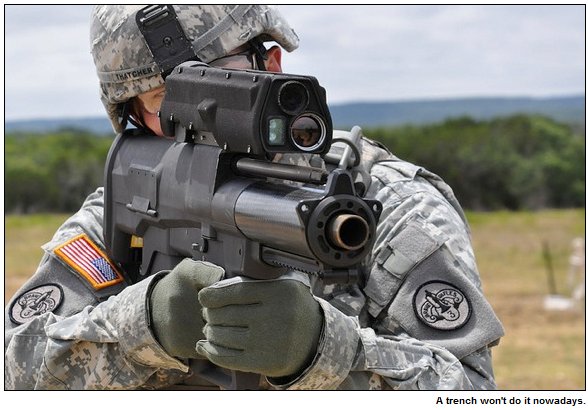
A brief outline of the US Army’s quest to find better camouflage patterns for troops in the field:

While the MultiCam was an improvement on the older ACU pattern uniforms, the troops did not get new packs (which also use cano pattern cloth) at the same time they received the MultiCam uniforms. Thus when troops went off into the hills, the combination of MultiCam uniforms and ACU pattern packs do a lot to ruin the camouflage effect.

The U.S. military has been having a tough decade when it comes to camouflage uniforms. Since September 11, 2001, the U.S. Army has changed camouflage patterns for their combat uniforms twice. First it was the adoption of digital patterns, then the current move to MultiCam.

It was SOCOM (special operations command) troops who first had second thoughts about the older digital camo pattern. The digital camouflage pattern uses “pixels” (little square or round spots of color, like you will find on your computer monitor if you look very closely), instead of just splotches of different colors. Naturally, this was called “digital camouflage.” This pattern proved considerably more effective at hiding troops than older methods.

For example, in tests, it was found that soldiers wearing digital pattern uniforms were 50 percent more likely to escape detection by other troops, than if they were wearing standard green uniforms. What made the digital pattern work was the way the human brain processed information. The small “pixels” of color on the cloth makes the human brain see vegetation and terrain, not people. One could provide a more technical explanation, but the “brain processing” one pretty much says it all. Another advantage of the digital patterns is that they can also fool troops using night vision scopes. American troops are increasingly running up against opponents who have night optics, so wearing a camouflage pattern that looks like vegetation to someone with a night scope, is useful.

September 16, 2010

QotD: Trial By Jury

Filed under: Government, Law, Liberty, Quotations, USA — Tags: , — Nicholas @ 17:03

In 1850 Spooner published A Defence for Fugitive Slaves, Against the Acts of Congress on February 12, 1793 and September 18, 1850, where he argued that juries “are judges of the law, as well as the fact” and are therefore justified in nullifying federal fugitive slave laws. “No man can be punished for resisting the execution of any law,” Spooner wrote, “unless the law be so clearly constitutional, as that a jury, taken promiscuously from the mass of the people, will all agree that it is constitutional.” Today we call this radical approach “jury nullification.”

Two years later, in Trial by Jury, Spooner developed his argument in full, expertly tracing the right of jury nullification back to the Magna Carta. “It is indispensable that the people, or ‘the country,’ judge of and determine their own liberties against the government,” he wrote. “How is it possible that juries can do anything to protect the liberties of the people against the government; if they are not allowed to determine what those liberties are?” According to Spooner, it was essential to distinguish between trial by jury, which meant trial by the people, chosen by lot, and trial by government, which was an illegal usurpation of the people’s power. “If the government may decide who may, and who may not, be jurors,” he wrote, “it will of course select only its partisans, and those friendly to its measures.” Furthermore, he said, if the government had its way, it “may also question each person drawn as a juror, as to his sentiments in regard to the particular law involved in each trial…and exclude him if he be found unfavorable to the maintenance of such a law.”

Of course, that’s exactly what happens today when potential jurors who oppose the death penalty are prevented from serving on death penalty cases or when those who oppose drug prohibition are excluded from drug cases, thereby stacking the jury in the government’s favor. As Spooner presciently observed, “if the government may dictate to the jury what laws they are to enforce, it is no longer a ‘trial by the country,’ but a trial by the government.”

Damon W. Root, “Clarence Thomas’ Favorite Anarchist: The radical anti-statism of Lysander Spooner”, Reason, 2010-09-16

September 14, 2010

When the bureaucracy strangles its young

Filed under: Bureaucracy, Military, USA — Tags: , , , — Nicholas @ 07:42

Noah Schactman uncovers the reason it takes a decade for the Pentagon to buy new weapons:

And you thought winning the Afghanistan war was tough. Try building the Army’s new armored vehicle. Or piecing together the Navy’s new network.

All of the complexity of the Afghan conflict — and all of the bureaucracy NATO used to manage the counterinsurgency effort — was summed up by a single spaghetti monster of a PowerPoint slide. “When we understand [it],” war commander Gen. Stanley McChrystal joked when he saw the slide, “we’ll have won the war.”

But that slide was child’s play compared to the three-foot wall chart the military uses to explain its gajillion-step process for developing, buying, and maintaining gear. The “Integrated Acquisitions Technology and Logistics Life Cycle Management” diagram is kind of a precis to the whole interminable progression, from “decompose concept functional definition into component concepts & assessment objective” to “execute support program that meets materiel readiness and operational support performance requirements and sustains system in most cost-effective manner.” Stare long enough, and you’ll start to see why it takes a decade for the Defense Department to buy a tanker plane, or why marines are still reading web pages with Internet Explorer 6.

The chart is put out by the Pentagon’s Defense Acquisitions University, where the Pentagon educates 180,000 people a year on its, um, unique process for purchasing equipment.

Full-sized horror of the slide at the link. If you think you can survive the insanity of it.

September 13, 2010

Call the president a “pr*ck”, get banned from the US for life

Filed under: Britain, Politics, USA — Tags: , , , , , — Nicholas @ 16:09

Fox News picks up an item from The Sun:

A British teenager who sent an e-mail to the White House calling President Obama a “pr*ck” was banned from the U.S. for life, The Sun reported Monday.

The FBI asked local cops to tell college student Luke Angel, 17, that his drunken insult was “unacceptable.”

Angel claims he fired off a single e-mail criticizing the U.S. government after seeing a television program about the 9/11 attacks.

He said, “I don’t remember exactly what I wrote as I was drunk. But I think I called Barack Obama a pr*ck. It was silly — the sort of thing you do when you’re a teenager and have had a few.”

Angel, of Bedford, in central England, said it was “a bit extreme” for the FBI to act.

“The police came and took my picture and told me I was banned from America forever. I don’t really care but my parents aren’t very happy,” he said.

Note that I’ve been very careful not to spell out that “unacceptable” word in the headline. No need to risk that just for reporting the news, right?

September 11, 2010

Nine years on

Filed under: History, USA — Tags: , , — Nicholas @ 00:04

Video by James Lileks.

But every so often — every week, really — I remember the event in some odd echo of the emotions I felt on September 11. It might be the closing credit music of a BBC comedy, or an old movie about New York, or driving past a building designed by the architect of the WTC, or just standing in the spot where I stood when I saw the towers fall. Or more: for God’s sake, the Gallery of Regrettable Food’s publication date was 9/11; half the time I look at the book on the shelf I recall being in the shower, thinking of the interviews I had lined up, turning off the water and hearing Peter Jennings on the radio, wondering why they were replaying tape of the 91 attack on the towers. I remember what Natalie was doing — a happy toddler, she was digging through her box of toys and handing me a phone with a smile as bright as the best tomorrow you could imagine. I remember Jasper on his back, whining, unsure. I remember these things because I picked up my camera and filmed them, because this was a day unlike any other. Today I answered the phone in the same spot where I stood when I called my Washington bureau, told them I’d be rewriting the column — obviously — and wished them well. They were four blocks from the White House. Impossible not to imagine the Fail-Safe squeal on the other end of the line.

On the Hewitt show tonight I started talking about 9/11, and my mouth overran my head, because somewhere down there is a core of anger that hasn’t diminished a joule. This doesn’t mean anything, by itself — anger is an emotion that believes its justification is self-evident by its very existence. Passion is not an argument; rage is not a plan. But as the years go by I find myself as furious now as I was furious then — and no less unmanned by the sight of the planes and the plumes. Once a year I watch the thing I cobbled together from the footage I Tivo’d, and the day is bright and real and true again.

Update: How Twitter can be almost poetry. Disturbing, yet moving.

September 9, 2010

QotD: Why football is king in America

Filed under: Football, Quotations, USA — Tags: , , , , — Nicholas @ 09:37

You probably remember the pain, the feeling of deja voodoo.

You probably remember a sense of disbelief, as the Vikings and Brett Favre blew another epic game.

If you can forgive the Vikings their sins of that day — the 12th man in the huddle, the five turnovers, that fateful Favre pass — what you should remember is this:

The Vikings’ 31-28 loss to the Saints in the NFC Championship Game stands as the latest, best demonstration of why football is king in America.

Baseball is a beautiful and comforting game. Basketball showcases the world’s most spectacular athletes. Football reaches into our guts, reaches into the most evolved and most prehistoric portions of our brain, combining all of the elements of our greatest dramas, from violence to pathos to unpredictability to intricately interwoven plots.

What happened in the Superdome on Jan. 24 was Shakespearean. Not Shakespearean in the popular use of the word, meaning “effete” or “intellectual.” Shakespeare became popular by writing plays filled with blood and revenge, lust and greed.

And tragedy.

Shakespeare would have loved Favre.

Jim Souhan, “Take your seat, the big show is about to resume”, Star Tribune, 2010-09-09

September 8, 2010

Austrian economics? That’s crazy talk

Filed under: Economics, Politics, USA — Tags: , , , , — Nicholas @ 07:35

As has been observed over and over again, we’re all Keynsians now. It’s usually meant in the economic sense, but perhaps it’s a reflection of Keynes’ other famous dictum: in the long run, we’re all dead. A different school of economics deserves a longer look:

Common sense is the crux of Austrian theory economics. Austrians look at how individuals act, not how “economies” or “nations” act or behave. Ludwig von Mises, the greatest Austrian thinker, and in my opinion the greatest economist, entitled his great work, Human Action not National Action. The Austrian School was referred to by the Germans as the Psychological School because its analysis started with individual action and how those actions would either attain or fail to attain the goals sought by individuals. In other words, it involves a lot of the “common sense” that guides human behavior most of the time. It’s comforting to know there’s a philosophy of economics that conforms to what human beings actually do rather than how some economist thinks we ought to behave.

Examples of economic Newspeak flourish, especially if you listen to President Obama’s economic team. My favorite example is the present conflict between consumer spending and consumer saving. Since the crash, consumers have cut back on spending and are increasing their savings. Most economists are saying this is bad for the economy; they urge us to spend, spend, spend to save the economy.

Actually, it’s just the opposite: Saving is the road to recovery.

It seems rather obvious that during a downturn of the economy it would be natural for people to save more and spend less: They’re uncertain about their jobs; the values of their homes have plummeted (about 30% since the peak in 2006); their stocks have declined, and their debts are high. Isn’t it common sense that people are doing the rational thing by saving? This is something our parents and grandparents understood well.

September 6, 2010

When “informers” become “enablers”

Filed under: Law, Liberty, Media, USA — Tags: , , , , , — Nicholas @ 10:12

Stephan Salisbury writes that many “foiled” terror plots could never have become actual threats . . . without government assistance:

Informers have by now become our first line of defense in our battles with the evildoers, the go-to guys in the never-ending domestic war on terror. They regularly do the dirty work — suggesting and encouraging the plots, laboring as bag men to move the money, fashioning the bombs, and eliciting the flamboyant dialogue, even while following the scripts of their handlers to the letter. They have attended to all the little details that make for the successful and now familiar arrests, criminal complaints, trials, and (for the most part) convictions in the ever-distracting war against . . . what? Al-Qaeda? Terror? Muslims? The inept? The poor?

The Liberty City Seven, the Fort Dix Six, the Detroit Ummah Conspiracy, the Newburgh Four — each has had their fear-filled day in the sun. None of these plots ever came close to happening. How could they? All were bogus from the get-go: money to buy missiles or cell phones or shoes and fancy duds — provided by the authorities; plans for how to use the missiles and bombs and cell phones — provided by authorities; cars for transport and demolition — issued by the authorities; facilities for carrying out the transactions — leased by those same authorities. Played out on landscapes manufactured by federal imagineers, the climax of each drama was foreordained. The failure of the plots would then be touted as the success of the investigations and prosecutions.

It’s often been observed that war is the health of the state. Can we now also say that the war on terror is the health of the intelligence agency?

H/T to Bruce Schneier for the link.

September 5, 2010

Detroit Police save money by eliminating pistol practice?

Filed under: Law, USA — Tags: , , , — Nicholas @ 11:36

At least, based on this story, you’d have to think it’s the most likely answer:

Cop Fires Twelve Shots at Dog, Hits Two Animal Control Workers Instead

[. . .]

Detroit Police needed to remove the dogs, so they called the Michigan Anti-Cruelty Society. While the rescuers were setting traps for the three pit bulls, one got loose and started running towards a police officer. That’s when, we’re told, she pulled her gun and fired off twelve rounds.

[…]

“The police pulled a gun out and shot, but she missed the dog. I guess she was scared or something, and she hit the animal control person,” he said.

One animal rescue worker took a bullet in the back of the leg. Another grazed his back side. A stray bullet also clipped his co-worker’s boot.

Not quite the best advertisement for range safety, weapons handling expertise, or accuracy.

September 1, 2010

T.R. Fehrenbach’s This Kind of War

Filed under: Asia, Books, History, Military, USA — Tags: , — Nicholas @ 12:01

Austin Bay recommends a book first published in 1963 as still being the best single-volume history of the Korean War (and I agree):

June 25 marked the 60th anniversary of North Korea’s premeditated attack on South Korea. The attack, which scattered South Korea’s weak and disorganized defense forces, began a vicious two and a half months of combat. The North Koreans would smash the ill-starred U.S. 24th Division’s Task Force Smith, then shove remnant South Korean troops and U.S. reinforcements into the Pusan Perimeter, at the southern tip of the peninsula.

In the weeks since June 25, I’ve re-read T.R. Fehrenbach’s “This Kind of War,” still the premier Korean War history. (Clay Blair’s “The Forgotten War” is also an excellent book.) Published in 1963 and reissued in 2000, “This Kind of War” is lyric history, delivering analysis in elegant, honest prose. Fehrenbach is also a decorated Korean War veteran, a man in touch with the emotions as well as the facts.

“This kind of war,” Fehrenbach writes, “is dirty business first to last.” Fehrenbach’s commentary on those first battles of July and August 1950 depicts the confusion of initial defeat and retreat, as well as the courage and intellect required to stem the onslaught. His chapter on the Inchon landing of September 1950 — the American amphibious counter-stroke — is incisive. Its 60th anniversary is two weeks away.

I think I first saw This Kind of War recommended by Jim Dunnigan, many years ago, but the Korean War has never been a major historical interest of mine. When I did get around to reading the book, it certainly opened my eyes. As Bay points out, the work is still topical because the war has never officially ended (as the sinking of the ROKS Cheonan amply demonstrated).

August 31, 2010

Commercial hypocrisy, oilsands edition

Filed under: Environment, Media, USA — Tags: , , , , — Nicholas @ 08:03

Ezra Levant isn’t amused by some US businesses trying to make political statements by slagging Alberta’s oilsands while being less than clean themselves:

Walgreens is the largest pharmacy chain in the U.S.

It’s also corrupt.

For years, they secretly altered their customers’ prescriptions, without their doctor’s knowledge, in a giant insurance scam across 42 states. They targeted Medicaid, the program for low-income Americans. So they were stealing from taxpayers and the poor at the same time. That kind of big thinking is why Walgreens is number one.

Walgreens replaced inexpensive drugs with drugs that were up to four times more costly. Only when an honest pharmacist finally blew the whistle on them were they stopped — and fined a whopping $35 million.

Are you ready to take moral lessons from Walgreens? Because they’ve just announced that they’re switching their trucks to fuel that doesn’t come from Canada’s oilsands — as an ethical statement.

Taking ethical guidance from Walgreens is sort of like taking abstinence lessons from Hugh Hefner.

I’d call for a boycott of Walgreens, but they don’t have any stores in Canada (and, despite their name, they are no relation to Walmart).

But Walgreens isn’t the only moral hypocrite to come out against Canada. So did The Gap, which also owns Banana Republic and Old Navy.

Do yourself a favour: Don’t buy their clothes.

« Newer PostsOlder Posts »

Powered by WordPress