
“Privilege” is a term that’s overused and misused in modern political discourse. Too often it’s used like a crass “shut up, I win” button in an argument. But “privilege” is sometimes an apt descriptive term of a human phenomenon: a person’s evaluation of a situation (like interaction with law enforcement) is colored by his or her own experiences, and those experiences are usually circumscribed by that person’s cultural identity and wealth. Any criminal defense attorney who has served affluent clients is familiar with this: such clients often conclude that they are a victim of a conspiracy, or of a “rogue cop” or “loose cannon prosecutor,” because their life experiences lead them to assume that the system can’t possibly treat all people the way they are being treated. By contrast, clients who have lived in poverty (or clients who are African-American or Latino) tend to recognize outrageous conduct in their case as the system working the way the system typically works — business as usual. In my post about the prosecution and death of Aaron Swartz, I argued that Swartz’ community showed such privilege in its reaction to his prosecution, seeing some sort of singular conspiracy where others saw the banal grinding of the system’s unfeeling wheels.
My advice to shut up is colored, in part, by privilege. I was reminded of this yesterday when Los Angeles County Sheriff’s Deputies searched Justin Bieber’s house. I praised Bieber for shutting up and declining to talk to the cops, and joked that criminal defense attorneys could shame clients into better practices by asking why they aren’t smarter than Justin Bieber.
But Justin Bieber and I — and many of my clients — share a crucial quality: we’re affluent and fortunate. This privilege makes us better able to endure the potential downside risks of shutting up. If we get arrested on a petty or bogus charge by a pissed-off cop, we can make bail. We won’t spend weeks or months in custody on that bogus charge because we can’t scrape together a few thousand dollars. Maybe we’ll spend the weekend in jail, because cops love to arrest you Friday afternoon, but we’ll get out in a few days at most, and in the meantime we won’t lose our jobs. Because we have families and support systems, if we do get thrown in jail on a bogus job by an angry cop, the Department of Child and Family Services won’t take away our children, plunging us into another broken system we have neither the money nor the knowledge to navigate. If the cops tow or impound our car, we can afford to pay the few hundred to few thousand dollars to get it out, and we won’t lose our jobs for lack of transportation. Even if we do lose our jobs because of a bogus and retaliatory arrest, we have savings, and families with savings, and we won’t swiftly lose our homes. If the police choose to retaliate against our silence with petty tickets and infractions and fines rather than arrest, we can fight them or absorb them.
That’s a privilege. Poor people don’t have it. Poor people live on the razor’s edge, and a bogus retaliatory arrest can destroy them. Retaliatory and capricious enforcement of petty crimes and infractions can destroy them financially. Police wield disproportionate power over them, and the criminal justice system and its agendas (like the War on Drugs) disproportionately impacts them. Police are more likely to use force against poor people and for the most part can do so without any significant risk of discipline.
When you and I weigh the downside risks of shutting up against the downside risks of talking, our downside risks are milder, and can be endured. People without our resources face a must starker choice: talk, and incriminate themselves, or shut up, and face an array of consequences they may not be equipped to survive.
Ken White, “The Privilege To Shut Up”, Popehat, 2014-01-15
June 15, 2014
QotD: Shut up – it’s your right and (for some) your privilege
June 14, 2014
QotD: The sins of the modern university system
Few if any other professions — not law, medicine, finance, engineering, etc. — offer guaranteed lifetime employment after a six-year apprenticeship. Tenure was predicated on a simple premise: The protection of faculty free speech and instruction was worth the possible downside of complacency and an absence of serious ongoing faculty audit. Whatever may once have been the case, in our time tenure does not ensure free expression, but instead a banal orthodoxy, in which 90 percent of the faculty in the humanities share the same progressive outlook. Tenure also created a caste system far more rigid than anything found in private enterprise, while a huge permanent faculty class ensured inflexibility in scheduling and budgeting. The associate or full professor enjoyed a lifelong right of selection of his classes without too much worry over whether they were either needed or taught well. Worse, the nontenured faculty member, in the fashion of the Middle Ages, was admitted to the guild only if his tenured peers believed that he was agreeable in politics and attitude. He was usually judged by teaching and publication criteria that did not necessarily apply to his board of overseers, many of whom had achieved tenure 20 years earlier under entirely different criteria.
[…]
The abuse of lecturers, part-timers, and graduate students is institutionalized. In a word, the university is the most exploitative institution operating at present in the United States, protected by the notion that it is progressive and that its protocols cannot possibly be understood by the ordinary public. Temporary and adjunct faculty members often have degrees as good as those of their tenured betters. Often their teaching records and publications are comparable, if not superior. They may teach the same classes as permanent faculty do, and yet often receive about half the compensation. Were Wal-Mart or a coal mine to operate under such protocols, it would earn Labor Department sanctions. At some public universities, nearly half of the curriculum is taught by part-time faculty — in effect a subsidy that allows the tenured caste to teach smaller and less-in-demand classes, where less time is needed for preparation and grading. Worse still, universities knowingly turn out too many PhDs in the humanities, which ensures a glut of job applicants, which, again, ensures a continued supply of cheap temps to sustain tenured privilege.
Victor Davis Hanson, “The Outlaw Campus”, VDH’s Private Papers, 2014-01-07
June 12, 2014
QotD: Regulating cheese
France, for all its faults, has genuinely federalized food: a distinctive cheese every 20 miles down the road. In America, meanwhile, the food nannies are lobbying to pass something called the National Uniformity for Food Act. There’s way too much of that already.
The federalization of food may seem peripheral to national security issues, and the taste of American milk — compared with its French or English or even Québécois equivalents — may seem a small loss. But take almost any area of American life: what’s the more common approach nowadays? The excessive government regulation exemplified by American cheese or the spirit of self-reliance embodied in the Second Amendment? On a whole raft of issues from health care to education the United States is trending in an alarmingly fromage-like direction.
Mark Steyn, “Live Brie or Die!” SteynOnline.com, 2014-03-13
June 11, 2014
“None of the Above” wins Nevada Democratic primary
NBC News reports the breakthrough for perennial candidate in Nevada:
Elections have historically been defined by their winners and losers — but on Tuesday a primary in Nevada returned a disheartening result for all the candidates: nobody won.
Voters in the state’s Democratic primary for governor were so unimpressed by the eight men on offer that the most popular option on the ballot paper was “none of these candidates,” which received 30 percent of the vote, according to figures from The Associated Press.
Democrat activists in the state acknowledged earlier this year that they had failed to find a credible challenger to face incumbent Republican Gov. Brian Sandoval, according to Politico. And it clearly showed at the polling stations, with more than 21,000 people turning out with the express purpose of saying “no thanks” to the sum total of their party’s would-be governors.
Unfortunately, Nevada state law doesn’t allow NOTA to be on the ballot for the general election:
If voters did in fact want an empty seat instead of a challenger to face Sandoval they will be disappointed: In second place behind “none of these candidates” was Robert Goodman, a man who has run twice before and this time received 25 percent of the vote. State law means he will be the Democratic candidate.
H/T to Popehat for the link.
LA court delivers a major blow against tenure for teachers in California
The Los Angeles Times on yesterday’s decision:
Teachers union officials denounced a ruling Tuesday by a Los Angeles County Superior Court judge deeming job protections for teachers in California as unconstitutional as a misguided attack on teachers and students.
The ruling represents a major loss for the unions and a groundbreaking win by attorneys who argued that state laws governing teacher layoffs, tenure and dismissals harm students by making them more likely to suffer from grossly ineffective instruction.
If the preliminary ruling becomes final and is upheld, the effect will be sweeping across California and possibly the nation.
Judge Rolf M. Treu ruled, in effect, that it was too easy for teachers to gain strong job protections and too difficult to dismiss those who performed poorly in the classroom. If the ruling stands, California will have to craft new rules for hiring and firing teachers.
[…]
The Silicon Valley-based group Students Matter brought the lawsuit on behalf of nine students, contending that five laws hindered the removal of ineffective teachers.
The result, attorneys for the plaintiffs said, is a workforce with thousands of “grossly ineffective” teachers, disproportionately hurting low-income and minority students. As a result, the suit argued, the laws violated California’s constitution, which provides for equal educational opportunity.
The laws were defended by the state of California and the two largest teacher unions — the California Teachers Assn. and the California Federation of Teachers. Their attorneys countered that it is not the laws but poor management that is to blame for districts’ failing to root out incompetent instructors.
June 10, 2014
The two Hillary Clintons
Charles Cooke on the political phenomenon that is (are?) Hilary Clinton:
It seems clear now that there are two Hillary Clintons. The first, who exists wholly in the abstract, is the one we have been waiting for. She is a Maker of History and a savior of women; an equal partner in the power couple that presided over the prosperity, cool, and competence of the 1990s; a world-beating secretary of state; a feminist who smashes glass ceilings and fights for all that is right and good. Millions of us are “Ready!” for her.
The other exists in the real world. This Hillary is a person who lacks concrete achievements; whose inevitability never quite translates into evitability; whose rhetoric always seems to turn up empty; who has an impressive capacity for saying things that hurt her and her interests; and, most distressingly of all, who becomes instantly less likeable the moment she opens her mouth.
It is the second Hillary that is currently making the news. Indeed, important as the Democratic party’s internecine war was to her loss, one has to start considering the possibility that what ultimately doomed Hillary Clinton in 2008 was that she is Hillary Clinton. The husband whose name she took has a political knack unmatched in our times — a capacity to spin straw into gold and to rise unscathed from the dirtiest of ashes. Hillary, alas, seems to have the opposite quality, possessing a remarkable ability to snatch defeat from the jaws of victory and to turn favorable moments into cudgels that might later be wielded against her. Responding in May to a question about suicide, Clinton voluntarily launched into an unwise disquisition about gun rights, including in her messy remarks the politically dangerous recommendation that the federal government should look to “rein in” the right to bear arms. This weekend, she made a similar error. Asked about her astronomical public-speaking fees, Clinton declined to give the honest answer — which is, “I have the opportunity to make a lot of money speaking; wouldn’t you take it?” — and instead went off on a peculiarly defensive tangent. “We came out of the White House not only dead broke but in debt,” Clinton explained to Diane Sawyer. “We had no money when we got there and we struggled,” she continued, “to, you know, piece together the resources for mortgages for houses.” Later, she repeated the claim, noting that the couple was in dire need of the cash to “get us houses.”
What a difference a plural makes.
June 9, 2014
Indianapolis police “needed a mine-resistant vehicle to protect against a possible attack by veterans returning from war”
When you dress and act like an occupying army, eventually the citizenry will view you as just that:
Inside the municipal garage of this small lakefront city [Neenah, Wisconsin], parked next to the hefty orange snowplow, sits an even larger truck, this one painted in desert khaki. Weighing 30 tons and built to withstand land mines, the armored combat vehicle is one of hundreds showing up across the country, in police departments big and small.
The 9-foot-tall armored truck was intended for an overseas battlefield. But as President Obama ushers in the end of what he called America’s “long season of war,” the former tools of combat — M-16 rifles, grenade launchers, silencers and more — are ending up in local police departments, often with little public notice.
During the Obama administration, according to Pentagon data, police departments have received tens of thousands of machine guns; nearly 200,000 ammunition magazines; thousands of pieces of camouflage and night-vision equipment; and hundreds of silencers, armored cars and aircraft.
The equipment has been added to the armories of police departments that already look and act like military units. Police SWAT teams are now deployed tens of thousands of times each year, increasingly for routine jobs. Masked, heavily armed police officers in Louisiana raided a nightclub in 2006 as part of a liquor inspection. In Florida in 2010, officers in SWAT gear and with guns drawn carried out raids on barbershops that mostly led only to charges of “barbering without a license.”
[…]
The number of SWAT teams has skyrocketed since the 1980s, according to studies by Peter B. Kraska, an Eastern Kentucky University professor who has been researching the issue for decades.
The ubiquity of SWAT teams has changed not only the way officers look, but also the way departments view themselves. Recruiting videos feature clips of officers storming into homes with smoke grenades and firing automatic weapons. In Springdale, Ark., a police recruiting video is dominated by SWAT clips, including officers throwing a flash grenade into a house and creeping through a field in camouflage.
In South Carolina, the Richland County Sheriff’s Department’s website features its SWAT team, dressed in black with guns drawn, flanking an armored vehicle that looks like a tank and has a mounted .50-caliber gun.
Update: It’s not just Wisconsin or Indiana … even Maine feels the threat.
Cops must militarize because Maine foothills face previously unimagined threat from tourism — sorry, terrorism [NYT] http://t.co/gP3sxdhaco
— Walter Olson (@walterolson) June 9, 2014
June 7, 2014
Europe should bear more of the costs of their own defence
The American government is being called upon to re-assure NATO allies with suddenly volatile borders (that is, those near Russia and Ukraine). That re-assurance is to take the form of greater US military involvement in the Eastern European sector of NATO. The Cato Institute’s Doug Bandow says that this is actually an opportunity for those NATO countries to start living up to their own obligations to maintain viable defensive forces:
The Baltic States are screaming for enhanced military protection. Yet Estonia devotes just two percent of its GDP to defense. Latvia spends .9 percent of its GDP on the military. Lithuania commits .8 percent of its GDP on defense.
Poland may be the country most insistent about the necessity of American troops on along its border with Russia. To its credit, Poland has been increasing military outlays, but it still falls short of NATO’s two percent objective. Warsaw spent 1.8 percent last year.
Only Great Britain and Greece joined Estonia in hitting the two percent benchmark. France and Turkey fall short. Germany comes in at 1.3 percent. Overall NATO hit 1.6 percent last year. America was 4.1 percent.
Per capita military spending is even more striking. My Cato Institute colleague Chris Preble figured that to be $1896 for Americans. And $399 for Europeans. A disparity of nearly five to one.
Unfortunately, President Barack Obama doesn’t appear to recognize the dependency problem. At West Point he merely indicated that “we are now working with NATO allies” to reassure the Eastern Europeans. “We”?
Poland expects to hit 1.95 percent of GDP this year. Latvia and Lithuania promised to up outlays to meet the two percent standard — in a few years. No one else is talking about big spending increases. Absent is any commitment to move European troops to NATO’s eastern borders.
Nothing will change as long as Washington uses the defense budget as a form of international welfare. The more the president “reassures” U.S. allies, the less likely they are to do anything serious on behalf of their own defense.
Canada is also a military freeloader on US resources. While our NATO commitments imply we’ll spend 2% of GDP on our defences, we spend 1.3% in 2012, and the Department of National Defence is struggling to reduce spending below previous years’ outlays to meet the federal government’s overall budget balancing plans.
Update, 8 June: Stephen Gordon posted a Twitter update that puts Canadian military spending into a bit of perspective
Increase GST by 3 ppts? RT @pmlagasse: If Cda to meet 2% NATO request, defence budget ~0 $40b/yr. Good to know where extra $20b wd come from
— Stephen Gordon (@stephenfgordon) June 8, 2014
June 6, 2014
Mulberries, PLUTO and Hobart’s Funnies
Seventy years ago today, the Allies launched Operation Overlord, the invasion of Normandy by the combined British, American, and Canadian armies. A huge fleet of combat and transport vessels, supported by a large proportion of the United States Army Air Force and the Royal Air Force bomber and fighter aircraft were all deeply involved in making the invasion a success. In addition, perhaps the world’s largest disinformation campaign was being run to keep the German high command unsure of the real time and location of the invasion: the Pas de Calais and the Norwegian coast were also potential invasion targets, forcing the defenders to spread their forces thinner and to keep as many as possible out of reach of the real beaches.
In addition to the operational uncertainty of where to expect the blow, the Germans were also split about how best to conduct the defence: Field Marshal Rommel wanted to rush units to the beach as soon as possible, to defeat the Allies before they got inland. General Geyr von Schweppenburg, commander of Panzer Group West (and Field Marshal von Rundstedt, overall commander in the West), on the other hand, preferred to meet the Allies further inland (not taking the full impact of Allied air superiority into account). On 6 June, the defenders fell between the two philosophies, not being able to mass enough force to stop the invaders in their tracks, but suffering higher casualties in the attempt to move units toward the coast in the teeth of RAF/USAAF attacks.

Operation Overlord (detail) Click to see full-sized image at wwii-info.net
The invasion beaches were code-named Utah (4th US Division), Omaha (1st and 29th US divisions), Gold (50th British Division), Juno (3rd Canadian Division), and Sword (3rd British Division). Before the amphibious forces landed, three paratroop divisions were dropped behind the beaches to slow down German response (US 82nd and 101st Airborne Divisions to the West and Southwest of Utah beach, and the 6th British Airborne to the East of Sword beach).
One thing to note from the map is that there wasn’t a significant port within the invasion zone: the Allies had learned the bitter lessons of attacking a port in August of 1942 and the 2nd Canadian Division had paid in blood for the tuition. This meant a way had to be found to keep getting supplies to the troops after they moved off the beaches, until a functioning port could be secured. The Allied answer was to bring a port with them from England — two of them, actually — one to support the US forces in the West and one to support the British and Canadian forces in the East. These were the Mulberry harbours:
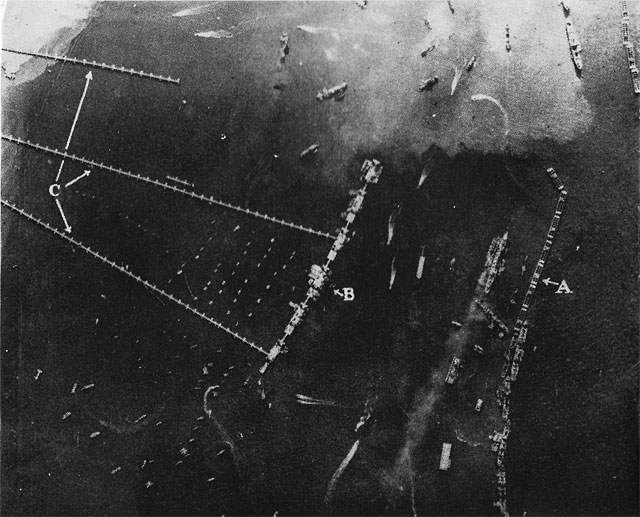
Think Defence explains how the Mulberry harbour worked:
In the image above these three components are shown.
A; Breakwater to attenuate waves
B; Pier heads at which to load and unload
C; Causeways that connected the pier heads to the beach
Each of the components was given a code word but fundamentally, they were concerned with either providing sheltered water or connecting ships and the beach.
There have been a number of different theories about how the Mulberry name was chosen, the more fanciful ones being completely incorrect.
Brigadier White recalls the moment he received a memo, unclassified, with the heading ‘Artificial Harbours’ and after recovering from the shock of such poor security immediately consulted with the Head of Security at the War Office. The next code, from the big book of code words, was Mulberry, it was that simple.
[…]
There were two complete Mulberry harbours, A for American and B for British, each the size of Dover harbour. Once the task of constructed and assembling the components on the South coast of England was complete they were ordered to Normandy on the 6th of June 1944, D-Day, departing on the 7th
Assembling the components was an effort in itself, requiring 600 tugs drawn from all parts of the UK and USA, all under the supervision of the Admiralty Towing Section commanded by Rear Admiral Brind.
Operational security was paramount, the captains of the block ships were told they were going to the Bay of Biscay and a model of the Mulberry harbour and invasion beaches in the headquarters of the Automobile Association at Fanum House was made by toymakers who were confined to the building until well after the invasion.
Unfortunately, the Western harbour was severely damaged in a storm a few weeks after coming into service, so the Eastern Mulberry had to do double duty after that.
Aside from the need to get reinforcements, rations, ammunition and other supplies forward, the Allied armies were highly motorized, and required vast amounts of fuel. Without a port’s specialized unloading facilities, it was assumed that it would be somewhere between difficult and impossible to keep the armies mobile. To address this, PLUTO was developed: Pipe Line Under The Ocean.
A great solution, although as Think Defence points out, it didn’t actually go into service until a few months after D-Day, and was not quite the war-winner the newsreel portrayed:
Second in daring only to the artificial harbors project and provided our main supplies of fuel during the Winter and Spring campaigns.
What also PLUTO did was allow vital tanker tonnage to be deployed to the Far East theatre.
Despite the understandable over exaggeration of the success of PLUTO it should be noted that fuel did not start flowing until September 1944, well after the invasion and on the 4th of October, BAMBI was closed down and operations concentrated on DUMBO after it had delivered a measly 3,300 tonnes, hardly war winning.
Cherbourg was by then receiving tanker supplies direct from the USA.
 Getting across the channel was a major undertaking, but getting the troops ashore with enough firepower to break out of the beach defences required more innovation. The British army established a specialized unit to develop and operate vehicles and weapon systems specifically designed for that purpose. Major General Sir Percy Hobart was the commander of the 79th Armoured Division, and he was exactly the right man for the job (being related by marriage to Montgomery may have helped, too, but before taking command he was acting as a corporal in the Home Guard).
Hobart’s unit developed some of the most interesting armoured vehicles (not all of which were brilliant successes) and it’s safe to say that the Allies would have suffered much higher casualties without Hobart’s “Funnies”. In fact, General Eisenhower said as much himself: “Apart from the factor of tactical surprise, the comparatively light casualties which we sustained on all beaches, except OMAHA, were in large measure due to the success of the novel mechanical contrivances which we employed, and to the staggering moral and material effect of the mass of armor landed in the leading waves of the assault. It is doubtful if the assault forces could have firmly established themselves without the assistance of these weapons.” Think Defence has a good summary of many of these odd and interesting vehicles:
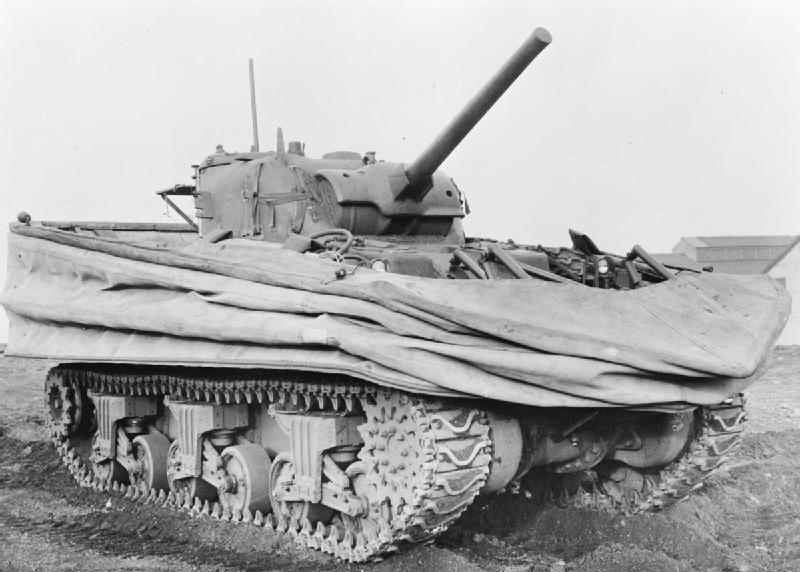
Sherman tanks were also converted into amphibious vehicles by the addition of a canvas skirt, propellers and other modifications. These provided vital armoured fire support in the opening phase of the beach assault although a number were lost to the heavy seas when they were launched too far from the beach. It is widely thought that as these losses were particularly heavy on Omaha beach it was this that contributed to the very high losses in that area.
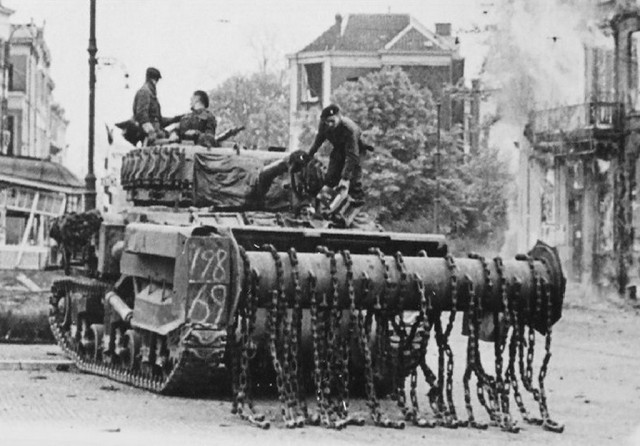
Mine clearance was carried out by a number of means but the preferred method was to use rotating chain flails to detonate the mines thus clearing a path the width of the tank. The flails were mounted on the front of the tank and were called Sherman Crabs. A number of Churchill based designs using rollers and ploughs were also employed, although this image shows one mounted on a Sherman.

The beach surveys had revealed the existence of large patches of clay that would not bear the weight of heavy vehicles and artillery. To overcome this the ‘bobbin’ tanks were used that laid a continuous reinforced canvas mat over the soft ground, thus spreading the load over a wider area.
June 5, 2014
QotD: Churchill, Roosevelt and de Gaulle
The central problem of relations with de Gaulle stemmed from President Roosevelt’s distrust. Roosevelt saw him as a potential dictator. This view had been encouraged by Admiral Leahy, formerly his ambassador to Marshal Petain in Vichy, as well as several influential Frenchmen in Washington, including Jean Monnet, later seen as the founding father of European unity.
Roosevelt had become so repelled by French politics that in February he suggested changing the plans for the post-war Allied occupation zones in Germany. He wanted the United States to take the northern half of the country, so that it could be resupplied through Hamburg rather than through France. “As I understand it,” Churchill wrote in reply, “your proposal arises from an aversion to undertaking police work in France and a fear that this might involve the stationing of US Forces in France over a long period.”
Roosevelt, and to a lesser extent Churchill, refused to recognize the problems of what de Gaulle himself described as “an insurrectional government”. De Gaulle was not merely trying to assure his own position. He needed to keep the rival factions together to save France from chaos after the liberation, perhaps even civil war. But the lofty and awkward de Gaulle, often to the despair of his own supporters, seemed almost to take a perverse pleasure in biting the American and British hands which fed him. De Gaulle had a totally Franco-centric view of everything. This included a supreme disdain for inconvenient facts, especially anything which might undermine the glory of France. Only de Gaulle could have written a history of the French army and manage to make no mention of the Battle of Waterloo.
Anthony Beevor, D-Day: The Battle for Normandy, 2009.
Conspiracy theorist’s festival day
Matt Welch on the last few decades that paved the way for a re-expansionist Russia:
On September 10, 1990, U.S. President George Bush and Soviet President Mikhail Gorbachev issued a simple and remarkable joint statement. “We are united in the belief that Iraq’s aggression must not be tolerated,” the former Cold War opponents declared after a seven-hour meeting in Helsinki to discuss Saddam Hussein’s annexation of Kuwait. “No peaceful international order is possible if larger states can devour their smaller neighbors.”
Observers understood immediately the historical significance of two previously antagonistic superpowers agreeing on the principle that countries cannot swallow one another. What was less obvious at the time is that the moment would look like science fiction from the perspective of the future as well.
President Bush — we did not need to differentiate him as “H.W.” back then — was so giddy about the prospects of rules-based global cooperation that on the not-yet-portentous date of September 11, 1990, he gave an unfortunate name to the concept during an address to a joint session of Congress: new world order.
“Most countries share our concern for principle,” he asserted. “A new partnership of nations has begun, and we stand today at a unique and extraordinary moment. The crisis in the Persian Gulf, as grave as it is, also offers a rare opportunity to move toward an historic period of cooperation. Out of these troubled times, our fifth objective — a new world order — can emerge: a new era-freer from the threat of terror, stronger in the pursuit of justice and more secure in the quest for peace. An era in which the nations of the world, east and west, north and south, can prosper and live in harmony. […] A world where the rule of law supplants the rule of the jungle. A world in which nations recognize the shared responsibility for freedom and justice. A world where the strong respect the rights of the weak.”
Because “new world order” sounded creepy and was already a phrase used by conspiracists worried about one-world government, Bush’s larger point got washed away in the ensuing brouhaha. But terminology aside, the creation of an international taboo against subsuming weaker countries was a worthwhile endeavor.


