
Between 1945 and about 1965, atom bombs and then hydrogen bombs were devised and demonstrated by the two biggest Great Powers, and then manufactured and attached to rockets in sufficient numbers to cause any all-out war between these two superpowers very probably to be a catastrophic defeat for both, to say nothing of being a similar catastrophe for all other humans, within a few hours. This new kind of destructive power also spread to a small club of lesser Great Powers.
This did not happen overnight. It didn’t all come about in 1945. But it happened pretty quickly, historically in the blink of an eye. It changed the world from a place in which Great Wars between Great Powers had to be prepared for, at all costs, to a place in which Great Wars between Great Powers had to be avoided, again, at all costs. That is a very big change.
I do not assert that all wars have ended. Clearly they have not, as one glance through a newspaper or news website will tell you. Small powers still have small wars, and Great Powers regularly join in, in small ways. Sometimes, Great Powers start small wars, like the one in the Ukraine now. But even these small wars have been getting less numerous and smaller in recent decades. Small wars can get big, so even small wars are now discouraged by Great Powers.
Nor do I assert that all preparations for war by Great Powers have ceased, or that they should. But more than ever, the purpose of such preparations is to enable mere confrontations to be emerged from victoriously or failing that satisfactorily, rather than for such preparations — such weapons — constantly to be “used”, in the sense of being fired, fought with, and so on. The purpose of weapons is to scare, as well as to win fights, and they are being “used” whenever anyone is scared by them. Great Powers will still spend lots of money on weaponry.
But what has not happened, for many decades now, and what still shows no sign of happening despite all kinds of diplomatic, ideological and financial turbulence, is an all-out fire-every-weapon-we-have war involving two or more Great — by which I of course mean nuclear — Powers. In this sense, countries like mine, and almost certainly yours too given that you are reading this, have become peaceful in a way that they have never experienced before in all of human history before 1945.
Brian Micklethwait, “From the Great Peace … to the ordeal of Adam Lyth at the Oval cricket ground”, Samizdata, 2015-08-20.
June 9, 2017
QotD: The post-war world and (relative) peace
June 8, 2017
Shoes and changing tastes
Virginia Postrel says that the market for shoes is changing rapidly, and men are poised to take over as the largest sector of the American shoe-buying market:
The Sex and the City stereotype of the shoe enthusiast as a fashionista with a passion for high heels is seriously out of date. Today’s shoe collector is probably buying sneakers and is quite likely male. Shoes may have as much glamour as ever, but it’s not the kind Christian Louboutin would recognize.
If current trends continue, men’s U.S. shoe sales will soon surpass women’s. At $26.2 billion in 2016 versus $29.9 billion for women’s footwear, “men’s is closer in size to women’s than it’s ever been,” says Beth Goldstein, fashion footwear and accessories analyst at the NPD Group. Women’s sales are shrinking as men’s continue to rise, in both revenue and number of pairs sold.
Behind the sales figures is a cultural shift. As dress becomes more casual, habits are converging, with women buying more versatile styles while men expand their shoe collections.
Traditionally, men got more wear out of any given pair of shoes. “If you’re getting a pair of desert boots or brogues, you can wear those every day, all day, all year,” says Andrew Luecke, a New York-based menswear writer and co-author of the new book “Cool: Style, Sound, and Subversion.” “A pair of Louboutin stilettos? Not so wearable.”
That’s changing, however. Instead of picking up sandals in the spring and boots in the fall, women are buying shoes they can wear year-round, such as ankle boots and sneakers. Their purchase patterns now look more like men’s. That’s bad news for retailers who count on seasonal lines to drive purchases.
Meanwhile, the rise of sneakers as all-occasion footwear is encouraging men to build their wardrobes while depressing women’s sales. “Men have the tendency to collect things,” observes Luecke. “Once it was baseball cards. Now it’s sneakers. If you’re collecting, you can’t have too many sneakers.” And if you’re not into sneakers, you can buy shoes to go with your favorite pastime — camping, fishing, rock climbing, snowshoeing, whatever. They aren’t frivolous fashion; they’re serious gear!
I don’t buy shoes too often … I think I bought a pair of leather shoes in 2015 and a pair of court shoes for badminton the year before that. I have no immediate plans to add to my collection, so I guess it’s up to all of you chaps to make up the difference.
QotD: The Cloud People look out upon the land of the Dirt People
In the French Revolution, after the White Terror, the Constitution of 1795 established The Directory. This was the start of a new phase in which the lower classes were mostly ignored, as the new ruling class consolidated its power. That may be what we are seeing with our managerial class as they largely ignore the results of recent elections and enforce discipline in their own ranks. It’s not a perfect analogy, but it may be useful in analyzing what we are seeing.
There is another angle, one you can see in this Scott Alexander post a few weeks ago, that was popular with the cognoscenti. Star Slate Codex is popular with people who not only think they are smart, but see themselves as steely-eyed reason machines. It’s also popular with people who like to believe stuff like this:
Yes, CNN leans liberal, but it’s not as liberal as FOX is conservative, and it’s not as open about it – it has a pretense of neutrality that FOX doesn’t, and although we can disagree about how realistic that pretense is I think few people would disagree that the pretense is there. Nor is there a liberal version of FOX that lacks that pretense of neutrality.
That’s a very believable argument if you have no familiarity with cable news or you look out at the world from deep inside the Progressive fever swamps. It is the sort of thing people write when they want to seem like the people who write things like this. It’s the worldview of someone confusing a mirror with a telescope. To Alexander, Fox is way out on the fringe and they are brazen about it. CNN, on the other hand, is maybe a little biased, but they are good people, my people, so they mean well.
Of course, there is the omnipresent hive mindedness. The world for Scott Alexander, and most of his readers, is a world of black hats and white hats. There are those inside the walls, the people of light, and the people outside the walls, in the outer darkness. The people outside are an undifferentiated collection of eyes peering out of the darkness, which is why they routinely misuse works like “conservative” when describing the people outside the walls. Words like “conservative” and “right-wing” just mean the outsiders.
The Z Man, “Ruminations On The Way Down The Mountain”, The Z Blog, 2017-05-24.
June 7, 2017
“To rely solely on the U.S. security umbrella would make us a client state”
That’s Canadian Foreign Affairs Minister Chrystia Freeland with a statement that would cause the late Liberal PM Pierre Trudeau to throw her out of cabinet … because Canada has been relying solely on the US security umbrella since shortly after the elder Trudeau became Prime Minister in 1968. The interesting thing is that the federal government is reportedly going to announce significant new funds for the Canadian Forces in the wake of Donald Trump’s election to the presidency:
Foreign Affairs Minister Chrystia Freeland says Ottawa will forge its own path on the world stage because Canada can no longer rely on Washington for global leadership.
In a major speech setting the stage for Wednesday’s release of a new multibillion-dollar blueprint for the Canadian Armed Forces, Ms. Freeland rejected Donald Trump’s “America First” foreign policy and its dismissal of free trade, global warming and the value of Western alliances in countering Russian adventurism and the Islamic State.
While she did not mention the U.S. President by name, Ms. Freeland expressed deep concern about the desire of many American voters to “shrug off the burden of world leadership.”
[…]
Ms. Freeland said Canada has been able to count on the powerful U.S. military to provide a protective shield since the end of the Second World War, but the United States’ turn inwards requires a new Canadian approach to defend liberal democracies.
“To rely solely on the U.S. security umbrella would make us a client state,” she said. “To put it plainly: Canadian diplomacy and development sometimes require the backing of hard power.”
Giving Canada’s military “hard power” will allow it to meet global challenges, she said, listing North Korea, the civil war in Syria, the Islamic State, Russian aggression in the Ukraine and Baltic states and climate change as major threats to the world order.
“We will make the necessary investments in our military, to not only address years of neglect and underfunding, but also to place the Canadian Armed Forces on a new footing – with new equipment, training, resources and consistent and predictable funding,” she said.
Wednesday’s defence-policy review is expected to lay out the military’s priorities for future overseas deployments, and outline Ottawa’s 20-year plan for spending billions of dollars to upgrade warships and fighter jets, among other things.
Amazing. I didn’t think it would fall to Freeland to announce that we’re planning to stop being freeloaders on the US military…
The Articles of Confederation – I: Becoming the United States – Extra History
Published on May 6, 2017
When the thirteen colonies of North America broke away from Great Britain, they struggled to draft their first constitution. After great debate, they created the Articles of Confederation and formed the United States of America.
QotD: Blame America
Canadians love to compare themselves to Americans, for all kinds of reasons — to congratulate themselves, to flagellate themselves, to comfort themselves when they’re somewhat embarrassed. The “meanwhile in Canada” genre of tweets is a bit of all three: in the midst of chaos in Washington, someone will oh-so-cleverly take note of a comparatively minor Canadian scandal. There is no charitable interpretation to be made of it: it’s either bragging, or it’s suggesting that we worry too much about Canada’s ostensibly piddling scandals — like, say, the prime minister’s chief of staff cutting a $90,000 cheque to a sitting Senator. That’s not Watergate, but it’s bonkers nonetheless.
The effect is both to confuse the conversation about any given issue and to absolve Canadians of any responsibility for it. The ultimate example was CBC Marketplace’s moronic attempt to sell racist t-shirts on Canadian streets and chalk up any interest to “the Trump effect.” But again, that was just an extreme manifestation of this unhealthy blame-America instinct — one we would do well to eradicate.
Chris Selley, “‘Canada’s Donald Trump’ was never on offer in the Conservative leadership race”, National Post, 2017-05-26.
June 6, 2017
D-Day in Colour
Published on 1 May 2017
(c) D-Day in Colour (2004), narrated by John Hurt
D-Day, 6th June 1944: the launch of Operation Overlord. The battle that began the liberation of Europe. The last moment the German Army might have rescued the fate of Adolf Hitler. The beginning of the end of the Second World War. D-Day is a date permanently etched in our nation’s memory.
From the makers of Britain At War In Colour, this documentary takes an in-depth look at the events and experiences of the greatest sea-borne invasion in history, focusing on the personal stories of those involved including not only the men in combat but also the family and friends anxiously awaiting news of their loved ones.
Narrated by John Hurt, D-Day In Colour relives the events of those decisive yet perilous days and reflects on the private triumphs and personal tragedies that proved crucial to the outcome of the Second World War. It provides an intimate first-hand account of the arduous months and crucial hours that shaped the future peace of the civilised world. The vivid colour film and personal witness material combine with original sound archive to illustrate the reality of battle, the complexity of human emotions and the sacrifices that were made in the fateful summer of 1944.
June 4, 2017
Exploring the Romagne 14-18 Museum in France I THE GREAT WAR Special
Published on 3 Jun 2017
Check out Jean-Paul’s museum or book him as a guide if you want to explore the Verdun or Meuse-Argonnes region: http://www.romagne14-18.com/index.php/de/
This winter we went to the Meuse region in France and explored the battlefield of Verdun and the Meuse-Argonne Offensive. Jean-Paul was our guide there and also showed us his impressive collection of WW1 relics that he all found in the area over the last decades.
The Battle of Midway, 4-7 June 1942
Last month, Victor Davis Hanson recounted the American side of the Battle of Midway, which many historians see as the turning point of the Pacific War:
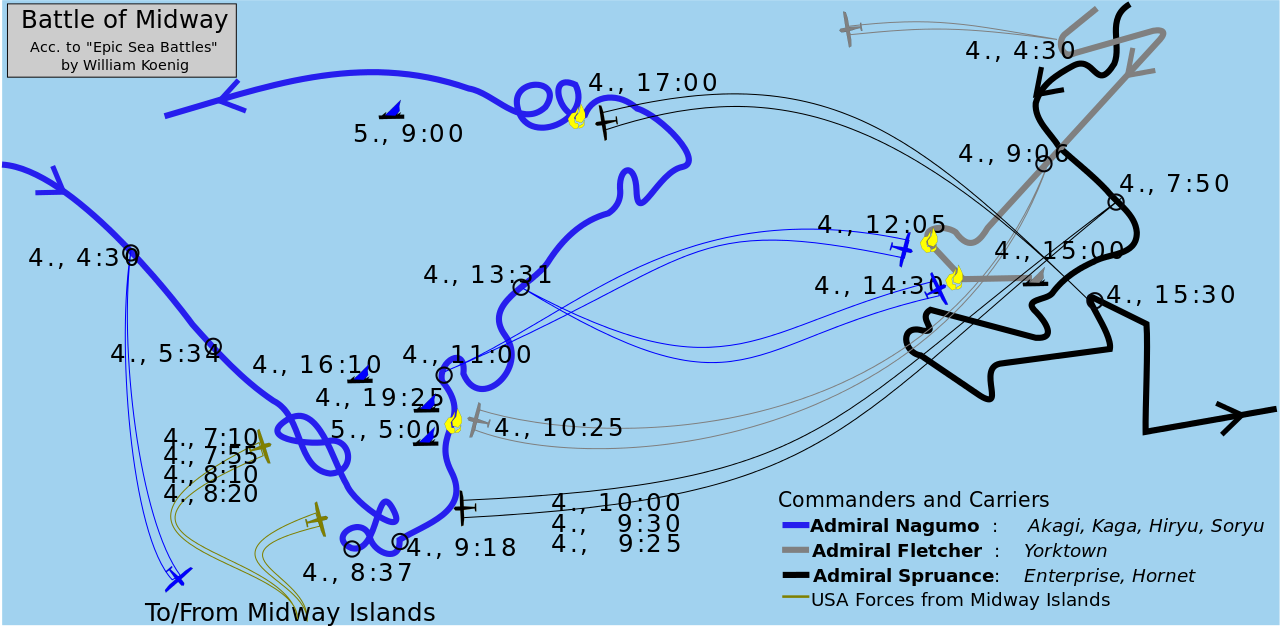
Battle of Midway deployment map, according to Seeschlachten der Weltgeschichte by William Koenig (German version of Epic Sea Battles) via Wikimedia
Seventy-five years ago (June 4-7, 1942), the astonishing American victory at the Battle of Midway changed the course of the Pacific War.
Just six months after the catastrophic Japanese surprise attack on Pearl Harbor, the U.S. crushed the Imperial Japanese Navy off Midway Island (about 1,300 miles northwest of Honolulu), sinking four of its aircraft carriers.
“Midway” referred to the small atoll roughly halfway between North America and Asia. But to Americans, “Midway” became a barometer of military progress. Just half a year after being surprised at Pearl Harbor, the U.S. Navy had already destroyed almost half of Japan’s existing carrier strength (after achieving a standoff at the Battle of the Coral Sea a month earlier).
The odds at the June 1942 battle favored the Japanese. The imperial fleet had four carriers to the Americans’ three, backed up by scores of battleships, cruisers and light carriers as part of the largest armada that had ever steamed from Japan.
No military had ever won more territory in six months than had Japan. Its Pacific Empire ranged from the Indian Ocean to the coast of the Aleutian Islands, and from the Russian-Manchurian border to Wake Island in the Pacific.
Yet the Japanese Navy was roundly defeated by an outnumbered and inexperienced American fleet at Midway. Why and how?
June 3, 2017
Secondary boycotting
Ace describes the way political groups can exercise economic pressure on third parties to influence or even to eliminate media voices with which they disagree:
The tactic being objected to — and I didn’t make this clear yesterday — is the tactic created by the left called a “secondary boycott.”
None of you can “boycott” Rachel Maddow — you’re already not watching her, and you enjoy not watching her, and you recommend not watching her to all of your friends.
Well, leftists realized that about Rush Limbaugh — you can’t boycott that which you already don’t use — and so invented the tactic of telling advertisers: Stop advertising on his show or we will boycott you.
That’s the “secondary” part of the boycott: You’re not boycotting the primary target. Which is obviously your right. You’re now conducting political campaigns against businesses to make them stop advertising, and get the show taken off the air entirely.
This is why Cars Dot Com and USAA boycotted Hannity — because the losers of this movement decided to start pressuring the advertisers to stop advertising there.
This is what I mean by “constant political campaigns being run against people not actually running for any office.” These are actual political campaign style efforts — with websites, donor buttons, etc. — being run not just during campaign season, and not just against an office-seeker, but 24 hours a day, seven days a week, fifty two weeks a year, against just about anybody.
Note that the fringe actors who do this shit do so to raise money. They’re fringe, and they’re not going to be hired by actual political campaigns, for the most part.
But they have to make money, don’t they?
So they just decided to invent their own political campaign which is not time-limited as ordinary campaigns are, and just buckrake endlessly to get this or that person silenced.
And they’ve had some success.
Even where they don’t succeed outright, they make themselves permanent residents of your mind: Because they’ve taught you to fear them.
This is what I’m objecting to — I understand that there will be politics in politics, but I don’t want fundraising political campaigns constantly running against anyone the left doesn’t like making all of lives, every single day, every single hour, part of and endless and ugly War of All Against All just so some energetic obsessives can make a dime and feel powerful.
June 2, 2017
QotD: Daytime TV
I’m writing this sentence (who can say where I’ll be in an hour) at the Brooklyn Diner off Times Square (the pastrami frittata is fantastic!). I’m about a block away from the set of Good Morning America, where hundreds of decent, normal Americans are willingly turning themselves into meat props for a three-hour spectacle, two hours and forty-five minutes of which is dedicated to something someone named Kanyé said about someone else; the troubling rise in Pilates injuries; J-Lo’s ass; and breaking news of a puppy making friends with a stuffed toy — from someone’s Facebook page somewhere out in America. I don’t actually know that’s what’s on today’s show, but I’m pretty confident it’s not that far off either.
I don’t mean to single out Good Morning America — The Today Show is equally vapid. It’s just that Good Morning America is fresh in my mind because I happened to watch an hour or so of it earlier this week while waiting for my car at the shop. I would have blown my brains out, but the show depleted my IQ so rapidly I couldn’t manage even the most rudimentary tasks. I got so dumb, Debbie Wasserman Schultz could have beaten me at checkers. But I did learn how Victoria Beckham struggles to have it all as a working mom. I don’t know how she does it. She’s a trooper.
And then there was the long segment on Suzy Favor Hamilton, the courageous former Olympic runner who married her college sweetheart, won a bunch of medals, started a family and a business, and then, “after one night with a Vegas call girl,” decided to become a hooker herself. “That light-bulb moment in my head, wow, why shouldn’t I get paid for sex?” she told GMA’s Lara Spencer. We then learn that her husband knew all about her moonlighting in Vegas, but he disapproved, as all decent husbands would, don’t ya know. You can read all about it in her new book (and so can her daughter). Oh yeah, I forgot to mention that — there’s a book. Contain your surprise.
Now, I’m not going to get all judgey here — because that would be wrong. Hamilton says she had serious mental-health problems, and that certainly seems more than plausible. Besides, we live in an age where having addictions, conditions, disorders, and issues is often a moral get-out-of-jail-free card. I have my own “issues” with that. But that’s a topic for another day.
[…]
And that was that. Hamilton betrayed her family and then compounded that “hurt” by splashing it all across the country — and somehow in a matter of seconds this becomes proof of her heroic struggle. She will have to live with this, but it was worth it because another journalist pandering to an interview subject said something that may or may not be true.
I’m not a big consumer of bipolar tell-alls, but I kind of feel like there are already more than a few out there and that it’s possible — just possible — the genre didn’t need one more, at least this one more. I’m sure this book helped someone, somewhere. But I resent the idea that somehow we’re all expected to celebrate this woman’s struggle and honesty and heroism and blah blah blah. And if we don’t celebrate it, not only are we the bad guys, but our judgmentalism makes her more of a hero.
It seems to me that if you don’t want people to judge you, maybe you shouldn’t herd your demons onto a public stage like they’re contestants in a beauty pageant?
Yeah, maybe her book will help someone out there. But maybe her top priority should be helping her family? I’d bet the book tour isn’t doing that.
Jonah Goldberg, “Our Culture Makes a Virtue Out of Victimhood”, National Review, 2015-09-18.
May 31, 2017
“JFK before the speechwriters got to him is far more interesting”
Mark Steyn celebrates what would have been JFK’s 100th birthday by looking at the pre-Camelot JFK’s life:
Jack’s early life was certainly privileged but not idyllic. The family patriarch, Joe, is an easy target: an enthusiastic adulterer at home, and abroad, as US Ambassador to the Court of St James’s, an equally enthusiastic appeaser. His wife, Rose, reacted to his infidelities by retreating into her social life. The distance she put between her and her husband also left her nine children (four of whom she would outlive) beached on the other side of the divide. She regarded them, as one biographer put it, as “a management exercise”, and she believed in mostly hands-off management. Jack was a sickly child who spent months in hospital, but his mother was too far away to visit. Maternal affection was confined to a postcard from Paris, a ship-to-shore telegram from the Queen Mary. For the rest of his life, Kennedy disliked being touched or hugged even in the course of his many fleeting, transient sexual encounters.
Sex was fine. Anything more he found awkward and difficult. He showered up to five times a day. You can do your own analysis; everybody else does. “If he were my son,” declared a master at Choate, “I should take him to a gland specialist.” “He has never eaten enough vegetables,” decided Rose.
Duty is more easily borne when the the world’s eminences are your dinner companions. You meet the seigneurs, and you get to enjoy a little of their droit de, too. A former lover of Prince George, Duke of Kent introduced herself to young Jack as “a member of the British Royal Family by injection”. The line seemed fresh to him, as it might not have a quarter-century later were random showgirls and mob molls running around Vegas and Malibu introducing themselves as members of the Kennedy family by injection. He signed his letters from Harvard, “Stout-hearted Kennedy, despoiler of women.”
On the other hand, not many 24-year-olds get to shoot the breeze with Lord Halifax, British Ambassador in Washington, at the height of the Second World War about where the man he served as prime minister had gone wrong. “Halifax believed,” wrote young Kennedy after their conversation, “that Chamberlain was misled and defeated by his phrases, which he did not really believe in, such as ‘Peace in our time’.” By the time Kennedy got into the phrase-making business, he left it to the professionals to craft all that sing-songy seesawing jingles people seem to think meets the definition of powerful rhetoric: Ask not what your country can do for you, ask what you can do for your country. Mankind must put an end to war or war will put an end to mankind. Let us never negotiate out of fear, but let us never fear to negotiate. Mankind must put an end to cheap applause lines, but let us never fear to invert them formulaically yet portentously.
The JFK before the speechwriters got to him is far more interesting. “We are at a great disadvantage,” Kennedy the gunboat skipper writes from the Pacific. “The Russians could see their country invaded, the Chinese the same. The British were bombed, but we are fighting on some islands belonging to the Lever Company, a British concern making soap… I suppose if we were stockholders we would perhaps be doing better, but to see that by dying at Munda you are helping to ensure peace in our time takes a larger imagination than most men possess.”
May 30, 2017
The unfriendly border
I’ve generally had little trouble crossing the US/Canadian border, but I’ve perhaps been quite lucky. An old friend of mine recently was turned back from the border crossing at Port Huron and had an exceptionally unpleasant time dealing with US officials:
On Wednesday May 10, I was denied entry into the USA.
I was attempting to travel to the International Congress for Medieval Studies at Kalamazoo MI.
I have attended this conference, presenting at organized sessions, since (at least) 2012.
One of these sessions was to be a combination demonstration / hands on. I had undertaken similar sessions there in 2013 and 2015.
I had booked a vendor’s table, selling objects made in Ontario at my studio, either by myself as the Wareham Forge, or by my partner as Elfworks Studio. I have done this since 2014.At ICMS 2017 I was intending to undertake the following:
– travel straight to and straight back from the event, a total of 5 days.
– setting up a vendor’s table to sell products made in Canada (all at my home studio), at a total combined value of $2450 US
– participate in an panel discussion session (#41)
– participate in a hands on workshop session (#224)I can not remain dispassionate about this whole episode.
Through this entire event, I made a deliberate attempt to keep my body language calm and unassertive. My hands folded in front of me, on steering wheel or visible on the desk. I attempted to keep my voice casual, calm and relaxed.
I do appreciate that some questions, some actions, are part of standard operations policy. I did attempt to make allowances for all this, never refusing to answer or follow instructions – as they were given.
I consider it extremely important to remember that I have decades of experience communicating to the general public. My spoken language skills are excellent.[…]
The Officer returns. I overhear a comment about ‘all his tools’. (12)
Over this conversation, I finally get asked ‘What all are you doing at this conference.’
I state that along with the vendor table, I will be participating in two academic sessions. One a panel discussion, one a workshop session where participants will be able to make cast pewter badges they can keep. I stress that I am not being paid for any of this.
Eventually, I get told that the goods will be released with no duties and allowed to pass importation.
‘But there is something else I can’t determine, so you will have to go to Immigration.’
Just what the potential problem may be is not given.Another, heavily equipped (tactical) Officer arrives.
‘I don’t think I need to put you in handcuffs for this, but I am required to put you under restraint’
Please put you hands behind your back, fingers interlaced.
He holds my hands with one of his, pushing up and forward so my weight is off balance on my toes. He is supporting me with his other hand on my upper arm.
This officer is polite and professional. I get escorted in this manner across an open parking area, through a public area at the front of the separate Immigration building. (13)
The Commercial Officer is accompanying as well, with my original invoice document in hand. He still has my car keys.
Dealing with customs at the border tends to be a tense moment for many travellers, even if they’re not in violation of any rule or regulation. Darrell’s account shows that the tension can be more than matched on the other side of the booth. It’s certainly soured him on the idea of visiting the US again.
May 29, 2017
QotD: Western intellectuals’ anti-Western bias
Much of the West’s intelligentsia is persistently in love with anything anti-Western (and especially anti-American), an infatuation that has given a great deal of aid and comfort to tyrants and terrorists in the post-9/11 world. Besides these obvious political consequences, the phenomenon Julian Benda famously called le trahison des clercs has laid waste to large swathes of the soft sciences through ideologies like deconstructionism, cultural relativism, and postmodernism.
I believe, but cannot prove, that le trahison des clercs is not a natural development of Western thought but a creation of deliberate propaganda, directly traceable to the successes of Nazi and Stalinist attempts to manipulate the climate of opinion in the early and mid-20th century. Consequently I believe that one of the most difficult and necessary tasks before us in the next half century will be to banish the influence of totalitarian nihilism from science in particular and our culture in general.
Eric S. Raymond, “What Do You Believe That You Cannot Prove?”, Armed and Dangerous, 2005-01-06.
May 28, 2017
The Handmaid’s Tale, is indeed timely, but not the way they mean
In the Los Angeles Times earlier this month, Charlotte Allen discusses the “timeliness” of Hulu’s TV adaptation of Margaret Atwood’s novel The Handmaid’s Tale:
I’ve lost count of the articles I’ve read about Hulu’s adaptation of Margaret Atwood’s 1985 novel The Handmaid’s Tale that used the word “timely.” Timely, that is, in the sense of the presidency of Donald Trump. Here’s just a short list of print and online outlets where the T-word appears in connection with the re-creation of Atwood’s fictional America turned into a grim theocracy called Gilead that treats women like breeding cattle: the Hollywood Reporter, the Washington Post, the Guardian, Mother Jones, Harper’s Bazaar, the Daily Beast, Bustle, NPR, and CNN. The 77-year-old Atwood herself chimed in, telling the Los Angeles Times’ Patt Morrison: “We’re no longer making fiction — we’re making a documentary.”
The idea, in these mostly liberal media outlets, seems to be that under President Trump, America has become — or will become terrifyingly soon — a militant Bible-based patriarchy (hello Texas, hello Mike Pence) in which women have no rights, especially no reproductive rights, and are divided into rigidly stratified social classes whose very names give their status away: privileged, churchy Wives at the top, Econowives in the lower social orders, and cook-and-bottle-washer Marthas who do the housework for the Wives and their powerful husbands, the Commanders.
At the very bottom are Handmaids, political pariahs (wrong ideas, such as feminism) who become the literal property of the top-dog men and are forced to bear their children. (The Wives suffer from environmental pollution-related fertility problems.) As the New Republic’s Sarah Jones, one of the “timely” crowd, explains, “Of course, we don’t divide women into classes of Marthas, Handmaids, Econowives, and Wives; we call them ‘the help,’ ‘surrogates,’ the working class, and the one percent.”
At first I scoffed. There couldn’t be any more unlikely a theocrat than Trump, what with his misquotes from the Bible and speculation that he hasn’t been in a church more than twice since the inauguration. But then I realized that the liberal paranoiacs were right. Except not in the way they think. Instead of seeing Atwood’s fictional Gilead as a near-future militant fundamentalist Christian elite dystopia, we should see it as the mostly secularist elite dystopia we live in right now.


