
Ninescore and fifteen years ago, with the ink only just sanded on the United States Constitution, President George Washington and Treasury Secretary Alexander Hamilton decided it was time to try out their shiny brand-new powers of taxation.
Their first victims would be certain western Pennsylvania agricultural types long accustomed to converting their crops into a less perishable, more profitable high-octane liquid form. Unfortunately for the President and the Secretary, many of these rustics, especially near the frontier municipality of Pittsburgh, placed a slightly different emphasis than high school teachers do today on the Revolutionary slogan regarding “taxation without representation”. In their view, they’d fought the British in 1776 to abolish taxes and they weren’t interested in having representation imposed on them by that gaggle of fops in Philadelphia, the nation’s capital. They made this manifestly clear by tarring-and-feathering tax collectors, burning their homes to the ground, and filling the stills of those who willingly paid the hated tribute with large-caliber bullet holes.
Feeling their authority challenged, George and Alex dispatched westward a body of armed conscripts equal to half the population of America’s largest city (Philadelphia once again, later famous for air-dropping explosives on miscreants charged with disturbing the peace). Four hundred whiskey rebels, duly impressed by this army of fifteen thousand, subsided. The miraculous process by which the private act of thievery is transubstantiated into public virtue was firmly established in history. The results — chronic poverty and unemployment, endless foreign wars, and reruns on television — are with us even today.
L. Neil Smith, “Introduction: A Brief History of the North American Confederacy”, The Spirit of Exmas Sideways: a “novelito” by L. Neil Smith.
January 7, 2018
QotD: The Whiskey Rebellion
January 6, 2018
QotD: The teacher as social worker
Here we come to one of the most pernicious aspects of identity politics as it reshaped the American university — the confusion of teaching with social work. The issue of improper advocacy in the classroom has never been adequately addressed by the profession. Teaching and research must strive to remain objective and detached. The teacher as an individual citizen may and should have strong political convictions and activities outside the classroom, but in the classroom, he or she should never take ideological positions without at the same time frankly acknowledging them as opinion to the students and emphasizing that all students are completely free to hold and express their own opinions on any issue, no matter how contested, from abortion, homosexuality, and global warming to the existence of God or the veracity of Darwin’s theory of evolution. Unfortunately, because of the failure of American colleges and universities to seek and support ideological diversity on their campuses, the humanities faculties have trended so far toward liberal Democrats (among whom I number myself) that they often seem naively unaware that any other beliefs are possible or credible.
Camille Paglia, “The Modern Campus Has Declared War on Free Speech”, Heat Street, 2016-05-09.
January 4, 2018
“This is what you get when you touch the Orb”
Jonah Goldberg thinks he’s identified the moment our timeline went screwy, sorta:
Ever since Donald Trump touched the Orb, praise be upon it, I’ve been making “This is what you get when you touch the Orb” jokes.
If you don’t know what I’m talking about, I’ll tell you: On his trip to the Middle East in May, President Trump, along with the Saudi king and the president of Egypt, laid his hands on a glowing white orb for two minutes (which strikes me as a long time to touch an orb).
The image was like a mix of J.R.R. Tolkien and 1970s low-budget Canadian sci-fi. It looked like they were calling forth powerful eldritch energies from the chthonic depths or perhaps the forbidden zone.
Ever since then, when things have gotten weird, I’ve credited the Orb. For instance, when the Guardian reported that sex between Japanese snow monkeys and Sika deer may now constitute a new “behavioral tradition,” I tweeted, “the Orb has game, you can’t deny it.” When Roy Moore, the GOP Alabama Senate candidate, was plausibly accused of preying on teenagers and many evangelical leaders rallied to his defense, invoking biblical justifications for groping young girls, I admired the Orb’s cunning. And when the bunkered Moore decided to give one of his only interviews to a 12-year-old girl, I sat back and marveled at the Orb’s dark sense of humor.
But I know in my heart that it’s not the Orb’s fault things have gotten so weird, for the simple reason that rampant weirdness predates the Orb-touching by years.
I have a partial theory as to why, and it doesn’t begin with Trump. It begins with a failure of elites and the institutions they run.
January 3, 2018
Oregon reacts in horror to the idea of pumping their own gas
Full-service gas stations have been on the endangered list for a long time … I can’t remember the last time I saw one in my travels. Apparently, if I’d been to Oregon, that’s all I’d have encountered because it’s one of two states that forbid drivers to pump their own gas. At least, that was until the start of 2018, when Oregon allowed certain rural gas stations to allow self-service, and you’d think the world was about to end, based on these Facebook comments:
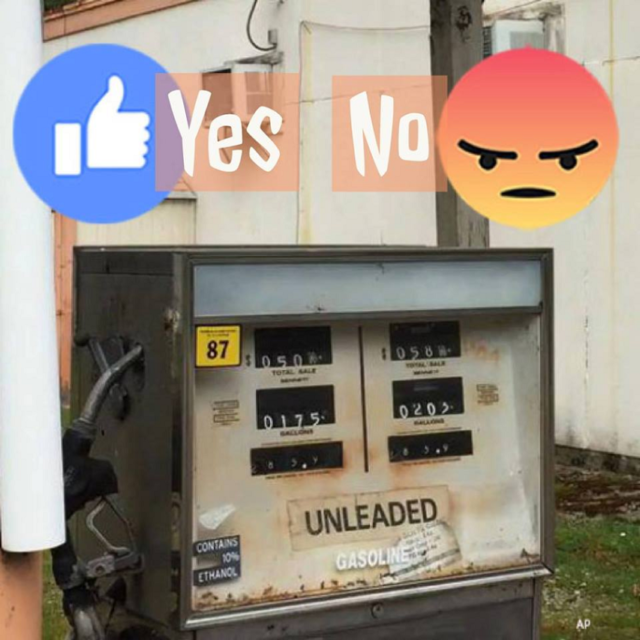
Click to see Facebook comments.
Sandy Franklin I don’t even know HOW to pump gas and I am 62, native Oregonian…..I say NO THANKS! I don’t want to smell like gasoline!
Cathy Dahl No! Disabled, seniors, people with young children in the car need help. Not to mention getting out of your car with transients around and not feeling safe too. This is a very bad idea. Grrr
Tina Good Not a good idea, there are lots of reason to have an attendant helping, one is they need a job too. Many people are not capable of knowing how to pump gas and the hazards of not doing it correctly. Besides I don’t want to go to work smelling of gas when I get it on my hands or clothes. I agree Very bad idea.
Kyle Allen One time, my dad came to Oregon and pumped his own gas. The street immediately lit on fire and he caused massive recession countrywide because he took away 20 billion jobs by pumping his own gas. I was in the back seat when brother was nabbed through the locked door by a transient creeper who raised him to be his human ottoman. My dad then tried wiping his windshield but the stuff he used turned out to be sulfuric acid. The car exploded with me in it and I died. My dad lost 3 parenting points because he was 2 feet away fueling his car when he could have had someone else do this very simple task for him.
Joseph Kimrey It’s official.
Oregon is full of mentally defective, full grown children, incapable of the most mundane of adult tasks.Chris Donnelly Apparently most people in Oregon assume that in order to pump gas you must first remove all people from the vehicle and stand in the open while thugs attack from all angles, all while being sprayed with gas
Mike Perrone I’ve lived in this state all my life and I REFUSE to pump my own gas. I had to do it once in California while visiting my brother and almost died doing it. This a service only qualified people should perform. I will literally park at the pump and wait until someone pumps my gas. I can’t even
Shifty McQuick If your only marketable job skill is being able to pump gas, by god, move to Oregon and you will have reached the promised land.
Kelsa Freitas Yuck! Pumping my on fuel in freezing temperatures and handling a nasty ole fuel nozzle that 50 other people have touched that day (and who knows what cooties are on there), no thank you. It’s nice to not have to pump your own fuel.
H/T to M.A. Rothman for linking to the original post.
December 31, 2017
QotD: The rise of the man-child
I just turned 51, and a disturbingly large percentage of men in their twenties and thirties seem like spoiled narcissistic man-children to me. I thought for a while that this might mean I was turning into the sort of crusty old fart I laughed at when I was twenty-five, until I noticed that the percentage of man-children varied a great deal depending on my social context.
At the martial-arts school where I’m training, zero to not much. Even the teenage boys there are pretty manly, on the whole – not surprising, since manliness is very nearly defined by stoicism and grace under pressure, and a martial-arts school should teach those things if it teaches nothing else. Anywhere firearms are worn or displayed openly, ditto — go to a tactical-shooting match, for example, and you’ll see even prepubescent boys (and, though rarely, some girls) exemplifying quiet manliness in a very heartening degree.
On the other hand…when I go to places where people are talking rather than doing, the percentage of man-children rises. Occasionally my wife Cathy and I go to screenings at the Bryn Mawr Film institute, most recently to see Sergei Bodrov’s The Mongol; it’s pretty much wall-to-wall man-children there, at least in the space not occupied by middle-aged women. If our sample is representative, my wife is manlier than the average male art-film buff.
How does one tell? The man-child projects a simultaneous sense of not being comfortable in his own skin and perpetually on display to others. He’s twitchy, approval-seeking, and doesn’t know when to shut up. He’s never been tested to anywhere near the limits of his physical or moral courage, and deep within himself he knows that because of this he is weak. Unproven. Not really a man. And it shows in a lot of little ways – posture, gaze patterns, that sort of thing. He’ll overreact to small challenges and freeze or crumble under big ones.
One of the things this culture badly needs is a set of manhood ordeals. Unlike the tribal societies of the past, we’re too various for one size to fit all — but to reliably turn boys into men (or, to put it in more fashionable terms, to help them become mature and inner-directed) you need to put them under stress in a way that, except for the small percentage that go through military boot camps, we basically don’t any more.
Instead, we prolong adolescence into the twenties and thirties. With dolorous consequences for everyone…
Eric S. Raymond, “Where the men are”, Armed and Dangerous, 2008-12-15.
December 30, 2017
Congressional New Year’s Resolutions
ReasonTV
Published on 29 Dec 2017In this special holiday edition of “Mostly Weekly” Andrew Heaton comes up with some out-of-the-box New Year’s resolutions for our legislators.
As 2017 thankfully limps to its conclusion, we turn our sights to 2018 and ways in which Congress can be less awful. In this special holiday edition of “Mostly Weekly” Andrew Heaton comes up with some out-of-the-box ideas for our legislators:
•Find out what’s inside the stuff they vote on
•Quit hemorrhaging money like a drunken sailor
•Balance mental health with Mr. Trump’s twitter account
•Find healthy outlets for pint up sexual energy otherwise directed at staffersAnd, of course, what to do about that shrimp running on a government-funded treadmill.
Mostly Weekly is hosted by Andrew Heaton with headwriter Sarah Rose Siskind.
Script by Andrew Heaton with writing assistance from Sarah Rose Siskind
Edited by Sarah Rose Siskind and Austin Bragg
Produced by Meredith and Austin Bragg.
Theme Song: Frozen by Surfer Blood.
December 29, 2017
2017 wasn’t all doom and gloom and Trump tweet wars
Veronique de Rugy manages to find three things that 2017 produced that somehow didn’t kill millions of Americans (so far, as far as we know):
First, President Donald Trump just signed a historic reduction in the corporate income tax rate, from 35 percent — the highest of all industrialized nations — to 21 percent. And except for a one-time repatriation tax, the U.S. will no longer tax most profits made by businesses overseas.
Both changes should boost economic growth and American workers’ wages. Moreover, the reform removes many of the distortions that discourage companies from investing foreign-earned income in the United States and prompt them to use tax avoidance techniques.
Second, this was a very good year for deregulation. Cutting taxes isn’t the only way to boost growth and raise wages; innovation may matter even more. Getting rid of duplicative and outdated regulatory hurdles to innovation promises to have a real impact on our lives. That’s what the Trump administration, with the help of Congress, seems committed to doing.
When the president first got to the White House, for example, he froze many not-yet-implemented Obama-era regulations. These include the punishing overtime pay regulation, which would have increased the cost of employing workers and ultimately reduced their base compensation to offset the increase in overtime pay.
[…]
Last but not least are the sustained efforts by Sens. Pat Toomey, R-Pa., and Richard Shelby, R-Ala., to slow down the process that would restore the Export-Import Bank, a bastion of cronyism, to its full and former glory.
Appointing enough board members to give Ex-Im a full quorum would instantly restore the agency’s ability to sign off on deals above $10 million for the benefit of a handful of very large foreign and domestic corporations. By resisting, the two senators are fighting a lonely fight on behalf of the unseen victims of corporate welfare.
QotD: Post-structuralism
Another problem in 1970s academe was a job recession in the humanities that arose just as deconstruction and post-structuralism arrived from Europe. The deconstructionist trend started when J. Hillis Miller moved from Johns Hopkins University to Yale and began bringing Jacques Derrida over from France for regular visits. The Derrida and Lacan fad was followed by the cult of Michel Foucault, who remains a deity in the humanities but whom I regard as a derivative game-player whose theories make no sense whatever about any period preceding the Enlightenment. The first time I witnessed a continental theorist discoursing with professors at a Yale event, I said in exasperation to a fellow student, “They’re like high priests murmuring to each other.” It is absurd that that elitist theoretical style, with its opaque and contorted jargon, was ever considered Leftist, as it still is. Authentic Leftism is populist, with a brutal directness of speech.
Post-structuralism, in asserting that language forms reality, is a reactionary reversal of the authentic revolutionary spirit of the 1960s, when the arts had turned toward a radical liberation of the body and a re-engagement with the sensory realm. By treating language as the definitive force in the world — a foolish thesis that could easily be refuted by the dance, music, or visual arts majors in my classes — post-structuralism set the groundwork for the present campus impasse where offensive language is conflated with material injury and alleged to have a magical power to create reality. Furthermore, post-structuralism treats history as a false narrative and encourages a random, fragmented, impressionistic approach that has given students a fancy technique but little actual knowledge of history itself.
Camille Paglia, “The Modern Campus Has Declared War on Free Speech”, Heat Street, 2016-05-09.
December 28, 2017
How A Cargo Ship Helped Win WW2: The Liberty Ship Story
Mustard
Published on 14 Nov 2017During World War Two, hundreds of cargo ships raced across the Atlantic in an effort to keep Britain supplied. But these ships were being sunk by German U-boats, warships and aircraft. In 1940 alone, over a thousand allied ships were lost on their way to Britain.
The United States, while not yet at war, was playing a vital role in supplying Britain. But with ships being sunk daily, Britain and America desperately needed a way to keep all that material moving across the Atlantic. In response, 18 shipyards across the coastal United States mobilized to build thousands of large cargo ships known as Liberty Ships. They would be built even faster than the enemy could sink them. At one point the shipyards were building one large Liberty Ship every eight hours.
Two revolutionary changes in shipbuilding will make this enormous feat possible. The first is welding and the second is the use of a modular assembly process. By mid 1941, the sheer number Liberties out at sea, along with increasing armed escorts overwhelmed German forces. Advances in anti-submarine technologies also started stamping out the U-boat threat.
Today, there are only three Liberty Ships remaining of the 2,710 built that remind us of their enormous contribution to winning World War Two.
QotD: The 1960s cultural revolution
The entire political and cultural trajectory of the decades following World War II in the U.S. was a movement away from the repressions of the Cold War standoff with the Soviet Union, when the House Un-American Activities Committee of the U.S. House of Representatives searched for signs of Communist subversion in every area of American life. A conspicuous target was the Hollywood film industry, where many liberals had indeed been drawn to the Communist Party in the 1930s, before the atrocities of the Stalinist regime were known. To fend off further federal investigation, the major studios blacklisted many actors, screenwriters, and directors, some of whom, like a favorite director of mine, Joseph Losey, fled the country to find work in Europe. Pete Seeger, the leader of the politicized folk music movement whose roots were in the social activism of Appalachian coal-miners in the 1930s, was banned from performing on network TV in the U.S. in the 1950s and ‘60s.
There were sporadic landmark victories for free speech in the literary realm. In 1957, local police raided the City Lights Bookshop in San Francisco and arrested the manager and owner, Beat poet Lawrence Ferlinghetti, for selling an obscene book, Allen Ginsberg’s epic protest poem, Howl. After a long, highly publicized trial, Howl was declared not obscene, and the charges were dropped. The Grove Press publishing house, owned by Barney Rosset, played a heroic role in the battle against censorship in the U.S. In 1953, Grove Press began publishing affordable, accessible paperbacks of the voluminous banned works of the Marquis de Sade, a major thinker about sex and society at the close of the Enlightenment. In 1959, the Grove Press edition of D.H. Lawrence’s 1928 novel, Lady Chatterly’s Lover, then banned in the U.S., was confiscated as obscene by the U.S. Postal Service. Rosset sued and won the case on federal appeal. In 1961, the publication by Grove Press of another banned book, Henry Miller’s 1934 novel, Tropic of Cancer, led to 60 obscenity trials in the U.S. until in 1964 it was declared not obscene and its publication permitted.
One of the supreme symbols of newly militant free speech was Lenny Bruce, who with Mort Sahl transformed stand-up comedy from its innocuous vaudevillian roots into a medium of biting social and political commentary. Bruce’s flaunting of profanity and scatology in his improvisational onstage act led to his arrest for obscenity in San Francisco in 1961, in Chicago in 1962, and in New York in 1964, where he and Howard Solomon, owner of the Café Au Go Go in Greenwich Village, were found guilty of obscenity and sentenced to jail. Two years later, while his conviction was still under appeal, Bruce died of a drug overdose at age 40.
This steady liberalizing trend was given huge impetus by the sexual revolution, which was launched in 1959 by the marketing of the first birth control pill. In Hollywood, the puritanical studio production code, which had been adopted in the early 1930s under pressure from conservative groups like the Legion of Decency and the United States Conference of Catholic Bishops, was gradually breaking down and was finally abandoned by the late 1960s. The new standard of sexual expression was defined by European art films, with their sophisticated scripts and frank nudity. Pop music pushed against community norms: in 1956, Elvis Presley’s hip-swiveling gyrations were cut off by the TV camera as too sexual for the Ed Sullivan Show, which was then a national institution. As late as 1967, the Ed Sullivan Show was trying to censor the song lyrics of major bands like the Doors and the Rolling Stones, who were imitating the sexual explicitness of rural and urban African-American blues. (The Stones capitulated to Sullivan, but the Doors fought back — and were never invited on his show again.) Middle-class college students in the 1960s, including women, began freely using four-letter words that had rarely been heard in polite company, except briefly during the flapper fad of the 1920s. In the early 1970s, women for the first time boldly entered theaters showing pornography and helped make huge hits out of X-rated films like Deep Throat, Behind the Green Door, and The Devil in Miss Jones.
In short, free speech and free expression, no matter how offensive or shocking, were at the heart of the 1960s cultural revolution. Free speech was a primary weapon of the Left against the moralism and conformism of the Right.
Camille Paglia, “The Modern Campus Has Declared War on Free Speech”, Heat Street, 2016-05-09.
December 26, 2017
QotD: Most consumers say they want local-grown food, but won’t pay the costs to get it
Food grown locally, on small-lot farms without modern chemical assistance, is really expensive. The complex modern food-supply chain that ensures restaurants and food processors can get the same consistent mix of staple ingredients year-round also relentlessly beats down the price of food, sourcing wherever supply is cheapest, redistributing temporary local abundance to a steady global diet of everyday low prices. This is also not such a terrible way to eat; it is the foundation of much of our modern prosperity. But it is not local, artisanal, organic. It is global, industrial, indifferent. It has to be, both because organic inputs are much more expensive, and because trying to separate and track all the food so that restaurateurs can be sure of provenance and process would mean abandoning many of the efficiencies that make the stuff so cheap.
And Americans expect cheap. Cheap, after all, is what makes it possible for us to spend so much money at restaurants; if we had to pay all the workers $20 an hour and ensure that all our meat and produce had been farmed in the latest and most approved 19th-century methods, few of us could afford to have weekly dining out in our budget. Restaurants might be more authentic, delicious, moral places. They would also be much emptier ones.
Reading the Tampa Bay Times article, you get the sense that many of these restaurateurs tried to provide an authentic farm-to-table experience and found that customers were not willing to pay what it would cost — in money or variety — to have one. People are probably willing to pay some premium for that kind of food, but the premium is probably closer to 10 to 15 percent than it is to the sky-high sums that it would actually cost to rely on those sorts of farms, those sorts of methods. So the restaurateurs inevitably sold them what they were happily willing to pay for: food from an industrial supply chain, with a side of moral satisfaction.
It’s hard to be too angry at consumers. To be sure, they probably should have known that you couldn’t really buy organic, locally sourced food year-round at just a smidge more than you’d pay for a regular meal. After all, the average American spent half their income on food in 1900, while the modern American now spends a paltry 12 percent, even including a lavish helping of restaurant meals. That should give us some sign that local, artisanal food is not going to be cheap. But most Americans are not economic historians.
But it’s not even that easy to be mad at the restaurants. They’re in a viciously competitive business where most places don’t survive. In a competitive equilibrium where so many people want to be told they’re eating farm-fresh food — and so few people seem willing to pay for it — many of them probably feel that their choice is “lie or die.”
Megan McArdle, “Dining Out on Empty Virtue”, Bloomberg View, 2016-04-15.
December 25, 2017
Repost – “Fairytale of New York”
Time:
“Fairytale of New York,” The Pogues featuring Kirsty MacColl
This song came into being after Elvis Costello bet The Pogues’ lead singer Shane MacGowan that he couldn’t write a decent Christmas duet. The outcome: a call-and-response between a bickering couple that’s just as sweet as it is salty.
December 24, 2017
The Dangerous Toys of Christmas: Debunked!
ReasonTV
Published on 22 Dec 2017Author Lenore Skenazy says today’s holiday toys are so risk averse that there’s almost nothing left to warn about. But still, the warnings come every year from consumer groups.
——–
Are you sick of being warned about anything and everything when it comes to the holiday season?
Me too. That’s why I’m ready to throw an icicle at a group called World Against Toys Causing Harm (WATCH). Every year since 1973, they’ve published a paranoid list of the “10 Worst Toys” at Christmastime.
These warnings may have been necessary back in 1973 when companies were still selling toy ovens that could smelt ore and chemistry sets that could actually blow things up.
In fact, the toy world was littered with bad ideas — from the Cabbage Patch Kid dolls with mechanical jaws that chewed everything — including chunks of hair from kids’ heads — to lawn darts — sharp metal things you’d toss at your friends’ toes that caused over six thousand injuries.
The Consumer Product Safety Commission eventually banned those items — and it’s hard to disagree with them — but today’s toys are so risk averse, so super safe, that there’s almost nothing left to warn about. But still the warnings fall like cookie crumbs onto Santa’s beard.
It is this zero tolerance for “risk” that WATCH and other consumer groups exploit every Christmas. Among its top 10 dangers this year are the popular fidget spinners.
Also on this year’s list is the Wonder Woman Battle Action Sword, which, the WATCH team says, encourages young children “to bear arms” — as if you get a Wonder Woman toy and immediately deploy to Yemen. They also say that the “rigid plastic sword blade has the potential to cause facial or other impact injuries.” Yeah … and so does a fork. In fact, so does a candy cane, if you suck it to a sharp point.
Even an innocent looking Disney-themed plush toy did not escape WATCH’s nannying notice. The group warns that the toy could be dangerous due to “fabric hats and bows that can detach, posing a choking hazard.”
That’s a lot of coulds, especially considering the Consumer Product Safety Commission notes on its website that it has had ZERO reports of injuries.
The Toy Association, which is an industry trade group, says WATCH’s dangerous toys list is “full of false claims that needlessly frighten parents and caregivers.”
It’s obvious that toys that explode and toys that are just plain dumb — a boomerang made out of razor blades — are bad. But if they only worked a little harder, I’ll bet WATCH could stop kids from playing with toys. Any toys. Ever.
You want a really great gift for the kids? How about they wake up Christmas morning, unwrap the giant package under the tree to find their very own product liability lawyer? Wind him up and watch him sue all the other toys. Hours of fun!
And when the kids get bored, they lock him in the toy chest, and go play with a great toy. A stick.
Written by Lenore Skenazy. Produced by Alexis Garcia and Paul Detrick. Camera by Jim Epstein, Alex Manning, and Paul Detrick.
Hilarious History: That Time Cadets at West Point Rioted Over Eggnog
Today I Found Out
Published on 6 Dec 2017In this video:
From the beginning, heavy drinking was fairly commonplace among the cadets at the United States Military Academy at West Point (founded in 1802). In an attempt to stem this in 1826, the academy’s strict superintendent and the “Father of West Point,” General Sylvanus Thayer, began a crackdown by prohibiting alcohol on campus. As Christmas approached and the cadets realized that the prohibition would put a damper on their traditional Christmas Eve festivities that included consumption of a fair amount of eggnog, a bold few began to plan away around the problem.
Want the text version?: http://www.todayifoundout.com/index.p…
December 23, 2017
Words as weapons, words as tools
In City Journal, Howard Husock looks at the recent media fuss about certain words being “banned” by Trump or the Republicans:
A political tempest arose last week when the Washington Post reported that the Department of Health and Human Services had banned the use of certain words or phrases — “vulnerable,” “science-based,” and “entitlements,” among others — in official budget documents. National Affairs editor Yuval Levin debunked the story, though, finding instead that bureaucrats concerned about offending Republican budget overseers had, in fact, decided to censor themselves. If so, that suggests that the bureaucrats have been reading their George Orwell, who observed in his classic essay “Politics and the English Language” that language is “an instrument which we shape for our own purposes”; they are sharp enough to realize that even neutral terms can constitute mini-arguments. Each of the terms in question — and a great many more — have been weaponized for use in political conflict.
“Vulnerable,” for example, is a substitute for “poor” or “low-income,” but it usually suggests that the person in question should not be considered in any way responsible for his or her situation, because social conditions that transcend individual action have stacked the deck adversely. “Science-based” is a pithy way to characterize the views of one’s political opponents as ignorant or superstitious. The belief that climate change will prove catastrophic is said to be science-based; any view that minimizes the risk constitutes “denial,” another noun that has become an argument. The widely used “entitlement” has also become an argument. The idea that all citizens are “entitled” to certain forms of financial support — checks for those above a certain age, health insurance for those below a certain income — implies no other way of seeing the situation. Those who would change the way entitlements are disbursed, then, are impinging on rights, not programs.
Other examples abound. “Disadvantaged” describes low-income children — while implying that other children are advantaged — and thus that the system is unfair and violates “social justice,” another loaded term. The “homeless,” by and large, are not living on the street but are often doubled up with friends or family; they don’t have their own home, in other words. But the word-picture painted by “homeless” is more powerful. The Right plays the same game. “Death tax” as a substitute for “estate tax,” for example, characterizes a debatable policy as an immoral absurdity.


