The Armourer’s Bench
Published on May 19, 2019During World War One massive railway guns were used to reach deep behind enemy lines and attack enemy infrastructure with both sides using the massive artillery pieces. In this episode Matt takes a look at some archival footage of America’s massive railway guns ranging from 10 to 16 inches.
Check out our accompanying article for more information and sources at:
https://armourersbench.com/2019/05/19/us-military-railway-guns-in-action/If you enjoy our work please consider supporting us via Patreon, TAB is a viewer supported, non-monetised channel and any help is very much appreciated!
We have some great new perks, check out our Patreon page here: https://www.patreon.com/thearmourersb…
The Answer:
According to the original footage notes the mystery item is a 60-feet tall captured German field periscope ‘claimed to have been used by the German Crown Prince during the war’.Footage:
https://catalog.archives.gov/id/24749
July 17, 2019
TAB Short: US Military Railway Guns In Action
QotD: “The United States government [became] the greatest and most potent maker of criminals in any recent century”
For most of the history of the United States, drugs were legal. People could buy opiates and cocaine-based products from their local pharmacy. An opiate-laced brew called Mrs. Winslow’s Soothing Syrup, for example, was particularly popular with housewives. One person who viewed this legal system with skepticism was a Los Angeles doctor named Henry Smith Williams. When a small number of his patients became addicted, he was disgusted, and he came to see them as despicable “weaklings.” So when opiates and cocaine were banned in 1914, he welcomed this first birth-pang of the drug war with glee.
But then he noticed what happened to his addicted patients. They didn’t stop using. Instead, “here were tens of thousands of people, in every walk of life, frantically craving drugs that they could in no legal way secure,” he wrote in one of his books. “They craved the drugs, as a man dying of thirst craves water. They must have the drugs at any hazard, at any cost.”
At the same time, Smith Williams realized that the drug war was “in effect ordering a company of drug smugglers into existence.” Because pharmacists could no longer sell these drugs, the Mafia and other criminal organizations stepped in, selling a vastly inferior product at extortionate prices. In the pharmacies, morphine had cost two or three cents a grain, but the criminal gangs charged a dollar.
The death rate among addicts rose, and those who survived began to behave very differently. An official government study had found that, before the drug war kicked in, three-quarters of self-described addicts had steady and respectable jobs: some 22% were wealthy, while only 6% were poor. They were more sedate as a result of their addiction, but they were rarely out of control or criminal. Yet faced with the need to meet these extortionate new prices, many of the men started to commit property crimes, and many of the women started to steal or prostitute themselves.
So Smith Williams watched as the drug war created two waves of crime: first a wave of violent criminal drug-dealers, and then a wave of criminality among addicts. “The United States government,” Henry wrote in shock, had become “the greatest and most potent maker of criminals in any recent century.”
Johann Hari, “A 1930s California story shows why the war on drugs is a failure”, Los Angeles Times, 2017-06-16.
July 14, 2019
The Epstein scandal is another example of the importance of accurate names
ESR has some concerns about the Epstein case, specifically on the correct terminology to use:
The sage Confucius was once asked what he would do if he was a governor. He said he would “rectify the names” to make words correspond to reality. He understood what General Semantics teaches; if your linguistic map is sufficiently confused, you will misunderstand the territory. And be readily outmaneuvered by those who are less confused.
Mug shot of Jeffrey Epstein made available by the Palm Beach County Sheriff’s Department, taken following his indictment for soliciting a prostitute in 2006.
Image via Wikimedia Commons.And that brings us to the Jeffrey Epstein scandal. In particular, the widespread tagging of Epstein as a pedophile.
No, Richard Epstein is not a pedophile. This is important. If conservatives keep misidentifying him as one, I fear some unfortunate consequences.
Pedophiles desire pre-pubertal children. This is not Epstein’s kink; he quite obviously likes his girls to be as young as possible but fully nubile. The correct term for this is “ephebophile”, and being clear about the distinction matters. I’ll explain why.
The Left has a long history of triggering conservatives into self-discrediting moral panics (“Rock and roll is the devil’s music”). It also has a strong internal contingent that would like to normalize pedophilia. I mean the real thing, not Epstein’s creepy ephebophilia.
Homosexual pedophiles have been biding their time in order to get adult-on-adult homosexuality fully normalized as battlespace prep, but you see a few trial balloons go up occasionally in places like Salon. The last round of this was interrupted by the need to take down Milo Yiannopolous, but the internal logic of left-wing sexual liberationism always demands new ways to freak out the normals, and the pedophiles are more than willing to be next up in satisfying that perpetual demand.
Liberals have proven themselves utterly useless at resisting the liberationist ratchet, so I’m not even bothering to address them. Conservatives, if you want to prevent the next turn, don’t give the pedophilia-normalizers maneuvering room. Rectify the names; make the distinctions that matter.
Epstein’s behavior is repulsive because we judge young postpubertal humans to be too psychologically immature to give adult consent, but it’s nowhere near the evil that is the sexual abuse of prepubertal children.
QotD: The legacy of the original hippies
In my younger days, when I myself wore my hair long and may have dabbled in the occasional Red Dragon, Purple Om and Roobarb ‘n’ Custard, I think I might have been quite surprised to learn that the hippies I idealised at the time — well, I liked Easy Rider, and used to play Jefferson Airplane’s “White Rabbit” more often than was good for me — in fact shared the same ideological roots as the Hitler Youth.
Not now I’m older and wiser, I don’t. Beneath the kaftan of every other hippie beats the heart of a fascist — the intolerance, the zeal, the control-freakery — and it all stems from that moment, pinpointed in the documentary, when a left-wing activist and Berkeley drop-out named Jerry Rubin had a sudden insight: that there were more hippies than there were radicals.
The unfortunate result of this was that Rubin and his ilk realised that they could prey like vampires on these fluffy-headed flower children and turn their innocent yearning for peace, love and drug-addled sex into something much more dangerous, whose effects we are ruing to this day.
All that long hair, those beads, the patchouli, the starry eyes, the psychedelic sounds of the Grateful Dead; they were really just a kandy-kolored, tangerine-flake Trojan Horse for the values — or rather the anti-values — that have gone on to make our culture so weak, decadent and vulnerable to destruction by more iron-willed invaders.
This was, of course, exactly what influential campus thinkers of the time such as German-born cultural Marxist philosopher Herbert Marcuse wanted. For them, free love, female emancipation, black empowerment, the groovy rejection of authority and pursuit of the self — all sugar-coated with a great soundtrack and lashings of lovely psychotropics — were really just a means to an end: the death of the family, the dismantling of the system, and, ultimately the destruction of western civilisation.
James Delingpole, “Hippies gave us wonderful things, but they left an evil legacy too”, The Spectator, 2017-06-10.
July 13, 2019
Piling on the charges to encourage plea bargaining – modern policing at work
A recent local crime story included the following laundry list of charges for one of the accused:
Shaquille Lovell, 21, of Ritson Road South in Oshawa is charged with careless carry of a prohibited firearm, contravention of storage regulations, unauthorized possession of a firearm, possession of a firearm knowing its possession is unauthorized, possession of a loaded prohibited firearm, and possession of a controlled substance for the purpose of trafficking (cocaine).
He was found to be carrying a prohibited weapon (a handgun) and a controlled substance (cocaine). Those two offences should be more than enough to prosecute with strong chance of conviction. All the rest of the bafflegab charges appear to be piled on to encourage plea bargaining, because they’re literally peripheral to the main criminal activity the accused has been charged with.
Lawyers, especially legal aid lawyers, will encourage the accused to “bargain down” the charges — one of the reasons for so many separate charges being applied — to avoid the cost and delay of a full trial … and the risk of facing the full potential sentence. Even relatively well-to-do middle class people will be more likely to want to avoid a long, drawn-out legal battle because it might well cost them everything they own. Poor people don’t even have that much of an option.
Canadian law enforcement is continuing to follow down the path of the United States, where a 90% conviction rate is considered low. According to Statistics Canada, “In 2013/2014, 63% of all cases completed in adult criminal court resulted in a finding of guilt”, but also “The extent to which plea negotiations are utilized in Canada currently remains unknown.”
July 12, 2019
“Devil Dogs” – U.S. Marines – Sabaton History 023 [Official]
Sabaton History
Published on 11 Jul 2019The United States entered the battlefields of Europe in 1918. Among the first Americans to participate in the fight were the U.S. Marines, who quickly adopted the name “Devil Dogs”. One of their most notable engagements is the Battle of Belleau Wood in June 1918, where the Marines fought the battle-hardened Germans for 26 days.
Support Sabaton History on Patreon (and possibly get a History Channel special edition): https://www.patreon.com/sabatonhistory
Pre-order The Great War here: https://www.sabaton.net/pre-order-of-…
Check out the trailer for Sabaton’s new album The Great War right here: https://www.youtube.com/watch?v=HCZP1…
Watch more videos on the Sabaton YouTube channel: https://www.youtube.com/user/Sabaton?…
Listen to Sabaton on Spotify: http://smarturl.it/SabatonSpotify
Official Sabaton Merchandise Shop: http://bit.ly/SabatonOfficialShopHosted by: Indy Neidell
Written by: Markus Linke and Indy Neidell
Directed by: Astrid Deinhard and Wieke Kapteijns
Produced by: Pär Sundström, Astrid Deinhard and Spartacus Olsson
Creative Producer: Joram Appel
Executive Producers: Pär Sundström, Joakim Broden, Tomas Sunmo, Indy Neidell, Astrid Deinhard, and Spartacus Olsson
Maps by: Eastory
Edited by: Iryna Dulka
Sound Editing by: Marek KaminskiEastory YouTube Channel: https://www.youtube.com/channel/UCEly…
Archive by: Reuters/Screenocean https://www.screenocean.com
Music by Sabaton.Sources:
IWM: Q 61342, Q 70181, NTB 319-2, IWM 687, 1061-08e, IWM 508-67, IWM 501-9, IWM 435, IWM 778, Q 98994, IWM 484An OnLion Entertainment GmbH and Raging Beaver Publishing AB co-Production.
© Raging Beaver Publishing AB, 2019 – all rights reserved.
From the comments:
Sabaton History
2 days ago
This episode is about the US Marines and their actions during the Battle of Belleau Wood in 1918. While most of the footage in this episode is depicting the Marines and the Germans in 1918, and some of it is even depicting the actual fighting in Belleau wood, there is not a whole lot footage or imagery from the action. So for whoever is enough of a history buff to spot that some of our illustrative material is in fact depicting other engagements, well spotted! We try to use authentic material whenever we can, but in the end we have to make an episode visually attractive and dramatic, and we can’t do that with just looking at Indy’s head for 15 minutes (although I’m sure that many of you wouldn’t mind). That was the announcement. Peace, rock on and cheers!
Mark Steyn urges caution when considering the Epstein case
It may make sense to avoid a rush to judgement, as the way the federal justice system works these days does not encourage a belief in its impartiality or, for that matter, its dedication to the concept of “justice”:
I am wary of saying anything too definitive re the Jeffrey Epstein case, because so much of the reporting is way too trusting of the federal prosecutors’ official narrative. Don’t get me wrong: I take it as read that he’s an industrial-scale pedophile, if only because it seems to be the only thing anybody knows about him – including how he made his billion dollars. He apparently requires three “massages” a day by underage girls. So, upon being informed that Mr Epstein was flying his “Lolita Express” around Africa with Bill Clinton, Kevin Spacey and a softcore porn actress called Chauntae Davies on board, I’m disinclined to accept the official explanation that this was an Aids-relief “humanitarian” mission.
Mug shot of Jeffrey Epstein made available by the Palm Beach County Sheriff’s Department, taken following his indictment for soliciting a prostitute in 2006.
Image via Wikimedia Commons.That said, as longtime readers know, I regard federal justice as appallingly corrupt, and so the sudden revival of Epstein’s prosecution is somewhat more than intriguing. First, and as often with prominent American cases, the details make no sense:
In a memo filed to the court, prosecutors outlined the scope of Epstein’s vast wealth to argue that he has the means to flee the country and escape prosecution, noting that he not only has homes in Manhattan, Palm Beach, New Mexico and Paris — with his Upper East Side townhouse, of which prosecutors are seeking the forfeiture, alone worth $77 million — but also owns a private island in the US Virgin Islands.
He also has three US passports, owns at least 15 vehicles and has access to two private jets, according to the memo.
I can understand how a rich man comes to have fifteen cars, but how pray, does one individual citizen acquire three US passports? And from a government supposedly on “orange alert” these last eighteen years.
Second, Epstein was the beneficiary of a ludicrously lenient federal plea deal a decade ago for exactly the same charges. So this would appear to be “double jeopardy”. Not so fast, say the feds:
It is well-settled in the Second Circuit [appellate court] that a plea agreement in one US Attorney’s office does not bind another unless otherwise stated.
Is that so? Thanks to that litigious loser Cary Katz, I’m more familiar with Second Circuit jurisprudence than I might otherwise wish. But I had no idea of the above. So apparently, when you enter into a plea deal with “the United States” that says things like “the United States, in consultation with and subject to the good faith and approval of Epstein’s counsel, shall select an attorney representative for…” and “if Epstein successfully fulfills all of the terms and conditions of this agreement, the United States also agrees that it will not institute any criminal charges against…”, the words “the United States” only apply to the United States that resides at 27 Ocean View Parkway, Miami Beach and not the United States that resides at 32b Rotting Wharf Lane, The Bronx. So forget double jeopardy; you could have demicentuple jeopardy. Who knew?
One more thing: it seems fairly obvious that Epstein is also a procurer for those whose appetites likewise run to schoolgirls. This is where the manifests of his airplane are at least somewhat inferential. Yet the new indictment is concerned only with “the New York Residence” and “the Palm Beach Residence” — and not the Lolita Express jetting well-heeled buddies to Paedo Island. Is this some cozy arrangement to ensure that Bill Clinton et al are excluded from the case?
July 11, 2019
From Aerobatics to Terror Bombing | Between 2 Wars | 1927 Part 2 of 2
TimeGhost History
Published on 10 Jul 2019With thousands of planes left over from World War One, hobby pilots and entrepreneurs set out to create the modern airline industry. Charles Lindbergh, Amelia Earhart, and many more set record after record, while airplane manufacturers start the creation of passenger, freight planes, and a new generation of aerial weapons.
Join us on Patreon: https://www.patreon.com/TimeGhostHistory
Hosted by: Indy Neidell
Written by: Joram Appel and Spartacus Olsson
Directed and Produced by: Astrid Deinhard and Spartacus Olsson
Executive Producers: Bodo Rittenauer, Astrid Deinhard, Indy Neidell, Spartacus Olsson
Creative Producer : Joram Appel
Post Production Director: Wieke Kapteijns
Research by: Joram Appel
Edited by: Daniel WeissArchive by Reuters/Screenocean https://www.screenocean.com
A TimeGhost chronological documentary produced by OnLion Entertainment GmbH
The genesis of the administrative state during the Great Depression
Leonid Sirota provides some interesting background on the rise of the administrative state during the 1930s:

Top left: The Tennessee Valley Authority, part of the New Deal, being signed into law in 1933.
Top right: FDR (President Franklin Delano Roosevelt) was responsible for the New Deal.
Bottom: A public mural from one of the artists employed by the New Deal’s WPA program.
Wikimedia Commons.
To a degree that is, I think, unusual among other areas of the law, administrative law in the United States and, to a lesser extent, in Canada is riven by a conflict about its underlying institution. To be sure there, there are some constitutional lawyers who speak of getting rid of judicial review of legislation and so transferring the constitution to the realm of politics, rather than law, but that’s very much a minority view. Labour unions have their critics, but not so much among labour lawyers. But the administrative state is under attack from within the field of administrative law. It has, of course, its resolute defenders too, some of them going so far as to argue that the administrative state has somehow become a constitutional requirement.
In an interesting article on “The Depravity of the 1930s and the Modern Administrative State” [PDF] recently published in the Notre Dame Law Review, Steven G. Calabresi and Gary Lawson challenge the defenders of the administrative state by pointing out its intellectual origins in what they persuasively argue was
a time, worldwide and in the United States, of truly awful ideas about government, about humanity, and about the fundamental unit of moral worth—ideas which, even in relatively benign forms, have institutional consequences that … should be fiercely resisted.
That time was the 1930s.
Professors Calabresi and Lawson point out that the creation of the administrative state was spearheaded by thinkers ― first the original “progressives” and then New Dealers ― who “fundamentally did not believe that all men are created equal and should democratically govern themselves through representative institutions”. At an extreme, this rejection of the belief in equality led them to embrace eugenics, whose popularity in the United States peaked in the 1930s. But the faith in expertise and “the modern descendants of Platonic philosopher kings, distinguished by their academic pedigrees rather than the metals in their souls” is a less radical manifestation of the same tendency.
The experts, real or supposed ― some of whom “might well be bona fide experts [while] [o]thers might be partisan hacks, incompetent, entirely lacking in judgment beyond their narrow sphere of learning, or some combination thereof” ― would not “serve as wise counselors to autonomous individuals and elected representatives [but] as guardians for servile wards”. According to the “advanced” thinkers of the 1930s, “[o]rdinary people simply could not handle the complexities of modern life, so they needed to be managed by their betters. All for the greater good, of course.” Individual agency was, in any case, discounted: “the basic unit of value was a collective: the nation, the race, or the tribe. Individuals were simply cells in an organic whole rather than ends in themselves.”
H/T to Colby Cosh for the link.
July 10, 2019
Summer Stupidity: CHICAGO (City Review!)
Overly Sarcastic Productions
Published on 9 Jul 2019O Chicago, a city near and dear to my heart. And not just because I have a healthy respect for pizza that’s functionally pie.
PATREON: https://www.Patreon.com/OSP
OUR WEBSITE: https://www.overlysarcasticproductions.com/
Find us on Twitter https://www.Twitter.com/OSPYouTube
Find us on Reddit https://www.Reddit.com/r/OSP/
Fake news, whacky conspiracy theories, and the arrest of Jeffrey Epstein
In The Week, Matthew Walther uses the Epstein case to illustrate why many so-called “low information voters” tend to believe all sorts of odd things like Pizzagate:
The arrest of the apparent billionaire investor Jeffrey Epstein at a New Jersey airport on Saturday on federal charges for crimes he was accused of during the Bush administration should not be surprising to anyone who has followed the news carefully. He may have escaped in 2008 with a ludicrous one-year stint in a county jail that he was allowed to leave six days a week, but his name has never quite been out of the headlines. Between 2008 and 2015 Epstein reportedly settled more than a dozen lawsuits from Jane Does alleging sexual assault; the youngest of his alleged victims was 14 years old.
Mug shot of Jeffrey Epstein made available by the Palm Beach County Sheriff’s Department, taken following his indictment for soliciting a prostitute in 2006.
Image via Wikimedia Commons.The only question is why did it take this long? Why was the ludicrous deal that gave Epstein and his fellow conspirators immunity in exchange for a slap-on-the-wrist jail sentence ever allowed to go through in the first place?
[…]
We should keep all of this in mind the next time we feel inclined to sneer at so-called “low-information voters,” especially the kookier sort. You know the people I mean. Wackos. Gun nuts. 8channers. Conspiracy theorists in Middle America who watch InfoWars (one of the few journalistic outlets to discuss the issue of pedophilia regularly) and post about QAnon and “spirit cooking” and the lizard people. The news that a globalized cabal of billionaires and politicians and journalists and Hollywood bigwigs might be flying around the world raping teenaged girls will not surprise them in the least because it is what they have long suspected. For the rest of us it is like finding out that the Jersey Devil is real or turning on cable news and finding Anderson Cooper and his panel engaged in a matter-of-fact discussion of Elvis’s residence among the Zixls on the 19th moon of Dazotera.
Among other things, the Epstein case forces us to ask ourselves some uncomfortable questions about the real meaning of “fake” news. There is, or should be, more to being informed than fact-checking formalism. If you have spent the last few years earnestly consuming mainstream left-of-center media in this country you will be under the impression that the United States has fallen under the control of a spray-tanned Mussolini clone who is never more than five minutes away from making birth control illegal. If you watch Fox News and read conservative publications, you no doubt bemoan the fact that Ronald Reagan’s heir is being hamstrung by a bunch of avocado toast-eating feminist witches. Meanwhile, Alex Jones’s audience will tell you that America, like the rest of the world, is ruled by a depraved internationalist elite whose ultimate allegiance is not to countries or political parties or ideologies but to one another. These people believe in nothing. They will safeguard their wealth and privilege at any cost. They will never break rank. And they will commit unspeakable crimes with impunity, while anyone who dares to speculate openly is sued or hounded out of public life as a kook.
July 9, 2019
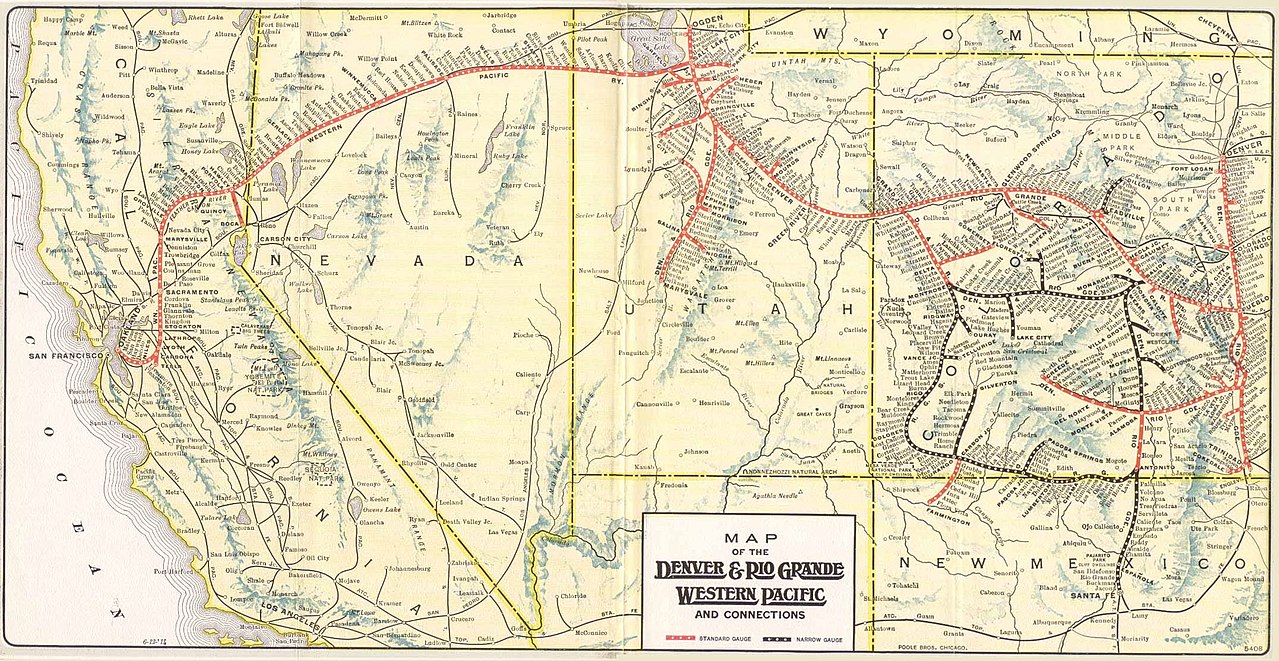
“Why can’t America have great trains?”
At the very end of his recent book Romance of the Rails, Randal O’Toole regretfully (he really, genuinely is a train fan) answers the question three ways … none of which bolster the hopes that the United States will go back to great passenger railway service:
First, when we had great trains, they were used mainly by the elite, and that remains true of great trains in other countries today. Before 1910, it is likely that a majority of Americans had never traveled more than 50 miles from home, and most had never been on a train, while many others had taken only one or two train trips in their life. As James Hill observed, “the so-called ‘travelling public’ forms in reality but a small, and the more fortunate class of the community.” If he was prejudiced against passenger trains, as some claim, it may have been for altruistic reasons, as the people who relied on freight trains “direct and indirect, include all. Hence justice requires that railway systems … should be cautious not to favor passenger traffic at the necessary expense of freight payers.” It is neither sensible nor fair fo the government to subsidize transportation catering mainly to the wealthy.
Second, new transportation technologies have replaced trains and streetcars. Planes are faster and less expensive for long distances; cars and buses are more convenient and less expensive for short distances; and there is no midrange distance at which passenger rail has an advantage over both cars and planes.
Third, and just as important, other new technologies, including the moving assembly line, telecommunications and the electrical grid, have reshaped our cities so the urban patterns that once made rail convenient to large numbers (though never a majority) of people have been replaced by patterns in which rail makes no sense for passenger travel.
Although we might want great trains in our fantasy of what the world should be like, the reality is we don’t need trains. Most Americans don’t ride the trains we have, nor would they ride them even if they met some arbitrary devinition of “great.” We love passenger trains, and we will remember them in museums and tourist lines. But if the government stays involved in transportation at all, it should be to prepare for the next revolution in transportation, not to try to reverse the previous one.
Plan Red: Britain and America’s Planned Wars on Each Other
Historigraph
Published on 27 Jan 2019If you enjoyed this video and want to see more made, consider supporting my efforts on Patreon: https://www.patreon.com/historigraph
Check out my other videos here: https://www.youtube.com/playlist?list…
#WarPlanRed #Historigraph
► Twitter: https://twitter.com/historigraph
►Patreon: https://www.patreon.com/historigraph
►Discord: https://discord.gg/f8JZw93
►My Gaming Channel: https://www.youtube.com/c/Addaway
►My Twitch: https://www.twitch.tv/addawaySources:
Christopher M. Bell, “Thinking the Unthinkable: British and American Naval Strategies for an Anglo-American War, 1918-1931”, The International History Review, Vol. 19, No. 4 (Nov. 1997).
Kevin Lippert, War Plan Red: The United States’ Plan to Invade Canada and Canada’s Secret Plan to Invade The United States (New York: Princeton Architectural Press, 2015)
Stephen Roskill, Churchill and the Admirals
Ben Wilson, Empire of the Deep: The Rise and Fall of the British Navy
July 7, 2019
Does this sound like your gym?
Instapundit linked to this older Sean Kelly article about the “Planet Fitness” chain of health clubs. According to him, it’s even less pretty than you might have thought:

“Planet Fitness”by JeepersMedia is licensed under CC BY 2.0
Here’s what you need to know…
- Planet Fitness: The gym for people who don’t really want to get in shape, owned by people who really can’t afford for the members to be there.
- A survey of over 20 different Planet Fitness locations in 12 different states revealed that they provide no nutritional guidance. They do however supply candy and pizza.
- Planet Fitness seems to promise that health and fitness will ultimately be comfortable and not involve any real effort.
- Planet Fitness is a big, purple-colored adult daycare marketed to people afraid to go to an actual gym.
- Many Planet Fitness members do want to make progress of course, but the gym’s own rules and operating guidelines seem to dissuade this.
Cancelling student loans would be a really, really bad economic move
Art Carden explains why cancelling outstanding student loan debt — despite its huge popularity on the campaign trail — would be a very bad idea:

University College, University of Toronto, 31 July, 2008.
Photo by “SurlyDuff” via Wikimedia Commons.
It’s one of the rules of electoral success: advocate policies that concentrate the benefits on an easy-to-identify interest group (preferably one that is sympathetic in the public eye) and disperse the costs onto the entire electorate. It’s how we get Coke sweetened with corn syrup rather than actual sugar. It’s also how we get proposals to cancel student loans. As my AIER colleague Will Luther points out, the fact that two of the Democratic frontrunners have made debt cancellation such an important part of their campaigns suggests that the issue is going to be with us for a while.
But would it be a good idea to cancel student debt? And importantly, how does even the prospect of canceled student debt affect people’s incentives?
Regressive Tax
First, let’s consider the quality of the policy. A lot of commentators are pointing out that it’s fundamentally regressive, meaning that we’re basically taxing the poor to pay the rich. As economist Alexander William Salter puts it in the Dallas Morning News, it’s
a transfer of wealth to those with relatively high levels of expected lifetime income, at the expense of those with relatively lower levels of expected lifetime income.
The idea might have some merit, but it will make wealth and income inequality worse rather than better.
Even saying that the idea might have some merit is perhaps too charitable. In 2011, economist Justin Wolfers called it the “Worst. Idea. Ever.” in a Freakonomics post. Why? First, there’s the distributional effect. If we’re going to have policies that transfer wealth from one group to another, it doesn’t make much sense to transfer wealth from taxpayers generally to high-income college graduates. As Will Luther and so many others have pointed out, a college degree brings spectacular financial returns. As a group, college graduates aren’t “needy” by any reasonable definition.