
August 29, 2011
Freedom, Science Fiction and the Singularity: A conversation with author Vernor Vinge
TED talk: Tim Harford on trial, error and the God complex
August 25, 2011
ESR: what now for Apple in the wake of Jobs’ resignation?
Eric S. Raymond looks at the hard road ahead for Apple without Steve Jobs:
I’ve said before that I think Apple looks just like sustaining incumbents often do just before they undergo catastrophic disruption from below and their market share falls off a cliff. Google’s entire game plan has been aimed squarely at producing disruption from below, and with market share at 40% or above and Android’s brand looking extremely strong it is undeniable that they have executed on that plan extremely well. The near-term threat of an Apple market-share collapse to the 10% range or even lower is, in my judgment, quite significant — and comScore’s latest figures whisper that we may have reached a tipping point this month.
For Apple, the history of technology disruptions from below tells us that there is only one recovery path from this situation. Before the Android army cannibalizes Apple’s business, Apple must cannibalize its own business with a low-cost iPhone that can get down in the muck and compete with cheap Android phones on price. Likewise in tablets, though Apple might have six months’ more grace there.
Of course, this choice would mean that Apple has to take a massive hit to its margins. Which is the perennial problem in heading off a disruption from below before it happens; it is brutally difficult to convince your investors and your own executives that the record quarterlies won’t just keep coming, especially when your own marketing has been so persuasive about the specialness of the company and its leading position in the industry. This is a failure mode that, as Clayton Christensen has documented, routinely crashes large and well-run companies at the apparent peak of their success.
Does Tim Cook have the vision and the will to make this difficult transition happen? Nobody knows. But the odds are against it.
August 20, 2011
For his next trick, he’ll be knapping his own flint for arrowheads
Okay, I exaggerate . . . a bit:
When IBM released its first personal computer, the 5150, 30 years ago, it was deliberately drab — black, gray, and low-key. That’s because IBM intended the 5150 to be a serious machine for people doing serious work.
So how better to celebrate this important anniversary than by using the 5150 for what it was meant to do? Working on a 5150 seems to be a tall task in today’s vastly accelerated computing world, however. Could a PC that’s as old as I am manage to email, surf the Web, produce documents, edit photos, and even tweet?
I sequestered myself for four days amid boxes of 5.25-inch floppy drives and serial cables to find out. The answer to my question turned out to be both yes and no — but more interesting was all the retro-computing magic I had to perform. In the end, my experiment proved two things:
- People now use the PC for many things that weren’t even conceived of in 1981, and the 5150, unsurprisingly, is woefully underpowered for those advanced tasks. But when you use it for the core computing tasks the 5150 was designed for, IBM’s first PC has still got game.
- Early floppy discs were just too darned small!
August 19, 2011
Excellent news for players of impact sports
It’s becoming more a topic of concern for players (and especially for the parents of younger players) in sports which feature significant amounts of contact: detecting when a player has suffered a concussion. Football and hockey players are often determined to prove how tough they are by “playing through” injury, but concussions are not like bruises or other injuries — they can have long-term dangerous side-effects. There’s now a product available at the retail level that may help:
Over the next few weeks, a U.S. company called Battle Sports Science is making its Impact Indicator available throughout Canada and the United States. It is a sensor that is fastened to a helmet chin strap and detects when the user’s head undergoes an impact likely to cause a concussion.
Football versions of this device should be on the way to Canada in two weeks, said Battle Sports CEO Chris Circo, and one for hockey is expected to be available in late September or early October.
When attached and operating, a green light will be illuminated at the player’s chin. If the light turns red, it’s indicating that the player has been hit hard and should be evaluated before returning to play.
Once the technology is widely available, the professional leagues and the college and university teams should adopt them as standard equipment. Junior players would have less reason to resist using the device if all the top-level players were seen to be using them. It’ll take longer to retrain sports announcers to stop glorify big hits and featuring them on slo-mo playbacks while saying things like “He got jacked-up”, “They blew him up” and “He got his bell rung on that hit”.
August 18, 2011
Omnibus bills: Canada’s equivalent to “riders” on US legislation
An omnibus bill is a collection of several individual bills that may or may not have been able to pass muster individually. It’s (from the government’s point of view) a great way to get a lot of legislative changes through parliament in relatively short order, but it encourages legislators to include their pet projects and special causes because of the decreased opportunity for opposition. The Conservative government’s proposed omnibus crime bill is a good example of this, as it is likely to incorporate warrantless data searches for police:
When Canada’s Conservatives took the most votes in the May 2011 federal election, Prime Minister Stephen Harper said that an “omnibus” security/crime bill would be introduced within 100 days. The bill would wrap up a whole host of ideas that were previously introduced as separate bills — and make individual ideas much more difficult to debate. A key part of the omnibus bill will apparently be “lawful access” rules giving police greater access to ISP and geolocation data — often without a warrant — and privacy advocates and liberals are up in arms.
Writing yesterday in The Globe & Mail, columnist Lawrence Martin said that the bill “will compel Internet service providers to disclose customer information to authorities without a court order. In other words — blunter words — law enforcement agencies will have a freer hand in spying on the private lives of Canadians.”
He quotes former Conservative public safety minister Stockwell Day, now retired, as swearing off warrantless access. “We are not in any way, shape or form wanting extra powers for police to pursue [information online] without warrants,” Day said—but there’s a new Conservative sheriff in town, and he wants his “lawful access.”
How bad were the last set of “lawful access” proposals? This bad:
Even the government’s own Privacy Commissioner is upset about the lawful access idea. On March 9, Privacy Commissioner Jennifer Stoddart sent a letter to Public Safety Canada in which she and other provincial privacy officials said the bill would “give authorities access to a wide scope of personal information without a warrant; for example, unlisted numbers, e-mail account data and IP addresses. The Government itself took the view that this information was sensitive enough to make trafficking in such ‘identity information’ a Criminal Code offence. Many Canadians consider this information sensitive and worthy of protection, which does not fit with the proposed self-authorized access model.”
“In our view, law enforcement and security agency access to information linking subscribers to devices and devices to subscribers should generally be subject to prior judicial scrutiny accompanied by the appropriate checks and balances.”
H/T to Brian Switzer for the link.
How unique (and therefore how easy to track) is your web browser?
The good folks at the Electronic Frontier Foundation (EFF) have a new tool you can use to find out how easy it would be for third parties to track your browser usage, based on how it differs from others:

As you can see from my test (on a brand new machine), I have a unique browser configuration among the 1.7 million tested so far. My browser would be easy to track.
August 17, 2011
The source of all those kitten videos
H/T to Ace.
August 16, 2011
Charles Stross on the future of network security
Charles isn’t a professional in network security, but he has a good track record of exploring the consequences of new technology in his science fiction works. He was invited to give the keynote address at the 2011 USENIX conference.
Unlike you, I am not a security professional. However, we probably share a common human trait, namely that none of us enjoy looking like a fool in front of a large audience. I therefore chose the title of my talk to minimize the risk of ridicule: if we should meet up in 2061, much less in the 26th century, you’re welcome to rib me about this talk. Because I’ll be happy to still be alive to rib.
So what follows should be seen as a farrago of speculation by a guy who earns his living telling entertaining lies for money.
The question I’m going to spin entertaining lies around is this: what is network security going to be about once we get past the current sigmoid curve of accelerating progress and into a steady state, when Moore’s first law is long since burned out, and networked computing appliances have been around for as long as steam engines?
I’d like to start by making a few basic assumptions about the future, some implicit and some explicit: if only to narrow the field.
August 15, 2011
Google buys Motorola Mobile: it’s all about the patents
At least, so says Eric S. Raymond:
We’ll see a lot of silly talk about Google getting direct into the handset business while the dust settles, but make no mistake: this purchase is all about Motorola’s patent portfolio. This is Google telling Apple and Microsoft and Oracle “You want to play silly-buggers with junk patents? Bring it on; we’ll countersue you into oblivion.”
Yes, $12 billion is a lot to pay for that privilege. But, unlike the $4.5 billion an Apple/Microsoft-led consortium payed for the Nortel patents not too long ago, that $12 billion buys a lot of other tangible assets that Google can sell off. It wouldn’t surprise me if Google’s expenditure on the deal actually nets out to less – and Motorola’s patents will be much heavier artillery than Nortel’s. Motorola, after all, was making smartphone precursors like the StarTac well before the Danger hiptop or the iPhone; it will have blocking patents.
I don’t think Google is going to get into the handset business in any serious way. It’s not a kind of business they know how to run, and why piss off all their partners in the Android army? Much more likely is that the hardware end of the company will be flogged to the Chinese or Germans and Google will absorb the software engineers. Likely Google’s partners have already been briefed in on this plan, which is why Google is publishing happy-face quotes about the deal from the CEOs of HTC, LG, and Sony Ericsson.
August 11, 2011
August 10, 2011
xkcd on the paradox of passwords
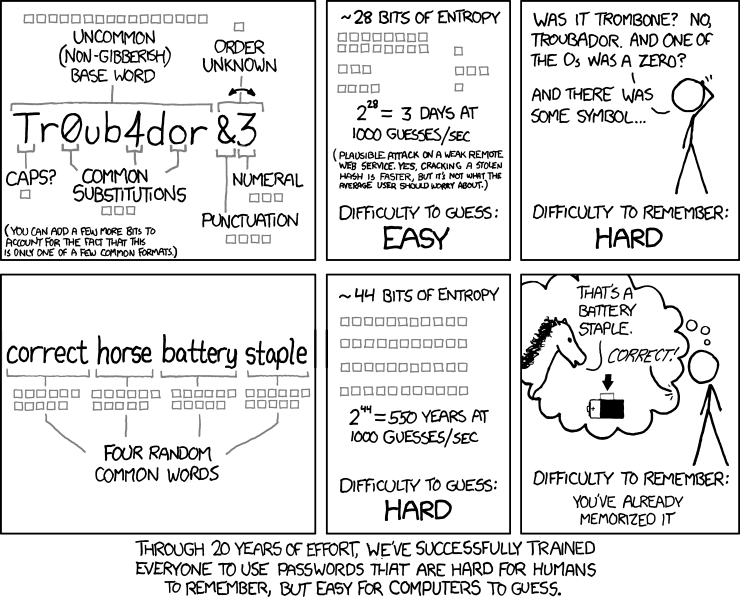
He’s absolutely right, you know . . .
August 9, 2011
(Temporarily) Drying out USS Monitor
John Tierney reports on the conservation efforts on one of the most revolutionary warships in history:
[In 1861] a shipyard in Greenpoint, Brooklyn, launched not merely an ironclad but an entirely new kind of warship. The U.S.S. Monitor had no masts and no line of cannons. It was essentially a submarine beneath a revolving gun turret, something so tiny and bizarre-looking that many experts doubted the “cheese box on a raft” would float, much less fight.
But somehow it survived both the Navy bureaucracy and a broadside barrage to become one of the most celebrated ships in the world. Its designer and crew were the 19th-century celebrity equivalent of astronauts. Long after the ship sank in a storm off Cape Hatteras, N.C., the turret remained a cultural icon: an “armored tower” in Melville’s poetry, an image on book covers and film posters, a shape reproduced in items from toys to refrigerators.
Now the original turret, which was recovered from the ocean floor nine years ago and placed in a freshwater tank to protect it from corrosion, is on display again. It has been temporarily exposed to the air so that it can be scraped clean — very carefully, in front of museum visitors and a live webcam — by a team of researchers at the U.S.S. Monitor Center of the Mariners’ Museum here in Newport News. The team expects to have nearly all the barnacles and sediment removed by the end of this month, giving the public a new look at the dents from the Confederate cannonballs and shells that would have sunk any ordinary ship of its day. Then the turret will be submerged again in fresh water for 15 more years, until enough ocean salt has been removed from the metal to allow it to face the air permanently.
August 8, 2011
Another technical problem? Must be a day with a “y” in it
Last week, you’ll recall that I was bewailing the failings of the Microsoft Windows Easy Transfer utility. Having given up on that and managed the transfer of files by the traditional tools of Brute Force and Ignorance (BF&ITM), I thought I was done.
All the necessary files now reside on the new laptop, and the old laptop has been dedicated to a new life as a genealogy workstation for Elizabeth. Today’s problem was network connectivity.
But not just network connectivity for the laptop, as I discovered when I tried turning on my desktop machine a little while ago.
At some point while we were away, the wireless router seems to have had some hiccoughs, because now it seems to imagine that it’s actually two separate machines. When I tried to connect to the internet this morning (from the new laptop), it insisted that I was connected to both a public network and our own named private network. But because it thought the public network was the primary, it refused to actually interact with our named network. It took several iterations of running diagnostics and power-cycling the router before the phantom “public” network disappeared and I was able to connect to the internet normally.
This evening, I had a similar problem with my desktop, except that my desktop machine is connected by ethernet cable, not wireless. That phantom “public” network re-appeared, and nothing I could do would get rid of it. The physical connections were fine, but nothing could persuade my desktop that it actually had a connection to the router and it was unable to get an IP address.
Having just bought a new laptop, I’m hoping that these symptoms do not imply that I need to also buy a new router, as you can imagine.


