With a hard-earned, thrilling victory Sunday, the United States surprised Canada, both the hockey team and the nation.
The Americans did it exactly as General Manager Brian Burke and Coach Ron Wilson built them to do it — through speed, relentless diligence and unflappable goalkeeping. They withstood a furious Canadian attack, hitting as hard as they got hit, and prevailed despite the deafening roars of the red-clad crowd at Canada Hockey Place.
“For these young guys I think it was great to win in an atmosphere like this,” Wilson said. “Everything was stacked against us, but we came out on top.”
The entire nation is in mourning, black armbands, sackcloth, and ashes all round. The shock was so unexpected that Vancouver police had to close down the bars — where stunned hockey fans were desperately trying to find oblivion in alcoholic excess. The Prime Minister may be forced to call for a national day of penitence and prayer to assuage the angry Hockey gods.
Or so I’m told . . . ours was one of the few television sets in the country not tuned to the Olympics. We will, however, be watching Canada take on Finland in the women’s semi-finals tonight.
But that’s not the Olympic match-up, that’s in Kandahar:
“Half of our team is in Iraq” was one of the good-natured excuses offered by U.S. troops to explain Canada’s 16-2 victory over the United States in a ball-hockey game on Sunday that had all the passion, but none of the drama, expected of the Olympic ice hockey tilt between the two countries later in the day in Vancouver.
The lopsided score was a fair indication of the play before a crowd of nearly 1,000 often deliriously happy soldiers at the smartly laid out ball-hockey rink that Canada built at Kandahar Airfield in 2006.
Honestly taken aback by a Canadian offer to balance the game by swapping a few players when the score stood 10-1 in Canada’s favour, U.S. army Col. Mark Murray, invoked the immortal words of Gen. Anthony McAuliffe, commander of the 101st Airborne, who responded to a Nazi ultimatum to surrender during the Battle of the Bulge, by replying: “Nuts! It will be a cold day in hell before we do that.”
My new Olympic hero, with a gold medal in press relations, Sven Kramer:
Update, 25 February: If you felt that Kramer was showing Hubris in the clip above, you might also feel that Nemesis showed up right on schedule, too:
After 25 laps around the Richmond Olympic Oval, Sven Kramer of the Netherlands crossed the finish line Tuesday and raised his arms in triumph, having secured — or so he thought — his second Olympic record and gold medal of these Winter Games.
Within seconds, Kramer’s celebration turned icy cold. When his coach, Gerard Kemkers, caught up to him during his cool-down lap, he palmed his head and delivered the bad news: Kramer was disqualified for incorrectly changing lanes with eight laps remaining in the 10,000-meter race.
Kramer, who has dominated the distance since finishing seventh at the 2006 Olympics, spiked his glasses upon learning his fate. He looked as if he wanted to punch Kemkers, who later accepted full blame for what happened. He said he glanced up from recording split times, became momentarily disoriented and barked at Kramer to switch to the inner lane.
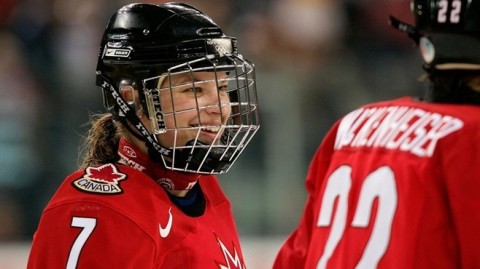
The men may be struggling (just scraping through against the Swiss yesterday), but the women are doing their best juggernaut imitation. It’s getting lots of attention, but not always the kind the organizers were hoping for. After their 18-0 demolition of the Slovak team to open the tournament, they’ve handily beaten the Swiss (10-1) and the Swedes (13-1).
I don’t follow hockey at all, but I’ve been trying to catch these games, as Elizabeth’s god-daughter is Cherie Piper:
One sign of just how dominating Canada has been in the preliminary round of the Winter Olympic women’s ice hockey tournament is that Scarborough native Cherie Piper has nine points in three games — and she’s only in fifth place in scoring. And that’s just on her own team.
Canada rolled through their opposition, like a hair dryer through snow, outscoring their opposition 41-2, defeating, in order, Slovakia 18-0, Switzerland 10-1 and Sweden 13-1.
And through that the Scarborough native contributed a ‘modest’ four goals and five assists.
Piper already has two Olympic gold medals to her credit, including the last time around in Turin where she was co-leader in goals-scored and second in total points for the tournament.
Their preliminary round is over, and they’ll be facing the 2nd place team from the other pool (either the US or Finland). Sweden, the other team to advance will face the 1st place team.
Update: It’ll be Canada vs Finland, US vs Sweden. Winner of each game goes to the gold medal match, losers go to the bronze medal match.
Comments Off on Canadian dominance of hockey at the Olympics
In another common refrain, Canada’s “Own the Podium” slogan appears to be doing irreparable damage to our international image . . . according to a few bored reporters. Again, it seems to shock and dismay people that Canadians might actually want to compete and win in the Olympics — apparently that’s not “Canadian”. Dahlia Lithwick looks at some of the “we can’t believe it” coverage:
Someday, someone is going to explain to me why it is that journalists so frequently speak about Canadians as though we are all about 2 feet tall and 7 years old. See, for instance, this exceedingly strange New York Times piece about how those tiny little Canadians are building a “giant laser” or some such thing, in order to bring home more Olympic medals than ever before. Look! Look at all those funny little Canadians in their funny little hats, trying to be good at sports! Look at them spending their whole allowance on a top-secret program to create a human slingshot for speed skaters and “super-low-friction bases for snowboards and [to find out] whether curling brooms really melt the ice.” The Seattle Times describes this effort as “Canada’s non-nuclear Manhattan Project.”
It was bad enough when they were calling us “un-Canadian” and “inhospitable” just for wanting to win medals. It got uglier last Friday when Georgian luger Nodar Kumaritashvili was tragically killed in a practice run. The Canadians’ decision to limit outsiders’ use of Olympic facilities before the Games began — a maneuver that every other host country pulls — got spun as “an unfortunate nationalistic impulse” that put patriotism ahead of safety. The subtext: When Canadians care about winning just as much as the rest of the world, can there be any more warmth and goodness left in the universe?
The flip-side of all this is . . . the world barely even knows that Canada exists. Why do we get all worked up about how the world “sees” us? More evidence that Canada still needs to grow up a bit and get over the teenage angst. It’s unbecoming in teenagers, but it’s much worse for a nation.
Of course, this effort to caricature Canadians has been aided most of all by Canadians. You know you’re suffering an international feistiness deficit when your prime minister begs his fellow citizens to show the world a little more testosterone. “We will ask the world to forgive us this time,” declared Stephen Harper in an effort to rouse Canadians into showy displays of patriotism, “this uncharacteristic outburst of patriotism and pride, our pride of being part of a country that is strong, confident and stands tall among the nations.”
What’s strange about all this deep Freudian analysis is that Canada has done pretty darn well on the hardware front in recent years. It jumped from 13 medals in 1994 to 24 at Turin in 2006. Canada ranks seventh overall in winter medal wins. Not bad for a country of 33 million people where per capita spending on Olympians has historically been a fraction of what some other countries spend. Is it possible that Canada has been doing just fine at the Winter Olympics but nobody ever bothered to notice?
However, I have to take issue with one thing she writes:
It has always seemed to me that sweeping efforts to identify a Canadian national character are pointless. It’s a vast country built on compromises between French and English, Canadians and the British. The nation differs so fundamentally from east coast to west that, Olympics notwithstanding, it’s hard to know what a Newfoundlander and a British Columbian might find to talk about.
Get two Canadians together from different parts of the country, and they’ll immediately have something to talk about: their shared loathing of Toronto . . .
British journalism is a bit less respectful than the Canadian variety (not that “respectful” is all that common here). British journalists also tend to look for lines of attack, rather than lines of inquiry. It works for them: the British newspaper scene is far more entertaining than anywhere else in the world, but it doesn’t do much for those in the scrutiny of the Fleet Street flashmob. Vancouver and the VANOC folks are squarely in the crosshairs at the moment, and bored British journalists are bringing their patented approach to Olympic criticism:
If there was a gold medal for premature Winter Olympic whining, the British would be perennial occupants of the middle podium.
Right on schedule, on the fourth of 17 event days, U.K. scribes have written off the Vancouver Olympics as a “worst-ever” Games in the making, an “abomination” for producing the accidental death of a luger and an organizational “fiasco” for slow buses and venue meltdowns.
Well, in fairness, never before at an Olympic venue has there ever been a weather delay or mechanical breakdown. Only in Vancouver have these things ever . . . oh, what? There have been problems before? Funny, the way it’s being reported — with ice-ruining machines and immobile buses — you’d think this was an absolutely unprecedented series of disasters.
There’s no obvious explanation for why London reporters are the most caustic of the contingent, having elevated Vancouver-bashing into an unofficial Olympic sport.
Perhaps they’re dreadfully bored. After all, the BBC alone has more personnel at the Games than the kingdom’s entire 52-member Olympic team. There’s also dispiriting news that bookies back home predict the U.K. will experience a medal shutout in Vancouver, with only an outside shot at the curling podium.
What’s that? You think they could have a motive for painting the Vancouver games in the worst possible light?
Guardian columnist Martin Samuel went postal in his attack in the aftermath of the luge fatality. “Canada wanted to Own The Podium,” he snarled. “This morning they can put their Maple Leaf stamp on something more instantly tangible: the nondescript little box carrying the lifeless body of Nodar Kumaritashvili back to his home in Bakuriani, Georgia.” Good grief.
Other U.K reporters predict financial disaster for Vancouver, a defensive move given that London’s 2012 Summer Olympics are already $1.8-billion over budget.
They complain of heavy-handed customs officials and no-nonsense security, which is a tad rich from a country where police will have the right to enter homes without a warrant while Olympic officials storm residences or enterprises near Games venues to search for protest material.
Of course, Canadians are not being as polite in response to what they see as provocation from the British press:
Not surprisingly, thin-skinned Canadians are filling British newspapers with backlash sneers and jeers.
“London will be worse (in 2012). It will also be dirtier, smellier, and have worse teeth,” mocked one offended Canuck. “Just because you long ago abandoned any ambitions in the world – or for that matter basic sense of identity or dignity – and became a lethargic nation of elitist whiners who no one really likes, don’t fault those younger nations who do enjoy and embrace life,” snapped another.
Which will, in turn, provide more fuel for the fires. Exactly the sort of reaction they were hoping to get.
Comments Off on Fleet Street, in unison: “Worst. Games. Ever.”
The Super Bowl is one of those great annual events that is uniquely American — except for the Roman numerals. I think those still belong to the Vatican.
If you missed it, the final score was Saints, XXXI and Colts, XVII.
The Super Bowl represents what we Americans are all about: creative commercials occasionally interrupted by violence. During the six-hour broadcast, there were only 11 minutes of actual, live football action. Some of the commercial breaks were so long that, when we finally came back to the game, I had forgotten which teams were playing.
And what better Norman Rockwell-esque ritual could I have with my kids than to watch 20 erectile dysfunction commercials to every snap of the football? “Daddy, why are those people in bathtubs watching the sun set?” I just tell them the people lost their homes to foreclosure.
Football is a lot like sex: countless hours of advertising how good it will be with only 11 minutes of actual action. Then, for me, there is always that awkward moment at the end when my credit card is declined.
I’ve been living under a bunch of misapprehensions about the “sport” of Curling. I admit, I haven’t subjected these revelations to any peer review or fact checking, but if the climate “scientists” can get away with that kind of sloppiness, why can’t I?
* The movie Death Race 2000 was loosely based on curling. * Curling has been described as shuffleboard plus ice plus chess times football plus ninjas times a grizzly bear plus a nuclear explosion minus badminton. * Curling is banned in most of Europe due to making their heads explode with its awesomeness * The stones in curling are made from brimstone mined from the very depths of hell. * Placing a stone perfectly in the house has been rated the hardest act in any sport, harder than hitting a fast ball or catching the golden snitch. * Due to the excitement, curling is not recommended for the elderly, those with heart conditions, pregnant women, and people who suck and don’t like awesome things. * In ancient times, only the greatest, strongest warriors were chosen to play curling… and housewives good at sweeping. * No one is sure where curling came from, but most guess it was a collaborative project of Chuck Norris, Mr. T, Jack Bauer, and Fred Thompson.
What is the difference between a Canadian and an American? The old question is coming up again here at the Olympics, with answers involving eagerness for war, ketchup, the pronunciation of toque or the ability to identify poutine and the Tragically Hip.
But none may be so simple as how one holds a hockey stick. According to sales figures from stick manufacturers, a majority of Canadian hockey players shoot left-handed, and a majority of American players shoot right-handed. No reason is known for this disparity, which cuts across all age groups and has persisted for decades.
Most Canadians, like most Americans, are naturally right-handed, so the discrepancy has nothing to do with national brain-wiring. And how you hold a pencil, say, has little or no bearing on how you hold a stick. A left-handed shooter puts his right hand on top; a right-hander puts the left hand there.
Comments Off on It’s not surprising that more Canucks are lefties than Yanks
Holy smack people. We spent about a billion gazillion dollars on this thing. Every fourth person in the country has had their picture in the paper after getting a chance to carry the Olympic torch on some weird relay race around the country. We’ve been warned that anyone hinting these games aren’t the absolute bestest thing that ever happened in Canada will be drawn up on treason charges. And when the thing finally gets underway (hallelujah!), all we can think of is finding people who are “disappointed” because their particular race/creed/colour/language group wasn’t better represented.
My God. Vanoc should have asked Stats Canada to drawn up a statistical breakdown of the country, and then awarded spaces at the ceremonies strictly on that basis: 4.2 French-speaking non-Quebec First Nations people; 0.6 Presbyterian Metis single mothers; 1 Catholic that everyone else is allowed to make fun of; exactly 50% female representation, subdivided among the top 34 national racial, ethnic and religious groups; no men.
Then everyone would be happy, right? Actually, I doubt it.
At least, for Canadians watching the game on CTV, we didn’t get to see most of these ads, including Audi’s brief trip into the very near future:
Audi’s effort won both best and worst titles from the readers at the Wall Street Journal.
Update: Nick Gillespie also thought this ad to be quite noteworthy:
. . . the great ad in last night’s game was, IMO, the Audi “Green Police” spot, and not simply because it showcased a classic Cheap Trick tune to astonishingly great (read: totally nostalgic for late-era boomers who grew up thinking Robin Zander was cool and Bun E. Carlos was an animatron and Rick Nielsen was crazy funny and that Tom Petersson was, like Kurt Von Trapp in The Sound of Music or Jan Brady in The Brady Bunch, well, I don’t know but he must have done something to be there) advantage. No, it was also right up to the moment I realized that it was a pitch for a car that I will never purchase, it seemed like a Mike Judge vision of a future that is almost the present (finally, a reason to thank SCOTUS for flipping the coin toward George W. Bush in 2000).
Will it move cars? Who knows. It moves . . . minds. Which rarely come with the sort of 100,000 mile warranty that is standard even on overpriced, underpowered, and breakdown prone vehicles like Audis.
Some interesting comments to Nick’s post:
grrizzly|2.8.10 @ 9:04AM|# Imagine a Holocaust movie. Jews are in concentration camps. Regularly sent to gas chambers. Suddenly one man receives documents proving he is not a jew. He’s set free. He walks away. Happy End. This is what the ad is.
iowahawk|2.8.10 @ 9:10AM|# I thought it was the best Super Bowl ad of all time, and not for the reasons Audi was hoping for. Hilarious, creepy and upbeat all at the same time. And the punchline: The sponsor (Audi) merrily approves of the dystopian fascism. My jaw hit the ground.
Enjoy Every Sandwich|2.8.10 @ 9:16AM|# When I saw the ad I was thinking “this will give Al Gore a hard-on, assuming he still gets those”. It’s a left-wing dream world.
PM770|2.8.10 @ 11:20AM|# Right. I think Audi probably owes Al one clean television.
Tulpa|2.8.10 @ 11:28AM|# It’s called extremely skilled advertising. Give different messages to different target audiences, hopefully a message that makes them want to buy your product. I looked at it and liked the (obviously ironic) portrayal of the Green Police, while your average lefty is saying “Yeah man, they should totally send swat teams to people’s houses looking for light bulbs!”
Update, 9 February: Added the tag GreenGestapo, as this appears to be trending in the blogosphere . . . I expect to have further use for the tag in the future.
Update, 2 February 2014: The original video has been removed, so here’s another link instead:
And Mark Steyn‘s original comments, recently republished:
A man asks for a plastic bag at the supermarket checkout. Next thing you know, his head’s slammed against the counter, and he’s being cuffed by the Green Police. “You picked the wrong day to mess with the ecosystem, plastic boy,” sneers the enviro-cop, as the perp is led away. Cut to more Green Police going through your trash, until they find … a battery! “Take the house!” orders the eco-commando. And we switch to a roadblock on a backed-up interstate, with the Green Police prowling the lines of vehicles to check they’re in environmental compliance.
If you watched the Super Bowl, you most likely saw this commercial. As my comrade Jonah Goldberg noted, up until this point you might have assumed it was a fun message from a libertarian think-tank warning of the barely veiled totalitarian tendencies of the eco-nanny state. Any time now, you figure, some splendidly contrarian type — perhaps Clint lui-même in his famous Gran Torino — will come roaring through flipping the bird at the stormtroopers and blowing out their tires for good measure. But instead the Greenstapo stumble across an Audi A3 TDI. “You’re good to go,” they tell the driver, and, with the approval of the state enforcers, he meekly pulls out of the stalled traffic and moves off. Tagline: “Green has never felt so right.”
So the message from Audi isn’t “You are a free man. Don’t bend to the statist bullies,” but “Resistance is futile. You might as well get with the program.”
Strange. Not so long ago, car ads prioritized liberty. Your vehicle opened up new horizons: Gitcha motor running, head out on the highway, looking for adventure. … To sell dull automobiles to people who lived in suburban cul de sacs, manufacturers showed them roaring round hairpin bends, deep into forests, splashing through rivers, across the desert plain, invariably coming to rest on the edge of a spectacular promontory on the roof of the world offering a dizzying view of half the planet. Freedom!
Update, 9 February, 2017: The original and revised video links have all gone sour, so here’s a current version of the ad, triggered by Audi’s latest Super Bowl ad fiasco.
Amusingly, the tag line shown at the end of the commercial, Audi: Truth in Engineering, is proven to be false by the company’s systematic cheating on emission testing software in their cars (being part of the Volkswagon group, where the cheating was first discovered in their diesel models).
In late 2015, Volkswagen Group became embroiled in an emissions cheating scandal that also involved its Audi brand. Delicious irony — here was a brand that had touted itself a leader in environmental stewardship only to be unmasked as a fraud of epic proportions.
As late as November 2016, new revelations about the extent of Audi’s emissions scam were still coming to light. It was revealed that the scandal was not limited to diesel-engine cars, as previously thought, but included gasoline-powered Audi models as well.
So it was a curious choice for Audi to pat itself on the shoulder for yet another politically correct stand — pay equality for women — when its credibility was torn to shreds in its core competency: automobile manufacturing. Perhaps Audi thought this would provide good cover from their credibility woes, or perhaps they banked on an inattentive public with amnesia. A pretty good bet, I admit. But I have a long memory and a nose for hypocrisy.
So what is the answer to George Clooney’s questions? What should he tell his daughter?
I would tell her (and mine) that once a person has lied to you, then you can no longer trust that person. That if the person is truly repentant, they will find a way to make it up to you and rebuild the trust. But if they they try to distract from the extent of their dishonesty, you might as well put that relationship in the junkyard.
Comments Off on The Super Bowl ads we didn’t get to see
Judd Zulgad rounds up the rather pathetic story of Vikings offensive tackle Bryant McKinnie’s Pro Bowl antics:
McKinnie was booted off the NFC roster after missing three of four practices, all but one meeting and even the team photo last week. After using his twitter account to document his partying ways, McKinnie also used twitter to say that he was in the process of pulling out of the game because of injury. However, that did little to help his NFC teammates. The fact is McKinnie was kicked off the roster and it was too late to replace him.
Craig was told that McKinnie became a “running joke” among players on the NFC roster — something that isn’t funny at all in reality. So how is McKinnie taking all of this? Well, it appeared that last night and early this morning he was back to using twitter to express himself.
Among McKinnie’s tweets:
— “What I realize is ppl like negative that’s what sells [at] the end of the day.”
That was followed by:
— “HATERS MAKE ME STRONGER SO THANX 4 THE FAVOR! I DON’T BREAK SUCKAS!”
— “That’s My Motto! So Feed me the hate! All yall doing is make me stronger! Don’t know what yall Talking bout! THanx 4 getting me followes!”
— “I’m thankful 4 every1 who voted 4 me from the bottom of my heart!”
— “I give the LORD PRAISE 4 giving me the strength 2 deal anything that come my way and 4 being by my side! ONLY GOD can JUDGE ME!”
Unlike defensive linemen, where hearing their names mentioned during a game usually means they did something good, hearing the name of your offensive tackle mentioned in a broadcast usually means they’re scraping your quarterback up off the turf. McKinnie’s name got mentioned a lot this year.
If his Pro Bowl behaviour is typical of his regular season behaviour, the Vikings would be well advised to look to replace him during the draft in April. Stars who have behaviour issues can be tolerated, but his star value isn’t anywhere near as high as he seems to think it is.
Comments Off on Perhaps the Vikings should draft to replace McKinnie
This year’s Super Bowl halftime act is The Who, a band that would be eligible for Medicare if its members were American — Roger Daltrey is 65, Pete Townshend is about to turn 65. Now, I like senior citizens who scream into microphones as much as the next guy, but isn’t the Super Bowl halftime format getting a bit geriatric? Last year we got Bruce Springsteen, age 60. The year before — Tom Petty, age 59. Yes, recent halftime shows have been more up-tempo than the 1970 Super Bowl halftime act: Carol Channing. But there have got to be some younger groups out there that merit the Super Bowl stage, and could broaden the appeal to those younger than the Baby Boomer demographic.
Surely The Who will sing “Won’t Get Fooled Again.” When rock anthems are heard on television or in advertising, often they are electronically edited to emphasize well-known lines and downplay or delete anything that might make audiences uncomfortable. When this song is heard, the refrain “We won’t get fooled again!” is amped up — it sounds bold and defiant. Done away with are other lines such as “Meet the new boss, same as the old boss” or “We’ll be fighting in the streets/with our children at our feet/and the morals that they worship will be gone.” And the following lyrics — what, exactly, do they mean? “I’ll move myself and my family aside/if we happen to be left half alive/I’ll get all my papers and smile at the sky/for I know that the hypnotized never lie.” What does any of the song mean?
Originally, the song was received as anti-war or an extremely vague call to revolution. Some thinkers maintain the song is conservative — a disillusioned revolutionary declaring that street-protest tactics are useless. Townshend, who wrote the song, maintains the lyrics are apolitical, and mean, “Don’t expect to see what you expect to see. Expect nothing and you might gain everything.” Huh? My guess is that, like a lot of what was received as “deep” in this field — Bob Dylan’s music, some of Springsteen’s — the lyrics don’t have any coherent meaning, they’re just a bunch of interesting individual lines cobbled together. I wince to think that a billion people watching the halftime show will nod happily as the line “We won’t get fooled again!” echoes around the world, when the majority of those watching will, most assuredly, get fooled again.
Tiger Woods may be invisible at the moment, but the public reaction to his troubles appears to be contributing to further financial trouble for the PGA:
The troubles facing the professional-golf tour without Tiger Woods will be on display when the annual tournament tees off at the Torrey Pines course in San Diego this week: Ticket sales are down, fewer hospitality tents have been sold, and the title sponsor had to be lured with a cut-rate price.
It is a harbinger of what the PGA Tour may be without its most popular player. Three of the Tour’s 46 tournaments scheduled for 2010 don’t have a lead corporate sponsor, nor do 13 of next year’s tournaments. Television viewership of the first two events of this year’s Tour tumbled.
In past years, Mr. Woods, the game’s most popular player, usually skipped the first three tournaments and began play on the San Diego tournament’s seaside course, perched on scenic cliffs overlooking the Pacific. As Mr. Woods’s opener, San Diego became one of the highest-profile early events of each PGA Tour season. This year, Mr. Woods, caught up in a sex scandal, is on leave from the game, with no word on when he will return. Without his unmatched star power, the value of Tour sponsorships, through which companies cover most tournament prizes, could be sharply lower. And without a rich flow of cash from those sponsorships, the PGA Tour’s economic model is cracked.
This shows the danger inherent in having a single, iconic representative. If the icon stumbles, it has a severe knock-on effect.
Comments Off on The Tiger Woods effect hits the PGA in the pocketbook
Minnesota looked great in the stat sheet: total yards — 475 yards to 257, passing — 310 yards to 189 and rushing 165 to the Saints’ 68. But there was one big number they couldn’t overcome: turnovers. It was as if someone had greased the football, with Adrian Peterson fumbling twice (once on the Saints’ goal line) and recovering a third. Even Percy Harvin let one get away from him, while Brett Favre was picked off twice (once to kill the Vikings’ best chance to win in regulation time). The Saints, by comparison, played almost turnover free, except for a bad decision on fielding a punt by Reggie Bush.
Brett Favre took a beating, as Saints defenders took every opportunity to hit him (only drawing a penalty once for a flagrant hit). Near the end of the third quarter, Favre was so slow getting up again that it appeared he’d be leaving the game. After having his ankle examined and re-taped, Favre re-entered the game on the next series. He must have been quite emphatic about it with the coaches, as backup Tarvaris Jackson didn’t even start warming up.
Chip Scoggins talked with Adrian Peterson after the game:
Adrian Peterson came out of the locker room — still dressed in full uniform — to watch the New Orleans Saints celebrate their first trip to the Super Bowl. As fans cheered, confetti fell and the Saints gathered on a stage at midfield, Peterson stood silent and watched the scene from the tunnel.
“It was painful,” he said. “Especially the way the game ended. Our guys fought hard and I honestly feel like we just gave the game away. Too many turnovers. It came back at the end to bite us.”
Peterson had a hand in that. Though he finally rushed for 100 yards and scored three touchdowns, Peterson also fumbled two times and took responsibility for the botched handoff at the end of the first half.
Peterson finished with 122 yards rushing on 25 carries, ending a streak of eight games without reaching the 100-yard mark. But his performance was marred by his fumbles and he admitted afterward that he started thinking too much about his mistakes.
“After the first one close to the goal line, I let it play in my head too much,” he said. “I came out the second half and was thinking about it too much. I had to get my mind back focused and not thinking about it when I was out there.”
Peterson’s fumbling problem became a major issue in his third season. He fumbled seven times, losing six of them in the regular season. He said he will spend the offseason trying to solve it.
Comments Off on Vikings dominant in all categories, except the most important one