Quotulatiousness

December 7, 2013

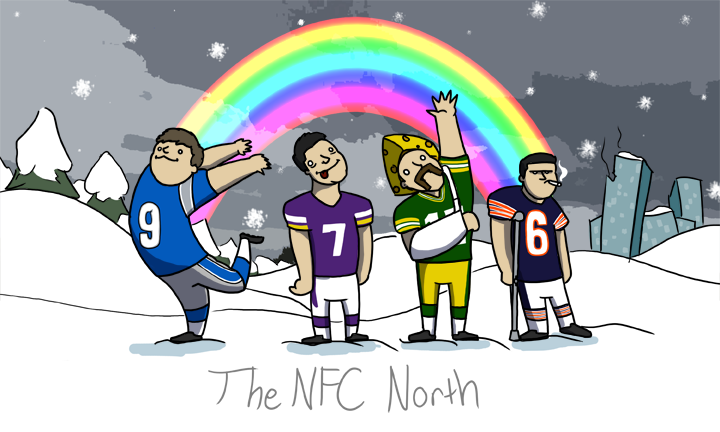
The NFC North QBs in picture form and “Rudolph the Vikings Tight End”

Filed under: Football, Humour — Tags: , , , , — Nicholas @ 11:54

After seeing several amusing retweets by @ArifHasanDN, I started following @DrawPlayDave for entertaining little things like his pictoral explanation of the quarterbacks of the NFC North and his Twitter Christmas song for Kyle Rudolph:

DrawPlayDave - The NFC North

Pro and college football as taxpayer-funded non-essential services

Filed under: Football, Government — Tags: , , , , — Nicholas @ 00:01

In Time, Nick Gillespie points out that among the most-subsidized industries in the United States, the college and pro football leagues get a lot from taxpayers (even taxpayers who don’t like football):

As we enter the drama-filled final week of the regular college football season and the final month of the National Football League’s schedule, forget about GM and Chrysler, Solyndra, or even cowboy poetry readings. Fact is, nothing is more profitable, more popular, and more on the public teat than good old American football. That’s right. You, dear taxpayer, are footing the bill for football through an outrageous series of giveaways to billionaire team owners and public universities that put pigskin before sheepskin.

It’s just not right when governments shovel tax dollars at favored companies or special interests, even when those firms are called, say, the Minnesota Vikings or the Scarlet Knights of Rutgers University. The NFL’s Vikings are lousy at scoring touchdowns — they have the worst record in the NFC North — but they’ve proven remarkably adept in shaking down Minnesotans for free money. Next year they’ll be playing ball in a brand-spanking new $975 million complex in downtown Minneapolis, more than half of whose cost is being picked up by state and local taxpayers. Over the 30-year life of the project, the public share of costs will come to $678 million. The team will pay about $13 million a year to use the stadium, but since it gets virtually all revenue from parking, food, luxury boxes, naming rights, and more, it should be able to cover that tab. Not that the Vikings were ever hard up for money: Forbes values the franchise at nearly $800 million and the team’s principal owner, Zygi Wilf, is worth a cool $310 million. When the Minnesota legislature signed off on its stadium deal for the Vikings, the state was facing a $1.1 billion budget deficit. Priorities, priorities.

[…]

Especially in an age of busted government budgets, even the most rabid sports fan should agree that it’s an outrage that the highest-paid public employee in a majority of states is a college football coach (in another 13, it’s a basketball coach). It’s far better to be broke and have a cellar-dwelling NFL franchise, right?

Minor nit: they just broke ground for the Vikings’ new stadium, so it’ll be a few years before they actually open for business there. Other than that, Nick is quite right.

December 5, 2013

The much-touted economic benefits of government subsidized professional sports facilities

Filed under: Business, Economics, Government, Sports — Tags: , , , , , — Nicholas @ 09:32

In short, if there are any positive externalities to governments spending vast sums to erect baseball, basketball, football, or hockey facilities for professional teams … most of the profit is captured by the well-connected and doesn’t benefit the communities who put up the money. I’ve linked to several articles that debunk the usual claims about how building this team a new stadium will provide so many millions of dollars in new spending, and the story always seems to be the same, regardless of the location of the latest corporate welfare pitch.

Earlier this year, Neil deMause linked to this Tampa Bay Times analysis of the local economic impact of the Tampa Bay Rays:

In 2008, Matheson studied sports projects from across the country to see if taxable sales rose after stadiums were built. The study also examined whether tax collections dipped when sports leagues shut down for strikes or lockouts.

“There was simply not any bump at all,” Matheson said.

Tax collections were as likely to drop as rise when a team started play in a new city. And collections dropped during some strikes, but rose during others.

The main reason relates to how spending ripples through an economy, said Dennis Coates, an economist at the University of Maryland, Baltimore County.

When a couple spends $100 for dinner and a movie, much of that money goes to waiters, ticket takers and other local workers and suppliers. Those people, in turn, spend their paychecks on rent, food and other sectors of the local economy.

Each dollar of original spending can contribute $3 to $4 to economic activity and job creation.

Professional sports mute this ripple effect.

“Spending that goes on inside a stadium tends to flow into the pockets of a relatively few, high-income individuals who live a large portion of the year outside the city,” Coates said. “Much of that money flows out.”

[…]

Sports franchises also drain an economy by soaking up taxpayer money that could go to other city services or tax relief — both of which stimulate economic activity.

In her 2005 study, the “Full Count,” Harvard University professor Judith Grant Long pegged Tropicana Field’s public subsidy at 130 percent of its construction cost, one of the highest public shares in the country.

“The real cost of public subsidies for sports facilities is significantly higher than commonly reported,” Long wrote. “Public costs associated with the operation of the facility and foregone property taxes are routinely ignored.”

The best face on Rays economic impact came from two 2008 studies that indicated that baseball bolsters tourism revenues to the tune of $100 million to $200 million a year.

Tourism analysis is an optimistic approach because it focuses only on dollars flowing into the area without examining how baseball might sap local spending levels.

At Field of Schemes, Neil deMause also notes:

The economists note other reasons why sports spending is overblown (some studies could be double-counting fans for each game that they attend even if they’re in town for an entire series, among other things); the whole article is worth reading. And when you’re done with that, check out Shadow of the Stadium’s rundown of other reports on how economists nearly unanimously agree that stadium subsidies are a really, really bad idea. Not that economists are always right, but it should if nothing else put the burden of proof on team owners to show why the heck they should be getting hundreds of millions of dollars in public cash, when nobody can spot any significant public benefits.

December 2, 2013

Reason.tv: Gregg Easterbrook on how football fleeces taxpayers

Filed under: Books, Business, Football, Media — Tags: , , , — Nicholas @ 16:46

Published on 2 Dec 2013

Whether you like football or not — whether you’ve ever bought a ticket to a high school, college, or NFL game — you’re paying for it.

That’s one of the takeaways from The King of Sports: Football’s Impact on America, Gregg Easterbrook’s fascinating new book on the cultural, economic, and political impact of America’s most popular and lucrative sport.

“The [state-supported] University of Maryland charges each…undergraduate $400 a year to subsidize the football program,” says Easterbrook, who notes that only a half-dozen or so college teams are truly self-supporting. Even powerhouse programs such as the University of Florida’s pull money from students and taxpayers. “They do it,” he says, “because they can get away with it.”

At the pro level, billionaire team owners such as Paul Allen of the Seattle Seahawks and Shahid Khan of the Jacksonville Jaguars benefit from publicly financed stadiums for which they pay little or nothing while reaping all revenue. Easterbrook also talks about how the lobbyists managed to get the NFL chartered as a nonprofit by amending tax codes designed for chambers of commerce and trade organizations.

As ESPN.com‘s Tuesday Morning Quarterback columnist, Easterbrook absolutely loves football but also isn’t slow to throw penalty flags at the game he thinks is uniquely America. In fact, he sees the hypocrisy at the center of the business of football as “one of the ways that football synchs [with] American culture….Everyone in football talks rock-ribbed conservatism, self-reliance. Then their economic structure is subsidies and guaranteed benefits. Isn’t that America?”

Easterbrook sat down with Reason‘s Nick Gillespie to discuss The King of Sports, how the business of football burns taxpayers, and whether increased worries about brain injuries and other problems spell eventual doom for the NFL and other levels of play.

Produced by Todd Krainin. Cameras by Meredith Bragg and Krainin.

Vikings win in overtime against Chicago

Filed under: Football — Tags: , , , , , — Nicholas @ 10:20

The second game in a row that went to overtime against a divisional rival, but unlike last week’s game, the Vikings somehow came away with the win. Christian Ponder started at quarterback, but left the game with concussion symptoms and Matt Cassel stepped in to bring the team back from a 10-point deficit and force overtime. Poor Rhett Ellison was the goat not once but twice on what would have been game-winning plays: allowing an interception at the goal line and then committing a facemask infraction on a field goal attempt.

ESPN‘s Ben Goessling:

Ponder had completed just 3-of-8 eight passes for 40 yards before being examined for a concussion in the second quarter on Sunday, and had been sacked twice. The Vikings trailed 20-10 entering the fourth quarter, but Cassel directed two scoring drives to send the game into overtime. He rebounded from an interception that negated another scoring drive when Rhett Ellison couldn’t handle a would-be touchdown pass and the ball wound up in Bears linebacker Khaseem Greene’s hands. In overtime, Cassel marched the Vikings down the field twice more — once for a missed field goal after Ellison’s facemask penalty negated Blair Walsh’s would-be game winner, and another time for the 34-yard kick from Walsh that ended the game.

Cassel finished with 243 yards passing and a touchdown, hitting 20-of-33 passes in relief of Ponder. And while his success might have been due to the fact the Bears hadn’t prepared for him, he might have also put himself back in the race to start next Sunday against the Baltimore Ravens, especially if Ponder can’t play.

Frazier has talked on several occasions this year about not considering Cassel as one of his starting options, preferring to keep him in reserve in case of situations such as Sunday’s, and Cassel showed again how much value he has as a veteran backup. But the Vikings also have been hesitant to go back to Freeman after he went 20 of 53 in his one start against the New York Giants, and if Ponder isn’t cleared in time to return, Cassel might get his second start of the season.

At the Star Tribune, Jim Souhan sings the praises of Adrian Peterson, who passed the 10,000 yard career rushing mark during yesterday’s game:

He begins his carries with the upright bearing of Eric Dickerson, and finishes them with the pugilistic mien of Jim Brown. Adrian Peterson bulled and sprinted into the company of legends again on Sunday, passing one of those round-number milestones so rapidly that he again made all of his outlandish goals seem attainable.

Peterson is chasing Emmitt Smith and other fast men now, and like all fast men he will find time to be his most worrisome enemy. At 28, Peterson on Sunday rushed 35 times for 211 yards to reach 10,000 yards faster than any backs in history other than Dickerson, who did it in 91 games, and Brown, who did it in 98.

Smith rushed for an NFL-record 18,355 yards, and while logic and history suggest Peterson will slow to an unsustainable pace long before he challenges that mark, logic has yet to constrain him, and history speaks well of him.

In the first 694 games in Vikings history, one back rushed for 200 yards in a game — Chuck Foreman gaining exactly 200 on Oct. 24, 1976. In his first 101 games, Peterson rushed for 200 yards or more five times.

In NFL history, only one player has had more 200-yard games than Peterson — O.J. Simpson, who had six. Peterson is tied for second with Tiki Barber.

December 1, 2013

QotD: The psychological profile of a losing team’s fans

Filed under: Quotations, Sports — Tags: , , — Nicholas @ 10:39

One of the joys of living in New York City is that a psychoanalyst is never too far away. Indeed, my neighbor Barry Stern is a professor of medical psychology at Columbia University College. After I had explained my predicament, he quipped, “I think New York Mets fans would have a lot to say about this,” before launching into a psychoanalytical explanation in which “masochists” (his word) “turn passive into active” when faced by a traumatic experience over which they have no control.

“It sounds like you take control of the experience of disappointment by preemptively becoming disappointed,” he told me. “You savor the anticipated loss when the team is down, a stance from which you can comfortably root for a win, without risking too much.” Viewed like that, the 1-0 lead is inherently less pleasurable.”Rather than enjoying your team being ahead, you manage the anxiety associated with them inevitably mucking up, negating the positive mood created through their lead … by spoiling it yourself. No more anxiety, just depression, and the familiar feeling of managing the weak sense of hope they might just pull this one out.”

Roger Bennett, “Is there such a thing as a happy football fan?”, ESPN Relegation Zone, 2013-09-17

November 30, 2013

Vikings defence unfamiliar with that newfangled “two minute” stuff

Filed under: Football — Tags: , — Nicholas @ 10:13

There are a lot of things that have gone wrong for the Minnesota Vikings this season, but one of the worst has been their inability to close out games. No matter how well all the other aspects of the game have gone, the opponent’s final drive has been a painful experience for players and fans. ESPN‘s Ben Goessling says they have the league’s worst record in this area:

Minnesota has played more defensive snaps with a late lead than any team in the NFL this season, with worse results than any club in the league. When leading by seven or fewer points in the final three minutes of a game, the Vikings have allowed quarterbacks to go 30 of 47 for 365 yards and three touchdowns, according to ESPN Stats & Information. Teams have run for another 36 yards and gained a total of 23 first downs. The Vikings’ only sack, and only turnover, came when Everson Griffen took Ben Roethlisberger down and forced a fumble to end the Vikings’ win over the Pittsburgh Steelers in London. But since Cutler beat them, Cleveland’s Brian Hoyer and Dallas’ Tony Romo have done the same, and Green Bay’s Matt Flynn drove the Packers to a game-tying field goal last Sunday.

“The results don’t say we’ve learned a lot [from the first Bears game],” coach Leslie Frazier said. “We haven’t produced in these situations as often as we need to, obviously. I think we did learn some things from that situation. We’ve just got to find a way to make some plays. We did in the Washington game and the Pittsburgh game but we haven’t done it enough.”

There’s not much of a silver lining in blowing four last-minute leads this season, but Frazier tried to find one Friday by pointing out the Vikings’ defense stiffened and held the Packers to a field goal in Sunday’s tie. The Vikings have also taken to calling timeouts on two-minute drills in their last two games, both to give their offense another crack at scoring and to make sure their defense is set. Frazier blamed himself for not getting more involved in the defensive play-calling at the end of the Bears game, and linebacker Erin Henderson said defensive coordinator Alan Williams’ call on the touchdown was something the Vikings hadn’t practiced in last-minute situations leading up to the game.

[…]

The youth of the Vikings’ secondary has rarely been more apparent this season than it was that Sunday in Chicago, and Frazier wanted to believe they’d be better on Sunday if the Vikings found themselves in the same situation. With so many injuries sapping the Vikings’ cohesiveness in the defensive backfield, though, it’s hard to know exactly what would happen.

November 28, 2013

The equine Range Rovers race

Filed under: Britain, Sports — Tags: , — Nicholas @ 09:02

Published on 24 Nov 2013

Five Clydesdale shire horses have taken part in a charity race at Exeter racecourse.

The horses thundered down the home straight with the aim of promoting the breed, which has been given “at risk” status.

The horses took part in the Devon Air Ambulance charity race 35 minutes before before the day’s main racing and were ridden by professional jockeys.

The two furlong race was won by Tom Parker, ridden by Michael Nolan.

November 25, 2013

Vikings blow large lead, settle for tie in Green Bay

Filed under: Football — Tags: , , — Nicholas @ 08:49

A tie is an uncommon result in the NFL. The last time the Vikings tied a game was in 1978 (and that was also a game against the Packers) — and their oldest player on the roster is defensive tackle Kevin Williams, who was born in 1980. It’s been a long time. As Arif Hasan notes, this was a very odd week for the standings in the NFC North, as the Lions and Bears both lost their games:

It wasn’t a particularly exciting game for casual football fans, but there were some aspects of interest. The Vikings started middle linebacker Audie Cole for the first time in his career and he responded very well, notching a sack on the first defensive series, three quarterback hits, two tackles for loss, and leading the team with 13 tackles overall. Cornerback Xavier Rhodes was having a very good game until he was injured late (as with most defensive players, you don’t want your name coming up too often with the broadcast crew, except in a positive context: all Rhodes got was praise from the announcers).

Dan Zinski at The Viking Age described the game as a 26-26 loss for the Packers:

That headline is not a typo. The final score was a tie but in the grand scheme of things this goes as a loss for the Packers. Vikings had nothing on the line, Packers are still fighting for the playoffs. With a win the Packers could’ve crawled — and I believe “crawled” is the right word, the way they’ve been playing — into a three-way tie with Detroit and Chicago. A tie keeps them out of first and still in a lot of trouble headed into a showdown game with Detroit.

[…]

Watching the game swing back toward the Packers in the second half was sort of like watching an old rusty gate slowly swing shut. You sort of figured the Packers would finally lock the gate but they were never able to do it. The game slopped into overtime and both teams just sort of zombie-walked through it, tacking on a field goal each before finally petering out.

It wasn’t what you would call an epic performance by either team. There was lots of mediocre offense and frankly bad defense. The Packers struggled trying to stop the run — they almost gave up 100 yards to Toby Gerhart for gosh sakes — and the Vikings just committed too many dumb penalties. It wasn’t really a game either team deserved to win, so it’s sort of fitting that it ended in a tie.

November 24, 2013

Jim Souhan welcomes Packer Nation back to reality

Filed under: Football — Tags: , , — Nicholas @ 11:05

One of the most remarkable things about the Green Bay Packers is how long in their recent team history they’ve had a top-flight quarterback to depend on. Unlike more mortal teams like the Vikings (or Bears, or Lions, or …), Packer fans aren’t used to the notion of uncertainty at the most important position in the game of football. After Aaron Rodgers was injured, Packer fans suddenly had to discover what it’s like being a fan of a team without a superstar under centre:

Not all Packers starting quarterbacks were named Starr, Favre or Rodgers. You could look it up.

There was a time, children, when Packer Nation not only wasn’t called Packer Nation, because nobody back then conferred statehood on people because they wore the same-colored hoodies, but also because it was embarrassing to admit you followed a team that called Randy Wright its starting quarterback for an entire season.

Bart Starr started at least one game at quarterback every season for the Packers from 1956 through 1971. Favre became the NFL’s most admirable iron man from 1992 through 2007 before beginning his Sojourn of Revenge. Aaron Rodgers pried Favre’s cold, live digits off the baton in 2008 and, until suffering an injury on Nov. 4, didn’t require a backup, much like Starr and Favre.

In the three weeks since Rodgers’ injury, the Packers have been reminded what it’s like to hold open tryouts at the most important position in sports. They have learned what it’s like to be the modern Vikings — and the Packers of 1971-1992.

This is how shoddy the Packers’ quarterback play was in their Dark Years: In 1989, Packer Province believed a mullet-headed unknown named Don Majkowski was a savior.

The Pack won the Super Bowl following the 1967 season. They would not win another postseason game until Favre took them to the conference title game in 1995. Between the tenures of Starr and Favre, the Packers would win 10 games in a season only twice.

Scott Hunter quarterbacked them to a 10-4 record in 1972. Majkowski led them to a 10-6 record in 1989.

Before Majkowski arrived, the Packers existed only as a vehicle through which to celebrate the ghost of Vince Lombardi. Lambeau Field, now a manicured shrine, was nothing but a dump. The team actually played some of its regular-season games at decrepit Milwaukee County Stadium.

Update: 1500ESPN‘s Andrew Krammer illustrates the difference at quarterback between the Packers and the Vikings:

The next chapter in the Minnesota Vikings-Green Bay Packers rivalry will be the first since 1992 that doesn’t feature either quarterbacks Brett Favre or Aaron Rodgers in green and gold.

Quarterback Christian Ponder will start his sixth consecutive regular season Vikings-Packers contest since being drafted in 2011, but is the 14th Vikings’ quarterback since 1992 to do so.

What appeared to be another uphill battle at Lambeau Field suddenly became a winnable game with Rodgers on the sideline. Running back Adrian Peterson vows he will play again through an injured groin, much like he did to the tune of 65 rushing yards last week at Seattle.

Peterson racked up more than 500 rushing yards against the Packers in three games last year and will need some of the same magic to overcome Ponder’s deficiencies. The Vikings gave Ponder his fifth consecutive start this week over Matt Cassel and Josh Freeman despite his 1-6 record this season. Ponder’s also accounted for 13 of the team’s 22 turnovers and threw back-to-back fourth-quarter interceptions before his benching last week.

November 20, 2013

Proving that any moron can do well at “fantasy” sports

Filed under: Randomness, Sports — Tags: — Nicholas @ 08:23

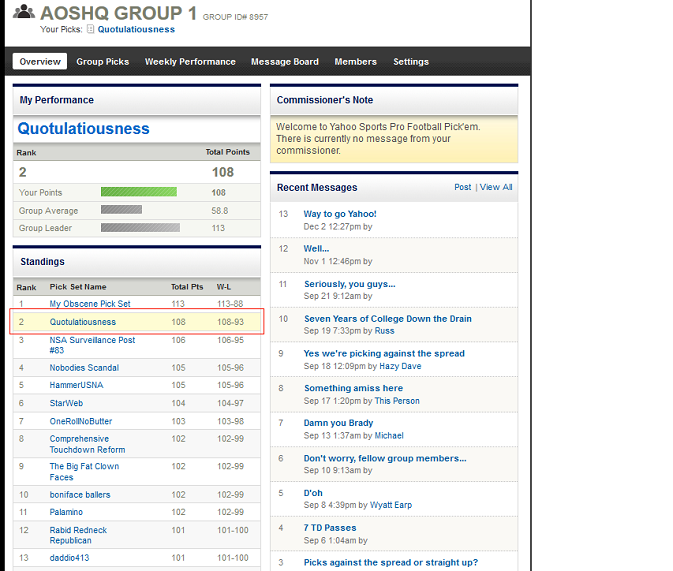
I’m actually doing quite well in the Ace of Spades HQ football pool at Yahoo this year:

Fantasy football ranking

November 18, 2013

Vikings crushed by “Vikings West”

Filed under: Football — Tags: , , , , — Nicholas @ 09:07

It actually looked like a competitive game for most of the first half, as the Seattle Seahawks and Minnesota Vikings traded scores, but a 58-yard return by Percy Harvin helped put the Seahawks in the driver’s seat just before halftime with a 24-13 score, and the Vikings had no answers after that. There are a lot of former Vikings on the Seahawks roster, starting with their head coach and offensive co-ordinator, both of whom were coaches for Minnesota earlier in their careers. Pete Carroll served under both Bud Grant and Jerry Burns as an assistant, while Darrell Bevell was the offensive co-ordinator for Brad Childress. Former Vikings wide receiver Sidney Rice was sidelined with an injury (the story of Rice’s NFL career), but fellow alumni Percy Harvin put on a very good performance against his former team, and former Vikings quarterback Tarvaris Jackson came in to finish the fourth quarter after the game was out of reach. On the other side of the field, former Seahawk John Carlson was one of the few Vikings to have a good game against his former team.

ESPN‘s Ben Goessling explains why many of us are expecting Josh Freeman to get his second start as a Viking next week against the Green Bay Packers:

Stock watch: Falling: Ponder. The quarterback’s second half was among the ugliest he’s had in 2 1/2 professional seasons; he hit just four of nine passes for 15 yards and threw two interceptions. He had another pass that could have been intercepted for a touchdown. Ponder hit seven of seven throws in the second quarter, and finished the first half 9-of-13 for 114 yards and a touchdown, though he did fumble deep in Vikings territory. But as he’s done so many times in Minnesota, he proved unable to put two consistent halves together, and was pulled for Matt Cassel with just more than 12 minutes left in the game. Coach Leslie Frazier could take most of the week, once again, to decide on a starting quarterback, but if the Vikings aren’t going to use Freeman now, it’s worth asking if they ever will.

Dan Zinski of The Viking Age chimes in on the Ponder situation:

Seattle’s defense set the tone in the second half, picking off Christian Ponder twice, and returning one of those picks for a TD. Ponder played reasonably well in the first half, but whatever tweaks the Seahawks introduced in the third quarter utterly bewildered the Vikings QB. His interceptions were not rushed throws or bad footwork throws or anything that could be chalked up to poor pass protection or receivers running bad routes or any of the rest of it. No excuses for Ponder: he made two of the worst throws you will ever see from a third-year quarterback.

Leslie Frazier decided after the pick-six that he had seen enough and yanked Ponder. But by that point it was too late for backup Matt Cassel to get anything going anyway. Seattle didn’t even need much from their offense in the second half. Russell Wilson did all the damage he needed to in the first half. With Ponder throwing the ball around like a fool, Seattle’s D was able to put the game away without any difficulty.

John Holler makes the same point about quarterbacking for Viking Update:

Christian Ponder’s inconsistency was encapsulated against the Seahawks: promising first half, brutal second half. By now, the Vikings should have seen enough to know what they have in Ponder and make a change to evaluate the next possibility.

What Vikings fans saw Sunday from quarterback Christian Ponder is nothing unusual. His three-year NFL career has been defined more by his failures than his achievements and Sunday was no exception. The difference this time is that it just might be his last disappointing game as the Vikings’ starting quarterback.

Head coach Leslie Frazier said team officials will talk about a quarterback change Monday, but Ponder continued with some of the trends that have made him a human piñata among Vikings fans. He completed 13 of 22 passes to his offensive teammates and two passes to Seattle defenders, one that was brought back for a touchdown. On his first dropback of the game, he was hit from behind and fumbled, leading to the game’s first three points. His three turnovers accounted for 17 Seattle points and turned a close game into a blowout.

This hasn’t been anything unusual for Ponder this season. He has at least one interception in seven of the eight games he has played, and almost invariably his turnovers directly lead to points.

What made Sunday’s game so painful for Ponder apologists is that, aside from the blindside fumble in the first quarter, he was having a decent game. At halftime, he had completed nine of 13 passes for 114 yards and a touchdown – giving him a passer rating of 122.0.

I liked Christian Ponder when the Vikings drafted him, and I wanted him to get the opportunity to show what he could do, but after two-and-a-half seasons, I think we now know what Ponder can do. He may still be able to improve as a passer, but I think it’ll be for another team. The Vikings will almost certainly be drafting a quarterback in the first round of the 2014 draft, and if the team keeps Ponder for the final season of his contract, he’ll just be holding the spot until the rookie is able to take over.

November 13, 2013

The NFL “closed shop”

Filed under: Business, Football, Law, Liberty — Tags: , , , , — Nicholas @ 10:35

In Reason, S.M. Oliva discusses how the NFL’s exemption from normal labour regulations makes it difficult to assess the rights and wrongs in the Miami Dolphins “bullying” situation:

Many libertarians see nothing wrong with the NFL’s labor system. Even in a pure free market, employers and unions could enter into “closed shop” agreements like the NFL’s CBA. But as we all know, professional sports hardly exist in a free market. The NFLPA itself holds a government-sanctioned monopoly over all current and future NFL players. Indeed, Martin was not even a union member when the NFLPA signed the current CBA in 2011.

More importantly, in a free market any closed shop would face competition from new entrants seeking to exploit the incumbent’s labor restrictions. There’s little risk of that with the NFL given that most of its infrastructure is subsidized by government. This includes not just stadiums built with billions in taxpayer financing, but also player development, as most NFL players are the product of college football programs subsidized by state-run universities.

There’s also the perverse incentives created by federal antitrust law. The collective bargaining process creates an exemption from antitrust law. Without that exemption, most NFL labor policies, such as the draft, would be deemed illegal. Now, that’s hardly a libertarian outcome. But consider the NFL’s position. The more rules and restrictions they can stuff into the CBA, the lower the risk of future antitrust lawsuits. Thus, the exemption encourages the NFL (and the NFLPA) to centralize as much of its labor policy as possible.

That means there’s little motive to experiment with more flexible labor policies. Individual teams can’t offer employee incentives or enforce discipline in any way that conflicts with the CBA. When there are workplace disputes like the Dolphins situation, the bureaucracy acts not to “protect” employees, but to ensure nothing disturbs the government-granted authority of the league and its monopoly labor union.

November 10, 2013

QotD: The New Zealand rugby team

Filed under: Humour, Quotations, Sports — Tags: , — Nicholas @ 11:27

There is a saying that you do not beat New Zealand — you just get more points than them at the final whistle.

Tim Worstall, “About next week’s rugby”, TimWorstall.com, 2013-11-10

November 9, 2013

Why Cordarrelle Patterson isn’t getting more playing time

Filed under: Football — Tags: , , — Nicholas @ 11:16

In a long two-part post at Cover 32, Arif Hasan explains why in spite of all his talent, Vikings wide receiver Cordarrelle Patterson isn’t seeing as many snaps as fans think he should:

A markedly different picture than the year before, Vikings fans have noted that one of their favorite receivers hasn’t been able to see the field, partially due to the talent ahead of him on the depth chart. The vaunted first-round receiver has only taken 150 snaps of the 563 snaps the Vikings had taken as of Week 10.

But with such a significant investment, it seems odd that they can’t play him more regularly — especially as he finally hauled in the first receiving touchdown of his professional career.

At the same time, it might be asking too much. Fans see a significant move to grab an impact wide receiver — knowing that the Vikings were weak at the position — and assume he’ll be able to contribute right away.

But coming into the draft, it was well-known that Patterson may have been the least-NFL ready of the incoming crop of receivers. Eric Galko at Optimum Scouting argued that this defined Patterson as a prospect in his scouting guide:

    The enigma of Patterson is the fact that, while successful and productive in his first season in the SEC, he still remains both highly unrefined as a receiver and his own worst enemy at times … Tremendously gifted with limitless upside but an equally unrefined skill set, Patterson grades out as a mid-to-late 1st round draft choice.

ESPN’s Mel Kiper also came to the same conclusion, claiming that Patterson “is extremely raw as a receiver in terms of route-running and reading coverages on the fly. There are questions about how much of an offense he can absorb right away, and his hands have been inconsistent on tape.”

In part 2, Arif looks at the pro and con for getting Patterson more touches this season:

Like most everything in football, it’s a difficult question to answer despite its relative simplicity, although it ultimately comes down to a question of philosophy. There’s a good chance that increasing his snap count from where it stands now doesn’t substantially increase the Vikings’ chance of winning a particular game and could even hurt it given his limited potential contribution versus the other receivers on the roster.

On the other hand, it’s hardly a question that playing him will help him acclimate to time in the NFL, as nothing can replace in-game experience for player development and evaluation. It’s entirely possible that Patterson may end up as a “kick-returner only” like so many other athletically gifted receiver prospects but he is by no means consigned to that fate.

It isn’t enough to think that Patterson can get away with his preternatural physical talent. Every receiver to enter the Hall of Fame did so with incredible technical precision — even Randy Moss, who has often been maligned as a poor route runner because of his dominance as a deep threat. Much of Moss’ games and many of his best years were built on the back of his technical ability and incredible intelligence at his position.

“Bullet” Bob Hayes and Don Maynard, incredible athletes for their day, were also more technically refined than they were given credit for — and Maynard didn’t start consistently dominating the NFL until late in his career. There are dozens of smaller skills receivers need to master to even get on the field, much less make an impact, so it’s impossible to understate the importance of developing these skills — without them, the receiver will simply take up space on the field or be used as bait for interceptions.

In other Vikings wide receiver news, Jerome Simpson has apparently been arrested for DWI this morning. As Simpson has already been the subject of league discipline for earlier lapses, this may mean a significant punishment (suspensions, fines, etc.) is in his immediate future.

« Newer PostsOlder Posts »

Powered by WordPress