
So far we’ve only been talking about guys, but the gals went through their own version of the same process way back in the days. Indeed, it’s because the girls changed that the guys got into PUA in the first place.
Under the old dispensation, back before the Clinton Era (1988-2001), everyone acknowledged that there were a lot of users and abusers, douchebags and parasites and losers, out there in the world. That being the case, simply being an all-around ok guy with a steady job — what the PUAs came to term “beta providers” — was, in itself, a pretty solid resume in the dating market. “Just be yourself” was every guy’s dad’s advice when it came to dating, and back then it was pretty solid, since it was assumed that the decent job etc. flowed from being a decent human being. And since every girl’s mom was telling her complementary things, the system worked … until it didn’t, and you can date the change precisely: June 6, 1998, the premiere of the HBO series Sex and the City.
[…] Everyone has met one of those “one of the guys”-type girls. They’re great fun, and while you know what I mean when I say they’re not necessarily marriage material as-is, you therefore also know what I mean when I say they really are what feminists all claim to be: Strong, confident women. They are what they are, and they know it, take it or leave it.
The problem is, most women — and, it goes without saying, all feminists — aren’t “strong, confident women”, in the same way the vast majority of guys aren’t naturally “alpha males”. That’s the dialectic I’ve been trying to get at in this series of posts. Sex and the City, as much as every episode needs to be burned and the ashes shot into deep space, was just the manifestation of a long-developing process. Thanks to all that “self-esteem” shit that started in the Seventies, sometime in the Clinton Era a critical mass of young women decided that what they needed was to be “strong” and “self-confident”. But they didn’t know how to do that, because the people telling them this were fat lesbian college professors. Then HBO, sensing a valuable market niche, got into the act …
Sex and the City […] is the gayest show in the history of television. Carrie and the Gals don’t act like women; they act the way women think men act — which is to say, they act like gay men. Recall that the late 1990s also saw an explosion of female “comedians”, whose one “joke” was some version of “I got my period today, but damn, I still crave dick.” (Sex and the City, you’ll recall, was pitched as a comedy). And that’s a serious problem, because as every straight guy has said at least once in his life, being gay would be fabulous if not for the “sex with guys” part. I mean, how awesome would it be (every young man thinks), if you could reorient your whole life around your crotch?
Severian, “Mental Middlemen III: SATC”, Rotten Chestnuts, 2021-05-06.
February 28, 2024
QotD: When the rules in the dating market all changed
February 26, 2024
Time to pry the smartphones from the clutches of our dopamine-addicted youngsters?
A couple of articles this weekend deal with the already acknowledged problem of dopamine addiction especially among the young whose brains and personalities are still in the formative stages. First, here’s Christopher Gage reporting with some delight that British schoolchildren are going to have to learn how to cope with a full school day without the electronic binkies they’ve grown so dependent on:
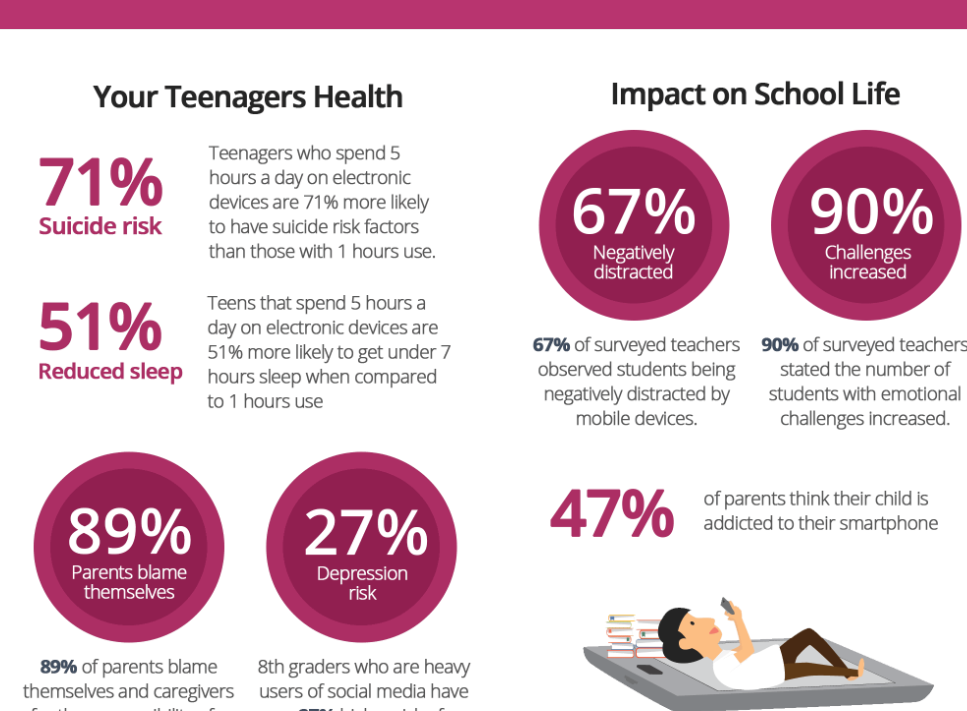
Detail of an article at bankmycell.com
I long for the day when gawking at one’s phone like a lobotomy patient invokes derision. Don’t you know your filthy addiction pollutes every atom of our society? You selfish bastard. You perverts should be ashamed of yourselves, etc. That day is on the horizon.
This week, British lawmakers banned smartphones in schools. Those pocket perils are lobotomising those whom sentimentalists call “the nation’s future”. Denied their devil devices, schoolchildren will endure hours of reading, thinking, and writing. Heaven forbid, they’ll talk to their friends and teachers in flesh and blood.
In these matters, I am militant. Children are not vessels of wisdom and wonder corrupted by a cruel world. They’re ignorant. By teaching them how to think and live, adults civilise children. That bleeping burping buzzing beehive in their pockets renders that civilising mission impossible.
Many disagree. But their knee-jerk reaction to this “knee-jerk reaction” crashes against concrete evidence. Smartphones erode concentration, dull critical thinking, blunt memory, and shred retention. The monstrous equation: Smartphones plus face-hugger apps equals ignorant, depressed, anxious youths.
Yes, technology invites moral panic. Plato worried that the written word would mulch minds into mush. But this is serious.
Last year, Dr Vivek Murthy, the United States surgeon general, issued a rare public health advisory. Across 19 pages, Dr Murthy warned that the effects of social media on adolescent mental health were “not fully understood”.
“There are ample indicators that social media can also have a profound risk of harm to the mental health and well-being of children and adolescents,” he said.
And what did we say? Not much. We had more important matters to attend. If I remember correctly, on that very day, Kim Kardashian revealed on Instagram her latest arse or her newest boyfriend.
However, serious people think this is a serious problem. Dr Benjamin Maxwell, a director of child and adolescent psychiatry at Rady Children’s Hospital in San Diego, said he is “immensely concerned” by a study linking social media and poor mental health. That “highly stimulating environment” may corrode “cognitive ability, attention span and memory during a time when their brains are still developing,” Maxwell said. “What are the long-term consequences? I don’t think we know.”
The UN’s education, science, and culture agency says the more young Jack scrolls through TikTok and the like, the lower his grades sink.
Countless studies show smartphones and their face-hugger apps — designed by behavioural psychologists to addict and milk the user — worsen anxiety, depression, and self-esteem. Not to mention lining up children for the predation of bullies 24/7.
Psychologists Jonathan Haidt and Jean Twenge are the canaries in the cultural coalmine. They say HMS Progress is crashing toward the icebergs — rising rates of suicide, depression, and anxiety. To them, the evidence is almost irrefutable. Turn back now, they say, or the ship sinks.
The second item is a follow-up by Ted Gioia to his post on dopamine culture last week:
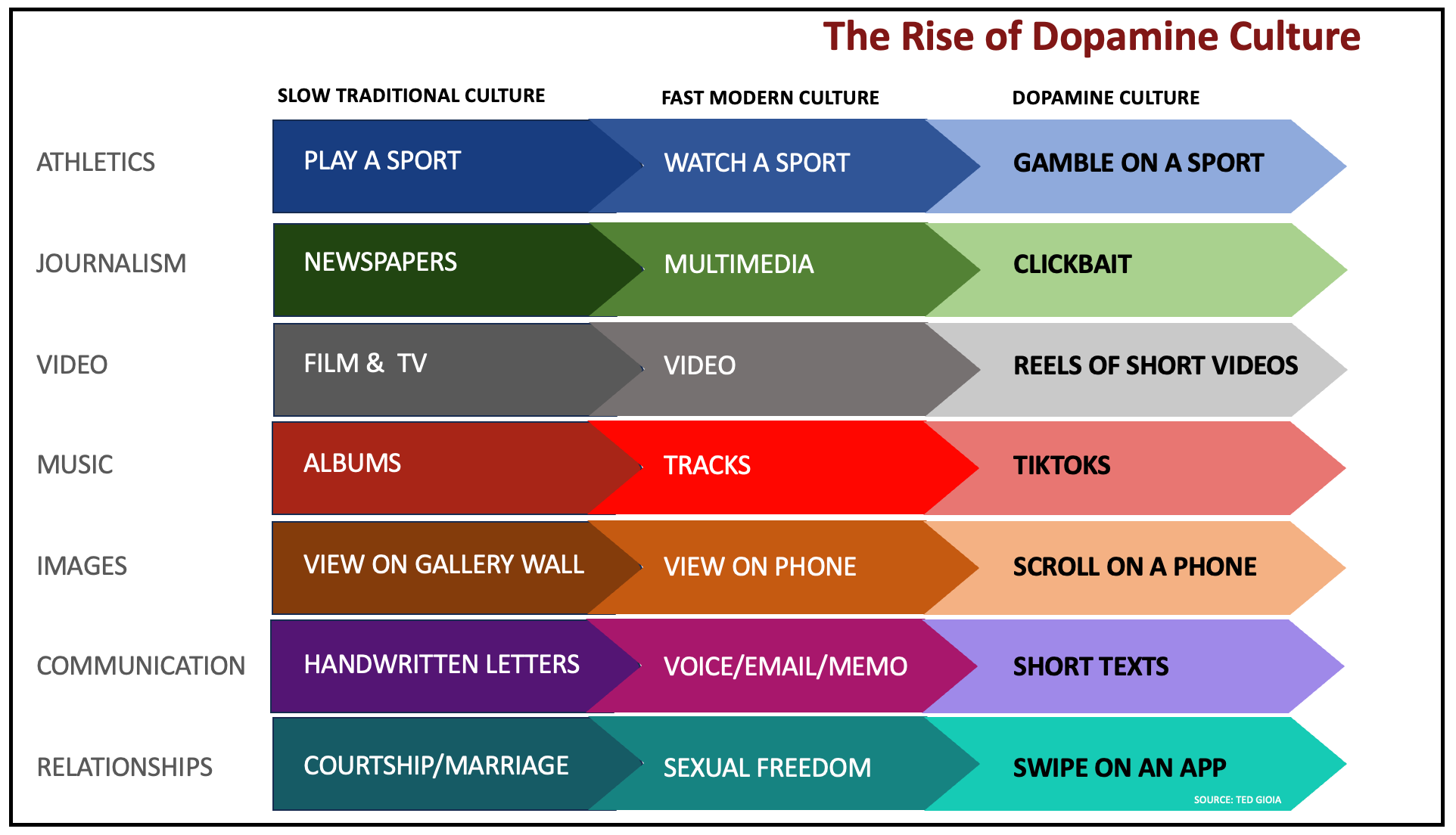
My article on “dopamine culture” has stirred up interest and (even more) raised concerns among readers who recognize the symptoms I described.
One of the illustration went viral in a big way. And I’ve gotten requests from all over the world for permission to translate and share the material. (Yes, you can all quote generously from the article, and reprint my charts with attribution.)
This image was shared widely online
But many have asked for more specific guidance.
What can we do in a culture dominated by huge corporations that want us to spend hours every day swiping and scrolling?
I find it revealing and disturbing that readers who work on the front lines (in education, therapy, or tech itself) expressed the highest degree of alarm. They know better than anybody where we’re heading, and want to find an escape path.
Here’s a typical comment from teacher Adam Whybray:
I see it massively as a teacher. Kids desperately pleading for toilet breaks, claiming their human rights are being infringed, so they can check TikTok, treating lessons as though they’re in a Youtube reaction video, needing to react with a meme or a take — saying that silence in lessons scares them or freaks them out.
One notable difference from when I was at school was that I remember a lesson in which we got to watch a film was a relief or even pleasurable (depending on the film). My students today often say they are unable to watch films because they can’t focus. I had one boy getting quite emotional, begging to be allowed to look at his phone instead.
Another teacher asked if the proper response is to unplug regularly? Others have already embraced digital detox techniques of various sorts (see here and here).
I hope to write more about this in the future.
In particular, I want to focus on the many positive ways people create a healthy, integrated life that minimizes scrolling and swiping and mindless digital distractions. Many of you have found joy and solace — and an escape from app dependence — in artmaking or nature walks or other real world activities. There are countless ways of being-in-the-world with contentment and mindfulness.
Today I want to discuss just one bedrock of real world life that is often neglected — or frequently even mocked: Ritual.
I know how much I rely on my daily rituals as a way of creating wholeness and balance. I spend every morning in an elaborate ritual involving breakfast, reading books (physical copies, not on a screen), listening to music, and enjoying home life.
Even my morning coffee preparation is ritualistic. (However, I’m not as extreme as this person — who rivals the Japanese tea ceremony in attention to detail.)
I try to avoid plugging into the digital world until after noon.
I look forward to this daily time away from screens. But my personal rituals are just one tiny example. There are many larger ways that rituals provide an antidote to the more toxic aspects of tech-dominated society.
Below I share 13 observations on ritual.
QotD: Lockdown rebuttal
Nor were lockdowns “essential”. As Nocera and McLean note,
… the weight of the evidence seems to be with those who say that lockdowns did not save many lives. By our count, there are at least 50 studies that come to the same conclusion. After The Big Fail went to press, The Lancet published a study comparing the COVID infection rate and death rate in the 50 states. It concluded that “SARS-CoV-2 infections and COVID-19 deaths disproportionately clustered in U.S. states with lower mean years of education, higher poverty rates, limited access to quality health care, and less interpersonal trust – the trust that people report having in one another.” These sociological factors appear to have made a bigger difference than lockdowns (which were “associated with a statistically significant and meaningfully large reduction in the cumulative infection rate, but not the cumulative death rate”.)
Second, the lockdowns were, contra Mr. Orrell’s claim, utterly unprecedented. Isolating individuals known to be infected, such as Typhoid Mary, is a categorically different measure than locking down whole societies. Such lockdowns were never used until China locked Wuhan down in early 2020. Here again are Nocera and McLean: “On April 8, 2020, the Chinese government lifted its lockdown of Wuhan. It had lasted 76 days – two and a half months during which no one was allowed to leave this industrial city of 11 million people, or even leave their homes. Until the Chinese government deployed this tactic, a strict batten-down-the-hatches approach had never been used before to combat a pandemic. Yes, for centuries infected people had been quarantined in their homes, where they would either recover or die. But that was very different from locking down an entire city; the World Health Organization called it ‘unprecedented in public health history’.”
It’s jarring to encounter in an essay that features many excellent arguments – as Mr. Orrell’s does – such irrational and utterly uninformed claims as Mr. Orrell offers about lockdowns.
Donald J. Boudreaux, responding to an article by Brent Orrell in Law & Liberty, 2023-10-31.
1. “COVID Lockdowns Were a Giant Experiment. It Was a Failure.” Intelligencer, October 30, 2023.
February 21, 2024
“College attendance is our society’s only meaningful initiation ritual, and it thus assumes an existential importance that renders it near-impossible to replace until an alternative is found”
Johann Kurtz believes the modern university’s survival despite its increasingly irrational and counterproductive actions can be explained as the last modern example of an initiation ritual:
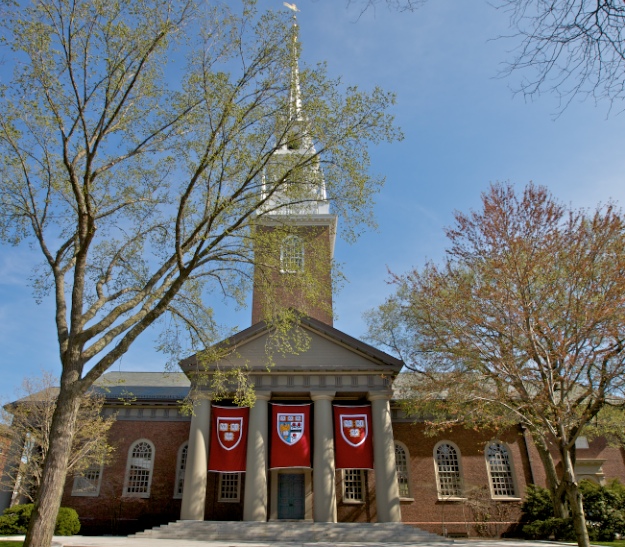
Harvard University Memorial Church.
Photo by Crimson400 via Wikimedia Commons.
Our understanding of the college system is incomplete. Until we correct this, we won’t be able to fix or replace the system.
First, consider a paradox: college attendance remains near all-time highs [Link], yet the majority of Americans no longer believe it is worth the cost [Link].
The college system seems irrationally resistant to declining value. We must therefore ask: is there an important non-rational reason for college attendance which we have failed to acknowledge?
I believe the answer is “Yes”. College attendance is our society’s only meaningful initiation ritual, and it thus assumes an existential importance that renders it near-impossible to replace until an alternative is found.
Our culture is historically anomalous in lacking explicit initiation rituals.
Mircea Eliade, the great religious historian of the 20th-century, defined initiation rituals as “a body of rites and oral teachings whose purpose is to produce a decisive alteration in the religious and social status of the person to be initiated“.
In philosophical terms, initiation is equivalent to a basic change in existential condition; the novice emerges from his ordeal endowed with a totally different being from that which he possessed before his initiation; he has become another.
— Mircea Eliade, Rites and Symbols of Initiation: The Mysteries of Birth and Rebirth
In Europe, fully expressed initiation rituals were common until the end of the Middle Ages, and in the wider world, until the end of the First World War. Now, they only persist in the West in the sacramental practices of devout Christians (baptism, confirmation, and so forth).
Once, however, these practices were of tremendous importance to us, as Eliade makes clear:
To gain the right to be admitted among adults, the adolescent has to pass through a series of initiatory ordeals: it is by virtue of these rites, and of the revelations that they entail, that he will be recognized as a responsible member of the society. Initiation introduces the candidate into the human community and into the world of spiritual and cultural values. He learns not only the behavior patterns, the techniques, and the institutions of adults but also the sacred myths and traditions of the tribe, the names of the gods and the history of their works …
In the absence of local community rituals, the universities are a natural site for their replacement. These have always been religious sites, although the nature and expression of this religion has transmuted over time.
H/T to Bruce Gudmundsson at Extra Muros for the link and his additional comments:
This hypothesis accords with the argument, made often in this blog, that education and schooling are two very different things. At the same time, it suggests that one of the definitive purposes of Extra Muros, the encouragement of young people to eschew the conventional college experience in favor of a combination of practical pursuits and systematic self-tuition, may be a fool’s errand. After all, if four (or five or six) years of drinking second-rate beer from red plastic cups does for the office-bound folk of North America what fear-filled rites of passage do for members of the bone-in-the-nose set, then I might well be sailing against the wind.
Upon second thought, I find hope in the possibility that the parasite (or, to be more precise, the cancer) promoted by d’Angelo, Kendi, and company will soon deal the coup de grâce to its mortally-wounded host.
The coming-of-age ordeals of warrior tribes demand that boys who would be men prove possession of such martial virtues as courage and self-command. The rites-of-passage of the modern middle classes, however, require that postulants demonstrate a mixture of conformity, conscientiousness, and, to a diminishing degree, intelligence. (Readers familiar with the oeuvre of economist Bryan Caplan will recognize the source of this troika. However, it is worth noting that, while Professor Caplan will occasionally tip his hat in the direction of the campus-based building of basic brain-power, he devotes far more attention to the collegiate cultivation of the two components of Sitzfleisch.)1
The cult of Marx, Mao, and Marcuse demands complete compliance, not only with its basic tenets, but also with any changes in the party line that, from time to time, may occur. (I am old enough to remember the days when campus commies of the caucasian persuasion could don dashikis without facing charges of “cultural appropriation”.) Thus, those who sit at the feet of the acolytes of critical theory learn an art of great value to people who wish to thrive in a large organization, that of discarding the old hat, and putting on the new one, at just the right time. (Think, if you will, of the mid-level employees of the McDonalds Corporation, who, over the course of the last four decades, were obliged to alter their opinion of the McRib sandwich more often than they changed the oil in their cars.)
1. Bryan Caplan, The Case Against Education: Why the Education System is a Waste of Time and Money (Princeton: Princeton University Press, 2018), pages 9-21.
February 16, 2024
“… the rise in emotional disturbance among young women correlates precisely with the introduction of the smart phone”
At Postcards from Barsoom, John Carter sets off all the alarms with a proposal to address the burgeoning issue of social media addiction and the closely correlated rise in mental health issues among young women:

The psychic breakdown of the young Western female has been the defining political phenomenon of the twenty-first century. Women are suffering from depression, anxiety, neurosis, and dysphoria as never before, they’re drugged to the gills to deal with it, and they’ve got the SSREyes to prove it.
This isn’t only a problem for young women. Their suffering is everyone’s suffering. The romantic paranoia engendered by MeToo, a mass hysteria that has grown directly out of this plague of neurosis, has destroyed courtship among the young. As a result a shocking fraction of young men are virgin incels, while their femcel counterparts are contemplating a future where 45% of them will be childless. Driven by their neglected ovaries to latch on to surrogate children in the form of migrants and minorities, and entering into lesbian civil unions with the Mammy State, childless women overwhelmingly vote left – as always, the party of the psychically distressed thrives to whatever degree it cultivates psychic distress. The political derangement is downstream of their emotional derangement, and the two feed on one another in a vicious spiral of crazed minds pushing crazed policies that craze minds yet further, a cycle that threatens to break civilization, either gradually through steady demographic deflation and spiritual demoralization, or perhaps – if the young men alienated by a society that has ruined their women cease stupefying themselves with porn, and cohere as an army – more catastrophically.
There’s no real mystery as to why this has happened.
Jonathan Haidt has demonstrated at length and in extraordinary empirical detail that the rise in emotional disturbance among young women correlates precisely with the introduction of the smart phone, and the mass migration of social lives onto social media that immediately followed. The slot machine engineers of Silicon Valley trapped the world’s young women in a Skinner box by hacking their instinctive sexual competition strategies. Suddenly every young girl in the world was measuring herself against every other young woman, all viewing one another through the distorting filters of flattering camera angles, ruthlessly curated digital photographs, makeup, plastic surgery, and AI filters that smoothed wrinkles, removed blemishes, and reduced unwelcome poundage. On the Internet no girl is ever the prettiest girl in the room, or even the second or third prettiest. Meanwhile they’re flooded with a relentless barrage of that most intoxicating of drugs: male attention.
Of course they went mad.
They’re all wandering around in a state of selfie-shock.
QotD: The PUA (Pick-up artist)
This was two decades or more ago, and College Town was in Podunkville. Imagine what they’re charging to get into the hot nightspots on the Sunset Strip. I bet just getting into the clubs costs these aspiring PUAs a couple hundred bucks, every week, for months. Then there’s all the other stuff Strauss said he did to transform himself into “Style” — laser-whitening his teeth, tanning beds, classes on elocution and posture, a whole new (and ever-changing) wardrobe, surfing. I can’t even begin to calculate it, but at one point he and three other PUAs are living in a Hollywood Hills mansion that once belonged to one of the Rat Pack — monthly rent, $50K. Then throw in the fact that all of this takes a tremendous amount of time, and consider the toll that must take on your body. I hit the sauce pretty hard back in my day, and one of the reasons I stopped was that the hangovers really started hurting — one night of bar-hopping now, and I’d be bedridden for days. I’m getting exhausted just typing this, and do you see what I mean?
And all this without getting a single girl. I think everyone here has been in at least one relationship, so we know that no matter how casual you keep it, bare-bones relationship management, even of pump-and-dumps, takes a fairish bit of time (so I’ve heard, anyway). I might be misremembering, but at one point Strauss claims he was managing something like four or five more or less long-term hookups simultaneously. I don’t think there are enough hours in the day …
Much better, then, to just say you’re a PUA. To do it Tyler Durden style, in other words. I’m pretty sure you could sell the illusion of yourself as a hardcore PUA with one not-too-expensive night on the town. Just dress up like one of these goobers, hit up one bar, and take selfies with a bunch of girls, making sure to alter the shot angles enough that no one can tell you’re in the same bar the whole time. Post one or two stories of your conquests a week, and you could portray yourself as some kind of pickup master in no time at all.
Of course, that’s if you want to consciously fake it. I have no idea what “Tyler Durden” was doing, not being a sociopath myself, but as Strauss tells it, his disciples got snookered into it. They really did want to learn how to pick up girls, but since dressing up like a PUA and talking about getting girls is much easier than actually getting girls, a night on the town with those guys ended up being an endless series of “approaches”. Again, it’s how you define “effective”, and Strauss lets the cat out of the bag a bit when he informs us of the PUA’s weird lingo for “closing”. There’s the “f-close”, of course, which should be obvious, but there’s also the “kiss close” and even the “phone number close” … and both of those count as complete successes.
Severian, “Mental Middlemen”, Rotten Chestnuts, 2021-05-05.
February 7, 2024
QotD: Indoctrinating children into progressive worldviews
It’s also vital to expose children to the fact of their race as the core constituent of their identity. Here is an essay written by a woke teacher about the difficulty of teaching “White boys”:
I spend a lot of my days worried about White boys. I worry about White boys who barely try and expect to be rewarded, who barely care and can’t stand being called on it, who imagine they can go through school without learning much without it impacting in any way the capacity for their future success, just because it never has before.
This sounds to me as if he is describing, well, boys of any race. And when boys are labeled as “White” (note the capital “W”) and this requires specific rules not applied to nonwhite boys, they often — surprise! — don’t like it:
This week, a student spoke up in class to say that every time a particular writer talked about White people and their role in racism, he would start to feel really guilty, and it made him not want to listen … I try to keep an arm around the boys who most need it, but it’s hard, because I’m also not willing to give an inch on making my room safe for my students of color. It’s not their job to keep hurting while White boys figure it out.
Children, in other words, are being taught to think constantly about race, and to feel guilty if they are the wrong one. And, of course, if they resist, that merely proves the point. A boy who doesn’t think he is personally responsible for racism is merely reflecting “white fragility” which is a function of “white supremacy”. QED. No one seems to have thought through the implications of telling white boys that their core identity is their “whiteness”, or worried that indoctrinating kids into white identity might lead quite a few to, yes, become “white identitarians” of the far right.
One of the key aspects about social-justice theory is that it’s completely unfalsifiable (as well as unreadable); it’s a closed circle that refers only to itself and its own categories. (For a searing take down of this huge academic con, check out Douglas Murray’s superb new book, The Madness of Crowds.) The forces involved — “white supremacy”, “patriarchy”, “heterosexism” — are all invisible to the naked eye, like the Holy Spirit. Their philosophical origins — an attempt by structuralist French philosophers to rescue what was left of Marxism in the 1960s and 1970s — are generally obscured in any practical context. Like religion, you cannot prove any of its doctrines empirically, but children are being forced into believing them anyway. This is hard, of course, as this teacher explains: “I’m trying. I am. But you know how the saying goes: You can lead a White male to anti-racism, but you can’t make him think.”
The racism, sexism, and condescension in those sentences! (The teacher, by the way, is not some outlier. In 2014, he was named Minnesota’s Teacher of the Year!) Having taken one form of religion out of the public schools, the social-justice left is now replacing it with the doctrines of intersectionality.
Andrew Sullivan, “When the Ideologues Come for the Kids”, New York Magazine, 2019-09-20.
February 6, 2024
On gender issues, “Progressives may even find themselves — dare we say? — on the wrong side of history”
In the portion of The Line‘s weekly dispatch that’s visible to freeloaders, the editors discover to their horror that they have to weigh in on the gender fracas:

So to be clear, we really don’t have any problem with Alberta restricting elective gender-related surgeries on minors under the age of 17. While we are rather concerned about the use of puberty blockers and cross-sex hormones among minors, we also suspect that trying to ban these drugs for absolutely everyone under a certain age represents an overreach by the state.
Also, bluntly, we don’t think that in an ideal world, the state should be involving itself in most of this stuff at all. We want to exist in a country in which sports leagues, doctors, schools and teachers can be trusted to make sensible, evidence-based decisions on a case-by-case basis.
Take sports, for example: does a rec-league pickleball tournament need to have the same rules around trans participation as a competitive women’s rugby league? And do we really want any state regulation bulldozering over the people who are actually on the ground, and best understand the physical and cultural realities of that sport?
Or take puberty blockers.
Should we really be treating a 12-year-old who has displayed severe and crippling gender dysphoria since the age of three with the same treatment protocol as a depressed 14-year-old boy who comes into the gender clinic for the first time attached to a Munchausen-by-Proxy mom documenting every moment of her child’s transition for TikTok? Do we want politicians in Edmonton writing the precise rules that will be faithfully applied in both those situations?
Sigh.
We understand how we got here. Any discussion around trans issues is now highly insane; in a hyper-polarized, borderline hysterical moment, we actually can’t trust our institutions to possess the requisite reserve and dispassion needed to make credible and defensible decisions. These institutions are, or are perceived to be, too ideologically captured to be trustworthy.
For an example that just happened to cross our path today, take this quote from Dr. Simone Lebeuf, a pediatrician in Edmonton who specializes in gender-diverse youth. In it, she notes that restricting puberty blockers to children over the age of 15 effectively makes the treatment useless, as they would be administered at an age well past the onset of puberty.
“It’s done. The window has passed,” the doctor told City News. “And we really look at puberty blockers as an option for kids to have some space and time to make decisions about their future selves and who they might want to be as adults. Their puberty is not benign, it is not a nothing process to go through. The physical changes with puberty are permanent.”
Right off the bat, a statement like this ought to raise eyebrows, and not only because it’s a talking point we’ve already heard dozens of times on TikTok. This doctor — a physician who is actually treating children — is conflating the harms caused by artificially delaying a natural process with the apparent harms caused by the biological process itself. That logic is not sound. There is a clear difference between, say, permanent loss of sexual function and bone density caused by interfering in the natural course of puberty, and the harm of allowing a child’s body to grow an Adam’s apple despite that individual feeling like a woman.
Secondly, Dr. Lebeuf isn’t addressing the core concern with puberty blockers, above and beyond their physical side effects. The majority of children who present with gender dysphoria are not trans. Most of them turn out to be simply gay — a fact they discover via the process of growing up and sexually maturing. By delaying or denying a gender dysphoric child the opportunity to experience normal puberty, critics of these treatment protocols fear that a doctor may be preventing the very process by which gender dysphoria would resolve itself without medical intervention. Most — certainly not all, but most — gender dysphoric children would otherwise grow up to be at ease with their natal sex. But once kids start with the puberty blockers and then cross-sex hormones, this process of medical transitioning may be psychologically self reinforcing, pushing physically healthy minors into pursuing more and more unnecessary and invasive interventions with serious lifelong consequences.
In short, puberty blockers are not magic cures for gender dysphoria. They might be appropriate for some kids with lots of supports and monitoring. But they could be disastrous for others, and we have no foolproof way to know in advance which kids will fall into what camp.
This stuff is complicated, and it’s made more so because it’s difficult to study objectively in ideologically captured environments dominated by activists on all sides who muddy the waters with emotionally charged rhetoric, and confuse good science with bad. If you want to understand why people are turning to Danielle Smith instead of the Alberta Medical Association to address their fears, quotes like the one above are a prime example.
And, by the way, we include “The Media” writ large as having failed on this file. The lack of skepticism and neutrality that the media has demonstrated on even the most maximalist and unpopular positions on gender and sexuality has — to our mind — significantly contributed to the radical decline in its collective credibility.
February 4, 2024
“[L]et’s face it head-on: you’re a social and political outlier, a dangerous extremist”
You, yes you are exactly the kind of dangerous extremist that mature and sensible journalists at all the right media outlets have been warning us about for years:
You’re very weird.
In fact, let’s face it head-on: you’re a social and political outlier, a dangerous extremist. Your views put you firmly on the fringe, and that fringe is becoming a real problem. For example, the Premier of Alberta, Danielle Smith, has just embraced a bunch of radical fringe policies about parent notification and consent regarding schools and transgender children, simultaneously limiting the ability of young children to have their bodies medically altered to match their declared gender — and some pretty disturbing people are supporting this crazy stuff. Look how appalled normal Canadians are by these extremist maneuvers to keep parents involved in the lives of LGBT children:
See the whole poll here, if you can stand the disgust from seeing extremist material, or see a detailed report on a poll of Californians that offers similar results.
Fortunately, the responsible mainstream leaders of the Liberal Party and NDP are standing strong with the 14% in the majority who want parents out of the lives of transgender children, rejecting the fringe views of the 78% who live at the extremist edges.
At the same time, the New York Times has just published a remarkable opinion piece on the growing concern among longtime transgender advocates, including transgendered clinicians, about the casual and rushed process by which American pediatric gender clinics are pushing children into gender transition. The essay centers on detransitioners, trans youth who change their minds and accept their biological sex.
This being the New York Times, the author is compelled to mention the true danger: “The real threat to transgender people comes from Republicans who wish to deny them rights and protections.” Ahh, but watch what comes next:
But the doctrinal rigidity of the progressive wing of the Democratic Party is disappointing, frustrating and counterproductive.
“I was always a liberal Democrat,” one woman whose son desisted after social transition and hormone therapy told me. “Now I feel politically homeless.”
She noted that the Biden administration has “unequivocally” supported gender-affirming care for minors, in cases in which it deems it “medically appropriate and necessary.” Rachel Levine, the assistant secretary for health at the U.S. Department of Health and Human Services, told NPR in 2022 that “there is no argument among medical professionals — pediatricians, pediatric endocrinologists, adolescent medicine physicians, adolescent psychiatrists, psychologists, et cetera — about the value and the importance of gender-affirming care.”
Democrats are doctrinally rigid, and a top health official in the Biden administration says proudly that there is no debate. See, everyone believes the same thing, except mean Republicans, but that’s also now understood to be a sign of excessive ideological rigidity. Then the same piece in the Times also says a whole bunch of things like this:
Studies show that around eight in 10 cases of childhood gender dysphoria resolve themselves by puberty and 30 percent of people on hormone therapy discontinue its use within four years, though the effects, including infertility, are often irreversible.
I’ve removed the links from the quoted paragraphs, because they don’t work well after cutting and pasting, but you can find them all at the link to the non-paywalled opinion piece.
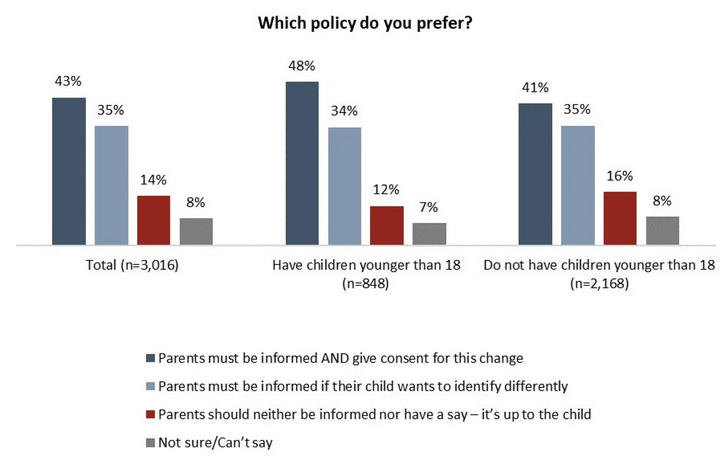
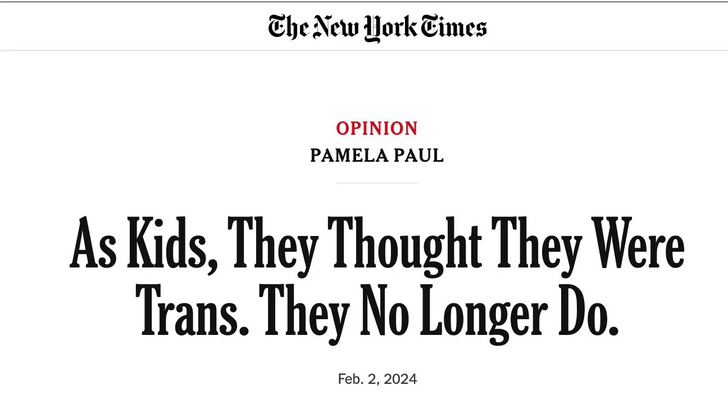
Well, I guess the secret’s out:

January 30, 2024
The foul “nudgers” are at it again at Cambridge
Christopher Gage reports on a recent fun-reducing experiment by paid psychological meddlers at Cambridge University:

“Wineglass” by quinn.anya is licensed under CC BY-SA 2.0 

 .
.
Researchers found they could “nudge” people into drinking less wine when they denied the unsuspecting blighters a large 250ml measure.
Last summer, these wholly well-adjusted people convinced 21 Cambridgeshire pubs and restaurants to offer only small or medium glasses of wine. The result left the boffins breathless. But sadly, not in the medical sense of the word.
When denied a large, vivifying glass of wine, the subjects drank eight percent less than usual, and the pubs didn’t lose any money — smaller measures cost more. Puritans: two. Oenophiles: nil.
The usual suspects cooked up this obscene waste of time and money. Professor Dame Theresa Marteau, director of the behaviour and health research unit at Cambridge University, boasts lurid form in control freakery.
Her previous studies read like an almanac of neurotic impulses. The mad mullah dreams of shrinking plates and sinking sodas. This finger-wagger-in-chief obsesses with the vinous, porcine masses and what they may slip into their faces when she’s not looking. Marteau chillingly laments that large wine glasses “increase the pleasure of drinking wine”.
The fundamentally nosey swear these are the first murmurs of Utopia. Next, they’ll bend boozing regulations into a truncheon to batter the gastronomic swine over its head. They don’t stop. First, they shrink the large glass. Then, the medium glass affects as the large. What happens next? Take a wild guess.
This is not the work of some rogue Colonel Kurtz. One Daily Telegraph writer seized on the study. Employing the presumptuous “we” beloved of oppressive minds, they offered tips to help us drink less, assuming we drink large wines only because we are weak-willed effigies desperate for professional helpers to show us what’s best for us.
Advocates of “nudging” drive themselves senseless over this psychological thimblerig. The potential to correct “undesirable” behaviour proves too great to resist. They are a species of featherless biped with which I share nothing but the right to a trial before a jury of my peers.
As I write, I’ve just returned from a five-mile jaunt with 33 pounds strapped to my back. Loading a bag with weights burns double the calories. Therefore, whatever I do after that trek is my business alone. On my desk is a large glass of Portuguese red blend. Beside that soul-tingling measure sits a smouldering, hand-rolled, menthol-tipped cigarette.
Why strangers stake their mental well-being on what others put into their bodies, I will never know. Why they wish I’d sit here choking on sparkling water and its vegetable equivalent — celery — I’ve not the foggiest of insights. All I do know, friends, is that I am not the one in dire need of a few sessions with a psychoanalyst. My professional advice: Seven letters. Vulgar slang. A phrasal verb rhyming with “duck cough”.
January 28, 2024
Adolescence is “a profoundly unnatural life-stage”
Sarah Hoyt on the plight of the younger Millennials and the Gen Z kids in our over-supervised safety-at-all-costs culture today:
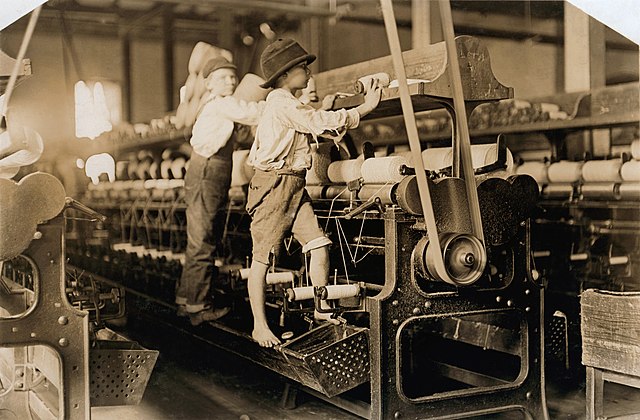
Child labour laws did generally get younger children out of dangerous places like mines, mills, and factories. Modern child labour laws instead keep young adults from gaining work experience in many cases.
Photo of pre-teen children working in a mill in Macon, Georgia in 1909. Photo NCLC.01581, Library of Congress via Wikimedia Commons.
Mostly, it gets attributed to “kids these days” but unless you have kids, these days, you don’t know how they are bound. And even if you do, you might not realize it, because all you see is the infantilization of a generation, and not that they, themselves, aren’t the ones doing the infantilizing, but all those “good rules” and regulations and laws are doing it.
I realized about 10 years ago that my son’s generation was about 10 years behind where we were. In their mid twenties they were doing things we did in our teens. It was disconcerting. And even I had no idea why, other than too much regimentation in school, too much of a never end of button counting, and not enough room or freedom to think or be on their own.
Since then … I’ve seen more. And a lot of the reason they are younger than we were is that the entire world is geared not to let them grow up. I mean, let’s be glad that — unprepared or not — they’re legal adults at 18, or people would be denouncing them for walking alone down the street, without an “adult” at 25.
There’s also … adolescence is in some ways a profoundly unnatural life-stage, and more or less invented in the 20th century. In the past, sure, people were children, and people grew to be adults, but there wasn’t this protracted time period where they were adults in size and at least some ability, but weren’t allowed to be adults: they weren’t allowed to earn or spend, or make their own decisions, for years.
The earn or spend thing is important. Kids used to grow along with their tasks. Read Tudor or colonial memoirs, and you find four year olds looking after cows or horses, or learning Latin, or other unlikely things even for twelve year olds in our time.
Mom went to work at 10 and started getting a salary. It wasn’t much, and 90% of it went to her parents’ budget. But she was working, holding down a job, doing things that were maybe not at adult level, but could lead to it, eventually, if she applied herself. This was normal for her generation. In my own generation, amid the working class, most people went to work at 10. Heck, amid the middle class, most people went to work at 15 or so, after 9th grade. Were they more mature than the rest of us that went all the way to college?
I wouldn’t have thought that at the time, but yes, of course they were. Most of my elementary school classmates were married, with kids by the time my biggest worries were final exams. Of course, with my intellectual pride I looked down on them but now I understand they were managing a very difficult job, which at the time I could not have done.
I always feel stunned and shocked when someone says the kids should be “holding down two jobs like I was at 16” or “working to pay their way through college”. (That last is a giggle as it has two impossibilities. Finding a job that pays enough after college which has a lot of make-work expectations, and making a full-time middle-class salary, which is what college costs these days.) Two Jobs. At 16. The difficulties in giving work to 16 year olds, increasingly restriction of hours, etc. combined with chaotic scheduling in the only unskilled jobs remaining (mostly just retail) means that until recently none of them could find A job. Let alone two. And the recently was during Covid. I haven’t seen so many little 16 year olds cashiering, or serving at tables recently. And that’s because most people I’m seeing are around my age: I guess unemployment is biting hard.
But you know, all these strong rules against “child labor” mean that most kids hit 18 or, if they’re going to college, 22 or — more likely, as most degrees (remember make work?) are taking 6 or 7 years — 24, with absolutely no job experience. Which means their applications aren’t even looked at. Not seriously.
Honestly, almost every young person — particularly young men — I know who found a job, and is doing relatively well, did so through contacts. Through friends of friends. Through knowing someone.
This is a bad sign, because it’s how Portugal functions, and it is not in any way shape or form meritocracy, which in turn contributes to other things falling apart.
But more and more what I’m seeing is young people hitting their mid twenties lost, and doing this, and doing that, and trying this and trying that, and nothing ever gels. To make things worse, they don’t have the habits mom had by 10, because they haven’t been allowed to acquire them.
There was a similar generation — one, while here we’re well into two — in Portugal, where unemployment was so bad (the generation before mine) that most people weren’t “established” on a path till their mid thirties. I’d guess about half of them never got the knack of it: of the day to day of working, fulfilling the work duties, just … the unglamorous day to day that makes us adults.
January 26, 2024
Why isn’t Trump Derangement Syndrome or Biden Derangement Syndrome in the DSM?
At Astral Codex Ten, Scott Alexander wonders if the kind of political insanity that takes over the lives and personalities of so many Americans should qualify as a kind of mental dysfunction:
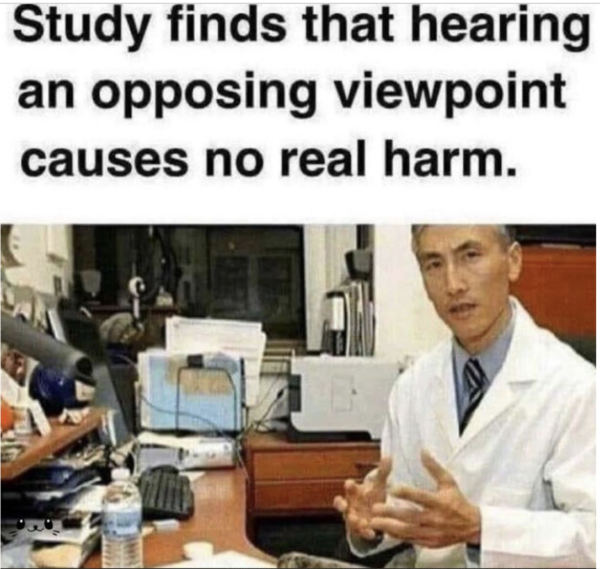
Everyone knows politics makes people crazy. But what kind of crazy? Which page of the DSM is it on?
I’m only half joking. Psychiatrists have spent decades developing a whole catalog of ways brains can go wrong. Politics makes people’s brains go wrong. Shouldn’t it be in the catalog? Wouldn’t it be weird if 21st century political extremists had discovered a totally new form of mental dysfunction, unrelated even by analogy to all the forms that had come before?
You’ll object: politics only metaphorically “makes people crazy”; we just use the word “crazy” here to mean “irrational” or “overly emotional”. I’m not sure that’s true. Here are some stray findings that I think deserve to be synthesized:
- Very smart people lose basic reasoning abilities when the topic switches to politics. This isn’t just a truism, it’s been demonstrated in formal experiments. You can give people simple math/logic problems and confirm that they get the right answers. Then you can change the wording from “five apples and eight oranges”, to “five Democrats and eight assault weapons” and these same people will flounder and say idiotic things.
- Paranoia and conspiracy theories, considered psychotic symptoms in individuals, are almost the norm in politics. Forget the people who believe that Biden/Trump/FEMA/whoever literally want to put them in camps. The coastal elites/the patriarchy/the rich/the liberal media may all be real groups with agendas different from yours, but the way some people think about them actively plotting to dismantle everything good in the world shades into paranoia (if you don’t believe this about your side, at least consider it on the other!) I’m not just making fun of other people, I find myself making this mistake constantly.
- Politics can create such strong emotions that they impair normal social functioning. People mock college students who demand trigger warnings whenever they have to listen to a conservative speaker. But I’ve talked to some of these college students and they’re not making it up — they find listening [to] a politically discordant opinion is as unpleasant as (let’s say) a claustrophobic person sitting in an enclosed space. If you’re a right-winger who feels tempted to dismiss this response, imagine having to sit through a six-week diversity training workshop and give the answers the lecturer wants or else you’ll fail. Obviously you could just fake the right answers and fly through easily, but doesn’t something about this still sound profoundly enraging and invalidating on a deep level? Enraging even beyond the level of (for example) having to fake the right answers in a class on acupuncture because you’re doing an undercover investigation or something?
- Politics can become something between an addiction and an obsession. People can spend hours every day watching cable TV or scrolling through their Twitter feeds, trying to stay abreast of the latest outrage the other side is perpetrating. To be clear, they hate this. Each time they hear another outrage they’re somewhere between dejected and enraged. But they keep doing it. For hours a day. They will justify this with claims like “I need to stay informed so I can make a difference”. Then they will forget to vote because they were tired on Election Day.
In any other situation, a condition with impaired cognition, psychotic symptoms, emotional instability that impaired normal functioning, and associated addictions/obsessions would qualify as a mental disorder. So again, which mental disorder is it?
This post is about the possibility that it might be trauma.
January 24, 2024
Poor Novak …
Chris Bray explains how vaccines provide complete immunity … but with a catch:

Novak Djokovic during his fourth round match at Roland Garros in June, 2023.
Detail of a photo by 350z33 via Wikimedia Commons.
Three years ago, Novak Djokovic refused to save his own life. Threatened by a deadly virus, he refused the lifesaving vaccines. And now you see the terrifying result. Djokovic is so obviously crippled by Covid-19, a virus he unnecessarily chose to face unprotected, that he’s … well, one of the most shockingly fit human beings on the planet, an absolute beast of a professional athlete who dominates a remarkably difficult one-on-one sport so completely that no one else in the game comes close to consistently playing at his level. I don’t follow tennis closely enough to be sure about any of that, so I Googled — to get the commissariat-approved answer — and found this statement: “Djokovic has been ranked No. 1 for a record total of 409 weeks in a record 13 different years.” NOW DO YOU SEE WHAT HAPPENS WHEN YOU DON’T GET VACCINATED!?!?!?!?
But what I can’t get over, the thing that just keeps churning in my mind, is that some jackass watched Djokovic play a match, in person, saw how completely he dominated, saw how absurdly healthy and fit he is, and then — at match point, at the end — shouted at him to get vaccinated, like he was rebuking someone for an appalling failure. Why won’t you protect your health, you stupid … most powerful and dominant professional athlete in the world.
Djokovic responded by drilling the very next serve for an ace to win the match, slamming it across the court so brutally hard that his much younger opponent couldn’t even get his racket on it and had to just watch it go by.
But the person in the crowd: To do that, to shout that thing at that person at that moment, requires a total immunity to information. You have to have a mind that can’t notice physical reality in any way, no matter how obvious it becomes. I guess you have to be the Novak Djokovic of stupidity, the best in the world at the game of making your own head fit inside your ass.
So, yes: Vaccines induce immunity. To information. In case you’re looking for a way to protect yourself from that.
Update: One of the journalists who mocked Djokovic for not being vaccinated reportedly died suddenly the other day.
January 21, 2024
Polycules – “Reading about this shit is like watching paint dry. It’s astoundingly sexless.”
One of the first times I encountered the term “polycule” was in joking reference to the pre-prison lifestyle of SBF and his intimate (?) circle and a photo of the seven diverse individuals from the Disney Snow White cast, but as Chris Bray says, it’s suddenly becoming a popular topic in the legacy media:
Sex is a lagging indicator. As the historians John D’Emilio and Estelle Freedman have written, sexual behaviors reflect everything that happens around them: “Political movements that attempt to change sexual ideas and practices seem to flourish when an older system is in disarray and a new one forming.” Radical changes in sexual practices tell you that significant social change is already well advanced, and sex is trying to catch up.
It appears that an older system is in disarray. Polyamory litters the media landscape, suddenly, like a memo went out.
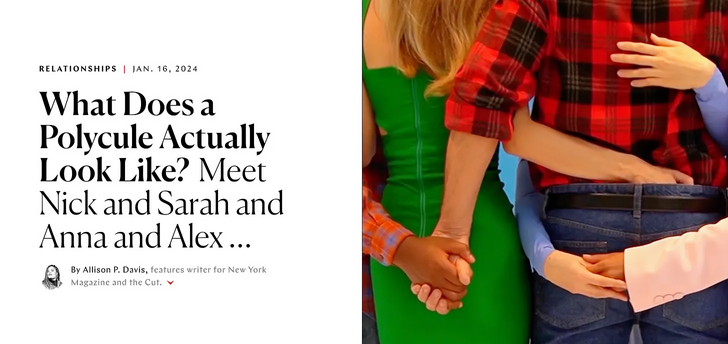
See if you can spot a trend, because the last week has brought big features on polycules and their enthusiasts from New York magazine, the New York Times, and the New York Post. If you live in Brooklyn, have hand sanitizer and a reliable source of Valtrex.
As the Times notes, television and publishing are similarly rushing to join in:
Along with novels, TV shows and movies that depict throuples, polycules and other permutations of open relationships, there is a growing body of nonfiction literature that explores the ethics and logistical hurdles of polyamory. Recent titles include memoirs like the journalist Rachel Krantz’s 2022 book Open: An Uncensored Memoir of Love, Liberation, and Non-Monogamy, and self-help and inspirational books like The Anxious Person’s Guide to Non-Monogamy, The Polyamory Paradox and A Polyamory Devotional, which has 365 daily reflections for the polyamorous.
I’m begging you: read some of this stuff, because you’re not going to believe what I say about it. At least skim the thing in New York; here’s the link again. Here’s a link to the Amazon preview of A Polyamory Devotional, with daily thoughts about mindfulness and relationship structures. Now, armed with evidence, here’s my Big Conclusion:
Reading about this shit is like watching paint dry. It’s astoundingly sexless.
Polyamory turns out to be a front for therapeutic culture and a neurotic love of mirrors. The sexy thing with Alice and Anna and Nick and Sarah involves a lot of checking in and managing expectations and maintaining supportive dialogue. Actual quote from Nick: “Some people like to run marathons. We like to do polyamory, complex relationship stuff. Sarah’s favorite activity for the two of us to do is couples therapy.” You’re jealous of all that heat and pleasure, right? It’s so sexy that it’s like running a marathon. Of talking. With a therapist.
January 20, 2024
“This ruling is definitely going to embolden the already tyrannical regulatory boards”
Jordan Peterson’s reaction to the Ontario court decision that sided with the College of Psychologists of Ontario to order him to undergo re-education at his own expense until some non-specified goals have been reached:
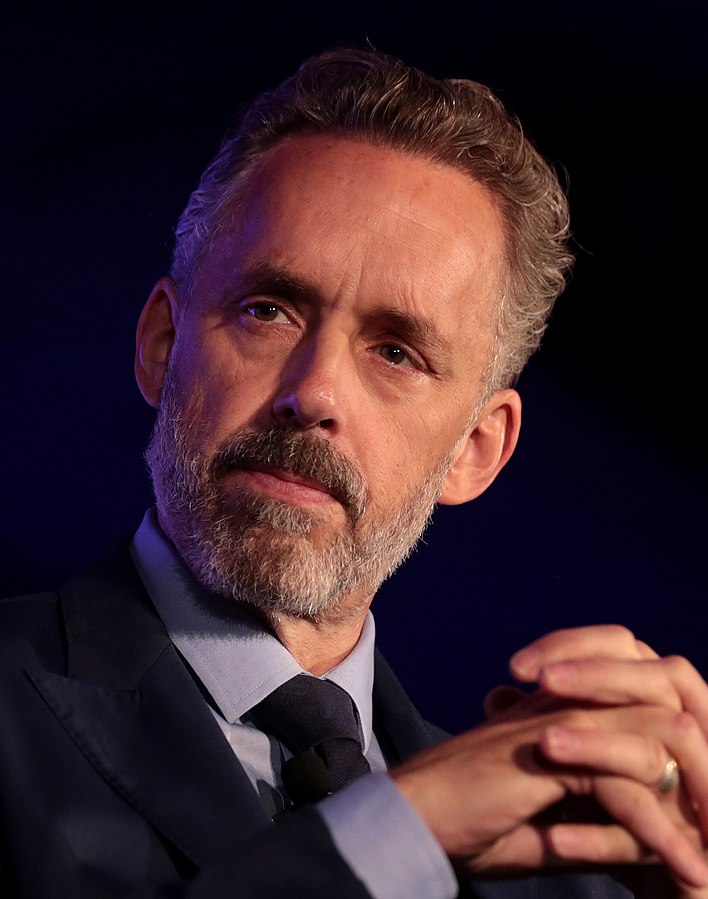
Jordan Peterson speaking at an event in Dallas, Texas on 15 June, 2018.
Detail of a photo by Gage Skidmore via Wikimedia Commons.
[National Post interviewer Tyler Dawson] What was your reaction when you found out the Ontario Court of Appeal had dismissed your challenge?
Oh, well, I’d already factored that into account as a high probability, so it actually didn’t affect me very much.
I’m upset because of what it signifies. This might be hard for people to believe, but I don’t believe that this is about me. I don’t want to claim some sort of capacity to transcend mere egotism, but there isn’t anything the college can really do to me, except they can take a hit out on my professional reputation to some degree.
Practically speaking, I’m beyond their purview, because I’m not dependent on them financially. I don’t even need my licence. I’m not practising. I have a reputation that’s going to withstand this regardless, and perhaps even be enhanced by it.
The reason that I’m fighting for this is because, well, first of all, I didn’t want them to take my damn licence. I worked hard on that and there’s no — I’ve done nothing to deserve that, quite the contrary. I think I’ve helped millions of people.
This ruling is definitely going to embolden the already tyrannical regulatory boards. But also Canadians don’t understand that if they can’t trust their professionals to tell them the truth, then they don’t have professionals anymore.
You know, this country is in rough shape. It’s in far rougher shape than people understand. So the reason I’m fighting this is to try to bring that to public attention, like I’ve been trying since 2016. You know, now a cynic would say well, you know, look at all the success you’ve had with it. It’s like, wow, yeah, believe me, man, it took a lot of dancing in place to turn the cataclysm of negative public opinion and pillorying by the press into success. That wasn’t a foregone conclusion.
What options does this leave you specifically with regards to the college? Do the training or resign?
The status is crystal clear. I’ve already been sentenced to a course of re-education, of indeterminate origin, at my expense, until I comply. And all they have to do now is tell me when to do it and where — that’s where we’re at.
There’s nothing that I know of now that I can do to stop that from happening. I just cannot understand how that’s going to work, because the probability that they’re going to re-educate me in some manner they deem successful, there’s no universe in which that can occur.
Or I can reject it, in which case I’ll fail, which is the outcome that’s desired anyways. Or I can tell them to go directly to hell and just refuse to do it, in which case they can say, well, we gave Dr. Peterson every opportunity to maintain his professional licence, but when push came to shove, he was unwilling to abide by our dictates. So those are my options.
Could you just register in another province?
It’s not that easy to switch registration jurisdictions. It should be easier than it is, because there are bureaucratic impediments in the way that make it very difficult for professionals to move and there’s no excuse for that.
It’s certainly an option I will and have to some degree explored. But it’s not just like rolling over in bed.


