Quotulatiousness

February 23, 2021

The danger period is when “the coherence of the news breaks” … and it appears to be breaking before our eyes

In the latest Libertarian Enterprise, Sarah Hoyt remembers the breakdown of the Soviet Union and the disturbing parallels we can see today:
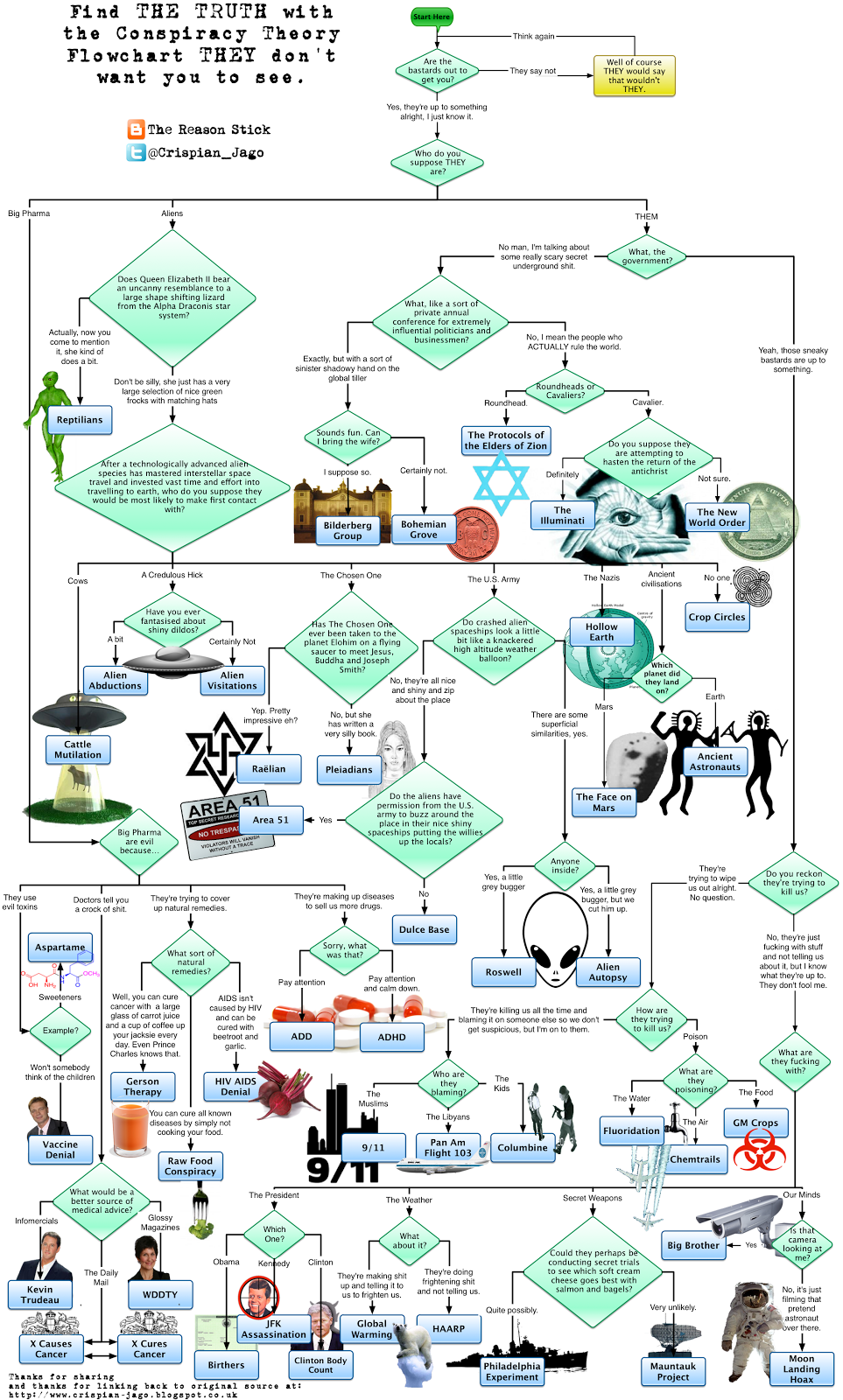
[Click to see full-size flowchart]

Our likelihood of coming out of this a constitutional republic is still high. Why? Well, because societies under stress become more themselves.

I remember when the USSR fell. And out of the ashes Tzar Putin emerged, who is despicable, but not particularly out of keeping with Russian monarchy.

So, yeah, the pull of our culture will be towards the reestablishment of who and what we are and were: a constitutional republic.

But on the way …

Look, I remember when the USSR fell.

The people in the USSR knew they were being treated like mushrooms: kept in the dark and fed on crap. They knew there was truth in Pravda. But they were used to having certain information, and interpreting it.

And there is something worse than reading the news in totalitarianism. You can get used to interpreting the news, and knowing the shape of the hole of what they’re not reporting.

But once you realize it’s all nonsense, once the coherence of the news breaks — and it’s doing so now, earlier than I expected, with the Times article, with the New York Times admitting the protesters at the capitol didn’t kill the police officer — once there are holes, but they’re not consistent, or they’re consistent, but then contradicted; once the narrative changes almost by the week, to the point it can’t be ignored, that’s the dangerous period.

I know I joke that by the end of this year I’ll have to apologize to the lizard-people conspiracy theorists. But the problem is that the lizard people conspiracy theorists can acquire respectability and a strange new respect. Or something even crazier. Heck, a lot of crazier things.

To an extent the 9/11 troofer conspiracies, which yes, are crazy and also anti-scientific were our warning shot. That they flourished and that to this day a lot of people believe them means that there was already a sense that the news made no sense, that there were other things going on behind the scenes that we weren’t aware of.

It’s going to get far, far worse than that, as the actual elites, the top of various fields fall like struck trees in a thunder storm. There is a good chance that authorities you rely on for your profession, or just for your knowledge have been compromised. A lot of our research is tainted by China paying to get the results it wants, for instance. And there’s probably worse. You already know most research can’t be reproduced, and that’s not even recent.

As all this stuff comes out, the problem is that people won’t stop believing. Instead they’ll believe in all and everything.

I don’t know how much was reported here, as the USSR collapsed. but I remember what I read in European magazines and journals. All of a sudden it was all new age mysticism and spoon bending and only the good Lord knew what else.

And that’s what we’re going to head into. So, when you find yourself in the middle of an elaborate explanation that someone constructed, well …

First find the facts. Pace Heinlein: Again, and again what are the facts. Never mind if your ideology demands they be something else. Establish the facts to the extent you can. Facts and math don’t lie. (Statistics do. So be aware you can lie with them. And any metrics that involve intangibles, like intelligence or performance much less sociability or micro anything? forget about it.)

From the facts, deploy Occam’s razor. What is the simplest explanation?

Then remember that humans run at the mouth, and the more humans in the conspiracy, the more facts are likely to leak out somewhere.

And while we’ve seen a lot of Omerta among leftists, note that they’re all afflicted by evil villain syndrome. Sooner or later, they brag about how clever they were in deceiving us. So, if your conspiracy theory requires perfect silence forever, it’s probably not true.
February 22, 2021

Australia experiments with social distancing from social media

Filed under: Australia, Government, Media, Politics, Technology — Tags: , — Nicholas @ 03:00

Arthur Chrenkoff is mildly surprised to find that the Leviathan of social media — Facebook — considers his personal account to be a publisher for Australian ban purposes:

As of this morning, Australian media outlets – as well as government agencies – are not able to post anything on Facebook, and their articles and stories cannot be shared by anyone in the world using Mark Zuckerberg’s now somewhat anti-social network. This is Facebook’s retaliation for a law being introduced by the Australian government that would have companies like Facebook and Google pay Australian media outlets for having their content on their sites. Google has in fact just reached a global agreement with News Corp regarding content use, but Facebook is opting for a much more of a FU negotiating approach.

As much as I dislike Big Tech, I have so far been unable to see a good rationale for the new law. While the media keeps complaining that Facebook and Google (in particular) are monopolising the online advertising revenue, links to media stories are to my mind advertisements that drive online users to the source – and to the source’s advertisers. Perhaps it’s the media who should be paying the socials for this publicity. In the end, the war between the Big Tech and the Mainstream Media is one, to borrow from Henry Kissinger, it’s a pity that both sides can’t lose.

Apart from the fact that various health authorities around Australia are now unable to share COVID information on Facebook, the other ironic casualty of the Aust-Zuck spat is yours truly, whom Facebook has kindly deemed to be an Australian publisher, even though The Daily Chrenk media empire consists of a single ageing desktop in an inner Brisbane suburb utilised (all too rarely and irregularly) by yours truly for the love of it with no commercial element whatsoever. And so, the main avenue of promoting my new posts by sharing their links with the 1000-plus good people around the world who follow TDC page on Facebook has been (I hope only temporarily) lost to me. While it’s flattering to stand shoulder-to-shoulder with The Australian, I’m now somewhat confused: should Facebook be paying me when I voluntarily use their site to try to get eyeballs for my work? Thank you, Australian government, for thinking that should be the model.

I think the whole notion of taxing social media sites like Facebook is cracked … which might explain why the Canadian government has legislation in the works to do something similar … and earlier European attempts to extract money from the “tech giants” have always backfired. That said, I think Facebook’s retaliation is ill-advised, being both disproportional and very likely to induce other governments to look into ways to exercise more control over Facebook and other social media platforms. There are likely no winners in this dispute or the future confrontations that this will likely inform.

February 20, 2021

Confessed genocidal nation refuses to accuse China of genocide

Filed under: Cancon, China, Politics — Tags: , , , — Nicholas @ 03:00

Jen Gerson considers the moral smallness of Canadian government wiggling out of labelling China’s treatment of their Uyghur minority as the genocide it certainly is:

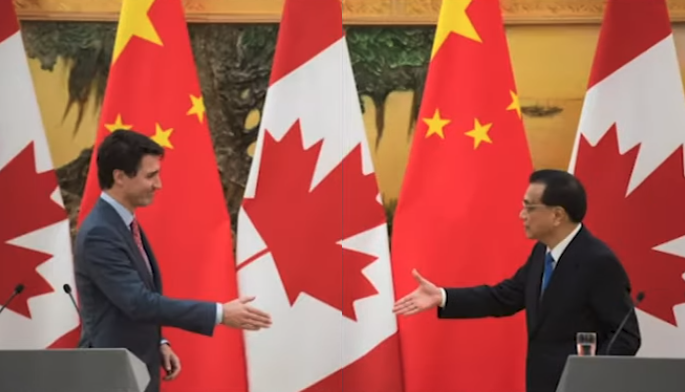
This week, the Prime Minister of an admittedly genocidal G7 state refused to condemn China for its treatment of its minority Uyghur population. A treatment that has included family separation, forced sterilization, and warehousing thousands of people in what can only be described as modern concentration camps.

Justin Trudeau failed to condemn China, noting, quite rightly, that genocide is an “extremely loaded” term. One not to be bandied about lightly. It demonstrates some moral cowardice on his part, certainly, but also a degree of pragmatism. Canada’s squeaky and lonely objection would do little good. We’re already in a vulnerable position, what with the ongoing captivity of two Canadians who remain in Chinese detention as an act of retaliation for our arrest of Huawei executive Meng Wanzhou. A declaration of genocide in this case is probably better handled by a collection of nations. As long as we can live with the shame of the smallness that such an argument implies.

(Although perhaps it was unwise to pin so many of our early hopes of an early vaccine rollout on a doomed collaboration with a Chinese manufacturer with a vaccine backed by China’s Institute of Biotechnology and its Academy of Military Medical Sciences. Who could have predicted we would run into problems with such a notoriously reliable and honourable global partner that occasionally engages in hostage diplomacy? But I digress.)

The real issue with Trudeau’s grovelling little deflection on the question of Chinese genocide is that it made his own position on the subject not two years ago impossible to ignore in comparison. The final report of the Missing and Murdered Indigenous Women and Girls inquiry stated that the truths it uncovered in the process of its years-long investigations:

    … tell the story — or, more accurately, thousands of stories — of acts of genocide against First Nations, Inuit and Métis women, girls, and 2SLGBTQQIA people. This violence amounts to a race-based genocide of Indigenous Peoples … This genocide has been empowered by colonial structures, evidenced notably by the Indian Act, the Sixties Scoop, residential schools, and breaches of human and Inuit, Métis and First Nations rights, leading directly to the current increased rates of violence, death, and suicide in Indigenous populations.

Several pundits at the time noted at the time that this stretched the definition of “genocide” beyond ordinary recognition. “Genocide” is not the result of a set of compounding government failures over time: it’s a word that we reserve to describe a discreet set of acts motivated by the deliberate intent to decimate or totally exterminate an ethnic population. But after a day or so of hemming and hawing on the issue after the report was released, our prime minister noted: “The issue that we have is that people are getting wrapped up in debates over a very important and powerful term … We accept the finding that this was genocide, and we will move forward to end this ongoing national tragedy.”

There was some careful phrasing in this response. Note, Trudeau agreed that this was genocide, not that it is genocide. The prime minister dodged the implication that Canada is engaged in deliberate ethnic cleansing. But it’s worth peeling back the skin of the onion, past the obvious and easy allegation of hypocrisy, and instead ask ourselves why?

Why can we get away with calling ourselves a genocidal state, but not China?

February 17, 2021

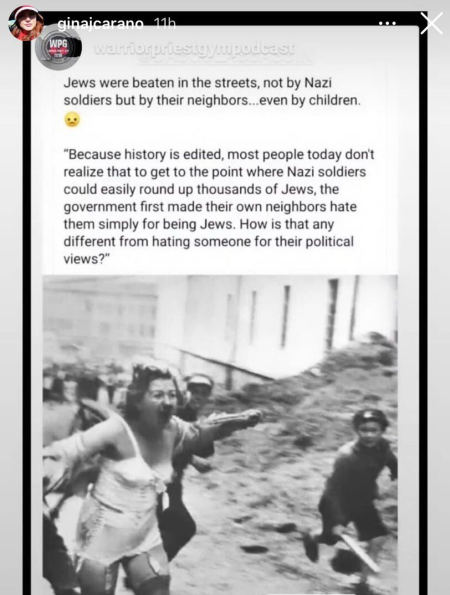
Sarah Hoyt on why Progressives think Gina Carano’s tweet was antisemitic

Filed under: History, Media, Politics, USA — Tags: , , , , , — Nicholas @ 03:00

I’m a few days behind, so I didn’t see this post by Sarah Hoyt until Tuesday morning:

My first reaction was “Oh. Actress said something, and … they cancelled her.” Which is not only “day ending in y” right now, but also has been for a long time. Part of the reason I came out of the political closet is because I’d gotten tired of watching every word I said, and every expression I made in public. Because even a slight slip would have caused my career to be completely dead. […] So, I was going “Yeah, only innocents who don’t realize what life is like in a completely taken-over industry would think this is surprising. All power to the lady, but I’m sure she knew what would hit her for stepping out of line.”

And then I came across a screen capture of what she said. And someone asking “how is this anti-semitic.”

Which is when I panicked.

[…]

The only way, remotely, no matter how much you stretch it, that what she said can be considered “anti-semitic” is this:

    The left believes the Jews were innocent. (This is correct, btw.) That what happened to them was shameful and terrible, and a dishonor on those who attacked them.

    BUT they also believe it’s an insult to compare them to the people the left hates FOR THEIR POLITICAL VIEWS.

Because they think the people they hate for their political views — us — are really that bad, and really deserve everything the left intends to do to them. Which is more or less—in rough outlines — what the Nazis did to the Jews.

I mean, they have already talked of reeducating us, taking our children away, and they do in fact do think of us as not fully human.

Mind you, they have absolutely no idea who we are and what we believe, but they know we don’t agree with them, and since their hearts are pure, and utopia is their objective, we must be the very devil, and terrible on principle.

They’ve been exquisitely propagandized to the point they think the only American president with Jewish grandchildren was “anti-semitic.” They think that black people who don’t want to careen into ruinous and deadly socialism are “white supremacists” (the poor things swallowed Gramsci without chewing); they think other races aren’t hetero-normative; they think America is the most racissss, sexissss, homophobic nation on Earth … and they will not listen to corrections of their appalling and atrocious ignorance of true history or foreign anthropology or … really anything. Because anything opposing the indoctrination has been trained into them is an attack on their psyche.

So, they’re ignorant. They live in a political/social universe where if you oppose the completely insane leftist version of the world, you must be evil and “a nazi” which is to say the devil. They are so completely saturated in utter inanity that they call Israel “fascist.”

BUT one thing they know, and they know it at gut level: everyone to the right of Lenin — or perhaps Mao — are untermensch who will have to be utterly destroyed, so that the final promised utopia that they were promised since elementary school will come to be.

So, in their eyes comparing innocent Jews to their political opponents is experienced as an insult to the Jews.

Because in leftist eyes, we are evil, cockroaches and sub-humans whom they have to eradicate from society.

And they will not look in the mirror, or admit that what they’re engaging in is exactly what the nazis did, only with political beliefs instead of race. And it’s complicated. These idiots have simply decided that the real master race are black people. And that all evil comes from white males. But to be fair, it shades to people like me who have “internalized oppression” and are therefore “male.”

QotD: Protectionists, left and right

Filed under: Economics, Politics, Quotations — Tags: , , , — Nicholas @ 01:00

Conservatives who embrace protectionism thereby embrace both the fear that businesses, entrepreneurs, and workers in their country are simply not up to the task of competing against foreign rivals, and the belief that among the steps in making their country “great” is for their own government to restrict the freedom consumers in their country.

“Progressives” who embrace protectionism share conservatives’ low opinion of their country’s businesses, entrepreneurs, and workers, but also mistakenly believe that protectionism “sticks it to” corporate oligarchs when, in fact, it creates corporate oligarchs.

Don Boudreaux, “Quotation of the Day…”, Café Hayek, 2018-09-10.

February 15, 2021

The current (and future) rash of newsroom purges

Filed under: Business, Media, Politics — Tags: , , , , — Nicholas @ 03:00

Some thoughts from The Line on why people like former New York Times science reporter Donald McNeil are being given the show trial treatment and why it’s not going to stop quickly:

The New York Times Building in New York City, 1 January, 2008.
Photo by Frieder Blickle via Wikimedia Commons.

The first issue, of course, is a steady weaponization of HR processes and unions. Vehicles intended to fix problems like unfair pay structures, workplace misconduct and lack of due process are being re-deployed as tools of ideological conformity — fuelled by healthy doses of personal dislike and professional resentment.

Make no mistake: there are bad people in journalism, as there are in any profession. Abusers should be rooted out, and there should always be clear processes in place to handle toxic personalities fairly, decisively and effectively. (“Fairly” isn’t a buzzword here — the accused must have rights, too.)

But there has also been a steady lowering of the bar as to what evils warrant an HR intervention. Every newsroom should be a safe place from abuse, harassment and violence — but not from ideas that are offensive. We recognize the entirely legitimate concerns of employees who are from marginalized groups about historic injustices, microaggressions and systemic power imbalances. But being in the world sometimes involves working with people who are simply insensitive assholes. Drawing the line between the merely difficult and the truly dysfunctional isn’t always easy.

Further, many of the complaints now being bandied about are strategic. They are being used to pummel terrified HR staffs and weak, ineffectual managers into compliance with ideological agendas. A staff at war with itself and ever-fearful of the axe is easier to silence and control. Owners have long understood this; it’s a grim irony that our peers have now decided to take up the hood and the blade.

These workplace revolts always boil down to an internal struggle for control. The very concept of where power rests is being challenged by those who think the traditional way of running newsrooms is as obsolete as a classifieds page. Uprisings are about who decides institutional values, and who gets to enforce those values. An entire class of leaders needs to wake up to the fact that they’re three campaigns deep into a battle for their own legitimacy. And they’re losing.

That brings us to the third issue: management. We’ve said this before, but managers need to show some spine. The most consistent theme in all these newsroom eruptions is management either lacking the confidence to assert its authority, or hesitating to do so just long enough to make things worse. Too many leaders have been selected for their affability rather than their toughness. We at The Line suspect this is no accident. Powerful editors, necessary for effective management of staff, are inconvenient for owners intent on slashing said newsrooms. The kind of people who’d be most effective at crushing the odd staff rebellion also annoy the suits. So instead, we get nice people — truly nice people — who know the right folks and subscribe to the right politics, and shy away from embarrassment, conflict, and loss of status. They’re marks.

February 11, 2021

QotD: Progressive credentials as positional goods

[Political correctness] is driven by a loathing for ordinary people. According to spiked, PC brigadiers view ordinary folks as extremely impressionable, easily excitable, and full of latent resentment. Exposure to the wrong opinions, even isolated words, could immediately awaken the lynch mob. PC, then, is about protecting “the vulnerable” from the nasty tendencies of the majority population.

But if PC was not really about protecting anyone, and really all about expressing one’s own moral superiority, PC credentials would be akin to what economists call a “positional good”.

A positional good is a good that people acquire to signalise where they stand in a social hierarchy; it is acquired in order to set oneself apart from others. Positional goods therefore have a peculiar property: the utility their consumers derive from them is inversely related to the number of people who can access them.

Positionality is not a property of the good itself, it is a matter of the consumer’s motivations. I may buy an exquisite variety of wine because I genuinely enjoy the taste, or acquire a degree from a reputable university because I genuinely appreciate what that university has to offer. But my motivation could also be to set myself apart from others, to present myself as more sophisticated or smarter. From merely observing that I consume the product, you could not tell my motivation. But you could tell it by observing how I respond once other people start drinking the same wine, or attending the same university.

If I value those goods for their intrinsic qualities, their increasing popularity will not trouble me at all. After all, the enjoyment derived from wine or learning is not fixed, so your enjoyment does not subtract from my enjoyment. I may even invite others to join me – we can all have more of it.

But if you see me moaning that the winemakers/the university have “sold out”, if you see me whinging about those ignoramuses who do not deserve the product because they (unlike me, of course) do not really appreciate it, you can safely conclude that for me, this good is a positional good. (Or was, before everybody else discovered it.) We can all become more sophisticated wine consumers, and we can all become better educated. But we can never all be above the national average, or in the top group, in terms of wine-connoisseurship, education, income, or anything else. We can all improve in absolute terms, but we cannot all simultaneously improve in relative terms. And that is what positional goods are all about – signalising a high position in a ranking, that is, a relation to others. This leads to a problem. Positional goods are used to signalise something that is by definition scarce, and yet the product which does the signalling is not scarce, or at least not inherently. You can increase the number of goods which signal a position in the Top 20 (of whatever), but the number of places in that Top 20 will only ever be, er, twenty. Increasing the number of signalling products will simply destroy their signalling function. Which is why the early owners of such a signalling product can get really mad at you if you acquire one too.

Kristian Niemietz, “The economics of political correctness”, Institute of Economic Affairs, 2014-04-30.

February 10, 2021

“Did you know that seventy years ago, our grandparents were having an underpolarization crisis?”

Filed under: Books, History, Politics, USA — Tags: , , , , , , — Nicholas @ 05:00

Scott Alexander reviews Why We’re Polarized by Ezra Klein, beginning with the underpolarization crisis of the mid-20th century:

In 1950, the American Political Science Association “released a call to arms … pleading for a more polarized political system”. The report argued that “the parties contain too much diversity of opinion and work together too easily, leaving voters confused about who to vote for and why”. Everyone agreed with each other so much, and compromised so readily, that supporting one party over the other seemed almost pointless.

In 1976, three years after Roe v. Wade, Democrats and Republicans were about equally likely to support abortion restrictions. That same year, a poll found that “only 54% of the electorate believed that the Republican Party was more conservative than the Democratic Party”; 30% thought there was no difference. As late as 2004, about equal numbers (within 5 pp) of Democrats and Republicans agreed with statements like “government is almost always wasteful and inefficient” and “immigrants are a burden on our country”. Between the late 60s and early 90s, Democratic presidents deregulated the airlines and passed welfare reform; Republican presidents pushed immigration amnesties and founded the EPA.

What happened between then and now? Klein has two answers: a historical answer, and a structural answer.

The historical answer is: the Dixiecrats switched from Democrat to Republican.

When the North won the Civil War, it had grand plans to remake the South into a paradise of racial equality and universal love. After Lincoln’s death, his successor Andrew Johnson decided this sounded hard and gave up. Within a few decades, the South was back to being a racist, paramilitary-violence-prone one-party dictatorship. That one party called itself “Democrat”, but had few similiarites to the Democrats in the North. The Southern Democrats (“Dixiecrats”) and northern Democrats disagreed on lots of issues, but the South hated the Republicans so much after their experience with Lincoln that they caucused with the northern Democrats anyway. This turned into a stable coalition, with northern Democrats agreeing to support the South against civil rights for blacks, and the Dixiecrats supporting the northern Democrats whenever they needed something.

But since the Democratic party contained both northern Democrats (relatively liberal) and Dixiecrats (relatively conservative), it didn’t want to take a coherent party-wide stance on liberalism vs. conservatism. And by the median voter theorem, that meant the Republicans also didn’t want to take a coherent stance on liberalism vs. conservatism. So both parties ended out centrist and identical.

In 1964, the Civil Rights Act threatened the Dixiecrats’ key issue. It wasn’t quite as simple as “Democrats were for it, Republicans were against it” – in fact, 80% of Republicans and 60% of Democrats supported it. But that year’s presidential election pitted heavily pro-CRA Democrat Lyndon Johnson against anti-CRA Republican Barry Goldwater, beginning Southerners’ defection to the Republican Party.

Klein says this successfully got all the conservatives on one side of the aisle and all the liberals on the other, allowing polarization to begin. Essentially, he believes polarization is a natural process, which the odd coalitions of the early 20th century temporarily prevented. Once the coalitions were broken, it could begin to do its work. He spends the rest of the book talking about why exactly polarization is so natural, what aspects of modernization have made it worse, and what sort of feedback loops make it keep going

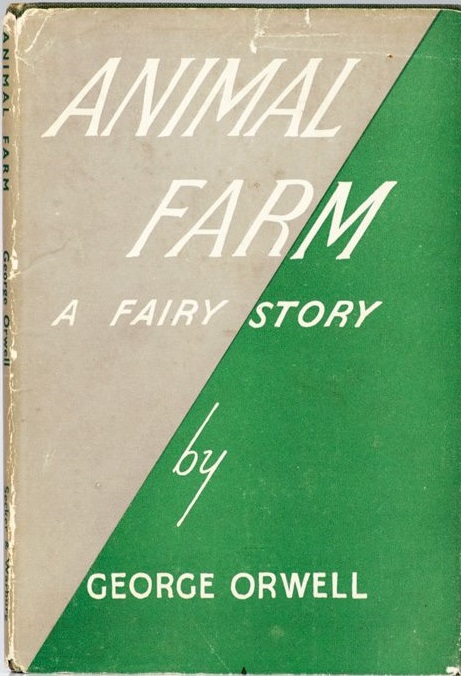
Victor Davis Hanson on Animal Farm, America’s nightmare 2021 version

Filed under: Books, Liberty, Politics, USA — Tags: , , , , , , — Nicholas @ 03:00

Victor Davis Hanson outlines the original George Orwell novel and then contrasts today’s situation with what progressives demanded back in the 1960s and 70s:

Yes, the downtrodden pigs, the exploited horses, and the victimized sheep finally did expel Farmer Jones from America’s Animal Farm.

But in his place, as Orwell predicted, revolutionary pigs began walking on two feet and absorbed all the levers of American cultural influence and power: the media, the bureaucracies, Wall Street, Silicon Valley, publishing, the academy, K-12 education, professional sports, and entertainment. And to them all, the revolutionaries added their past coarseness and 1960s-era by-any-means-necessary absolutism.

We are now finally witnessing the logical fruition of their radical utopia: Censorship, electronic surveillance, internal spying, monopolies, cartels, conspiracy theories, weaponization of the intelligence agencies, pouring billions of dollars into campaigns, changing voting laws by fiat, a woke revolutionary military, book banning, bleeding the First Amendment, canceling careers, blacklisting, separate-but-equal racial segregation and separatism.

Conspiracies? Now they brag of them in Time. Read their hubristic confessionals in “The Secret History of the Shadow Campaign That Saved the 2020 Election.” Once upon a Time, radicals used to talk of a “secret history” in terms of the Pentagon Papers, or a “shadow campaign” in detailing Hollywood blacklisting. They are exactly what they once despised, with one key qualifier: Sixties crudity and venom are central to their metamorphosis.

Our left-wing American revolutionary cycle from the barricades to the boardroom was pretty quick — in the manner that the ideology of the Battleship Potemkin soon led to Stalin’s show trials, or Mao’s “long march” logically resulted in the Cultural Revolution. The credo, again, is that the noble ends of forced “equity” require any means necessary to achieve them.

The Left censors books in our schools, whether To Kill a Mockingbird or Tom Sawyer. It is the Left who organizes efforts to shout down campus speakers or even allows them to be roughed up.

The Left demands not free-speech areas anymore, but no-speech “safe spaces” and “theme houses” — euphemisms for racially segregated, “separate-but-equal” zones. “Microaggressions” are tantamount to thought crimes. The mere way we look, smile, or blink can indict us as counterrevolutionaries. Stalin’s Trotskyization of all incorrect names, statues, and commemoratives is the Left’s ideal, as they seek to relabel Old America in one fell swoop. No one is spared from the new racists, not Honest Abe, not Tom Jefferson, not you, not me.

For “teach-ins,” we now have indoctrination sessions. But the handlers are no longer long-haired 1960’s dreamy, sloppy, and incoherent mentors. They are disciplined, no-nonsense brain-washers.

The Left’s Russia is our new old bogeyman. Putin is the new “We will bury you” Khrushchev.

QotD: Wells’s Rules of Canadian Politics

Filed under: Cancon, Humour, Politics, Quotations — Tags: , — Nicholas @ 01:00

There have been questions about my Rules of Politics around here in the last few days. Okay, not a lot of questions, but still. Here is the full list of rules. About a year after I came up with the original two, I added two more, which was probably a mistake. Sometimes I come up with candidates for additions to the list, and here today I will reveal one I considered adding, before deciding against it. But I think it’s time to show a little discipline, so the canonical list will stop at four. Four shall be the number thou shalt count, and the number of the counting shall be four. Ready?

1: For any given situation, Canadian politics will tend toward the least exciting possible outcome.

2: If everyone in Ottawa knows something, it’s not true.

3. The candidate in the best mood wins.

4. The guy who auditions for the role of opposition leader will get the job.

Paul Wells, “Wells’s Rules, annotated”, Maclean’s, 2009-05-21.

February 8, 2021

QotD: The deeply rooted anti-Americanism in Canadian politics

Filed under: Cancon, History, Politics, Quotations, USA — Tags: , , , — Nicholas @ 01:00

… in 2011, the only time Conservatives have managed to win a federal majority in the last three plus decades, they ran one of the most effective campaigns in recent memory against Michael “just visiting” Ignatieff by waging a patriotic campaign against him. In Ignatieff the Conservatives had the perfect rival to attack; a patrician member of the Laurentian new class. But the campaign against Ignatieff wasn’t just effective because it successfully portrayed him as an elite, it was effective because in attacking the time Ignatieff had spent aboard and at Harvard especially, they actually managed to make the Conservatives the champions of Canada, and the Liberals the more American party.

Ben Woodfinden, “True North Patriotism and a Distinctly Canadian Conservatism”, The Dominion, 2020-10-20.

February 7, 2021

Former Liberal MP dishes on Justin Trudeau in her new book

Filed under: Books, Cancon, Politics — Tags: , , , , , , — Nicholas @ 03:00

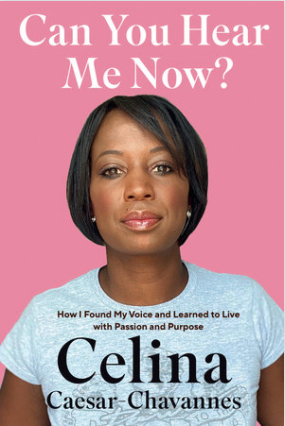
When I moved out of Whitby, the local Member of Parliament was Liberal Celina Caesar-Chavannes. She was, we thought, a high-profile person who’d probably be quickly moved into a junior cabinet position, as Justin Trudeau sets a very high value on being seen to be supportive of women and minorities. As she quickly discovered, however, with Trudeau it’s very much the “being seen” part that matters to him and almost nothing in the way of actually being supportive:

[After a kerfuffle with opposition MP Maxime Bernier] she said she didn’t hear from most of her Liberal colleagues or the prime minister until a #hereforCelina hashtag campaign started weeks later, in response to a column that accused her of “seeing racism everywhere.” When she later confronted Trudeau about the lack of support, she said he told her, “As a strong Black woman, I didn’t think you needed help.” She said Conservative MP Michelle Rempel Garner was more supportive to her during that period than Trudeau.

The incident is one of many allegations of racism, tokenizing, and microaggressions Caesar-Chavannes wrote about in her new memoir Can You Hear Me Now?, which came out February 2.

[…]

Caesar-Chavannes told VICE World News her experiences of being tokenized, excluded, and undervalued led her to resign from the Liberal caucus and not run again in the 2019 election. Her decision culminated in an explosive conversation with Trudeau in February 2019, during which she alleges he complained to her about being confronted about his privilege. She said he was angry that she wanted to resign on the same day then Minister of Veterans Affairs Jody Wilson-Raybould quit her cabinet role, in the midst of the SNC-Lavalin scandal, the biggest crisis the governing Liberals had faced since Trudeau’s election in 2015.

“I was met with an earful that I needed to appreciate him, that everybody talked to him about his privilege, that he’s so tired of everybody talking to him about this stuff, and that I cannot make this announcement right now,” she said. She alleges he told her “he couldn’t have two powerful women of colour leave at the same time.”

After listening to his “rant” for a while, Caesar-Chavannes said she cussed out the prime minister.

“I had to ask him, ‘Motherfucker, who the fuck do you think you’re talking to?'” she said. “I was so angry.”

She said she didn’t make out what Trudeau said after that, but it “sounded like he was crying.” She ended up delaying her resignation announcement until March 2019.

Caesar-Chavannes said the Liberal party’s treatment of Wilson-Raybould — an Indigenous woman and whistleblower — made her feel like many of her colleagues were “fake as fuck” and cemented her desire to sit as an independent.

February 6, 2021

QotD: Political virtue signalling in everyday conversation

Filed under: Politics, Quotations — Tags: , , — Nicholas @ 01:00

At the time, I was struck by the presumption — the belief that everyone present would naturally agree — that opposition to Brexit and a disdain of Trump were things we, the customers, would without doubt have in common. That the poem’s sentiment of friendship and community was being soured by divisive smugness escaped our local academic, whose need to let us know how leftwing he is was apparently paramount. The subtext was hard to miss: “This is a fashionable restaurant and its customers, being fashionable, will obviously hold left-of-centre views, especially regarding Brexit and Trump, both of which they should disdain and wish to be seen disdaining by their left-of-centre peers.” And when you’re out to enjoy a fancy meal with friends and family, this is an odd sentiment to encounter from someone you don’t know and whose ostensible job is to make you feel welcome.

It wouldn’t generally occur to me to shoehorn politics into an otherwise routine exchange, or into a gathering with strangers, or to presume the emphatic political agreement of random restaurant customers. It seems … rude. By which I mean parochial, selfish and an imposition — insofar as others may feel obliged to quietly endure irritating sermons, insults and condescension in order to avoid causing a scene and derailing the entire evening. The analogy that comes to mind is of inviting the new neighbours round for coffee and then, just before you hand over the cups to these people you’ve only just met, issuing a lengthy, self-satisfied proclamation on the merits of mass immigration, high taxes and lenient sentencing. And then expecting nodding and applause, rather than polite bewilderment.

David Thompson, “The Blurting”, David Thompson, 2019-09-04.

February 4, 2021

Ace reads the upper middle class out of the conservative movement

Filed under: Politics, USA — Tags: , , , , , , , — Nicholas @ 03:00

At Ace of Spades H.Q., Ace himself explains why he doesn’t consider anyone who evinces loyalty to “the mores of the upper middle class” to be in any way, shape, or form “conservative”:

Never once do these bougie “cons” notice that the class whose class markers they are so eagerly collecting like Cub Scout merit badges are entirely created by progressives.

I’m going to say this more straightforwardly than I’ve ever said it. I’ve hinted around it, I’ve never said it straight up.

But here goes:

People loyal to the mores of the upper middle class are left-liberal. Period.

They should have no place in the leadership and “thought” leadership of any “conservative” movement. They are not conservative.

They are all pro-gay marriage.

They are all pro-abortion.

They are all in favor of shipping out every single working-class job to China, and, for those few remaining jobs which must be performed in America, shipping in workers from the third world to displace Americans.

They are all supporters of a soft version of the SJW progressive stack. They all believe in “White Privilege,” for an obvious reason — as the rich children of the prosperous upper-middle class, they’re actually the ones born to privilege, but they wish to obscure that fact. So they buy into the left’s claims about the “White Privilege” of 63% of the country, instead of focusing on the wealth privilege of 10%.

Jake Tapper will entertain he shares a kind of privilege with two thirds of the country but he will never acknowledge his real privilege, one shared by only 10% of the country.

And the social-climbing “conservative” media class is almost entirely born from the same prosperous class. They too do not want to talk about real privilege.

I always want to ask these guys, so desperate to peonize the working class: How far back in time do you have to go to find an ancestor who had a job which caused callouses to form on his hands?

Was it two generations ago? Three? It’s obvious the “conservative” media class has never had to work a shovel in their lives. The toughest job they’ve ever held was working in their dad’s law office, or valet parking Beemers at the country club.

And yes, they support the leftwing SJW claims about race. Bullshit like “minorities can’t be racist,” or at least not racist in a way that should be held against them.

That’s why they all rushed to defend notorious, swaggering racist Sarah Jeong, and refuse to even acknowledge the eyebrow-singing anti-white racism seen every single day in the media.

To acknowledge there’s such a thing as “anti-white racism,” and that it ought to be condemned, is, they’ve decided, an “alt-right” idea, and the alt-right is a lower class phenomenon, and, as I’ve noted, they really, really really need you to know they are not lower class.

The only way in which they are arguably “conservative” is that … they are in favor of oligarchical fascism directed by the billionaires signing their paychecks.

Which is of course not “conservative” at all. But that’s the one category in which they can make an arguable case for their “conservatism” — in always championing the Ruling Class’ right to rule over the downscale Dirties.

Is that the “conservatism” we want? A gonzo left-liberalism which is also thoroughly anti-republican, anti-egalitarian?

Also at Ace of Spades H.Q., OregonMuse quoted this rather timely Barry Goldwater statement:

I have little interest in streamlining government or in making it more efficient, for I mean to reduce its size. I do not undertake to promote welfare, for I propose to extend freedom. My aim is not to pass laws, but to repeal them. It is not to inaugurate new programs, but to cancel old ones that do violence to the Constitution or that have failed their purpose, or that impose on the people an unwarranted financial burden. I will not attempt to discover whether legislation is “needed” before I have first determined whether it is constitutionally permissible. And if I should later be attacked for neglecting my constituents’ “interests”, I shall reply that I was informed that their main interest is liberty and that in that cause I am doing the very best I can.

February 2, 2021

Well, it is a very, very cunning plan …

Filed under: Government, History, Media, Politics, USA — Tags: , , , , , , — Nicholas @ 03:00

In the latest Libertarian Enterprise, Sarah Hoyt explains why the progressives’ cunningest of cunning plans may not be cunning enough:

The left has a plan so cunning that if it were a person, it would be teaching cunningology at Oxford. And the ones who get the reference will also know that their plan is about to go pear shaped in all sorts of interesting ways, and at the end of it there might very well be a turnip or two involved, but not as the only item available in the shelves of the grocery store.

Look, someone pointed out in the comments the left are trying to follow the “plan” for other communist revolutions round the world.

He’s right. They’re trying to follow it to the letter. Partly because it’s worked before, and partly, because to be fair, they’re a cult, and cults don’t know the reason for the ritual, they just follow it.

… but it’s already going wrong. And it’s only going to get worse.

You see, part of the problem is that the cult of communism and the procedures for “the revolution” were set in the early twentieth century. And it’s designed for the early twentieth century. To the extent they worked in places like Venezuela, it is because the underlying structures of the society were still very much “early twentieth century.”

The US? Well, not so much. In fact we never were much like the early twentieth century in Europe, which is why they’ve had a hell of a time getting a foothold here.

The communist revolution is designed to work in a country that is mostly urban, with a vast urban underclass that can’t rise above for reasons both internal and external despite working unreasonable hours. It’s designed for a country with a firm aristocracy of the hereditary sort (even if that aristocracy is often from trade), it is designed for a country with a conscript army where the plum assignments go to the “good families” as a matter of course, it is designed to work — most of all and very importantly — in a country where they ABSOLUTELY control all the means of mass communication and do so without the vast majority of the people being aware of it.

The last time they could have pulled that off in the US was in the mid seventies. And my guess, honestly, is that they tried. I don’t know for sure, since the news of the time were all reported by biased sources, and besides I’m too lazy and too busy […] to spend my day chasing down hints. I bet they did try, though. I bet they gave it a sporting try. And I bet part of the issue back then — as now, btw — is that they were pinning their hopes on a race war, having both not realized how much of a minority people of African descent are in the US (last estimate is what? 14%? Sizeable, sure, but not a large minority and certainly not a majority. Also, and seriously, a lot of that minority is middle class and whatever they voice from the mouth-out as uninterested as the rest of us in having the apple cart overturned. Apples are tasty. Genocide not so much.) Mostly because that sh*t was so successful in Africa, and again the left doesn’t think. It ritualistically applies “what worked” without being able to account for changed conditions.

Anyway, that was the last time they could have MAYBE credibly have followed their little red map to revolution and have it work. And even then Americans were just too darn contrarian. Why everyone and their parents were telling us that Republicans were so dangerous, that they were going to start the nuclear war, that — And we went and voted Reagan in. (Well, not me. I only worked towards it. I didn’t vote. I wasn’t a citizen and I’m not a democrat.)

In fact, America could have engraved on its door lintel “authorities can go f*ck themselves.” The left keeps forgetting that. And sometimes justifiably. Take their Covid-psy-ops. It worked. And it was all run on the “experts” and how important it was.

Uh uh. So, they think their control is back! They’re golden again, baby!

« Newer PostsOlder Posts »

Powered by WordPress