
Those who, for political reasons, keep past oppression or crime constantly before the mind of the descendants of the victims (that is to say, descendants of the victim group, not necessarily of the individual victims) help to foment and foster a deep mistrust or resentment that is no longer justified, but which can lead people in effect to cut off their noses to spite their faces.
This is to the great advantage of political entrepreneurs who surf resentment as surfers ride waves in Hawaii; and such resentment, the most damaging of all emotions, can easily become a self-reinforcing loop. It is not that past oppression or crime should be forgotten, much less denied, but that past achievements and change for the better must also be recognised, lest oppression and crime come to occupy minds entirely and distort decisions.
It is the same with injustice. It is important to oppose injustice, but just as important not to see it everywhere. To ascribe everything that you think undesirable to injustice may blind you to its real causes.
Theodore Dalrymple, “History and Self-Perpetuating Resentment”, The Iconoclast, 2021-03-20.
June 26, 2021
June 24, 2021
“[M]any of the woke genuinely do not understand why anyone finds their politics, or their political tactics, threatening”
In The Line, Joseph Heath tries to explain why many adherents of the wokist ideology fail to understand why anyone could possibly be against their policies or their tactics:
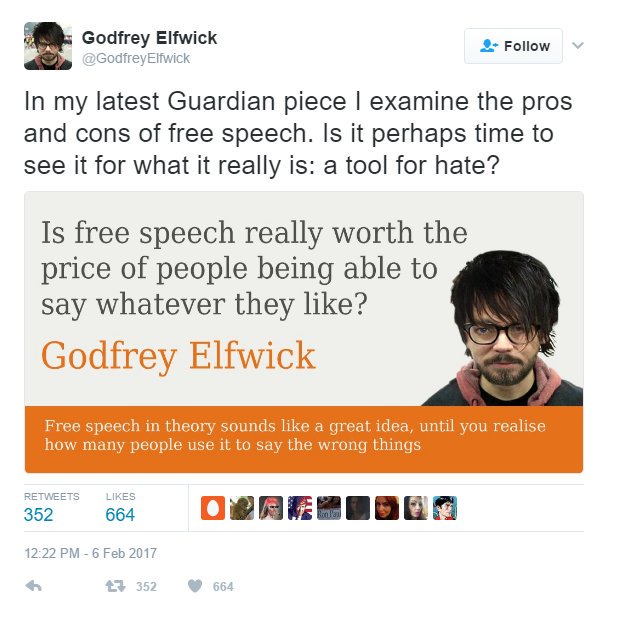
Godfrey Elfwick’s disturbingly accurate summary of free speech support among the woke.
After several years of creeping illiberalism under the guise of progressive politics, American liberals are finally getting their act together. They are pushing back, creating several organizations committed to combating the influence of “woke” politics and ideology. They have momentum, not just because many woke mantras like “defund the police” have proven spectacularly unpopular, but also because there is genuine growing alarm about the intolerant and authoritarian brand of politics that has become associated with the woke left.
Unfortunately, many of the woke genuinely do not understand why anyone finds their politics, or their political tactics, threatening. In particular, the accusation that they are being authoritarian, or that “cancel culture” is a threat to freedom of expression, is one that they are simply unable to process.
There is a reason for this — and one that’s worth understanding. There are several key phrases that play an enormously important role in woke politics (e.g. “safety”, “mental health”, “microaggression”, “bullying” and even “human rights”) which they use to deflect the accusation of authoritarianism. If you adopt the right words, it’s easier to convince yourself that you’re the good guys even as you’re acting like the bad ones.
I want to take a shot at explaining how this works.
The most important thing to understand about woke politics is that it is not a conventional form of illiberalism, it is better thought of as a type of “illiberal liberalism”. It involves making a set of political demands that are fundamentally illiberal, but then articulating them in a way that fits the conventional structure of liberal political discourse. Because of the way that their complaints are packaged, the woke are able to brush off criticism of their tactics.
Take an issue like freedom of speech. There are various versions of this traditionally liberal virtue; predominant among them, is that those who hold this belief are opposed to content-based restrictions on speech. In the old days, lots of politicians didn’t really believe in freedom of speech, as many among the ruling class maintained straightforwardly illiberal views.
June 21, 2021
“The public are getting a little bit fed up of virtue-signalling police officers when they’d really rather we just locked up burglars”
Gawain Towler on the sudden, unexpected — and undoubtedly unwelcome to self-appointed guardians of the official narrative — appearance of what sounds surprisingly like common sense from a top police officer in Britain:
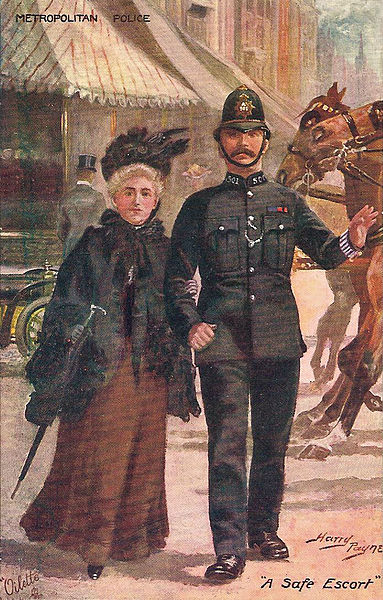
“A Safe Escort” by Harry Payne (1858-1927), first published in August 1911 but possibly painted a few years earlier. From the back of the card: “Among the hundred and one duties of the London Policeman he is here depicted as a kindly protector, halting the traffic as he escorts a Lady across the congested streets. This is essentially a London incident, and has no parallel in any other Police Force in the world.”
Photo of the Tuck’s Oilette by Leonard Bentley via Wikimedia Commons.
Has Robert Peel been reincarnated as the Chief Constable for Manchester?
“But officer, if you are not on your knee, and wearing a rainbow lanyard, how do we know that you are on the side of the oppressed, the intersectional, the poor, downtrodden graduates of minor universities?”
“I’m sorry madam, may I call you madam? I am on the side of the law.”
The promotion of Stephen Watson as the new Chief Constable for Manchester comes as a shaft of light cutting through the murk of muddled thinking. He has said two things that will resonate with millions and will cause consternation amongst thousands:
I would probably kneel before the Queen, God and Mrs Watson, that’s it … The public are getting a little bit fed up of virtue-signalling police officers when they’d really rather we just locked up burglars.
It sounds like the first blast of the trumpet, but not only does it strike an astonishingly different note than the honky tonk tunes played by other constabularies. Stentorian and self confident it also marks a huge departure in that he makes a very public statement that he would kneel before God. A very courageous statement in the current climate in itself. But it is his approach to policing that strikes the eye.
One almost feels that as was once the case, each new officer in the Manchester Metropolitan Area will be issued with Sir Robert Peel’s 1829 Nine Principles of Policing. It is worth our while looking at those principles and deciding whether or not to accept that they should remain at the core of policing, or be junked as impossibly dated.
What is clearly apparent is that Peel’s principles are at heart about consent. Famously it described the police as merely the citizens in uniform, or that “the police are the public and that the public are the police, the police being only members of the public who are paid to give full time attention to duties which are incumbent on every citizen in the interests of community welfare and existence”.
Underlying this basic thought is an understanding that the police rely, entirely on the goodwill of the populace, if they wish to carry out their basic duties. In order to fulfil their functions and duties they are “dependent on public approval of their existence, actions and behaviour and on their ability to secure and maintain public respect”.
“… the GOP needs an inflammatory issue to rile their racist base, and so this entire foofaraw is really just an astro-turfed, ginned-up partisan gambit about nothing”
An excerpt from Andrew Sullivan’s most recent Weekly Dish looks at the burgeoning fight over the use of Critical Race Theory in public schools:
The stories in the mainstream media this past week about the broadening campaign to ban critical race theory in public schools have been fascinating — and particularly in how they describe what CRT is. Here’s the Atlantic‘s benign summary of CRT: “recent reexaminations of the role that slavery and segregation have played in American history and the attempts to redress those historical offenses.” NBC News calls it the “academic study of racism’s pervasive impact.” NPR calls CRT: “teaching about the effects of racism.” The New York Times calls it, with a straight face, “classroom discussion of race, racism” and goes on to describe it as a “framework used to look at how racism is woven into seemingly neutral laws and institutions.”
How on earth could merely teaching students about the history of racism and its pervasiveness in the United States provoke such a fuss? No wonder Charles Blow is mystified. But don’t worry. The MSM have a ready explanation: the GOP needs an inflammatory issue to rile their racist base, and so this entire foofaraw is really just an astro-turfed, ginned-up partisan gambit about nothing. The MSM get particular pleasure in ridiculing parents who use the term “critical race theory” as shorthand for things that just, well, make them uncomfortable — when the parents obviously have no idea what CRT really is.
When pushed to describe it themselves, elite journalists refer to the legal theories Derrick Bell came up with, in the 1970s — obscure, esoteric and nothing really to do with high-school teaching. “If your kid is learning CRT, your kid is in law/grad school,” snarked one. Marc Lamont Hill even tried to pull off some strained references to Gramsci to prove his Marxian intellectual cred, and to condescend to his opponents.
This rubric achieves several things at once. It denies that there is anything really radical or new about CRT; it flatters the half-educated; it blames the controversy entirely on Republican opportunism; and it urges all fair-minded people to defend intellectual freedom and racial sensitivity against these ugly white supremacists.
What could be more convenient? NBC News “reporter”, Brandy Zadrozny, even decried parents’ attempts to discover through FOIA requests just what their children are being taught — and argued this week that, “for longtime ultra conservative activists, CRT is the opportunity of a lifetime.” CRT, she explains, is not a threat at all, and there is no proof that it is even being taught. It’s “just a catch-all term repurposed as a conservative boogeyman.” She goes on: “it harnesses pushback against 2020’s racial justice movement, covid denialism, and depends on a base still energized by Trump and misinformation, looking for political power.”
I’m sure the MSM will continue to push this narrative indefinitely. They are still insisting, after all, that “white supremacy” is behind hateful attacks on Asian-Americans, and that soaring murder rates are purely a function of Covid19. And you can see why: this dismissive take is extremely helpful in avoiding what is actually happening. It diverts attention from the stories and leaks and documents that keep popping up all over the place about extraordinary indoctrination sessions that have become mandatory for children as early as kindergarten.
QotD: The young Richard Nixon
The Orthogonians’ base was among Whittier’s athletes. On the surface, jocks seem natural Franklins, the Big Men on Campus. But Nixon always had a gift for looking under social surfaces to see and exploit the subterranean truths that roiled underneath. It was an eminently Nixonian insight: that on every sports team there are only a couple of stars, and that if you want to win the loyalty of the team for yourself, the surest, if least glamorous, strategy is to concentrate on the nonspectacular — silent — majority. The ones who labor quietly, sometimes resentfully, in the quarterback’s shadow: the linemen, the guards, the punter. Nixon himself was exemplarily nonspectacular: the 150-pounder was the team’s tackle dummy, kept on squad by a loving, tough, and fatherly coach who appreciated Nixon’s unceasing grit and team spirit — nursing hurt players, cheering on the listless, even organizing his own team dinners, entertaining the guests on the piano, perhaps favoring them with the Orthogonian theme song. It was his own composition.
Nixon beat a Franklin for student body president. Looking back later, acquaintances marveled at the feat of this awkward, skinny kid the yearbook called “a rather quiet chap about campus,” dour and brooding, who couldn’t even win a girlfriend, who attracted enemies, who seemed, a schoolmate recalled, “the man least likely to succeed in politics.” They hadn’t learned what Nixon was learning. Being hated by the right people was no impediment to political success. The unpolished, after all, were everywhere in the majority.
Rick Perlstein, Nixonland: The Rise of a President and the Fracturing of America, 2008.
June 20, 2021
L’Affaire Annamie Paul – “… it’s like every Liberal across the land forgot about politics”
The weekly wrap-up from The Line wonders why Canadian media outlets pay so much attention to the Green Party (far in excess of their political influence normally), but recent Green Party fratricidal bun-fighting merits attention just because of the injured bystander, the Prime Minister of the current year:
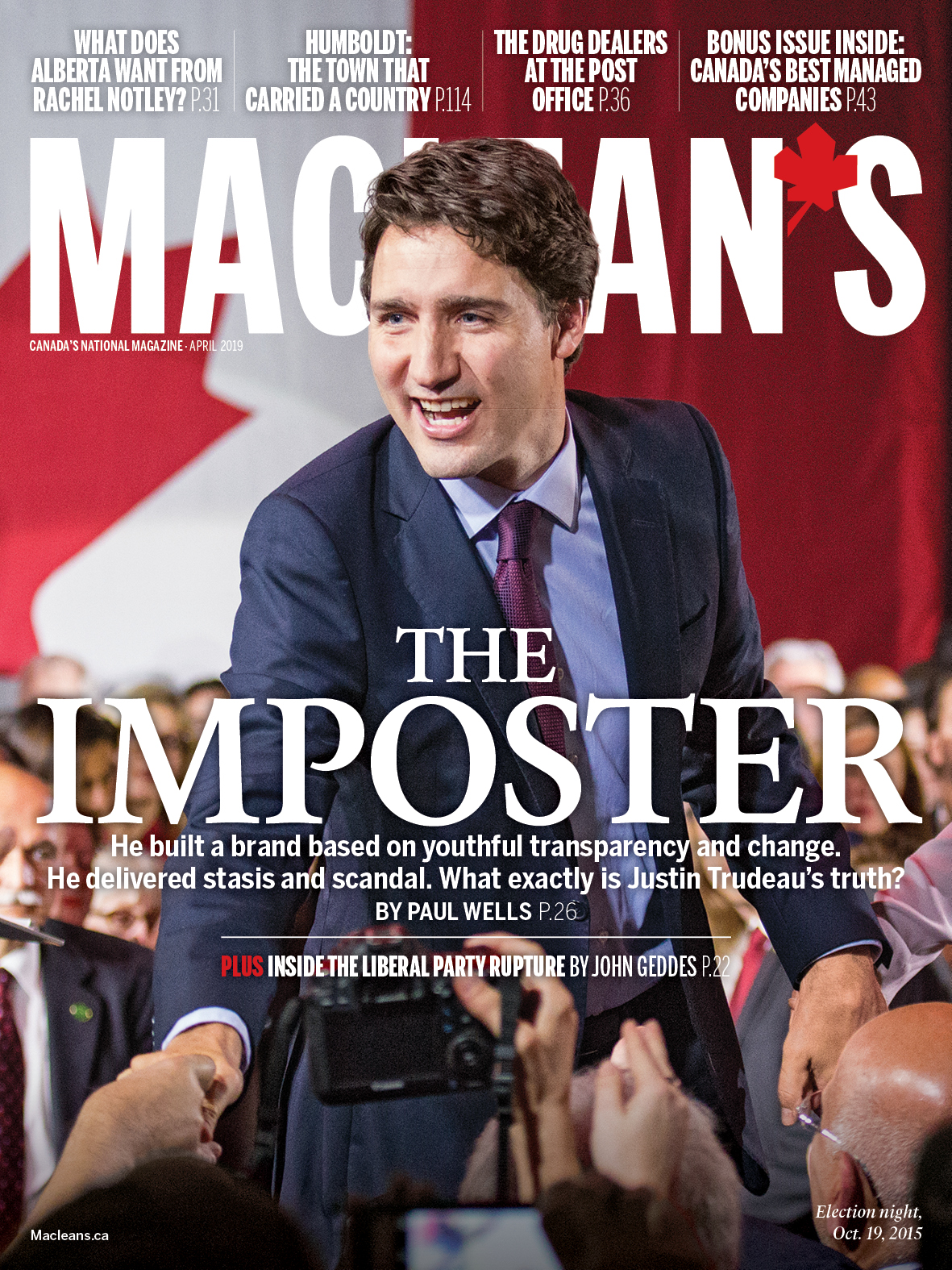
The background of all of this is complicated, and we’re not going to bother recapping it. If you care enough about Canadian politics to follow the Greens, you know it all already. What’s interesting to us — and funny as all hell — is how angry the PM’s die-hard fanbase was, how shocked and sincerely surprised they were, when Paul turned her guns on the PM instead of her own rebelling party executives and grassroots:
“To the prime minister, Justin Trudeau,” Paul said at a press conference, “I say to you today, you are no ally. And you are no feminist. Your deeds and your words over these past weeks prove that definitively. A real ally and feminist doesn’t end their commitment to those principles whenever they come up against their personal ambition.”
And, gosh. Liberals everywhere were just stunned.
It was cute. As we said, it’s like every Liberal across the land forgot about politics. And that’s ridiculous. Canadian Liberals are the most ruthlessly effective vote winners precisely because they are relentlessly amoral and craven. We don’t even mean this as an insult! Your typical Canadian Liberal constitutes the purest sample of raw partisanship known to human science — which is why they’re so good at winning.
And that’s why they should have instantly understood what Paul was doing when she attacked the PM. She was picking a fight she could win because she’s losing the one she’s actually facing. Paul is a black woman. She’s Jewish. She’s obviously lost control of her own party. The only chance in hell she has of surviving is to lay every possible identity group card down on the table, declare herself the champion of those oppressed groups, and then dare her own party to purge her. She’s adopting the mantle of the WOC woke champion. It’s a lot easier for Paul to fight that battle against the PM than it is for her to fight it against her own party.
As much as Liberals hate to admit it — and they really, really, really hate to admit it — the PM is vulnerable to accusations of hypocrisy on the feminism and racial equality files. Obviously.
Paul is desperate. She’s in a fight for her political life, and she seems to be losing. So she’s picked a fight with a powerful white man to play up her own “voice of the oppressed” credentials. It’s cynical and desperate. Frankly, the Liberals ought to be honoured. What’s that they say about imitation and flattery?
QotD: Cargo cult thinking in education
The problem of course is that college is not the cause of prosperity, but a marker (with prosperity) of other traits — focus on long-term goals, discipline, hard work, and yes knowing 2+2=4. This sort of woke BS just makes it worse, because it attacks the real roots of prosperity. There are real barriers to poor blacks achieving prosperity — eg how do you focus on long-term goals when you don’t know where you are sleeping tonight or when you have no role models who do so — but the purity and objectivity of math is not among these.
This sort of cargo cult thinking can be seen all the time in Progressive economic proscriptions. The government push for home ownership is another — middle class people own homes so if low income people owned homes they would become middle class. Now, this has a bit of accuracy in that, like the stock market, the elite have goosed the housing market to always go up. But leaving that aside for a moment, owning a home vs renting is a terrible decision for many people — it piles on a lot of financial risk but perhaps more importantly it limits geographic mobility which used to be critical to lower-income people improving their lot.
Warren Meyer, “Are the Woke a False Flag Operation of White Supremacists?”, Coyote Blog, 2021-02-16.
June 17, 2021
QotD: Declaring war on the Upper-Class Media
67% of US families watch the Super Bowl — what percent of New York Times editors and reporters do? 20% of Americans go to religious services weekly — how many of those work for the New York Times? How come 96% of political donations from journalists go to Democrats? Your job is to take a page from the Democratic playbook and insist there is no reason any of this could be true except systemic classism, that any other explanation is offensive, and it’s the upper-class media’s moral duty to do something about this immediately. Until they do so you are absolutely justified in ignoring them and trusting less bigoted and exclusionary sources (I hear Substack is pretty good!)
Insist that working-class people have the right to communicate with each other without interference from upper-class gatekeepers. Make sure people know every single fact about @Jack and what a completely ridiculous person he is, and point out that somehow this is the guy who decides what you’re allowed to communicate with your Twitter friends. Every time tech companies censor social media, even if they’re censoring left-wing views, call their CEOs in for long and annoying Congressional hearings where you use the words “Silicon Valley elites” a lot.
Scott Alexander, “A Modest Proposal For Republicans: Use The Word ‘Class'”, Astral Codex Ten, 2021-02-26.
June 16, 2021
“One nation, indivisible”?
As a child in England and then in Canada, I was used to the relatively low-key acknowledgements of the Crown and the nation which may be why I was quite befuddled watching American TV portrayal of the in-your-face patriotic displays of the United States, especially the Pledge of Allegiance required of schoolchildren. It seemed oddly statist and even collectivist (although I didn’t know those terms at the time) for a country that constantly seemed to be patting itself on the back as the “home of the free”. I later learned that the Pledge hadn’t even been invented until nearly a century after the nation had been established (and the current version was devised and popularized by a noted utopian socialist, then adopted by Congress in 1942). Tom Mullen explores how the Pledge came about and considers the idea that it is time to drop it:

“American Flag” by JeepersMedia is licensed under CC BY 2.0

An Atlanta, Georgia, charter school announced last week its intention to discontinue the practice of having students stand and recite the Pledge of Allegiance during its schoolwide morning meetings at the beginning of each school day, opting to allow students to recite the pledge in their classrooms instead. Predictably, conservatives were immediately triggered by this “anti-American” decision, prompting the school to reverse its decision shortly after.
The uproar over periodic resistance to reciting the pledge typically originates with Constitution-waving, Tea Party conservatives. Ironically, the pledge itself is not only un-American but antithetical to the most important principle underpinning the Constitution as originally ratified.
[…]
Then, there’s “indivisible”. One would think a federation born by its constituent states seceding from the nation to which they formerly belonged would make the point obvious enough. But the Declaration makes it explicit:
That whenever any Form of Government becomes destructive of these ends, it is the Right of the People to alter or to abolish it, and to institute new Government, laying its foundation on such principles and organizing its powers in such form, as to them shall seem most likely to effect their Safety and Happiness.
It would be impossible to exercise that right — that duty, as the Declaration later calls it — if the republic were indivisible. The strictest constructionists of the time didn’t consider the nation indivisible. Thomas Jefferson didn’t threaten to send troops to New England when some of its states considered seceding upon his election. Quite the opposite. And in an 1804 letter to Joseph Priestly, he deemed a potential split in the union between “Atlantic and Mississippi confederacies” not only possible but “not very important to the happiness of either part.”
The people advocating “one nation, indivisible” in those days were big government Federalists like Hamilton, whose proposals to remake the United States into precisely that were flatly rejected in 1787.
Proponents of absolute, national rule like to quip this question was “settled” by the American Civil War. That’s like saying Polish independence was “settled” by Germany and the Soviet Union in 1939.
In fact, it is precisely the trend towards “one nation” that has caused American politics to become so rancorous, to the point of boiling over into violence, over the course of the last several decades. This continent is inhabited by a multitude of very different cultures, which can coexist peacefully if left to govern themselves. But as the “federal” government increasingly seeks to impose a one-size-fits-all legal framework over people who never agreed to give it that power, the resistance is going to get more and more strident. If there is any chance to achieve peace among America’s warring factions, a return to a more truly federal system is likely the only way.
Getting rid of the un-American pledge to the imaginary nation would be a good, symbolic start.
June 12, 2021
Canadian “Conservatives” start listing their preferred pronouns
Mark Steyn surveys the “conservatives” in the UK, the US, and last-and-least, Canada:

Michelle Rempel Garner, Conservative MP for Calgary Nose Hill (preferred pronouns she/her).
Photo attributed to “Michelle Staff” via Wikimedia Commons.
So much for UK conservatism. What of Canada? The two most rock-ribbed “right-wingers” in the Dominion’s politics, Doug Ford of Ontario and Jason Kenney of Alberta, have taken the position that conservatism is an indulgence you can’t afford in a pandemic: Just as there are no atheists in foxholes, so there are no conservatives in lockdowns.
At the federal level, the cautious and eventually stalled incrementalism of Stephen Harper was followed by the unprincipled hollowness of Andrew Scheer and, after his predictable failure, the everything-must-go massive-storewide-clearances of Erin O’Toole. Even so, I was startled by a tweet from Michelle Rempel Garner, an Alberta MP whom I knew only as an occasionally lively thorn in the side of Justin & Co. Ms Rempel Garner was responding to the appalling killings of a Muslim family in London, Ontario, which within minutes had been seized on by the media-left alliance for the usual purposes, notwithstanding that the perp does not appear to fit the desired narrative. Nevertheless, the outbreak of vehicular “Islamophobia” was taken by Michelle Rempel Garner as the perfect opportunity for an express checkout:
I humble myself and ask forgiveness, and seek to make things right.
I have privilege; I am cis/straight/white. But I am also a woman who works in a system dominated by white maleness.
But no excuses. I will do what I can.
Seeing the above at the great Kate McMillan’s website, I assumed it was a giant leg-pull by Ms Rempel Garner, as did many other of Miss McMillan’s readers. So, as she clarified, no, sorry, it’s for real. The Tory member’s Twitter account now shows her pronouns: “she/her” (at the time of writing). In 2019 it was a big deal when Kamala Harris, at the start of a Democrat debate, announced her pronouns. Less than two years later, “conservative” politicians want a piece of the pronoun action too. Already a key player in O’Toole’s shadow cabinet, the she/her move could make Michelle a shoo-in for Deputy Prime Minister.
Except, of course, that that would require the Tories to win an election.
Guys, it was a joke that modern conservatism is just progressive policies on a five-year delay … please stop taking it seriously!
June 11, 2021
The concept of philanthropy is another one with conflicting meanings to the left and to the right
In the Daily Chrenk, Arthur Chrenkoff has a bit of fun outlining the recent kerfuffle over Alexandria Ocasio Cortez’s attempt to use her grandmother’s situation in Puerto Rico for scoring political points, and then explains why the notion of philanthropy is a very different thing to progressives than it is to conservatives:
“Charity in the dictionary” by HowardLake is licensed under CC BY-SA 2.0

Well may we laugh about (and be disgusted by) the hypocrisy, corruption and indifference shown by prominent members of the left towards the very people they supposedly care about. But it would be to miss the broader point relating to how the left views the world, the role of politics, and the place of the individual.
It might surprise many that the caring and compassionate left isn’t actually all that big on philanthropy and charity, i.e. people helping other people. What could be wrong with that? Wouldn’t the world be a better place if even more people helped even more other people? Well, no, the left would say, because it’s not something that people should be doing in the first place; it’s not their responsibility. It is up to the state to solve all the social and economic problems; our role as citizens (as well as, thanks to the open borders advocates, non-citizens) is to be the grateful recipients of the government’s largesse. For the more elite group (no pun intended) – “the rich” – their role is to pay for all this with their taxes. Private initiative is by its very nature limited and patchy; only the all-seeing and all-powerful state can ensure that everyone who needs “free” assistance (and that’s literally everyone) gets it in a comprehensive, uniform and fair way. Hence, AOC won’t lift a finger to help her grandmother because it’s the state’s duty to help everyone rebuild their lives after a natural disaster. Occasional Cortex already contributes with her taxes on the hard-earned Congressional salary, and in any case, she’s not some billionaire, you know.
With that attitude, needless to say, you won’t be surprised to learn that much of what goes for the left-wing philanthropy does not actually go to help those in need to solve their problems and provide them what they are lacking. Instead, it is largely channels to finance political agitation by the activist-industrial complex to make the government (whether through lobbying, campaigning or helping elect sympathetic law-makers) take responsibility instead. That’s what people like Soros, Laurene Powell-Jobs (Steve Jobs’ widow) and MacKenzie Scott (Jeff Bezos’ ex) are all about – billions spent to create more activist jobs to agitate for the state to create more public sector jobs to run the “Big Daddy”.
But it goes deeper than that, back to Marx himself in fact and to his analysis of what’s wrong with the world and how to fix it. According to Marxism, both in its original class-based iteration and the more recent race/gender/sexuality variants, every society is divided into two mutually antagonistic groups: the powerful oppressors and the powerless oppressed, with the society structured in the interest of the former by facilitating in every possible way the exploitation and keeping down of the latter. Thus, all the problems, ills and injustices are “systemic” in nature; they are a feature, not a bug. To solve them and so to help the downtrodden you need to overthrow the entire old unjust system and build a new one that benefits the masses. Based on this sort of understanding of the world – to which, coincidentally, people like AOC and BLM founders all subscribe – any private charity is bound to be ineffectual and shortcoming. After all, what can a person, however generous with their money and time – even if there are multitudes of them – do to solve problems that are the direct (and intended) consequence of the way the society has been set up? Nothing, of course. You can’t mend it, you have to end it. But not only is it naïve and pointless to try, it’s actually counter-productive and therefore positively wrong. Because while no philanthropic effort can solve systemic problems, it can actually provide some limited and temporary relief. Such relief, however, by its very nature is a band-aid solution, i.e. not a solution at all. All it does it momentarily numbs the pain, and that is bad, because the oppressed masses need to feel the pain and feel it good in order to spur them into revolutionary action to overthrow their oppressors and on the ruins of the old build the utopian new society of equality and justice. This is the far-left’s accelerationism: the worse it gets, the better it gets (for the prospects of radical change).
Latin and Greek are the next sacrifices to the great god Antiracism
In the latest edition of It Bears Mentioning, John McWhorter considers the Princeton University classics department decision to get rid of the requirement for students to read classic texts in the original languages:

“USA – New Jersey – Princeton” by Harshil.Shah is licensed under CC BY-ND 2.0

I have written recently about the Princeton classics department’s decision to eliminate the requirement that students engaging closely with Latin and Greek texts be able to … read them in Latin and Greek. The new idea is that the department will attract more majors by opening up to ideas from students who may be full of beans but just not inclined to tackle complex, ancient languages. And sub rosa, the idea is clearly – as we can see from words in the official statement like underrepresented, perspectives, and experiences – that of especial interest will be black students, especially in light of today’s racial reckoning which the department openly acknowledges was the primary spur for this change.
My disappointment with this decision is because it is part of a tradition of arguments that we do black people a favor by exempting them from certain kinds of faceless, put-up-or-shut-up challenges to entry. Back in the aughts, the classic example was brilliant, fierce black lawyers confidently arguing that because black firefighter applicants don’t do as well on the entrance exams required for the job, the exams are racist and should be eliminated. More recently there has been the idea that if black kids are rare at top-ranked public schools in New York City like Stuyvesant because few excel on the standardized test one must ace to be admitted, then the solution is to eliminate the test as “racist”. The Princeton decision is a variation: to get black kids into classics, it’s supposedly immoral to expect them to master the intricacies of Latin and Greek, languages which I suppose we can see as foreign, “white” to them as well. Rather, they must be admitted in shining expectation that their class comments will be bracingly “diverse” in good old English.
My Atlantic colleague Graeme Wood is more sanguine about the Princeton decision. He argues sagely that a certain kind of student happens to enjoy working their way through languages like Latin as a kind of puzzle (I openly admit being that type), but that there are others who don’t go in for that particular task and yet are itching and well-equipped to engage and analyze classical texts regardless. Graeme notes that we do not consider it an educational tragedy that specialists in English history are not required to be able to read Old English. (Although I wonder if this analogy would hold if the idea were someone specializing in England of the first millennium, where all of the relevant linguistic matter was in Old English [and Latin].)
I can go with him here to an extent. On the one hand, as I have argued here, to engage work only in translation is, of course, to lose a lot. Yet, in making that argument here, I was referring to my own reading War and Peace in English, as I myself was not inclined to hack through it in Russian (although my being black was not the reason for this disinclination [couldn’t help it!]). The question is how important we consider that loss to be.
Having no facility in languages myself, I’m more sympathetic to the students’ viewpoint than I might otherwise be, but depending on someone else’s translation of the text being studied has unexpected risks, as Sarah Hoyt explained from her own translation studies:
The discussion […] reminded me of when I was sixteen and embarked on a class called “Techniques of Translation”.
Although I had studied French and English and German, the translations I’d done so far were of the “I took the pen of my neighbor” variety. I thought the class would teach me to smooth out the sentence to “I took my neighbor’s pen” and that would be that.
I was wrong. Oh, it taught that also, but that was a minor portion of it. The class mostly hinged on the moral, ethical and — most of all — professional dilemmas of being a translator. I know any number of you are translators, formal or informal, but any number of you are also not. So, for the ones who are not, let me break the news with my usual gentleness:
There is no such thing as translation.
The French have a proverb “to translate is to betray a little” — or at least that’s the closest meaning in English. It’s fairly close to the true meaning, but slightly askew, of course. Every language is slightly askew to other languages.
The idea that there exists in every language a word that is exactly the equivalent of other languages is sort of like assuming that aliens will — of course — live in houses, go to school, ride buses, understand Rebecca Black’s “Friday”. [This was originally written in 2011.]
Language is how we organize our thoughts, and each word, no matter how simple, carries with it the cultural freight and experience of the specific language. Oh, “mother” will generally mean “the one who gave birth to” — except for some tribal, insular cultures where it might mean “the one who calls me by her name” or “my father’s principal wife” — but the “feel” behind it will be different, depending on the images associated with “mother” in the culture.
So, when you translate, you’re actually performing a function as a bridge. Translation is not the straightforward affair it seems to be but a dialogue between the original language and the language you translate into. If you’re lucky, you meet halfway. Sometimes that’s not possible, and you feel really guilty about “lying” to the people receiving the translation. When on top of language you need to integrate different cultures and living systems (which you do when translating anything even an ad) you feel even more guilty, because you’re going to betray, no matter how much you try. At one point, a while back, I had my dad on one phone, my husband on the other, and I was doing rapid-fire translation about a relatively straight forward matter. And even that caused me pangs in conscience, because my dad simply doesn’t understand how things are done here. I had to approach his experience and explain our experience in a way he wouldn’t think I was insane or explaining badly. That meant a thousand minor lies.
June 10, 2021
“That’s a nice Pride flag you’ve got there. Be a shame if something were to happen to it …”
In The Line, Allan Stratton argues against replacing the common “rainbow” Pride flag with a new “Progress” variant:
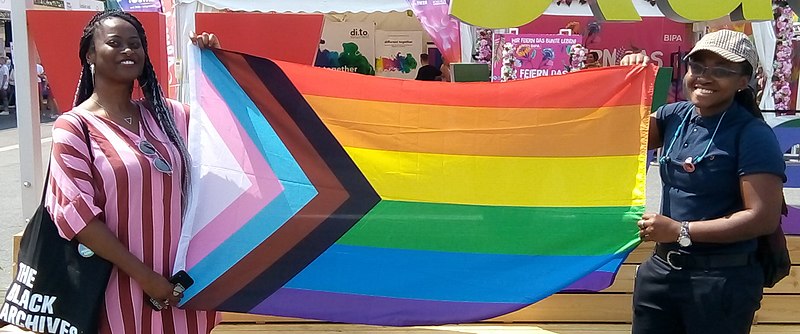
Two people at EuroPride 2019 in Vienna holding an LGBTQ+ pride rainbow flag featuring a design by Daniel Quasar; this variation of the rainbow flag was initially promoted as “Progress” a PRIDE Flag Reboot.
Photo by Bojan Cvetanović via Wikimedia Commons.
Question: What do the following have in common: A hammer and sickle, a Union Jack, five interlocked rings, a Black fist, a cross, a Star of David, and the Rainbow flag?
Answer: They are internationally recognized symbols. Not spring fashions. Not cool memes. No. Symbols that communicate across all languages and countries in the world.
That’s what’s so infuriating about the push by hashtag activists to replace the Rainbow flag with the so-called “Progress flag”. The Progress flag takes the pink, blue, and white stripes of the trans flag, adds black and brown stripes for race, turns those five stripes into a chevron tipped on its side, and ploughs it into the rainbow in an eleven-colour pile-up. It’s a regressive, ill-considered mess that looks like a child’s Crayola box.
Naturally, it’s the creation of a Portland designer who whipped it off one night while suffering insomnia. The story of Daniel Quasar (ze/them) and their flag is a real-life satire, featuring moxie, hustle, viral posts and a Kickstarter campaign. Ze and their (not surprisingly) all-white team have leveraged ze’s design into Quasar Digital, a company that sells Progress flags, pins, patches, T-shirts, tank tops, notebooks, clutch bags, coffee mugs, stickers, slappers, socks and more, individually and in bundles.
Marketed with the trendy buzzwords progress, diversity and inclusion, the Progress flag has been a viral hit with woke straights and nouveau queers as well as corporate PR departments at places like Goldman Sachs and TD Bank, who signal virtue while screwing customers of every gender. But by separating specific races and a single identity from the rainbow, the Progress flag creates divisions, hierarchies and exclusions. And it trashes the power and weight that a 43-year-old symbol of hope and strength gives to people worldwide who continue to be imprisoned, beaten and murdered for being LGBT+.
[…]
Slapping the “Progress” chevron on the Rainbow is like slapping the fleur de lys on the Maple Leaf. It creates resentment and division to the sole benefit of performative social climbers keen to wave their Alphabet status and cachet. Step outside the West to see what it really means to have people out to “deny your very existence”. To trade the Rainbow, the symbol of our suffering and resilience, for a viral craze is bourgeois privilege at its self-indulgent worst.
June 9, 2021
Charles Stross on Robert Heinlein’s Starship Troopers
In his first blog post in nearly a month, Charlie Stross opines on one of Heinlein’s most polarizing novels:

In the 1930s, Heinlein was a soft socialist — he was considered sufficiently left wing and “unreliable” that he was not recalled for active duty in the US Navy during the Second World War. After he married Virginia Gerstenfeld, his third and last wife, his views gradually shifted to the right — however he tended towards the libertarian right rather than the religious/paleoconservative right. (These distinctions do not mean in 2021 what they might have meant in 1971; today’s libertarian/neo-nazi nexus has mostly emerged in the 21st century, and Heinlein was a vehement opponent of Nazism.) So the surface picture is your stereotype of a socially liberal centrist/soft leftist who moved to the right as he grew older.
But to muddy the waters, Heinlein was always happy to pick up a bonkers ideological shibboleth and run with it in his fiction. He was sufficiently flexible to write from the first person viewpoint of unreliable/misguided narrators, to juxtapose their beliefs against a background that highlighted their weaknesses, and even to end the story with the narrator — but not the reader — unaware of this.
In Starship Troopers Heinlein was again playing unreliable narrator games. On the surface, ST appears to be a war novel loosely based on WW2 (“bugs” are Nazis; “skinnies” are either Italian or Japanese Axis forces), but each element of the subtext relates to the ideological awakening of his protagonist, everyman Johnny Rico (note: not many white American SF writers would have picked a Filipino hero for a novel in the 1950s). And the moral impetus is a discussion of how to exist in a universe populated by existential threats with which peaceful coexistence is impossible. The political framework Heinlein dreamed up for his human population — voting rights as a quid pro quo for military (or civilian public) service — isn’t that far from the early Roman Republic, although in Rico’s eyes it’s presented as something new, a post-war settlement. Heinlein, as opposed to his protagonist, is demonstrating it as a solution to how to run a polity in a state of total war without losing democratic accountability. (Even his presentation of corporal and capital punishment is consistent with the early Roman Republic as a model.) The totalizing nature of the war in ST isn’t at odds with the Roman interpretation: Carthago delenda est, anyone?
It seems to me that using the Roman Republic as a model is exactly the sort of cheat that Heinlein would employ. But then Starship Troopers became the type specimen for an entire subgenre of SF, namely Military-SF. It’s not that MilSF wasn’t written prior to Starship Troopers: merely that ST was compellingly written by the standards of SF circa 1959. And it was published against the creeping onset of the US involvement in the Vietnam War, and the early days of the New Wave in SF, so it was wildly influential beyond its author’s expectations.
The annoying right wing Heinlein Mil-SF stans that came along in later decades — mostly from the 1970s onwards — embraced Starship Troopers as an idealized fascist utopia with the permanent war of All against All that is fundamental to fascist thought. In doing so they missed the point completely. It’s no accident that fascist movements from Mussolini onwards appropriated Roman iconography (such as the Fasces): insecure imperialists often claim legitimacy by claiming they’re restoring an imagined golden age of empire. Indeed, this was the common design language of the British Empire’s architecture, and just about every other European imperialist program of the past millennium. By picking the Roman Republic as a model for a beleagured polity, Heinlein plugged into the underlying mythos of western imperialism. But by doing so he inadvertently obscured the moral lesson he was trying to deliver.
June 6, 2021
George Orwell’s “Politics And The English Language” remains the best guide to writing non-fiction
Despite pulling most of his writing behind a paywall, I still get the occasional “Weekly Dish” post excerpt from Andrew Sullivan, including his homage to the still-relevant Orwell essay “Politics and the English Language”:
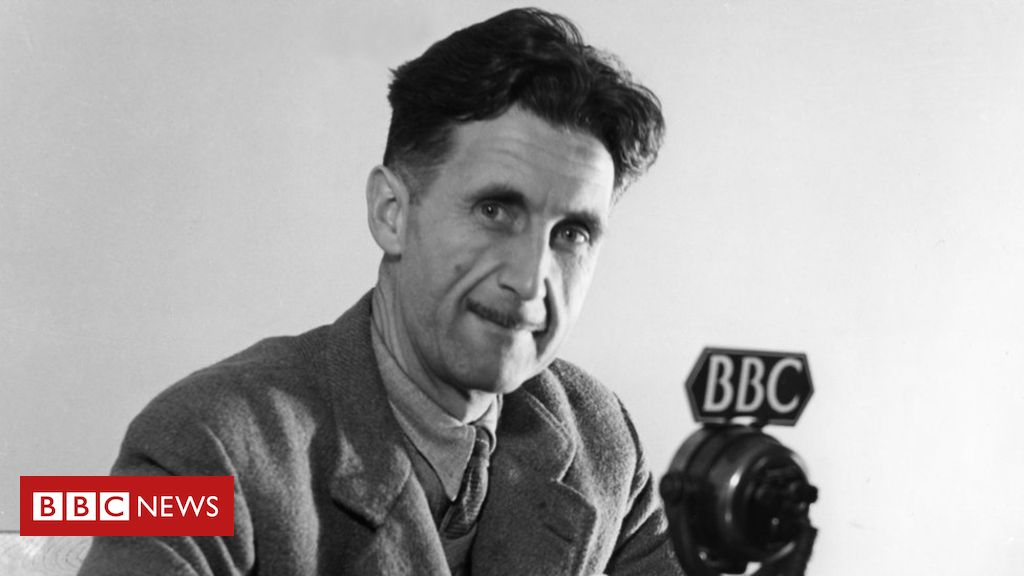
From time to time, I make sure to re-read George Orwell’s classic essay, “Politics And The English Language“. It remains the best guide to writing non-fiction, and it usually prompts a wave of self-loathing even more piercing than my habitual kind. What it shows so brilliantly is how language itself is central to politics, that clarity is as hard as it is vital, and that blather is as lazy as it is dangerous. It’s dangerous because the relationship between our words and our politics goes both ways: “[The English language] becomes ugly and inaccurate because our thoughts are foolish, but the slovenliness of our language makes it easier for us to have foolish thoughts”. We create language and language creates us. If the language is corrupted, so are we.
Near the end of the essay, Orwell lists a few rules to keep writing clear, accessible and meaningful:
i. Never use a metaphor, simile or other figure of speech which you are used to seeing in print.
ii. Never use a long word where a short one will do.
iii. If it is possible to cut a word out, always cut it out.
iv. Never use the passive where you can use the active.
v. Never use a foreign phrase, a scientific word or a jargon word if you can think of an everyday English equivalent.
vi. Break any of these rules sooner than say anything outright barbarous.
Originality, simplicity, brevity, active verbs, everyday language, decency: as simple as it is very, very hard. It’s a relief in a way to recall that Orwell thought things were pretty damn shitty in his day as well, but the more you read broadly across most elite media platforms these days, the more similar it all sounds. To reverse Orwell’s virtues: so much of it is repetition, complexity, length, passive verbs, endless jargon, barbarism.
I was just reading about the panic that occurred in the American Medical Association, when their journal’s deputy editor argued on a podcast that socio-economic factors were more significant in poor outcomes for non-whites than “structural racism”. As you might imagine, any kind of questioning of this orthodoxy required the defenestration of the deputy editor and the resignation of the editor-in-chief. The episode was withdrawn from public viewing, and the top editor replaced it with a Maoist apology/confession before he accepted his own fate.
But I was most struck by the statement put out in response by a group called “The Institute for Antiracism in Medicine”. Here it is:
The podcast and associated promotional message are extremely problematic for minoritized members of our medical community. Racism was created with intention and must therefore be undone with intention. Structural racism has deeply permeated the field of medicine and must be actively dissolved through proper antiracist education and purposeful equitable policy creation. The delivery of messages suggesting that racism is non-existent and therefore non-problematic within the medical field is harmful to both our underrepresented minoritized physicians and the marginalized communities served in this country.
Consider the language for a moment. I don’t want to single out this group — they are merely representative of countless others, all engaged in the recitation of certain doctrines, and I just want an example. But I do want to say that this paragraph is effectively dead, drained of almost any meaning, nailed to the perch of pious pabulum. It is prose, in Orwell’s words, that “consists less and less of words chosen for the sake of their meaning, and more and more of phrases tacked together like the sections of a prefabricated hen-house.”
It is chock-full of long, compounded nouns and adjectives, riddled with the passive voice, lurching and leaning, like a passenger walking the aisle on a moving train, on pre-packaged phrases to keep itself going.
Notice the unnecessary longevity: a tweet becomes an “associated promotional message”. Notice the deadness of the neologisms: “minoritized”, “marginalized”, “non-problematic”. As Orwell noted: “the normal way of coining a new word is to use a Latin or Greek root with the appropriate affix and, where necessary, the -ize formation. It is often easier to make up words of this kind (deregionalize, impermissible, extramarital, non-fragmentatory and so forth) than to think up the English words that will cover one’s meaning.” Go back and see if you can put the words “minoritized” or “non-problematic” into everyday English.
Part of the goal of this is political, of course. The more you repeat words like “proper antiracist education” or “systemic racism” or “racial inequity” or “lived experience” or “heteronormativity”, the more they become part of the landscape of words, designed to dull one’s curiosity about what on earth any of them can possible mean. A mass of ideological abstractions, in Orwell’s words, “falls upon the facts like soft snow, blurring the outlines and covering up all the details.”
Then this: “Racism was created with intention.” Abstract noun, passive voice, vague meaning. Who “created” it? What was the intention exactly? Hasn’t racist tribalism been a feature of human society for tens of thousands of years? They never say. Or this phrase: “purposeful equitable policy creation”. Again: what are they talking about? It is as vague as “doing the work” — and as deliberate as the use of a highly contested term like “structural racism” to define objective reality. These are phrases not designed to say anything real. They are phrases designed to send a message of orthodoxy, and, as Orwell also noted, “orthodoxy, of whatever colour, seems to demand a lifeless, imitative style”. Try reading Slate or Vox or the Huffington Post: the tedium you feel is the tedium of a language rendered lifeless by ideology.


