
I’ve updated the earlier report.
April 1, 2011
XM-25 man-packable cannon moves into production
Comments Off on XM-25 man-packable cannon moves into production
March 29, 2011
RAF has only 69 qualified pilots for Typhoon fighters?
I’m not sure how an organization which recently performed brilliantly in their bureaucratic and political struggle against their arch-enemies in the Royal Navy can also be this stupid:
Since the conflict began, a squadron of 18 RAF Typhoon pilots has enforced the Libya no-fly zone from an air base in southern Italy. However, a shortage of qualified fighter pilots means the RAF may not have enough to replace all of them when the squadron has to rotate in a few weeks.
The situation is so serious that the RAF has halted the teaching of trainee Typhoon pilots so instructors can be drafted on to the front line, according to air force sources. The handful of pilots used for air shows will also be withdrawn from displays this summer.
The RAF put in a merciless performance in the recent defence review negotiations, eliminating three two aircraft carriers and downing all of the remaining Harrier jets. Perhaps their emphasis on bureaucratic and political in-fighting meant they had no time or energy to train pilots for their shiny new aircraft?
The Government’s decision to decommission HMS Ark Royal, Harrier jump jets and the Nimrod reconnaissance aircraft — all of which could have played a role in the Libya conflict — has exacerbated the problem. Serving RAF pilots contacted The Daily Telegraph to warn of the risks to the Libya operation. “We have a declining pool of pilots,” one said. “There’s less people to do twice as much work. If we are not training any more we are going to run out of personnel very soon.”
[. . .]
Out of 69 qualified RAF Typhoon pilots, including instructors, 18 are in southern Italy flying missions over Libya. Of the rest, 24 are committed to the Quick Reaction Alert protecting Britain’s air space and six are in the Falklands in a similar role. A further six are being used to train Saudi Arabian air force pilots. That leaves only 15 to replace those currently based in Italy.
Because of the intensity of flying on operations, pilots deploy for a maximum of two months at a time and the replacements for those currently enforcing the no-fly zone in Libya will be expected to deploy at the end of next month.
Comments Off on RAF has only 69 qualified pilots for Typhoon fighters?
March 28, 2011
QotD: Even heroes wear out their welcome eventually
Fraternization between soldiers and civilian women in the weeks following libertion was intense, and inhibitions in the traditionally prudish Dutch society fell away. The fighting was over, but a new battlefront now loomed. By the summer of 1945, a medical officer in General Hoffmeister’s Fifth Division was confirming a sharp rise in VD rates among the troops. This was despite an efficient campaign to hand out contraceptives and warn the troops about the dangers of unprotected sex. “Perhaps,” noted the officer, “it was because the Dutch and Canadians get along well together.” There were no reports of rape in the area.
However, as the summer passed, popular resentment about the behavior of Canadian soldiers and Dutch girls began to rise, and the sight of their women arm in arm with their occupiers started to grate. “Dutch men were beaten militarily in 1940, sexually in 1945,” observed one Dutch journalist. Popular songs and doggerel reflected a new mood about the Canadians.
[. . .]
A joke hinting at the number of girls who were “getting into trouble” also began to circulate. “In twenty years, when another world war breaks out, it will not be necessary to send a Canadian expeditionary force to the Netherlands. A few ships loaded with uniforms will be enough.”
David Stafford, Endgame, 1945: The missing final chapter of World War II, Little, Brown 2007. pp 451-452.
Comments Off on QotD: Even heroes wear out their welcome eventually
March 27, 2011
March 25, 2011
Libya operations do not support UK’s recent defence decisions
Lewis Page is doing an analysis of the current British involvement in Libya. He points out that many of the recent decisions by the British government are not being proven by the actual pattern of combat:
Recent combat operations by British and allied forces in Libya are beginning to tell us a lot: not so much about the future of Libya, which remains up for grabs, but about the tools one actually needs for fighting real-world wars against real-world enemy armed forces.
The vast bulk of our own armed forces are set up, equipped and focused on this type of mission — rather than the hugely more common one of battling guerillas and insurgents, as seen in Afghanistan — so the Libyan operations of the last week are very important to us at a time of shrinking budgets and worldwide turbulence. Libya is telling us how well the Coalition government did in its recent Strategic Defence and Security Review — and bluntly, it is showing that the Review was a fiasco.
Mr. Page has not been a fan of the Eurofighter, and sees the initial stages of the Libyan campaign as proving the investment is so much wasted money:
. . . highly advanced specialist air-to-air combat capability has not been necessary here. The RAF has rushed Eurofighter Typhoons to Italy — they were the first British aircraft to arrive there, in fact — but they are pure air-to-air planes at the moment (the RAF doesn’t expect to have them properly ready for use as bombers until 2018). The odds are that they will not fire a shot — and if they do it will be to swat down some rusty old MiG flown by a suicidal pilot. For this job, much cheaper fighters would have been more than adequate: say American F-18s or F-16s, or even our previous embarrassing Tornado F3, now retired.
So, point one: buying the Eurofighter remains a stupid idea on our part.
Canada’s F-18 aircraft have seen more combat in Libyan airspace than the RAF’s Eurofighters, because the F-18 has a ground-attack capability.
On the other hand, Mr. Page rejoiced at the overdue decision to scrap the Nimrod, but the ancient-but-terribly-expensive aircraft appear to have a valid role to play in Libya:
Point two: electronic warfare and AWACS planes are useful, even against the minor regimes who we might genuinely fight in the real world. The decision to keep both in the recent UK Defence Review was sensible (the Nimrod R1 Elint planes were marked for the bin — and have been temporarily been reprieved for duty in the Libyan situation — but replacement “Rivet Joint” aircraft are on order).
The use of the Tornado aircraft for very long range attacks seems like a waste of time and resources:
We are told in official announcements that some 112 Tomahawk cruise missiles were used in the initial strike at the weekend, launched from US and British warships and submarines off the Libyan coast. We are also told that “a number” of Storm Shadow shorter-ranged cruise missiles were launched from Tornado bombers. The Tornadoes had flown 3,000 miles from
KentNorfolk to do so, requiring the aid of repeated air-to-air refuelling assistance both on the way out and on the way back.We can be pretty sure what the unspecified number of Storm Shadows was, as the Tornado can carry only one Storm Shadow into combat and we are told that a total of four Tornadoes have been assigned to Operation ELLAMY, the British contribution to the Libyan fighting. Some accounts suggest that in fact only three Storm Shadows were fired in the initial long-range Tornado raid.
[. . .]
Our lesson from a shooting war against a national air force — the first we have fought since 1982 — is that you don’t suppress enemy air defences of the sort you actually meet in the real world with deep penetration bombers and clever air-launched weapons (far less with stealth planes). You do it with AWACS and Elint planes and Tomahawks launched from the sea.
And speaking of the sea . . . what about the Royal Navy contribution to the Libya campaign?
Don’t we just wish we had a carrier off Libya now? Shame we scrapped ours just months ago. Nice work, Mr Cameron
There can be little doubt that the Harrier would also have been better for Libya. The Harrier fleet actually had more aircraft modernised to drop the latest smart weaponry — it was a superior battlefield strike plane — and it was cheaper to run. Best of all, it could operate from our also-recently-axed pocket aircraft carriers right off the coast and thus reach the theatre of action in minutes rather than hours. France and the USA both have carriers operating off the Libyan coast right now, but our foolish decisions in the recent review have left us on the sidelines.
Mr. Page still thinks the Royal Navy got royally shafted by the RAF:
Point four: The decisions taken over many years to whittle down the Harrier force to the point where it was barely viable – and then finally axe it in the Review — were totally wrong. Instead the Tornado should have been scrapped. Our present-day fleet of more than 130 of these cripplingly expensive-to-run, slow, lumbering low-altitude jets, assisted by similarly costly tanker planes, has offered us an utterly pathetic capability to deliver three or four dodgy missiles into Libya and a minimalist air support capability thereafter.
Even by the time of the Review, when the Harrier fleet was down to an almost unviable 44 jets, it would have made more sense to keep them, scrap the Tornado and buy or lease some nice cheap F-18s from America to bulk up our strike forces somewhat. The RAF should be ashamed of itself for manipulating the Prime Minister into keeping Tornado; heads should roll.
Is it too late to save the Ark Royal and Invincible? Yes:
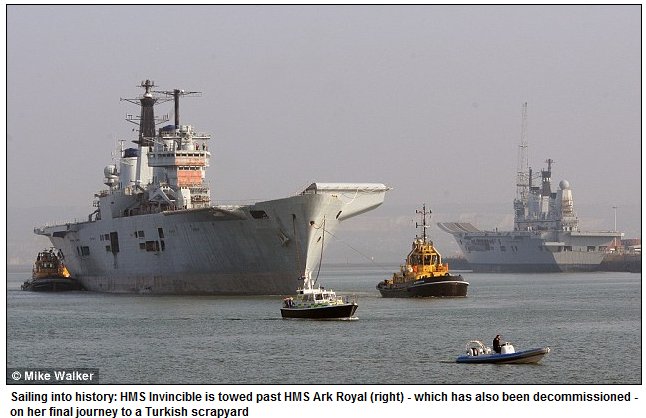
To make the situation even more pathetic:
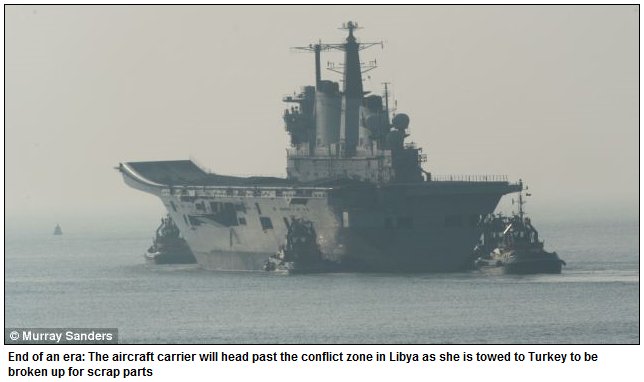
Once, this would have been a sight to strike fear into the hearts of any enemy fleet, a vivid portrait of the naval clout of this island nation.
But, today, these are two ghost ships. This depressing photograph taken yesterday is merely a reminder of the current state of the Royal Navy. Until recently, Britain had three aircraft carriers. The latest round of defence cuts means we have just one carrier — HMS Illustrious — and no planes on board. It only does choppers these days.
Invincible is bound for the Middle East. But Colonel Gaddafi need have no fears about this gallant old warhorse. In a few days’ time she will be off the coast of Libya but she won’t be stopping. She’ll be pressing straight on for Turkey where she is due to be cut up — or ‘recycled’ as an MoD spokesman insisted yesterday.
Back to Mr. Page’s conclusions (not that there should be any surprises based on the examples I’ve included):
Summing up, the lesson of Libya is that the recent Defence Review was, indeed, a dismal failure. RAF empire-preservation saddled us with the useless Tornado at the cost of our carrier capability. The army insisted on preserving pointless tanks and big guns and as a result we are not pulling our weight in Helmand — a war we more or less unilaterally started in 2005 — and we have no option to intervene on the ground in Libya seriously.
The navy made no real effort to help matters. It might have managed to preserve a carrier capability by making concessions on its pointless frigate flotilla, but this it refused to do.
[. . .]
But the chance to change things is not gone yet. So badly fudged were the Strategic Defence and Security Review’s figures that more reorganisation remains on the cards; in effect, a review of the Review is now very likely. The chance is still there to scrap the cripplingly expensive Tornado and Eurofighter altogether and replace them with cheap, excellent F-18s — so getting our carrier capability back in just a few years, as well. When the F-35C actually becomes affordable at last around 2025 we can buy some — by that point its Stealth and other new technologies might actually be becoming relevant for wars that might really happen, along the lines of Libya.
March 24, 2011
China’s “sexy spies” score another intelligence goal
Strategy Page says that the Chinese are “probably the most enthusiastic, and successful, users of this technique these days”:
China is widely known to use sex to obtain secrets from foreigners, inside and outside of China. Four years ago, Japan uncovered a widespread Chinese effort to use sex to steal military technology. Attractive Chinese female intelligence agents in Japan were marrying members of the Japanese armed forces, and then using that access to obtain military secrets. The situation was complicated by the military attempts to keep these “embarrassing incidents” secret. The government was particularly anxious to keep the Americans in the dark about all this, since the Chinese apparently got their hands on Aegis anti-aircraft system technology via their sexy spies.
Actually, most of the Chinese agents don’t have to marry Japanese troops. Just putting out usually does the trick. In Japan, the military doesn’t get much respect, and many of the bases are in backwaters. So the troops are pretty lonely. It’s not unusual for Chinese women to be in the country, as many come, legally or illegally, looking for jobs. The set-up is perfect for using the old “honey pot” (sexual entrapment) routine to extract military secrets.
The military geeks are the most sought after, as these guys have access to the most valuable military secrets. Geeks tend to be least experienced with women, and most vulnerable to a clever, and shapely, Chinese spy. Military commanders are not sure if they have the problem under control, but now that the situation is out in the open, there will be more efforts to tighten up security. As the Japanese expected, the Americans were not amused. And the Chinese honey pot scandal was apparently one reason for refusing to sell F-22s to Japan. To make matters worse, part of the Japanese cover-up involved prosecuting the Chinese spies on immigration, not espionage, charges.
Comments Off on China’s “sexy spies” score another intelligence goal
Stone the CROWS: US Army’s next step to robotic combat
It may not herald a new droid army, but it’s a welcome development for front-line troops:
The Protec RWS is the key component of the U.S. Army CROWS (common remotely operated weapon stations). This idea of a remote control turret has been around for nearly half a century, but years of tinkering, and better technology, have finally made the remote control gun turret finally work effectively, dependably and affordably. This has made the RWS practical for widespread combat use. While some troops miss the greater feeling of situational awareness (especially being able to hear and smell the surroundings) you got as an old-school turret gunner, most soldiers and marines have adapted and accepted the new system. What it lacks in the smelling and hearing department, it makes up in terms of night vision and zoom. And it’s a lot safer.
CROWS is a real life saver, not to mention anxiety reducer, for troops who drive through bandit country a lot, and man the turret gun. You’re a target up there, and too often, the bad guys get you. Not with CROWS. The gunner is inside the vehicle, checking out the surroundings (with night vision, zoom and telephoto capabilities). CROWS also has a laser rangefinder built in, as well as a stabilizer mechanism to allow more accurate fire while the vehicle is moving. The CROWS systems (RWS, weapon and installation) cost about $260,000 each, and can mount a variety of weapons (M2 .50 caliber machine-gun, MK19 40-mm automatic grenade launcher, M240B 7.62mm machine-gun and M249 5.56mm squad automatic weapon). CROWS comes in several different configurations, based on weapon mounted and armor installed (light, at 74 kg/163 pounds, standard, at 136 kg/298 pounds and CROWS II, at 172 kg/379 pounds.) The heaviest version is usually used in MRAP (armored trucks) and has a better user interface, a thermal imager and sniper detection system.
By the end of 2006, there were about a thousand CROWS in service. There are now nearly 8,000. Many of the enemy fighters have seen Western or Japanese films featuring killer robots, and often think that’s what they are facing. The fear factor is real, and it helps. The accuracy of the fire, and uncanny speed with which the CROWS gun moves deliberately, is due to something few officers expected. The guys operating these systems grew up playing video games. They developed skills in operating computer systems (video games) very similar to the CROWS controls. This was important, because viewing the world around the vehicle via a vidcam is not as enlightening (although a lot safer) than having your head and chest exposed to the elements (and any firepower the enemy sends your way). But experienced video gamers are skilled at whipping that screen view around, and picking up any signs of danger.
Comments Off on Stone the CROWS: US Army’s next step to robotic combat
March 23, 2011
March 22, 2011
March 19, 2011
March 18, 2011
Tim Harford: The management lessons from the war in Iraq
Comments Off on Tim Harford: The management lessons from the war in Iraq
March 17, 2011
Industrial espionage, Chinese style
Another good post at Strategy Page on the recent uptick in detection of Chinese industrial spies in the United States, and how this may not be a result of more successful anti-espionage efforts by the FBI or CIA — it may just be a by-product of stepped up efforts by China’s intelligence services:
For over two decades, China has been attempting to do what the Soviet Union never accomplished; steal Western technology, then use it to move ahead of the West. The Soviets lacked the many essential supporting industries found in the West (most founded and run by entrepreneurs), and was never able to get all the many pieces needed to match Western technical accomplishments. Soviet copies of American computers, for example, were crude, less reliable and less powerful. Same with their jet fighters, tanks and warships.
China gets around this by making it profitable for Western firms to set up factories in China, where Chinese managers and workers can be taught how to make things right. At the same time. China allows thousands of their best students to go to the United States to study. While most of these students will stay in America, where there are better jobs and more opportunities, some will come back to China, and bring American business and technical skills with them. Finally, China energetically uses the “thousand grains of sand” approach to espionage. This involves China trying to get all Chinese going overseas, and those of Chinese ancestry living outside the motherland, to spy for China, if only a tiny bit.
This approach to espionage is nothing new. Other nations have used similar systems for centuries. What is unusual is the scale of the Chinese effort. Backing it all up is a Chinese intelligence bureaucracy back home that is huge, with nearly 100,000 people working just to keep track of the many Chinese overseas, and what they could, or should, be to trying to grab for the motherland. It begins when Chinese intelligence officials examining who is going overseas, and for what purpose. Chinese citizens cannot leave the country, legally, without the state security organizations being notified. The intel people are not being asked to give permission. They are being alerted in case they want to have a talk with students, tourists or business people before they leave the country. Interviews are often held when these people come back as well.
Those who might be coming in contact with useful information are asked to remember what they saw, or bring back souvenirs. Over 100,000 Chinese students go off to foreign universities each year. Even more go abroad as tourists or on business. Most of these people were not asked to actually act as spies, but simply to share, with Chinese government officials (who are not always identified as intelligence personnel) whatever information was obtained. The more ambitious of these people are getting caught and prosecuted. But the majority, who are quite casual, and, individually, bring back relatively little, are almost impossible to catch.
Comments Off on Industrial espionage, Chinese style
AWACS in Libyan airspace
Strategy Page reports on the use of AWACS resources over the north African country:
A week after NATO began sending its AWACS aircraft to monitor aircraft activity over northern Libya, it’s been decided to have these radar aircraft monitor that airspace 24/7. The AWACS can fly over international waters and still monitor air activity several hundred kilometers into Libya. This may become crucial if a no-fly zone is established over the Libyan coastal area (where most of the population lives). AWACS can spot Libyan aircraft taking off, and call in fighters to deal with that problem before the Libyan warplanes can get very far.
The Libyan rebels resisted calling for a no-fly zone, but recent defeats have changed their minds. The Arab League has also called on the UN to authorize a no-fly zone, and the U.S. has agreed to participate. American and French carriers, plus, possibly, Egyptian fighters, would provide the combat aircraft needed for enforcement. While Libya doesn’t have many flyable warplanes, the few they do get into the air have proved to be powerful weapons against the rebels. In at least three cases, Libyan pilots refused to bomb the rebels. The pilots of two aircraft defected and flew to Malta. The two crew in another fighter-bomber ejected and let their aircraft crash. It’s believed that Libyan dictator is now using mercenary pilots (perhaps from Syria).
Comments Off on AWACS in Libyan airspace
March 16, 2011
March 6, 2011
Foreign troops in Libya?
While some are debating the possibilities of providing troops to help the Libyan rebels, others may already be there:
The rebellion against the Kadaffi dictatorship in Libya has not produced any official outside help, but Egypt has apparently sent some of its commandos in to help out the largely amateur rebel force. Wearing civilian clothes, the hundred or so Egyptian commandos are officially not there, but are providing crucial skills and experience to help the rebels cope with the largely irregular, and mercenary, force still controlled by the Kadaffi clan. There are also some commandos from Britain (SAS) and American (Special Forces) operators are also believed wandering around, mainly to escort diplomats or perform reconnaissance (and find out who is in charge among the rebels).
The Egyptian commandos come from Unit 777, a force that was established in the late 1970s, but underwent some ups and downs in the next two decades before achieving its current form. Today, the 250-300 -man Unit 777 is a significantly improved force. They fall under the command of the Army Commando Command, both of whom are based in Cairo. Force 777 trains with the help of the German GSG-9, French GIGN, and American Delta Force commandos.
Comments Off on Foreign troops in Libya?


