
We lecture the [West Point] cadets on professionalism but we practice bureaucracy. To summarize the difference, professional cultures debate, discuss, and continually innovate to stay effective in the changing world. Bureaucracies churn out ever-restrictive rules and seek to capture every eventuality in codified routines.
Consider this: From day one at the academy every possible situation that a cadet could conceivably encounter is accounted for by strict regulations. Not sure how many inches should be between your coat hangers, whether you can hold your girlfriend’s hand on campus, or how your socks should be marked? Consult the regulations. Moreover, all activity is subjected to the cadet performance system, which essentially assigns a grade to every measurable event in a cadet’s life (think shoe shines, pushups and pop quizzes) then ruthlessly ranks the entire class from first to last. Cadets at the top of the list get the jobs and postings they want after graduation. Those near the bottom end up driving trucks at Fort Polk, Louisiana.
The result is two-fold: First, cadets have very little experience adapting to unfamiliar environments. After all, what happens when the regulations don’t describe what’s going on around you? Second, cadets devote zero attention to activities that “don’t count.” If it’s not on the syllabus, and it’s not for a grade, the cadets aren’t learning it. Ask a cadet to spend a few minutes writing up a list of the skills, traits, and knowledge that he wishes he’d have when he finally takes over his first platoon in combat. Then compare this to his four-year curriculum and summer training plans. There will be surprisingly little overlap between the two lists, and the cadet has neither the time nor the incentive to learn what’s missing. In the end, we graduate far too many cadets that are more bureaucrat than professional, lacking the expert knowledge of their trade and the flexibility to be effective in the complex environments they’ll soon encounter.
Major Fernando Lujan, U.S. Army, quoted in “West Point faculty member worries it is failing to prepare tomorrow’s officers”, Foreign Policy, 2010-06-11
August 11, 2014
QotD: The decay of the profession of arms
Canada’s Special Forces
 Last month, I posted an item on the organization of the Canadian Army, but I didn’t include the Canadian special forces … partly because the special forces are Canada’s “fourth” branch of service and not organizationally part of the Canadian Army … and partly because I just plain forgot about them. Having just read a short article in the most recent Dorchester Review, I was reminded to include Canada’s special forces units (as much as we know about them, anyway). Special forces fall under their own service command, separate from the Canadian Army, the Royal Canadian Navy, and the Royal Canadian Air Force, known as the Canadian Special Operations Forces Command (CANSOFCOM), established in 2006.
The core unit of CANSOFCOM is the original Joint Task Force-2 (JTF2) which was formed in 1992-3 when the Canadian Forces took over the domestic counterterrorism role from the RCMP. When JTF2 was included in the new command, other units were established to support a wider range of missions and capabilities. CANSOFCOM is headed by a Brigadier General and composed of a headquarters and the following units:
- Joint Task Force 2 (JTF 2), CFB Trenton
- Canadian Special Operations Regiment (CSOR), CFB Petawawa
- 427 Special Operations Aviation Squadron (SOAS), CFB Petawawa
- Canadian Joint Incident Response Unit – Chemical, Biological, Radiological and Nuclear (CJIRU-CBRN), CFB Kingston/CFB Trenton
- Canadian Special Operations Training Centre (CSOTC), CFB Petawawa
Although the official web page for CANSOFCOM emphasizes its domestic role, Canadian special forces have also been involved in overseas operations beginning (so far as we know) with Afghanistan in 2001-2. Very little information about JTF2 missions in specific or CANSOFCOM in general has been released by the government, and this is unlikely to change in the near future. Joseph Jockel’s article in the Dorchester Review states:
The consequences of the successful deployment […] are clearer. JTF2 had been tested and admitted to the “international tier 1 counterterrorism community”, the other members being the special forces of the US, UK, and Australia. A good indication of this was that the US military planned to include Canadian special forces in the 2003 invasion of Iraq. A year after Canada declined to go to Iraq, “the US government sends a démarche to Ottawa specifically requesting JTF2 deploy to Afghanistan for a second one-year commitment”. Ottawa “obliges relatively quickly to the US request for forces and CANSOF deploys for a second one-year commitment in the summer 2005”
The Wikipedia page has more:
Core tasks
CANSOFCOM’s core tasks are: to provide the Canadian Forces with a capacity to prevent and react to terrorism in all environments, to provide the CF with a capability to perform other missions as directed by the Government of Canada, such as direct action (DA), special reconnaissance (SR), defence diplomacy and military assistance (DDMA), as well as special humanitarian assistance (such as the evacuation of non-combatants).
Commanding officers
On September 12, 2005, Colonel David Barr was appointed the provisional commander of the CANSOFCOM. During his tenure as commander, Colonel Barr also deployed to Afghanistan as commander of the Canadian special operations task force in Operation Enduring Freedom.
Major-General D. Michael Day, OMM CD – Commander of the Canadian Special Operations Forces Command 2007–2011
Brigadier-General D.W. Thompson, OMM MSC CD is the current commander of the Canadian Special Operations Forces Command, appointed in April 2011.
The current command chief warrant officer is Chief Warrant Officer John H. Graham, MSM CD.
Uniform
With operational uniforms, all members of CANSOFCOM wear the tan beret, regardless of their environment (navy, army or air force), with the badge of their personnel branch or, in the case of the Royal Canadian Armoured Corps and Royal Canadian Infantry Corps members, the badge of their former regiment. With ceremonial and service dress, navy members wear service caps with tan bands, army members wear tan berets and air force members wear blue wedge caps with a tan insert.
August 6, 2014
Who is to blame for the outbreak of World War One? (Part eight of a series)
We’re getting closer to the end of the series now … you can catch up to the earlier posts here: part one, part two, part three, part four, part five, part six, and part seven. The previous post touched on Russia’s disaster in the far east and the dangerous domestic situation it faced after the war. In this post we discover that Italy could be at least as perfidious as “Perfidious Albion”, and that the Balkans are a hell of a place to wage a war.
Italy tips the first domino … in Africa
In The Sleepwalkers, Christopher Clark talks about a war I don’t think I’d ever heard of … an Italian campaign against the Ottoman Empire:
At the end of September 1911, only six months after the foundation of Ujedinjenje ili smrt! [“Union or death!” aka The Black Hand], Italy launched an invasion of Libya. This unprovoked attack one one of the integral provinces of the Ottoman Empire triggered a cascade of opportunistic attacks on Ottoman-controlled territory in the Balkans.
Italy’s attack on the Ottoman Empire was literally planned to steal what is now Libya and incorporate it into a new Italian Empire. Although the formal war was over in thirteen months, indigenous Arabs were still fighting back twenty years later. This attack broke the public-but-informal international understandings about leaving the remaining parts of the Ottoman Empire alone to prevent the risk of great power struggles breaking out. Britain and France had gone to war in 1854 to ensure that Russia did not gain access to the straits and thus a warm-water route to the Mediterranean and the coastlines of southern Europe, but the outcome of both the 1870-71 Franco-Prussian War and the 1877-78 Russo-Turkish War (and the secret Reinsurance Treaty with Germany) meant that Russia’s hands were largely free as long as Constantinople and the straits were not directly attacked. Italy’s attack broke with that understanding, and could be said to have started the most recent (and also most fatal) scramble for territory in the Balkans.
However, Italy did not act completely outside the norm for a would-be great power: they had an understanding with the French government that was formalized in a secret treaty in 1902 — Italy would not oppose French designs on Tunisia in exchange for French acceptance of Italy’s similar hopes for Tripolitania and Cyrenaica (modern day Libya). Italy’s attack was only possible because of the anomaly of the British position in Egypt: although still formally part of the Ottoman Empire, day-to-day Egyptian affairs were run by or overseen by British officials. Egypt was militarily occupied, but not a colony of the British Empire, and the country was — in theory — still run by the government of the Khedive. The Ottomans could not move formed bodies of troops through Egypt, and the Ottoman navy did not have the ships to transport them from Anatolia directly to Libya. This gave Italy the opportunity to concentrate against the weaker Ottoman forces.
The otherwise obscure Italo-Turkish War was interesting for several reasons, as the Wikipedia article notes:
Although minor, the war was a significant precursor of the First World War as it sparked nationalism in the Balkan states. Seeing how easily the Italians had defeated the weakened Ottomans, the members of the Balkan League attacked the Ottoman Empire before the war with Italy had ended.Italian airships bomb Ottoman troops in Libya (via Wikipedia)
The Italo-Turkish War saw numerous technological changes, notably the airplane. On October 23, 1911, an Italian pilot, Captain Carlo Piazza, flew over Turkish lines on the world’s first aerial reconnaissance mission, and on November 1, the first ever aerial bomb was dropped by Sottotenente Giulio Gavotti, on Turkish troops in Libya, from an early model of Etrich Taube aircraft. The Turks, lacking anti-aircraft weapons, were the first to shoot down an aeroplane by rifle fire.
It was also in this conflict that the future first president of Turkey and leader of the Turkish War of Independence, Mustafa Kemal Atatürk, distinguished himself militarily as a young officer during the Battle of Tobruk.

Although Italy ended up with possession of the disputed land, it did not come easily or cheaply:
The invasion of Libya was a costly enterprise for Italy. Instead of the 30 million lire a month judged sufficient at its beginning, it reached a cost of 80 million a month for a much longer period than was originally estimated. The war cost Italy 1.3 billion lire, nearly a billion more than Giovanni Giolitti estimated before the war. This ruined ten years of fiscal prudence.
After the withdrawal of the Ottoman army the Italians could easily extend their occupation of the country, seizing East Tripolitania, Ghadames, the Djebel and Fezzan with Murzuk during 1913. The outbreak of the First World War with the necessity to bring back the troops to Italy, the proclamation of the Jihad by the Ottomans and the uprising of the Libyans in Tripolitania forced the Italians to abandon all occupied territory and to entrench themselves in Tripoli, Derna, and on the coast of Cyrenaica. The Italian control over much of the interior of Libya remained ineffective until the late 1920s, when forces under the Generals Pietro Badoglio and Rodolfo Graziani waged bloody pacification campaigns. Resistance petered out only after the execution of the rebel leader Omar Mukhtar on September 15, 1931. The result of the Italian colonisation for the Libyan population was that by the mid-1930s it had been cut in half due to emigration, famine, and war casualties. The Libyan population in 1950 was at the same level as in 1911, approximately 1.5 million in 1911.
The war ended well — at least geographically speaking — for Italy, having gained title not only to Libya but also to the Dodecanese: a group of twelve large and about 150 small islands in the Aegean Sea. The largest and most economically valuable island was Rhodes, which became a useful base for Italian forces for more than 40 years. The treaty ending the Italo-Turkish War required Italy to vacate the islands, but due to both fuzzy wording and the dissolution of the Ottoman Empire at the end of the First World War, Italy managed to retain possession.
The Ottoman tide ebbs

A German map of the Balkans, showing the borders as of 1905 (via Wikipedia)
Italy’s attack was the first domino falling. Christopher Clark writes:
The First World War was the Third Balkan War before it became the First World War. How as this possible? Conflicts and crises on the south-eastern periphery, where the Ottoman Empire abutted Christian Europe, were nothing new. The European system had always accommodated them without endangering the peace of the continent as a whole. But the last years before 1914 saw fundamental change. In the autumn of 1911, Italy launched a war of conquest on an African province of the Ottoman Empire, triggering a chain of opportunistic assaults on Ottoman territories across the Balkans. The system of geopolitical balances that had enabled local conflicts to be contained was swept away. In the aftermath of the two Balkan Wars of 1912 and 1913, Austria-Hungary faced a new and threatening situation on its south-eastern periphery, while the retreat of Ottoman power raised strategic questions that Russian diplomats and policy-makers found it impossible to ignore.
Margaret MacMillan, in The War That Ended Peace:
It was in the Balkans […] that the greatest dangers were to arise: two wars among its nations, one in 1912 and a second in 1913, nearly pulled the great powers in. Diplomacy, bluff and brinksmanship in the end saved the peace but although Europeans could not know it, they had had a dress rehearsal for the summer of 1914. As they say in the theatre, if that last run-through goes well, the opening night will be a disaster.
The First Balkan War of 1912 — A Pan-Slavic triumph
To some, the Balkans were a comic opera assemblage of exotic uniforms, passionate actors, indecipherable languages, a bit of bloodshed, but no real source of international danger or worry. Margaret MacMillan explains that much happened beneath the surface of the above-ground culture: much that portended danger to the entire region and beyond.
To the rest of Europe the Balkan states were something of a joke, the setting for tales of romance such as the Prisoner of Zenda or operettas (Montenegro was the inspiration for the The Merry Widow), but their politics were deadly serious — and frequently deadly with terrorist plots, violence and assassinations. In 1903 King Peter’s unpopular predecessor as King of Serbia and his equally unpopular wife had been thrown from the windows of the palace and their corpses hacked to pieces. […] The growth of national movements had welded peoples together but it had also divided Orthodox from Catholic or Muslim, Albanians from Slaves, and Croats, Serbs, Slovenes, Bulgarians or Macedonians from each other. While the peoples of the Balkans had coexisted and intermingled, often for long periods of peace through the centuries, the establishment of national states in the nineteenth century had too often been accompanied by burning of villages, massacres, expulsions of minorities and lasting vendettas.
Politicians who had ridden to power by playing on nationalism and with promises of national glory found they were in the grip of forces they could not always control. Secret societies, modelling themselves on an eclectic mix which included Freemasonry, the underground Carbonari, who had worked for Italian unity, the terrorists who more recently had frightened much of Europe, and old-style banditry, proliferated throughout the Balkans, weaving their way into civilian and military institutions of the states.
In addition to the ethnic, proto-national, cultural, and religious aspects of Balkan conflict, it was also an inter-generational conflict:
The younger generation who were attracted to the secret societies were often more extreme than their elders and frequently at odds with them. “Our fathers, our tyrants,” said a Bosnian radical nationalist, “have created this world on their model and are now forcing us to live in it.” The young members were in love with violence and prepared to destroy even their own traditional values and institutions in order to build the new Greater Serbia, Bulgaria, or Greece. (Even if they had not read Nietzsche, which many of them had, they too had heard that God was dead and that European civilization must be destroyed in order to free humankind.) In the last years before 1914, the authorities in the Balkan states either tolerated or were powerless to control the activities of their own young radicals who carried out assassinations and terrorist attacks on Ottoman or Austrian-Hungarian official as oppressors of the Slavs, on their own leaders whom they judged to be insufficiently devoted to the nationalist cause, or simply on ordinary citizens who happened to be in the wrong religion or the wrong ethnicity in the wrong place.

French map of the territorial changes due to the First Balkan War (via Wikipedia)
And there it might have ended, but the unexpectedly successful campaign by the Balkan League left just a few too many loose ends, which almost immediately led to conflict among the victorious allies. Since I’ve already tipped you to the fact that there was more than one Balkan War, you probably won’t be surprised to find that the Second Balkan War happened quite soon after the first one. But that’s a tale for another day.
August 5, 2014
Who is to blame for the outbreak of World War One? (Part seven of a series)
I thought we’d be done by now, but there’s still more historical ground to cover on what I think are the deep origins of the First World War (part one, part two, part three, part four, part five, part six). The previous post examined the naval arms race between Britain and Germany. Today, we’re looking at the unhappy Russian experiences in the far East and the dangerous domestic situation it faced after the war.
Russia’s Oriental catastrophe
The Russo-Japanese War of 1904-05 was a huge upset, as all the great powers expected Russia to crush the upstart Japanese and put them back “in their place”. Japan’s stunning naval and military successes at the Battle of the Yellow Sea, Tsushima and Port Arthur left Russia in a potentially disastrous situation, with utter undeniable defeat in the East and revolution brewing at home.
The war came about due to irreconcilable differences in the expansionary plans of the two empires: Russia wanted control of Manchuria and Japan wanted control of Korea, but neither side trusted the other enough to make negotiations work. Japan decided to initiate the conflict with a surprise attack on the Russian naval forces in Port Arthur (now known as the Lüshunkou District of Dalian in China’s Liaoning province). From that point onwards, Japan maintained the initiative, forcing Russia to react and interrupting Russian moves on land and at sea.

The Russian Baltic Fleet passage to and return from the Battle of Tsushima (via Wikipedia)
Despite nearly starting a war with the Royal Navy over the Dogger Bank incident (Britain and Japan had signed an alliance in 1902), Admiral Rozhdestvensky was unapologetic and insisted it was the trawlers’ fault and his ships were perfectly entitled to defend themselves from Japanese attackers. As a result of the Russian mistake, Britain refused to allow the fleet passage through the Suez Canal, forcing them to take the far longer trip around Africa instead. If ever a military expedition has had bad omens, the sortie of the Baltic Fleet — now renamed the Second Pacific Squadron for this mission — must be one of the best examples.
When the Russian and Japanese fleets met in the Tsushima Straits, Admiral Tōgō managed to “cross the T” of the Russians, allowing his ships to use their full broadside armament against only the forward-facing guns of the Russian ships. In the end, the Second Pacific Squadron lost all eleven battleships and over 4,000 men killed, another 5,900 captured, and 1,800 interned. Japanese losses were trivial in comparison: three torpedo boats sunk, 117 men killed and about 500 wounded.
There were no major subsequent battles, and Russia was forced to sign the Treaty of Portsmouth to end the war in September 1905. Despite the Tsar’s initial instructions to the Russian delegation, the Russians agreed to recognize Japan’s sphere of influence in Korea, withdraw their troops from Manchuria, and to give up their lease on Port Arthur and Talien. The reaction in both countries was similar: political unrest. Japanese public opinion was that they had been cheated of their full reward from the war, and the government fell in the aftermath. Russians were even more angry and the result was revolution.
The (first) Russian revolution
While the result of the Russo-Japanese war was the trigger for the 1905 Revolution, it was far from being the only grievance. Margaret MacMillan wrote in The War That Ended Peace:
In 1904 the Minister of the Interior, Vyacheslav Plehve, is reported to have said that Russia needed “a small victorious war” which would take the minds of the Russian masses off “political questions”.
The Russo-Japanese War showed the folly of that idea. In its early months Plehve himself was blown apart by a bomb; towards its end the newly formed Bolsheviks tried to seize Moscow. The war served to deepen and bring into sharp focus the existing unhappiness of many Russians with their own society and its rulers. As the many deficiencies, from command to supplies, of the Russian war effort became apparent, criticism grew, both of the government and, since the regime was a highly personalized one, of the Tsar himself. In St. Petersburg a cartoon showed the Tsar with his breeches down being beaten while he says, “Leave me alone. I am the autocrat!” Like the French Revolution, with which it had many similarities, the Russian Revolution of 1905 broke old taboos, including the reverence surrounding the country’s ruler. It seemed to officials in St. Petersburg a bad omen that the Empress had hung a portrait of Marie Antoinette, a gift from the French government, in her rooms.
In December 1904, a strike in St. Petersburg triggered sympathy strikes in other industries, leading to 80,000 workers and supporters protesting in the city. In January 1905, a mass march by the strikers to the Winter Palace was met with rifle fire from the defending troops. Casualty estimates range from 200 to over 1,000 on Bloody Sunday. The strikes and protests spread beyond St. Petersburg, to the point that the government was threatened. Eventually the Tsar was persuaded to offer concessions :
Under huge pressure from his own supporters, the Tsar reluctantly issued a manifesto in October promising a responsible legislature, the Duma, as well as civil rights.
As so often happens in revolutionary moments, the concessions only encouraged the opponents of the regime. It appeared to be close to collapsing with its officials confused and ineffective in the face of such widespread disorder. That winter a battalion from Nichlas’s own regiment, the Preobrazhensky Guards, which had been founded by Peter the Great, mutinied. A member of the Tsar’s court wrote in his diary: “This is it.” Fortunately for the regime, its most determined enemies were disunited and not yet ready to take power while moderate reformers were prepared to support it in the light of the Tsar’s promises. Using the army and police freely, the government managed to restore order. By the summer of 1906 the worst was over — for the time being. The regime still faced the dilemma, though, of how far it could let reforms go without fatally undermining its authority. It was a dilemma faced by the French government in 1789 or the Shah’s government in Iran in 1979. Refusing demands for reform and relying on repression creates enemies; giving way encourages them and brings more demands.
Russia’s economy did recover eventually, but the political solution was not strong enough to stand the strains of another war any time soon. In some ways, it’s hard to imagine what the Russian leaders who advised the Tsar were thinking as the Russians continued to stir the pot in the Balkans…
August 4, 2014
Who is to blame for the outbreak of World War One? (Part six of a series)
Over the last week, I’ve posted entries on what I think are the deep origins of the First World War (part one, part two, part three, part four, part five). And yes, to be honest, I didn’t think it would take quite this many entries to begin to explain how the world catastrophe of August 1914 came about — putting together this series of blog posts has been educational for me, and I hope it’s been at least of interest to you. The previous post examined the history of the Dual Monarchy of Austria-Hungary, in some detail (yes, it matters). Today, we finally clear the Victorian era altogether and begin to look at the last decade-or-so before the outbreak of the war.
The Anglo-German naval race
Even after the creation of the German Reich in 1871, Germany was not seen (by the British government) to be a major threat to British interests: Germany had no significant presence beyond Europe to worry the Colonial Office, and instead was seen as a potentially useful balancing factor in the European theatre. That all changed with the accession of Kaiser Wilhelm II as explained by Christopher Clark in The Sleepwalkers:
The 1890s were […] a period of deepening German isolation. A commitment from Britain remained elusive and the Franco-Russian Alliance seemed to narrow considerably the room for movement on the continent. Yet Germany’s statesmen were extraordinarily slow to see the scale of the problem, mainly because they believed that the continuing tension between the world empires was in itself a guarantee that these would never combine against Germany. Far from countering their isolation through a policy of rapprochement, German policy-makers raised the quest for self-reliance to the status of a guiding principle. The most consequential manifestation of this development was the decision to build a large navy.
In the mid-1890s, after a long period of stagnation and relative decline, naval construction and strategy came to occupy a central place in German security and foreign policy. Public opinion played a role here — in Germany, as in Britain, big ships were the fetish of the quality press and its educated middle-class readers. The immensely fashionable “navalism” of the American writer Alfred Thayer Mahan also played a part. Mahan foretold in The Influence of Sea Power upon History: 1660–1783 (1890) a struggle for global power that would be decided by vast fleets of heavy battleships and cruisers. Kaiser Wilhelm II, who supported the naval programme, was a keen nautical hobbyist and an avid reader of Mahan; in the sketchbooks of the young Wilhelm we find many battleships — lovingly pencilled floating fortresses bristling with enormous guns. But the international dimension was also crucial: it was above all the sequence of peripheral clashes with Britain that triggered the decision to acquire a more formidable naval weapon. After the Transvaal episode, the Kaiser became obsessed with the need for ships, to the point where he began to see virtually every international crisis as a lesson in the primacy of naval power.
The Royal Navy (RN) had been Britain’s most obvious sign of global dominance, and Britain’s fleets had gone through many technological changes over the century since Waterloo. What had been for centuries a slow, steady process of gradual improvement and incremental change suddenly became the white-hot centre of rapid, even revolutionary, change:
At the same time that you need to add armour to protect the ship, you also need to mount heavier, larger guns. Between placing your order with the shipyard for a new ship, the metallurgical wizards may have (and frequently did) come up with bigger, better guns that could defeat the armour on your not-yet-launched ship. Oh, and you now needed to revise the design of the ship to carry the newer, heavier guns, too.
The ship designers were in a race with the gun designers to see who could defeat the latest design by the other group. It’s no wonder that ships could become obsolete between ordering and coming into service: sometimes, they could become obsolete before launch.
The weapons themselves were undergoing change at a relatively unprecedented rate. As late as the mid-1870′s, a good case could be made for muzzle-loading cannon being mounted on warships: until the gas seal of the breech-loader could be made safe, muzzle-loaders had an advantage of not killing their own crews at distressingly high frequency. Once that technological handicap had been overcome, then the argument came down to the best way to mount the weapons: turrets or barbettes.
The RN’s international prestige invited envious imitators (like Wilhelm) and challengers (the United States Navy and the Imperial Japanese Navy), but the RN was the supreme naval power against which all other nations measured themselves. In 1889, parliament passed the Naval Defence Act, which specified that the Royal Navy would be maintained at the “two-power standard”: that the RN’s fleet of capital ships would be at least equal to the number of battleships maintained by the next two largest navies (at that time, the French and Russian navies). The increased spending allowed ten battleships plus cruisers and torpedo boats to be added to the fleet … but the French and Russian navies added twelve battleships between them over the same period of time. “Another British expansion, known as the Spencer Programme, followed in 1894 aimed to match foreign naval growth at a cost of over £31 million. Instead of deterring the naval expansion of foreign powers, Britain’s Naval Defence Act contributed to a naval arms race. Other powers including Germany and the United States bolstered their navies in the following years as Britain continued to increase its own naval expenditures.”
In The War That Ended Peace, Margaret MacMillan describes the implicit power of the RN in peacetime:
In August 1902 another great naval review took place at Spithead in the sheltered waters between Britain’s great south coast port of Portsmouth and the Isle of Wight, this time to celebrate the coronation of Edward VII. Because he had suddenly come down with appendicitis earlier in the summer, the coronation itself and all festivities surrounding it had been postponed. As a result, most of the ships from foreign navies (except those of Britain’s new ally Japan) as well as those from the overseas squadrons of the British navy had been obliged to leave. The resulting smaller review was, nevertheless, The Times said proudly, a potent display of Britain’s naval might. The ships displayed at Spithead were all in active service and all from the fleets already in place to guard Britain’s home waters. “The display may be less magnificent than the wonderful manifestation of our sea-power witnessed in the same waters five years ago. But it will demonstrate no less plainly what that power is, to those who remember that we have a larger number of ships in commission on foreign stations now than we had then, and that we have not moved a single ship from Reserve.” “Some of our rivals,” The Times warned, “have worked with feverish activity in the interval, and they are steadily increasing their efforts. They should know that Britain remained vigilant and on guard, and prepared to spend whatever funds were necessary to maintain its sovereignty of the seas.”
Admiral Fisher’s new broom

Admiral Sir John “Jackie” Fisher (via Wikipedia)
Margaret MacMillan describes him in The War That Ended Peace:
Jacky Fisher, as he was always known, shoots through the history of the British navy and of the prewar years like a runaway Catharine wheel, showering sparks in all directions and making some onlookers scatter in alarm and others gasp with admiration. He shook the British navy from top to bottom in the years before the Great War, bombarding his civilian superiors with demands until they usually gave way and steamrollering over his opponents in the navy. He spoke his mind freely in his own inimitable language. His enemies were “skunks”, “pimps”, “fossils”, or “frightened rabbits”. Fisher was tough, dogged and largely immune to criticism, not surprising perhaps in someone from a relatively modest background who had made his own way in the navy since he was a boy. He was also supremely self-confident. Edward VII once complained that Fisher did not look at different aspects of an issue. “Why should I waste my time,” the admiral replied, “looking at all sides when I know my side is the right side?”
Fisher had been a maverick throughout his career (which makes it even more amazing that he eventually did rise to become First Sea Lord), as his actions when he took command of the Mediterranean Fleet clearly illustrate:
A programme of realistic exercises was adopted including simulated French raids, defensive manoeuvres, night attacks and blockades, all carried out at maximum speed. He introduced a gold cup for the ship which performed best at gunnery, and insisted upon shooting at greater range and from battle formations. He found that he too was learning some of the complications and difficulties of controlling a large fleet in complex situations, and immensely enjoyed it.
Notes from his lectures indicate that, at the start of his time in the Mediterranean, useful working ranges for heavy guns without telescopic sights were considered to be only 2000 yards, or 3000-4000 yards with such sights, whereas by the end of his time discussion centred on how to shoot effectively at 5000 yards. This was driven by the increasing range of the torpedo, which had now risen to 3000-4000 yards, necessitating ships fighting effectively at greater ranges. At this time he advocated relatively small main armaments on capital ships (some had 15 inch or greater), because the improved technical design of the relatively small (10 inch) modern guns allowed a much greater firing rate and greater overall weight of broadside. The potentially much greater ranges of large guns was not an issue, because no one knew how to aim them effectively at such ranges. He argued that “the design of fighting ships must follow the mode of fighting instead of fighting being subsidiary to and dependent on the design of ships.” As regards how officers needed to behave, he commented, “‘Think and act for yourself’ is the motto for the future, not ‘Let us wait for orders’.”
Lord Hankey, then a marine serving under Fisher, later commented, “It is difficult for anyone who had not lived under the previous regime to realize what a change Fisher brought about in the Mediterranean fleet. … Before his arrival, the topics and arguments of the officers messes … were mainly confined to such matters as the cleaning of paint and brasswork. … These were forgotten and replaced by incessant controversies on tactics, strategy, gunnery, torpedo warfare, blockade, etc. It was a veritable renaissance and affected every officer in the navy.” Charles Beresford, later to become a severe critic of Fisher, gave up a plan to return to Britain and enter parliament, because he had “learnt more in the last week than in the last forty years”.
One of his first changes was to sell nearly one hundred elderly ships and move dozens of less capable vessels from the active list to the reserve fleet, to free up the crews (and the maintenance budget) for more modern vessels, describing the ships as “too weak to fight and too slow to run away”, and “a miser’s hoard of useless junk”. Between his reforms as Third Sea Lord (where he had championed the development of the modern destroyer and vastly increased the efficiency and productivity of the shipyards) and his new role as First Sea Lord, Fisher was able to get more done even on a budget that dropped nearly 10% in the year of his appointment than his predecessor had managed.
HMS Dreadnought and the naval revolution
Fisher was not a naval designer, but he knew how to push new ideas to the front and get them adopted. The one thing that most people remember him for is the revolutionary battleship HMS Dreadnought, the first all big gun, fast steam turbine powered battleship, and when she went into commission, she signified the obsolescence of every other capital ship in every navy from that moment onwards.

HMS Dreadnought underway, circa 1906-07
Dreadnought was the platonic ideal of a battleship: she was faster than any other capital ship in any other navy, her guns were at least the equivalent in range, rate of fire, and throw of shot, and her armour was sufficient to allow her to take punishment from opposing ships and still deal out damage herself. She was the first British ship to be equipped with electrical controls allowing the entire main armament to be fired from a central location. Thanks to Fisher’s earlier efforts with the shipyards, Dreadnought took just a year to build — far faster than any other battleship had been built.
The “entirely crazy Dreadnought policy of Sir J. Fisher and His Majesty”
The Kaiser was not happy with the new British battleship, as it had been German policy since his accession to build up the German navy to at least provide a tool for pressuring Britain (if not for actually confronting the Royal Navy in battle). Now his entire naval plan had been upset by the Dreadnought revolution. Margaret MacMillan:
As far as the Kaiser and [Admiral] Tirpitz were concerned the responsibility for taking the naval race to a new level rested with what Wilhelm called the “entirely crazy Dreadnought policy of Sir J. Fisher and His Majesty”. The Germans were prone to see Edward VII as bent on a policy of encircling Germany. The British had made a mistake in building dreadnoughts and heavy cruisers, in Tirpitz’s view, and they were angry about it: “This annoyance will increase as they see that we follow them immediately.” […] Who could tell what the British might do? Did their history not show them to by hypocritical, devious and ruthless? Fears of a “Kopenhagen”, a sudden British attack just like the one in 1807 when the British navy had bombarded Copenhagen and seized the Danish fleet, were never far from the thoughts of the German leadership once the naval race had started.
German fears of British attack increased almost in lockstep with British fears of German attack (William Le Queux had his equivalents among the German press and popular novelists). The thought had actually occurred to Fisher himself, who outlined a possible coup de main against the German fleet. The king responded “My God, Fisher, you must be mad!” and the suggestion was ignored, thankfully.
The popular worries about an attack from Britain fed the support for the German Navy laws, which funded dreadnought and battlecruiser building programs. In direct proportion, the increased German support for their naval expansion worked to the advantage of British politicians who wanted to build more dreadnoughts of their own. And, in fairness, Britain risked far more by allowing an enlarged German navy than Germany risked by stopping their building program … but in either case, the fear of popular unrest kept the shipyards humming anyway. As Churchill later wrote, “The Admiralty had demanded six ships; the economists offered four; and we finally compromised on eight.”
There we go, finally getting within striking distance of the triggering events of the First World War … and I’m still not sure how many more posts it will take to get us there! More to come this week.
August 3, 2014
The Princess Patricia’s Canadian Light Infantry at 100
The Ottawa Citizen notes the centennial of one of Canada’s three regular force infantry regiments, the PPCLI:
During four years of war, from August 1914 to November 1918, Canada contributed some 620,000 men to the fight against Germany. By war’s end, 61,000 — about 1o per cent — of those who served in the Canadian Overseas Expeditionary Force had been killed. Another 172,000 had been wounded, gassed, crippled or psychologically damaged by the war. For a country of not yet eight million, it was an enormous undertaking, and an enormous sacrifice. The proportional loss for Canada a war today, with a population of about 34 million, would be more than 250,000 killed and 550,00 wounded.
The Canadian Corps acquired a reputation for battlefield prowess. British prime minister David Lloyd George referred to the C.E.F. as “the shock army of the British Empire.” This reputation was in some ways the making of the country, historians say. Canada’s contribution to the war effort — men, munitions and food supplies — fostered a deeper sense of national identity and led to greater political sovereignty. Canada went from being a subordinate member of the British Empire to a nation in its own right on the world stage.
[…]
When Britain declared war on Germany on Aug. 4, 1914, Canada, as a Dominion within the Empire, was automatically at war, too. Canadians, by and large, responded with enthusiastic support. Within days of the declaration of war the country was mobilizing. One Montreal businessman, Andrew Hamilton Gault offered $100,000 of his own money — about $2 million in today’s currency — to finance and equip a regiment.
Prime minister Robert Borden’s government was only too happy to accept the offer, having committed itself to raising an army division of 25,000 men as Canada’s initial contribution to the war. The Patricias received their official charter on Aug. 10. Gault, joined by Lt-Col. Francis Farquhar, a British Army veteran and military secretary to the governor-general, the Duke of Connaught, launched a cross-country recruitment campaign.
More than 3,000 men responded to the call to arms, and headed for Ottawa. “Prospectors, trappers, guides, cow-punchers, prize-fighters, farmers, professional and businessmen, above all old soldiers, poured into Ottawa by every train,” writes regimental historian, Ralph Hodder-Williams. By Aug. 19, 1,098 men were chosen — the Originals, as they became known —- and Farquhar was named regimental commander.
The PPCLI officially formed up on Aug. 23 at Ottawa’s Lansdowne Park. Gault had asked the governor-general’s daughter, Princess Patricia, if he could name the regiment after her. She agreed and offered to design a regimental Colour. “I have great pleasure in presenting you with these colours, which I have worked myself. I hope they will be associated with what I believe will be a distinguished corps,” the princess told the assembled soldiers. “I shall follow the fortunes of you all with the deepest interest, and I heartily wish every man good luck and a safe return.”
It was a naive hope, as it turned out. The Patricias boarded the R.M.S. Royal George for England in late September 1914. On Dec. 20, after a few months training in Britain, they arrived in Le Havre. Two weeks later, on Jan. 6 and 7, 1915, the Patricias moved into the Ypres Salient, the first Canadian regiment to go into the field.
[…]
The Camp Colour presented by Princess Patricia in August of 1914 was consecrated in a religious ceremony in Belgium in late January 1919. A month later, the princess, who had returned to England in 1916, attached a commemorative silver gilt laurel wreath to the Colour’s staff in a ceremony before the regiment’s return to Canada. “My thoughts have been continually with you during the years of suffering and trial through which you have passed,” she told the assembled regiment, “and I think with mingled sorrow and pride of your many and gallant comrades who so willingly laid down their lives in the greatest of all causes.”
Such sentiments may sound alien to contemporary ears, but to dismiss them as deluded or naive is to presume that those who lived through the Great War couldn’t possibly have understood what they were doing as well as we can with our historical hindsight and sophisticated post-modern worldview.
But that is an arrogant and condescending assumption, as Philip Child, a Canadian army officer who served with a howitzer battery in the trenches, suggests in his 1937 novel, God’s Sparrow. Child tells the story of Daniel Thatcher, a veteran of the trenches. At one point, reflecting on the dead, Thatcher reaches this conclusion: “The thousands went into battle not ignobly, not as driven sheep or hired murderers … but as free men with a corporate if vague feeling of brotherhood because of a tradition they shared and an honest belief that they were doing their duty in a necessary task.”

H/T to Steve Paikin for the link.
& for us born here too. "@HDrakeUK: For any guest like me living in this great country, I think this is a must-read http://t.co/LnpegOEUjg”"
— Steve Paikin (@spaikin) August 3, 2014
July 31, 2014
Churchill on the news from the Battle of Mons, August 1914
History Today are nearly done digitizing their back-catalogue of articles, including this 1964 article by John Terraine on how the news got back to Britain after the Battle of Mons:
At seven o’clock in the morning of August 24th, 1914, Mr. Winston Churchill was sitting up in bed, working, at his room in the Admiralty. The door opened, and the Secretary of State for War, Field-Marshal Lord Kitchener, appeared.
“These were the days before he took to uniform, and my recollection is that he had a bowler hat on his head, which he took off with a hand which also held a slip of paper. He paused in the doorway and I knew in a flash and before ever he spoke that the event had gone wrong. Though his manner was quite calm, his face was different.
I had the sub-conscious feeling that it was distorted and discoloured as if it had been Punched with a fist. His eyes rolled more than ever. His voice, too, was hoarse. He looked gigantic. ‘Bad news,’ he said heavily and laid the slip of paper on my bed. I read the telegram.
It was from Sir John French: …I forget much of what passed between us. But the apparition of Kitchener Agonistes in my doorway will dwell with me as long as I live. It was like seeing old John Bull on the rack!”
Sir John French’s telegram contained the first information to the British Government of the Battle of Mons, which had taken place on the preceding day:
“My troops have been engaged all day with the enemy… we held our ground tenaciously. I have just received a message from G.O.C. 5th French Army that his troops have been driven back, that Namur has fallen… I have therefore ordered a retirement… which is being carried out now. It will prove a difficult operation, if the enemy remains in contact…”
The last sentence was electrifying:
“I think that immediate attention should be directed to the defence of Havre.”
It was the reference to Namur that produced the first shock in Churchill’s mind.
“We were evidently in the presence of new facts and of a new standard of values. If strong fortresses were to melt like wisps of vapour in a morning sun, many judgments would have to be revised. The foundations of thought were quaking…
‘Fortify Havre,’ said Sir John French. One day’s general battle and the sanguine advance and hoped-for counterstroke had been converted into ‘Fortify Havre’.”
The War was now precisely three weeks old. During those three weeks, governments, military leaders and populations had existed in a fog of ignorance and misconception. This was equally true of both sides; but the worst effects were felt by the Allies. Britain had committed her army to the direct support of the French; but almost no-one in Britain understood the nature of the operations to which the French had committed themselves.
July 27, 2014
Floating HMS Queen Elizabeth for the first time
Three hours of careful work compressed into a short video:
QotD: Qui veut tout défendre ne sauve rien (Who defends everything defends nothing)
This is an elementary and self-evident Principle. Indeed, it is so axiomatic that few examples of it will be given in these pages. The only point to stress is that it is useless to hope to obtain complete security in passive defense. It is also unsound. “He who tries to defend everything saves nothing.” declared Marshal Foch, echoing Frederick the Great. It should be noted that the very act of assuming the offensive imparts a certain degree of security. Make as if to strike a man, and he instinctively assumes a defensive attitude. As General Rowan Robinson expresses it in his Imperial Defence, “The highest form of strategic security is that obtained through the imposition of our will upon the enemy, through seizing the initiative and maintaining it by offensive action.” There may sometimes be an element of risk in this, but, as we have seen, war in its nature involves risk.
Lt. Colonel Alfred H. Burne, The Art of War on Land, 1947.
July 26, 2014
Royal Navy commander may have had affair with crew member
From the Guardian, a report on a current investigation into a Royal Navy officer who may have had an affair with a subordinate:
The first female commander of a major Royal Navy warship has left her vessel after claims she had an affair with a shipmate.
Commander Sarah West, 42, took charge of Type 23 frigate HMS Portland in May 2012.
It is understood she has left the ship while the navy investigates the claims. Her second-in-command has taken over the running of the vessel, but West is still the commanding officer.
The navy inquiry will consider whether West breached the armed forces’ code of social conduct, which governs personal relationships within the military. Possible punishments for a breach include a formal warning, reassignment and even termination of service.
A Royal Navy spokesman said: “We are aware of an allegation of a breach of the code of social conduct on board HMS Portland, which we are treating seriously.
“Anyone who is found to fall short of the Royal Navy’s high standards can expect to face appropriate action. It would be inappropriate to comment further.”
West made headlines when she became the first female commander of a frontline warship in the 500-year history of the service.
But earlier this year she explained how work commitments made it difficult to have a relationship.
July 25, 2014
US Marine Corps Commandant goes off-message
James Joyner discusses the problem with depending on partial reporting:
Many of us have experienced occasions where we’ve read about an event in which we were a participant — either as a direct actor or merely an observer — and found ourselves perplexed by the written account. Whether because of an ideological agenda, an inadequate understanding of the topic, or — more commonly — a desire for a juicy headline and a scandal, reporters frequently misrepresent what transpired or was said. Paradoxically, however, we instinctively treat reports about events where we were not present as gospel.
Recently, a collaborator and I fell into this trap. A series of venues reported some remarks by General Jim Amos, the Commandant of the Marine Corps, which seemingly questioned the president’s leadership on issues of international security, blamed the current crisis in Iraq on his fecklessness, and strongly implied that the president had betrayed the sacrifices of American warriors who had died there. As strong advocates for civilian control of the military, we submitted a blistering piece to War on the Rocks outlining the proper limitations for general officers publicly speaking on matters of policy, explaining the rationale for those limitations, and ending with Amos standing at attention in the Oval Office being reminded of his place in the chain of command. It was right on all counts — except for the not so minor detail that Amos hadn’t done what we were criticizing him for doing.
July 24, 2014
The current organization of the Canadian Army
 I posted a link about a military exercise to be held next month in the Niagara Peninsula, and it mentioned the 31st Brigade, which reminded me I’d lost track of the current organization of the Canadian Army (which back in my day was still hiding under the name “Mobile Command”). In common with other allied armies, the units and organizations have changed significantly since the end of the Cold War — in the case of the Canadian Army, many of the changes were triggered earlier by unification in 1968. In the case of the regular infantry regiments, Wikipedia has this to say about the post-WW2 era:
Niagara Peninsula to host brigade-level military exercise in August
A report in Niagara This Week by Paul Forsyth discusses a major Canadian military exercise to be held in the area next month:
Called Stalwart Guardian 14, the exercise is an annual one for troops across Ontario. But unlike many other training exercises that typically take place on military bases, this one will be much more visible to the public.
Col. Brock Millman, commander of the London, Ont.-based 31 Canadian Brigade Group, said in a letter to Thorold Mayor Ted Luciani earlier this year that the exercise will be “massive,” but will be conducted in a “safe, respectful and environmentally sound manner.”
At the July 15 meeting of Thorold city council, Millman and Maj. Paul Pickering — who is co-ordinating the exercise — said conducting the operation off-base makes it more realistic, because foreign bad guys are likely to hit infrastructure in populated areas.
“The terrain (on bases) is not complex, there are not big buildings, there are not roads, there is not a civilian population,” said Millman. “The training is not as effective as it can be.
“We’re coming here because it’s much more effective.”
Millman’s brigade, which is the reserve Canadian army in southwestern Ontario, is part of the 12,000-strong 4th Canadian division. He said more than 2,000 soldiers — a mix of reservists and veterans of missions in Afghanistan and Bosnia — will descend on Niagara for the exercise running from Aug. 16 to 24.
Back in my day, we’d have a camp established just outside Niagara-on-the-Lake and unless something went wrong, most of the civilian population in the area wouldn’t know we were there except for the unusually high number of short-haired guys in the bars after 6pm. In the mid-1970s, short hair was an unusual fashion statement…
While the soldiers take their soldiering seriously, Millman said there will be civil-military co-operation personnel to arrange interaction between soldiers and Niagara residents.
“Kids will get a chance to climb on their vehicles,” he said. “We’re not going to discourage (residents) from engaging with the soldiers” if it doesn’t conflict with the training, he said.
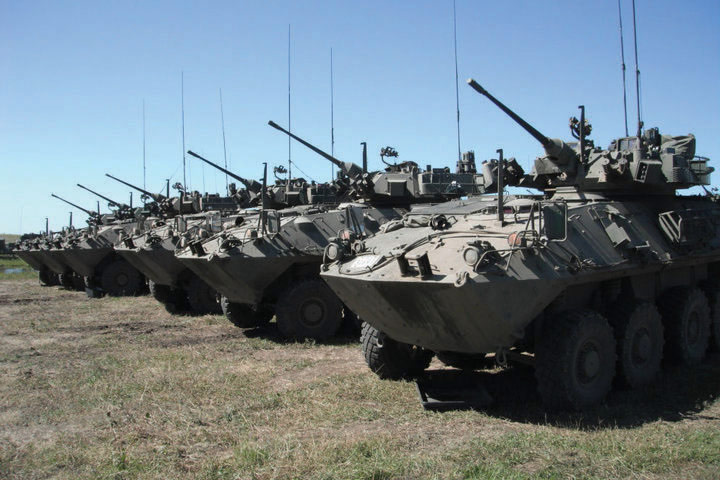
He told St. Catharines city council on Monday night that people simply find military vehicles fascinating
“There’s a five-year-old child in all of us who thinks…Thomas the Tank (Engine) is pretty cool,” he said. “Thomas the Coyote surveillance vehicle is super cool.”
Thorold city councillor Becky Lott said she hopes there is plenty of publicity about the exercise before soldiers arrive so people don’t fear the worst.
“I can see people calling and saying ‘why is there a tank rolling down my street?’” she said.
Coyotes? In my day we were just getting rid of the Korean War-vintage trucks and jeeps… get off my lawn, you kids!
July 23, 2014
Closing the Eastern Ukraine pocket
CDR Salamander links to a recent Ukrainian report that seems to show how far the Ukraine forces have come since May in reclaiming territory from the “separatists”:
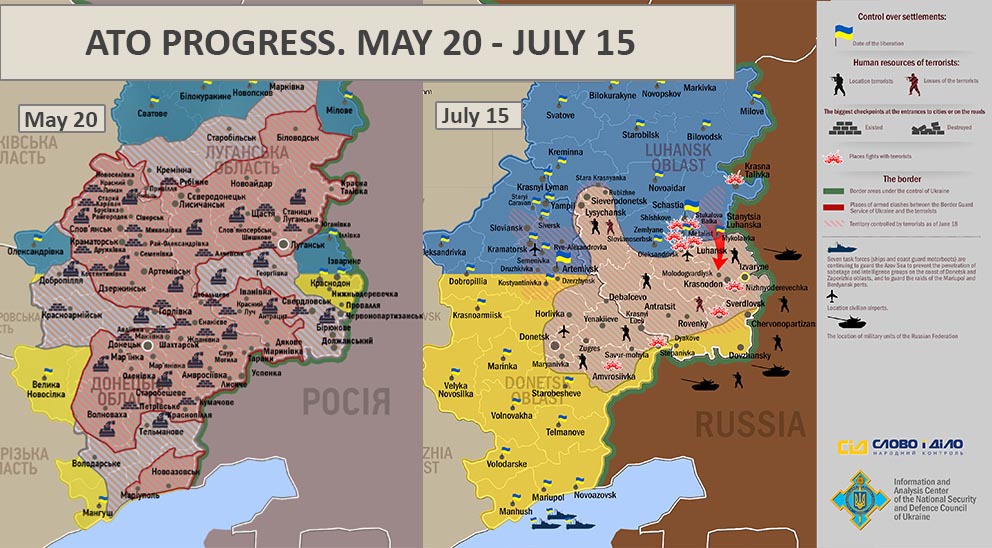
Click to see full-size image
Look at what has happened in the last two months.
1. Ukraine secured its maritime territory.
2. Ukraine managed to re-establish control over most of its borders – though in a thin salient in some places. Not firm control as we know traffic is getting through, but at least partial control to the point they are willing to claim it.
3. They are pushing to widen the salient in the south while increasing its SE bulge, pushing north along the Russian border.
4. From the north, they are pushing south along the Russian border.
5. Yes kiddies, we have a classic pincer movement to envelope a pocket of the enemy, nee – a double envelopment at that. As a matter of fact, a secondary double envelopment is about to take place in that middle thumb centered on Lysychansk – or at least there is an opportunity for one.Cut off the Lysychansk based separatists there while at the same time cutting off their unopposed access to the Russian border – and then you can destroy the pro-Russian separatists piecemeal at your leisure.
A quick Google search for “ATO progress map” also turned up this map posted to Twitter a couple of days ago by Viktor Kovalenko:
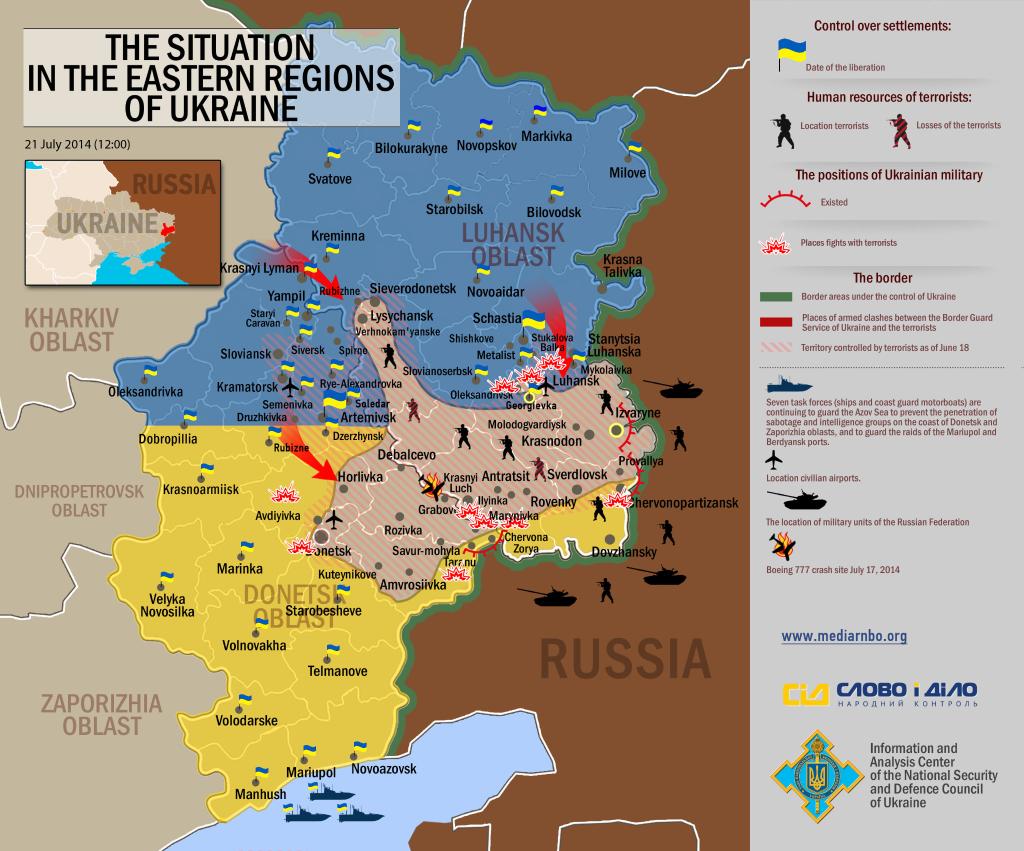
Click to see full size image
As the original CDR Salamander post points out, these are based on claims by one side so apply whatever filters you feel are needed to counteract any PR or propaganda bias.
The Yom Kippur War of October 1973
In History Today, Colin Shindler reviews a recent collection of essays on the initially successful surprise attack on Israeli forces by Egypt, Syria, and a token brigade from Jordan in early October, 1973.
During the early afternoon of October 6th, 1973 the Egyptian army crossed the Suez Canal and overran the Israeli Bar-Lev line on the eastern bank. This assault on Yom Kippur, the holiest day in the Jewish calendar, was designed to reverse Israel’s conquest of the Sinai peninsula during the 1967 Six Day War.
Six hundred Syrian tanks, outnumbering Israel’s 178, also advanced to reclaim the Golan Heights and to threaten a penetration of Israel’s heartland. The mehdal (blunder) indicated a profound intelligence failure and cost 2,691 Israeli lives. Forty years on, Asaf Siniver has gathered his colleagues to dissect this war in a series of essays.
The October or Ramadan War – as it is known in Egypt – is celebrated as a holiday even though Arab losses were around 18,000. The Yom Kippur war – as it is known in Israel – is regarded more as an enforced stalemate, even though Israeli forces crossed back over the canal, encircled the Egyptian Third Army and were 60 miles from Cairo. The Syrians, too, were pushed back and the Israelis shelled the outer suburbs of Damascus. Soviet threats to involve the USSR directly in the conflict forced President Nixon to stop the Israelis in their tracks.
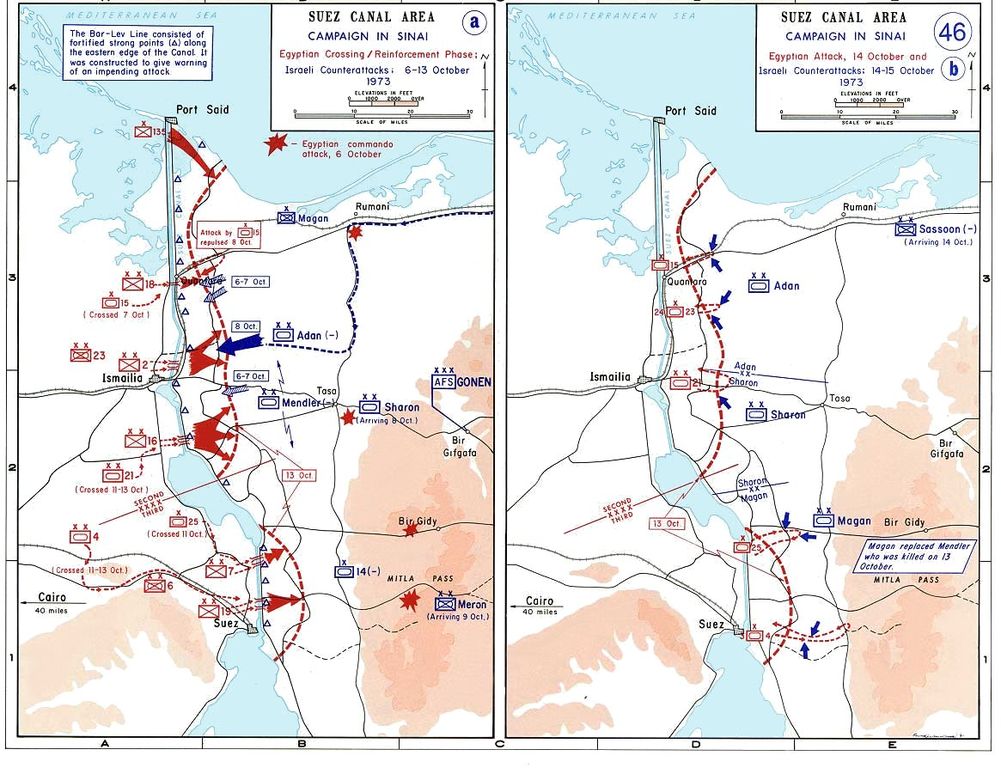
Yom Kippur War – Sinai front 6-15 October, 1973 (via Wikipedia)
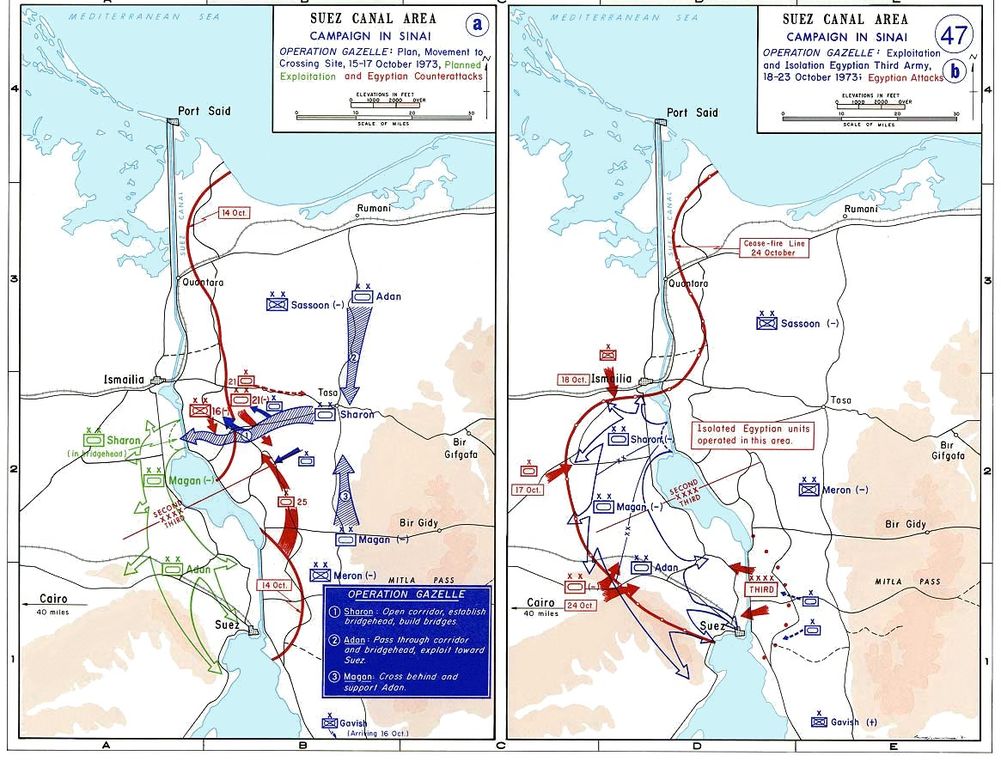
Yom Kippur War – Sinai front 15-23 October, 1973 (via Wikipedia)
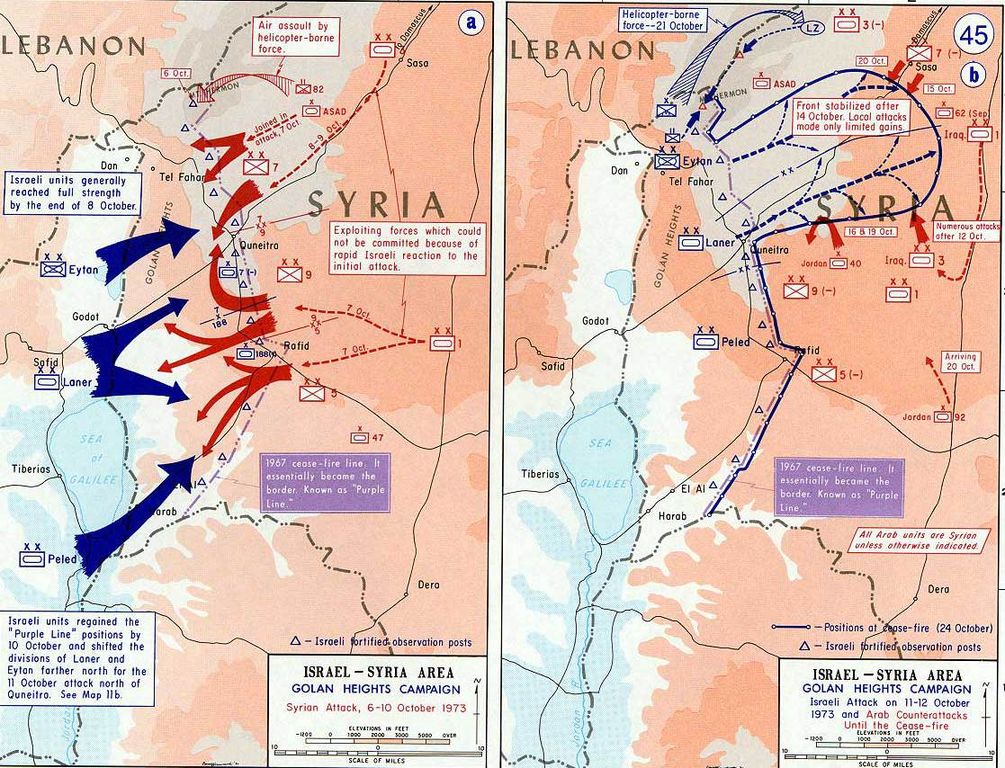
Yom Kippur War – Golan Heights front (via Wikipedia)


