Quotulatiousness

September 28, 2022

Putin’s nuclear option may not be as decisive in Ukraine as many fear

Filed under: History, Military, Russia, Weapons — Tags: , , — Nicholas @ 05:00

Like almost everyone else, I’m still hopeful that the Russians will not resort to nuclear weapons as their invasion of Ukraine drags on and on — especially as it’s expected that any first use of nuclear weapons will trigger a global crisis or even a new world war. At Quora, John Mark McDonald offers his take on the issue that certainly doesn’t match what most pundits appear to believe:
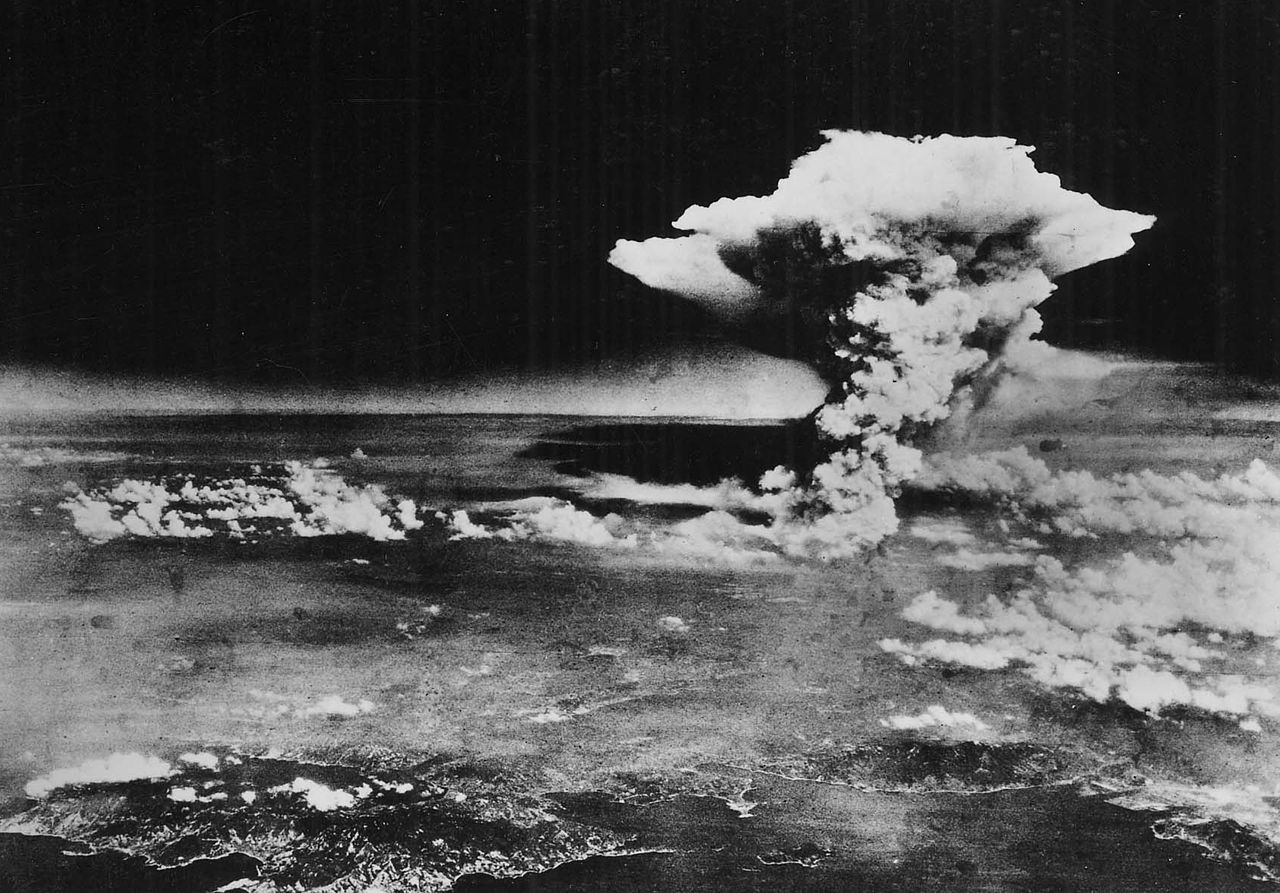
Atomic cloud over Hiroshima, taken from “Enola Gay” flying over Matsuyama, Shikoku, 6 August, 1945.
US Army Air Force photo via Wikimedia Commons.

As someone who has studied nuclear war for close to forty years now, I am going to give you an answer that will blow your mind. Even if the entire Russian nuclear arsenal were used against Ukraine, it wouldn’t substantially change the course of the war. How could I possibly say that? Because, the power of nuclear weapons has been used as a boogeyman for so long that the actual power of a nuclear detonation has almost no relation to their actual destructive power. No nuclear power can afford to actually use one in combat because it would expose the mythical nature of nuclear weapons.

Nuclear weapons are hyped to the point that no one contradicts it when a media outlet publishes a statement indicating that even a single nuclear device will destroy the world. This is a blatantly, stupidly, obviously untrue, but never corrected. After all, two were used in WWII. BUT that is just the tip of the iceburg. I thought there had been a couple of hundred nuclear test that prove this point. I was off by over an order of magnitude. There have been nearly THREE THOUSAND NUCLEAR DETONATIONS ALREADY, that are either known or suspected and this has not effected the survivability of life on Earth even slightly.

Well then, how dangerous are nuclear weapons? Nuclear weapons, if they weren’t their own catagory, would be classified as incendiary weapons. They set stuff on fire. They set a lot of stuff on fire. In fact they can set things on fire as far as two miles away from the actual detonation. Besides this, nuclear detonation are very bright, capable of blinding people 20–30 miles away. This is only constrained by the curvature of the earth. They also create hurricane force winds as the air around the detonation expands and contracts. If you are outside and unshielded and within a mile of a nuclear detonation, you are going to die.

The problem here is that Ukraine is really big. I mean the size of Texas big. Cities there tend to be spread out in modern times and their larger ones cover over a hundred square miles. The average nuclear detonation are only burn 2–3 square miles of territory. A city the size of Kiev would take on the order of 200 warheads to cover the whole thing.

Which brings us to our next point. Modern cities are just not that vulnerable to incendiaries. Modern city centers and industrial areas are made of concrete and steel. Most of the damage in Hiroshima and Nagasaki was done because almost all the buildings were made of wood and paper. The initial blast set the city centers on fire which spread and ended up burning down most of the city. Modern cities are just not that vulnerable. In Ukraine, despite millions of rounds of being poured into their cities, not one of them caught fire and burned to the ground like the Great Chicago or Great London Fires in the 19th century or the fire storms of WWII. In the Japanese nuclear detonations, the brick buildings were still standing, despite being much less sturdy than modern buildings. This leads to the most surprising revelation about nuclear detonations: If you are not outside, you stand a good chance of surviving even within the blast zone. Nuclear blasts are mainly line of sight killers. The vast majority of “radiation” created by an nuclear detonation is infrared radiation, or heat the same as a gas stove or fireplace makes. Unless the building you are in is collapsed by the wind or you fail to leave if it catches on fire or you happen to be in front of a window with a direct line of sight to the detonation, you are probably going to be fine.

Thus we get to the real reason why Putin will not use nuclear weapons: they’re just not all that effective compared to the boogeyman that is in our collective imaginations. Were a nuclear missile to detonate over central Kiev, no one would believe that it was an actual nuclear blast because the city is still there and all the major buildings are still standing.

Secondly, he doesn’t have very many of them. The numbers given for the Russian nuclear arsenal are an outright farce. You get that number by taking of bombs that the USSR claimed to have built, and subtract the number used in their testing program. This leaves you with about 9,000 warheads. First of all, Russia doesn’t have nearly enough delivery systems to put those warheads on. The second problem here is that nuclear warheads have a very short shelf life. Nuclear warheads require a detonator made of conventional explosives. These detonators are some of the most precision pieces of engineering in the history of mankind. A series of explosives has to go off in such a way that the core is hit by the same amount of pressure from all directions simultaneously. If any of those explosives are even slightly off, the nuclear warhead will not go off. You now have an extremely precise machine sitting around a core of material emiting hard radiation. Hard radiation is not friendly to machines. Nuclear warheads need to be rebuilt a least every five years and maintained a lot more often than that. Even with that, a twenty year old warhead is a piece of junk. It’s been more than twenty years since the Putin kleptocracy came to power. I’m sure that Russia has a number of Potemkin warheads that are kept in top shape for inspectors, but given the current Russian system, the Russian nuclear arsenal most likely resembles the Russian tank reserves: the bare minimum kept in service while the rest is a scrap pile.

Currently, the spector of the vast Russian nuclear arsenal is the last card he has in his hand. If he were to actually use it, it would expose that he never had anything but a junk hand and bluffing to back it up.

H/T to Never Yet Melted for the link.

CDR Salamander also looks at the nuclear question:

Some are looking closer at the nuclear option that Russia has. I think they are looking too hard. A good example of this line of concern was in yesterday’s WaPo by Joseph Cirincione.

NB: Before the pull quotes, a fair warning – Cirincione is selling a book titled, Nuclear Nightmares: Securing the World Before it is Too Late, so keep that in consideration;

    Russian President Vladimir Putin is losing his war. If the Ukrainians continue to liberate areas of their country from his invading army, would he actually use nuclear weapons as he has threatened? If so, how? And what would the U.S. response be?

    It is difficult to put percentages on risk. Nor does it really matter. Given the stakes, if the chances are 10 percent or 40 percent, the response would be the same: Minimize the possibility of nuclear use, and prepare responses in advance.

This is when I remind everyone that “we” are horrible at predicting the next war early enough to prevent them. The track record is simply not very good. However, Cirincione has invested a lot of time and effort in looking at this — so we should give his ideas some consideration;

The next quote reminded me of a little reminder a peer gave me back when I was a NATO staff weenie at the other end of the HQ p-way from him. As a JO, he was on the other side of the wire as an JO in the Warsaw Pact. “Americans may not follow their doctrine very well, but Russians do.”

    Russian military writings describe in detail how, if Russia is losing a conflict, it could use nuclear weapons to force its enemy to retreat. This “escalate to de-escalate” or “escalate to win” strategy is somewhat controversial, but it is not dissimilar to various U.S. plans for using nuclear weapons first.

Well, sometimes we follow our doctrine. Sometimes the Russians don’t … but if you are playing odds …

I still stand by my belief — and that is a weak thread, I know — that in the next war, nuclear weapons will be what chemical weapons were during WWII. Everyone had them; no one used them.

If nuclear weapons were to appear on the Ukrainian stage, Cirincione does not have this COA as his most likely … but it is my most likely if one must choose from the “Nuke” basket;

    Demonstration shot. One option is for Russia to fire a nuclear weapon over an uninhabited area — say, part of the Black Sea — as a demonstration of its seriousness in hopes that the West will back down. Some scientists involved in the Manhattan Project urged just such a demonstration shot as an alternative to bombing Japanese cities at the end of World War II. While no one would be killed and there would not be physical damage, the explosion would stop the world in its tracks. There has not been a nuclear weapon used in combat in 77 years. No one has even seen a nuclear explosion above ground since 1980.

This is their neighborhood and fallout will drift to their lands if nukes are used. Is anyone going to buy grain downwind? No. Next to underground explosions, explosions high over the water or in the atmosphere create the least secondary radiation effects. Don’t underestimate the lingering memory of Chernobyl. I see “Demonstration Shot” of the most likely COA of the least likely Nuke COAs.

    As shocking as this would be, Russia would likely reject this option for the same reason U.S. military leaders did in 1945: It is not shocking enough.

Don’t agree. Russia believes their own FITREPs, so to speak. The arrogance of their initial OPLAN speaks to this. They hold most of Central and especially Western Europe in contempt. I am sure a nuke over the Black Sea would be shocking enough (and they’re right).

September 27, 2022

The War That Made Germany Prussian – Austro-Prussian War 1866

Filed under: Europe, Germany, History, Italy, Military, Weapons — Tags: , , , , — Nicholas @ 04:00

Real Time History
Published 23 Sep 2022

After settling the Schleswig-Holstein question in 1864, Austria and Prussia are uneasy allies. Both are the biggest players in the German confederation. In Bismarck’s dream of a united Germany, he sees Prussia as the only leader and wants to force the so called “small German solution” without Austria. And so, in 1866 a war between Austria and Prussia (plus other German states like Bavaria, Baden, Württemberg, Saxony, Hanover) breaks out to settle this question once and for all.
(more…)

September 26, 2022

Did D-Day win WW2? – a WW2 expert discussion

Filed under: Britain, Europe, France, Germany, History, Media, Military, USA, WW2 — Tags: , , , , , — Nicholas @ 04:00

World War Two
Published 25 Sep 2022

WW2 historians Indy Neidell, Spartacus Olsson, and Paul Woodadge moderated by Ryan Socash discuss the meaning and significance of D-Day from historical, current, and future perspectives. Recorded on the road while shooting in Normandy for TimeGhost’s 24-hour documentary on the events of June 6, 1944.
(more…)

September 25, 2022

Red Army Reaches the Dnieper – WW2 – 213 – September 24, 1943

World War Two
Published 24 Sep 2022

Benito Mussolini proclaims a new fascist republic in Italy, but this time it is a full puppet state to Germany. There is scattered fighting around Italy and the Dodecanese — including a massacre of Italian POWs, but the big Allied advances this week are the Australians in New Guinea and the Soviets retaking their own territory. They take ground, in fact, from near Smolensk all the way south to the Sea of Azov.
(more…)

200 Medals Won in an Hour – The Raid on Zeebrugge, 1918

Filed under: Britain, Germany, History, Military, WW1 — Tags: , , , — Nicholas @ 02:00

Historigraph
Published 11 May 2022
(more…)

QotD: Sparta’s military reputation as “the best warriors in all of Greece”

… the Spartans seemed to have leaned into Herodotus’ image of them as the best warriors in all of Greece and the eternal opponents of all kinds of tyranny. Spartan “messaging” in the war against Athens portrayed Athens itself as a “tyrant city” ruling over the rest of Greece (which was, to be fair, pretty accurate at the time). Likewise, the image of military excellence the Spartans put forward is picked up and represented clearly in the writings of Xenophon, Plato, Aristophanes and Thucydides (though he is, at least, more skeptical that the Spartans are supermen) and in turn picked up and magnified by later writers (Diodorus, Plutarch, etc) who rely on them. Other states sought out Spartan military advisors, famously Syracuse (advised by the mothax Gylippus) and Carthage (by Xanthippus, a Spartan mercenary).

That reputation could be a real military advantage. Greek hoplite armies arranged themselves right-to-left according to the status of each polis‘ army (poleis almost always fight in alliances). Since Sparta was always the leader of its alliance, the Spartan king and his force always took the right – opposite the weakest part of the enemy army. You may easily imagine the men facing the Spartans – they know the Spartan reputation for skill (and do not have the advantage of me telling them it is mostly hogwash) and by virtue of where they are standing know that they do not have the same reputation. Frequently, such match-ups resulted in the other side running away before the Spartans even got into spear’s reach (e.g. Thuc 5.72.4).

There’s a story in Xenophon, embedded in the larger Battle of Lechaeum, which I think illustrates the point well. Early on, the Argives (the men of Argos, always the enemy of Sparta) meet and rout a group of Sicyonians (who are allies of Sparta). A passing Spartan cavalry company under a Pasimachus sees this and rushes in; getting off their horses, they grab the Sicyon shields (marked with the city’s sigma) and advance against the Argives. But whereas later in the battle the arrival of the Spartans will trigger panic and retreat, here the Argives do not know they are fighting Spartans (because of the shields) – and so they advance with confidence; Pausimachus with his small force is crushed. As he attacks Pausimachus declared (according to Xenophon), “By the two gods, Argives, these Sigmas will deceive you” (Xen. Hell. 4.4.10; the “two gods” or “twin gods” here are Castor and Pollux).

I rather think that Pausimachus was deceived by the lambda his own shield may have carried (there is debate about if Spartan shields always had the lambda device, I tend to think they did not). Pausimachus expected to surprise the Argives with his Spartan skill. Instead, he found out – fatally – that the magic was never in the Spartan, it was in the image of Sparta that lived in the mind of his opponent.

Bret Devereaux, “Collections: This. Isn’t. Sparta. Part VI: Spartan Battle”, A Collection of Unmitigated Pedantry, 2019-09-20.

September 24, 2022

Life Inside a Panzer – Tank Life Part 1 – WW2 Special

Filed under: Germany, History, Military, Weapons, WW2 — Tags: , — Nicholas @ 04:00

World War Two
Published 23 Sep 2022

The German Panzers are high on the list of the most feared and respected weapon systems of the Second World War. Much of their effectiveness however did not simply stem from technical or tactical superiority, but was achieved through rigorous training and the tight camaraderie of their crews. Days, weeks, or even months on end, the men operating a Panzer would stay together, maintaining the tank, and training for the battle to come. Through summer and winter, heat and snow, mud and rain, the tank would become their home.
(more…)

Business Intrigue Gone Wrong: High Powers for Oman

Filed under: Europe, Middle East, Military, USA, Weapons — Tags: , , , , — Nicholas @ 02:00

Forgotten Weapons
Published 16 May 2022

The story of the Browning High Power pistols with Omani national crests is an interesting one. It begins with a man named Paul Van Hee brokering a contract for Cadillac-Gage “Commando” armored cars for the Omani government in the late 1960s. These were to be equipped with FN MAG machine guns, and it came to Van Hee’s attention that Oman might also be interested in High Power pistols. He wasn’t an FN agent, but figured he could make that deal happen (and presumably make a nice profit on it).

Van Hee imported 36 new High Powers into the US, and then had them engraved with Omani crests (although the first 9 were accidentally engraved backwards). Around the time he was showing the guns to the Omani delegation, though, the deal fell apart. FN got wind of it and arranged the sale themselves, eventually shipping 5,000 pistols to Oman (without any special markings).

The demonstration guns remained in the US, and were sold off onto the collector market having never actually seen Oman. Interestingly, they are exempted from the NFA when fitted with original Belgian shoulder stocks, like this one is.
(more…)

September 23, 2022

Lessons from the Eighteenth Century for the Russo-Ukraine conflict

Filed under: Europe, Food, History, Military, Russia — Tags: , , , — Nicholas @ 05:00

In Strategika, Edward Luttwak considers what lessons can be drawn from wars of the past to help inform the ongoing Russian invasion of Ukraine:

Every war must end, but no war need end quickly — neither world war makes it to the top ten in longevity. The nearest parallel to the Ukraine war – the Dutch War of Independence (1568–1648), fought between a smaller but more advanced nation, and the world-spanning Spanish Empire, the superpower of the age – persisted for eighty years because the Spanish kept losing, but there was so much ruination in that declining power.

In our own days, expeditionary wars fought against enemies far away who could hardly fire back, lasted for many years as the different war-ending theories promoted by fashionable generals were tried seriatim to no avail, till the day when evacuation was preferred even if utterly ignominious.

The eighteenth-century wars fought by rival European monarchs who could all converse in French with each other, were enviously admired in the bloody twentieth century, because they allowed much commerce and even tourism to persist — utterly unimaginable even in Napoleon’s wars, let alone the two world wars — and because they ended not in the utter exhaustion of the collapsing empires of 1918, nor in the infernal destructions of 1945, but instead by diplomatic arrangements politely negotiated in-between card games and balls. The 1763 Treaty of Paris that ended the Seven Years’ war and French America, inadvertently opening the way for the American republic, was not drafted by the victorious British Prime Minister Lord Bute, but by his very good friend the French foreign minister Étienne-François de Stainville, duc de Choiseul, who solved the three-way puzzle left by the French defeat by paying off Spain with Louisiana, Britain with money-losing Canada, and regaining the profitable sugar islands for France, which still has them.

And instead of the winners charging the losers with incurable bellicosity as Versailles did with Germany, or stringing them up individually as war criminals, as in the ending of twentieth-century wars, eighteenth-century winners were more likely to console the losers just short of “better-luck next time” — and in a century in which there was war every single year without exception from 1700 to 1800, if one war ended another necessarily started or at least persisted, allowing a “next time” soon enough.

By contrast, the ensuing nineteenth-century wars held no lessons at all for the twentieth century, which was equally bereft of a Napoleonic superman at the start and ample tropical lands easily conquered later on, while the Crimea expedition in the middle was mostly a counter-example of how not to wage war, and the Franco-Prussian war was just as sterile: all it proved was that there really was only one Helmuth von Moltke who could win wars by parsimonious force, unlike his homonymous nephew who lost a five-year war in its first five weeks; and that there really was only one Otto von Bismarck, who crowned his incomplete 1871 unification of German lands by refusing to complete it by unifying all Germans as the Italians were unified, lest the world combine to make a bigger Germany smaller.

Clearly only the eighteenth-century precedents apply to the Ukraine War. Neither Putin nor Zelensky speaks French but neither needs it to converse in their Russian mother-tongue, and if they do not actually talk (Putin demurely said that he could not possibly be expected to negotiate with Kiev’s drug addicts and Neo Nazis), their officials certainly can, and do so often.

When it comes to the persistence of commerce in war — the habit that Napoleon wanted to break with his Blocus Continental against British exports — every day Russian gas flows to the homes and factories of Ukraine on its way into Western Europe, with Ukraine transferring money to Russia every day, even as it attacks its faithful customer. And, Ukrainian wheat is now shipped past Russian navy vessels to reach the hungry Middle East, after a negotiation unthinkable in twentieth-century wars, or in Napoleon’s either.

In Russia, sanctions have certainly diminished easy access to imported luxuries in local franchised shops, but they still arrive via Turkey at a slight premium … or discount depending on the previous Moscow markup. All over Russia the sanctions have been felt in all sorts of ways because the country was actually more internationalized than anyone realized, including Putin no doubt (arriving in Tomsk at 0600 one winter morning at a temperature of minus infinity, the one place to eat was McDonalds).

But unlike China, which must choose between fighting and eating protein — some 90% of its chicken, pork, and beef is raised on imported cereals plus some 150 million metric tons of soya per annum from U.S. and Canadian Pacific ports, or the Atlantic ports of Brazil and Argentina that would be an ocean too far for China-bound vessel – Russia produces all its own staple foods and can therefore fight and eat indefinitely, and neither does it import any energy as China must.

In other words, just as Russian propaganda has claimed from day one, the sanctions cannot stop the war materially, even if they played a large role in the flight of tens of thousands of elite Russians, once again diminishing the human capital of the largest European nation, as the Bolsheviks and Civil War did a century ago, and the opening of borders did again a generation ago.

It is a problem that the sanctions, which end the war by stopping Russia, might cause defections from the Western camp if the winter happens to be unusually cold, a subject on which Angela Merkel – so enthusiastically applauded for closing nuclear power stations and preferring Russian piped gas over American and Qatari liquified gas – has remained strangely silent.

A Short History of Ships Cats – Floating Felines, Maritime Moggies and Kleptomaniac Kittens

Filed under: Britain, Germany, History, Military, WW2 — Tags: , , , — Nicholas @ 02:00

Drachinifel
Published 26 Feb 2020

A quick look at the origins of a vital part of the ship’s maintenance crew, and some notable examples.
(more…)

September 22, 2022

RAF Coastal Command vs U-Boats

The History Guy: History Deserves to Be Remembered
Published 5 Oct 2020

The contest between aircraft and U-Boats during the Second World War was one of competing technological innovations, culminating with a decisive struggle in the summer of 1943. The History Guy tells the forgotten story of the development of anti-submarine warfare and the contest between the aircraft of RAF Coastal Command and U-Boats of the Kriegsmarine in the Bay of Biscay.
(more…)

Waking – or shaking – NATO’s freeloaders (like Canada)

Filed under: Britain, Cancon, Europe, France, Germany, Italy, Military, Russia, USA — Tags: , , , , — Nicholas @ 05:00

CDR Salamander has a proposal to encourage cheapskate freeloaders like Justin Trudeau’s Canada (although it didn’t start with him … Canada has been freeloading militarily since the early 1970s) to take on more like a fair share of NATO’s needs:

So, what did you wake up to?

    President Vladimir Putin on Wednesday ordered Russia’s first mobilisation since World War Two and backed a plan to annex swathes of Ukraine, warning the West he was not bluffing when he said he’d be ready to use nuclear weapons to defend Russia.

    In the biggest escalation of the Ukraine war since Moscow’s Feb. 24 invasion, Putin explicitly raised the spectre of a nuclear conflict, approved a plan to annex a chunk of Ukraine the size of Hungary, and called up 300,000 reservists.

This should not be a shock to anyone. If it is, perhaps you should consider investing your time in cat-blogging.

It should bring to the front that NATO can no longer allow unserious nations to play like they are anything but security free-riders. They need to contribute their fair share or pay some consequence. Alliances have benefits and responsibilities. You should not have one without the other.

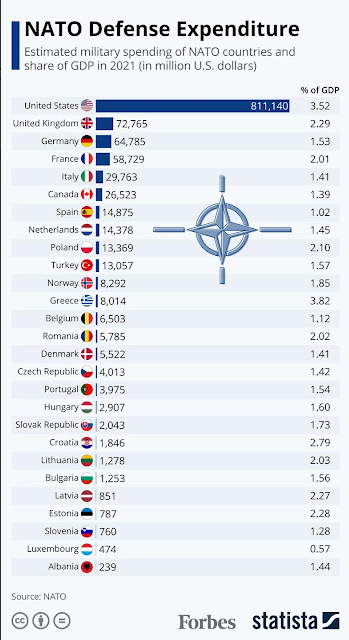
While percentage of GDP is an imperfect measure of contribution, it is better than all the other ones. It is as simple benchmark of national effort.

As these are the best numbers we have, let’s look at 2021 and then forward.

It is amazing that after all Russia has shown Western Europe — both of its nature and the nature of modern warfare — that so many of our NATO allies continue to slow walk defense spending, doing the very minimum to be a full and fair partner in the alliance.

Russian victory — however they define it — or Russian defeat — however Ukraine defines it — will not change the geography or nature of Russia. She is not going anywhere.

So, what’s to be done to encourage nations like Canada to put up or shut up? This might help:

“Out years” are where dragons live, so anyone not on guide-slope to 2%+ by the end of 2023 – when one way or another the Russo-Ukrainian War should be over – will find someway to not get there in a wave of excuses and bluffing.

We should call their bluff.

As such, and this is generous, we need to finally pursue PLAN SALAMANDER for NATO “Flags-to-Post” that I first proposed almost six years ago.

    In NATO, General and Flag Officer billets are distributed amongst nations in a rather complicated way, but this formula is controlled by NATO – and as such – can be changed.

    Entering argument: take the present formula for “fair distribution” and multiply by .75 any nation that spends 1.5% to 1.99% GDP on defense. Multiply by .5 any nation that spends between 1.25% to 1.499%. Multiply by .25 1.0% to 1.240%. If you fall below 1%, you get nothing and your OF5 (Col./Capt) billets are halved.

    1.25x for 2.01%-2.25%. 1.5X for 2.26%-2.75%; 1.75x for 2.76% -3.0%. 2x for +3.01%.

The math gets funky when a lot of people get over 2%, but we can refine it later. Doesn’t cost a penny and will unquestionably get the attention of those nations. Trust me on this. By January 1st, 2024 no more excuses. A small and symbolic punishment, but a good start that may be all that is needed. This is not the second half of the 20th Century any more.

September 21, 2022

Radom’s Vis 35: Poland’s Excellent Automatic Pistol

Forgotten Weapons
Published 9 Feb 2016

In the 1920s Poland began looking for a new standard military pistol, and tested a variety of compact .380s. The representative from FN brought along an early iteration of the High Power (along with their other entry) even though it was much too large and heavy to meet the Polish requirements. After a couple iterations of testing, it became clear to the Polish Ordnance officers that the High Power was a much more effective service pistol than the compact guns they had been instructed to look for.

Lo and behold, the ultimate choice was a domestic design based largely on the High Power (a direct deal with FN was not an option after Poland’s relationship with FN had suffered through problems with the wz.28 version of the BAR). Toss in a delay to redesign the early decocking mechanism to satisfy the Cavalry (who didn’t realize that the decocker wasn’t actually meant to be used, but rather to just add another claim to the patent), and by 1935 the pistol was finished and formally adopted.

The Vis 35 is one of the best automatic pistols of WWII in terms of both handling and quality. In total 46,000 were made pre-war for Poland’s military, and German occupation forces built another 300,000+ during the war.
(more…)

QotD: Why postwar western economic and humanitarian “interventions” almost always failed

… it is a general truism that the majority of persons who run for office in North America and various European countries do so because they sincerely want to help and improve their communities/countries. However, in all of Africa and most of Asia, persons who seek public office do so for one purpose, and one purpose only: to steal everything that they can get away with. So when some ignorant, naïve, American shows up with buckets full of money, oblivious of the culture and the longstanding, entrenched, corruption, and with an announced intention to make the local community more like an American community, they are welcomed with open arms while suppressing their snickering. This also explains something where Americans exhibit willful blindness: other cultures don’t play fair. Honesty is seen as the trait of fools. Fools are to be taken advantage of. Especially in trade and diplomacy. Just look at China.

Prior to the Cold War, America’s interference in other countries’ internal affairs was practically nonexistent outside of the Caribbean where America’s preoccupation was with the stability in the region. What went on in Egypt, Thailand, Argentina, or Greece was none of our business, nor did we frankly care. However, having just survived the cataclysm of WWII, and the realization that Communism was a danger bent on world domination, and that each country that became Communist made that possibility much more likely changed that laissez faire attitude 180 degrees. Whereas NATO was formed for the purpose of deterring a military attack on Western Europe by the Soviet Union (the generals mentally fighting the last war as is always the case, not realizing that the war now was ideological and propagandistic rather than military), diplomats began to question how to best combat Communist insurgencies in the Third World. The arrived (wrong) conclusion was that the reason a country became Communist was because the dirt-poor people were so desperate that they became Marxists in order to improve their lives, so if the West helped poor countries economically Communists could not gain a foothold. As such, they ignored the fact that most Communist movements are organized and headed not by poor people, but by a cadre of power-hungry middle-class intellectuals.

As has been mentioned, the first approach was with foreign aid. The second was with military intervention, in Korea, Vietnam, Santo Domingo, Grenada, and Lebanon. Although such interventions were mostly successful, they carried a heavy price as American blood was spilled in foreign countries. America’s supposed allies hardly helped at all, including the citizens of the countries (Korea and Vietnam) that themselves were in danger of being conquered by Communist forces.

Armando Simón, “Schlimmbesserung“, New English Review, 2022-06-16.

September 20, 2022

The Evolution of the Rifleman’s Uniform 1860-1990’s

Filed under: Cancon, History, Military, Weapons, WW1, WW2 — Tags: , — Nicholas @ 02:00

Queen’s Own Rifles of Canada Regimental Museum
Published 30 Nov 2020

See the evolution of the rifleman’s uniform throughout most of our history.
You can also read more about this evolution on our Museum website:
https://qormuseum.org/history/timelin…
(more…)

« Newer Posts — Older Posts »

Powered by WordPress