
Imperial War Museums
Published 5 Oct 2022The BMP-1 is a Soviet infantry fighting vehicle from the 1960s. Ours was captured during Operation Desert Storm in 1991 and has been on display at IWM Duxford for over 30 years. Yet vehicles just like It are still being used by both sides in the ongoing Russo-Ukrainian War, with heavy losses. So why are museum pieces being fielded in a 21st century war? And how are they performing?
(more…)
October 6, 2022
This vehicle belongs in a museum. Why is it still being used in Ukraine?
Comments Off on This vehicle belongs in a museum. Why is it still being used in Ukraine?
Carl Gustav m/42: A 20mm Recoilless Antitank Rifle
Forgotten Weapons
Published 21 Apr 2017The Swedish Pansarvärnsgevär fm/42 made by the Carl Gustav company was an interesting early hybrid antitank weapon — a recoilless rifle firing solid armor-piercing projectiles. It used a 20x180mm case, propelling the 108g (1650gr) bullet at 950 m/s (3150 fps). This was capable of perforating 40mm of perpendicular armor plate at 100m (a high explosive projectile was also made). This was on the high end of armor penetration for anti-tank rifles, and the m/42 was able to do this with a weapon weighing just 11.7kg (25 lb) — less than a quarter of a comparable 20mm conventional rifle.
This was possible because of its recoilless design — upon firing, the rear end of the cartridge case would blow out and vent out the back of the weapon, instead of being firmly sealed like a conventional rifle. This created a counter balancing recoil impulse which prevented the gun and shooter from having to absorb the full recoil energy produced by a heavy bullet launching off at high velocity. The tradeoff was that much of the potential energy of firing was wasted venting out the back instead of pushing the bullet forward, which is why the cartridge case was so oversized.
About a thousand of the guns were made by the end of World War 2, at which time even it had been made quite thoroughly obsolete by the rapidly increasing thickness of tank armor. It would, however, be the stepping-stone to the m/48 Carl Gustav 84mm recoilless rifle, which used a shaped charge warhead to perforate armor with a stream of molten metal instead of relying on velocity of a hardened projectile.
(more…)
Comments Off on Carl Gustav m/42: A 20mm Recoilless Antitank Rifle
October 4, 2022
Sweden: The Jews’ Salvation? – WAH 080 – October 2, 1943
World War Two
Published 2 Oct 2022As the Allies advance in southern Italy, the people of Naples join them in fighting the Wehrmacht. In Denmark, the biggest rescue operation of Jews thus far begins.
(more…)
Comments Off on Sweden: The Jews’ Salvation? – WAH 080 – October 2, 1943
October 3, 2022
Nazis Go Fascist Hunting – WAH 079 – September 25, 1943
World War Two
Published 2 Oct 2022The Wehrmacht continues Operation Axis and its slaughter of Italian soldiers. In Western Europe, the situation of the Jews becomes increasingly precarious, especially so in Denmark.
(more…)
Comments Off on Nazis Go Fascist Hunting – WAH 079 – September 25, 1943
“We’re one breaking news alert from seeing a day’s work dramatically reduced in importance, if not rendered obsolete forever”
It’s a very weird moment in time, as The Line‘s weekly editorial wrap-up notes:
This is perhaps the strangest dispatch we’ve ever written. It is a fact of life in the news business that top headline can change in an instant. We’re one breaking news alert from seeing a day’s work dramatically reduced in importance, if not rendered obsolete forever. Every journalist has known that frustration. And today, as Western officials remain concerned about the risk of nuclear attack, this seems more true than usual. All our little insights into Canadian politics and cultural issues would make a weird second and third item in a dispatch where the lead item was Kyiv going up in a mushroom cloud.
So yes. This is where our minds are. As discussed at some length in our podcast and video this week, your Line editors have been closely watching developments in the war between Ukraine and Russia, and indeed take very seriously threats by the Russians to use nuclear weapons. We understand fully that it is very possible that all of Putin’s talk of nukes is a bluff, intended to rattle the West and encourage Ukraine to accept Russian gains and negotiate.
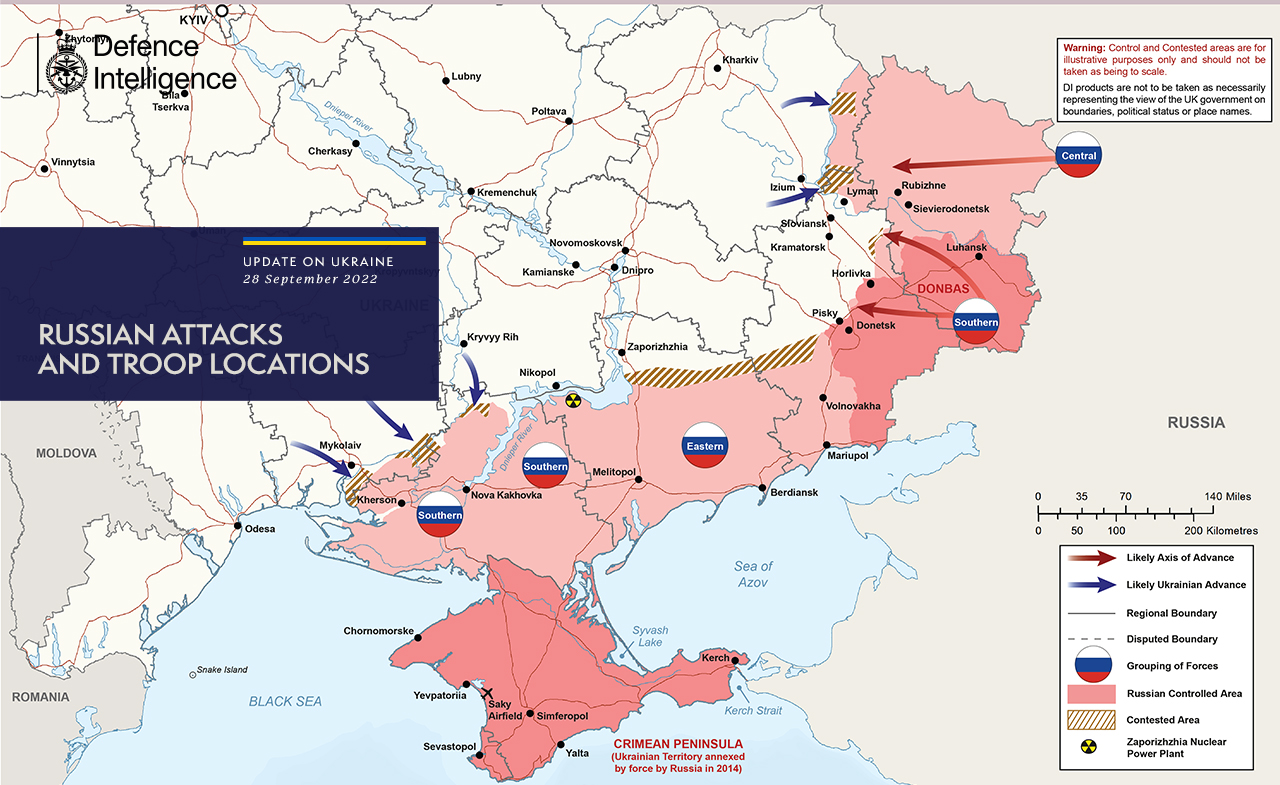
Neither seems likely — Ukraine is motivated and Western support, though imperfect, remains strong. We also see little indication that Putin could win the war in which he has stranded himself and his country, and we believe that things will only get worse for him. His attempt to mobilize 300,000 has turned into an item of mockery abroad, as pictures of old men and rusted equipment spread across social media. The “annexation” of occupied areas into Russia clearly didn’t deter either Ukraine or its Western backers; Ukraine’s forces remain on the move, with more Western weapons arriving all the time. And meanwhile, on the battlefield, the Ukrainian Armed Forces grow ever stronger: in just the last few hours, they have handed the Russians another embarrassing defeat in the city of Lyman. That city, a local rail junction, was important for Putin’s logistical efforts in the region, and fell into Ukrainian hands with a shocking lack of resistance.
See what we mean? This isn’t going well for Russia, and everything he tries is just stranding Putin deeper in the shit. He could have de-escalated this war at several points. At every juncture he has chosen escalation instead, and that has only made his problems worse — more deaths, more unrest, more humiliation. All of his efforts to intimidate the West or crush the Ukrainians have failed. What can he do? How can he get himself out of this problem? What will happen to him if he can’t?
These are the questions keeping us up at night. Seeing the conflict through his eyes, it’s not hard for us to imagine that Putin will come to view some kind of nuclear use as his only remaining chance to escape this war with his power still in place, or perhaps even simply with his life. After all, all this talk about whether Putin is “rational” depends entirely on how he understands his own circumstances. What may seem insane to us may, in fact, make perfect sense to him, and we suspect one’s definition of reason undergoes a radical re-evaluation when one feels a noose getting ever-tighter around the throat.
So that’s why we think it’s possible. Let’s talk what we think is possible. There are a few different ways he could use nuclear weapons. We are not the experts on this, but your Line editors are, if nothing else, reasonably well read on the topic, and we have spent the last few weeks talking with genuine experts. If we do see the use of a nuclear weapon, Putin could use a single small device on a minor target in Ukraine (or perhaps over the Black Sea) in hopes of shocking NATO and the world through his sheer willingness to break the nuclear taboo. We would expect him to go a bit further, and hit Ukraine with a series of small strikes intended to disrupt its military and seize some kind of conventional military advantage on the ground, on top of the political shock.
Or hey: he could go fully insane and try to terrorize the world into bending to his will by, for instance, attacking NATO directly, or using one of his larger nuclear weapons to utterly destroy a city in Ukraine.
Comments Off on “We’re one breaking news alert from seeing a day’s work dramatically reduced in importance, if not rendered obsolete forever”
France in the Cold War: AA52 Replaces the Hotchkiss
Forgotten Weapons
Published 27 May 2022
(more…)
Comments Off on France in the Cold War: AA52 Replaces the Hotchkiss
October 2, 2022
Smolensk and Naples Liberated! Both in ruins – WW2 – 214 – October 1, 1943
World War Two
Published 1 Oct 2022Major prizes are taken by the Allies this week on two fronts — Naples in Italy and Smolensk in the USSR, but they are advancing all over the Eastern Front, across the Italian peninsula, and in the South Seas, but the enemy is leaving a trail of destruction as he pulls back.
(more…)
Comments Off on Smolensk and Naples Liberated! Both in ruins – WW2 – 214 – October 1, 1943
“We are governed by a transnational criminal enterprise”
Elizabeth Nickson on the deliberately created web of disasters the entire western world faces thanks to our governments’ allegiance to philosophies promulgated by organizations like the WEF:
We are governed by a transnational criminal enterprise.
What are you doing about it?
One sentence caught my attention in Giorgia Meloni’s speeches this week. She said that most insulting thing for her and other Italians, was the EU’s order to erase all references to Christianity, Christmas and Christ from all government documents by Christmas (ironic) of 2022.
This is another of those blows from the One Worlders that feels like someone is stepping on your heart and pressing down. I may not be a church-going Christian, but it defines me like almost nothing else. It is my history, my literature, my culture, my ethical standards, my everything. Christianity defines the western world, it is an activist faith, it orders a congregant to spread goodness wherever he or she goes. Erasing it is a crime similar in effect as the death camps of which our leaders dream. It destroys the ground of our being.
And then I think of my father. Look at this photograph. As a teen, he was very much like the kids of today, self-involved, vain, a girl magnet like his great grandson, Bryson, who never sees a girl who doesn’t interest him. But he was one of the few fully adult men I have known. I want to say only, but I’ve met thousands of men and know few of them as well as I knew him.
It wasn’t until long after my father’s death that I discovered that he was at the tip of the spear of the British Army as they landed at D-Day, pressed forward into France and then into Germany. The Canadian Army, the fourth largest standing army in the world in 1945, had a reputation of brutalism like no other army, famous for it in WW1. This was in part because it was built – as was Canada – by some of the fiercest medieval clans in Europe. Just before James 1 murdered the British border clan heads, Elizabeth I said that with 10,000 such men, James could topple any throne in Europe. Canada attracted those clans, the climate, the terrain was the roughest in the world, and only they could conquer it. And in 1943, they formed an army like none other.
Being his child, I can grope myself into what he was feeling during those two years under remorseless fire, on the ground, buried into caves on the Rhine that last winter, responsible for hundreds of men. He woke up every day for two years, with death certain. I have his Book of Common Prayer. It is swollen with use, especially the prayers for the dead he read over the bodies of his friends. After the war he was put in charge of a Nazi camp and told to “sort those people out”. Kind of like a desert in hell, I would think.
His faith carried him through those years. He was welded to it by the time it was over, although he never proselytized, it was just part of him. Christianity acts, with good men, as spur and comfort. It informed every ethical decision he made. After the war, he came home and worked, fighting unions that destroyed the textile industry in Quebec, trying to keep his factory going in the face of actual bags of burning shit thrown at our house. He retired at 55 with a non-compete clause and spent the rest of his life in charity, working for free. He ran in succession one enterprise after another. His entire life, all of it, he used his spare time to work in the community. Three meetings a week, no matter what. He knew where every sparrow fell in the country village I grew up in, and in the city to which he retired. And if he missed one, his uncles, aunts or cousins picked them up and set them right. It was how they lived.
That used to be a requirement for adulthood. He learned it from his family who came to the New World in 1630, and who all, to a man or woman, worked for free in whatever village or county they found themselves in, making sure everyone was all right. In the towns and cities they settled, across the US and Canada from 1600 to 1945, you were only considered an adult if you rolled up your sleeves and worked for other people in the place that you lived, without being paid, and without expecting praise.
If you didn’t do that work, you were considered a baby that everyone else had to carry. You were made to feel that.
It was that above every single other thing, that made the US and Canada the magnet it is for every other race and country in the world. Self-government by adults. And by the way, for the race-hustlers, they were officers on the Underground Railroad, when it wasn’t popular to be on the side of people of color. They married into Indian bands when it was absolutely beyond the pale.
The boomer generation abandoned that task, and the devolution of the culture was swift. The left creates jobs by creating bureaucrats and the responsibilities that used to be held in common, solved in common, done for goodness alone, are now done for money and benefits by people who generally do not live in the regions they supervise. They have screwed up everything because they can’t make decisions because they have no courage. And they have no courage because they have no ethical standards. Their only standard is whether it increases their own comfort. And that of maybe two other people. To whom they are related.
The only thing they create is debt and obstacles to growth. Aside from technical/engineering standards, (which are being broken) everything they do, can be done by citizens acting in concert.
Our disengagement led to our current economic catastrophe, like nothing else. It is the reason the globalist criminals were able to take over. It is why we now sit in danger of nuclear war.

Comments Off on “We are governed by a transnational criminal enterprise”
QotD: US intelligence failures in the Tet Offensive
[In The Tet Offensive: Intelligence Failure in War, James] Wirtz argues that Tet was not an intelligence failure in the sense that “the Allies” (his term) had no idea it was coming. US analysts had lots of information indicating a pending attack — indeed, sometimes too much information. Nor was it a complete failure to analyze the available information — lots of US analysts were in the ballpark about the size, direction, and even timing of the attack, and one analyst, Joseph Hovey, produced a report that predicted the whole thing with astonishing accuracy. Rather — and this is my term, not Wirtz’s — it was a failure of narrative.
By summer 1967, MACV (for convenience) had convinced itself that the North Vietnamese no longer had the resources to win the war militarily, and they knew it. This conclusion was based in large part on metrics coming in from field commanders. Specifically, MACV argued that by mid-1967, the Communists had passed what they, MACV, termed the “inflection point” — the North Vietnamese were losing more forces than they could replace, which led to a significant decrease in NVA / VC fighting capacity, plummeting morale, etc.
At no point, it seemed, did they question this assumption, or the bases of this assumption, the key to which was: Kill ratio. We all know how that goes, no need to get into the weeds, but note that everything hinges on the North Vietnamese not only losing the war, but knowing themselves to be losing.
[…]
So, too, with ever-increasing reports that the Viet Cong were going to launch major attacks on South Vietnamese cities. Since US analysts assumed the VC didn’t have the forces for that, these reports were dismissed as propaganda.
Finally, the assumption that the NVA knew themselves to be losing was seemingly confirmed with the siege of the big US firebase at Khe Sanh. It shared a similar geography with Dien Bien Phu, and when some of the same units that had participated in the original battle showed up to take on the Marines, US analysts concluded that the Communists, desperate for a psychological victory, were trying to make another Dien Bien Phu out of Khe Sanh.
At most, US analysts reasoned, Khe Sahn was another Battle of the Bulge — a last-ditch “saving throw”-type attack by an almost-beaten enemy. Much like German forces in the Ardennes, then, the North Vietnamese would attack the Americans, because they were the strongest part of the Allies, and therefore the most immediate military threat.
In fact, almost the exact opposite was true, pretty much all the way down the line. The NVA’s plan was to attack ARVN (the South Vietnamese Army) because they were the weakest, and would be even weaker during Tet, when half of them would be on furlough. But ARVN wasn’t out on the perimeter and along the DMZ. They were in the cities. The whole point of the attack on Khe Sanh (and of a whole series of skirmishes called “the border battles”) was to keep US forces out on the perimeter and away from the cities.
It worked spectacularly, too — even as Tet was unfolding, Gen. Westmoreland assumed it was a diversion, to draw American troops away from Khe Sanh. Half the country had been overrun before Westy began to think maybe Khe Sanh wasn’t the target after all; he only really believed it when the NVA broke off the siege and withdrew.
It was Narrative uber alles.
Severian, “Book Rec: Tet, Intelligence Failure”, Founding Questions, 2022-06-30.
Comments Off on QotD: US intelligence failures in the Tet Offensive
October 1, 2022
“Father” – Fritz Haber – Sabaton History 113 [Official]
Sabaton History
Published 29 Sept 2022Fritz Haber is a controversial historical figure. He was responsible for scientific advances that fed billions, yet he created weapons of mass destruction that filled millions with terror. This is his story.
(more…)
Comments Off on “Father” – Fritz Haber – Sabaton History 113 [Official]
Tank Chat #154 | Valentine DD | The Tank Museum
The Tank Museum
Published 27 May 2022We’re back with another Tank Chat this week! Catch up with Historian David Fletcher as he chats in detail about the Valentine DD tank.
(more…)
Comments Off on Tank Chat #154 | Valentine DD | The Tank Museum
September 30, 2022
History Re-Summarized: The Roman Empire
Overly Sarcastic Productions
Published 16 Sept 2022
The plot twist of Rome is that it was always a mess, now sit back and enjoy the marble-covered mayhem.This video is a Remastered, Definitive Edition of three previous videos from this channel — “History Summarized: The Roman Empire”, “History Hijinks: Rome’s Crisis of the Third Century”, and “History Summarized: The Fall of Rome”. This video combines them all into one narrative, fully upgrading all of the visuals and audio, with a substantially re-written script in parts 1 and 3.
(more…)
Comments Off on History Re-Summarized: The Roman Empire
M1C Sniper Garand
Forgotten Weapons
Published 18 Sep 2016The M1C was an M1 Garand with a telescopic sight, using a mounting system developed by the Griffin & Howe company of New York. It utilized a rail pinned and screwed to the left side of the receiver, coupled with a quick-release scope on top. The rails had to be installed prior to heat treating the receivers, which had the unfortunately consequence of preventing rifles form being chosen for sniper conversion based on their mechanical accuracy. Instead, accuracy would be tested only after rifles were complete, leading to a 60% rejection rate.
The scope was offset to the left of the receiver so as not to interfere with the Garand’s clip loading, and issued with a leather cheek pad to give the shooter’s cheek weld a matching offset to the left. The scope used with the M1C was the M73B1, later replaced with the M81 and M82 scopes — all military versions of the 2.5x Lyman Alaskan hunting scope (which was a very good piece of equipment despite its low magnification)
The M1C was adopted in 1944, but production and quality control delays would prevent it from seeing any action in WWII. It was in use during the Korean War, however, before being replaced by the M1D.
(more…)
Comments Off on M1C Sniper Garand
September 29, 2022
Considering weird possible scenarios in Ukraine
In The Line, Matt Gurney walks through some until recently unimaginable outcomes of the Russian invasion of Ukraine:
It’s probably time for us to start thinking through some weird possible scenarios for what’s happening in Russia. Because the spectrum of what could happen is a lot broader than it seemed only six months ago.
But let’s start with an important exercise in accountability. In previous commentary, I predicted a lot of things well: that Ukrainian resistance would be very effective, that Russia would have major logistics problems, that the Russians would use mass artillery fire against civilians in place of military advances. I was quick to grasp that Ukraine was overperforming and that Russia was struggling early in the conflict.
But getting some details right didn’t help me avoid blowing the conclusion: I thought Russia would win. Not a total victory, but I thought Russia would seize a lot more of the country before its logistical problems and Ukrainian resistance brought their offensives to a halt, leaving Ukraine with some kind of rump state in the west. I certainly didn’t believe in February that Russia could lose, and I never would have believed that Ukraine could actually win on the battlefield, as it now seems more than capable of doing.
I don’t know if I underestimated Ukrainian capabilities, per se. I always expected them to fight bravely and well, and understood the lethality of modern man-portable weapons against tanks and armoured vehicles. It’s probably closer to the mark to say that I overestimated Russia’s capabilities — I was a cynic on their military and expected it to perform badly, but it’s somehow fallen well short of my already low expectations. It is absolutely delightful to be wrong on this one, but readers deserve the truth: I expected Russia’s military to perform better and grab a much bigger chunk of Ukraine before having to stop in the face of logistical dysfunction and Ukrainian resistance. Part of me wonders if the Russians themselves are surprised by how hollowed out their military had become.
With that on the record, let’s flash forward to the present. As noted above, Ukraine now seems fully able to win the war. As I write this, Ukrainian forces are on the move again in the northeast, and seem to be encircling Russian positions in occupied Lyman. If able to complete this latest manoeuvre, Ukrainian forces will cut off a large force of Russian troops and will also seize control of an important local rail junction, threatening Russian logistics (such as they are) in the surrounding area. Perhaps more importantly to the overall conduct of the war, Russia’s effort to mobilize 300,000 men for the war is running into obvious challenges. Men of military age are fleeing the country. Reports from Russia reveal that the army has little in the way of equipment and weapons for the new draftees, and no system in place to train them. There have been comically bizarre stories of infirm old men getting call-up notices, and of draftees being sent to the front after only a day or two of training … at best.
This isn’t a solution to Putin’s problems. It’s a new problem being created in real time. Even if Putin can find 300,000 men, it seems unlikely he can equip them, and even less likely that he can train them. Whether or not he can transport what men he does round up into the battle area is an open question, as is whether or not he can supply them once they get there.
This is the long way of saying something I’ll now just state bluntly: Russia is losing. Putin’s latest actions reveal that he knows he’s losing. If the mobilization flops, as seems likely, he’ll be losing even worse than he was losing before, and he’ll have damn few options to turn that around.
And this is why we need to start thinking through some weird scenarios.
Comments Off on Considering weird possible scenarios in Ukraine
The History of Cyprus Explained in 10 minutes
Epimetheus
Published 24 May 2022The history of Cyprus explained from ancient times to modern.
(more…)
Comments Off on The History of Cyprus Explained in 10 minutes


