
… we have already noted that year after year Sparta would invade Attica with hoplite armies which were singularly incapable of actually achieving the strategic objective of bringing Athens to the negotiating table. The problem here is summed up in the concept of a strategic center of gravity – as Clausewitz says (drink!), it is the source of an enemy’s strength and thus the key element of an enemy’s force which must be targeted to achieve victory. The obvious center of gravity for the Athenians was their maritime empire, which provided the tribute that funded their war effort. The Corinthians saw this before the war even started. So long as the tribute rolled in, Athens could fight forever.
It takes Sparta years of fighting Athens to finally recognize this – an effort in 413/2 to support revolts from Athens is pathetically slow and under-funded (Thuc. 8, basically all of it) and it isn’t until Sparta not only allies with Persia but entrusts its fleet to the mothax Lysander that they seriously set about a strategy of cutting Athens’ naval supply lines. This isn’t a one-time affair: Sparta’s inability to coordinate ends and means shows up again in the Corinthian war (e.g. in Argos, Xen. Hell. 4.7), where they are pulled into a debilitating defensive stalemate because the Corinthians won’t come out and fight and the Spartans have no other answers.
This is compounded by the fact that the Spartans are awful at diplomacy. Sparta could be the lynch-pin of a decent alliance of cities when the outside threat was obvious and severe – as in the case of the Persian wars, or the expansion of Athenian hegemony. But otherwise, Sparta consistently and repeatedly alienates allies to its own peril. Spartan leadership at the end of the Persian wars had been so arrogant and hamfisted that leadership of the anti-Persian alliance passed to Athens (creating what would become the Athenian Empire, so Spartan diplomatic incompetence led directly to the titanic conflict of the late fifth century). And to be clear, Athenian diplomacy does not score high marks either, but it is still a far sight better than the Spartans (Greek diplomacy, in general was awful – rude, arrogant and focused on compulsion rather than suasion – so it is telling that the Spartans are very bad at it, even by Greek standards).
In 461, Spartan arrogance towards an Athenian military expedition sent to help Sparta against a helot revolt utterly discredited the pro-Sparta political voices at Athens and in turn set the two states on a collision course. Sparta had ejected the friendly army so roughly that it had created an outrage in Athens.
During the Peloponnesian War, Spartan diplomatic miscalculations repeatedly hurt their cause, as with the destruction of Plataea – the symbol of Greek resistence to Persia. Later on in the war, terrible Spartan diplomacy repeatedly derails efforts to work with the Persian satrap Tissaphernes, who has the money and resources Sparta needs to defeat Athens; it is the decidedly un-Spartan actions first of Alcibiades (then being a traitor to Athens) and later Lysander who rescue the alliance. After the end of the Peloponnesian War, Sparta promptly alienated its key allies, ending up at war first with Corinth (the Corinthian War (394-386) and then with Thebes (378-371), both of which had been stalwarts of Sparta’s anti-Athenian efforts (Corinth was itself a member of the Peloponnesian League). This led directly to the loss of Messenia and the breaking of Spartan power.
In short, whenever Sparta was confronted with a problem – superior enemy forces, maritime enemies, fortified enemy positions, the need to keep alliances together, financial demands – any problem which could not be solved by frontal attack with hoplites, the traditional Spartan leadership alienated friends and flailed uselessly. Often the Spartans attempted – as with Corinth and later Thebes – to compel friendship with hoplite armies, which worked exactly as poorly as you might imagine.
It is hard not to see both the strategic inflexibility of Sparta and the arrogant diplomatic incompetence of the spartiates as a direct consequence of the agoge‘s rigid system of indoctrination. Young Spartiates, after all, were taught that anyone with a craft was to be despised and that anyone who had to work was lesser than they – is it any surprise that they disdained the sort of warfare and statecraft that depended on such men? The agoge – as we are told – enforced its rules with copious violence and was designed to create and encourage strict, violent hierarchies to encourage obedience. It can be no surprise that men indoctrinated in such a system – and thus liable to attempt to use its methods abroad – made poor diplomats and strategic thinkers abroad.
Bret Devereaux, “Collections: This. Isn’t. Sparta. Part VII: Spartan Ends”, A Collection of Unmitigated Pedantry, 2019-09-27.
October 15, 2022
QotD: Spartan strategic and diplomatic blunders during and after the Peloponnesian War
October 14, 2022
Nazis Suck at Sabotage – WW2 – Spies & Ties 23
World War Two
Published 13 Oct 2022They say every masterpiece has its cheap copy. Well, the German Sicherheitsdienst are trying to copy the success of the Soviet Partisans. With Walter Schellenberg, Heinrich Himmler, and Reinhard Heydrich in charge, you know it’s going to be a bloody affair.
(more…)
October 13, 2022
The Nazis’ Justification for the Genocide – October 9, 1943 – WAH 081
World War Two
Published 12 Oct 2022This week the Nazis go on the record about their genocide of the Jews. Meanwhile the Jews in Denmark are coming closer to safety, and the Roman Jews are again at peril.
(more…)
QotD: “Russia is a nation built for tank warfare”
Russia also benefits from an outstanding rail network able to quickly move tanks and other heavy elements of military power such as APCs and self-propelled guns around easily, and has the space and reserves of conscript manpower from previous generations to draw on to crew its simple but effective designs, such as the T64 and T72.
This is underpinned by a national philosophy which is best summed up as “don’t throw away any military asset that, no matter how old it is, could be used to kill an invader”. There are storehouses across Russia full of elderly tanks that with a bit of TLC could, probably function as a last gasp capability. Russia regularly exercises its armoured capability, mobilising forces and moving them around the country to test readiness against the theoretical threat of a NATO invasion.
Russia then is a nation intended for operating tanks, but only when supported by a logistics chain that can support the front. Start moving away from the Russian landmass and their ability to sustain a force at any distances is quickly called into doubt. While Russia may “rank” as the largest tank operator in the world, much of this is only a threat to any nation foolish enough to invade Russia in the first place.
Sir Humphrey, “Tanks for nothing — Why it does not matter if the British Army has fewer tanks than Cambodia”, Thin Pinstriped Line, 2019-04-24.
October 12, 2022
Walther P38 Development
Forgotten Weapons
Published 13 Apr 2016The Walther P38 was adopted by Germany in 1938 as a replacement for the P08 Luger — not because the Luger was a bad pistol, but because it was an expensive pistol. Walther began development of its replacement in 1932 with two different development tracks — one was a scaled-up Model PP blowback in 9x19mm and the other was the locked-breech design that would become the P38.
The initial prototypes look externally quite similar to the final P38, although the locking system went through several changes and the controls did as well. Several of the early developmental models used shrouded hammers.
In this video I will take a look at both initial “MP” pistols (the blowback and the locked breech), then the Armee Pistole (aka the AP) in its standard configuration and also a long barreled model with a shoulder stock, then the second Model MP, and finally the HP which was the commercial model of the final P38. In addition, I will check out a sheet metal prototype of the locked breech model form the very beginning of the development program.
(more…)
October 11, 2022
A tribute to the F-101 ‘Voodoo’ Fighter
Matsimus
Published 4 Jun 2022The McDonnell F-101 Voodoo is a supersonic jet fighter which served the United States Air Force (USAF) and the Royal Canadian Air Force (RCAF).
Initially designed by McDonnell Aircraft Corporation as a long-range bomber escort (known as a penetration fighter) for the USAF’s Strategic Air Command (SAC), the Voodoo was instead developed as a nuclear-armed fighter-bomber for the USAF’s Tactical Air Command (TAC), and as a photo reconnaissance aircraft based on the same airframe. An F-101A set a number of world speed records for jet-powered aircraft, including fastest airspeed, attaining 1,207.6 miles (1,943.4 km) per hour on 12 December 1957.[1] They operated in the reconnaissance role until 1979.
Delays in the 1954 interceptor project led to demands for an interim interceptor aircraft design, a role that was eventually won by the B model of the Voodoo. This required extensive modifications to add a large radar to the nose of the aircraft, a second crew member to operate it, and a new weapons bay using a rotating door that kept its four AIM-4 Falcon missiles or two AIR-2 Genie rockets hidden within the airframe until it was time to be fired. The F-101B entered service with USAF Air Defense Command in 1959 and the Royal Canadian Air Force in 1961. US examples were handed off to the USAF Air National Guard where they served until 1982. Canadian examples remained in service until 1984.
(more…)
October 10, 2022
Chinese Warlords and the Royal Canadian Navy – WW2 – OOTF 028
World War Two
Published 9 Oct 2022In today’s episode of Out of the Foxholes, we discuss the role of Chinese warlords played in the war against Japan, while also shining a bit more light on the Canadian Navy and its impact on WW2.
(more…)
Look at Life — Trouble Shooters (1964)
PauliosVids
Published 20 Nov 2018
From the comments:
David Mills
1 year ago
We never wore berets but jungle hats. This is an honest attempt to illustrate their role but so obviously, painfully stage managed. In reality, it was a hot, sweaty, stinking environment with constant tensions. Contacts were few and far between. Going into the IBAN long houses and chatting with the headman (Kampong Ketua) was fascinating, useful and, for the short period, relaxing. Between June 1965 and Aug 1982 I had four tours in the area. Learning Malay was essential and welcomed by the indigenous population.Iolis
1 year ago
The late Paddy Ashdown at 6.36. Later in life he would becone leader of Britain’s Liberal Democrat Party. He sadly died on 22 December 2018.
October 9, 2022
What do you call it when a military-funded organization intervenes in US domestic politics? It’s “anti-fascism“, obviously
Chris Bray continues digging into the activities of a Department of Defence-funded operation at the University of Maryland:
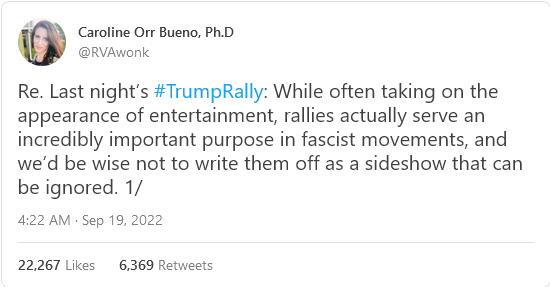
I wrote this morning about the disinformation expert Caroline Orr Bueno, a postdoctoral fellow at ARLIS — the Applied Research Laboratory for Intelligence and Security at the University of Maryland (who is identified as Caroline Orr on her ARLIS profile, so that’s the name I’ve used for her). Orr aggressively and repeatedly argues against the American political right, framing conservative politics as fascist and describing Donald Trump as an authoritarian figure. She makes a political argument, and she does it often.
This is true not only of her social media posts, but also of her published work. She’s a pro-Antifa political partisan (more about this in a moment), specifically arguing against the right and against Donald Trump rather than only studying disinformation across the political spectrum.
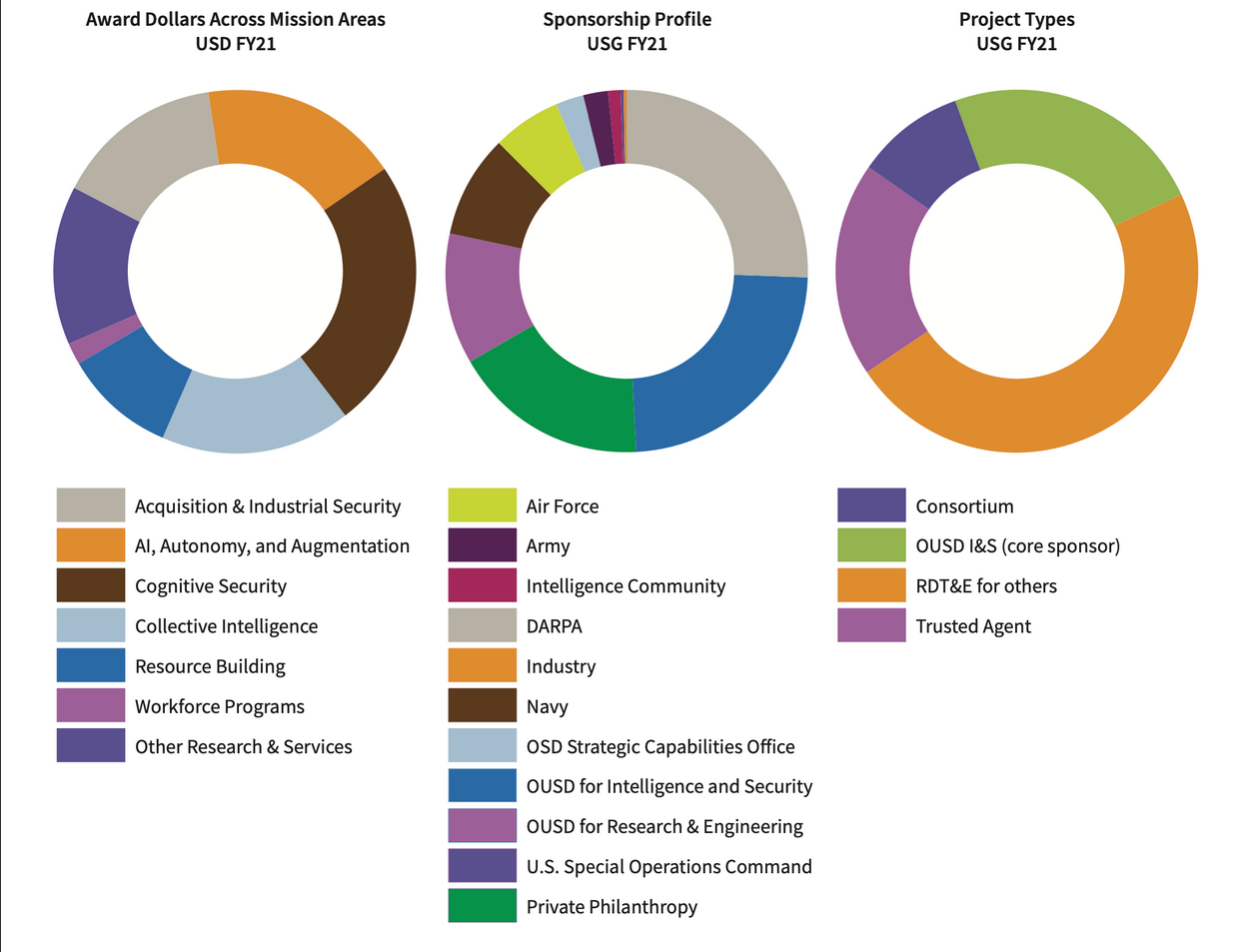
Now: ARLIS, where Orr works, is primarily funded by the Department of Defense, and its “core sponsor” is the Undersecretary of Defense for Intelligence and Security. You can download the 2021 annual report from ARLIS here […] You can find a description of the laboratory’s $46 million in funding on page 26 of that report:
So a research center largely funded by the military, and specifically sponsored by and aligned with the Undersecretary of Defense for Intelligence and Security, is arguing against a likely candidate for President of the United States and his supporters, participating in the work of shaping a political narrative while drawing DOD funds. Orr’s national security work as a military intelligence-funded researcher is to make sure people know that Donald Trump is bad.
This scholar has military funding:
Military intelligence is paying for politics. Military-funded academic researchers have the same academic freedom every other academic researcher has, and Orr has a right to express political opinions. But she’s doing government-funded research into the academic topic of Trump is bad so don’t support him, and that’s a misuse of federal funding and military authority. I assign the failure to the institution, not to the person. (The irony of military-funded academic leftist politics is not hard to spot, but that sort of thing doesn’t seem to matter anymore.)

Could the Soviets Cut Off Crimea? – WW2 – 215 – October 8, 1943
World War Two
Published 8 Oct 2022The Germans booby-trapped Naples when they evacuated last week and local civilians now pay the price. In the Mediterranean, Kos falls to the Germans while Corsica is liberated by the French. There is action all along the Dnieper in the USSR, and the Australians advance in New Guinea, and the Japanese evacuate Vella Lavella in the Solomons.
(more…)
SIG M5 Spear Deep Dive: Is This a Good US Army Rifle?
Forgotten Weapons
Published 3 Jun 2022The NGSW (Next Generation Squad Weapon) program began in 2017 to find a replacement for the M4, M249, and the 5.56mm cartridge. It came to a conclusion in April 2022 with the formula acceptance of the SIG M5 rifle, M250 machine gun, Vortex M157 optic, and the 6.8x51mm cartridge. SIG released a handful of civilian semiauto M5 / Spear rifles and thanks to Illumin Arms I have one to examine.
The rifle (Spear is its commercial designation; M5 is the military one) is an evolution of the SIG MCX, which is in turn an evolution of the AR-15 and AR-18 systems. The MCX moved the recoil spring assembly into the top of the upper receiver, allowing the use of a folding stock. It also had very easily swapped barrels and a suite of fully ambidextrous controls. Scaled up to AR-10 size and chambered for 6.8x51mm, the MCX became the Spear.
That new cartridge (commercial designated .277 SIG Fury) is designed to produce high muzzle velocities out of a short barrel (the M5 has a 13 inch barrel). It does this by boosting the operating pressure up to an eye-watering 80,000psi, which required the development of hybrid case using a stainless steel case head. This allows the case to handle those pressures safely. The currently available commercial ammunition is loaded to lower pressure, however. Much of the military and civilian use of this rifle will be done with downloaded training ammunition, which uses a conventional all-brass case.
Both the M5 and M250 were ordered by the Army with suppressors on every weapon, a significant advancement in Army policy. The can is another SIG development, entirely made using additive manufacturing and designed specifically to prevent gas blowback into shooters’ faces (which is succeeds at wonderfully).
Overall, I believe the M5 / Spear is an excellent rifle — soft shooting, reliable, and very accurate. However, that does not mean it is the right rifle for the Army. Will its ability to defeat modern body armor prove worth the tradeoff in extra soldier combat load weight and reduced ammunition capacity? Only time will tell…
(more…)
QotD: The Paras in peacetime … the “Millwall of the British Army”
The Regimental history is littered with gallantry awards and tales of valour that are both inspirational and humbling to read. There is no doubt that within their world, the airborne infantryman can, when deployed on operations, be a ferocious foe, who few would wish to tangle with. The problem is that this aggression and drive is not something that is commonly needed outside of military operations, and the chances of these occurring are in ever shorter supply.
After a period when there were opportunities for deployments and kinetic action in Afghanistan and Iraq, the call for missions for Paratroopers is, currently, slim. Designed as a force intended to be ready to go when called, their leadership have to balance off maintaining an aggressive “ready for anything” mentality, coupled with trying to keep the behaviour of their people under manageable control.
Sir Humphrey, “Values, Standards, and Leadership in the Internet Age”, Thin Pinstriped Line, 2022-06-18.
October 8, 2022
Prelude to WW1 – The Balkan Wars 1912-1913
The Great War
Published 7 Oct 2022The Balkan Wars marked the end of Ottoman rule in Southeastern Europe, and they involved several countries that would join the First World War just a few years later. A complicated alliance between Serbia, Montenegro, Bulgaria and Greece imploded over disagreement of the war spoils after defeating the Ottomans. This led to the 2nd Balkan War and also created much resentment that would play a role between 1914 and 1918 too.
(more…)
Tank Chat #155 | Warthog | The Tank Museum
The Tank Museum
Published 3 Jun 2022David Willey is back with another Tank Chat. This week join David as he chats about the armoured vehicle Warthog — the Viking successor.
(more…)
October 7, 2022
The Combat Dogs of World War Two – WW2 Special
World War Two
Published 6 Oct 2022Where man goes, so does man’s best friend. Across the globe, tens of thousands of dogs are called up. They play their part in tales of heroism and joy. But without any agency over their own lives, they also experience fear, death, and cruelty.


