
World War Two
Published 18 Sep 2022The German Nazi Genocide of the Jews surpasses four million deaths, while the Soviet Union and US step up oppression against some their own citizens.
(more…)
September 19, 2022
Albania – Hitler’s Latest Ally? – WAH 078 – September 18, 1943
Comments Off on Albania – Hitler’s Latest Ally? – WAH 078 – September 18, 1943
City Minutes: Crusader States
Overly Sarcastic Productions
Published 13 May 2022Crusading is one thing, but holding your new kingdoms is a much trickier business. See how the many Christian states of “Outremer” rolled with the punches to evolve in form and function over multiple centuries.
(more…)
Comments Off on City Minutes: Crusader States
September 18, 2022
Jailbreak! Mussolini on the Loose Again! – WW2 – 212 – September 17, 1943
World War Two
Published 17 Sep 2022
(more…)
Comments Off on Jailbreak! Mussolini on the Loose Again! – WW2 – 212 – September 17, 1943
Austria’s Take on the Uzi: Steyr MPi-69
Forgotten Weapons
Published 13 May 2022
(more…)
Comments Off on Austria’s Take on the Uzi: Steyr MPi-69
September 17, 2022
In the wake of the Russo-Ukrainian war, Europe’s cold winter looms ahead
Andrew Sullivan allows his views on the fighting in Ukraine to be a bit more optimistic after Ukrainian gains in the most recent counter-attacks on Russian-held territory around Kharkiv:
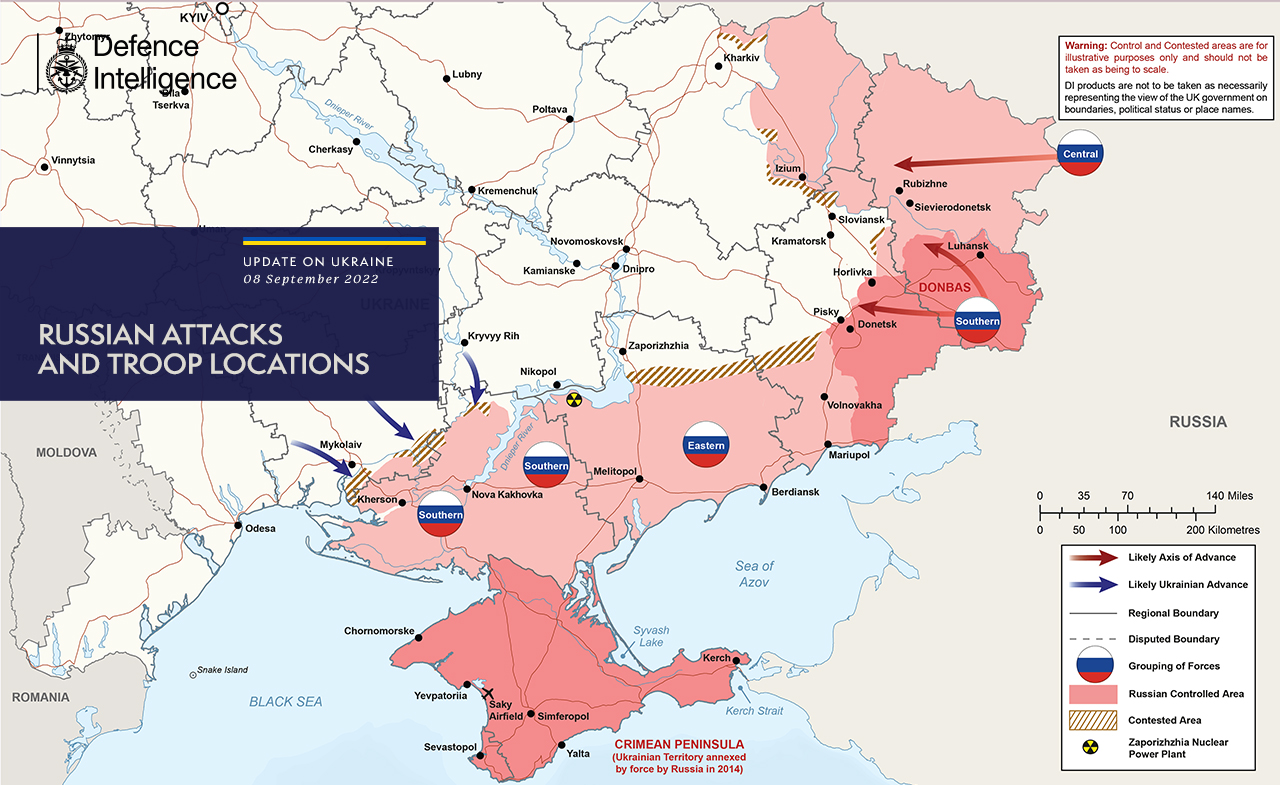
Approximate front-line positions just before the Ukrainian counter-attack east of Kharkiv in early September 2022. The MOD appears to have stopped posting these daily map updates sometime in the last month or so (this is the most recent as of Friday afternoon).
As we were going to press last week — I still don’t know a better web-era phrase for that process — Ukraine mounted its long-awaited initiative to break the military stalemate that had set in after Russia’s initial defeat in attempting a full-scale invasion. The Kharkiv advance was far more successful than anyone seems to have expected, including the Ukrainians. You’ve seen the maps of regained territory, but the psychological impact is surely more profound. Russian morale is in the toilet — and if it seems a bit premature to say that Ukraine will soon “win” the war, it’s harder and harder to see how Russia doesn’t lose it. By any measure, this is a wonderful development — made possible by Ukrainian courage and Western arms.
Does this change my gloomy assessment of Putin’s economic war on Europe, which will gain momentum as the winter drags on? Yes and no. Yes, it will help shore up nervous European governments who can now point to Ukraine’s success to justify the coming energy-driven recession. No, it will not make that recession any less intense or destabilizing. It may make it worse, as Putin lashes out.
More to the point, the Kharkiv euphoria will not last forever. September is not next February. Russia still has plenty of ammunition to throw Ukraine’s way (even if it has to scrounge some from North Korea); it is still occupying close to a fifth of the country; still enjoying record oil revenues; has yet to fully mobilize for a war; and still has China and much of the developing world in (very tepid) acquiescence. Putin is very much at bay. But he is not finished.
Europe’s scramble to prevent mass suffering this winter is made up of beefing up reserves (now 84 percent full, ahead of schedule), energy rationing, government pledges to cut gas and electricity use, nationalization of gas companies, and billions in aid to consumers and industry, with some of the money recouped by windfall taxes on energy suppliers. The record recently is cause for optimism:
The Swedish energy company Vattenfall AB said industrial demand for gas in France, the U.K., the Netherlands, Belgium and Italy is down about 15% annually.
But the use of gas by households is trivial in the summer in Europe compared with the winter — and subsidizing the cost doesn’t help conservation. Russia will now cut off all gas — which could send an economy like Italy’s to contract more than 5 percent in one year. There really is no way out of imminent, deep economic distress across the continent. Even countries with minimal dependence on Russia, like Britain, are locked into an energy market with soaring costs.
That will, in turn, strengthen some of the populist-right parties — see Italy and Sweden. The good news is that the new right in Sweden backs NATO, and Italy’s post-liberal darling, Georgia Meloni, who once stanned Putin, “now calls [him] an anti-Western aggressor and said she would ‘totally’ continue to send offensive arms to Ukraine”. The growing evidence of the Russian army’s war crimes — another mass grave was just discovered in Izyum — makes appeasement ever more morally repellent.
So what will Putin do now? That is the question. His military is incapable of recapturing lost territory anytime soon; he is desperate for allies; and mobilizing the entire country carries huge political risks. It’s striking to me that in a new piece, Aleksandr Dugin, the Russian right’s guru, is both apoplectic about the war’s direction and yet still rules out mass conscription:
Mobilization is inevitable. War affects everyone and everything, but mobilization does not mean forcibly sending conscripts to the front, this can be avoided, for example, by forming a fully-fledged volunteer movement, with the necessary benefits and state support. We must focus on veterans and special support for the Novorossian warriors.
This is weak sauce — especially given Dugin’s view that the West is bent on “a war of annihilation against us — the third world war”. It’s that scenario that could lead to a real and potentially catastrophic escalation — which may be why the German Chancellor remains leery of sending more tanks to Ukraine. The danger is a desperate Putin doing something, well, desperate.
I have no particular insight into intra-Russian arguments over mobilization, but there seems to be zero point (other than for propaganda … and that cuts both ways) to instituting a “Great Patriotic War”-style mass conscription drive at this point. The Russian army could absolutely be boosted to vast numbers through conscription. Vast numbers of untrained, unwilling young people with little military training and no particular passion to save the Rodina this time, despite constant regime callbacks to desperate struggle against Hitler in 1941-45. Pushing under- or untrained troops into battle against a Ukrainian army equipped with relatively modern western weaponry would be little more than deliberate slaughter and I can’t believe even Putin would be that reckless.
Comments Off on In the wake of the Russo-Ukrainian war, Europe’s cold winter looms ahead
Maple Fury: Canada’s Mechanized Infantry Explained
Battle Order
Published 12 Nov 2020
(more…)
Comments Off on Maple Fury: Canada’s Mechanized Infantry Explained
September 16, 2022
Look at Life — East of Suez (1966)
PauliosVids
Published 20 Nov 2018More than 50,000 British soldiers, sailors and airmen police the rivers and jungles of Borneo.
Comments Off on Look at Life — East of Suez (1966)
QotD: Counting coup
… the moment we get into how courage (and showing courage) was understood in these cultures, both the idea of a universal battle experience and also a universal notion of “warrior courage” break down. To take just a few examples …
Among Great Plains Native Americans, the sign of great courage was the individual act (on this, see A.R. McGinnis, Counting Coup and Cutting Horses (2010), which is replete with examples), particularly touching an enemy combatant (“counting coup“) or stealing enemy horses from their camp, typically by night and by stealth. It is sometimes asserted that counting coup means touching an enemy without killing them, but McGinnis fairly handily debunks this – not only could the enemy be killed, he could be already dead, killed by someone else and in some cases up to four warriors might count coup on the same fallen foe, none of whom need be the person who did the killing (McGinnis, 44, 63). These acts were fundamentally individual and the honor that resulted from them was entirely from the daring, rather than, necessarily, their direct efficacy. As McGinnis notes at multiple points, it was not the killing of an enemy, but the actual act of rushing forward to touch the body that was rewarded with honor.
Of course in many cases, counting coup in this way was followed by swift retreat, since the body in question was likely to be amongst the still living and dangerous enemy, which was the point since the purpose of the act was to show supreme daring and skill to rush forward among the enemy and get back out after touching one. The same of course was true of “cutting horses”, a task which could generally only be done by sneaking into an enemy camp, literally surrounded by (hopefully unaware) enemy warriors, before grabbing their horses and riding off (there is a first person account of such a raid in Black Elk Speaks (1932) which has always stuck with me, but McGinnis provides several other examples).
(I should note that the last Great Plains Native American to achieve the complete set of military honors and be made a war chief was Joe Medicine Crow who quite famously managed to lead a war party, take an enemy’s weapon, count coup (on a live opponent!) and steal some fifty horses from the Nazi SS during the Second World War)
Bret Devereaux, “Collections: The Universal Warrior, Part IIa: The Many Faces of Battle”, A Collection of Unmitigated Pedantry, 2021-02-05.
Comments Off on QotD: Counting coup
September 15, 2022
Italy Switches Sides in World War Two – WAH 077 – September 11, 1943
World War Two
Published 14 Sep 2022When Italy leaves WW2, The Nazi German Reich immediately begins occupying the country, and the occupied nations it has held until now.
(more…)
Comments Off on Italy Switches Sides in World War Two – WAH 077 – September 11, 1943
Lahti L-35: Finland’s First Domestic Service Automatic Pistol
Forgotten Weapons
Published 23 Apr 2018When Finland decided to replace the Luger as its service handgun, they turned to Finland’s most famous arms designer, Aimo Lahti. After a few iterations, Lahti devised a short recoil semiautomatic pistol with a vertically traveling locking block, not too different from a Bergmann 1910 or Type 94 Nambu. It was adopted in 1935, but production did not really begin in earnest until 1939 at the VKT rifle factory. Several variations were made as elements of the gun were simplified to speed up production, and the design was also licensed to the Swedish Husqvarna company, which manufactured nearly 10 times as many of the pistols as VKT eventually did.
In today’s video we will look at each of the variations, including one with an original shoulder stock and the early and late military guns as well as the post-war commercial guns marked Valmet instead of VKT.
(more…)
Comments Off on Lahti L-35: Finland’s First Domestic Service Automatic Pistol
September 14, 2022
“Americans, particularly the kind of Very Serious people who make up our intelligentsia, are desperate for a good war”
Freddie deBoer thinks he’s sussed out the reason so many Americans are so very, very pro-Ukraine in the ongoing fighting between the Russian invaders and the Ukrainian defenders (beyond the normal desire to “root for the underdog”):
Approximate front-line positions just before the Ukrainian counter-attack east of Kharkiv in early September 2022.
It was not until I was an adult that I realized that the absurd fervor for Desert Storm was in fact about Vietnam. Fifteen years earlier, American helicopters had fled in humiliation from Saigon, and nothing had happened to take the sour taste out of the mouth of Americans since. There was plenty of power projection in that decade and a half, but no great good wars for the United States to win in grand and glorious fashion, unless you worked really hard to talk yourself into Grenada. America had been badly stung by losing a war to a vastly poorer and less technologically-advanced force. Americans had been nursing their wounds all those years. So when Saddam Hussein invaded Kuwait, and the “international community” rose to expel him, the country was ready. We were ready for another righteous combat of the Goodies vs. the Baddies. We were ready for the good guys to be the winners again.
This dynamic, I’m certain, is the source of American bloodlust over Ukraine.
We have now spent twenty years without good, noble wars against the Baddies ourselves. Afghanistan was a war effort undertaken in rage and terror, and was accordingly never intelligently conceptualized at the most basic level. The war aim of finding and capturing bin Laden and destroying Al Qaeda gave way to a war on the Taliban that ensured an endless occupation. The Potemkin government we installed was never popular with the people of the country, entailed comical levels of corruption, and showed no ability to train a loyal and effective Afghan army. After 20 years our country tired of spending hundreds of billions on that failure, we left, the government collapsed almost without resistance, and the Taliban are in power again. In Iraq, the basic arguments for the war (WMDs and a Hussein-al Qaeda connection) were swiftly revealed to be bullshit. Saddam’s army fell quickly and he was dispatched after a show trial, but a persistent insurgency inflicted thousands of American casualties. The chaos enabled the rise of ISIS and its various horrors. The new Iraqi government we’ve installed is impossibly corrupt and scores a 31/100 on Freedom House’s ratings of a country’s dedication to political rights and civil liberties. That’s what the United States has gotten for $8 trillion spent on warmaking since 9/11.
America loves a winner, and will not tolerate a loser. So I once heard. Americans, particularly the kind of Very Serious people who make up our intelligentsia, are desperate for a good war. A just war. A war where we win. They’re sick of wars that feel morally complicated, sick of wars that they have to feel queasy about, sick of wars that aren’t just Goodies and Baddies. They are very, very hungry for good war. I think Ukraine is the Desert Storm a lot of people have been waiting for: a war with (they insist) perfectly simplistic moral stakes, an impossibly noble (they assume) set of Goodies, a marauding and senseless (they demand) set of Baddies. All they’re waiting on is victory. And it’s for this reason, this view of war as one big cope, that the pro-Ukraine position is the single most rigidly enforced consensus in our country since 9/11. There is no other issue on which the majority has more vociferously demanded total consensus or more viciously attacked any who dissent or even ask questions. Because America needs a win. People need to believe in a Goodies and Baddies world again.
There are, of course, all manner of hard questions that we could ask, even if we were supportive of Ukraine in this war. That this is a conflict that has constantly inspired left-leaning people to literally say “well, yes, there’s Nazis, but …” might be seen as a matter of some concern. Perhaps, we might just say, isn’t that a little disturbing? But not in this discursive environment. Or we might consider that a total loss for Russia could be one of the most dangerous outcomes for the world even if you support Ukraine. What do you think happens, with a wounded and isolated Russia? Let’s say people get what they want and Putin is deposed. What do you think happens next? We finally get that shining city on a hill in Moscow that we were promised with the collapse of the Soviet Union? That we’ll get the world leader we expected Bagdhad to be in 2003, that a foreign country with foreign people and foreign concerns will suddenly become a docile member of the liberal-capitalist order? Maybe the best post-Putin outcome would be for a similar corrupt autocrat to take his place; at least then there might be stability. A far more likely and more frightening outcome is that leadership is splintered, you have in effect a set of rival warlords squabbling over the spoils, and the world’s largest nuclear arsenal is exposed in a terrifying way. Seems like something to worry about.
But, no. To a degree that genuinely shocks me, hard questions have been forbidden. Complications have been denied. Comparisons to previous conflicts have been forsaken. And this from Democrat and Republican, liberal and leftist, neocon and Never Trumper. It’s constant, everpresent, and relentless, the denial of any complication in the case of Ukraine and Russia. The glee and the gloating and the urge to ridicule anyone who takes even a single step outside of the consensus is remarkable, unlike anything I’ve ever really encountered before. And I find that I can’t even get people to have a conversation about that, a meta-conversation about why the debate on Ukraine is not a debate, about why there are many people who will consider any political position except one that troubles the moral question of Russia’s invasion, about why so many people who learned to speak with care and equivocation during Iraq now insist that there is no complication at hand with this issue at all. I can’t even get a conversation about the conversation going. People get too mad.
Comments Off on “Americans, particularly the kind of Very Serious people who make up our intelligentsia, are desperate for a good war”
September 13, 2022
The Greatest Escapes of World War Two – WW2 Special
World War Two
Published 12 Sep 2022This is an intimate story inspired by real events (notably inspired by the story of a member of the Danish resistance and grandmother of Hans von Knut Skovfoged, Head of Development at PortaPlay. A story told not on the front line, but in the intimate setting of a small Danish village.
(more…)
Comments Off on The Greatest Escapes of World War Two – WW2 Special
September 12, 2022
The Lord of the Rings and Ancient Rome (with Bret Devereaux)
toldinstone
Published 10 Sep 2022In this episode, Dr. Bret Devereaux (the blogger behind “A Collection of Unmitigated Pedantry”) discusses the relationships between fantasy and ancient history – and why historical accuracy matters, even in fiction.
(more…)
History Summarized: Classical Warfare (Feat. Shadiversity!)
Overly Sarcastic Productions
Published 22 Jul 2017How did people fight in ancient times? Well that’s a good question! Step right up and I’ll learn you a thing or two about history.
(more…)
Comments Off on History Summarized: Classical Warfare (Feat. Shadiversity!)
September 11, 2022
The Allies’ Latest Victory – WW2 – 211 – September 10, 1943
World War Two
Published 10 Sep 2022Dwight Eisenhower publicly announces the secret armistice signed last week, and Italy is now officially out of the war. The Italian fleet sails for Malta and Allied captivity. The Allies have landed in force in Southern Italy and they do face some heavy opposition from German forces — who have no intention of giving up Italy. In the USSR, though, the Soviets continue liberating territory all over Ukraine as they force the Germans back to the Dnieper River.
(more…)
Comments Off on The Allies’ Latest Victory – WW2 – 211 – September 10, 1943


