
World War Two
Published 4 Feb 2023The Allies begin a new operation in the Pacific this week: assaulting the Marshall Islands. They also make big attacks from their beachhead in Italy at Anzio, but these are called off after only a few days in the face of heavy enemy resistance. However, in the USSR there are several successes against the Axis, as they are pushed back both in the far north and the far south of the front, and still surrounded near Korsun.
(more…)
February 5, 2023
Leningrad: NO STEP BACK! – Week 232 – February 4, 1944
Comments Off on Leningrad: NO STEP BACK! – Week 232 – February 4, 1944
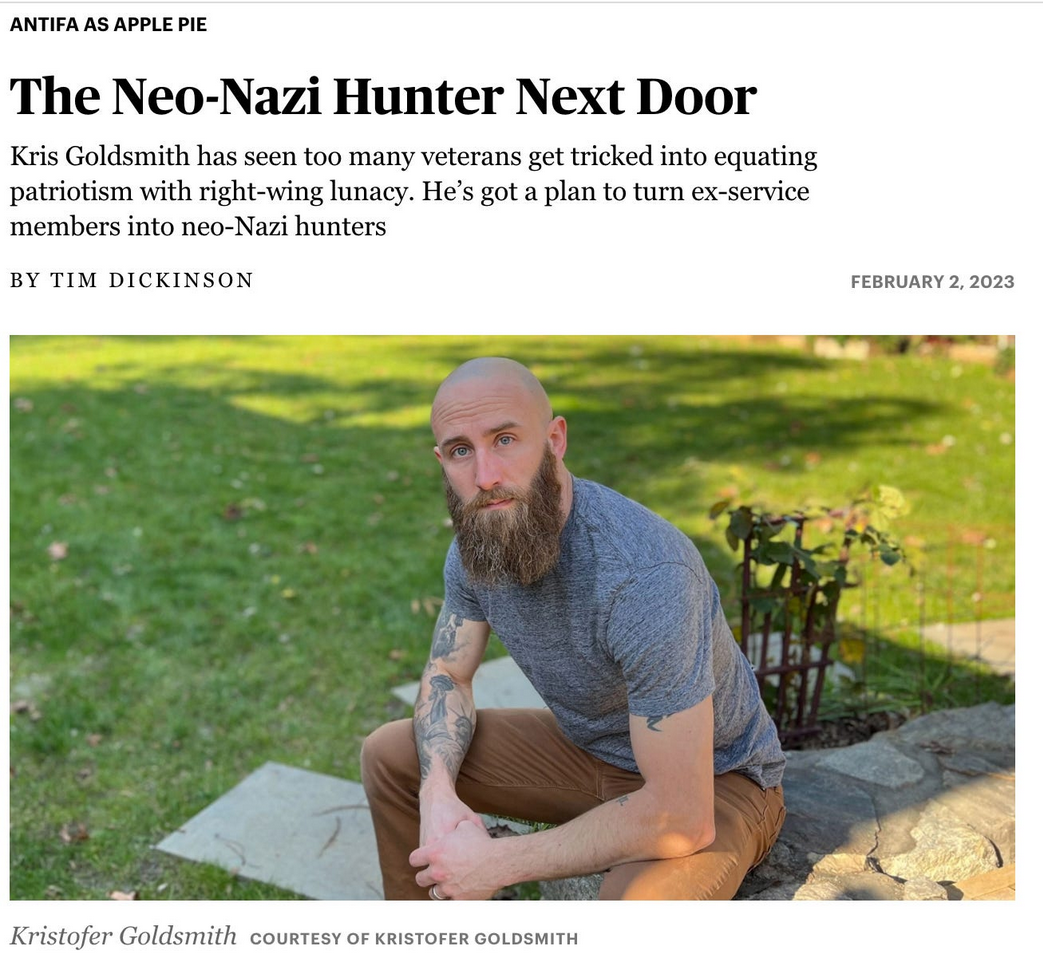
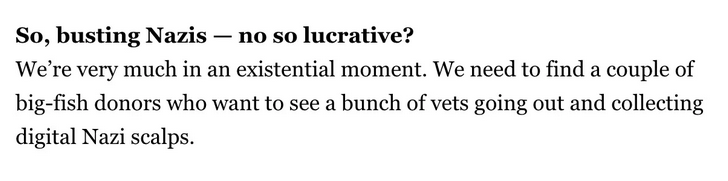
“We need to find a couple of big-fish donors who want to see a bunch of vets going out and collecting digital Nazi scalps”
Chris Bray examines the cutting edge of anti-Nazi crusading:
So here’s the most important political story to appear in Rolling Stone since Sabrina Rubin Erdely earned early retirement:
There’s a growing movement of American Nazis, you see, so military veterans are pulling on their boots to fight for their country again, hunting those Nazis and taking them out. But actually reading the story is, pardon me for a moment, a little like hammering a fucking spike into your brain. Every claim self-refutes; paragraph by paragraph, the story tells you X and Not X, side-by-side, with equal authority.
Start with the foundation of the claim. Goldsmith’s work, Rolling Stone explains, “centers on exposing the inner workings and public wrongdoing of neo-fascist groups through deep-dive intelligence reports that can give prosecutors the evidence they need go after the hatemongers in court.” Try to find a definition of “neo-fascist” in the story, though, and you fail. Fascism, it turns out, is being mean. It’s politics for the TikTok era: fascism is haters! Actual fascists thought they believed in the sacredness and centrality of the state, government as the highest form of human expression; the LARPers tracking fascists in 2023 think it means you didn’t contribute to WinBlue last month.
And so Goldsmith says he’s tracking “these people who would literally kill their fellow Americans to install a fascist dictator”, which would be a pretty dire confrontation. Then, making the claim concrete, Goldsmith gets to this description of the Patriot Front, his primary Nazi nemesis:
I have come to understand them as a unique threat against the people of the United States. While they’re a small group — they may have 200, 220 members at any given time — the thing that makes them so dangerous is the cult like atmosphere.
So the headline is a life-and-death struggle between the rising tide of American fascists who are preparing to kill us all and install their Hitler; the story is 200 people — maybe 220! — “at any given time”. Here, by the way, is a leaked Patriot Front training video, so you can see just how terrifyingly dangerous they are:
The only thing the Patriot Front threatens is the retail availability of your favorite product at Dunkin’ Donuts, but let’s go on.
Standing across the battlefield from this terrifying group, the story reveals, Goldsmith & Co. now total a force of “two dozen volunteers”. Then comes this exchange, deep into the Q&A:
Rolling Stone has turned a cosplayers-on-cosplayers circle jerk into the Battle of the Bulge. Compare THE NAZI HUNTER NEXT DOOR to a living room’s worth of unpaid hobbyists who could really turn into something if someone would just, like, give us some money.
Now, the punchline: The NAZI HUNTER is very much having his big media moment, scoring a series of profiles since the start of the year. Here he is being interviewed by the New York Times (where his wife is an editor) in January, for example, under an intro that says he’s hunting “antigovernment” extremists who are fascist. We all remember how the original fascists were passionately anti-government, of course. Hitler, Franco, and Mussolini — big libertarians, all. Hardly wanted to have any government, so people could just hang loose and roll however they chose.
The tediousness of pumping all this sad-sackery into a big national story is exhausting, as is the news media in general. But we need the distraction of Nazis and insurrections, or we’d risk talking about things that are real.

Comments Off on “We need to find a couple of big-fish donors who want to see a bunch of vets going out and collecting digital Nazi scalps”
This 1970s tank simulator drives through a tiny world
Tom Scott
Published 17 Oct 2022At the Swiss Military Museum in Full, there’s the last remaining example of a 1970s tank-driving simulator. But there’s no virtual worlds here: it’s connected to a real camera and a real miniature model. ■ More about the museum: https://www.festungsmuseum.ch/
(more…)
Comments Off on This 1970s tank simulator drives through a tiny world
February 4, 2023
Poland’s Descent into Civil War – War Against Humanity 097
World War Two
Published 2 Feb 2023Poland, occupied, abandoned or even threatened by her allies is left to fight her own war. A war that under the influence of internal and external forces looks more and more like a full blown civil war inside the world war.
(more…)
Comments Off on Poland’s Descent into Civil War – War Against Humanity 097
February 3, 2023
“Lady of The Dark” – Milunka Savić – Sabaton History 117
Sabaton History
Published 2 Feb 2023One of the most badass and decorated soldiers of the Great War was a woman. Serving first in the Balkan Wars, this Serbian war heroin became a celebrity when she won the Karađorđe’s Star — the highest Serbian decoration — in 1914 and 1916. Those weren’t her only decorations either — watch to find out more.
(more…)
Comments Off on “Lady of The Dark” – Milunka Savić – Sabaton History 117
Tank Chats #166 | SOMUA S35 | The Tank Museum
The Tank Museum
Published 14 Oct 2022Join David Willey in this week’s Tank Chat as he details the history of the SOMUA S35, a French cavalry tank of the Second World War.
(more…)
Comments Off on Tank Chats #166 | SOMUA S35 | The Tank Museum
February 2, 2023
MAC Model 1947 Prototype SMGs
Forgotten Weapons
Published 12 Oct 2022Immediately upon the liberation of France in 1944, the French military began a process of developing a whole new suite of small arms. As it applied to SMGs, the desire was for a design in 9mm Parabellum (no more 7.65mm French Long), with an emphasis on something light, handy, and foldable. All three of the French state arsenals (MAC, MAS, and MAT) developed designs to meet the requirement, and today we are looking at the first pair of offerings from Chatellerault (MAC). These are the 1947 pattern, a very light lever-delayed system with (frankly) terrible ergonomics.
Many thanks to the French IRCGN (Criminal Research Institute of the National Gendarmerie) for generously giving me access to film these unique specimens for you!
Today’s video — and many others — have been made possible in part by my friend Shéhérazade (Shazzi) Samimi-Hoflack. She is a real estate agent in Paris who specializes in working with English-speakers, and she has helped me arrange places to stay while I’m filming in France. I know that exchange rates make this a good time for Americans to invest in Europe, and if you are interested in Parisian real estate I would highly recommend her. She can be reached at: samimiconsulting@gmail.com
(Note: she did not pay for this endorsement)
(more…)
Comments Off on MAC Model 1947 Prototype SMGs
February 1, 2023
What’s the Greatest Machine of the 1980s … the FV107 Scimitar?
Engine Porn
Published 19 Jan 2015Light, agile and very fast on all types of terrain, the fabulous Scimitar FV107 armoured reconnaissance vehicle was developed by car manufacturer Alvis, who were asked to build a fast military vehicle that was light enough to be airdropped — simply not an option for full sized battle tanks at the time, which averaged around 13 tonnes. [NR: I think they mean “light tanks” here, as MBTs of the era would have been more like 50+ tons.]
Alvis got the weight down to under 8 tonnes by using a new type of aluminium alloy and minimising armour rating in favour of speed. They built the Scimitar around a 220 horsepower, six cylinder, 4.2 litre Jaguar sports car engine with ground-breaking transmission that allowed differential power to each set of tracks. The result was a sports car of the the military world that might not be the toughest in the field, but could race its way out of trouble at speeds of up to 70 miles an hour.
What makes it great: A revolutionary armoured vehicle that brought the very best of British sports car performance to the battlefield.
Time Warp: The Scimitar was the only armoured vehicle to be used by the British Army in the Falklands War.
This short film features Chris Barrie taking the Scimitar for a spin.
(more…)
Comments Off on What’s the Greatest Machine of the 1980s … the FV107 Scimitar?
January 31, 2023
The Allied Flying Aces of World War Two – Documentary Special
World War Two
Published 30 Jan 2023Young, daring, and handsome, the Allied fighter aces of World War Two have captivated the public with their thrilling exploits. Join us as we take a look at the top scorers! Thanks to Curiosity Stream for sponsoring today’s video.
(more…)
Comments Off on The Allied Flying Aces of World War Two – Documentary Special
January 30, 2023
The Royal Marines at War: Rough Weather Landing
Royal Marines
Published 31 Aug 2012Rough Weather Landing is a secret film recording of “an experiment by No4 Commando” demonstrating their ability to launch a surprise attack on a seemingly impregnable coastline.
From the comments:
ogdiver
8 years ago
“That’s right lad, you’re going to land from a boat with all the reserve buoyancy of a digestive biscuit onto a rocky shore, in a pounding surf, with a 3″ mortar base plate strapped to your back and tackety boots for swimming. But don’t worry, we’ll give you the the inflated inner tube off an Austin 7 to cling to and we’ll be doing it in daylight for the cameras.” Those blokes were nails.
Comments Off on The Royal Marines at War: Rough Weather Landing
January 29, 2023
Anzio Begins – Allies Already Pinned Down – Week 231 – January 28, 1944
World War Two
Published 28 Jan 2023Some big news is the Allies amphibious offensive to hit the Germans behind their lines at Anzio in Italy, some other big news is that after nearly two and a half years, the Soviets have broken the siege of Leningrad and their twin northern offensives keep pushing back the enemy. Yet more big news is that the Soviets have managed to surround and cut off over 50,000 Axis troops near Korsun. This is one big week of action!
(more…)
Comments Off on Anzio Begins – Allies Already Pinned Down – Week 231 – January 28, 1944
France’s Ultimate WW1 Selfloading Rifle: The RSC-1918
Forgotten Weapons
Published 14 Sept 2017The French RSC-1917 semiauto rifle was a major step forward in arms technology during World War One, offering a reliable and effective self-loading rifle for issue to squad leaders, expert marksmen, and other particularly experienced and effective troops. No other military was able to field a semiauto combat shoulder rifle during this was in anything but very limited numbers. However, the RSC-1917 definitely had some shortcomings:
– It was just too long, at the same size as the Lebel
– The specialized clip was a logistical problem
– The gas system was fragile and difficult to clean or disassemble
– The magazine cover was easily damagedThese issues were all addressed in the Model 1918 upgrade of the rifle, although it was too late to see active service in the Great War. The new pattern was substantially shorter (both the stock and barrel), it used the standard Berthier 5-round clip, it had a substantially strengthened magazine cover, and a much improved gas system.
Today, we will compare the various features of the 1917 and 1918 rifles, and disassemble the 1918 gas system to show how it worked.
(more…)
Comments Off on France’s Ultimate WW1 Selfloading Rifle: The RSC-1918
January 27, 2023
The return of the revenge of the bride of the Doomsday Clock
It’s amazing how much free publicity you can get by pulling out the hoary old Cold War propaganda tools, as Andrew Potter explains with the re-re-re-introduction of the Doomsday Clock bullshit:

Earlier this week, the Bulletin of the Atomic Scientists moved the hands of its Doomsday Clock ahead by ten seconds, to 90 seconds to midnight. This is the closest the clock has ever been to midnight, and, according to the press release announcing the move: “Never in the Doomsday Clock’s 76-year history have we been so close to global catastrophe.”
If you’re under, say, 40 years of age or so, that paragraph is probably pure gobbledygook, the written equivalent of the squawk of a 2400 baud modem going through its handshaking protocols. But for those of us in the ever-dwindling cohorts of Gen-Xers and Baby Boomers, hearing about the movement of the Doomsday Clock is to be jerked back into a time marked by both profound moral clarity and deep existential anxiety.
A bit of background on the Doomsday Clock might help. It was a creature of the Cold War, founded in 1947 by some of the scientists who had worked on the Manhattan Project to raise public awareness of the threat of nuclear weapons. As the Bulletin puts it, the clock uses “the imagery of apocalypse (midnight) and the contemporary idiom of nuclear explosion (countdown to zero) to convey threats to humanity and the planet”. The decision to move or leave the minute hand of the Clock in place is made each year by the various trustees of the Bulletin, based on their evaluation of the world’s vulnerability to catastrophe.
The clock was initially set at a nice and relaxed seven minutes to midnight, and over the following few decades it was moved closer in response to clear nuclear threats, things like ramped-up testing of new bombs, nuclear proliferation, or rising Cold War tensions. During periods of detente or after the signing of arms reductions treaties, the minute hand would retreat. In 1991, it was moved back to 17 minutes to midnight after the dissolution of the Soviet Union.
For most of the second half of the 20th century, the Doomsday Clock was a healthy reminder of the most salient geopolitical fact of the era, which is that two superpowers were pointing thousands of nuclear weapons at one another.
But like many Cold War relics, the demise of the U.S.S.R. left it scrambling for a raison d’etre. In a bit of clever PR entrepreneurialism, the executive of the Bulletin of the Atomic Scientists turned the clock into a more generalized warning against war, climate change and other ecological or technological threats. The nadir of this shift in mission came on January 23rd 2020, when the Bulletin moved the clock’s hands to 100 seconds to midnight.
As the press release accompanying the ticking of the clock noted at the time, this put humanity “closer than ever” to catastrophe. Given that the clock had kept watch over our drive for self-destruction through the Suez Crisis, the Cuban Missile Crisis, the sabre-rattling Reagan administration, and the terrorist attacks of September 11, 2001, it makes one wonder just what happened in early 2020 to merit such a fearful move.
Comments Off on The return of the revenge of the bride of the Doomsday Clock
QotD: What is Strategy?
We should start by returning to our three levels of military analysis: tactics, operations and strategy. We’ve dealt with tactics (how you fight) and operations (where you fight, and how you get there). Strategy is an often misunderstood term: most “strategy” games (especially real-time strategy) are actually focused almost entirely on tactics and operations; as a rule, if “don’t have a war” isn’t an option, you are not actually doing strategy. Likewise, a lot of basic planning in business is termed “strategy” when it really is tactics; not a question of goals, but of means to achieve those goals. Because strategy is the level of analysis that concerns why we fight – and thus also why we might not fight. Let’s unpack that.
(Attentive readers who know their Clausewitz (drink!) will recognize that I am being both broader and narrower than he in how I use the term strategy. Clausewitz terms strategy as “the employment of battles to gain the end of war” which is more nearly what we today mean as operations. In contrast, strategy as it is used today in a technical sense corresponds more nearly to what Clausewitz terms policy, the third element of his “marvelous trinity”. A full exegesis of Clausewitz’ trinity is beyond the scope of this essay, but I wanted to note the differing usages, because I’m going to quote Clausewitz below. And as always, every time Clausewitz gets quoted you must take a drink; it’s the eternal military history drinking game).
At the strategic level of analysis, the first question is “what are your policy objectives?” (although I should note that grand strategy is sometimes conceived as an analytical level above strategy, in which case policy objectives may go there). There’s a compelling argument common in realist international relations theory that the basic policy of nearly all states is to survive, with the goal of survival then suggesting a policy of maximizing security, which in turn suggests a policy of maximizing the military power of the state (which ironically leads to lower the security of other states who then must further increase their military power, a reaction known as the “security dilemma” or, more colorfully, the “Red Queen effect”). I think it is also possible for states to have policy goals beyond this: ideological projects, good and bad. But survival comes first.
From there, strategy concerns itself with the best way to achieve those policy objectives. Is peace and alliances the best way to achieve security (for a small state, the answer is often “yes”)? Would security be enhanced by, say, gaining a key chunk of territory that could be fortified to forestall invasion? Those, of course, are ends, but strategy also concerns itself with means: how do you acquire that defensible land? Buy it? Take it by force? And then – and only then, finally – do you come to the question of “what sort of war – and what sort of conduct in war – will achieve that objective?”
You may note that this is not the same kind of thinking that animates tactics or operations. Military theorists have noticed that for quite some time, often suggesting a sharp separation between the fellows who do operations and tactics (generals) and those who do strategy (typically kings or politicians). As Clausewitz says (drink!), “The political object is the goal, war is the means of reaching it, and means can never be considered in isolation from their purpose … war should never be thought of as something autonomous, but always as an instrument of policy [emphasis mine].” In short, Clausewitz stresses – and leaders have long ignored to their peril – that of all of the factors in war, policy ought to guide action (although no part of the trinity may be neglected).
This creates subordination between the three levels of analysis (to get technical, this is because operations and tactics are part of a side of the Clausewitzian trinity which ought to be subordinate to policy). Operations is subordinate to strategy; an operation which achieves something that isn’t a strategic goal accomplishes nothing. And tactics is likewise subordinate to operations. Thus the thinking pattern should always proceed from the highest questions of strategy down to the prioritization of ends (still strategy), to the means to accomplish those ends (still strategy); only then to the execution of those means (operations) and then to the on-the-ground details of that execution (tactics). Of course what this tripartite division is mean in part to signal is that all three of these stages are tremendously complex; just because tactics is the subordinate element does not mean it is simple!
Bret Devereaux, “Collections: The Battle of Helm’s Deep, Part VIII: The Mind of Saruman”, A Collection of Unmitigated Pedantry, 2020-06-19.
Comments Off on QotD: What is Strategy?
January 26, 2023
Ukraine to receive Challenger II, M1 Abrams, and Leopard 2 tanks … both a solution and a new set of problems
In The Line, Matt Gurney outlines some of the benefits Ukraine will receive with this new transfusion of AFVs … and also the new and exacerbated set of practical problems that goes along with fielding so many different makes and models of tanks:
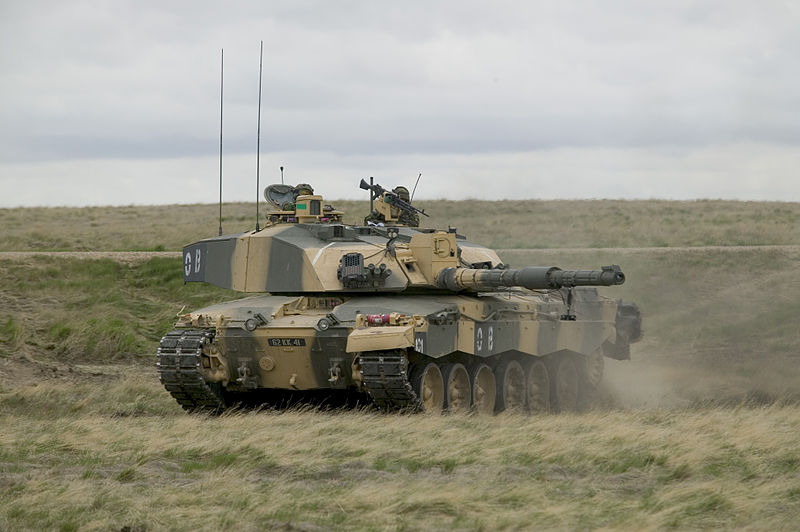
A British army Challenger Main Battle Tank, of 1 Royal Regiment of Fusiliers (1RRF), is shown returning to base after completing a firing mission as part of Exercise MedMan.
1RRF Battle group were based at the British Army Training Unit Suffield (BATUS) in Canada.
MOD photo by Mike Weston via Wikimedia Commons.
A column getting into all the details of why [the German government] were withholding said blessing would be several times longer than this one will be. Suffice it to say this is just the latest manifestation of Germany’s extreme discomfort with this war. Some of it relates to the lingering fallout of Germany’s blood-soaked history. But we would be naïve not to attribute at least some of the reluctance to Russia’s deep influence among some segments of the German ruling elite.
Germany has contributed to the defence of Ukraine, and it would be unfair to deny that. It would not be unfair to note that Germany has typically only done so later than the other allies, and under enormous pressure.
As part of the deals being announced, the United States will be sending several dozen of its M1 Abrams tanks, and Germany will send Leopards. Berlin will also allow other allies to send further Leopards. (Canada hasn’t committed to sending any of ours yet, but our few remaining Leopards are reported to be in poor shape, and are also all the way across an ocean, so we might not even be asked.) The British will send the Challengers. This gives Germany the ability to claim, with a reasonably straight face, that it has not chosen to escalate the conflict. Heavens, no! It’s simply moving in lockstep with its allies! As fig leaves go, it’s a pretty small and transparent one, but for the purposes of diplomacy and maintaining the appearance of allied solidarity, it’ll do.
And this brings us to the problem that the plan is exacerbating. A year ago, the Ukrainian military was largely armed and equipped along Russian lines — both militaries were, after all, descendants of the Soviet Red Army. Since then, much of its original equipment has been destroyed or lost, but this has generally been offset by an influx of Western weapons into the country as the allies empty their arsenals and get their production lines running again. This has allowed Ukraine to keep fighting, far more effectively than the Russians, among many others, expected. Despite huge losses of manpower, the Ukrainian military seems to actually have grown stronger as the war has gone on, thanks to the power of its new weapons.
Sending news is good news to that extent. It will make Ukraine stronger still. But it is also producing a situation where the Ukrainians are armed with an absurdly unwieldy mix of weapon systems. This is laying the groundwork for a future logistics disaster.
Any individual soldier can learn to use any specific piece of equipment. That’s just a matter of training and experience. Soldiers are smart. The longer they serve, the quicker they’ll get at picking up new pieces of equipment and kit. The challenge is more on the backend. The logistics of sustaining an arsenal of completely mixed weapon systems is a nightmare. Not only must Ukraine procure a huge variety of calibers of ammunition, it must also procure, sort, and then distribute a bewildering array of spare parts to keep all these weapons running. It’s not that this is impossible. The fact that Ukraine fights on is proof that it is not. But it adds tremendous cost and complexity, and requires a much larger effort to sustain than would be the case if Ukrainian units were equipped with standard weapons across comparable units.
The numbers of NATO tanks are initially small enough that only a few battalions can be re-equipped with the donated AFVs, but each different “brand” needs its own specialized support in the way of maintenace, repair, and re-supply. Ukraine is going to have to have at least a company-sized, fully trained maintenance unit for each battalion of NATO tanks and the logistics system will have to ensure that the different types of ammunition and ordinary wear-and-tear maintenance spares are delivered quickly enough to keep those battalions combat-ready. Some NATO nations with much better facilities sometimes struggle to do this for a single type of AFV, never mind for several different types.
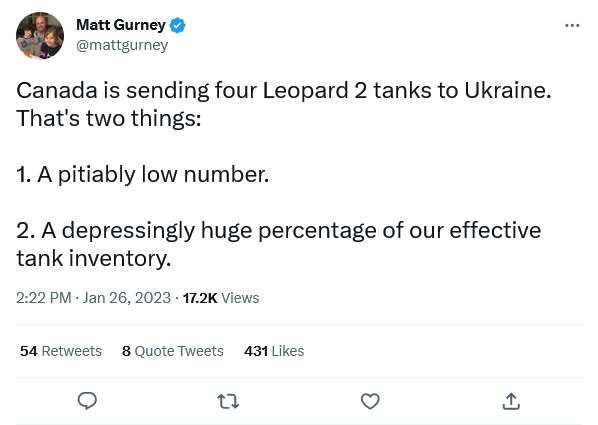
Update: Can’t help but agree with Matt here.
Comments Off on Ukraine to receive Challenger II, M1 Abrams, and Leopard 2 tanks … both a solution and a new set of problems


