
The Tank Museum
Published 30 Sept 2022In this weeks video, David Fletcher discusses the development and features of Striker, another vehicle from the CVRT family.
(more…)
January 26, 2023
Tank Chats #165 | Striker | The Tank Museum
Comments Off on Tank Chats #165 | Striker | The Tank Museum
QotD: Non-commissioned officers
“Deltas”, the “socio-sexual hierarchy” spergs inform us, are the good soldiers, the go-along-to-get-along types who know their place in an organization and — crucially — derive their sense of self worth from excelling in it.
Your ideal “delta” is something like a lifer noncom in a non-pozzed military. Back in the days, I’m told, new recruits and civilians used to call crusty old gunny sergeants “sir”, to which the gunny would reply “Don’t call me ‘sir’, I work for a living!” That’s the attitude. Those guys with all the stripes on their sleeves aren’t officers because they lack “command presence”; they’re not officers because they don’t want to be officers. They know themselves, and, crucially, they know where they best fit into the organization’s overall mission. “Get in where you fit in” is, in a very real sense, their identity.
Examples of that kind of guy are tougher to find in the historical literature, which is why we need to develop, and pump up, the archetype. […] the ideal is the centurion, the backbone of Marcus Aurelius’ army. A soldier, a Stoic, a leader … but one who knows, and values, his place in the organization above all things.
Severian, “Be a Centurion!”, Rotten Chestnuts, 2020-04-07.
Comments Off on QotD: Non-commissioned officers
January 24, 2023
The Vietnam War still has echoes in US politics
In UnHerd, Dominic Sandbrook outlines the end of US involvement in the Vietnam War:
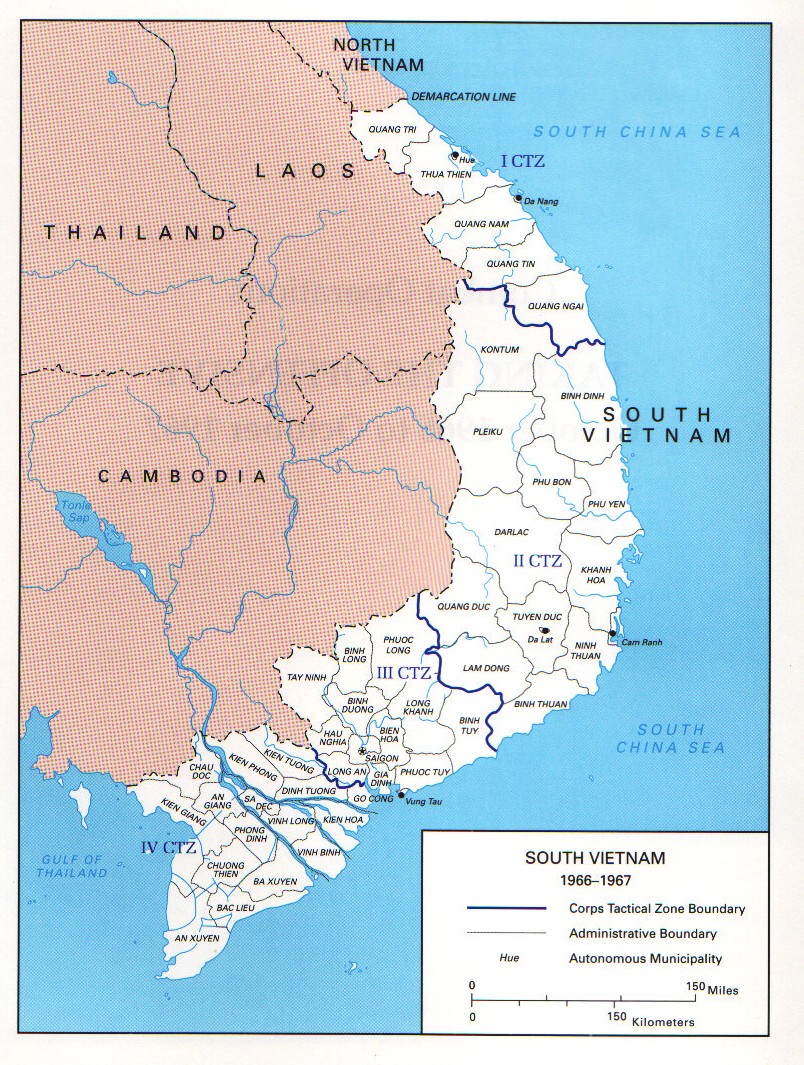
From George L. MacGarrigle, The United States Army in Vietnam: Combat Operations, Taking the Offensive, October 1966-October 1967. Washington DC: Center of Military History, 1998. (Via Wikimedia)
In the course of his troubled presidency, Richard Nixon spoke 14 times to the American people about the war in Vietnam. It was in one of those speeches that he coined the phrase “the silent majority”, while others provoked horror and outrage from those opposed to America’s longest war. But of all these televised addresses, none enjoyed a warmer reaction that the speech Nixon delivered on 23 January 1973, announcing that his Secretary of State, Henry Kissinger, had achieved a breakthrough in the Paris peace talks with the North Vietnamese.
At last, Nixon said, the war was over. At a cost of 58,000 American lives and some $140 billion, not to mention more than two million Vietnamese lives, the curtain was falling. The last US troops would be brought home. South Vietnam had won the right to determine its own future, while the Communist North had pledged to “build a peace of reconciliation”. Despite the high price, Nixon insisted Americans could be proud of “one of the most selfless enterprises in the history of nations”. He had not started the war, but it had dominated his presidency, earning him the undying enmity of those who thought the United States should just get out. But the struggle had been worth it to secure “the right kind of peace, so that those who died and those who suffered would not have died and suffered in vain”. He called it “peace with honour”.
Fifty years on, Nixon’s proclamation of peace with honour has a bitterly ironic ring. As we now know, much of what he said that night was misleading, disingenuous or simply untrue. South Vietnam was in no state to defend itself, and collapsed just two years later. The North Vietnamese had no intention of laying down their weapons, and resumed the offensive within weeks. And Nixon and Kissinger never seriously thought they had secured a lasting peace. They knew the Communists would carry on fighting, and fully intended to intervene with massive aerial power when they did. But then came Watergate. With Nixon crippled, Congress forbade further intervention and slashed funding to the government in Saigon. On 30 April 1975, North Vietnamese tanks crashed through the gates of the presidential palace, and it really was all over.
Half a century later, have the scars of Vietnam really healed? It remains not only America’s longest war but one of its most divisive, comparable only with the Civil War in its incendiary cultural and political impact. The fundamental narrative trajectory of the late Sixties — the turn from shiny space-age Technicolor optimism to strident, embittered, anti-technological gloom — would have been incomprehensible without the daily images of suffering and slaughter on the early evening news. It was Vietnam that destroyed trust in government, in institutions, in order and authority. In 1964, before Lyndon Johnson sent in combat troops after the Gulf of Tonkin incident, fully three-quarters of Americans trusted the federal government. By 1976, a year after the fall of Saigon, not even one in four did so.
It was in the crucible of Vietnam, too, that you can spot many of the tensions that now define American politics. Perhaps the most potent example came in May 1970, after Nixon invaded nominally neutral Cambodia to eliminate the North Vietnamese Army’s jungle sanctuaries. First, on 4 May, four students were shot and killed by the National Guard during a demonstration at Kent State University, Ohio. Then, on 8 May, hundreds more students picketed outside the New York Stock Exchange, only to be attacked by several hundred building workers waving American flags.
The “hard hat riot”, as it became known, was the perfect embodiment of patriotic populist outrage at what Nixon’s vice president, leading bribery enthusiast Spiro Agnew, called “the nattering nabobs of negativism … an effete corps of impudent snobs who characterise themselves as intellectuals”. Today it seems almost predictable, just another episode in the long-running culture wars. But at the time it seemed genuinely shocking. And with his brilliantly ruthless eye for a tactical advantage, Nixon saw its potential. When he invited the construction workers’ leaders to the White House two weeks later, he knew exactly what was doing. “The hard hat will stand as a symbol, along with our great flag,” he said, “for freedom and patriotism and our beloved country”.
Comments Off on The Vietnam War still has echoes in US politics
An alternative theory about German Chancellor Olaf Scholz’s hesitation to allow Ukraine access to Leopard 2 tanks
I’ve been going on the assumption that the German government was terrified of Russian reaction if they allowed some Leopard 2 tanks to be donated to the Ukrainian forces, but eugyppius points out there’s another strong contending explanation:
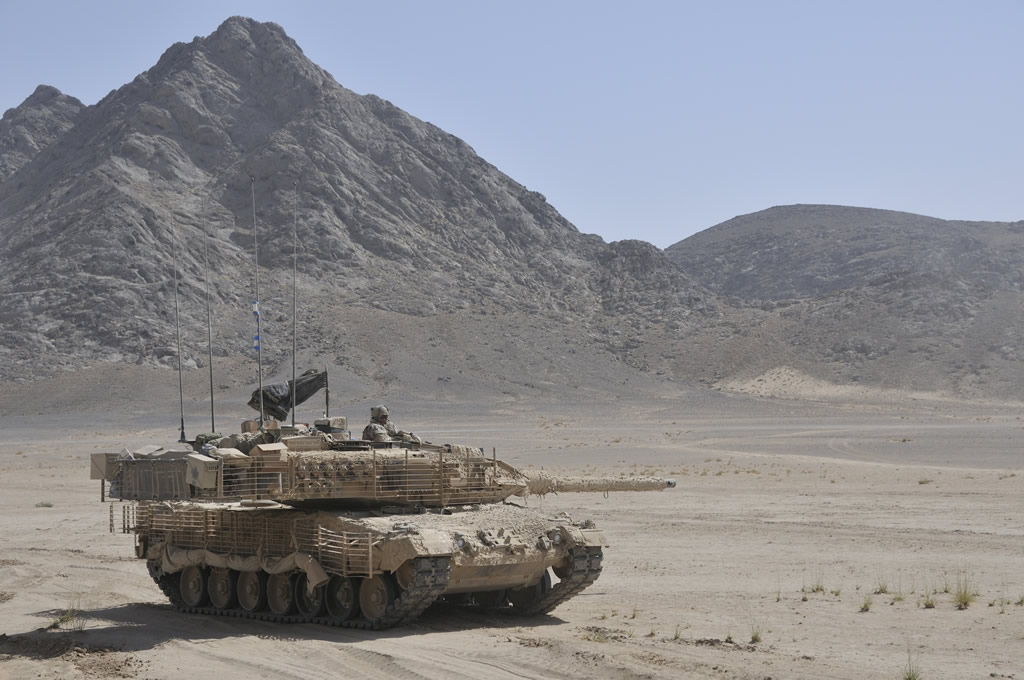
Leopard 2A6M in Afghanistan
Years of peace in Europe, an ageing population and a corresponding focus on expensive social programmes have caused Germany to put its defence industry into near-hibernation. Only a little over 2,000 Leopard 2s have ever seen the light of day. Each one is a hand-built machine that takes two years to make. If Germany permits the export of the European supply of Leopard 2s to Ukraine, the Russians will grind them to nothing within months, and then Europe will have no tanks except the tanks that the Americans sell them:
Defence industry representatives, who wish to remain anonymous, report that the Americans are offering their own used tanks as replacements to [European] countries able to supply Leopard 2s to Ukraine, together with a long-term industrial partnership. Any country that accepts the American offer would be hard to win back for the German tank industry. Berlin’s influence in armament policy would decrease correspondingly.
Tanks are driven by men, who have to be trained in the operation of specific models. Their use moreover requires a whole supply chain of munitions and especially spare parts, which the Americans are eager to offer. The upshot is that, once Europe opts into American armour, it will never switch back, and Germany will be out of the game for good. Nor should we lend much credence to the idea that our very few tanks will make any difference either way for Ukraine’s prospects. The insistence that Scholz release the Leopard 2s is simply an attempt to edge Germany further out of the European arms industry and into a position of lesser political and economic influence in Europe, so that the United States can fill the gap.
Noah Carl, over at the Daily Sceptic, drew attention last week to remarks by the French intellectual Emmanuel Todd that “this war is about Germany“:
After the collapse of the Soviet Union, Zbigniew Brzezinski called Eurasia the new “great chessboard” of world politics … The Russian nationalists and ideologues like Alexander Dugin indeed dream of Eurasia. It is on this “chessboard” that America must defend its supremacy – this is Brzezinski’s doctrine. In other words, it must prevent the rapprochement of Russia and China. The financial crisis of 2008 made it clear that with reunification Germany had become the leading power in Europe and thus also a rival of the United States. Until 1989, it had been a political dwarf. Now Berlin let it be known that it was willing to engage with the Russians. The fight against this rapprochement became a priority of American strategy. The United States had always made it clear that they wanted to torpedo [Nord Stream 2]. The expansion of NATO in Eastern Europe was not primarily directed against Russia, but against Germany. Germany, which had entrusted its security to America, became the Americans’ target [in the destruction of the pipeline]. I feel a great deal of sympathy for Germany. It suffers from this trauma of betrayal by its protective friend — who was also a liberator in 1945.
After the anti-Russian sanctions regime and its clear deindustrialising effects on the German economy, followed by the attack on the Baltic Nord Stream pipelines, and even smaller things, such as the high-profile anti-industry protests by the American-funded activist group Letzte Generation, I am willing to believe many conspiratorial things about the Ukraine war.
Comments Off on An alternative theory about German Chancellor Olaf Scholz’s hesitation to allow Ukraine access to Leopard 2 tanks
January 23, 2023
Monte Cassino, the Battle Begins – Ep 230 – January 21, 1944
World War Two
Published 21 Jan 2023The Allies have reached the linchpin of the German defenses in Italy, but a first attack proves disastrous. It does, though, divert troops from where they soon plan to make landings behind enemy lines. Meanwhile in the USSR, the huge Soviet offensive in the north makes great gains against the stunned Axis forces.
(more…)
Comments Off on Monte Cassino, the Battle Begins – Ep 230 – January 21, 1944
January 22, 2023
Where The British Army Figured Out Tanks: Cambrai 1917
The Great War
Published 20 Jan 2023The Battle of Cambrai in 1917 didn’t have a clear winner, but the conclusions that Germany and Britain drew from it, particularly about the use of the tank (in combination with other arms), would have far reaching consequences in 1918.
(more…)
Comments Off on Where The British Army Figured Out Tanks: Cambrai 1917
January 21, 2023
When the SS Go Too Far – War Against Humanity 096
World War Two
Published 20 Jan 2023The internal conflict between Poland and the other United Nations Allies deepens as Churchill faces them with diplomatic defeat over Soviet land grab. In the Occupied Netherlands and Poland the Nazis continue their atrocities.
(more…)
Comments Off on When the SS Go Too Far – War Against Humanity 096
Ask Ian: Liberators or Cobray Terminators for the Elbonian Resistance?
Forgotten Weapons
Published 29 Sept 2022From Jon on Patreon:
“Elbonia has been occupied by an enemy force. Do you sabotage their resistance by airdropping them Liberator pistols or Cobray Terminators?”To my mind, the Liberator is a substantially more useful resistance weapons, so I would supply Elbonia with lots of crates of Cobray Terminators. Why?
First, the Liberator is concealable. Historically, lots of resistance action requires hiding a small weapons. It’s not all forest encampments and ambushes.
Second, the Liberator is more effective. It uses a .45ACP pistol cartridge. The smooth barrel and atrocious sights certainly limit its utility, but if you actually hit someone with it, it will do the job. Most of the shotgun ammunition available to a resistance organization will be the most common sort of sporting ammunition, which is birdshot. Birdshot is very ineffective against people at anything but absolutely point-blank range.
Third, it is much simpler to fabricate a single-shot shotgun than a compact pistol. The Elbonian Resistance wouldn’t have much trouble making something like a Richardson Guerrilla Gun, so supplying them with Terminators doesn’t actually give them much that they couldn’t get already.
(more…)
Comments Off on Ask Ian: Liberators or Cobray Terminators for the Elbonian Resistance?
January 19, 2023
The Partisan War Behind the Frontlines – WW2 Documentary Special
World War Two
Published 18 Jan 2023There is a second war raging on the Eastern Front. From the huge expanses of no man’s land behind the German lines, Moscow’s battle-hardened and well-armed partisan bands are waging a Rail War in support of Red Army offensives. But every successful mission brings down the wrath of the genocidal Axis war machine.
(more…)
Comments Off on The Partisan War Behind the Frontlines – WW2 Documentary Special
Tanks Chats #164 | M-50 Sherman | The Tank Museum
The Tank Museum
Published 23 Sep 2022In this episode of Tank Chats, David Willey discusses the history of the M-50 version of the Sherman.
(more…)
Comments Off on Tanks Chats #164 | M-50 Sherman | The Tank Museum
January 18, 2023
The Roman Army, With Adrian Goldsworthy
Well That Aged Well
Published 12 May 2021In this episode we take a look at the Roman Army, and its comanders. What made the Roman Army so efficent? Was it the practice? The motivation? Their courrage? Or was it more to it? Find out in this week’s episode of “Well That Aged Well”, With Erlend Hedegart.
(more…)
Comments Off on The Roman Army, With Adrian Goldsworthy
L’affaire Dreyfus
Robert Zaretsky on an espionage scandal that convulsed the French Third Republic and still has resonance down to today:
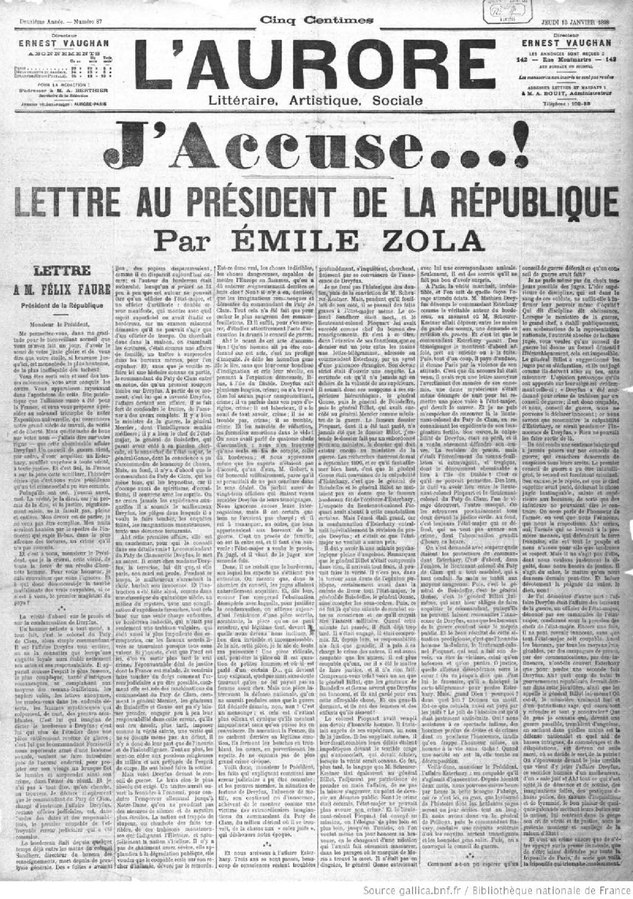
Front page of L’Aurore for 13 January, 1898 with Zola’s J’Accuse headline.
Wikimedia Commons.
On January 13, 1898, Parisians awoke to the chorus of hundreds of news criers who, striding along the grand boulevards and brandishing copies of the newspaper L’Aurore, were shouting passages from the article that sprawled across the front page. It had originally been titled by its author, the novelist Émile Zola, “A Letter to M. Félix Faure, President of the Republique”. But with a flair for the sensational, the newspaper’s editor, Georges Clemenceau, slapped on a punchier headline. Stepping out of a department store or stepping down from a carriage, sitting at a café or standing at an intersection, pedestrians were greeted by two words that continue to resonate 125 years to the day after their first publication: “J’Accuse!”
With this exclamation, Zola’s letter transformed une affaire judiciare into l’affaire Dreyfus or, more simply, the Dreyfus Affair. It catapulted the French novelist onto the world stage at a critical moment in the history of his country, which was reeling from the forces of globalisation and industrialisation and riven by opposing understandings of its revolutionary heritage. It is thus hardly surprising that Zola’s fame rests more heavily on the letter than on his sweeping 20-volume masterpiece of literary realism, the Rougon-Macquart. It took a novelist to heave the facts of this affair into a narrative which, more than a century later, thrums with equal urgency. Moreover, as with the novels of the Rougon-Macquart, the letter thrusts onto centre-stage a lone individual swept up, and all too often swept under, the political and social, irrational and ideological forces of the modern age.
It all began with the contents of a rubbish bin. In September 1894, a cleaning woman at the German Embassy, in the pay of France’s military intelligence service, delivered her nightly harvest to her employers. Buried in the mound of discarded papers was a memorandum, known as the bordereau or note, revealing top secret advances in French artillery technology and tactics. In a frantic scramble to find its author, the war ministry’s suspicion settled on Captain Alfred Dreyfus, an officer in the High Command who stood out for his standoffishness and Jewishness.
Upon being arrested and charged, a bewildered Dreyfus denied the charges, pointing out several things mentioned in the bordereau he could not possibly have known. The seven members of the military tribunal, ignoring these inconsistencies as well as the insistence of their own graphologist that Dreyfus’s handwriting did not match the bordereau‘s, unanimously found him guilty. He was sentenced to life imprisonment in solitary confinement on Devil’s Island, a malarial rock off the coast of French Guyana.
But first came a remarkable ritual of public humiliation. Dreyfus was marched into the courtyard of the École militaire, the renowned military academy a short distance from the recently erected Eiffel Tower. In the shadow of that monument to modernity, an officer preceded to snap Dreyfus’s sword — broken and soldered back together with tin the night before, to make the gesture seem effortless — and tear off his insignia — whose threads were already loosened — while a dense crowd howled with calls for the death of the “Jewish traitor!”
Two years later, as Dreyfus wasted away in solitary confinement, Colonel Georges Picquart, the newly appointed head of military intelligence, found that another missive about French military plans had ended up in the rubbish bin at the German Embassy. Moreover, the handwriting on this new document, which matched that of the bordereau, also matched the hand of Ferdinand Esterhazy, an officer notorious for his womanising and gambling.
Picquart disliked Jews as much as his many of his fellow officers did. But when his commanding officer asked him why it mattered if “this Jew remains on Devil’s Island”, Picquart replied: “Because he is innocent!” The answer earned Picquart a rapid transfer to a desert outpost in North Africa. Before he was packed off, though, Picquart vowed that he would not “carry this secret to my grave”. He then shared what he knew with Auguste Scheurer-Kestner, the leader of Dreyfusards, a small but growing coterie of politicians and writers seeking a retrial for Dreyfus.
In late 1897, Zola met with Scheurer-Kestner, who told him about Picquart’s discovery. As the mesmerised novelist listened, he glimpsed the theatrical as well as moral dimensions of the affair. “It’s thrilling!” he gasped. “It’s frightful! But it is also drama on the grand scale!” It took Zola to scale it to greatness by flipping Oscar Wilde’s sly quip that anyone could make history, but only a great man could write it. Instead, Zola showed, a man becomes truly great only by, in every sense of the word, making history.
Comments Off on L’affaire Dreyfus
Ask Ian: Why No German WW2 50-Cal Machine Guns? (feat. Nick Moran)
Forgotten Weapons
Published 20 Sep 2022From Nathaniel on Patreon:
“Why didn’t Germany or Axis powers have a machine gun similar to the American M2?”Basically, because everyone faced the choice of a .50 caliber machine gun or 20mm (or larger) cannons for anti-aircraft use, and most people chose the cannons — including Germany. There were some .50 caliber machine guns adopted by Axis powers, most notably the Hotchkiss 1930, a magazine-fed 13.2mm gun that was used by both Italy and Japan (among others). However, the use of the .50 caliber M2 by the US was really a logistical holdover form the interwar period. The M2 remained in production because it was adopted by US Coastal Artillery as a water-cooled anti-aircraft gun, and commercial sales by Colt were slim but sufficient to keep the gun in development through the 20s and 30s. It was used as a main armament in early American armor, but obsolete in this role when the war broke out.
However, with the gun in production and no obvious domestic 20mm design, the US chose to simply make an astounding number of M2s and just dump them everywhere, from Jeeps to trucks to halftracks to tanks to self-propelled guns. And that’s not considering the 75% of production that went to coaxial and aircraft versions …
Anyway, back to the question. The German choice for antiaircraft use was the 20mm and 37mm Flak systems, and not a .50 MG on every tank turret. And so, there was really no motive to develop such a gun. The Soviets did choose to go the US route, though, and developed the DShK-38 for the same role as the US M2 — although it was made in only a tiny fraction of the quantity of the M2.
(more…)
Comments Off on Ask Ian: Why No German WW2 50-Cal Machine Guns? (feat. Nick Moran)
QotD: Tanks for Ukraine?
It looks like the inhibition on sending tanks is finally cracking, though. While Germany is still dithering over letting Poland send some of its Leopard 2’s, Britain has announced it’s sending 14 Challenger 2 main battle tanks.
I found that particular number interesting. Late Cold War and post-Cold War Russian armored units use three-tank platoons and three platoons plus a commander’s tank make a ten tank company.
The British Army, from whose stores the Challengers will be pulled, uses some archaic TO&E, possibly left over from the Wars of the Roses or Cromwell’s New Model Army, wherein four tanks equal a Bonnet*, and four Bonnets plus two more tanks in a headquarters Bonnet equal an eighteen-tank Spanner†.
Fourteen tanks, however, is enough for three four-tank platoons plus two tanks for an HQ platoon, equalling a fourteen tank US-style armored company. Apparently the Ukies are using a US/(most of)NATO TO&E for their armored units. So the Ukrainians will have at least one company of Western MBTs.
* Bonnet = Troop
† Spanner = SquadronTamara Keel, “Clank Clank Goes the Tank”, View From The Porch, 2023-01-15.
Comments Off on QotD: Tanks for Ukraine?
January 15, 2023
Time to Liberate Leningrad! – Ep 229 – January 14, 1944
World War Two
Published 14 Jan 2023Three Soviet Fronts launch major offensives to try and finally free Leningrad, under siege for nearly two and a half years now. The Soviets are, in fact, making attacks along most of the Eastern Front. In the South Pacific, the Allies step up their aerial assault to wreck Rabaul’s air power, thus neutralizing it as a base.
(more…)
Comments Off on Time to Liberate Leningrad! – Ep 229 – January 14, 1944


