
The comments for that post were very active with suggestions for technological or strategic situations which would or would not make orbit-to-land operations (read: planetary invasions) unnecessary or obsolete, which were all quite interesting.
What I found most striking though was a relative confidence in how space battles would be waged in general, which I’ve seen both a little bit here in the comments and frequently more broadly in the hard-sci-fi community. The assumptions run very roughly that, without some form of magic-tech (like shields), space battles would be fought at extreme range, with devastating hyper-accurate weapons against which there could be no real defense, leading to relatively “thin-skinned” spacecraft. Evasion is typically dismissed as a possibility and with it smaller craft (like fighters) with potentially more favorable thrust-to-mass ratios. It’s actually handy for encapsulating this view of space combat that The Expanse essentially reproduces this model.
And, to be clear, I am not suggesting that this vision of future combat is wrong in any particular way. It may be right! But I find the relative confidence with which this model is often offered as more than a little bit misleading. The problem isn’t the model; it’s the false certainty with which it gets presented.
[…]
Coming back around to spaceships: if multiple national navies stocked with dozens of experts with decades of experience and training aren’t fully confident they know what a naval war in 2035 will look like, I find myself with sincere doubts that science fiction writers who are at best amateur engineers and military theorists have a good sense of what warfare in 2350 (much less the Grim Darkness of the Future Where There is Only War) will look like. This isn’t to trash on any given science fiction property mind you. At best, what someone right now can do is essentially game out, flow-chart style, probable fighting systems based on plausible technological systems, understanding that even small changes can radically change the picture. For just one example, consider the question “at what range can one space warship resolve an accurate target solution against another with the stealth systems and electronics warfare available?” Different answers to that question, predicated on different sensor, weapons and electronics warfare capabilities produce wildly different combat systems.
(As an aside: I am sure someone is already dashing down in the comments preparing to write “there is no stealth in space“. To a degree, that is true – the kind of Star Trek-esque cloaking device of complete invisibility is impossible in space, because a ship’s waste heat has to go somewhere and that is going to make the craft detectable. But detectable and detected are not the same: the sky is big, there are lots of sources of electromagnetic radiation in it. There are as yet undiscovered large asteroids in the solar-system; the idea of a ship designed to radiate waste heat away from enemies and pretend to be one more undocumented large rock (or escape notice entirely, since an enemy may not be able to track everything in the sky) long enough to escape detection or close to ideal range doesn’t seem outlandish to me. Likewise, once detected, the idea of a ship using something like chaff to introduce just enough noise into an opponent’s targeting system so that they can’t determine velocity and heading with enough precision to put a hit on target at 100,000 miles away doesn’t seem insane either. Or none of that might work, leading to extreme-range exchanges. Again, the question is all about the interaction of detection, targeting and counter-measure technology, which we can’t really predict at all.)
And that uncertainty attaches to almost every sort of technological interaction. Sensors and targeting against electronics warfare and stealth, but also missiles and projectiles against point-defense and CIWS, or any kind of weapon against armor (there is often an assumption, for instance, that armor is entirely useless against nuclear strikes, which is not the case) and on and on. Layered on top of that is what future technologies will even prove practical – if heat dissipation problems for lasers or capacitor limitations on railguns be solved problems, for instance. If we can’t quite be sure how known technologies will interact in an environment (our own planet’s seas) that we are intimately familiar with, we should be careful expressing confidence about how future technology will work in space. Consequently, while a science fiction setting can certainly generate a plausible model of future space combat, I think the certainty with which those models and their assumptions are sometimes presented is misplaced.
Bret Devereaux, “Fireside Friday: August 14th, 2020”, A Collection of Unmitigated Pedantry, 2020-08-14.
January 15, 2023
QotD: The uncertain “certainties” of war in space
January 14, 2023
Colonial History on the Mississippi River
Scenic Routes to the Past
Published 13 Jan 2023This video explores the surprising traces of French and American colonial history along the 150 miles of Mississippi River between St. Louis and Cairo, Illinois.
(more…)
January 13, 2023
Is the French Resistance Defeated by 1944? – War Against Humanity 095
World War Two
Published 12 Jan 2023While the Soviet Union declared they will annex parts of Poland, the Western Allies fear that the broken French Resistance may ruin the plans for D-Day.
(more…)
In a surprising bit of news, Canadian defence companies still don’t know what the government plans to acquire
On the CBC News website, Murray Brewster explains why Canadian defence industries haven’t gone to anything like a “war footing” because the federal government hasn’t told them what they plan to purchase or when, despite pleas that they “get with the program”:
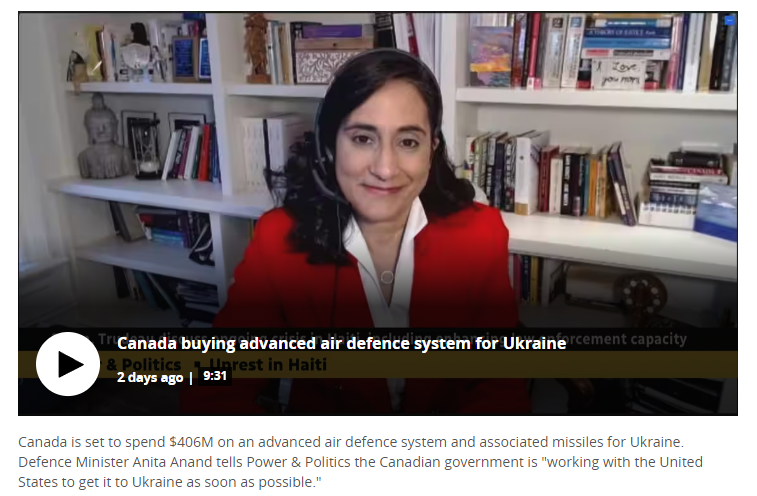
The association representing Canada’s defence contractors says it’s going to take a lot more than talk to put the industry on a so-called “war footing.”
In a bluntly-worded opinion piece published online Wednesday, Christyn Cianfarani, executive director of the Canadian Association of Defence and Security Industries, said that Canada — unlike its allies — has not put in place a framework to ramp up production to meet the demand triggered by the Russian invasion of Ukraine.
Instead, Cianfarani wrote, the industry has heard “vague pleas” from the Liberal government “for companies to get with the program,” without any clear sense of which items of equipment are needed and what the long-term expectations might be.
“Canadian defence companies can and would step up if they knew exactly what, and how much, to step up with,” she wrote.
In an interview with CBC News last summer, Defence Minister Anita Anand described the enlistment of weapons manufacturers in the struggle to save Ukraine as a “moral imperative.” Gen. Wayne Eyre, the country’s top military commander, also publicly urged the defence industry to get on a “war footing” in response to the crisis.
“No one in industry has a clue what government will require from companies to achieve that end, or even what ‘wartime footing’ means to government in the modern context,” wrote Cianfarani, adding that the last time the country’s defence industry was on a war footing was during the Second World War.
“No firm will take vague exhortations to ‘increase their production lines’ seriously without meaningful and systematic commitment from the government. No respectable CEO is going to take the risk of ordering tens of millions of dollars worth of parts to then see them sitting on a shelf awaiting integration, while simultaneously telling investors to trust them that a buyer will materialize in this highly managed protectionist market.”
January 12, 2023
Tank Chats #163 | Scorpion & Sabre | The Tank Museum
The Tank Museum
Published 9 Sep 2022In this episode of Tank Chats, David Fletcher details Scorpion and Sabre from the CVRT collection.
(more…)
January 11, 2023
Repurposing Obsolete Rifles: The Lebel R35 Carbine
Forgotten Weapons
Published 19 Dec 2017The French military had investigated the possibility of a Lebel carbine in the 1880s, but by the 1930s a different set of priorities was in place. In an effort to make some use of the vast stockpiles of obsolete Lebel rifles France had, a plan was put in place to shorten then into carbines for auxiliary troops like artillery crews and engineers. These men needed some sort of rifle or carbine, but they did not need the best and newest weapons. By giving them shortened Lebel carbines, it would free up more modern rifles like the M34 Berthiers in 7.5mm and the new MAS-36 rifles to go to the front line infantry who needed them most.
The R35 conversion was developed by the Tulle arsenal and adopted in January of 1936. The French government ordered 100,000 to be made, and deliveries began in April of 1937. Production would accelerate and continue right up to the spring of 1940, with a total of about 45,000 being actually delivered before the armistice with Germany. The conversions were all assembled at Tulle, but four other factories manufactured barrels for them: Chatellerault (MAC), St Etienne (MAS), Société Alsacienne de Constructions Mécaniques (SACM), and Manufacture d’Armes de Paris (MAP). These barrels were 450mm long (17.7 inches), and with the similarly shortened magazine tube, the R35 carbines held just 3 rounds. Production would not continue after the liberation of France in 1944.
(more…)
January 8, 2023
“Russians 27 miles from Poland!” – Ep 228 – January 7, 1944
World War Two
Published 7 Jan 2023That’s what the headlines say as the Red Army continues its advance in Ukraine. There are also plans afoot for a northern offensive to end the siege of Leningrad. There are also plans afoot for an Allied amphibious attack in Italy at Anzio. Both of these are set to go off within a couple weeks, so January promises to be full of active conflict.
(more…)
January 7, 2023
Converting the Lebel to 7.5mm: The M27 Lebel
Forgotten Weapons
Published 12 Dec 2017In the aftermath of World War One, the French military instituted a plan to introduce a completely new roster of small arms. This would begin with the development of a modern rimless rifle cartridge, which was adopted in 1924. With the new cartridge in hand, programs were begun to develop a light machine gun, bolt action rifle, and semiautomatic rifle using it. To supplement these new arms — especially during their development and production — plans were also made to convert existing 8mm rifles to the new cartridge.
The two rifles in large supply, of course, were the Lebel and the Berthier. The St Etienne arsenal was tasked with developing a Berthier conversion (this would become the M34 Berthier), and the Tulle arsenal was assigned to do the same with the Lebel. The first prototype was ready for testing in 1927. That first example was not satisfactory, and iterative development would continue into the early 1930s. Ultimately, the Lebel conversion was simply not as well liked by troops or as effective as the M34 Berthier, and so the Berthier was chosen for mass production. A total of about 1500 Lebel M27 conversions would be made by 1940, in a wide variety of configurations including different barrel lengths, rifling patterns, and optics mounting setups. While this did not result in a successful production rifle, it would inform the development of the MAS-36, and not go to waste. In addition, a number of M27 rifles would be converted into pressure testing guns to assist in ammunition development.
(more…)
QotD: The “camp followers” of a pre-modern army
We can start with sutlers, merchants buying or selling from the soldiers themselves (the Romans called these fellows lixae, but also called other non-soldiers in the camp lixae as well, see Roth (2012), 93-4; they also call them mercatores or negotiatores, merchants). Sutlers could be dealing in a wide array of goods. Even for armies where ration distribution was regular (e.g. the Roman army), sutlers might offer for sale tastier and fancier rations: meat, better alcohol and so on. They might also sell clothing and other goods to soldiers, even military equipment: finding “custom” weapons and armor in the archaeology of military forts and camps is not uncommon. For less regularly rationed armies, sutlers might act as a supplement to irregular systems of food and pay, providing credit to soldiers who purchased rations to make up for logistics shortfalls, to collect when those soldiers were paid. By way of example, the regulations of the Army of Flanders issued in 1596 allowed for three sutlers per 200-man company of troops (Parker, op. cit.), but the actual number was often much higher and of course those sutlers might also have their own assistants, porters, wagons and so on which moved with the army’s camp. Women who performed this role in the modern period are often referred to by the French vivandière.
For some armies there would have been an additional class of sutlers: slave dealers. Enslaved captives were a major component of loot in ancient warfare and Mediterranean military operations into and through the Middle Ages. Armies would abduct locals caught in hostile lands they moved through or enemies captured in battles or sieges; naturally generals did not want to have to manage these poor folks in the long term and so it was convenient if slave-dealer “wholesalers” were present with the army to quickly buy the large numbers of enslaved persons the army might generate (and then handle their transport – which is to say traffic them – to market). In Roman armies this was a regularized process, overseen by the quaestor (an elected treasury official who handled the army’s finances) assigned to each army, who conducted regular auctions in the camp. That of course means that these slave dealers are not only following the army, but are doing so with the necessary apparatus to transport hundreds or even thousands of captives (guards, wagons, porters, etc.).
And then there is the general category of “camp follower”, which covers a wide range of individuals (mostly women) who might move with the camp. The same 1596 regulations that provided for just three sutlers per 200-man Spanish company also provided that there could be three femmes publiques (prostitutes), another “maximum” which must often have been exceeded. But prostitutes were not the only women who might be with an army as it moved; indeed the very same regulations specify that, for propriety’s sake, the femmes publiques would have to work under the “disguise of being washerwomen or something similar” which of course implies a population of actual washerwomen and such who also moved with the army. Depending on training and social norms, soldiers may or may not have been expected to mend their own clothes or cook their own food. Soldiers might also have wives or girlfriends with them (who might in turn have those soldier’s children with them); this was more common with professional long-service armies where the army was home, but must have happened with all armies to one degree or another. Roman soldiers in the imperial period were formally, legally forbidden from marrying, but the evidence for “soldier’s families” in the permanent forts and camps of the Roman Empire is overwhelming.
The tasks women attached to these armies have have performed varied by gender norms and the organization of the logistics system. Early modern gunpowder armies represent some of the broadest range of activities and some of the armies that most relied on women in the camp to do the essential work of maintaining the camp; John Lynn (op. cit., 118-163) refers to the soldiers and their women (a mix of wives, girlfriends and unattached women) collectively as “the campaign community” and it is an apt label when thinking about the army on the march. As Lynn documents, women in the camp washed and mended clothes, nursed the sick and cooked meals, all tasks that were considered at the time inappropriate for men. Those same women might also be engaged in small crafts or in small-scale trade (that is, they might also be sutlers). Finally, as Lynn notes, women who were managing food and clothing seem often to have become logistics managers for their soldiers, guarding moveable property during battles and participating in pillaging in order to scrounge enough food and loot for they and their men to survive. I want to stress that for armies that had large numbers of women in the camp, it was because they were essential to the continued function of the army.
And finally, you have the general category of “servants”. The range of individuals captured by this label is vast. Officers and high status figures often brought either their hired servants or enslaved workers with them. Captains in the aforementioned Army of Flanders seem generally to have had at least four or five servants (called mozos) with them, for instance; higher officers more. But it wasn’t just officers who did this. Indeed, the average company in the Army of Flanders, Parker notes, would have had 20-30 individual soldiers who also had mozos with them; one force of 5,300 Spanish veterans leaving Flanders brought 2,000 such mozos as they left (Parker, op. cit. 151).
Looking at the ancient world, many – possibly most – Greek hoplites in citizen armies seem to have very often brought enslaved servants with them to carry their arms and armor; such enslaved servants are a regular feature of their armies in the sources. The Romans called these enslaved servants in their armies calones; it was a common trope of good generalship to sharply restrict their number, often with limited success. At Arausio we are told there were half as many servants (calonum et lixarum) as soldiers (Liv. Per. 67, on this note Roth (2013), 105), though excessive numbers of calones et lixae was a standard marker of bad general and the Romans did lose badly at Arausio so we ought to take those figures with a grain of salt, as Livy (and his sources) may just be communicating that the generals there were bad. That said, the notion that a very badly led army might have as many non-combatants following it as soldiers is a common one in the ancient sources. And while Roman armies were considered notable in the ancient world for how few camp servants they relied on and thus how much labor and portage was instead done by the soldiers, getting Roman aristocrats to leave their vast enslaved household staff at home was notoriously difficult (e.g. Ps.Caes. BAfr. 54; Dio Cass. 50.11.6). Much like the early modern “campaign community”, our sources frequently treat these calones as part of the army they belonged to, even though they were not soldiers.
Bret Devereaux, “Collections: Logistics, How Did They Do It, Part I: The Problem”, A Collection of Unmitigated Pedantry, 2022-07-15.
January 6, 2023
Will Stalin Liberate or Occupy Poland? – War Against Humanity 094
World War Two
Published 5 Jan 2023The last week of 1943 is a busy one. Stalin deports the Kalmyk minority from Kalmykia, the escapees from Fort IX get away, and the US President moves to found the post-war UN.
(more…)
January 5, 2023
Tank Chats #162 | Springer | The Tank Museum
The Tank Museum
Published 2 Sep 2022Join Curator David Willey in his latest Tank Chat as he delves into the Springer, a German demolition vehicle.
(more…)
January 4, 2023
The First Modern Military Rifle: The Modele 1886 Lebel
Forgotten Weapons
Published 5 Dec 2017The Lebel was a truly groundbreaking development in military small arms, being the first rifle to use smokeless powder. This gave it — and in turn the French infantry — a massive advantage in range over everyone else in the world at the time. This advantage was short-lived, but the French did their best to exploit it.
French chemist Paul Vielle successfully developed his smokeless powder (“poudre B“) formula in 1884, and French ordnance spent 1885 experimenting with different calibers of small bore bullet to see what would work best. They also began looking at rifle actions to use, including specifically the Remington-Lee and the Mannlicher. However, a new Minister of War was appointed in January of 1886 and he demanded a completed prototype rifle and ammunition be completed by May 1886. This was a nearly impossibly short deadline to meet, and it meant that the Ordnance officers could not possibly develop a wholly new rifle, and instead would have to modify something already in the inventory.
The only suitable option was the Model 1884/5, a combination of the Gras bolt and Kropatschek tube magazine. The new smokeless cartridge was made by simply necking down the 11mm Gras round, and the 1884 rifle was given a new barrel in 8mm and a new dual-locking-lug bolt head to accommodate the high chamber pressure of the new powder. The result was the Lebel, and it was formally accepted in April 1887 after a relatively short period of testing. The weapon may not have been used the most advanced elements, but it was without any doubt the foremost military rifle in the world at the time, by a substantial margin.
The three main French state arsenals of St Etienne, Chatellerault, and Tulle would all tool up to produce the Lebel, and by the end of 1892 approximately 2.8 million had been produced, enough to equip the entire Army. The rifle would remain in service as France’s primary infantry rifle until World War One, would be declared obsolete in 1920, and remain in inventory and in use until the end of World War Two.
(more…)
January 3, 2023
1943 in Numbers – WW2 Special
World War Two
Published 1 Jan 2023This war is massive. Our chronological coverage helps give us an understanding of it, but sometimes statistics help us understand the bigger picture.
(more…)
QotD: Spartan dominance over the Peloponnese
The core of this control lasted until 371, when Spartan defeat at the Battle of Leuktra shattered this control. Epaminondas, the Theban commander, used the opportunity to free the helots of Messenia and reform them into a polis to provide a local counter-weight to Sparta, while Arcadia and Elis split off from Sparta’s alliance to form their own defensive league against Sparta and, to top it off, a number of the perioikic communities – including the Spartans’ elite light infantry scouts, the Skiritae – along with various borderlands also formed the new polis of Megalopolis on the northern Spartan border – it promptly joined the Arcadian league (this polis would later give us the historian Polybius; his anti-Spartan stance comes out clearly in how he treats Cleomenes III). Sparta, surrounded now by hostile poleis who had once been allies, would spend the rest of Antiquity as a political non-entity, save for one brief effort to restore Spartan greatness in the 220s, crushed by the Macedonian Antigonids who were in no mood to entertain Spartan delusions of grandeur.
We might then say that Sparta is successful – though not entirely so (Argos!) – in establishing a hegemony over the Peloponnese, but only maintains it for c. 175 years. That’s not a bad run, but for the record of a larger state dominating its backyard, it is not tremendously impressive either.
Bret Devereaux, “Collections: This. Isn’t. Sparta. Part VII: Spartan Ends”, A Collection of Unmitigated Pedantry, 2019-09-27.


