
World War Two
Published 15 Feb 2023We’ve covered in great depth the Battle of the Atlantic and the war by and against German U-Boats, but what about the other side of the world? Why has the war on Japanese shipping been so much quieter? There are several very specific reasons for that, which we look at today.
(more…)
February 17, 2023
America’s War on Japanese Shipping – WW2 Special Documentary
Comments Off on America’s War on Japanese Shipping – WW2 Special Documentary
Vektor CR21: South Africa’s Futuristic Bullpup
Forgotten Weapons
Published 30 Apr 2018The CR-21 was a private effort to create a new rifle for the South African military in the 1990s. Bullpup designs were all the rage at the time (Austria has the AUG, France had the FAMAS, the UK had the SA80, etc), and so a company called Lyttelton Engineering Works (now part of Denel Land Systems) created a bullpup conversion design for the South African R4 (Galil). It was given a very fluid, futuristic look, and equipped with a fiber optic optic without any iron sights. The action and magazines remained original R4/Galil, however.
The weapon was promoted to the South African military as an economical upgrade package for the R4 rifles already in service, but was met with little interest. Further efforts to sell the weapon to South African police and international military or security customers similarly met with no success. In total, only 200 complete rifles were made, plus parts for another 200. They achieved some notoriety in fictional media because of their looks, including use in the film District 9. As often happens, however, becoming popular in film or video games does not equate to commercial success.
Many thanks to the anonymous collector who let me take a look at this piece and bring you a video on it!
(more…)
Comments Off on Vektor CR21: South Africa’s Futuristic Bullpup
February 14, 2023
China’s awkward actions on the world stage do not charm the neighbours
CDR Salamander explains why the BRIC (Brazil-Russia-India-China) “coalition” is as unlikely to occur in the real world as any other opium pipe-dream:

Yes, the USA and Canada had our Balloons of February, but in the last year or so, what has China been doing to seem like a pleasant alternative to the United States to the rest of the world?
Her largest neighbor? They get sticks:
The root cause is an ill-defined, 3,440km (2,100-mile)-long disputed border.
Rivers, lakes and snowcaps along the frontier mean the line can shift, bringing soldiers face to face at many points, sparking a confrontation.
The two nations are also competing to build infrastructure along the border, which is also known as the Line of Actual Control. India’s construction of a new road to a high-altitude air base is seen as one of the main triggers for a deadly 2020 clash with Chinese troops.
How bad is the situation?
Despite military-level talks, tensions continue. In December 2022 troops clashed for the first time in more than a year.
It happened near the Tawang sector of Arunachal Pradesh state, the eastern tip of India. Some soldiers suffered minor injuries.
De-escalation work has taken place since a major clash in June 2020. The Galwan Valley battle — fought with sticks and clubs, not guns — was the first fatal confrontation between the two sides since 1975.
At least 20 Indian and four Chinese soldiers died.
Another face-off in January 2021 left troops on both sides injured. It took place near India’s Sikkim state, between Bhutan and Nepal.
The “I” and “C” in the B.R.I.C. are not going to be close friends, ever — one of the reasons I roll my eyes at those who propose the BRIC nations as some kind of power block — something only slightly sillier than the Cold War “Non Aligned Movement.”
With the “B” being the basket case Brazil (always the nation of the future, and always will be), and the “R” being Russia, I mean, child please.
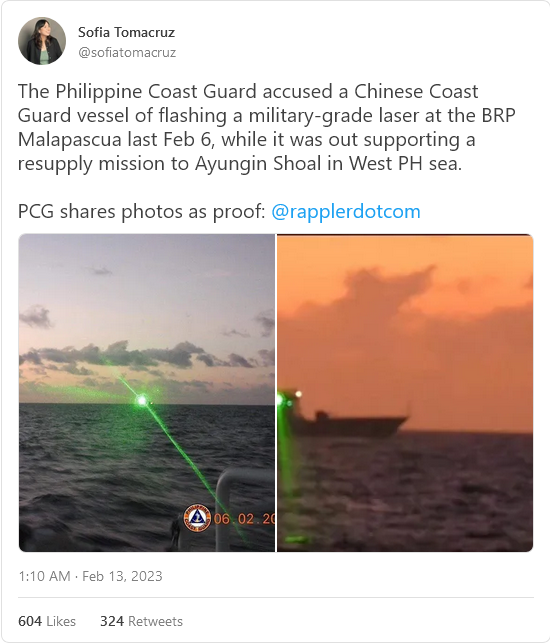
Another nation that if the PRC was just slightly more subtle and less arrogant they might have a chance to make things more difficult for the USA-Japan-Australia defense concerns is The Philippines. They had a window in the last couple of decades, but … if they’re doing this;
The PRC Wolf Warrior Lack of Charm Campaign perhaps may play well internally — and that may be all they care about — but there was a window not long ago that the PRC was playing smart on the world stage — making significant impact in Australia and having the USA happy to let them set up Confucius Institutes at our major universities, etc … but the last decade or so they somehow decided to play a different game.
Comments Off on China’s awkward actions on the world stage do not charm the neighbours
February 13, 2023
It’s open season for balloons over North America
In The Line, yet another incursion into NORAD air space, and no, this isn’t a re-post from last week:

Holy jumpin’ Jeepers, folks, we’ve got more balloons!
On Friday, the Americans shot down another unidentified flying object — gulp — off the coast of Alaska. By Saturday, NORAD was reporting yet another one, this time over Canadian territory. NORAD jets scrambled, and an American F-22 destroyed the object over Yukon. Canadian military teams are now en route to recover the wreck and find out what the hell we are shooting at.
This was an exciting enough little pick-me-up on Saturday, but it wasn’t done. Later that night, another air defence emergency was declared over Montana, and American F-15 jets were scrambled out of Oregon to intercept an object that had been detected on radar. They were not able to find anything, and as of press time, NORAD has said only that they will continue to monitor the situation.
A few points we’d make about a truly bizarre series of stories.
The first is that there’s nothing wrong or particularly embarrassing about an American plane defending Canadian air space. NORAD is a joint bi-national command. Missions are tasked to the first available aircraft. That might sometimes mean a Canadian jet defending U.S. territory. It’s happened! On Saturday, the object was closer to American bases in Alaska than the nearest CF-18 base in Alberta. There probably is a conversation worth having about whether Canada should maintain a small alert force of jets further north, better able to respond in the future. That’s expensive and logistically complicated, but may still be worth considering. For now, the system functioned as intended. So we say, quite sincerely, thanks, America. We appreciate the help.
That being said, we do think this is a useful reminder that the long and repeated delays by Canada to both replace the aging CF-18 jets and modernize NORAD with new sensors and capabilities were reckless and dumb. It was obvious that the CF-18s needed replacing when Stephen Harper took office, but we only got that underway in recent months. NORAD, for its part, functions well as an institution but needs upgraded technology. That project also should have begun many years ago. In both cases, we delayed because we didn’t want to spend the money and because defence projects in this country are almost always politically fraught. The Russian invasion of Ukraine and now the weird series of aerial intruders is a useful reminder that neglecting your own defences is never a good idea. We are realists about Canada’s ability to field a massive military, but our geography, in so many ways a blessing, does impose a few costs back on us. It’s not easy to patrol and police such massive territories, especially with a relatively small and concentrated population. But we have to do it. It’s what being a country means. Too often, we haven’t. We hope that changes. With the NORAD modernization announced and the F-35s ordered, perhaps we’re finally making right some of these failures. We hope so. But we are jaded, friends. We admit that.
Our final point is an appeal to calm. We don’t really know what the hell is happening with all these aerial intruders either, but there could easily be a pretty mundane explanation. Radar sets have programmable software filters that are intended to avoid cluttering up the scopes with too much information. Without these filters, clouds, snow storms and birds can cause returns that may look like planes and missiles. One way of filtering out such clutter is by establishing a minimum speed for flagging an object. Balloons are likely normally below that minimum. Your Line editors suspect that part of what is happening right now is that we’ve adjusted those filters, and are suddenly seeing things that were already there all along.
Is that better, or worse? We don’t know. We can make that argument either way. In any case, that may be what’s happening.
Or hell, maybe it’s aliens, and Canada and the U.S. just declared war on a more sophisticated race that travelled across the vastness of the stars only to end their journey by being murdered by Justin Trudeau and Joe Biden. We doubt it, to be honest. But it’s been a weird few years already, no?
Comments Off on It’s open season for balloons over North America
Reising M55 Submachine Gun
Forgotten Weapons
Published 28 Sept 2015When the US entered WWII, submachine guns were in short supply and high demand. Much of the production of Thompson guns was being purchased by the UK, and what guns were available to the US military went first to the Army. In accordance with long tradition, the Marine Corps were secondary to the Army in receiving new weapons. However, the formation of a Marine paratroop unit in particular necessitated the Corps finding some sort of suitable submachine gun.
What was available at the time were Eugene Reising’s M50 and M55 guns, being manufactured by Harrington & Richardson. The guns were chambered for the standard .45ACP cartridge and used a delayed blowback action which allowed them to be significantly lighter than the Thompson. The M50 had a full-length traditional stock, while the M55 used a pistol grip and wire folding stock. Mechanically, the two variants were identical. The M55, which is what we have today, wound up being specifically issued to tank crews and paratroops, where its compactness was a significant advantage.
The Reising developed a quite bad reputation in the Pacific for a couple of reasons. Its parts were not always interchangeable between guns (a deliberate choice to speed up manufacture, which troops were not necessarily aware of), its mechanism was more susceptible to fouling than other military small arms, and its disassembly procedure was far too complex for military service. However, these issues did not prevent it from being quite successful and well-liked as a law enforcement weapon in civilian police use after the war. Thanks to that negative wartime reputation, Reisings are some of the least expensive military machine guns available on the market today in the US.
(more…)
Comments Off on Reising M55 Submachine Gun
February 12, 2023
German Desperation in Korsun Pocket – Week 233 – February 11, 1944
World War Two
Published 11 Feb 2023It is crisis mode in the Korsun Pocket this week for the Axis troops surrounded, but they are also losing ground all over the Eastern Front this week, including the big prize of Nikopol. In Italy, it is a different story as the Germans play offense at Anzio, though with only small gains.
(more…)
Comments Off on German Desperation in Korsun Pocket – Week 233 – February 11, 1944
Avro Vulcan: What made the Vulcan the best V bomber?
Imperial War Museums
Published 28 Apr 2021The Avro Vulcan Bomber, the most famous of the British V bombers, is known for its distinctive howl and delta wing. Initially one of the delivery agents of Britain’s independent nuclear deterrent during the Cold War, the Vulcan later fulfilled another role, undertaking the longest bombing raid in history for Operation Black Buck in the Falklands Campaign of 1982. One of the first operational RAF aircraft with a delta wing, this impressive Cold War jet has never lost its appeal. In this video, events and experiences coordinator Liam Shaw takes us through the extraordinary history and technological achievements of the Avro Vulcan. We go into the cockpit and hear first-hand from the people who flew this unique machine throughout its long and remarkable history.
(more…)
Comments Off on Avro Vulcan: What made the Vulcan the best V bomber?
February 11, 2023
Napoleon’s Downfall: Why He Lost the Battle of Nations
Real Time History
Published 10 Feb 2023After the brief summer 1813 cease fire, Napoleon’s campaign in Germany resumes. Surrounded by the Allies — which also manage to slowly turn the tide at Großbeeren, Dennewitz, Kulm, and Dresden — his only remaining option is the ultimate battle which takes place in October 1813 at Leipzig: The Battle of Nations.
(more…)
Comments Off on Napoleon’s Downfall: Why He Lost the Battle of Nations
Tank Chats #167 | French Panhard EBR | The Tank Museum
The Tank Museum
Published 28 Oct 2022How much do you know about the Panhard EBR? Join David Willey for this week’s Tank Chat as he covers the development, design and use of this French armoured car.
(more…)
Comments Off on Tank Chats #167 | French Panhard EBR | The Tank Museum
February 10, 2023
When “Taffy 3” kicked the ass of the pride of the Imperial Japanese Navy
Chris Bray isn’t a milblogger, but I thought his summary of the Battle of Leyte Gulf was pretty darned good:
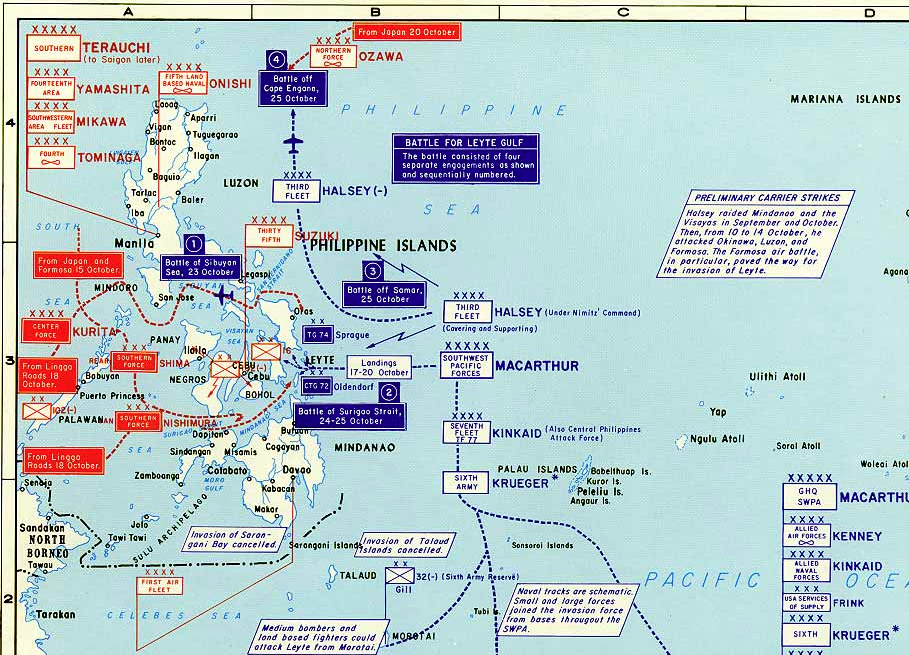
In October of 1944, US troops landing on Leyte Island in the Philippines were menaced from the sea by an enormous Japanese naval fleet that was divided into three separate attack forces.
Detail of the West Point Military Atlas: World War II: Asia-Pacific Invasion of Leyte, October 1944 map.
https://www.westpoint.edu/sites/default/files/inline-images/academics/academic_departments/history/WWII%20Asia/ww2%2520asia%2520map%252029.jpgSummarizing aggressively, the American ground forces were protected against an attack from the sea by the US Navy’s Third Fleet, commanded by Bull Halsey. But Halsey suddenly wasn’t there anymore, taking the bait of a decoy attack force [of de-planed Japanese carriers] and chasing it out into the sea. The Third Fleet’s departure uncovered Leyte Gulf, and the largest of the Japanese attack forces sailed in. Disaster became likely.
There were two American naval task forces in the path of the Japanese attack force, Taffy 2 and Taffy 3, but neither were meant for serious naval combat. They were supporting forces, designed to help the troops on the ground: a few escort carriers, a few lightly armed destroyer escorts, a very few destroyers. Aircraft on the American escort carriers were armed with 100-pound bombs to provide close air support to the infantry. The Japanese First Task Force had four battleships, eight cruisers, and eleven destroyers. One of the Japanese battleships was the Yamato, armed with 18-inch guns. The Japanese attack force sailed directly into contact with Taffy 3, which didn’t realize they were about to face the main Japanese attack force until they were already within range of its guns.
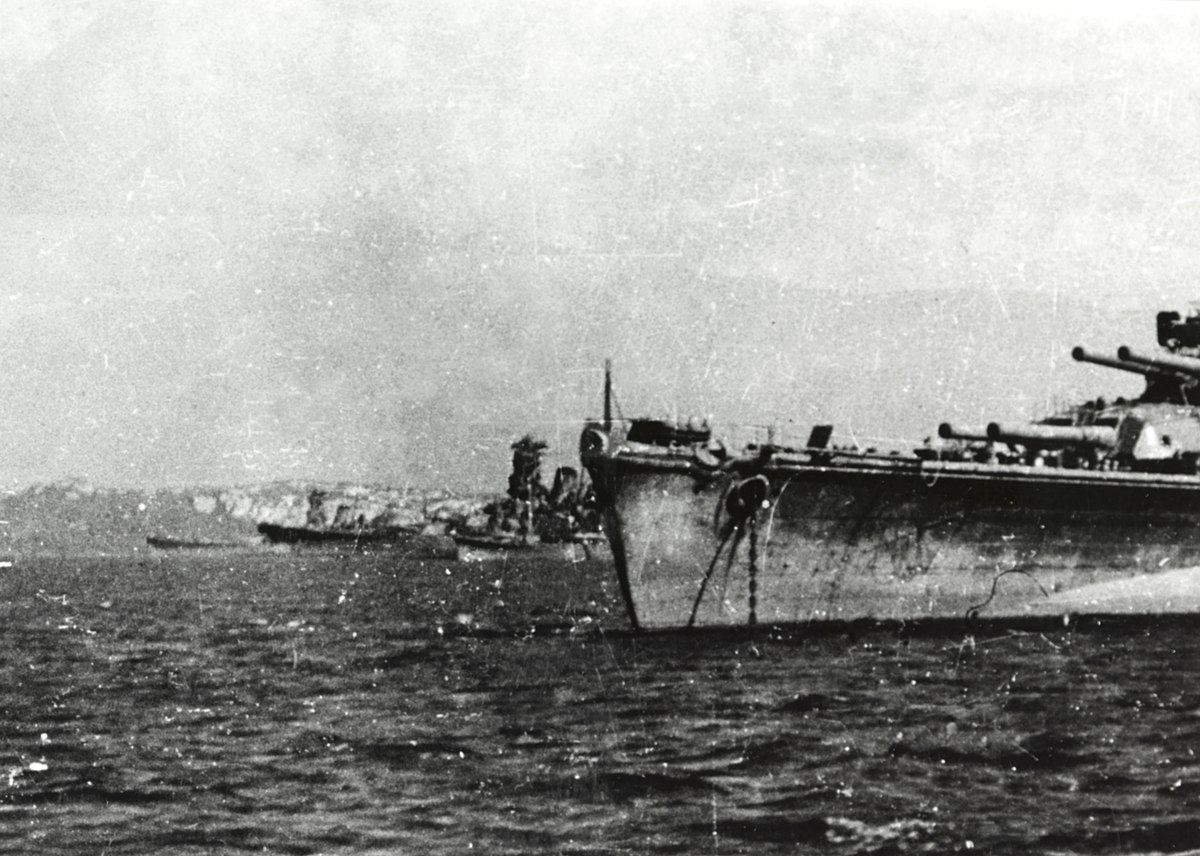
Imperial Japanese Navy ships at anchor in Brunei, Borneo shortly before the Battle of Leyte Gulf. Left to right, Musashi, Yamato, an unidentified cruiser, and Nagato.
Photo by Kazutoshi Hando from the US Naval History and Heritage Command collection.The commander of Taffy 3, Rear Admiral Clifton Sprague, saw immediately that his task force couldn’t survive the engagement, so he tried to salvage what he could: He ordered his destroyers and destroyer escorts to attack, to cover the hoped-for withdrawal of the escort carriers. The resulting battle is one of the best-known in naval history — and one of the least plausible, because Taffy 3 kicked the everloving shit out of that much larger Japanese attack force, compelling the Japanese to withdraw in the panicked belief that they’d sailed into the bulk of Halsey’s Third Fleet.
If you haven’t read [the late] James Hornfischer’s magnificent book about the battle, The Last Stand of the Tin Can Sailors, you should read it. The details are far beyond anything that could be summarized in a single short piece. But the battle was won by a remarkable combination of disciplined obedience, independent audacity, and a paradoxically disciplined disobedience — by men aggressively refusing to obey orders that threatened their cause.
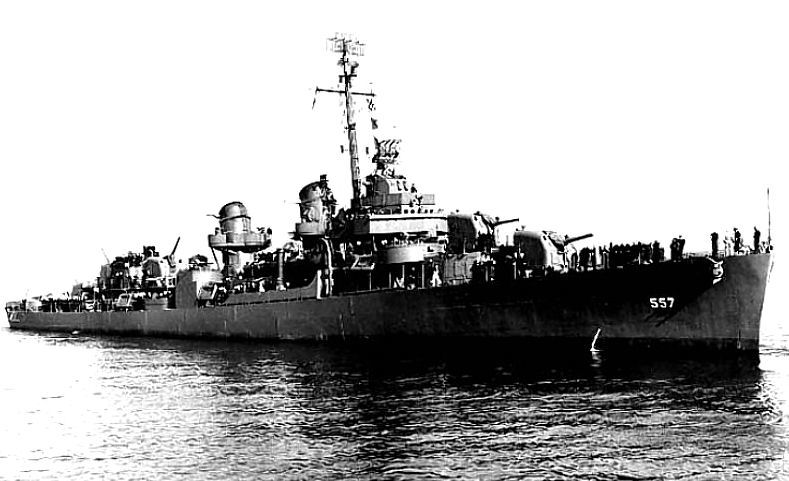
The Fletcher-class destroyer USS Johnston (DD-557), sunk in the Battle off Samar, 25 October, 1944.
US Navy photo with enhancement work by Wild Surmise via Wikimedia Commons.The battle began with one of the US Navy’s most famous moments. Before Sprague had time to order anyone to do anything, the captain of the Johnston, one of Taffy 3’s few destroyers, turned to attack the Japanese fleet. We have confused and contradictory accounts of the orders given by Cmdr. Ernest Evans, because the man who gave them, and most of the men who heard them, died soon afterward, but he is supposed to have said something like this:
1.) We’re under the guns of a much larger Japanese fleet.
2.) Survival is not to be expected.
3.) Hard left rudder, all ahead flank.
We’re all going to die; attack. The Johnston sank, and Evans died, but his first torpedo run blew the bow off a Japanese cruiser — setting the tone of the fight.
Comments Off on When “Taffy 3” kicked the ass of the pride of the Imperial Japanese Navy
Hitler’s Jazz Band – WW2 Documentary Special
World War Two
Published 9 Feb 2023Does Adolf Hitler like Duke Ellington? No, and nor do many National Socialists. But the story of the music in the Third Reich is more complicated than you might think. What if we told you that Joseph Goebbels has tried to create a Nazi-approved swing band tasked with bringing the Jazz War to the Allies?
(more…)
Comments Off on Hitler’s Jazz Band – WW2 Documentary Special
Water-Cooled .50s: The US Navy Mk22 Pedestal Mount
Forgotten Weapons
Published 27 Oct 2022In 1942, the US Navy adopted the Mk22 Pedestal mount, which fitted a pair of water-cooled Browning M2 machine guns (one left-hand feed and one right-hand). It was used for antiaircraft use primarily, and was also adopted by the Army as the M46 in 1943. The mount was an update to the previous single-gun MK21.
The gunner was protected by a 3/8″ (9.5mm) hardened steel shield, and the mount could rotate a full 360 degrees, with elevation from -10 degrees to 80 degrees. They were produced by the Heintz Manufacturing company (no relation to the Heinz company that makes ketchup) of Pittsburgh from 1942 until 1945.
(more…)
Comments Off on Water-Cooled .50s: The US Navy Mk22 Pedestal Mount
February 9, 2023
On Clausewitz
Bruce Gudmundsson’s Tactical Notebook Substack has covered a lot of WW1-era artillery unit organization since I started subscribing, but on Tuesday he offered some notes on how to approach the life and work of Carl von Clausewitz for the non-professional-soldier audience:

Carl von Clausewitz by Alexander Becker, circa 1867.
The beginning of wisdom where Clausewitz is concerned is to realize that he was the professional soldier with a great deal of trigger time under his belt. If you doubt this, crack open one of the two fine biographies that are readily available to English-speaking readers. Indeed, even if you need no convincing on the subject of the active service of the Philosopher of War, a biography is a good place to start your engagement with this extraordinarily interesting man.
For reasons of style and sentiment, I prefer the older of the two biographies. Composed by popular historian Roger Parkinson in the days before Clausewitz was cool, Clausewitz: A Biography devotes nine of its seventeen substantive chapters (the three-page epilogue doesn’t count) to tales of active service. It is, moreover, the sort of book that was written to be read, for edification and enjoyment, by intelligent members of the general public.
Clausewitz: His Life and Work, is the product of our own times, one in which a great deal of military history is written by people with doctoral degrees, and people with doctoral degrees teach at war colleges. Though afflicted with both of these aforementioned handicaps, author Donald J. Stoker has managed to produce a work as readable as that of Parkinson. Better yet, he has succeeded in devoting even more attention to periods when Clausewitz was more concerned with the immediate possibility of enfilade and defilade than the distinction between “nature” and “character”.
Once you have learned a bit about Clausewitz the soldier, you will be ready to embrace Carl the lover. For this stage of your journey, you will have but one companion, Vanya Eftimova Bellinger’s Marie von Clausewitz: The Woman Behind the Making of On War.
Fear not, while this biography of the remarkable Frau von Clausewitz is a love story, it has little in common with what passes for romance these days. Neither is it, as the subtitle suggests, largely about the posthumous assembly of the various fragments of On War into the work that made its author famous. (Professor Bellinger tells that tale in less than five pages.) Rather, Marie von Clausewitz is largely a tale of the books, ideas, culture, and politics of the times and places in which the heroine and her husband lived.
If you wish to delve further into the aforementioned milieu, you should read all three of the books of Peter Paret that have “Clausewitz” in their titles. In sharp contrast to his partner in translation, Professor Paret was much more interested in the ideas that influenced Clausewitz than the way that people of subsequent generations reacted to the products of his pen. (While the greatest, by far, of all American Clausewitz scholars, Paret was, first and last, a student of the great reform movement that took place in Prussia after the disaster of Jena-Auerstadt.) If, however, you wish a more direct route into the military mind of the subject of this piece, then the next step in your journey should consist of a long visit with Gerhard von Scharnhorst.
Comments Off on On Clausewitz
February 8, 2023
The ghastly Thirty Years’ War in Europe
In The Critic, Peter Caddick-Adams outlines the state of Europe four hundred years ago:
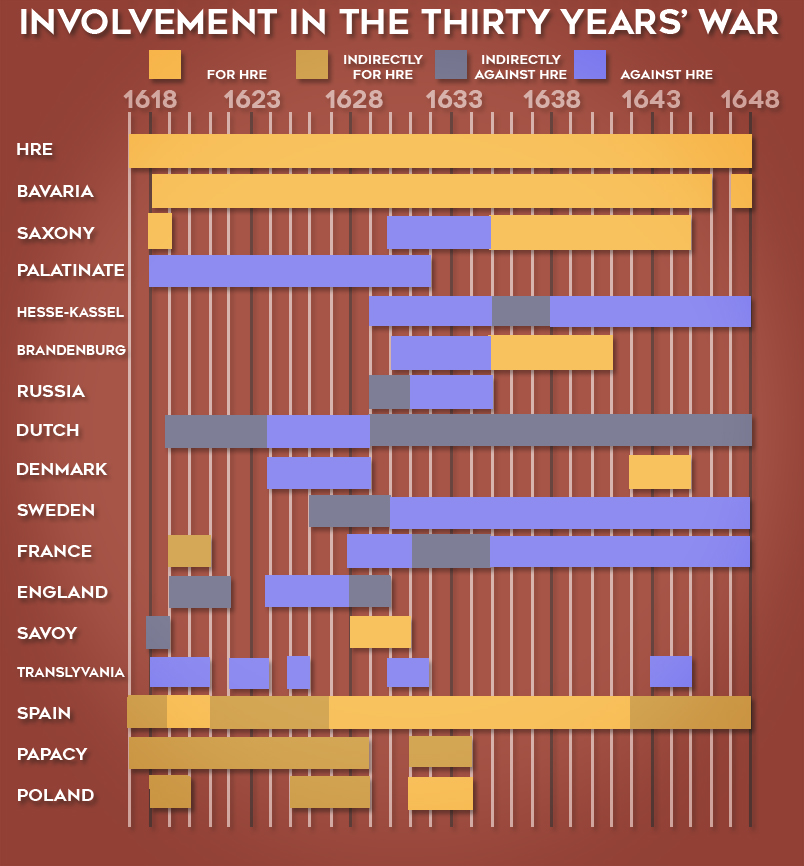
A war as long and as complex requires something like this to help keep the narrative somewhat understandable.
Exactly four hundred years ago, a dark shadow was slithering across mainland Europe. It stretched its bleak, cold presence into each hearth and home. Everything it touched turned to ruin. Musket and rapier, smoke and fire, ruled supreme. Nothing was immune. Animals and children starved to death, mothers and adolescent girls were abused and tortured. The lucky ones died, alongside their brothers and fathers, slain in battle. Possessions were looted, crops destroyed, barns and houses burned. There seemed no end to the evil and pestilence. Sixteen generations ago, many believed the end of the world had arrived.
This was not a tale of Middle Earth. The place was central Europe in the early 17th century. In 1618 the future Holy Roman emperor Ferdinand II, a zealous follower of the Jesuits, had attempted to restore the Catholic Church as the only religion in the Empire and exterminate any form of religious dissent. Protestant nobles in Bohemia and Austria rose up in rebellion. The conflict soon widened, fuelled by the political ambitions of adjacent powers. In Europe’s heartland, three denominations fought it out: Roman Catholicism, Lutheranism and Calvinism.
The result was an interwoven tangle of diplomatic plot twists, temporary alliances and coalitions, as princes, bishops and potentates beseeched outside powers to help. The struggle, which lasted for thirty years, boiled down to the Roman Catholic and Habsburg-led Holy Roman Empire, fighting an incongruous array of Protestant towns and statelets, aided by the anti-Catholic powers of Sweden under Gustavus Adolphus, and the United Netherlands. France and Spain also took advantage of the distractions of war to indulge in their own sub-campaigns. Britain took no formal part but was about to become embroiled in her own civil war.
The principal battleground for this collective contest of arms centred on the towns and principalities of what would become Germany, northern Italy, the Netherlands and the Czech Republic. The war devastated many regions on a scale unseen again until 1944–45. For example, at Magdeburg on the River Elbe, 20,000 of 25,000 inhabitants died, with 1,700 of its 1,900 buildings ruined. In Czech Bohemia, 40 per cent of the population perished, with 100 towns and more than a thousand villages laid waste. At Nordlingen in 1634, around 16,000 soldiers were killed in a single day’s battle. The town took three centuries for its population to return to pre-war levels. Refugees from smaller settlements swelled the many walled cities, increasing hunger and spreading disease.
Too diminutive to defend themselves, all states hired mercenaries, of whom a huge number flourished in the era, enticed by the prospect of quick wealth in exchange for proficiency with sword and musket. Employed by every antagonist, but beholden to no one, these armed brigands — regiments would be too grand a term for the uniformed thugs they were — roamed at will. With their pikes and their muskets, they plundered the countryside in search of booty, food and transport. In their wake, they left burning towns, ruined villages, pillaged farms. Lead was stripped from houses and church roofs for ammunition.
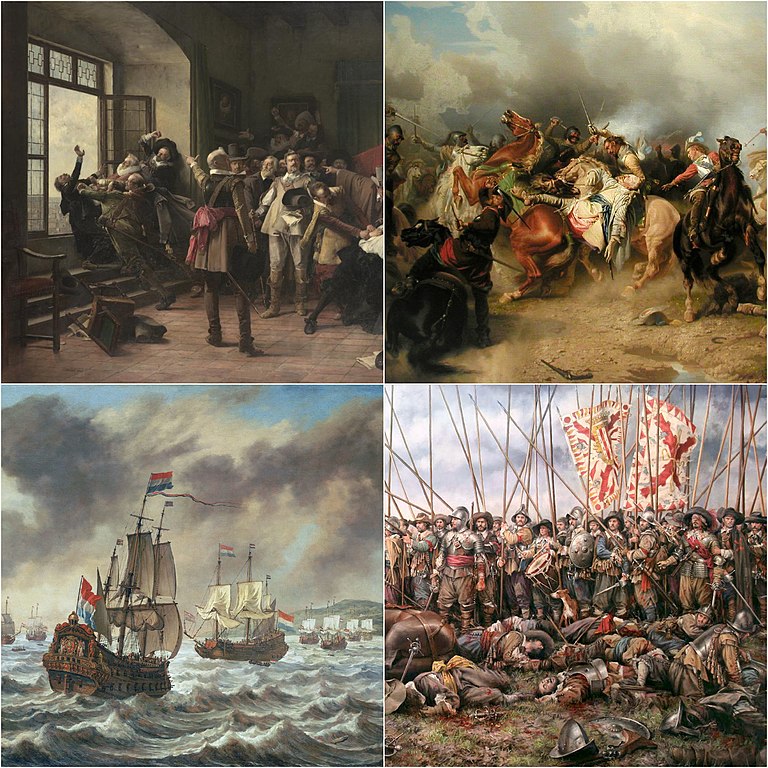
Left to right:
The Defenestration of Prague (23 May, 1618), The death of Gustavus Adolphus at Lützen (16 November, 1632), Dutch warships prior to the Battle of the Downs (21 October, 1639), and The Battle of Rocroi (19 May, 1643).
Collage by David Dijkgraaf via Wikimedia Commons.When in the winter of 1634 Swedish mercenaries were refused food and wine by the inhabitants of Linden, a tiny Bavarian settlement, they raped and looted their way through the village, leaving it uninhabitable. Across Europe, travellers noted the human and animal carcasses that decorated the meadows, streams polluted by the dead and rotting crops, presided over only by ravens and wolves. No respect was shown for the lifeless. Survivors stripped corpses of clothing and valuables; if lucky, the deceased were tossed into unmarked mass graves, since lost to history.
Having triggered the war, Ferdinand predeceased its end. We can never know how many died in Europe’s last major conflagration triggered by religion. Archives perished in the flames, and survivors were not interested in computations. Historians now put the death toll at between 8 and 12 million. Probably 500,000 perished in battle, with the rest, mostly civilians, expiring through starvation and disease. We think these casualties may equate to as much as 20 per cent of mainland Europe’s population and perhaps one-third of those in modern Germany, bringing the Thirty Years’ War a potency similar to the Black Death or either world war. The region did not recover for at least three generations.
Economic activity, land use and ownership altered terminally. When the exhausted powers finally met in October 1648 at Osnabrück and Münster in the German province of Westphalia to end the directionless slaughter, of whom self-serving militias were the only beneficiaries, Europe’s balance of power had shifted tectonically. Fresh rules of conflict and the legitimacy of a new network of 300 sovereign states, independent from a Holy Roman Emperor or a Pope, marked the struggle as a watershed moment, leading to the Enlightenment and an era that disappeared only with Napoleon.
Comments Off on The ghastly Thirty Years’ War in Europe
February 7, 2023
The Soviet Union Adopts an SMG: Degtyarev’s PPD-34/38
Forgotten Weapons
Published 21 Oct 2022The Soviet Union adopted its first submachine gun in 1935 after trials of some 14 different design in 1932/33. The winner of the trials was Vasily Degtyarev, once of the Soviet Union’s most prolific firearms designers. His model 1934 was a simple blowback gun reminiscent of the MP-28,II albeit with different trigger and magazine systems. The PPD34 used a 25-round box magazine, chambered for 7.62x25mm Tokarev. It was put into slow production, with just 3,300 or so produced by the end of 1938. During that time, Degtyarev made a number of small improvements to the gun, smoothing out the teething problems that are always found in new production systems. This improved version was designated the PPD34-38.
During the time, the submachine gun was not considered a priority by the Red Army. The leading generals did not see the value in the class of arms, and actually pulled all the PPDs from service in 1939 and had them put into storage. Only a few months later, the Red Army would be given a grim demonstration of SMG effectiveness when they closed the border into Finland and encountered determined Finnish resistance with kp/31 Suomi SMGs.
Some Suomis were captured by Soviet troops, and were very well liked — for obvious reasons. The inevitable inquiry into why the Red Army did not have such a weapon led to a frantic re-issuing of PPDs and production of as many as possible. At Stalin’s direction, the Suomi drum magazine was copied and adapted to the PPD34-38 as well. This required the addition of a short feed tower to fit the magazine well initially deigned for a standard box magazine. While PPD34-38 production continued, the PPD40 was quickly designed and put into production alongside the older model. Eventually, both were replaced in service by the PPSh-41, which was truly designed for mass industrial production.
(more…)
Comments Off on The Soviet Union Adopts an SMG: Degtyarev’s PPD-34/38


