
World War Two
Published 26 Feb 2023Allied and German Air Forces fight fierce battles over Europe with civilians caught in the crossfire, while Joseph Stalin and Lavrenti Beria deport two entire ethnicities of half a million in just one week.
(more…)
February 27, 2023
Luftwaffe Defeated in One Week?! – War Against Humanity 099
Comments Off on Luftwaffe Defeated in One Week?! – War Against Humanity 099
February 26, 2023
Tojo Takes Control – Week 235 – February 25, 1944
World War Two
Published 25 Feb 2023Now that the Americans have seized the Marshall Islands, they can bypass the Japanese base at Truk. This impels Prime Minister Hideki Tojo to shake up both army and navy command, and he even takes personal control over the Japanese Army. On the Anzio Front, Lucian Truscott replaces John Lucas as Allied Commander. In the field, the Allies win a big victory in Burma, and in Ukraine, the Soviets are still on the move.
(more…)
Comments Off on Tojo Takes Control – Week 235 – February 25, 1944
February 25, 2023
One year into Vladimir Putin’s “Three-Day War”
Tsar Vlad launched his short, victorious war a full year ago, expecting to have the troops home by spring if not sooner. It hasn’t worked out to his timetable at all. Ukraine still stands, although it’s taken one hell of a battering in the process and drawn in more and more vocal support in the west, which has belatedly been followed by actual military supplies and equipment to replace those expended holding back the Russian forces. CDR Salamander follows up his predictions from last year on how things looked to him at that moment in time:
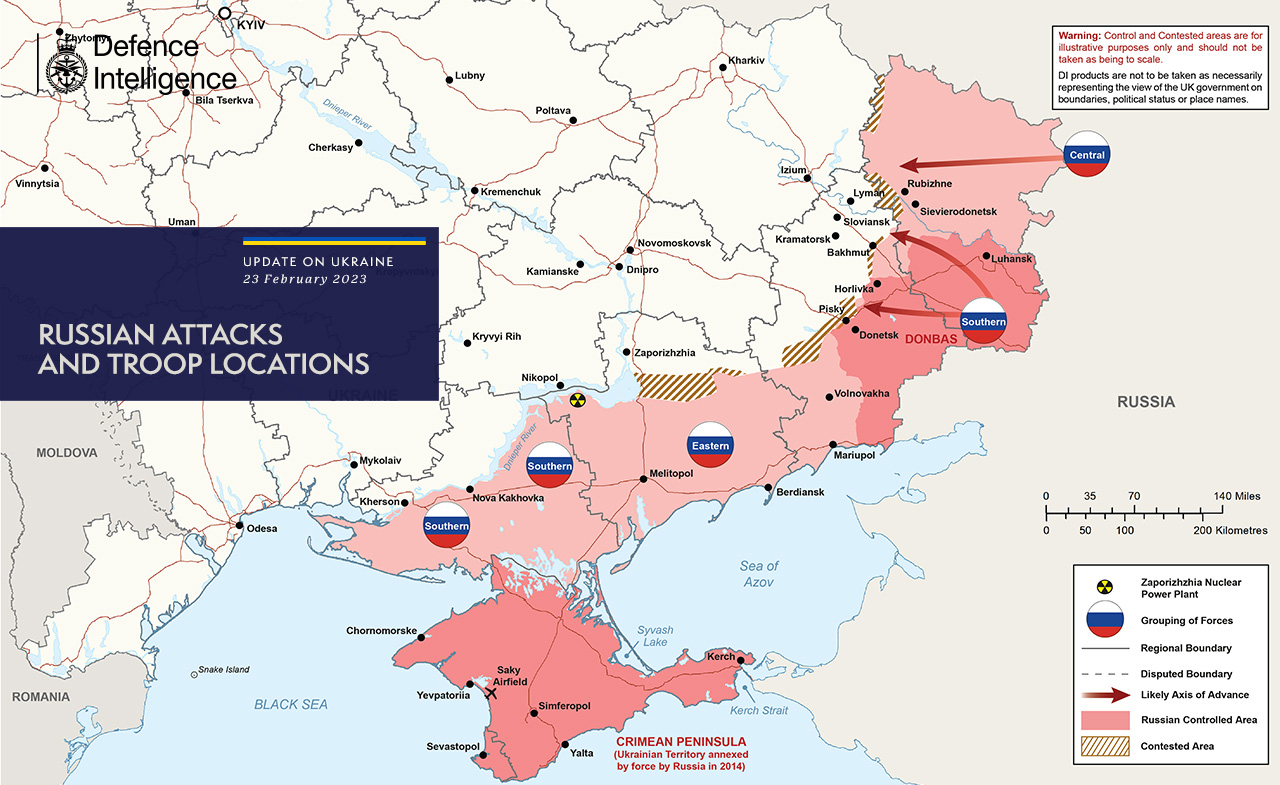
On the day the war started I made 7-points. Let’s review them and see how I did back on 24 FEB 22.
1. The remaining delusions about the post-Cold War security arrangements in Europe should be firmly buried. History is back and she has her Festivus pole front and center. She has some issues with us, and we’re going to hear about it.
This continues to get firmer and displayed in stark relief. All the “offsets” and “transformations” and “war is new” snake oil sold the last few decades really should not be allowed to have any public space besides to say, “I was wrong.” Rest assured, that won’t stop them — but the issues we raised over the almost 18-yrs of this blog and 14-yrs of the Midrats Podcast remain true. From the shallow magazines to the fact you never have enough large caliber guns to no war is short … we — and a lot of other people tut-tut’d for years — were correct.
2. NATO has a German problem. While all the “right people” will not shut up about how wonderful former Chancellor Angela Merkle was, people need to be very clear eyed about what a complete disaster she and the German political class have been over the last two decades. They have starved what should be continental European NATO’s most potent military into irrelevance. Her disastrous feel-good, ethno-masochistic immigration policy weakened European cohesion and fed the worst parts of European political subcultures. Yes, she made a lot of well meaning Germans feel good about themselves, but it was a sugar-high that rotted the teeth and poisoned the national metabolism. While willing to defend Europe to the last Pole and Germany to the last American, she decided to preen in her neo-pagan EuroGreen superiority onomastic politics by ditching clean nuclear power and through the complete corruption of her elite, shacked herself to Russian energy oligarchs and thus the Kremlin. Germany needs to fix herself, and NATO needs to work around her and punish her until she starts to behave like a constructive 21st Century security partner.
Germany has made great progress, but is being dragged kicking and screaming in to the 21st Century.
3. As our friend Jerry Hendrix pointed out yesterday, the moral leaders in NATO right now are the Baltic Republics and I would add Visegrad nations. You can throw Romania in there too. France will go hot and cold as she fights her desire to do the right thing for European security while at the same time nurse her 1,000 year old drive to be the premier leader of Western Europe. Serious but weaker nations will lean on a reluctant USA and limited United Kingdom … simply because — to be frank — much of the rest of the alliance is not that capable.
I think this graph tells that story well;
The front-line nations are putting their money where their existential threat is.
4. In line with #1 above, it is time for Finland at least, and probably Sweden, to join NATO. They both have a long and bloody history with the Russians and should see clearly what time it is.
Another check.
5. Ukraine waited too long to rearm. Weakened and distracted by a corrupt elite, the good parts of her nation could not get ready fast enough. After the first Russo-Ukraine war of 2014 she should have modeled the armed neutrality of Switzerland with a civilian populace trained and armed to the teeth. As we’ve discussed here before with the former Soviet republics and Warsaw Pact nations, every village needs a few ATGM militia teams trained to slow any advance through their patch of land. If Ukraine can, in whole or part, survive without vassalhood, perhaps they could get there. They can only get there if they build a nation people are willing to fight and die for.
Everyone is rediscovering the utility of a good military-industrial complex that can quickly grow to scale. Amazing what the green-eye-shade accounts forced those who actually are supposed to study war to believe.

A few days ago, Dominic Sandbrook explained that the Ukraine-Russia conflict “is not complicated”:
A year ago, as Vladimir Putin launched his so-called “special military operation” to seize the Ukrainian capital, kill Volodymyr Zelenskyy and wipe much of the latter’s country from the map of Europe, who’d have imagined that the third week of February 2023 would begin with Joe Biden strolling around the streets of Kyiv in sunglasses? For that matter, who would have predicted that Mr Zelenskyy, only recently returned from his own trip to London, would be at his side — still the president of a free country, and still very much alive?
Sometimes it’s nice to be wrong. Like many, probably most Western observers, I held out little hope for Ukraine once the drums of war began to beat in earnest. A couple of days after Mr Putin’s brutal invasion began, I wrote a bullish essay looking back at Ukraine’s history of suffering and resilience. But even as I was agonising over my prose, the bleak news continued to pour in. “Now, while I have been writing, Russian tanks are rolling into the suburbs,” I wrote at one stage. Did I think they would be driven back? I didn’t. “Kyiv will rise again,” I wrote at the end. Stirring words, or so I hoped. But the person I was really trying to persuade was myself, and I didn’t succeed.
In truth, I underestimated the Ukrainian people’s resilience, their courage, their love of country. And I was wrong, too, about the Western alliance. After more than a decade of drift and inaction, from the shameful failure to respond to the seizure of Crimea to the near-criminal indifference to the suffering in Syria, I doubted whether any major Western leader would make more than a token protest about the first full-scale European invasion since the Forties. I never expected to see Finland and Sweden jump off the fence and apply for Nato membership. Nor did I imagine that Joe Biden would be so unswerving in his commitment, or so generous with US military aid. Above all, I never anticipated that Kyiv would hold out, that Kharkiv would stand or that Kherson would be retaken. As I say, it’s nice to be wrong.
It’s often said that the war in Ukraine feels like a throwback, returning us to an age when nationalistic strongmen nursed atavistic dreams of conquest, sending thousands of men to die so that they might scratch new frontiers into the soil of Europe. For all the drones and social media gimmicks, the fighting certainly feels old-fashioned: reading David Patrikarakos’s harrowing dispatch from the front line in Bakhmut, it’s impossible not to think of Passchendaele or Verdun. But for a child of the Seventies, perhaps the most old-fashioned thing of all is the spectacle of a genuinely clear-cut conflict, an unambiguous clash of right and wrong, that feels closer in spirit to the struggle against Hitler’s Germany than to most of the wars in my lifetime.
Andrew Sullivan is convinced that the war is just, but worries whether it is prudent — and he calls it not Ukraine’s but “the West’s defensive war against Russia”:
It is right and just to defend a sovereign country from attack by a much larger neighbor; to fight back against an occupying force committing war crimes on a massive scale; to oppose the logic of dictatorships and defend the foundations of democracy; to uphold a post-Cold War international order which forbids the redrawing of borders by force; to unite democratic countries in Europe against a resurgence of imperial Russia; to defang and defeat a poisonous chauvinism that despises modern freedoms for women and gay people.
It is indeed right and just. But is it prudent?
That’s the question I’m still grappling with, in a week which saw the conflict deepen and the two sides entrench their positions further. President Biden’s trip to Kyiv and his speech in Poland have heightened the stakes, turning this into a more obvious proxy war between the United States and Russia … edging gingerly but relentlessly toward something more direct.
He’s all in now: declaring that Ukraine “must triumph” and that Russia cannot win a war that the Russian leader deems existential. NATO armaments are pouring into Ukraine at an accelerating rate. The training of Ukrainian troops is happening across the Continent. Germany is sending tanks. Pressure is building on Britain to send fighter jets.
The US is ratcheting up arms production as fast as it can, while seriously depleting our own Stinger surface-to-air missiles, 155mm howitzers and ammunition, and Javelin anti-tank missile systems. These are good times for arms producers:
The Army is planning a 500% increase in artillery shell production, from 15,000 a month to 70,000, according to Army acquisition chief Doug Bush … and intends to double the production of Javelin anti-tank missiles, make roughly 33% more Guided Multiple Launch Rocket Systems surface-to-surface medium-range missiles a year, and produce each month a minimum of 60 Stinger anti-aircraft missiles — which were “almost not in production at all”, according to Bush.
When Ukraine’s effective military is made up almost entirely of NATO equipment, and trained by NATO forces, there surely comes a point at which claiming NATO is not actually at war with Russia gets fuzzy.
Comments Off on One year into Vladimir Putin’s “Three-Day War”
Rise of Franco – The Spanish Rif War 1921-1926
The Great War
Published 24 Feb 2023The Rif War between Spain and the Rif Republic gave rise to a young Spanish officer named Francisco Franco — who later would become Spanish dictator. After Spain had almost lost the war against the Rifi people, they got help from France and WW1 hero Philippe Pétain.
(more…)
Comments Off on Rise of Franco – The Spanish Rif War 1921-1926
February 24, 2023
Up Close and Personal – Mountain Warfare in Italy – WW2 Special
World War Two
Published 23 Feb 2023Thanks to Curiosity Stream for sponsoring today’s video
Even as the Allied and Axis commanders focus on the sweeping warfare of the Eastern Front and the planning for the invasion of Europe, their men continue to fight a grinding war of attrition high in the Italian mountains. It’s a war of merciless terrain, brutal close-quarters combat, and vast quantities of artillery and bombs. They may be playing second fiddle, but the soldiers on the Italian front will never forget these battles.
(more…)
Comments Off on Up Close and Personal – Mountain Warfare in Italy – WW2 Special
War of 1812 – Freshwater Edition
Drachinifel
Published 4 Sept 2019Today we take a look at the War of 1812 as it progressed on the Great Lakes.
(more…)
Comments Off on War of 1812 – Freshwater Edition
QotD: Relearning lessons as old as warfare
DURING THE FIRST MONTHS of American intervention in Korea, reports from the front burst upon an America and world stunned beyond belief. Day after day, the forces of the admitted first power of the earth reeled backward under the blows of the army of a nation of nine million largely illiterate peasants, the product of the kind of culture advanced nations once overawed with gunboats. Then, after fleeting victory, Americans fell back once more before an army of equally illiterate, lightly armed Chinese.
The people of Asia had changed, true. The day of the gunboat and a few Marines would never return. But that was not the whole story. The people of the West had changed, too. They forgot that the West had dominated not only by arms, but by superior force of will.
During the summer of 1950, and later, Asians would watch. Some, friends of the West, would even smile. And none of them would ever forget.
News reports in 1950 talked of vast numbers, overwhelming hordes of fanatic North Koreans, hundreds of monstrous tanks, against which the thin United States forces could not stand. In these reports there was truth, but not the whole truth.
The American units were outnumbered. They were outgunned. They were given an impossible task at the outset.
But they were also outfought.
In July, 1950, one news commentator rather plaintively remarked that warfare had not changed so much, after all. For some reason, ground troops still seemed to be necessary, in spite of the atom bomb. And oddly and unfortunately, to this gentleman, man still seemed to be an important ingredient in battle. Troops were getting killed, in pain and fury and dust and filth. What had happened to the widely heralded pushbutton warfare where skilled, immaculate technicians who had never suffered the misery and ignominy of basic training blew each other to kingdom come like gentlemen?
In this unconsciously plaintive cry lies buried a great deal of the truth why the United States was almost defeated.
Nothing had happened to pushbutton warfare; its emergence was at hand. Horrible weapons that could destroy every city on earth were at hand — at too many hands. But pushbutton warfare meant Armageddon, and Armageddon, hopefully, will never be an end of national policy.
Americans in 1950 rediscovered something that since Hiroshima they had forgotten: you may fly over a land forever; you may bomb it, atomize it, pulverize it and wipe it clean of life — but if you desire to defend it, protect it, and keep it for civilization, you must do this on the ground, the way the Roman legions did, by putting your young men into the mud.
T.R. Fehrenbach, This Kind of War: A Study in Unpreparedness, 1963
Comments Off on QotD: Relearning lessons as old as warfare
February 23, 2023
Type 99 Arisaka Sniper Rifles
Forgotten Weapons
Published 29 Nov 2016The Japanese Army made significant use of snipers (or in today’s terminology, designated marksmen) as part of its infantry combined arms doctrine, and produced about 22,000 Type 97 sniper rifles for use in WWII and the Sino-Japanese War. In 1941, shortly after the adoption of the new 7.7mm rifle cartridge, it was decided that a sniper rifle variant of the Type 99 should be made in addition to the Type 97 (which was basically a scoped Type 38).
Testing through 1941 determined that there was almost no practical difference in accuracy between scoped examples of the Type 99 long and short rifles, and so the short rifle was chosen to be the basis for the Type 99 sniper (the Type 99 long rifles would drop from production altogether pretty quickly anyway). About 1,000 of the scoped 99s were manufactured by the Kokura Arsenal using the same 2.5x scope as on the Type 97 sniper, while the Nagoya Arsenal instead used a 4x scope, offering more magnification at the expense of a narrower field of view. Nagoya would produce approximately 10,000 of these rifles, with 4x scopes except for a period between serial numbers 5,000 and 7,000 with 2.5x scopes (most likely the remainder stored at Kokura when that plant ceased production). The rifles made into snipers were given no special selection criteria; simply taken at random from normal production. The utility of the weapon in Japanese practice came not from it being mechanically more accurate than any other issue rifle, but rather from the optical sight allowing better exploitation of that standard rifle’s inherent accuracy.
(more…)
Comments Off on Type 99 Arisaka Sniper Rifles
February 22, 2023
Mosquito Bombers Bust Out French Resistance – War Against Humanity 098
World War Two
Published 21 Feb 2023Across Europe the anti-Nazi Resistance continues to rise as does the infighting. In France the RAF carry out Operation Jericho to break out captured resistance members held at the prison in Amiens.
(more…)
Comments Off on Mosquito Bombers Bust Out French Resistance – War Against Humanity 098
Toward a taxonomy of military bullshit
Bruce Gudmundsson linked to this essay from “Shady Maples“, a serving officer in the Canadian Army, on the general topic of bullshit in the military:
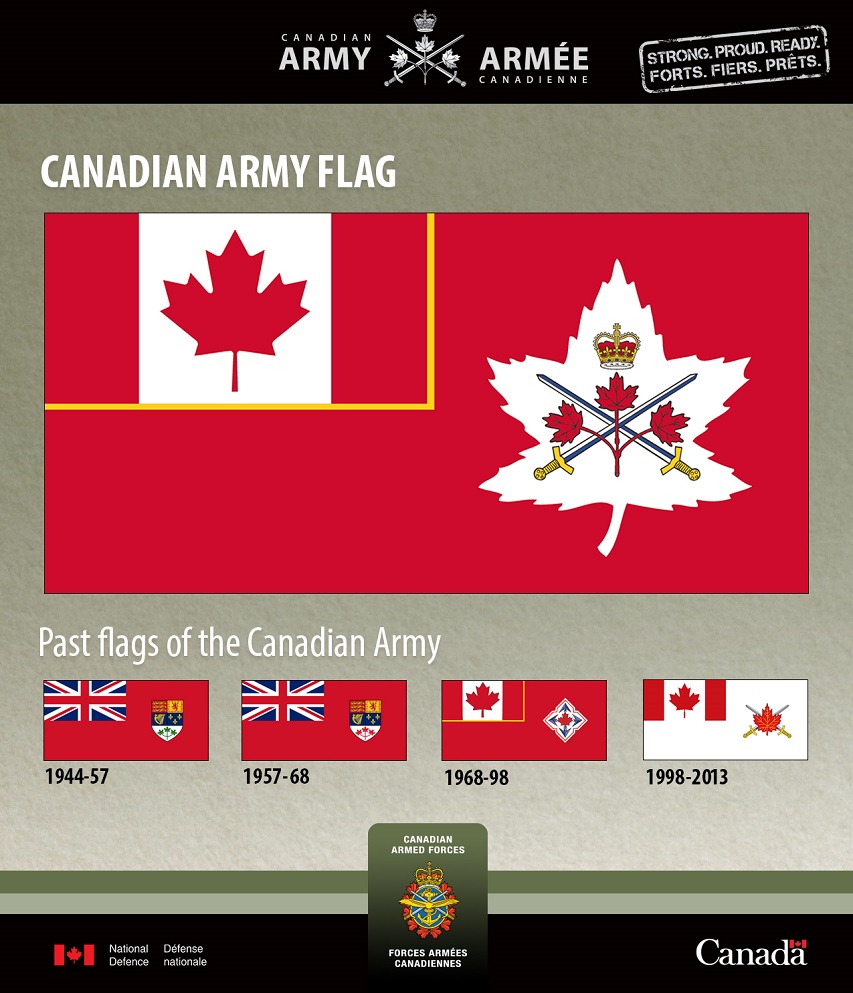
Armies, as a rule, are quagmires of bullshit. The Canadian Army is no exception. We accept that bullshit is an occupational hazard in the Army, but it’s a hazard that we struggle to manage and it’s one that threatens our effectiveness as a force.
In order to understand bullshit we need a taxonomy, that is, a map of bullshit and the common varieties found in the wild. Using our taxonomy, we can develop diagnostic tools to detect bullshit and expose its corrosive effects on our integrity and professional culture. I assume that bullshit is also a hazard in other environments and government departments, but since my experience is in the land force I will be focusing my attention on that.
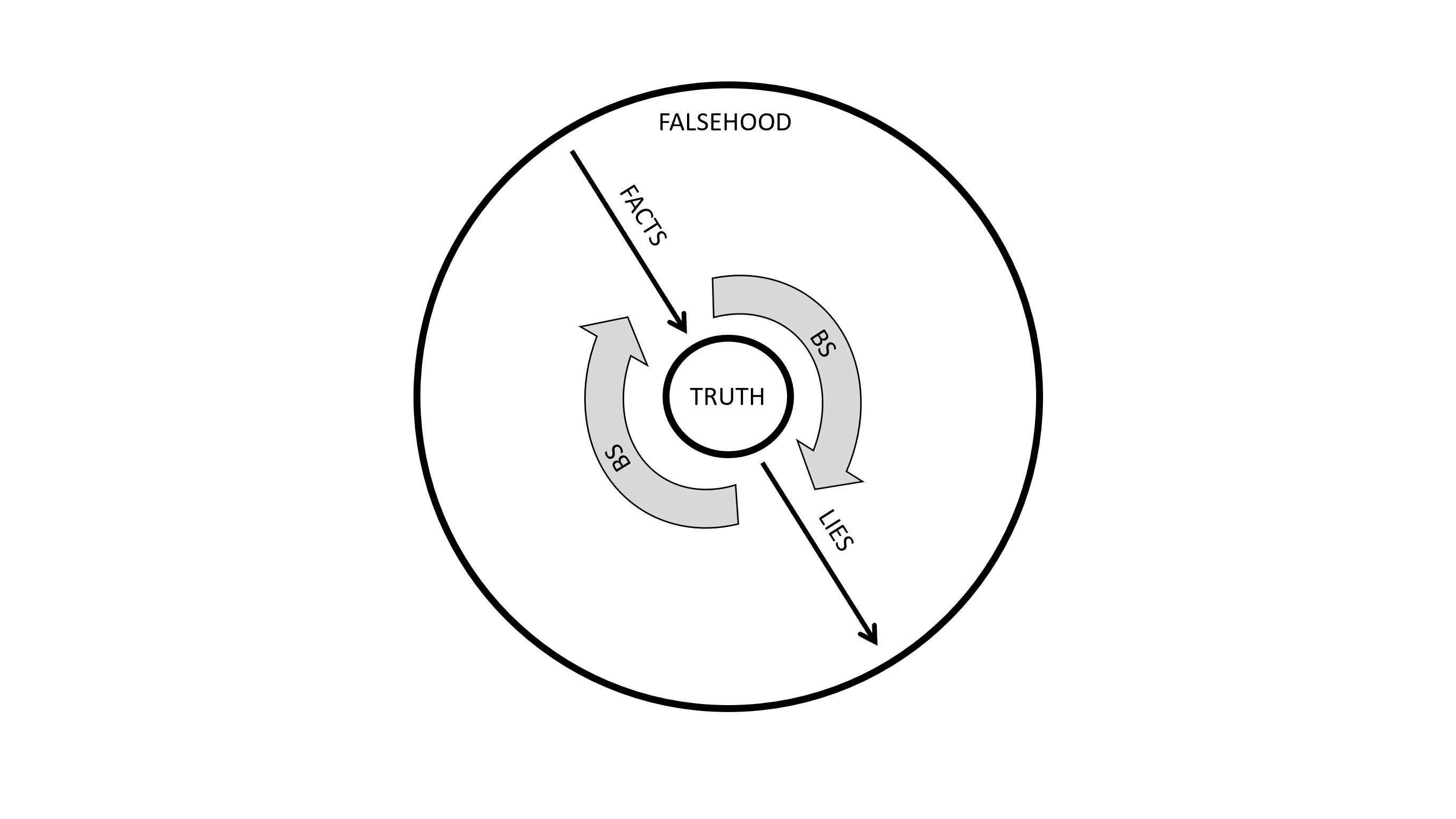
The subject of bullshit entered the mainstream in 2005 when Princeton University Press issued a hardcover edition of Harry G. Frankfurt’s 1988 essay “On Bullshit“. Frankfurt doesn’t mince words: “[one] of the most salient features of our culture is that there is so much bullshit. Everyone knows this. Each of us contributes his share.” He argues that even though we treat bullshit as a lesser moral offence than lying, it’s actually more harmful to a culture of truth. I believe this wholeheartedly, for reasons which will become clear.
In Frankfurt’s view, even though a liar and a bullshitter both aim to deceive their targets, bullshitting and lying require different mental states. In order to lie, someone must believe that they know the truth and intentionally make a false account of it. For example, if you believe that today is Monday but today is in fact Tuesday, and somebody asks you what day it is, you’re not a liar if you say “today is Monday”. You’re not lying because you really do believe that today is Monday, even though this belief is incorrect. In order to lie, you have to intentionally make a statement that is contrary to the truth as you understand it. In this example, you would be lying if you said “today is Tuesday” while believing that today is actually Monday. You would be accidentally correct, but you would still be lying because you are providing a false account of what you believe is true.
This means that lying actually requires a tacit respect for the truth on the part of the liar. The liar has to at least acknowledge the existence of truth in order to avoid it. To provide a false account of the truth, the liar must first believe in the truth.
The bullshitter, by contrast, does not operate under this constraint. Bullshit according to Frankfurt is speech without any regard for the truth whatsoever. To Frankfurt, “[the bullshitter] does not care whether the things he says describe reality correctly. He just picks them out, or makes them up, to suit his purpose.” Bullshit, Frankfurt argues, is speech that is disconnected from a concern for truth. The bullshitter will say anything if it helps them achieve their desired ends.
[…]
Let’s move on to the topic of “bull”, which is discussed at length by British psychologist Norman F. Dixon, author of On the Psychology of Military Incompetence. Dixon beat Frankfurt to the punch by publishing his own theory of bullshit in 1976, twelve years before “On Bullshit”. Dixon is a Freudian psychologist writing in the 1970s, so I am skeptical of the scientific merit of his book. Nonetheless, he provides an interesting outsider’s perspective of British military culture from the Crimean War up to the Second World War and how that culture enabled terrible officers while punishing competent ones (spoiler: aristocrats and nepotism are bad for meritocracy).
There is an entire chapter of the book about bullshit as a contributing factor to military incompetence. Dixon attributes the origin of the word “bullshit” to Australian soldiers, who in 1916 “were evidently so struck by the excessive spit and polish of the British Army that they felt moved to give it a label”. His theory of the Australian origin of bullshit is supported by Australian philosopher David Stove, who believed that it’s a signature national expression.
[…]
Canadian political philosopher G. A. Cohen added some depth to the discourse when he responded to Frankfurt in “Deeper into Bullshit“. Cohen wasn’t satisfied that Frankfurt had explored full range of bullshit as a social phenomenon. Frankfurt anchors his definition of bullshit in the intention or mental state of the speaker (the bullshitter) whose lack of concern for truth is what makes their statements bullshit. Cohen responds to this by pointing out that there are many people who honestly profess their bullshit beliefs. Reading this brought me back to my undergrad days. I had a TA in a 300-level philosophy course who claimed that he doubted his own existence. Personally, I wondered whether he would still doubt his own existence if I punched him in the balls for spewing such performative bullshit in class. So I think that Cohen makes a good point: there are bullshitters who honestly believe their own bullshit.
Cohen’s argument is squarely aimed at a certain style of academic writing, which he calls “unclarifiable unclarity.” These are intentionally vague statements which cannot be clarified without distorting their apparent meaning or dropping the veil of profundity altogether. If you want an example, you can try reading Hegel or a postmodernist philosopher, or just save yourself the effort and click on this postmodern bullshit generator (trust me, it’s indistinguishable from the real thing). Pennycook et al. label statements of this type as “pseudo-profound bullshit“. Hilariously, they ran a series of experiments to see if test subjects would find the appearance of profound truth in both real and algorithmically-generated Deepak Chopra tweets. The result, disappointingly, was yes.
Cohen adds a fourth type of bullshit to our taxonomy: “irretrievably speculative comment”. Basically, when someone is arguing for a proposition which they have no way of knowing is true or false, or they put forward an argument that’s completely unsupported by readily available evidence, then that argument is bullshit.
[…]
Still with me? So far we’ve identified and defined four types of bullshit (BS):
BS1 (Frankfurt): propositions made without concern for truth.
BS2 (Dixon): ritualistic activity which doesn’t serve its stated aim or justification.
BS3 (Cohen/Pennycook): unclarifiable unclarity aka pseudo-profound bullshit.
BS4 (Cohen): speculation beyond what’s reasonably permitted by the evidence.
The common denominator of all four types of bullshit is their disconnection from reality. Bullshit statements don’t enhance our understanding and bullshit activity doesn’t get us any closer to achieving our goals in the real world. Bullshit doesn’t necessarily move us further away from truth, like lies do, but it certainly doesn’t get us any closer to it either. Essentially, bullshit lowers the signal-to-noise ratio of discourse.
The endless carousel of bullshit.
Comments Off on Toward a taxonomy of military bullshit
True Size of a Roman Legion
Invicta
Published 29 Oct 2022The True Size of a Roman Legion.
A history documentary on the True Size of a Roman Legion. This is our first episode in the new True Size series which seeks to bring history to life in 3D using Unreal Engine 5. In this episode we cover the organization of a Roman Legion from the soldier to the Contubernium, the Century, the Cohort, and the Legion. Along the way we not only include the troops and their officers but all the slaves, mules, support, staff, and gear which accompanied them. This makes for a much better understanding of the Roman army structure.
We then put these into context by looking at a Roman army camp, a Roman army on the march, and a Roman army in battle order. This gives the viewer a full 3D history of a legion like never before.
(more…)
Comments Off on True Size of a Roman Legion
February 19, 2023
The Destruction of Monte Cassino – Week 234 – February 18, 1944
World War Two
Published 18 Feb 2023The Allies bomb the monastery atop Monte Cassino in Italy, but just to the Northwest it’s the Germans attacking them at Anzio this week. In the Soviet Union, the Axis break out of the Korsun Pocket, but at great cost, and in the Pacific comes a major Allied raid on the Japanese base at Truk and landings on Eniwetok Atoll.
(more…)
Comments Off on The Destruction of Monte Cassino – Week 234 – February 18, 1944
Flower-Class Corvettes – WW2 Atlantic Defender
Matsimus
Published 29 Jun 2020The Flower-class corvette (also referred to as the Gladiolus class after the lead ship) was a British class of 294 corvettes used during World War II, specifically with the Allied navies as anti-submarine convoy escorts during the Battle of the Atlantic. Royal Navy ships of this class were named after flowers, hence the name of the class.
The majority served during World War II with the Royal Navy (RN) and Royal Canadian Navy (RCN). Several ships built largely in Canada were transferred from the RN to the United States Navy (USN) under the lend-lease programme, seeing service in both navies. Some corvettes transferred to the USN were manned by the US Coast Guard. The vessels serving with the US Navy were known as Temptress and Action-class patrol gunboats. Other Flower-class corvettes served with the Free French Naval Forces, the Royal Netherlands Navy, the Royal Norwegian Navy, the Royal Indian Navy, the Royal Hellenic Navy, the Royal New Zealand Navy, the Royal Yugoslav Navy, and, immediately post-war, the South African Navy.
After World War II many surplus Flower-class vessels saw worldwide use in other navies, as well as civilian use. HMCS Sackville is the only member of the class to be preserved as a museum ship. Flower Class corvettes were originally intended for coastal escort and mine clearing work. Derived from a whaler design, they were simple, highly seaworthy vessels that could be constructed in secondary yards. The dire lack of ocean escorts early in the war necessitated their being used to screen convoys traversing the North Atlantic between Nova Scotia and the UK. This was a role for which they were ill-designed, and their crews suffered accordingly. The Flowers were wet, highly cramped and impossibly lively. Many sailors could not adjust to the exhausting routine. Compounding the misery was the inexperience of the crews, most of whom had never been to sea. But any escort was better than none at all, so the yards continued to turn out corvettes. 120 were built in Canadian yards, and slightly more in the UK.
(more…)
Comments Off on Flower-Class Corvettes – WW2 Atlantic Defender
February 18, 2023
British Empire Crackdown in South Africa – Boer War 1899-1902
The Great War
Published 17 Feb 2023The 2nd Boer War saw the British Empire bring to bear the entire imperial might to put to rest a dispute with the Boer Republics in South Africa. With scorched earth tactics and the use of concentration camps, the Boer War was a glimpse of what was to come in 20th century warfare.
(more…)
Comments Off on British Empire Crackdown in South Africa – Boer War 1899-1902
February 17, 2023
Spy ballooning has a remarkably long history (that’s clearly still ongoing)
In The Line, Scott Van Wynsberghe outlines the history of balloons in wartime and (as many are now aware from recent events) in peacetime:
China’s balloon spying is shocking on so many levels that you can take your pick. There is the ultra-flagrant violation of foreign sovereignty, the stunningly surreal air of denial exhibited by Beijing, and the fearful sense that something in the world order just lurched. There is also puzzlement: what, balloon spying is still a thing? Indeed it is, and its centuries-long history is instructive as to what China is now doing. It also makes clear that the U.S. is no innocent victim here but rather a past offender with a cleaned-up act.
Among the first major studies of aerial reconnaissance was a book brought out by military author Glenn B. Infield way back in 1970. In a way, Infield was charting unknown territory. When he addressed balloons in particular, he traced their use in spying to the many wars associated with the French Revolutionary and Napoleonic eras. In 1794, he related, the French military officer Jean-Marie-Joseph Countelle made an ascent at the city of Maubeuge in order to monitor enemy forces in the area. In the process, Countelle became the first balloon spy.
As technology improved, other firsts followed. By the 1850s, cameras were mounted on French military balloons. In the 1860s, during the American Civil War, Union forces battling the Confederacy used balloons trailing telegraphic wires, which transmitted immediate updates from the balloonists. Yet technology cut both ways. By the early 1900s, balloons had a nemesis in sight, in the form of winged and powered aircraft.
The inevitable showdown occurred in the First World War, and it was ugly. Large numbers of observation balloons were used by all sides in the conflict, and WWI historian Denis Winter claims the Germans alone deployed 170 of them in France by 1917. Typically, such balloons were tethered in place near the frontline, floating at several thousand feet, with telephone wires dangling to the ground. Although they seemed vulnerable, they were actually protected from below by anti-aircraft units, which blasted at any enemy plane that got too close. However, the reverse was also true, with balloons themselves being fired at from the ground. By 1915, says aviation writer Ralph Barker, the British were losing at least a dozen balloons a month from all forms of enemy action. Those balloonists who were not shot to pieces often had to bail out, putting their faith in parachutes that did not always work. (Horrified onlookers called them “balloonatics.”) The fighter pilots responsible for much of this mayhem — which they called “balloon-busting” — may not have had an easy time, but some of them scored heavily, with one Frenchman named Coiffard tallying 28 balloons. Although observation balloons managed to make it to the end of the war, it was a near-run thing. According to author Linda Hervieux, nobody after the war was talking about repeating that experience in any future fighting.
[…]
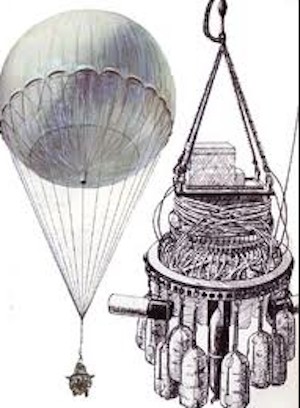
Once the Second World War was underway, some propaganda leafleting did occur, but secret balloon activity seemed to be at a low level. That was very misleading, because one of the tensest moments in ballooning history was playing out in the background, but it occurred amid so much security that the entire tale took years to emerge. In 1944, Japan launched the first of over 9,000 bomb-rigged balloons across the Pacific. Robert C. Mikesh, in a comprehensive 1973 monograph issued by the Smithsonian Institution, noted that almost a thousand of the balloons may have reached North America, but the true number is unknowable, because so many came down in remote wilderness. (One was found by forestry workers in British Columbia as late as 2014.) Mikesh tabulated 285 known incidents, ranging from Alaska all the way south to Baja California and as far inland as Manitoba. Both the U.S. and Canada clamped down hard on any news about the balloons, for fear of providing Tokyo valuable feedback about the results of the campaign. (In other words, balloon counterintelligence became a priority.) In general, the balloons did not cause a lot of harm, but one of them slaughtered six people in Oregon in 1945. By a strange fluke, one of the few groups in the U.S. that knew the full story of the balloons was an element of the Black community. The all-Black 555th Parachute Infantry Battalion was sent to the U.S. West to handle emergencies caused by the balloons.
The remains of a Japanese balloon bomb found in the Monashee Mountains near Lumby, BC in 2014. It was detonated on-site by the bomb disposal unit of Maritime Forces Pacific of the Royal Canadian Navy.
There is a strong temptation to blame the Japanese balloon bombs for what happened next, because the U.S. unaccountably entered the Cold War as the most pugnacious exponent of clandestine ballooning up to that time. Whatever the explanation, the epic struggle between the United States and the Union of Soviet Socialist Republics plunged U.S. ballooning into a tangle of psychological warfare, shadowy science, under-the-table finances, and clandestine belligerence indistinguishable from military attacks. Plus, UFOs and breakfast foods were involved (seriously).

Comments Off on Spy ballooning has a remarkably long history (that’s clearly still ongoing)


