Quotulatiousness

April 10, 2025

Canadian political aspirations to being “very mid” on the world stage

In The Line, Matt Gurney reflects on a recent statement by caretaker prime minister Mark Carney about Canada taking a “leadership role” on the international stage and supplanting the United States under President Trump:

Oh, we will, eh?

Don’t get me wrong, I like the sound of it. He’s certainly manifesting that elbows-up spirit that seems to be so impressing Canadians.

But, like — Carney knows which country he’s in, right? Canada? The one full of Canadians? Because as I heard him say what Canada would do in response to the accelerating American withdrawal from global affairs, I couldn’t help but note that there is a problem here.

Canada isn’t a leader. Canada doesn’t lead.

Even as I write this, I know it’s going to be a fraught statement. Canadian patriotism is a bit supercharged right now. It’s nice to see. But a lot of stupidity gets overlooked — or even caused — by patriotic outbursts. Internal dissent becomes a lot less popular when everybody is sewing the Maple Leaf onto their backpack. So I want to make my point respectfully and politely, largely to spare myself the agony of wading through idiotic replies for a few days. So here goes: many Canadians do indeed lead in their fields, and there is nothing inherent about Canada that makes us incapable of exercising leadership. If Mark Carney remains prime minister — or if someone with similar ambitions should replace him and make a point of pursuing a policy of broad-based Canadian global leadership — I don’t write that off as a doomed proposition.

There is more that we could choose to do. There are practical constraints that would bind us, and we’ll talk about those in a minute, but just to get into the spirit of the moment: sure. We could choose to exercise global leadership.

But we would first have to start with the recognition that it has been generations since we have actually tried to do that. This is not a moral judgment on Canada or Canadians. It is simply a recognition of the historical record. This country has not pursued a national policy — or even a series of smaller policies that take on a greater form in the aggregate — that sought to establish this country as a leader in the world.

If we’re being honest, we’ve typically pursued almost the opposite policy, and deliberately. I’m not saying we’re slavish followers. But this is a country that for generations has been quite comfortable thinking of itself as an overachieving middle power, nestled comfortably in a supporting role for allied countries that do seek to lead. Usually the Americans. Maybe sometimes the British or French. Or something like the UN or NATO. We’ve never claimed to land the hardest punches, or tried to. We’d settle for punching above our weight. We haven’t tried to conquer or command or even compel. In the words of a member of the incumbent government, our aspiration largely maxed out at wishing to convene.

But, of course, as we’re learning these days, Canadian politicians of almost all parties (Maxime Bernier is the only exception I’m aware of) consider the beneficiaries of our trade-distorting supply management system to be the only ones whose interests they always champion:

The most interesting field of international relations, though, and the most germane to what Carney said on Liberation Day, is in the field of trade. Canada definitely likes trade. I’ll even give some credit here to both Liberals and Conservatives. It has been broadly understood that Canada thrives when we have access to markets all over the world. The pursuit of expanded trading relationships has been a bipartisan priority for Liberals and Conservatives alike … so long as it doesn’t cost us anything on the domestic political front.


And yes, I’m talking about dairy. Some other things, too. But mostly the milk and eggs.

Seriously. Scroll up a bit. Look at that big quote I dropped in at the top from Carney. Watch the CTV feed again. Canada is going to pursue a role of leadership in defending liberalized free trade?

Really? Forgive me for squinting. I’m struggling with my middle-aged eyes to find the tiny text appended to Carney’s pledge that notes that “conditions apply”. Because that very same Mark Carney has already gone out of his way to say that protecting Canada’s supply-managed dairy and egg producers is an absolute, unbendable priority for him and his party.

So yes. Let’s all pledge ourselves to a new era of Canadian leadership in defence of free trade and unfettered market access, right up until the moment some weirdo foreigner gets it into their pathetic little brain that they should be allowed to sell me a stick of butter. Because that ain’t on, friends. Let’s get our elbows up, and bury them deep into this wheel of filthy xenocheddar.

HBO’s Rome – Ep 5 “The Ram has touched the wall” – History and Story

Filed under: Europe, History, Media — Tags: , , , , , , , — Nicholas @ 02:00

Adrian Goldsworthy. Historian and Novelist
Published 18 Sept 2024

Continuing series looking at the HBO/BBC co production drama series ROME. We will look at how they chose to tell the story, at what they changed and where they stuck closer to the history.

April 9, 2025

“South Africa is what happens when a country becomes ungovernable”

Niccolo Soldo’s weekend roundup includes some quotes from Lawrence Thomas on what he terms a “racketeer party state“, what the “Rainbow Nation” of South Africa has degenerated into since the end of Apartheid:

South Africa is what happens when a country becomes ungovernable. From endemic sexual crime to farm murders, rolling blackouts, and expropriation, the rest is just the details. What has come to be termed “South Africanization” is not the failed development of a Third-World nation such as Afghanistan or Somalia, but the structural de-development of a once fully modern state that had its own nuclear weapons program. President Trump’s support of Afrikaner farmers has brought global attention to the decaying state of the country and is perhaps the most high-level recognition yet that the 1990s “Rainbow Nation” dream is dead. What’s strange about it all is how much of it happened on purpose.

What may be worse is that the very system of law and government itself has become an instrument to be captured and used to further the mass looting of the country. South Africans of all races inherit a Western political culture and economy. The average South African experiences a strong civic identity, highly active political parties, popular national media networks, a market economy, and a parliamentary constitutional order. The last thirty years saw a coalition of political actors, patronage networks, and organized criminal gangs seize control of and use all the infrastructure of modern government for their own ends.

[…]

While songs like “Kill the Boer” at rallies tend to grab headlines, the most consequential development of late is the passing of expropriation without compensation into law by the supposedly moderate President Cyril Ramaphosa. In addition to further eroding property rights, it emboldens a widespread movement that sees land redistribution as the sole resolution to the country’s racial conflict and views the presence of any white population as fundamentally illegitimate. The radicalization of race politics is the means through which political fights are won, since it plays on the country’s major divides and wins over those who feel left out of the spoils.

On the ground, reports tell of ANC officials tacitly allowing invasions of private and public land by squatters. Occupations of this sort have sometimes preceded the farm murders which have gained media attention internationally, and squatters have now begun to invoke the Expropriation Act. Such groups become the shock troops of political pressure: they can harass and pressure the occupants of the lands they occupy, or worse, while becoming a media story about the “landless oppressed” used to justify broader government action. The broad facilitation of ground-level conflict and crime by those with political power is the defining feature of South Africanization.

[…]

In other words, decay is a burden without benefit. There is no “rock bottom”. Business, political organization, social fabric, and all other forms of Western cultural life just face increasing costs. Some are direct, while others are opportunity costs: how much doesn’t happen because almost no one can guarantee electricity? In a relatively developed country, there’s still much more to break down and expropriate.

The combination of social progressivism with an economic model of managed decline has become orthodoxy in many establishment parties across the developed world. South Africa is a study of the political phenomenon in its advanced stage and a demonstration of what is at stake in defeating it in the rest of the Western world. Flip Buys, leader of the Afrikaner trade union Solidariteit, was likely prophetic when he foresaw that South Africa would become home to the “first large grouping of Westerners living in a post-Western country”.

Emphasis from Niccolo’s excerpts.

April 8, 2025

Mark Carney explained how he viewed the world in his book Values

It’s worth considering what Mark Carney wrote about his beliefs before becoming prime minister and how he’s campaigning right now:

For those who haven’t had the misfortune of parsing through Mark Carney’s Values, it reads like a sermon from a high priest of globalism — polished, preachy, and packed with ideas that should send shivers down the spine of anyone who cares about Canada’s economy, especially Western energy producers.

Writing as the former Bank of Canada governor and a darling of the Liberal elite, Carney pitches a vision of “sustainable finance”, net-zero absolutism, and heavy-handed regulation. To the National Citizens Coalition, it’s clear: this isn’t a roadmap to prosperity, it’s a wrecking ball aimed at the heart of Canada’s resource sector and the West’s economic lifeline.

Start with Carney’s obsession with “revaluing value”. In Values, he argues markets should prioritize climate goals over profit, pushing financial institutions to choke funding for oil and gas.

For Alberta and Saskatchewan, where energy employs tens of thousands and pumps billions into the economy, this is a death knell dressed up as virtue.

Western producers aren’t just businesses; they’re the backbone of communities, powering schools, hospitals, and homes. Carney’s disdain for fossil fuels ignores their role in keeping Canada competitive while our allies and adversaries keep drilling. His plan? Starve the sector, stranding assets and jobs, all to appease international green lobbyists in European nations with nationalized economies on the road to being as disastrous as Canada’s.

Then there’s his love affair with regulation. Values champions policies just like Bill C-69 — the “No More Pipelines Bill” — which Carney has refused to repeal. He sees it as a tool to enforce his net-zero utopia, but for the West, it’s a padlock on progress. Pipelines that could carry Canadian oil to global markets sit stalled, leaving producers at the mercy of low prices, foreign competitors, and now, tariff threats.

Carney’s mental framework both then and now doesn’t just stop projects, it signals to investors that Canada’s energy sector is a no-go zone. The result? Capital flees, jobs vanish, and the West pays the price for the lofty ideals of a London and Manhattan banker, who spends only part of his time in Canada — specifically, Ontario and Quebec.

Dan Knight on Carney’s swing through some British Columbia ridings this week:

A mock campaign sign for the Liberals spotted on social media.

Mark Carney rolled into Victoria this week with the swagger of a man who’s never missed a wine-and-cheese reception in his life and delivered what the Liberal brain trust likely considers a “bold vision” for Canada. But peel back the banker buzzwords and Churchill cosplay, and what you really got was a cringeworthy display of delusion, detachment, and recycled globalist dogma.

He opened his mouth and immediately signaled his marching orders: “clean energy”. Not once. Not twice. It was practically every other sentence. Because when you’re out of ideas, just say “green transition” on repeat and hope nobody checks the receipts.

He’s not just pushing the same failed Liberal climate ideology — he’s doubling down on it.

Carney promised to turn Canada into a “clean energy superpower” — without explaining how, exactly, we get there when his party has spent years shutting down oil and gas, blocking pipelines, and handing our resource wealth to the Americans.

This wasn’t new policy. It was the same Liberal fantasy that has already gutted Alberta, choked investment, and driven electricity prices through the roof — just ask Europe how that’s going. And when it comes to reopening auto plants or restoring manufacturing jobs? Nothing. Not a plan, not a word, not a clue.

And don’t worry — when Trump’s tariffs hit our industries, Carney says we’ll respond with “retaliatory tariffs”. Sounds tough, until you remember who actually pays those. Working Canadians. Line workers. Parts manufacturers. People trying to keep the lights on while Ottawa plays global economic chicken.

Carney’s big idea for recovery? Just keep handing money to the Liberal-connected elite.

He promised to “give back” — and by that, he means pouring another $180 million into the CBC, the same taxpayer-funded mouthpiece that’s been running interference for the Liberals for nearly a decade. This comes after ArriveCAN, the $60 million QR code boondoggle funneled through Liberal contractors, and countless other slush funds masquerading as “public service”.

While the working class is bracing for a made-in-Ottawa recession, Carney’s pledging more green slogans, more centralized control, and more taxpayer money to keep the illusion alive.

April 7, 2025

Those brave, rare contrarians willing to risk everything by … criticizing Trump?

Filed under: Books, Government, Media, Politics, USA — Tags: , , , , , — Nicholas @ 05:00

Chris Bray is deeply concerned that a free society seems unable to produce even a mild array of differing political opinions these days:

I was at a small independent bookstore today, the exact kind of place that’s supposed to curate a culture of argument and criticism. The prominently displayed books about politics and current events were Timothy Snyder’s book about the terrifying rise of American fascism under that monster Trump, Jason Stanley’s book about the terrifying rise of American fascism under that monster Trump, Anne Applebaum’s book about the terrifying rise of American fascism under that monster Trump, and a bunch of other books by prominent journalists and professors about … okay, try to guess.

On the other side of that exchange, the books by public intellectuals offering a favorable or even neutral view of Trump and the Trump era were … not there? Maybe I just missed them. So every prominent figure moving to the cultural foreground from academia and “mainstream” journalism — every brave contrarian, every freethinking intellectual warrior rising against the prevailing fascist sentiment of the age to speak in his own voice as a free person — thinks and says the same things, the same ways, with the same evidence and the same framing and the same tone and in the same state of mind. They’re so free and brave and iconoclastic that they’re essentially identical, chanting in intellectual unison.

Forget Trump for a moment and answer this question in general: If you’re living through an era in which every prominent journalist and academic and artist says exactly the same fucking thing all the time, what kind of moment are you living in? Would you call people who all chant in unison the resistance?

Any engagement with these books reveals their emptiness. Snyder, Stanley, Applebaum, whatever: pick a book, then pick a page. See if it makes sense. Here, I spent a few nauseating minutes today with brave Jason Stanley’s book How Fascism Works: The Politics of Us and Them. Here’s a paragraph from the introduction to the paperback edition:

ICE is novel: It was created after 9/11, by the same law that created a bureau tasked with border protection: a “special force, created in an anti-democratic moment”.

I can’t calibrate the degree to which this person is a fool or a liar, but let’s go with both. The Border Patrol was created in 1924, and was itself the successor agency to a different organization that was created in 1904. You can read that history here. The post-9/11 organization that supposedly created this novel American institution merely reorganized a century-old American institution, making it not the least bit novel. Before ICE, we had INS. Yes, we had a border before 2003, and we policed it. This isn’t a novel concept at all, as it has operated in any form of practice.

You can go through that single amazing paragraph sentence by sentence and tear every last bit of it apart, at the lowest, simplest factual level. The argument isn’t wrong: all of it is wrong, every layer of fact and interpretation. This man is an absolutely enormous jackass. And he’s … important. An important public intellectual, you see.

April 6, 2025

“[U]pwards of 86 percent of Americans thought he was too old to serve another term. And no one did anything about it

Filed under: Books, Government, Media, Politics, USA — Tags: , , , , , , — Nicholas @ 05:00

Andrew Sullivan reacts to some new books on the Biden administration just hitting the bookstores recently:

By April of last year, the health of the president had clearly declined. As with many older men in their eighties, this didn’t happen in a slow, predictable glide-path down — but in swift, turbulent declines. Suddenly he took a while to get out of his limo, and then would emerge “with a blank look in his face”, according to the new campaign book, Fight, by Jonathan Allen and Amie Parnes. By early summer, Biden was suddenly freezing up in public, staring motionless into the air. At a fundraiser in Los Angeles, Obama had to jump in to answer some questions, and then had to guide Biden off the stage by hand. We had already seen Joe wander weirdly off the set of MSNBC and during a Medal of Honor ceremony. His memory lapses mounted.

Everyone around him saw this. Everyone close to him had seen it for over a year by then. Everyone in his campaign knew that upwards of 86 percent of Americans thought he was too old to serve another term. And no one did anything about it.

Sometimes human folly is just human folly. Sometimes, even at the pinnacle of the world, you find flawed people struggling with familiar human problems, like how to tell a beloved but fast-aging man that he needs to leave the stage before he falls off it. Just because she was First Lady did not prevent Jill Biden from putting family before country; and just because he was president didn’t mean that Biden reacted to his own decline with denial, anger, pig-headedness, and arrogance.

Do we learn anything new in this book and another one, Uncharted, by Chris Whipple out next week? Not really. We know, in fact, that everything I guessed happened did actually happen. Among the unsurprising confirmations: Obama was so aloof he didn’t even watch the fateful June debate live; he and Pelosi then wanted an open primary and did all they could to get one. (“He goes. She goes” was their mantra.) Hillary Clinton defended Biden — not because she knew his health was fine, but because her health had once been questioned by the press too. Biden’s closest advisers were his wife and, yes, his son Hunter, and they routinely put their clan’s interests well before the country’s. His inner circle — Mike Donilon especially — were so blindly loyal and informationally siloed they couldn’t absorb what was staring them in the face.

The Democrats, even as late as July, could have found a fresh candidate capable of taking on what they said was a vital moment for democracy’s survival. We might have avoided our current abyss:

    “It would have been very cheap. It would have been quick. A rocket ship for your career and no loss,” said one Democratic former governor. “If this had been a year earlier, twenty people would have gotten in,” said one governor who had kicked the tires on a 2024 bid.

Why didn’t they? That is a question that will reverberate through history. Wokeness was a factor. The only reason the embarrassingly mid Harris was made veep in the first place was to fill a slot Biden had already marked for a woman, and, in the wake of the Floyd murder, a black woman seemed the only option. Everyone, particularly Pelosi and Obama, knew Harris was a disaster about to happen, and her vice-presidency had the lowest approval ratings in history. Obama told friends directly that he thought she couldn’t win. The night after the epic debate, Pelosi gritted her teeth: “Oh my God. It’s going to be her.”

So yes, identity before merit was a principle the Dems clung to even at the expense of marching off an electoral cliff. “If you want to break the Democratic coalition, try to skip over the first African-American vice president,” Michigan Senator Elissa Slotkin argued at one point. “I watched the black-white stuff start on Thursday night [after the debate],” said another lawmaker. Donna Brazile assembled a team of black women operatives who called themselves “the colored girls” to ensure Harris became the nominee. Jim Clyburn was also a critical supporter: “I’m going all in with Kamala. I don’t want to look back and y’all ain’t there,” he told the DNC.

The open primary therefore never happened. Harris became the nominee for one core reason in the end. Biden, who had previously used the awfulness of Kamala as a way to dissuade anyone from pushing him out, decided to endorse her after she pleaded with him the day he decided to quit. One source “close to both men” explained: “It was a fuck-you to Obama’s plan. At that moment, you have very few things you control, and that’s one thing he had control over, and he chose to stick it to Obama.” So much for putting the survival of democracy first.

And yes, they lied. Jill Biden was one of the worst offenders. She insisted in January 2024, “I see his vigor, I see his energy, I see his passion every single day. I say his age is an asset.” Before the June debate, Joe had been drained by grueling international travel, was catching a cold and couldn’t last more than 45 minutes in the practice debates. But the First Lady went out and told the world: “The president’s feeling great. He’s ready. We’re going to win this thing.” The woman who had covered up her husband’s decline for the previous two years now set expectations that were, of course, utterly ruinous.

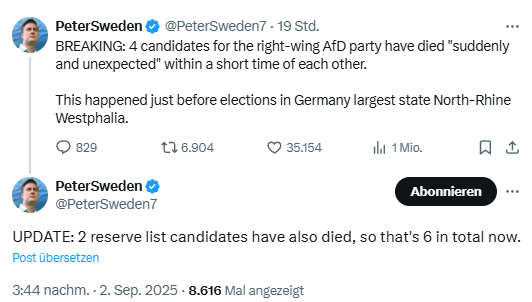
German democracy takes another blow as extremely extreme right pulls level with the extreme right!

Filed under: Germany, Media, Politics — Tags: , , , , — Nicholas @ 03:00

Despite the heroic efforts of the progressives in the Bundestag (and the media and in the EU bureaucracy), the dangerous demagogues of the extremely extreme extreme right AfD are now equally popular with those benighted, detested, dunderheaded “voters” as the almost-as-dangerous extreme right in the CDU:

It has finally happened: Alternative für Deutschland are no longer the second-strongest party in Germany; for the first time ever, they have pulled dead-even with CDU/CSU in a representative poll. Both claim 24% support in the latest INSA survey, conducted for BILD between 31 March and 4 April. It is the strongest poll result the AfD have ever received.

The results are partly symbolic and well within the margin of error (2.9 percentage points), but the trend is clear, and nobody seriously doubts that in the coming weeks AfD will assume the lead and become the strongest-polling party across the Federal Republic.

The running average of all major polls – which lags a week or two but yields the clearest view possible of the trend – looks like this:

The Union parties have been experiencing a slow but steady collapse in support as their voters abandon them in ever greater numbers for their hated blue rival. The erosion began after Friedrich Merz struck a deal with the disgraced Social Democrats (SPD) to overhaul the debt brake with the outgoing Bundestag, contrary to one of his primary campaign promises. Everything we’ve heard about the disastrous coalition negotiations with the SPD in the weeks since have confirmed the image of a careless, inexperienced yet ambitious CDU chancellor candidate, desperate to ascend to the highest political office, whatever the cost. Back in 2018, Merz pledged he would cut support for the AfD in half and drive his party back to 40% supporter or higher. He has achieved very nearly the opposite, plunging his future government to the depths of unpopularity before it is even formed and ceding first place to his most hated rivals. It is a farce beyond what even I could’ve imagined.

There is no plan or strategy here; Merz has no idea what he is even doing. He and CDU/CSU leadership did have a brief flash of insight back in January, when they reached across the firewall to vote with the AfD on legislation to restrict migration. Back then at least, they knew they had to show the left parties they had other options, or they would be destroyed in coalition negotiations with any potential “democratic” partner. Leftist activists took to the streets and Merz rapidly retreated, returning to his standard denunciations of the AfD and pledging never to vote with them again. In return for a measure of mercy from Antifa, Merz voluntarily led his party into a trap, ceding all possible leverage over a radicalised SPD, who will force the Union parties to swallow one poison pill after the other. It is a win-win for them. They get what they want and they get to grind the CDU and the CSU to dust at the same.

The election might be over, but make no mistake – these poll results matter. First, collapsing support deprives the CDU options in the present. They can’t walk away from the negotiating table and seek new elections, because they know they’d come out of them vastly worse. Their terrible numbers further strengthen the negotiating position of the SPD, who will force the CDU to accept still more damaging compromises, driving CDU support even lower. Then we must remember that federal elections are not the only game in town. The rank-and-file of the CDU have to contend in an array of district elections in the coming months, and five state elections are approaching in 2026, including two in East Germany (Mecklenburg-Vorpommern and Sachsen-Anhalt) that may well end in the collapse of the firewall at the state level. Dissatisfaction with Merz inside the CDU is widespread and growing.

April 5, 2025

Liberals spike the football after eliminating the consumer portion of the carbon tax

Among the items in this week’s “Bullshit Bulletin” from The Line is a thoroughly earned drubbing for the federal Liberals who took full credit for eliminating a particularly unpopular tax … that they spent the last several years justifying for “putting more money in Canadians’ pockets”:

Your Line editors are fans of loopholes. And we’re glad that when we laid out the ground rules for the Bullshit Bulletin last week, we made room for things that would technically pass a lie detector test, but are still too egregiously bullshitty to not be called out.

Mona Fortier, Liberal party whip, former cabinet minister and current candidate in Ottawa-Vanier-Gloucester, step up and collect your prize. You’re the first stop in our second bullshit bullet of this campaign. To be clear, Fortier is accepting this award on behalf of the entire Liberal party. The absolutely breathtaking hypocrisy of watching these guys campaign on the dismantling of the carbon tax is something to behold.

If you missed it, the zeroing out of the “consumer-facing” carbon tax took effect this week, at midnight on April 1. This resulted in an immediate drop in the price of gas at many stations across the country. This genuinely did make the news. Your Line editors heard local radio stories about it as they were out and about on their various errands this week. Many of those stories, but not all, made a point of noting that the price drop was directly related to the carbon tax coming off the price of a litre of gas.

And that’s where Fortier steps in. She was quick to take to social media with a video of herself at a gas pump, celebrating how her government had made the lives of Canadians more affordable.

Couple of things.

First, your Line editors have some history of noting the absurdity of politicians posing at gas pumps. Our favourite is still the Conservative who clearly did not have a car and simply posed awkwardly by a pump. But in general, these photo ops are really stupid. And we’re sure they’re demeaning and embarrassing for the people involved. Add this to the long and growing list of why we would never, ever agree to subject ourselves to the humiliation of a life in politics.

But we can’t help but note the chutzpah — or the bullshit, more plainly — of the Liberals touting lowering the price of gas, when that drop is explained by them removing the tax they chose to put on gas, and then spent years insisting was necessary to prevent, literally, the destruction of the planet. We guess we can take our kids on vacation without “letting the planet burn” now. Thanks, Carney!

And we just don’t mean that this is hypocritical in the abstract. Fortier herself, not all that long ago, was loud and proud about how the carbon tax was helping low-income Canadians by giving them more in rebates than they were paying in tax.

Keen-eyed observers might note that there is less than a year between those tweets.

What else can we call this bullshit? We can gussy it up a bit. We can call it hypocritical bullshit or shameless bullshit — but fundamentally, it’s bullshit. The Liberals taking credit for removing the carbon tax makes about as much sense as them taking credit for rescuing a man from drowning whom they beat senseless and threw over the side of a yacht. The entire thing reminds us of the Hot Dog Man sketch — an obviously guilty party insisting, despite the evident disbelief of everyone else, that they aren’t responsible for the problem. Except this is actually worse — they’re claiming they fixed the problem, while studiously ignoring any question of where it came from.

Only in politics would someone actually seek to claim any credit for reversing a cost that they had willingly inflicted on people, despite howls of protest, for years, all while insisting the pain was necessary, and even worth it, because of the rebate. And only in Canada would we have very little expectation that the voters would actually hold those people accountable for their, wait for it, bullshit.

April 4, 2025

Alberta plays a separate hand

In The Line, Jen Gerson discusses the disconnects between “Team Canada” (such as it is) and Alberta that now have Alberta sending its own delegation to talk to … someone … in Washington DC:

Photo by Jen Gerson, The Line.

Alberta’s periodic bursts of secessionist sentiment operate a little like the aurora that occasionally flash across the prairie sky, in tune with decades-long solar flare cycles. The phenomenon is always fascinating, yet it’s always impossible to know how seriously to take it. It waxes and wanes in line with a number of factors, only some of which can be predicted — oil prices, the partisan stripe of the federal government, and the introduction of new regulations.

We are getting another show, of late, and The Line has responded by commissioning some fresh hot polling numbers to determine just how willing Albertans are to take up U.S. President Donald Trump’s call of becoming the 51st state.

It is not a surprise that this is being talked about again. We appear to be on the verge of a potential fourth term of loathed Liberals — after being all but promised a Conservative one. Trump has declared economic war, and openly undermines our sovereignty. Alberta has elected a premier who seems to be willing to go much further than leaders past to both threaten the federal government, and align herself with Americans. Danielle Smith has made several appearances in conservative American media institutions to argue against tariffs; she also made a public appeal to her Quebec counterpart to create a common front for greater provincial autonomy. This after threatening to form another “Fair Deal” panel if a future federal government doesn’t meet a list of requests.

In the midst of this revived inter-provincial tension, an Alberta delegation has formed, insisting that it will be travelling to the U.S. in coming weeks to meet with members of the Trump administration.

Who are they meeting? Well, they won’t say.

“The response that we’re getting, quite frankly, from the present U.S. administration is very positive. We’ve been advised that the interest in what we’re doing is extremely high, and certainly everything that we’ve seen indicates that this is far from a fool’s errand,” said Jeffrey Rath, an Alberta lawyer leading the delegation, during a press conference last week held just off the lobby of a well-known Calgary hotel. The conference wasn’t well publicized, and it was obscurely signed — if you knew, you knew — and was thus populated by about 80 fellow travellers of the Alberta independence movement.

“We’ve been advised by the people we’re speaking to in the States to not disclose who it is that we’re talking to at this point,” Rath said. But the goal is clear. They’re going to Washington to meet with representatives of the Trump administration to “determine the level of support that the government of the United States would be prepared to provide to an independent Alberta.”

Admittedly, they’re only independent citizens — former Premier Jason Kenney called Rath a “treasonous kook” — though the press conference featured one former Conservative MP, LaVar Payne, and the U.S. delegation will reportedly include former Conservative MP Rob Anders.

April 3, 2025

Election 2025 – Candidates overboard, biological clocks ticking, and Trump tariff letdown

Filed under: Cancon, Economics, Media, Politics — Tags: , , , , , — Nicholas @ 03:00

One of the recent events in the federal election campaign — the Liberals finally getting rid of their toxic candidate in Markham-Unionville — has been reciprocated by the Conservatives dumping their candidate in a southwestern Ontario riding and another in the Montreal area. While the Liberals dragged their feet for several days, the Conservatives have been much faster to pull the ejection handle for their bozo eruptions (some might say too fast), but Poilievre absolutely did not want the kind of media circus that Carney enabled over the Chiang scandal.

The Liberals have been doing what they can to gin up angst and outrage over a recent Pierre Poilievre comment that they’re trying to portray as being somehow misogynistic and insensitive. In The Line, Melanie Paradis says that it’s nothing of the sort and instead it highlights a genuine concern for young Canadian women and their partners:

I just turned 40. I have two beautiful children — three-and-a-half years old and eight months — and I want a third.

That statement raises eyebrows. After all, I run a successful business. I work more than full-time. I live in the same economy as you. And yet — I want another baby. Not because I’m reckless. Because I love being a mom. Because I believe in investing in the future. Because I want to.

And in today’s Canada, that feels like a radical act.

This election, the conversation is dominated by Trump’s tariffs, and understandably so. But as we analyze different sectors that will be impacted by tariffs, and develop policy prescriptions for the hundreds of thousands of jobs that could be lost, where are the policies for the millions of young Canadians pausing their hopes and plans for children because of so much uncertainty? The untold story of Trump’s tariffs and threats is that the quiet collapse of Canada’s birth rate will only worsen. Nothing kills the mood or your hormonal balance quite like Trump.

Of course, the second Pierre Poilievre mentioned this, the Liberals couldn’t resist twisting it into a tired attack line about reproductive rights.

On Monday, Poilievre said, “We will not forget that 36-year-old couple whose biological clock is running out faster than they can afford to buy a home.” This is a statement rooted in the biological and economic realities of being 30-something and trying to conceive. Yet the Liberals are tripping over themselves to condemn Poilievre for somehow insulting women.

What a total misread. Poilievre is the only politician in this campaign who is speaking openly and clearly about a real issue that is radicalizing young Canadians: it has become far, far too hard to start and support a family in this country, and that is obviously a burden that lands entirely on the young. Given the demographics of the average Liberal voter, I can get why this would be below the radar for the party, but I’m begging them, and setting politics aside when I do, to stop viewing this as a moment to launch a political attack on your rival and instead ask if this is actually a national issue that we should be talking about more, not less. Even if the politician happens to be a man.

To my Liberal friends: You are punching down on hurting people when you dismiss this issue, and since this might matter to you more, you’re hurting your electoral chances, too. Your party has a blindspot here, and the issue is too important to become a partisan football. Like, my dudes, for all your stupid rhetoric about The Handmaid’s Tale, have you read the damn book? It starts with a fertility crisis and birth rate collapse. If you don’t want the red capes, maybe we should get out in front of the issue?

The latest round of Trumpian tariffs let Canada off easier than other American allies and trading partners in President Trump’s “Liberation Day” announcement:

While the rest of the world was trying to determine the length and breadth of the shaft, Trump waved around a cardboard chart that named their country and the percentage tariff hike they could expect to be hit with.

Top of the list was China, which will see a 34 per cent increase in the tariffs on its exports to the U.S. (on top of the previous 20 per cent). Japan will be hit with a 24 per cent increase and the European Union with 20 per cent.

But half of the chart was hidden behind Trump’s podium, so it took a while to figure that Canada was not on the list.

It was only after the Rose Garden press conference concluded that it became apparent that Canada is exempt, or at least the exports to the U.S. covered by the Canada-U.S.-Mexico trade agreement are not impacted (and they account for more than 90 per cent, according to RBC Economics).

However, the previously announced 25 per cent tariffs on autos, and on steel and aluminum from Canada remain in place.

The broad-based exemption is good news but the crisis facing the Canadian economy remains dire. As has been pointed out by many industry insiders, no auto plant in Canada can survive 25 per cent tariffs for an extended period at a time when their profit margins are less than 10 per cent.

April 1, 2025

Carney chooses not to dump Paul Chiang as Liberal candidate in Markham-Unionville

Filed under: Cancon, China, Media, Politics — Tags: , , , , , — Nicholas @ 05:00

Update: The National Post is reporting that Chiang has dropped out of the campaign.

Liberal leader Mark Carney may believe he’s showing something something strength and something something compassion by allowing Paul Chiang to stay on the ballot as the official Liberal candidate despite the awful optics of the situation:

In the National Post, Anthony Furey says that the decision indicates that Carney values China’s values ahead of Canadian values:

Liberal MP Paul Chiang, left, and Liberal leader Mark Carney, right.

Mark Carney’s mishandling of the Paul Chiang scandal has got to be one of the worst cases of poor judgment in recent Canadian political history. From the moment the story broke, it was a no-brainer that Chiang could not remain as a Liberal MP and as the Liberal candidate in Markham-Unionville.

The fact Carney didn’t immediately do the right thing was a problem. And that he’s now defiant in keeping Chiang on despite several days of significant pushback seriously calls his judgment into question.

On Friday, the civil rights group Toronto Association for Democracy in China broke the scandal on remarks Chiang made about Conservative candidate Joe Tay that appeared in Chinese-language newspaper Ming Pao Toronto.

“To everyone here, you can claim the $1 million bounty (on Joe Tay) if you bring him to Toronto’s Chinese consulate,” Chiang said during an ethnic media conference in January.

Jaws dropped when the news spread. Dozens of human rights groups have already condemned the remarks.

Hong Kong Watch, a human rights advocacy group, wrote in a statement: “It is clear that this is a Parliamentarian suggesting to a broad community that a political opponent be taken against their will and handed over to the custody of a foreign government that has a well-documented history of wrongfully detaining Canadian citizens and using coercion to get Canadian citizens to return to (China).”

[…]

Yet Liberal leader Mark Carney is downplaying it and standing by Chiang.

“The comments were deeply offensive,” Carney said on Monday. “This is a terrible lapse of judgment by Mr. Chiang. He has apologized for those comments.”

If they are that offensive and if Chiang’s judgment is that poor, why keep him on as a member of the team?

Carney was hammered with repeated questions to that effect from the news media but was firm that Chiang would remain as a candidate. He also seems to think that Chiang being a police officer makes the remarks less of an issue, when it clearly makes it a much bigger problem.

“Mr. Chiang is a veteran policeman with more than a quarter century of service to his community,” Carney told the press. “And he will continue his candidacy going forward, having made those apologies very clearly to the individual, to the community and moving forward to serve.”

From the outside, it looks less like Carney is trying to stand up for a member of his party and more as though he’s desperate to hang on to that seat (perhaps Liberal internal polls aren’t quite as rosy in the GTA as the public polls are showing at the moment).

Also on the social media site formerly known as “Twitter”, Dan Knight posts a long note on the situation:

This is no longer just a political scandal — this is a national disgrace. Joe Tay, the Conservative candidate targeted by Paul Chiang’s shocking comments, has now broken his silence — and it’s nothing short of damning.

In his official statement, Tay pulls no punches. He calls Chiang’s words what they are: “threatening public comments … intended to intimidate me”. Not debate. Not disagreement. Intimidation. And Tay makes it crystal clear: “no apology is sufficient”. Why? Because this isn’t some offhand gaffe — this is the exact playbook of the Chinese Communist Party, imported straight into Canadian politics.

Let that sink in. A Canadian MP, standing on Canadian soil, echoed a bounty issued by a hostile foreign regime. And the man targeted — Joe Tay — says it plainly: “Suggesting that people collect a bounty from the Chinese Communist Party to deliver a political opponent to the Chinese Consulate is disgusting and must never be condoned.”

Disgusting — and yet, here we are. Paul Chiang is still in the Liberal fold. Mark Carney, the man who wants to run the country, says nothing. Meanwhile, Tay is left fearing for his safety — already in touch with the RCMP before the public even knew what Chiang had said.

This is the state of Canadian politics under the Liberal machine: where the only people paying a price are the ones speaking out. Where the candidate who exposes foreign interference is the one who needs police protection. And the one who parrots CCP propaganda? He gets to keep his seat.

Even Michael Chong — a guy who knows firsthand what CCP intimidation looks like — is stepping in and asking the obvious question: Why is Paul Chiang still a Liberal candidate?

Chong just posted on X (formerly Twitter) that at least three Canadians have already been coerced into returning to the People’s Republic of China against their will. Against their will. Think about that. Beijing is actively running transnational repression ops on Canadian soil — and now, one of Carney’s own candidates is joking about turning a political opponent over to the CCP for a cash reward. And we’re supposed to believe the Liberals take foreign interference seriously?

Chong’s post includes actual evidence — parliamentary testimony, U.S. indictments, and RCMP-relevant keywords like “United Front”, “overseas station”, and “minutes or less”. In other words, this isn’t conspiracy talk. This is real. It’s happening. And it’s been happening under the Liberals’ watch.

And still, Paul Chiang stays in the race. No suspension. No investigation. Nothing from Carney, the security-cleared savior of the Liberal establishment.

And here’s where the hypocrisy hits terminal velocity.

Remember, Mark Carney has a security clearance. That’s been his whole pitch. That somehow he is more qualified to lead Canada because he has access to classified intelligence. Because he is in the know. He’s the grown-up in the room. The steady technocrat with one foot in the Privy Council and the other in Davos.

Well, here’s a question: What good is a security clearance if your own MPs are acting like a propaganda arm for Beijing?

Because while Mark “Bank of China” Carney sits on his classified briefings, his Liberal MP Paul Chiang is out there, on camera, floating the idea that a Conservative candidate should be delivered to a Chinese consulate to “claim the bounty” placed on his head by the Chinese Communist Party.

Let’s repeat that: A Canadian MP is echoing a CCP-issued bounty, and Carney — the man with all the intelligence, all the briefings, all the supposed national security credentials — says nothing. Not a peep. Not even a token tweet.

So what exactly is that security clearance buying us, Mark? If you’re such an expert on foreign threats, why can’t you recognize one when it’s sitting in your own caucus?

It’s a joke. The entire premise of Carney’s leadership bid is unraveling in real time. He promised Canadians he could stand up to foreign interference — meanwhile, his own candidate in Markham–Unionville is out there sounding like a CCP press secretary. And instead of showing leadership, Carney hides behind talking points, closed-door fundraisers, and his carefully curated media handlers.

Joe Tay is right. This isn’t just about intimidation — it’s about sending a “chilling signal to the entire community”. And the message from Carney is loud and clear: if you’re a threat to the Liberal regime, they’re not just coming for your policies. They’re coming for you.

Security clearance? Please. It’s not leadership if you only speak up when it’s politically convenient. And if Carney won’t condemn this, then he’s not qualified to lead a PTA meeting, let alone a country.

Marine Le Pen

Filed under: France, Law, Media, Politics — Tags: , , , , — Nicholas @ 03:00

Yet another right-of-centre European political leader has been taken out of the political arena. It’s starting to be a pattern, as the centre-left and the far left occupy a lot of the positions of power within the EU and are quite willing to use any tools at their disposal to remove actual or perceived threats to their stranglehold on the levers of power:

Marine Le Pen speaking in Lille during the 2017 French presidential election
Photo by Jérémy-Günther-Heinz Jähnick via Wikimedia Commons

Democracy is a sick joke, as the prosecution of Trump in America, Bolsonaro in Brazil, Imran Khan in Pakistan, Salvini in Italy, Georgescu in Romania, and now Le Pen in France, has displayed, unambiguously, to the whole world, if the world were capable of noticing, or thought. Each of these candidates stands accused of being a “populist” — i.e. likely to win an election, unless they had already won. Marine Le Pen is being put in prison, where the Democrats tried to put Trump (for up to 300 years on twisted and absurd charges), using the United States’ corrupt progressive judicial system. The specific charge brought against Le Pen was that she embezzled from the European bureaucracy. As all mainstream European politicians are constantly and obviously guilty of this, it was a convenient charge.

The parrot gallery is all singing that she is “far right”, this morning.

I am not your political reporter, and will not take the extravagant amount of space required to explain the detailed particulars of each case, when all are essentially simple. Democracy is a viciously corrupt system, in which the powers-that-be in each electoral district do what they think is necessary to maintain their dictatorship. Power is the only thing they care about, because with power, money can be appropriated. Truth is something they all despise. This has been my own experience, both here and abroad; and one must be a fool (though a “holy fool” perhaps) to stand up to a political establishment, for it will own even the opposition parties. (Find out what commands all-party agreement.)

I haven’t been following this story at all, and I have no idea whether the French court’s decision is fair or just, but it certainly is very convenient for those opposed to Le Pen and her party:

The French judicial system delivered a gut punch to the democratic process that ought to make any observer of history wince. Marine Le Pen, the firebrand leader of the National Rally (RN), has been convicted of embezzling European Parliament funds and barred from running for public office for five years — effective immediately. This ruling ensures she cannot contest the 2027 presidential election, a race she was poised to dominate with poll numbers hovering between 34-37%. The sentence — four years in prison (two suspended, two with an electronic bracelet) and a €100,000 fine — reads less like justice and more like a calculated assassination of a political movement. The French government and its courts have crossed a Rubicon, and the echoes of history suggest this won’t end quietly.

Let’s be clear: this isn’t about whether Le Pen is a saint. The charges stem from a scheme between 2004 and 2016, where she and 24 RN associates allegedly misused EU funds meant for parliamentary assistants to pay party staffers in France. The court claims €4 million was siphoned off, a serious accusation if proven beyond doubt. Le Pen denies it, calling it a “witch hunt” — language that resonates with anyone who’s watched populist leaders tangle with entrenched elites. But the real scandal isn’t the money; it’s the timing and the punishment. An immediate five-year ban, enforced even as she appeals, reeks of a system desperate to kneecap its most formidable opponent. This isn’t justice — it’s a power play, and the French state has a long, ugly history of bending the law to protect its own.

Rewind to 1793, when the French Revolution’s Committee of Public Safety turned the guillotine into a political tool. Robespierre and his ilk didn’t just execute aristocrats; they silenced dissenters under the guise of protecting the republic. Fast forward to the Third Republic in 1894, and you’ve got the Dreyfus Affair — Captain Alfred Dreyfus, a Jewish officer, falsely convicted of treason on flimsy evidence because the establishment wanted a scapegoat. The courts bowed to political pressure then, just as they seem to now. Le Pen’s conviction fits this pattern: a popular figure, reviled by the elite, taken out not by the ballot box but by judicial fiat. The presiding judge, Bénédicte de Perthuis, justified the immediate ban by citing “democratic public unrest” if a convicted embezzler were elected. But isn’t the greater unrest sparked by denying voters their choice?

eugyppius provides more information on the case against Le Pen:

Le Pen was convicted alongside eight other members of the Rassemblement national/Front national, and twelve parliamentary aides. She did not personally embezzle funds or enrich herself from EU coffers. Rather, prosecutors accuse her of directing aides to undertake work for her party while they were receiving salaries from the European Parliament. They claim this happened between 2004 and 2016, and that Le Pen and her associates misappropriated over four million Euros in this way. While nobody doubts the substance of the accusations, what Le Pen did was far from unusual and the sentence just seems ridiculous to me. Many European parliamentary representatives have used staff paid from parliamentary budgets for party projects – including Franziska Brantner, the present co-chair of German Green Party. Until recently this was a common practice, and even now the distinction between party and parliamentary work is not always easy to maintain, and both routinely and deliberately blurred.

Le Pen is a complex political figure, and she has not always been an unvarnished force for good. Her campaign to normalise the Rassemblement National (known as “dédiabolisation“, or “de-demonisation) came at devastating cost to Alternative für Deutschland during last year’s European elections. In service of casting the Rassemblement National as something less than “far right”, Le Pen and her party attacked the AfD for their rhetoric surrounding “remigration” and even seized upon Maximilian Krah’s inept remarks about the Waffen-SS to kick the entire AfD delegation out of the Identity and Democracy faction of the European Parliament.

In the wake of these fireworks, some German commentators have suggested that the AfD undertake a de-demonisation campaign of their own, for example by distancing themselves from nationalist AfD politicians like Björn Höcke. Le Pen’s fate shows that programmes of optical moderation and attempts to claim the political centre provide no salvation. The European political establishment only claims to be worried about “the extreme right”; their true anxieties attach to their hold on power, and nothing else.

Le Pen’s sentence confirms an ominous anti-democratic tactic emerging across Europe, namely attacks on the passive suffrage of opposition politicians. At the start of this month, the Central Election Bureau of Romania withdrew Călin Georgescu’s right to run for office there, months after Georgescu emerged as the frontrunner in the first round of the presidential elections and the Romanian Constitutional Court annulled the vote. In Germany, schemes to attack passive suffrage have also been gaining ground, with the CDU and SPD openly planning to use this measure against anyone convicted more than once of the broad and ill-defined speech offence of “incitement”.

This is very bad, and I fear it is a symptom of something much worse.

March 31, 2025

The infighting among the Conservatives is becoming a story in this election

Listening to Jen Gerson and Matt Gurney on The Line podcast a few days ago, I was surprised to hear that the Ontario Progressive Conservatives seem to be trying to actively torpedo the federal Conservative election campaign. While internecine combat among conservative factions is pretty normal, it isn’t quite as normal for it to be happening in the middle of a federal election campaign. It’s almost as if Ontario Premier Doug Ford’s team would rather throw the election to the Liberals than to let Pierre Poilievre’s team score a win. Some friction, sure, but this level of conflict is almost unheard of.

At Acceptable Views, Alexander Brown mulls the chatter he’s been hearing from the campaign trail:

“Something’s really going on here,” says word from on the ground in once-Liberal-safe Toronto.

“The polls say one thing, but we’ve never given out so many signs. We’ve had to print thousands more than usual.”

“We’re actually doing just fine,” says another source high up on the federal campaign trail.

“Don’t believe the chatter from disgruntled so-called conservatives … Nobody here is hanging up their skates. We’ve had a very good week — long days notwithstanding! — and are beginning to inflict solid brand damage on Carney.”

“The best is yet to come. We are running the campaign we should be running. One that’s true to conservative values and principles.”

On that “chatter”, this non-profit campaigner and writer has no qualms about going weapons-hot.

For those unaware, Ford-“conservative” insiders in Ontario have been taking to the media circuit, issuing complaint after complaint, as both anonymous and named sources, in an effort to pull the Conservatives off of major pocketbook issues such as immigration, housing, affordability, and crime, and on to, all but exclusively, Trump, Trump, Trump.

It matters to them not, apparently, that the Liberals have lucked into booby-trapping both sides of the Trump issue, and that it forces the Conservatives onto uneven terrain.

Drag this out and make it worse, as Carney has largely chosen to do? His elbows are up!

Get shoved around by the administration to the south? See, this is why he’s the one to deal with it. He’s Trump’s enemy!

(Apparently, it also matters not that Carney has received repeated pats on the head and quasi-endorsements from #45, and now, #47.)

The real story here? Allegedly embittered that they were left out of the war-room for reasons of not being all that conservative and being untrustworthy (a point they are now proving over and over again), and wanting to neglect a youth vote they were incapable of turning out, a select few in an Ontario crew think they know best, and would rather engage in public displays of industrial sabotage than keep it private and above the belt.

It’s a ridiculous little consultant slap-fight, at a time when 5000 people are standing out in the rain, to tell a man they don’t know that their Canadian Dream is now a nightmare, that they’re now drowning in debt and don’t feel hope for the future.

“These guys have no idea what they’re talking about. When this is all over, I hope they regret ever weighing in like this.”

For Doug Ford’s campaign manager Kory Teneycke, who has been working the Liberal podcast and media circuit the hardest, it might be worth noting that not every campaign has the advantage — nor indulgence — of being able to run on Liberal-lite and solely Trump.

The Ontario PCs were granted the easy road of being able to cut the corner to the polls in February, in an election no one asked for, while running Carney-adjacent messaging, and they still couldn’t pick up a seat against the worst Ontario Liberal leader of a generation.

The Line‘s Gerson and Gurney both seem quite taken with the attacks on Poilievre by Ford’s right-hand spokes-hatchetman, but others are reporting lots of enthusiasm on the campaign trail and contrasting it with Carney’s handlers deliberately keeping the PM away from the press as much as they can.

The numbers of people who show up to political events isn’t a dependable metric, but if the disproportion gets to the point that you’re able to hand-count the number of supporters at a given venue, it might be a useful bit of anecdata:

Remaking Robert Heinlein’s Starship Troopers, but without the mocking satirical mis-interpretation

Filed under: Books, Media, Military, Politics, USA — Tags: , , — Nicholas @ 04:00

Heinlein is still my favourite science fiction author, and Starship Troopers was one of the first of his books that I read when I was in Grade 5. I still love the book and re-read it every few years … unlike a lot of authors’ works, Heinlein’s writing holds up well decades after being published. John Carter is also a fan of Starship Troopers, but not the movie adaptation (which I managed to avoid seeing). He starts out this post with an updated treatment of the opening scenes of the book for an honest screenplay, which I think would work very well:

And that is how the cinematic adaptation of Robert A. Heinlein’s seminal military-SF masterpiece Starship Troopers should have started: with all of the pathos, action, and emotional intensity of the novel’s famous first chapter. I’ve taken extensive liberties with the source material, but in my head, this is what the first ten minutes or so of the movie would look like. If it had been a good movie.

But it was not.

Instead, director Paul Verhoeven served up Saved By the Bugs, a cheesy 90’s high-school drama cum college movie which felt more like Beverly Hills 90210 than Full Metal Jacket, liberally slathered with unnecessary sexual drama and drenched in hamfisted satire of the source material, with all of the coolest elements – the powered armour, the orbital drops, the backpack nukes – conspicuously stripped out.

I’ve read that Verhoeven claimed the powered armour was left out for budgetary reasons, but this has always struck me as a weak excuse. The budget had enough for CGI bugs and CGI spaceships, so CGI powered armour wouldn’t have stretched the budget at all. That’s like Blizzard saying that after they animated the Zerg, they didn’t have enough left over for the Terrans. Utterly absurd.

That’s to say nothing of the gaudy high-tech training facility the film set the boot camp scenes in, which was an utterly superfluous waste of money. In the novel, the boot camp was deliberately low-tech: some tents out in the middle of a grassy field a hundred miles from nowhere. The recruits didn’t learn how to use high-tech weapons until they’d learned to make their entire body, their entire being, into weapons; that’s the origin of the famous scene in the movie in which Sergeant Zim chucks a knife through Ace’s hand (in the book, Zim merely describes the possibility of doing this as an example of how a warrior armed with a low-tech weapon can disable someone with a high-tech weapon: can’t use the high-tech weapon if you can’t use your hand. Zim doesn’t actually stab one of his own troops). Graduation includes a fun exercise where they’re dropped naked and alone in the middle of the Rockies, with the objective of making it back to civilization alive; recruits were expected to hunt their own food and make their own shelter, using whatever tools they could improvise from the natural environment. They were expected to be just as dangerous as cavemen as they were wearing powered armour. That’s one of the many scenes from the novel which is sadly missing from Verhoeven’s movie.

You may be getting the idea that I am not a big fan of Verhoeven’s execrable adaptation, and you would be correct. Some of you may be surprised by this. I expect many readers have only seen the movie, and of those who have read the book, the younger readers probably saw the movie first, and have a nostalgic attachment to it.

Look, you might say this is personal for me.

I was ecstatic when I found out Starship Troopers was being brought to the silver screen. This was, by far, my favourite science-fiction novel of all time. Not only was it the pioneering archetype for the military science-fiction subgenre, but it introduced at least three novel concepts that have since become tropes: powered armour, which went on to inspire half of Japanese anime, along with Ironman, the Adeptus Astartes of Warhammer 40K, the Terran faction in Starcraft, Halo‘s Spartans, the Battletech games, and by now makes an appearance in practically every science-fiction universe you can name; the orbital drop, in which armoured space marines are fired down to the surface in drop capsules like living bullets, which also appears in 40K and Halo, and plays a prominent role in Pierce Brown’s Red Rising series by way of the planet-breaking Iron Rain tactic; and the insectoid alien hive mind, seen also in 40K‘s Tyrannids, Starcraft‘s Zerg, and numerous lesser-known works. As if this creative efflorescence was not enough, Heinlein’s novel grappled with the weighty issue of the moral philosophy of organized violence and its relationship to human politics in a deeply serious way, using the coming-of-age story of a young man turned soldier during an existential war for the survival of the human species as the dramatic frame for the philosophical exposition. Heinlein did all of this in just over 80,000 words – a short, fun read accessible to a bright ten-year-old.

The travesty that confronted me therefore filled me with a hot rage.

The reason Verhoeven left out the powered armour is quite simple: it was too cool, and his intention was not to make the Mobile Infantry look cool. His intention was to ridicule the philosophical position that Heinlein put forward in the book: that violence is at the heart of the political, and cultures – or species – who forget this, get rolled by the ones who don’t.

Liberals have been appalled by Starship Troopers since it was published, considering it a work of warmongering crypto-fascist apologetics, with very light emphasis on the “crypto”. They’ve been somewhat baffled by it, as well: how could the man who wrote the hippie free love bible Stranger in a Strange Land, or the libertarian anti-state manifesto The Moon is a Harsh Mistress, argue so compellingly for a society in which “service guarantees citizenship”, thereby ensuring that political power forever remains firmly in the hands of the military (or, rather, veterans of the military)? What sort of right-wing maniac gleefully smashes the beloved idol of “violence never solves anything” to replace it with the dictum that nothing in history has solved so many issues so decisively as violence; insists that communism isn’t only a bad thing but wholly unsuited to human beings (although very well-suited to insectoid hive-mind aliens); and insinuates that letting the scientists run society “rationally” according to the principles of managerial technocracy would bring about its ruin?

Verhoeven, as a good liberal, therefore set out to make the novel’s arguments look ridiculous.

The first genuine “bozo moment” of the federal election campaign

Filed under: Cancon, China, Media, Politics — Tags: , , , , , — Nicholas @ 03:00

I saw a mention on social media that an Ontario candidate had publicly suggested that his primary opponent be dragged off to the Chinese embassy for some kind of reward, and I assumed it was another example of something being taken wildly out of context … but no:

Liberal MP Paul Chiang, left, and Liberal leader Mark Carney, right.

So let’s just recap, because this is almost too surreal to believe.

A sitting Liberal Member of Parliament — Paul Chiang — stood in front of a Chinese-language media outlet in January 2025 and said that if someone were to kidnap Joe Tay, a Conservative candidate and Canadian citizen, and deliver him to the Chinese Consulate in Toronto, they could “claim the one-million-dollar bounty”. That wasn’t some fringe YouTuber or anonymous social media post. That was a sitting MP, elected to represent Markham—Unionville, who also happens to serve as the Parliamentary Secretary to the Minister of Diversity and Inclusion.

Let me be crystal clear here: that’s not just inappropriate. That’s not just “deplorable”. That’s language lifted directly from the Chinese Communist Party’s playbook. Joe Tay is on a real bounty list. Not fantasy. Not fiction. A real HK$1 million bounty placed on his head by the Hong Kong police for supporting democracy and speaking out against tyranny.

And what happens when a Canadian MP echoes that threat — on Canadian soil?

Nothing.

As of right now—this minute — Paul Chiang is still an MP in good standing in with the Liberals. Not suspended. Not removed from caucus. No RCMP probe. No parliamentary discipline. Nothing.

And the Carney campaign? The Liberal Party’s new face? Crickets. Absolute silence. Carbon Tax Carney, Trudeau’s old money-man turned globalist messiah, who’s spent the last month talking about “foreign interference” and demanding Pierre Poilievre get a security clearance? Not a word. Apparently, if a Conservative doesn’t submit to Ottawa’s surveillance state, it’s a national crisis. But if a Liberal MP plays mouthpiece for Beijing and jokes about abducting a political opponent? It’s just … Tuesday.

Imagine for a second that a Conservative MP had said anything remotely close to this — maybe even joked about placing a bounty on a Liberal politician funded by a foreign regime. Every major newsroom in the country would have declared martial law. CBC would be live for 72 hours straight. The RCMP would have launched a task force. But because it’s a Liberal, they issue a press release. A shrug. A “deplorable” comment, followed by a half-hearted apology and — get this — no consequences.

As former prime minister Justin Trudeau amply demonstrated, consequences are for other people, not members of the Liberal caucus.

« Newer PostsOlder Posts »

Powered by WordPress