
The Times seems to have forgotten the most important aspect of the news business. For years now ’skeptic’ has been a dirty word at the Times when the subject of climate change comes up. Excuse me, but reporters are supposed to be skeptics. They are supposed to be cynical, hard bitten people who trust their mothers — but cut the cards. They are supposed to think that scientists are probably too much in love with their data, that issue advocates have hidden agendas, that high-toned rhetoric is often a cover for naked self interest, that bloviating politicians have cynical motives and that heroes, even Nobel Prize laureates, have feet of clay. That is their job; it is why we respect them and why we pay attention to what they write.
Reporters are not supposed to be wide-eyed gee-whiz college kids believing everything they hear and using the news columns of the paper to promote a social agenda. They are wet blankets, not cheerleaders, Eeyores, not Piglets and they can safely leave all the advocacy and flag-waving to the editorial writers and the op-ed pages.
This is not just a question of liberal bias. The same wide-eyed gee-whiz culture shaped much of the reporting on the run-up to the Iraq War. Maybe the word we are looking for when trying to describe what’s wrong with the mainstream press isn’t ‘liberal’ — maybe the term is something like ‘credulous’ or ‘naive.’ The gradual substitution of ‘professional journalists’ for the old hard boiled hacks may have given us a generation of journalists who are used to trusting reputable authority. They honestly think that people with good credentials and good manners don’t lie.
Today’s journalists are much too well-bred and well-connected to stand there in the crowd shouting “The emperor has no clothes!” They’ve worked with the tailors, they have had long background interviews with the tailors, they’ve been present for some of the fittings. Of course the emperor’s new clothes are fantastic; only those rude and uncouth ‘clothing deniers’ still have any doubts.
Walter Russell Mead, “Treason is a matter of dates”, The American Interest Online, 2010-03-03
March 4, 2010
QotD: The problem with modern journalism
February 26, 2010
Is the Corolla the new Pinto?
David Harsanyi examines the different treatment Toyota is getting from the US government (majority owner of the former #1 US automaker):
The Toyota horror is well on its way to transforming the Corolla into the Pinto of the 21st century. Who knows? Perhaps the worst is true about Toyota. Perhaps it is hiding something. Maybe Toyota thought it was infallible. Maybe it is evil. Right now, though you might not know it, it’s all just a bunch of maybes.
There have been to this point 2,600 reported incidents of “sudden unintended acceleration” reported to Toyota — a company that used to sell 9 million cars yearly, most of them in the United States. This yet-to-be defined glitch — maybe a floor mat sticking — has reportedly caused more than 30 deaths.
What we do know is that anyone involved in a Toyota-driven accident now has a scapegoat. And, if they’re smart, a lawyer.
All of a sudden, Toyotas are dangerous. Edmunds.com, which reviewed more than 200,000 complaints filed with the National Highway Traffic Safety Administration over the past decade, found that Toyota ranked fourth- best among the top 20 automakers in the overall number of complaints per vehicle sold.
General Motors came in six spots lower. Then again, GM is special — or, rather, developmentally disabled. Thus, the U.S. government has the majority stake (with funding extracted from taxpayers) in Toyota’s main competitor. It also has the power to drag the CEO of its chief rival to Washington to nearly badger him into cutting off a pinky in one of those ritual atonement ceremonies.
And while Toyota is being subjected to show trials, what would happen if an American car company had to announce a big recall? No need to wonder:
Then there is the administration. Less than a year ago, Ford — a private, non-government good ol’ American corporation — issued the largest single recall in its long history. A total of 4.5 million vehicles were recalled after it was learned that faulty switches were fire hazards.
At the time, the Obama administration’s overmatched Transportation Secretary Ray LaHood gently prodded customers “to pay attention.” When news of Toyota’s problems began to emerge, before we even knew what it was all about, LaHood told Americans to “stop driving” them. (He later claimed to have misspoke.)
In spite of the media’s best efforts to blacken the brand, I’m still very happy with my Toyota Tacoma. If I had to go and buy another vehicle tomorrow, Toyota would still be my first stop, and would most likely be the brand I’d buy (Honda would be a distant second).
February 25, 2010
EMI launches appeal over “Down Under”
Following up from earlier this month, EMI is appealing against the decision that Men at Work plagiarized a popular folk song in their 80’s hit “Down Under”:
Papers filed with the Federal Court in Sydney listed 14 grounds for appeal and stated songwriters Colin Hay and Ron Strykert did not breach copyright.
It said similarities may be noted only by a “highly educated musical ear”.
[. . .]
EMI Music said the inclusion of the melody was, at most, a form of tribute to the tune.
In its appeal, EMI also argued that the Girl Guides Association of Victoria state actually owned the copyright, as they sponsored the 1934 Girl Guides song competition for which the song was written.
The decision seemed odd in another way: lack of proportionality. The “offending” part is a very small section of the song, which would not seem to justify awarding 40-60% of the profits from the work to the plaintiff. Perhaps Australian law allows it, but it seems to be an attempt to “right a wrong” by inflicting a disproportional penalty, rather than an equitable one (that’s not to say I think the decision was correct, just a comment on the initial finding).
February 24, 2010
Rechecking the data (where it still exists) is the only solution
Given all the “missing”, “normalized”, and “cherry-picked” data in the climate change debate, this is the only rational way forward:
More than 150 years of global temperature records are to be re-examined by scientists in an attempt to regain public trust in climate science after revelations about errors and suppression of data.
The Met Office has submitted proposals for the reassessment by an independent panel in a tacit admission that its previous reports have been marred by their reliance on analysis by the University of East Anglia’s Climatic Research Unit (CRU).
Two separate inquiries are being held into allegations that the CRU tried to hide its raw data from critics and that it exaggerated the extent of global warming.
In a document entitled Proposal for a New International Analysis of Land Surface Air Temperature Data, the Met Office says: “We feel it is timely to propose an international effort to reanalyse surface temperature data in collaboration with the World Meteorological Organisation.”
As I’ve said several times, we may actually have a global problem with rising temperatures, and if so we need to consider the potential impact and possible ways to address it. However, the science is far from settled — in fact, it’s more unsettled now than it was at any time in the last fifteen years. Without reliable data, we can’t pretend to make any predictions or recommend any course of action because we don’t know whether global temperatures are rising or not.
Sex and the single warlord
Strategy Page discusses one of the less-well-publicized aspects of life in Afghanistan:
[. . .] in the Islamic world, sex is, well classified. Especially illicit sex. Thus some enterprising reporters have latched onto the ancient practice (in the entire region, from North Africa to India) of using young (well, teenage down to about ten) boys for sex and other entertainments (dancing, cross dressing, camel jockeys). This has been a thing with the rich and powerful in the area, for thousands of years. In some places it is sort of legal, but generally it is tolerated, even if officially forbidden. That’s because this sort of thing is most popular among the wealthy and powerful. Getting this story for Western audiences is dangerous, as those who indulge would rather make Western reporters disappear, than stop. These guys don’t consider themselves pederasts, just the custodians of ancient cultural traditions. Or something like that.
When the Taliban came to power in the mid 1990s, they outlawed the practice, but it continued anyway, just more discreetly. The Taliban tried to crack down on homosexuality in general, especially in the south, around Kandahar (the “capital” of the pro-Taliban Pushtun tribes.) Didn’t work. Casual homosexuality has long been the custom down there, and Afghans from other parts of the country (especially non-Pushtuns) have a large repertoire of humor and insults about the proclivities of those Kandaharis (one of the more printable ones is about how birds flying over Kandahar have to do so with one wing, as the other one must be used to cover the avian backside.)
February 23, 2010
Why do people pirate DVDs and Blu-Ray discs?
Because of this kind of crap:
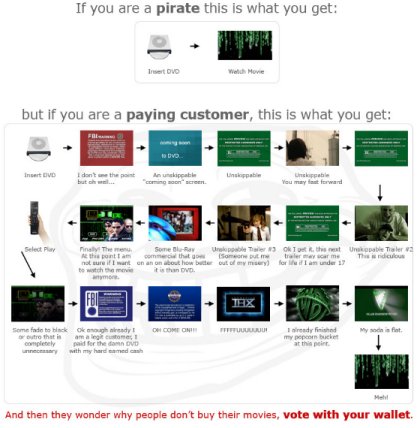
Click to see original
But maybe I’m misunderstanding why they all do it: instead of trying to warn me off from illegal activity, perhaps they’re actually trying to get me so irritated that I’ll go ahead and pirate it — and then they’ll swoop! It’s a society-wide legal entrapment scheme!
H/T to BoingBoing.
February 20, 2010
The editors at the National Post have the reverb setting too high
In two different articles I looked at today, there appears to be a slight problem with repetition. For example, in Rex Murphy’s piece on the on-again, off again boycott of oil from Alberta by BB&B, he appears to be trying to make some sort of point by repeating the company’s abbreviated name:
It cannot be very encouraging if one of the most dynamic industries in our recession-plagued country is operating in a state of mental waywardness. And if Bed Bath & Beyond, with an assist from Whole Foods, have rescued the captains of our oil industry from unknowing mental distress, why then this apparent BBB BBB BBB boycott would be worth its weight in stacked linens and whole sacks of the finest nickel-plated multiple-nozzle shower-heads.
[. . .]
Bed Bath & Beyond “clarified” in a press release: “Characterizations that we [BB BB and B] have ‘rejected’ any particular fuels are not accurate as we are not in a position to do so” (emphasis mine). Which is a little ambiguous since it leaves open the thought that were BBB BBB BBB in “a position to do so,” they would. So Albertans might take home the message that Bed Bath & Beyond have distanced themselves from the idea of “rejecting” oil sands fuel, not to spare Albertan sensibilities, but because there is no way for them not to do so. They’re just stuck with it. A little lacking, wouldn’t you say, in grace and tact?
[. . .]
My guess is the wavelet of backlash from Alberta at the ForestEthics press release was sufficient to haul the monks of BBB BBB BBB out of the eco-choir. BBB BBB BBB may have thought that sending a little incense to the Al Gore contingent of The Science is Settled and The Himalayan Glaciers are Toast Church of Global Warming (pre-Climategate Division) would titillate the balance sheet among the eco-fervent. But they quickly thought better of it. Oh that old Gloria Mundi. How Sic it Transits.
[. . .]
The IP IP CC has less prestige now than the Golden Globes, and bears no little resemblance to that farce’s incestuous relationship with its “industry.” The IP IP CC chairman is a rude, busy man who writes erotic novels — his muse, apparently, Jacqueline Susann.
(Emphasis mine). I decided that I just didn’t get the joke, until I looked at the lengthy criticism of the Liberal Party’s insistence on incorporating abortion rights into the government’s plans for targeting foreign aid to mothers and children, where Conrad Black seems to stutter over the acronyms, too:
Canada should tax provincial transactions and elective energy sales, the sale-of non-essential goods, and reduce income taxes and abolish capital gains taxes on sales by Canadians of Canadian securities. We should reintroduce private medicine alongside the public health system, as most advanced countries have done. Our health-care system should not be a model for the United States of what not to do, as it now is. We should be proposing drastic reforms to the UN UN , NATO NATO NATO NATO and the IMF, and building our defence capacity. An army of 19,000 is a scandal for a country as important as Canada. We should assist the private sector in making Canadians owners of a serious automobile manufacturer, and in the fair and advantageous repatriation of more of our industry. And the stocks, if not the lash, should be restored to deal with Dalton McGuinty and Jean Charest for fouling our nest by criticizing the Alberta oil sands at the most futile international conference, Copenhagen, since the Defenestration of Prague.
“Are you stupid?”
My new Olympic hero, with a gold medal in press relations, Sven Kramer:
Update, 25 February: If you felt that Kramer was showing Hubris in the clip above, you might also feel that Nemesis showed up right on schedule, too:
After 25 laps around the Richmond Olympic Oval, Sven Kramer of the Netherlands crossed the finish line Tuesday and raised his arms in triumph, having secured — or so he thought — his second Olympic record and gold medal of these Winter Games.
Within seconds, Kramer’s celebration turned icy cold. When his coach, Gerard Kemkers, caught up to him during his cool-down lap, he palmed his head and delivered the bad news: Kramer was disqualified for incorrectly changing lanes with eight laps remaining in the 10,000-meter race.
Kramer, who has dominated the distance since finishing seventh at the 2006 Olympics, spiked his glasses upon learning his fate. He looked as if he wanted to punch Kemkers, who later accepted full blame for what happened. He said he glanced up from recording split times, became momentarily disoriented and barked at Kramer to switch to the inner lane.
February 18, 2010
QotD: Where are the (American) media?
If it’s true that right wing bloggers and right wing Brit newspapers are now savaging the Warmists completely wrongly, well, isn’t that a story in its own right, given the huge scale of this phenomenon? Aren’t these bad bloggers and cynical Brit journos threatening the very future of the planet? And you guys are ignoring that? Why aren’t you grilling these bad, bad people? Why no big exposures of the wrongness and wickedness of Steve McIntyre? Why no stuff saying “What’s up with Watt’s Up With That??” One way or another, this is a huge story.
Trouble is, I guess they want the story to go one way, but that if they investigate it properly they fear that they’ll find it going the other way.
Brian Micklethwait, “Making the US old media notice Climategate”, Samizdata, 2010-02-17
February 17, 2010
Is “Own the Podium” the end of Canadian niceness?
In another common refrain, Canada’s “Own the Podium” slogan appears to be doing irreparable damage to our international image . . . according to a few bored reporters. Again, it seems to shock and dismay people that Canadians might actually want to compete and win in the Olympics — apparently that’s not “Canadian”. Dahlia Lithwick looks at some of the “we can’t believe it” coverage:
Someday, someone is going to explain to me why it is that journalists so frequently speak about Canadians as though we are all about 2 feet tall and 7 years old. See, for instance, this exceedingly strange New York Times piece about how those tiny little Canadians are building a “giant laser” or some such thing, in order to bring home more Olympic medals than ever before. Look! Look at all those funny little Canadians in their funny little hats, trying to be good at sports! Look at them spending their whole allowance on a top-secret program to create a human slingshot for speed skaters and “super-low-friction bases for snowboards and [to find out] whether curling brooms really melt the ice.” The Seattle Times describes this effort as “Canada’s non-nuclear Manhattan Project.”
It was bad enough when they were calling us “un-Canadian” and “inhospitable” just for wanting to win medals. It got uglier last Friday when Georgian luger Nodar Kumaritashvili was tragically killed in a practice run. The Canadians’ decision to limit outsiders’ use of Olympic facilities before the Games began — a maneuver that every other host country pulls — got spun as “an unfortunate nationalistic impulse” that put patriotism ahead of safety. The subtext: When Canadians care about winning just as much as the rest of the world, can there be any more warmth and goodness left in the universe?
The flip-side of all this is . . . the world barely even knows that Canada exists. Why do we get all worked up about how the world “sees” us? More evidence that Canada still needs to grow up a bit and get over the teenage angst. It’s unbecoming in teenagers, but it’s much worse for a nation.
Of course, this effort to caricature Canadians has been aided most of all by Canadians. You know you’re suffering an international feistiness deficit when your prime minister begs his fellow citizens to show the world a little more testosterone. “We will ask the world to forgive us this time,” declared Stephen Harper in an effort to rouse Canadians into showy displays of patriotism, “this uncharacteristic outburst of patriotism and pride, our pride of being part of a country that is strong, confident and stands tall among the nations.”
What’s strange about all this deep Freudian analysis is that Canada has done pretty darn well on the hardware front in recent years. It jumped from 13 medals in 1994 to 24 at Turin in 2006. Canada ranks seventh overall in winter medal wins. Not bad for a country of 33 million people where per capita spending on Olympians has historically been a fraction of what some other countries spend. Is it possible that Canada has been doing just fine at the Winter Olympics but nobody ever bothered to notice?
However, I have to take issue with one thing she writes:
It has always seemed to me that sweeping efforts to identify a Canadian national character are pointless. It’s a vast country built on compromises between French and English, Canadians and the British. The nation differs so fundamentally from east coast to west that, Olympics notwithstanding, it’s hard to know what a Newfoundlander and a British Columbian might find to talk about.
Get two Canadians together from different parts of the country, and they’ll immediately have something to talk about: their shared loathing of Toronto . . .
Fleet Street, in unison: “Worst. Games. Ever.”
British journalism is a bit less respectful than the Canadian variety (not that “respectful” is all that common here). British journalists also tend to look for lines of attack, rather than lines of inquiry. It works for them: the British newspaper scene is far more entertaining than anywhere else in the world, but it doesn’t do much for those in the scrutiny of the Fleet Street flashmob. Vancouver and the VANOC folks are squarely in the crosshairs at the moment, and bored British journalists are bringing their patented approach to Olympic criticism:
If there was a gold medal for premature Winter Olympic whining, the British would be perennial occupants of the middle podium.
Right on schedule, on the fourth of 17 event days, U.K. scribes have written off the Vancouver Olympics as a “worst-ever” Games in the making, an “abomination” for producing the accidental death of a luger and an organizational “fiasco” for slow buses and venue meltdowns.
Well, in fairness, never before at an Olympic venue has there ever been a weather delay or mechanical breakdown. Only in Vancouver have these things ever . . . oh, what? There have been problems before? Funny, the way it’s being reported — with ice-ruining machines and immobile buses — you’d think this was an absolutely unprecedented series of disasters.
There’s no obvious explanation for why London reporters are the most caustic of the contingent, having elevated Vancouver-bashing into an unofficial Olympic sport.
Perhaps they’re dreadfully bored. After all, the BBC alone has more personnel at the Games than the kingdom’s entire 52-member Olympic team. There’s also dispiriting news that bookies back home predict the U.K. will experience a medal shutout in Vancouver, with only an outside shot at the curling podium.
What’s that? You think they could have a motive for painting the Vancouver games in the worst possible light?
Guardian columnist Martin Samuel went postal in his attack in the aftermath of the luge fatality. “Canada wanted to Own The Podium,” he snarled. “This morning they can put their Maple Leaf stamp on something more instantly tangible: the nondescript little box carrying the lifeless body of Nodar Kumaritashvili back to his home in Bakuriani, Georgia.” Good grief.
Other U.K reporters predict financial disaster for Vancouver, a defensive move given that London’s 2012 Summer Olympics are already $1.8-billion over budget.
They complain of heavy-handed customs officials and no-nonsense security, which is a tad rich from a country where police will have the right to enter homes without a warrant while Olympic officials storm residences or enterprises near Games venues to search for protest material.
Of course, Canadians are not being as polite in response to what they see as provocation from the British press:
Not surprisingly, thin-skinned Canadians are filling British newspapers with backlash sneers and jeers.
“London will be worse (in 2012). It will also be dirtier, smellier, and have worse teeth,” mocked one offended Canuck. “Just because you long ago abandoned any ambitions in the world – or for that matter basic sense of identity or dignity – and became a lethargic nation of elitist whiners who no one really likes, don’t fault those younger nations who do enjoy and embrace life,” snapped another.
Which will, in turn, provide more fuel for the fires. Exactly the sort of reaction they were hoping to get.
February 15, 2010
QotD: “I was disappointed in the opening ceremonies because . . .”
Holy smack people. We spent about a billion gazillion dollars on this thing. Every fourth person in the country has had their picture in the paper after getting a chance to carry the Olympic torch on some weird relay race around the country. We’ve been warned that anyone hinting these games aren’t the absolute bestest thing that ever happened in Canada will be drawn up on treason charges. And when the thing finally gets underway (hallelujah!), all we can think of is finding people who are “disappointed” because their particular race/creed/colour/language group wasn’t better represented.
My God. Vanoc should have asked Stats Canada to drawn up a statistical breakdown of the country, and then awarded spaces at the ceremonies strictly on that basis: 4.2 French-speaking non-Quebec First Nations people; 0.6 Presbyterian Metis single mothers; 1 Catholic that everyone else is allowed to make fun of; exactly 50% female representation, subdivided among the top 34 national racial, ethnic and religious groups; no men.
Then everyone would be happy, right? Actually, I doubt it.
Kelly McParland, “I was disappointed in the opening ceremonies because . . . (fill in beef here)”, National Post, 2010-02-15
February 12, 2010
Careful wording of poll questions significantly influences responses
I know, “duh!”
But most people don’t know how much the choice of questions does influence the outcome of polling. This is a perfect example:
As the Obama administration proposes repealing the policy known as “Don’t Ask, Don’t Tell,” a new New York Times/CBS News poll finds that a majority of the public support allowing openly gay men and women to serve in the military.
There’s less support, however, for allowing homosexuals to serve openly.
Confused?
The results highlight the importance of wording on the issue. In a test, half of the poll’s respondents were asked their opinion on permitting “gay men and lesbians” to serve, and the other half were asked about permitting “homosexuals” to serve.
The wording of the question proved to make a difference. Seven in 10 respondents said they favor allowing “gay men and lesbians” to serve in the military, including nearly 6 in 10 who said they should be allowed to serve openly. But support was somewhat lower among those who were asked about allowing “homosexuals” to serve, with 59 percent in favor, including 44 percent who support allowing them to serve openly.
This is a very simple example. It can get a lot more sneaky:


