Quotulatiousness

March 14, 2011

Canadian in Japan claims government “providing no help” to him

Filed under: Cancon, Government, Japan, Media — Tags: , , , , — Nicholas @ 09:13

Phillip Ilijevski is shocked that the Canadian government hasn’t been providing him with personalized information on what’s happening near him:

A Toronto man living in Japan says the federal government is “providing no help” to Canadians wanting to know if they should leave the earthquake and tsunami-ravaged country, especially given the nuclear threat.

Phillip Ilijevski teaches English in Takasaki, about 100 kilometres north of Tokyo. He called Canada’s Department of Foreign Affairs and International Trade to find out if it’s safe to stay in Japan, but says the only advice they gave him was to watch the news.

I have no idea why the Canadian government is expected to have better information on what’s happening in Japan in the aftermath of the earthquake and tsunami than the Japanese government, but it must be Stephen Harper’s fault, right?

If Mr. Ilijevski was in a third world nation with poor communications and little infrastructure, it might be reasonable to assume that Canadian officials would be in a better position to provide advice than local government, but in this case there’s no reason — Japan is better equipped to handle this kind of disaster (and public information flow) than just about any other nation on earth.

As jonkay said in a Twitter update: “As usual,when disaster strikes abroad, TStar’s #1 focus is finding a Canuck to bitch about how Ottawa isn’t helping him”

I’m not sure what a “paprade” is, but apparently Toronto had one

Filed under: Cancon, Humour, Media — Tags: , , — Nicholas @ 08:56

I guess the weekend staff were celebrating St. Patrick’s day a little early, as not only the photo caption (left) but also the pa(p)rade directions leave you a little misdirected:

The parade begins at Bloor and St. George Sts. and heads west to Yonge, where it turns south and goes to Queen and then heads west again to University, ending just south of Dundas on University.

The streets are expected to be closed from 8 a.m. to 3 p.m., making driving to the parade difficult.

Highlighting mine. Going west from Bloor and St. George won’t get you to Yonge Street for a fair amount of time:

H/T to Chris Greaves for bringing this to my attention.

March 11, 2011

Amazon recommendation fail

Filed under: Books, Economics, Europe, France, History, Media — Tags: — Nicholas @ 08:45

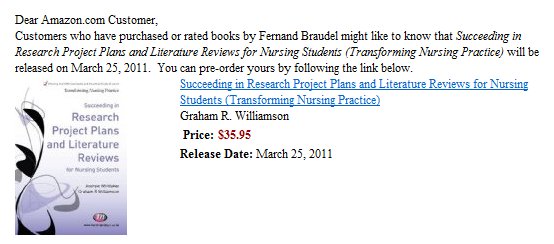
Like many of you, I’ve bought lots of books from Amazon over the years. Knowing a fair bit about my book-buying habits, their recommendations for books I might be interested in are usually pretty good. Today’s email rather missed the mark:

I’m not sure how that book relates in any way to the work of Fernand Braudel:

Fernand Braudel (24 August 1902 – 27 November 1985) was a French historian and a leader of the Annales School. His scholarship focused on three main projects, each representing several decades of intense study: The Mediterranean (1923–49, then 1949–66), Civilization and Capitalism (1955–79), and the unfinished Identity of France (1970–85). His reputation stems in part from his writings, but even more from his success in making the Annales School the most important engine of historical research in France and much of the world after 1950. As the dominant leader of the Annales School of historiography in the 1950s and 1960s, he exerted enormous influence on historical writing in France and other countries.

Braudel has been considered one of the greatest of the modern historians who have emphasized the role of large-scale socioeconomic factors in the making and writing of history.[1] He can also be considered as one of the precursors of World Systems Theory.

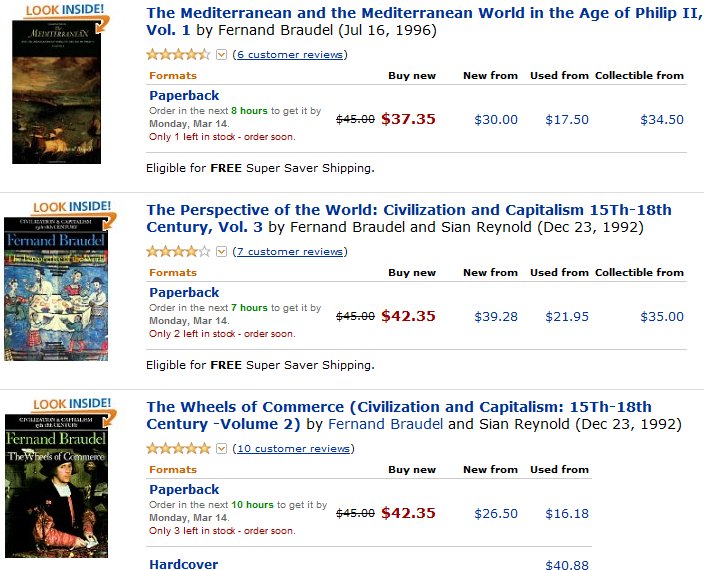
If you’ve browsed the history section, you’ll have seen them:

March 10, 2011

Very early railway film

Filed under: History, Media, Railways, Technology — Tags: , — Nicholas @ 10:12

H/T to “JtMc” for the link.

March 9, 2011

Charles Stross on the future of gaming (from 2007)

Filed under: Books, Gaming, Media, Technology — Tags: , — Nicholas @ 12:35

Charles Stross is the author of many fine books, but it was Halting State that many gamers would know him from. At the time the book was published, he wrote an article for GuildCafe on the future from a gamers viewpoint. The original article disappeared, so he’s reposted it on his blog:

I’ve been asked by our hosts to take a stab at identifying how online games will affect our culture over the next couple of decades. That’s an interesting target because it covers a bunch of time scales. So I’m going to look at where we stand today, and where we might go at various stages along that 25 year time-line.

That’s a tall order; technology doesn’t stand still, and it’s no good trying to guess where the gaming field is going without knowing where the tech base is taking us. So we need to look at where we are and where we’ve come from in order to plot a course ahead.

[. . .]

The first symptom is that Reuters pay Warren Ellis or some other cutting-edge cyber-celebrity to move into SL. (And, whaddaya know, if they did the job right, they picked someone who actually knows what they’re talking about.) Warren drinks their retainer or injects it into his eyeball or something, then dashes off some febrile prose which gets syndicated. Heads turn at AP and UPI: “why don’t *we* have someone covering this Whizzumajig? We’re falling behind! Hire Hunter Thompson!”

At the same time, some random gamers in places like the Swedish Foreign Ministry or the French Nazi Party decide they can get some free publicity by staking out some territory and figuratively mooning the straights. Exploding pigs, flying lutefisk, and other whackiness ensues.

And then the tidal wave of mass media awareness arrives, complete with the usual foaming mess of sewage, uprooted trees, and general crap turned out by the tabloid press and cheap news channels as they try to spew one lurid scenario after another through the playground. “It encourages pedophiles! Or terrorists! Kids get into Whizzumajig and fail their college exams! Users get hair in their palms and go blind! Ban Whizzumajigs now, before it steals our precious bodily fluid!”

Felicia Day, Wil Wheaton, and Amy Okuda panel discussion

Filed under: Gaming, Humour, Media — Tags: , , , — Nicholas @ 00:05

And, part two, with Wil Wheaton’s immortal advice “Guys . . . when a woman joins the game, don’t be a dick.”:

March 8, 2011

QotD: Don’t look forward to the summer crop of movies

Filed under: Media, Quotations — Tags: , — Nicholas @ 13:06

. . . let’s look ahead to what’s on the menu for this year: four adaptations of comic books. One prequel to an adaptation of a comic book. One sequel to a sequel to a movie based on a toy. One sequel to a sequel to a sequel to a movie based on an amusement-park ride. One prequel to a remake. Two sequels to cartoons. One sequel to a comedy. An adaptation of a children’s book. An adaptation of a Saturday-morning cartoon. One sequel with a 4 in the title. Two sequels with a 5 in the title. One sequel that, if it were inclined to use numbers, would have to have a 7 1/2 in the title.1

And no Inception. Now, to be fair, in modern Hollywood, it usually takes two years, not one, for an idea to make its way through the alimentary canal of the system and onto multiplex screens, so we should really be looking at summer 2012 to see the fruit of Nolan’s success. So here’s what’s on tap two summers from now: an adaptation of a comic book. A reboot of an adaptation of a comic book. A sequel to a sequel to an adaptation of a comic book. A sequel to a reboot of an adaptation of a TV show. A sequel to a sequel to a reboot of an adaptation of a comic book. A sequel to a cartoon. A sequel to a sequel to a cartoon. A sequel to a sequel to a sequel to a cartoon. A sequel to a sequel to a sequel to a sequel to a movie based on a young-adult novel.2 And soon after: Stretch Armstrong. You remember Stretch Armstrong, right? That rubberized doll you could stretch and then stretch again, at least until the sludge inside the doll would dry up and he would become Osteoporosis Armstrong? A toy that offered less narrative interest than bingo?

[. . .]

1. Captain America, Cowboys & Aliens, Green Lantern, and Thor; X-Men: First Class; Transformers 3; Pirates of the Caribbean: On Stranger Tides; Rise of the Apes; Cars 2 and Kung Fu Panda 2; The Hangover Part II; Winnie the Pooh; The Smurfs in 3D; Spy Kids 4; Fast Five and Final Destination 5; Harry Potter and the Deathly Hallows Part 2.

2. The Avengers; Spider-Man (3D); Men in Black 3 (3D); Star Trek untitled; Batman 3; Monsters, Inc. 2; Madagascar 3; Ice Age: Continental Drift in 3D; The Twilight Saga: Breaking Dawn, Part 2.

Mark Harris, “The Day the Movies Died”, GQ, 2011-02

March 5, 2011

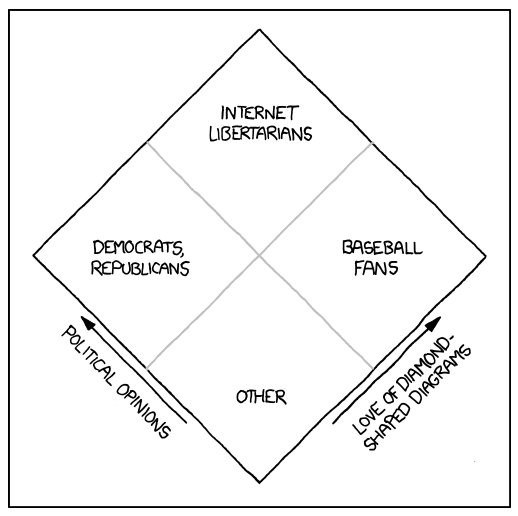
xkcd re-interprets the Nolan Chart

Filed under: Humour, Liberty, Media — Tags: , , , — Nicholas @ 11:36

Nolan Chart

March 3, 2011

It’s down to the wire for NFL lockout

Filed under: Football, Law, Media — Tags: , , — Nicholas @ 09:42

Mark Craig summarizes the labour situation between the NFL and its players:

A moment incomprehensible to fans of North America’s most popular and profitable sports league is now, finally, upon us.

At a tick past 11 p.m. Thursday, the three-year standoff between billionaire owners and millionaire players could result in the NFL’s first work stoppage since 1987. Barring a new collective bargaining agreement or a temporary extension of the current one, all NFL business except next month’s draft is expected to cease as the owners lock out the players. Meanwhile, all concerns for the 2011 offseason, preseason, regular season and Super Bowl XLVI officially shift to threat level Orange.[. . .]

Owners claim the status quo is a recipe for financial destruction of the league but resist the players’ request to open the books and prove it. Owners possess franchises worth an average of $1.02 billion, charge fans in some cities up to five figures just for the license to buy season tickets, and oversee a thriving empire that drew a record 111 million TV viewers for last month’s Super Bowl.

The two major stumbling blocks since the owners opted out of the current CBA in 2008 are dividing revenue and extending the regular season from 16 to 18 games. The owners get $1 billion off the top before giving the players 59.5 percent of the remaining $8 billion. The owners now want another $1 billion off the top.

Yesterday’s news of the decision in David Doty’s court room may force the owners to negotiate with more urgency, as they were depending on having access to the billions in TV revenue even if no games were played.

Update: Rumour on Twitter is that the players and the owners have agreed to a 24-hour extension of the CBA. Hopefully this time will be used to make progress, not merely postures.

Sneak preview of the next Guild comic

Filed under: Gaming, Humour, Media — Tags: , , — Nicholas @ 00:01

Whitney Matheson has a preview of the next comic starting the members of The Guild. This one is about Tink:

Peter Bagge cover for the Guild comic

This should be in the stores by mid-March.

March 2, 2011

NFL owners lose key legal battle with players’ union

Filed under: Football, Law, Media — Tags: , , — Nicholas @ 12:16

The looming lockout of NFL players may not be looming quite as large, due to a legal outcome in a Minnesota District Court:

In his ruling, Doty said the NFL breached its union contract by accepting below-established market contracts for their TV deals in 2011 that not only produced less revenue to share with players, but also protected the owners by guaranteeing the payment whether a lockout potentially canceled the season entirely.

In his 28-page opinion, Doty said the record showed the NFL entered contract negotiations with the TV networks with the expressed idea that, if there was no 2011 season, the owners would still get paid while the players would not, creating an imbalance used to “advance its own interests and harm the players.”

Doty overruled Burbank’s decision and ordered another hearing to determine if the owners are liable to paying damages to the NFLPA, which, given the current cost split, would give the players half of the $150 million each team would receive from the TV deal, or to block the owners from collecting any of the TV money without a product on the field. The NFLPA is asking Doty to issue an injunction to put the TV money in escrow until a new labor agreement is worked out.

This money might well have been a useful war-chest for the NFL owners to sit out a long work stoppage (whether a strike by the players’ union or a lockout), but thanks to the decision by David Doty they won’t have that money available until after some agreement is reached.

March 1, 2011

CBC posts G20 mini-documentary

Filed under: Cancon, Government, Liberty, Media — Tags: , , — Nicholas @ 07:48

I haven’t had a chance to watch it yet, but Cory Doctorow says “This video makes me ashamed to be a Canadian”. You Should Have Stayed At Home:

It’s been eight months since the G20 and the iconic images are still with us — burning police cars, rampaging mobs, the massive security presence that according to the official story is all that stood between Canada’s largest city and chaos. But that’s not the whole story of Toronto’s G20. Astonishing new images caught on camera are now emerging and they expose a troubling new picture of what happened to hundreds of ordinary citizens caught in the huge police dragnet during those three highly-charged days last June.

Gillian Findlay presents a revealing new street-level perspective of what happened when thousands of police were deployed in downtown Toronto and instructed to do what was necessary to ensure the wall around the G20 Conference Centre was never breached. Exclusive eyewitness video obtained by the fifth estate brings to light startling images captured on cellphones and minicams by the innocent bystanders who found themselves on the wrong side of all that G20 “order.” In a rare television interview, Toronto Police Chief Bill Blair explains why police took the actions they did.

I was critical of the G20 even before things went off the rails. It was a stupid idea to hold it in the middle of Canada’s biggest city, and the police reaction to provocation was worthy of any rag-tag third world dictatorship.

This may provide the boost 3D TV has been waiting for

Filed under: Europe, Media, Technology — Tags: , , — Nicholas @ 07:36

Lester Haines reports that Penthouse will be launching a European 3D TV service:

Marc Bell, big swinging dick of Penthouse owner FriendFinder Networks, enthused: “We are very excited about the launch of the Penthouse 3D channel. Our goal is always to deliver the latest technology on the world’s best platform.”

Jacky Wauters, head of Penthouse distributor NOA Productions, joined the love-in, saying: “Thanks to the increasing consumer acceptance of 3D, I am delighted to work with Penthouse to be able to satisfy the needs of the consumers and broadcasters alike who demand high quality, cutting edge entertainment backed by a solid and well established brand like Penthouse.”

Penthouse originally announced it’d be launching 3D porn in the US in the second quarter of this year, but has obviously decided to come early over European viewers.

Pornographic content has traditionally been one of the first major uses of new technology.

February 27, 2011

Athletes in the age of Facebook and Twitter

Filed under: Football, Media, Technology — Tags: , , , , — Nicholas @ 10:29

John Holler makes several good points in this story about a couple of NFL hopefuls who are having to defend their reputations due to the wonderful rumour-spreading abilities of social media and the willingness of sports reporters to try to create controversy:

Saturday at the Scouting Combine in Indianapolis, we got our first intense view of this media “New World Order.” Cam Newton and Ryan Mallett are two of the top quarterback candidates in this year’s draft. Yet, both of them spent significant portions of their media access to address questions that have nothing to do with football.

Newton, who has been under the media microscope for the last several months, had to clarify a comment he made about wanting to be “an entertainer” and “an icon.” It was a flippant comment made by a kid who is going to turn 22 in May. In his case, the question should be, “Yeah, so?” not a sanctimonious rant by media “entertainers” and/or “icons” to pass judgment that he is not focused on being a football player, but more interested in being a rock star.

Guess what? Newton should have nothing to apologize for. If you’re a star in the NFL, you are an entertainer. People drop hundreds of dollars to watch you perform for three hours. There are thousands of people employed to discuss what you do for a living. There is little difference between Peyton Manning and Bruce Springsteen. They do the same thing — entertain packed houses wherever they perform. [. . .]

Mallett is a different story. He has been called to task by what everyone reporting on it claims are rumors that he not only has taken drugs in college (no!) but might have an addiction to the party lifestyle. If it is true, he won’t be the first and he won’t be the last college football player to do things he wouldn’t put on his résumé. The timing of the accusations, the week of the NFL Scouting Combine, seems interesting. However, his response was hard to justify.

If there was no basis to the accusations, Mallett should have been advised to come out aggressive — denying the charges immediately and owning the situation before he gets his 15 minutes with NFL teams. Instead, he deflected the questions, which only gives rise to more speculation. In the Facebook/TMZ world we live in now, you can bet that media members are going to be provided with information — some will pay for it, others won’t — that will portray a bad side of Mallett that he likely doesn’t deserve, but will surely have to answer to.

The stakes are high for both of these young men: a badly chosen phrase could lose them literally millions of dollars by lowering their chances of being a high draft choice. It’s tough enough for media personalities and politicians to tap-dance around awkward situations, but young 20-something athletes don’t have the experience to avoid falling into the verbal traps.


Sunday book post

Filed under: Books, Economics, History, Media, Military, Wine — Tags: , , , , , — Nicholas @ 10:09

No, not my books: I’ve written lots, but they’re all technical manuals for software products the vast majority of you will never have heard of, and wouldn’t want to read about even if you had. I mean books I’ve read recently that I consider to be very good. I’ll categorize for convenience (both yours and mine):

Science Fiction and Fantasy

  • Darwin’s Watch: The Science of Discworld III, Terry Pratchett, Ian Stewart and Jack Cohen. An entertaining romp through (real) science placed within a fictional context. I read the first Science of Discworld book and quite enjoyed it, and this one is possibly even better. The Discworld, riding happily balanced on the backs of the four great elephants, who are in turn supported by the shell of the great turtle, has very different scientific principles than our own “exotic” roundworld. The most amusing part of the book is the wizards of the Unseen University attempting to ensure that Charles Darwin writes the “correct” book on roundworld. You’ll learn more science than you expect . . .
  • I Shall Wear Midnight, Terry Pratchett. The fourth of the Tiffany Aching sequence in the Discworld series. Although written for a younger audience, Pratchett’s sense of humour and brilliant presentation make this book eminently readable for all ages.
  • Cryoburn, Lois McMaster Bujold. The latest adventure of Miles Vorkosigan deals with the political and social implications of cryogenic preservation. No soaring battles in space, no stunner shootouts, no alien invasions. Sounds deadly dull, I realize, but I don’t think Lois could write a boring shopping list. It perhaps doesn’t stand alone quite as well as it might, but even if you haven’t read any of the other books in the series, I think you’ll find this worth reading.

History

  • The Canadian Army and the Normandy Campaign, John A. English. A book that undermines several widely held beliefs about the efficiency and capability of the Canadian First Army in 1944-45. Between incompetent, scheming generals and political interference, the Canadian Army was less than the sum of its parts, and the importance of training methods and doctrine are highlighted (that is, the faulty training methods in use probably added to the casualty lists in combat). Field Marshal Montgomery didn’t like or trust General Harry Crerar, but was forced to keep him in command due to Canadian government sensitivities. Montgomery’s view of Crerar almost certainly was reflected in the roles assigned to First Canadian Army after the Normandy landings.
  • The Grand Strategy of the Byzantine Empire, Edward N. Luttwak. A fascinating book about the differences between the Byzantine empire’s military and political goals and practices and those of the Roman empire from which it descended. Unlike Rome, the Byzantines were never the “superpower” of their part of the world, and their survival often depended on carefully constructed alliances, allies-of-convenience, and outright bribery of “enemies of their enemies”. Although not well remembered in the west, the survival of Byzantium almost certainly saved central Europe from conquest by the armies of the Caliph during the initial expansion of the Muslim empire. Byzantine armies rarely had much technological or doctrinal advantage over their opponents, so war had to be conducted with the key concept of retention of force: ambush, raid, counter-attack, feint, and misdirection became specialties because they offered (relative) effectiveness at lower risk of outright defeat.
  • In the Name of Rome: The Men Who Won the Roman Empire, Adrian Goldsworthy. A selection of mini-biographies of some of the greatest generals of the Roman empire. What is amazing, in reading about some of their careers, is how little actual military instruction Roman officers received, yet how effective the army could be in spite of that. Being an army officer was viewed as just part of the normal public service — in fact, it would have been problematic for a Roman patrician to remain with the army for an extended period of time, as it would slow down his progress through the civil government ranks.
  • The Defence of the Realm: The Authorized History of MI5, Christopher Andrew. If you wanted a thrilling account of the exciting and dangerous life of counter-espionage, you need to stick to works of fiction. The actual life of an MI5 officer is apparently much less James Bond and much more careful investigation, observation, and data correlation. Not that it isn’t an interesting career, but perhaps the “double oh” agents will get their own book (just kidding).

Economics

  • The Ascent of Money, Niall Ferguson. I enjoyed reading this one far more than I expected to: the author has a knack for carrying you through the less interesting bits without boring or lecturing you. The evolution of the modern monetary system, and the heroic roles played by unlikely characters in the process.
  • The Rational Optimist: How Prosperity Evolves, Matt Ridley. It’s easy to find depressing statistics and dreary anecdotes. Ridley’s view is that progress is a good thing, and that we’re enjoying a golden age even if we don’t realize it right now.

Biography

  • Robert A. Heinlein: In dialogue with his century Volume 1, William H. Patterson, Jr. I’ve been a huge fan of Heinlein’s works since I read Starship Troopers at about age 11. This biography more than met my expectations: I’d always regretted never having met Robert Heinlein, but between this book and Heinlein’s own autobiographical writings (Tramp Royale and Grumbles from the grave) I feel I’ve gotten as close to knowing him as possible — until the publication of Volume 2, anyway.
  • Thomas Paine’s Rights of Man, Christopher Hitchens. A lively appreciation of Thomas Paine’s most influential work, and much detail on his life. Paine was far from being the disreputable bomb-throwing anarchist his enemies painted him to be, but he also wasn’t the plaster saint his fans might imagine.

Wine

  • Billy’s Best Bottles: Wines for 2011, Billy Munnelly. Still the best annual wine guide for the everyday wine drinker in Ontario. If you like an occasional bottle of wine, but don’t want to study dozens of books in order to make a decision on what to buy, this is the book for you. He likes more “rustic” wines than I do, so I don’t find his recommendations in that category to be as useful, but he does a great job of sorting through the plethora of $10-20 wines available at the LCBO and tells you which ones are worth buying (and when to serve them).
« Newer PostsOlder Posts »

Powered by WordPress