
Quotulatiousness

January 22, 2013

Jazz has been shaped not only by musicians, but also by non-musical forces

Filed under: Books, History, Media, USA — Tags: , — Nicholas @ 13:42

Robert Fulford talks about some of the unexpected changes in society and how they impacted the evolution of Jazz music:

Marc Myers, who writes for the Wall Street Journal and blogs at JazzWax.com, shrewdly 
explains this process in his new book, Why Jazz Happened (University of California Press). He describes how events ranging from city planning to inventions in sound technology altered the nature of jazz during three decades beginning in 1942. In those 30 years jazz changed from an accompaniment to dancing and drinking to a concert-based performance art directed at careful, even scholarly listeners. Myers can give at least half a dozen reasons why this happened, beginning with the suburbs.

In California the sprawl of the cities did more than shrink the audiences for artists like Teagarden. It also redefined the way jazz musicians worked together. In New York they saw each other often, since most of them lived within a few subway stops. In California they were physically separated and saw each other less often. They had to plan their rehearsals and recordings with care. 
Arrangements became more important to them. And by the end of the 1950s West Coast jazz had its own smooth, orderly, distinctive style, music created by geography.

The G.I. Bill, by which the U.S. government paid the university costs of veterans, had an even larger effect. Under the G.I. Bill John Lewis spent years at the Manhattan School of Music and later founded the Modern Jazz Quartet, the most elegant group of the era. Dick Hyman studied music at Columbia and became a superb all-purpose arranger and pianist. Dave Brubeck learned techniques of composition from Darius Milhaud, a renowned French composer, at Mills College (And Brubeck never let you forget it.) Pete Rugolo, Nelson Riddle and Jimmy Giuffre made themselves musically literate with the government’s support.

They and their students and colleagues became a new community of broadly educated musicians, the first generation of that kind in jazz history. The government, by accident, altered the tone of an art form.

A single genius-level engineer changed the possibilities of jazz form more than anyone else. He was Peter Goldmark, a Jewish Hungarian immigrant who became the star of CBS Laboratories. His name doesn’t get mentioned in Why Jazz Happened, but Myers nevertheless pays tribute to his accomplishment. In 1948 Goldmark introduced the LP, the 33-1/3 rpm disc, which became the worldwide standard until the CD replaced it in the late 1980s.

Before Goldmark, musicians had been limited to single discs running three minutes. Improvisation had to be carefully limited. The LP record allowed them to write or improvise at much greater length.

The broken window fallacy in Middle Earth

Filed under: Books, Economics, Media — Tags: , , — Nicholas @ 10:36

Yes, even in the Third Age, there were Keynsian apologists:

Over on the Guerrilla Economist blog, Ust Oldfield discusses the economic consequences of the dragon Smaug on Tolkien’s fictional universe, Middle Earth. He argues that the net effect on Middle Earth’s economy may well have been positive. Both Dwarves and dragons hoarded the gold, so there would have been no monetary shock from the rapid withdrawal of so much precious metal from the economy. The Dwarves were then forced to offer their labour and skills to the outside world as refugees, contributing to the economy at large.

Perhaps. But there is something wrong with this picture. Ust neglects to mention that much of the Dwarven kingdom of Erebor and nearby Dale were utterly destroyed. Thousands of years’ worth of accumulated physical, human (or should that be Dwarven?) and social capital incinerated. In order to have a net positive effect on the economy of Middle Earth, the Dwarves’ integration with the wider economy must outweigh this massive destruction of wealth. This is unlikely, to say the least. For a start, the human city of Dale existed because of its trade with Erebor. Therefore the Dwarves were already engaging in peaceful and mutually beneficial exchange with the rest of Middle Earth. The Dwarves’ actions as refugees can only have created less value if their highest-value, voluntary choices were forcibly eliminated.

January 21, 2013

Should Bilbo have consulted his solicitor?

Filed under: Books, Law, Media — Tags: , , — Nicholas @ 09:23

In Wired, James Daily analyzes the contract between Bilbo Baggins and Thorin’s company:

Ordinarily I don’t discuss legal issues relating to fictional settings that are dramatically different from the real world in terms of their legal system. Thus, Star Wars, Star Trek, Tolkien’s Middle Earth, etc. are usually off-limits because we can’t meaningfully apply real-world law to them. But the contract featured in The Hobbit: An Unexpected Journey was just too good a topic to pass up, especially since you can buy a high-quality replica of it that is over 5 feet long unfolded.

First, it seems fairly clear (to me, anyway) that Tolkien wrote the Shire (where hobbits live) as a close analog to pastoral England, with its similar legal and political structures. For example, the Shire has a mayor and sheriffs, and there is a system of inheritance similar to the common law. The common law fundamentals of contract law have not changed significantly since the time that the Shire is meant to evoke, so it makes sense that the contract would be broadly similar to a modern contract (and likewise that we could apply modern contract law to it).

So, without further ado, let’s get to it.

Orwell Day

Filed under: Books, Britain, History, Media — Tags: , — Nicholas @ 09:04

To mark Orwell Day, History Today posted a short account of the publication of Orwell’s last book, 1984:

George Orwell’s forty-sixth birthday was less than a month off when his last novel was published in London by Secker & Warburg, and five days afterwards by Harcourt Brace in New York. The socialist author of the twentieth century’s most devastating critique of left-wing totalitarianism had less than a year left to live. The idea for the book had come to him in 1943 and themes in an early outline included, ‘The system of organized lying on which society is founded, the ways in which this is done (falsification of records, etc), the nightmare feeling caused by the disappearance of objective truth, leader-worship, etc…’. No one who knew London in the years immediately after 1945 will need to be told where the appalling shabbiness of the book’s setting came from. The shortages, the bombsites, the regular failure of things to work properly, the prevailing dreariness — were drawn from real life.

Update: History Today also posted a link to an earlier article comparing Orwell to Edmund Burke:

Both Orwell and Burke consistently mistrusted their fellow intellectuals. Orwell wrote, in his great wartime essay The Lion and the Unicorn, that ‘the Bloomsbury highbrow with his mechanical snigger is as out-of-date as the cavalry colonel’. His was not just an abstract dislike — he had seen how the blind worship of Stalin’s Russia by many on the left had given credence to the purges, paving the way for Communist repression of the non-Stalinist Left in Barcelona, to which he is a blistering eyewitness in Homage to Catalonia (1938).

[. . .]

Orwell hymns it differently. In Nineteen Eighty-Four history and memory are the subversives of a totalitarian order that has made grim flesh of the old Soviet joke ‘only the future is certain … the past is constantly changing’. But as Simon Schama has recently reminded us, ‘For Orwell, to have a future, at least a free future, presupposes keeping faith with the Past’. It is to the Past’s potential to undo Big Brother that Winston Smith proposes his rebel’s toast.

In The Lion and the Unicorn Orwell writes that it is patriotism that is ‘the bridge between the future and the past’. Bernard Crick’s description of him as a ‘revolutionary patriot’ whose ‘socialism embraces both memory and nature’ is spot-on. And in Orwell’s sense that the ‘privateness of English life … this strange mixture of reality and illusion, democracy and privilege, humbug and decency’, would eventually win through to victory over Fascism and a better world he is not all that far from Burke’s ‘idea of a liberal descent which inspires us with a sense of habitual native dignity’ — an untidy Britain but one where ‘the species is wise, and when time is given to it, as a species it almost always acts right’. Orwell saw his future Socialist Britain as an inconsistent Utopia: ‘it will not be doctrinaire, nor even logical … it will leave anachronisms and loose ends everywhere … but it will never lose touch with the tradition of compromise and the belief in a law that is above the State’. Burke might not have approved the Utopia but he would have appreciated its untidiness. In his view, ‘the circumstances are what render every civil and political scheme beneficial or noxious to mankind’.

January 20, 2013

Oxfam and the top 1%

Filed under: Economics, Media — Tags: , , , , — Nicholas @ 10:43

Oxfam is publicly blaming and shaming the top 1% of income-earners for their evil money-grubbing ways that deprive the worst-off and make poverty worse in developing countries. Simon Cooke explains why they’re wonderfully, gloriously wrong:

    “Concentration of resources in the hands of the top 1% depresses economic activity and makes life harder for everyone else — particularly those at the bottom of the economic ladder.”

And that top 1% isn’t you and me we’re led to believe — it’s those evil billionaire capitalists who are stealing the very bread from the mouths of the starving children. Let’s leave aside the fact that poverty is largely unrelated to inequality — people do not become rich by making others poor, however often Oxfam want to pretend that this is so. Instead let’s remind ourselves who the 1% are in terms of world development and poverty:

    The truth is that the entry level income for the world’s top 1% of earners is:

    $34,000

    That’s it, in real money not a great deal more than £20,000 a year gets you into the 1% club — sits you among the world’s filthy rich, among those to blame for all the sins and evil of the world. Capitalist scum.

Most of you reading this blog are in the top 1% sucking up all those resources — depriving the poor in Africa and elsewhere of the chance to grow, to get out of poverty.

Except you’re not. Sit back, put a smile on you face — punch the air with joy. You and me — capitalists both — have sat getting a little richer for thirteen years while a billion folk have escaped absolute poverty. All the international trade, all those businesses and those business folk filling the posh seats in aeroplanes flitting across the world — they’ve done that, they’ve lifted those people out of poverty.

Oxfam are wrong. Neoliberalism is making all the world richer. Even the UN celebrates that neoliberal success:

    “For the first time since records on poverty began, the number of people living in extreme poverty has fallen in every developing region, including sub-Saharan Africa. Preliminary estimates indicate that the proportion of people living on less than $1.25 per day fell in 2010 to less than half the 1990 rate…”

This is what capitalism does. Isn’t it wonderful.

January 19, 2013

Failing to charm

Filed under: Media, Sports — Tags: , , , , — Nicholas @ 10:33

Is the real reason Lance Armstrong’s televised confessions failed to “redeem” him in the public eye just a lack of charm?

But by the standards we have come to expect in these things it was relatively candid, blessedly free of self-pity. He’d told a lot of lies. Now he was telling the truth. Yet if he was expecting this confession to stanch the flow of vitriol, it appeared to have the opposite effect.

Because if there is one thing we expect of professional cyclists, it is that they will compete fairly and stay clear of drugs. And if there is one thing we expect, no demand of our public figures, it is that they will tell the truth.

Oh really. Listening to all this high dudgeon, I was carried back to last September’s Democratic convention, and the rapturous reception given to Bill Clinton, the former president and noted perjurist in the matter of Jones v Clinton.

That may have been the most famous of his lies, but it was hardly the first. Clinton was well known as a liar — an “unusually good” one, according to Bob Kerrey, the former senator — long before he ever reached the White House. As early as 1992, the question posed by his candidacy, as defined by Michael Kinsley, was not is he a liar, “but is he too much of a liar?” By the end the lies and abuses of power had piled up so high that Christopher Hitchens was forced to title his scathing account of the Clinton presidency No One Left To Lie To.

[. . .]

So let us drop the pretense that we’re all so scandalized by Armstrong because he lied. Granted, he lied about cycling, rather than mere financial dealings or affairs of state. But the reason he is in such obloquy, and Clinton and Mulroney are not, is not because his lies were worse, but because he’s not as good at it: because he is not as charming — shall we say manipulative? — as they. Frankly, when it comes to conning the public, he is not in their league.

Anyone can pull a con like Armstrong’s. You just lie and keep on lying until someone catches you. It takes a master to keep the con going even after you’ve been caught.

Infighting among the factions of the Assembly of First Nations

Filed under: Cancon, Media, Politics — Tags: , , , , — Nicholas @ 09:57

In the Toronto Star, Tim Harper recounts the behind-the-scenes battles currently going in the Assembly of First Nations:

As he rode to a meeting with Prime Minister Stephen Harper last Friday, Shawn Atleo’s Blackberry buzzed.

“Since you have decided to betray me, all I ask of you now is to help carry my cold dead body off this island,” the text message said.

It was sent in the name of Chief Theresa Spence, but those who saw the text believe it came from someone else in her circle on Victoria Island.

But they were certain about one thing — the timing, moments before he went into one of the most important meetings of his life, was meant to destabilize the National Chief of the Assembly of First Nations and undermine his efforts at a meeting which many in his organization fiercely opposed.

The missive distilled two vicious strains coursing through the internal fighting at the AFN — the threats and intimidation under which its leadership is functioning, and the growing sense from some that the Attawapiskat chief, now entering day 38 of a liquid diet with the temperature dipping to -27C here, is being used as a pawn in an internal political struggle.

To attend last week’s meeting Atleo already had to leave his Ottawa office from a back door to get out of a building with angry chiefs trying to blockade him inside.

He would have to enter the Langevin Block for the meeting through a back door for the same reason.

There have been no shortage of charges, countercharges and denials within the organization over the past weeks and the truth in this saga is often elusive.

January 18, 2013

When sarcasm goes right over their heads…

Filed under: Cancon, Humour, Media — Tags: , — Nicholas @ 12:00

Andrew Coyne parodied Toronto attitudes to winter in a Twitter update earlier this morning:

As often happens, the sarcasm went right past some folks:

For your “protection”, some new smartphones are configured to hide “mature” content

Filed under: Britain, Business, Media, Technology — Tags: , , , , , — Nicholas @ 09:52

Willard Foxton discusses some eye-raising configurations on new smartphones in the UK:

When you get a new phone, there’s a very good chance it comes with automatic filters enabled. For example, it’s very common for you have to explicitly request the ability to call premium-rate phone lines. This is long established, but now, a sinister new trend has started, whereby phone providers are automatically blocking access to certain websites for “mature content”, rather than “adult content”.

Mobile provider 3UK is blocking access to political satire as “mature content”; Orange is preventing access to feminist articles as “mature content” through its automatically applied Orange Safeguard service; several providers are blocking perfectly legitimate sites like Pink News because they deal with gay issues, or Channel 4’s excellent Embarrassing Bodies website, because of the graphic discussion of body parts and sexuality.

This was bad enough when these services were blocking porn (I for one wholeheartedly support the right of teenagers to watch smut on their iPhones), but now it seems overzealous providers are blocking access to anything a Catholic Bishop might consider for adults only. This carries not only the problem of “overblocking” caused by lazy filter design — notably, it’s hard to get your website read if it refers to Middlesex or Scunthorpe — but also as these filters are automatically applied, most people don’t even realise they are losing access to certain parts of the web.

Obsessing over drugs will damage sports much more than Lance Armstrong could

Filed under: France, Media, Sports — Tags: , , , — Nicholas @ 09:41

At sp!ked, Tim Black reviews Seven Deadly Sins: My Pursuit of Lance Armstrong, by David Walsh:

And so, in the aftermath of his Oprah-atic confession, bound to neither sate the critics nor elate the devout, the infernal humiliation of one-time cyclist Lance Armstrong continues.

The kicking and pelting began in earnest in August last year, when the US Anti-Doping Agency (USADA) stripped Armstrong of his seven Tour de France titles following his failure to challenge their numerous doping charges. The USADA then followed that up in October with a voluminous, damning report, complete with gruesome testimonies from Armstrong’s one-time confidantes and teammates. By this point, even the International Cycling Union (UCI), which had long sided with Armstrong, had given up the defence to join in the lynching. ‘Lance Armstrong has no place in cycling’, exclaimed UCI president Pat McQuaid. ‘Lance Armstrong deserves to be forgotten in cycling.’

As sporting officialdom condemned, large swathes of the media spat. Gossipy stories of Armstrong’s bullying, his lying, his alleged sociopathology were published without nuance; op-eds assassinating Armstrong’s character, inflating his wrongs to Biblical proportions, were rushed off without perspective. On a man once lionised by millions, whose fame had for years been wrapped yellow around the wrists of those who admired him, open season had been declared. All the hunt lacked was a sighting of the quarry himself. And then this week, that finally happened — in the interview with Oprah Winfrey. Caught and unavoidably contrite, Armstrong acted out the role of the doping sportsman. Yes, he was saying, I am everything that the Dopefinder Generals say I am: I am that witch.

January 17, 2013

BargainBinBlasphemy

Filed under: Humour, Media — Tags: , , , — Nicholas @ 14:53

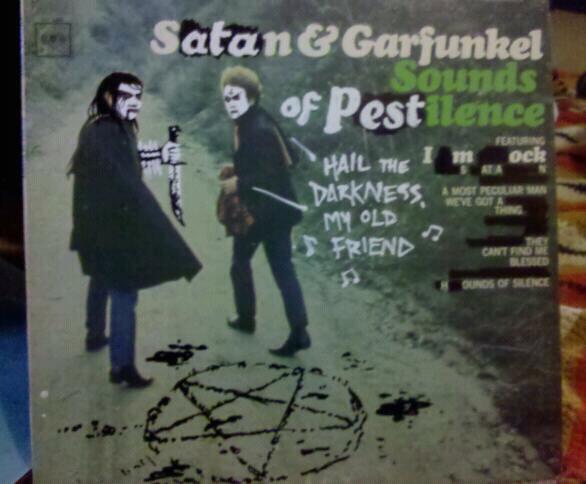
Satan and Garfunkel - Sounds of Pestilence

A Tumblr blog that might be of interest: BargainBinBlasphemy.

H/T to Boing Boing for the link.

Joe Strummer to be posthumously square in Granada

Filed under: Europe, History, Media — Tags: , — Nicholas @ 09:34

After legendary punk band The Clash fell apart, Joe Strummer retired to Granada and the city is going to rename a square in memory of his time there:

Granada City Council’s Daniel Galan told the BBC: “The initiative came from a neighbourhood association, backed by some political parties and was approved. It was a popular movement. It is very well known the connection between Joe and the city and people still remember him.”

Strummer’s relationship Spain began back in the 1970s, when he first visited Granada with his then girlfriend Paloma Romero, who later became the drummer of The Slits, under the nom de rock Palmolive.

His interest in Andalucia, the celebrated poet Federico García Lorca and the Spanish Civil War is reflected in the classic Spanish bombs, from 1979’s London Calling. During his later self-imposed exile, Strummer hooked up with Granada punk band 091, producing their 1986 album Más de 100 lobos (More than 100 wolves).

Galan said: “Joe Strummer loved Granada. He loved the whole of Spain but he had a very good connection with Granada because he was friends with 091.”

Borrowing from theoretical physics, we now have “Quantum Copyright”

Filed under: Books, Law, Media, USA — Tags: , , , — Nicholas @ 09:22

At Techdirt, Tim Cushing explores the legal phase changes that introduce heretofore unknown states of copyright:

Eric Hellman tackles the ambiguous nature of copyright infringement, especially as it pertains to the “region-free” aspects of the internet, in a post amusingly titled, “Heisenberg’s Uncertain Copyright.” (via The Digital Reader)

Hellman turns his attention to F. Scott Fitzgerald’s The Great Gatsby, and using his skills in the area of “Quantum Copyright” (a term he threw into his LinkedIn profile for a bit of fun), determines that the question of whether or not copyright infringement has occurred might depend on where the copying occurred, something that is even harder to define when the copying takes place via the internet.

[. . .]

While Hellman exaggerates the repercussions of making a hypothetical copy (the highest statutory claims would apply only to willful infringement [which this could be, especially when infringing in order to prove a hypothesis] and the jail time only applies to criminal infringement — which this almost certainly would not be), the fact remains that one deterrent of infringement is the underlying threat of legal action (whether civil or criminal). No doubt F. Scott Fitzgerald’s estate is in no hurry to give up the American rights (and the attendant enforcement of those rights), seeing as The Great Gatsby earned its author all of $8,400 during his lifetime — but generates $500,000 per year for his daughter. This secondhand largesse enjoyed by many heirs is one of the motivators behind the ever-extending copyright lengths here in this country.

[. . .]

Certainly, copyright-centered entities like the MPAA would prefer to simply have our copyright laws exported to other countries with less stringent laws, especially any sections that extend the length of copyright protection and weaken fair use/fair dealing exceptions. Getting other nations to sync up with our copyright lengths would certainly eliminate these hypothetical discussions, along with many items in the public domain. Many aspects of current copyright laws were written years ago, long before the internet made “country of origin” a meaningless term and reproductions as simple as a right-click on a mouse. What it usually boils down to, after all the discussion, is this:

    You could also be a cynic and say the only thing that matters is where the judge is sitting.

Much like fair use is often determined by a courtroom appearance, the “quantum” aspects of copyright are largely theoretical — right up to the point that someone finds themselves at the other end of an infringement lawsuit.

January 15, 2013

Don Cherry: Canadian … icon?

Filed under: Americas, Cancon, Media — Tags: , , , , — Nicholas @ 09:34

In an article designed to stir up controversy over aid to Haiti, Kathy Shaidle provides a neat thumbnail portrait of Don Cherry:

The Canadian Broadcasting Corporation (CBC) says taxpayers must keep funding this great unwatched billion-dollar behemoth because the network has a never-hear-the-end-of-it “mandate” to “reflect Canadian values.”

Which “the Corpse” does indeed, but for just about nine minutes every Saturday night, and only during hockey season, and by accident rather than design.

That’s when Don Cherry’s red light goes on and the former Boston Bruins coach begins bellowing about the fruitcakes and foreigners destroying his beloved game.

He’s old, white, loud, and uneducated. He’s bigoted, mawkishly patriotic, and he dresses like an Edwardian time traveler stuck in 1970s Detroit trying to pass himself off as a pimp — and Don Cherry’s Coach’s Corner has also been the CBC’s highest rated… thing for generations. It’s not even a show, you see, just a segment — possibly the only “intermission” in history that prompts people to run to their seats instead of away from them.

By lucky chance, “shhhh!” is the same “word” in both official languages, and that’s the sound heard in sports bars and rec rooms across Quebec and the ROC (Rest of Canada) as the show’s familiar intro gallops into millions of ears.

To the countless Canucks who can’t stand him, however, Cherry is a perpetual outrage machine. The coach doesn’t make “Kinsley gaffes,” either — those “controversial” statements which accidentally reveal some embarrassing truth. Cherry tells embarrassing truths on purpose. His only “crime” is saying things lots of his countrymen agree with but aren’t allowed to say — or even let themselves think — anymore.

January 13, 2013

“Please don’t pathologize this story”

Filed under: Law, Media, USA — Tags: , , , , — Nicholas @ 11:34

A plea for understanding, not just for the late Aaron Swartz, but also for the ethically broken justice system:

No doubt it is a certain crazy that brings a person as loved as Aaron was loved (and he was surrounded in NY by people who loved him) to do what Aaron did. It angers me that he did what he did. But if we’re going to learn from this, we can’t let slide what brought him here.

First, of course, Aaron brought Aaron here. As I said when I wrote about the case (when obligations required I say something publicly), if what the government alleged was true — and I say “if” because I am not revealing what Aaron said to me then — then what he did was wrong. And if not legally wrong, then at least morally wrong. The causes that Aaron fought for are my causes too. But as much as I respect those who disagree with me about this, these means are not mine.

[. . .]

Here is where we need a better sense of justice, and shame. For the outrageousness in this story is not just Aaron. It is also the absurdity of the prosecutor’s behavior. From the beginning, the government worked as hard as it could to characterize what Aaron did in the most extreme and absurd way. The “property” Aaron had “stolen,” we were told, was worth “millions of dollars” — with the hint, and then the suggestion, that his aim must have been to profit from his crime. But anyone who says that there is money to be made in a stash of ACADEMIC ARTICLES is either an idiot or a liar. It was clear what this was not, yet our government continued to push as if it had caught the 9/11 terrorists red-handed.

Cory Doctorow has a heartfelt obituary up on Boing Boing.

« Newer PostsOlder Posts »

Powered by WordPress

