
Quotulatiousness

February 1, 2013

EFF joins effort to quash “Gaymer” trademark

Filed under: Gaming, Law, Liberty, Media — Tags: , , , — Nicholas @ 09:27

Chris Vizzini registered the trademark “Gaymer” in March of 2008. More recently he’s started trying to enforce his trademark by sending a cease-and-desist letter to Reddit, which has a large, active, vocal gay gamer community in the r/gaymers subreddit. If you know anything about Reddit communities, you’ll not be surprised that they’ve rallied to fight against Vizzini’s efforts to shut them down:

The response was immediate. The first option presented was to change the subreddit’s name. Others looked to see if the trademark could even be considered valid, tracking down examples of prior use, one of them dating all the way back to 1991. Also discussed was the possibility of licensing the term for a nominal fee, the downside being that even if Vizzini did accept, it would do nothing to prevent him from pursuing others who used the word “gaymer.”

While the trademark’s description seemed to cover a large portion of Reddit’s “goods and services” (with a few notable differences), the discussion focused on whether or not Vizzini should have been able to trademark what many viewed as a descriptive or generic term.

The stakes were raised again when the Electronic Frontier Foundation (EFF) became an active participant:

And, as if facing the wrath of united redditors wasn’t enough, the EFF has now joined the push to have this trademark cancelled.

    [I]n a petition filed with the U.S. Patent and Trademark Office (USPTO) today, the group asks the USPTO to cancel the “gaymer” trademark registration so that people around the world can continue to use the word without interference.

    The Electronic Frontier Foundation (EFF) and the law firm Perkins Coie represent the Reddit gaymers — members of the lesbian, gay, bisexual, and transgendered community who have an active interest in video games…

    “This registration should never have been granted,” said EFF Intellectual Property Director Corynne McSherry. “Gaymer is a common term that refers to members of this vibrant gaming community, and we are happy to help them fight back and make sure the term goes back to the public domain where it belongs.”

    “Trademarks have one primary purpose: to protect consumers from confusion about the source of goods or services,” said EFF Staff Attorney Julie Samuels. “This registration isn’t being used to protect consumers — it’s being used to threaten free speech.”

EFF’s petition cites the same complaints the redditors discussed: that the word “gaymer” is both generic and descriptive and that it predates Vizzini’s application for exclusive use of the term (in relation to the services listed above — there’s also an unrelated Gaymer line of ciders). Whether or not the USPTO will find this argument convincing remains to be seen. Many dubious claims have made their way unscathed through the registration office in years past. The main benefit of this action is it puts the pressure on Vizzini to defend his claim to the term, something he may have no interest in doing.

January 31, 2013

Blaming “austerity” for most recent slowdown

Filed under: Economics, Government, Media, USA — Tags: , , , , , — Nicholas @ 09:47

David Harsanyi discusses the named (by the mainstream media) culprits for the unexpected drop in US fourth-quarter GDP:

So, U.S. consumer confidence unexpectedly plunged in January to its lowest level in more than a year. The U.S. economy unexpectedly posted a contraction in the fourth quarter of 2012 — for the first time since the recession — “defying” expectations that economic growth is in our future.

If the economy were as vibrant as President Barack Obama has told us it is, a belt tightening in a single sector of government surely wouldn’t be enough to bring about “negative growth.” But one did. Unexpectedly. No worries, though. Pundits on the left tell us that this contraction was good news — possibly the best contraction in the history of all contractions. The White House blamed Republicans and, I kid you not, corporate jet owners because — well, who else? But mostly, the left is bellyaching about the end of temporary military spending and a brutal austerity that’s enveloped a once great nation.

There’s a small problem with that argument. There is no austerity. In the fourth quarter of 2012, Washington spent $908 billion, which was $30 billion more than it spent in the last quarter of 2011 and nearly $100 billion more than it spent in the third quarter of 2012. Taxpayers took on another $400 billion in debt during the quarter. If this is poverty, can you imagine what robust spending looks like?

As always, for “austerity” to take the blame, there’d actually have to have been some austerity to start with. The US government certainly hasn’t been practicing austerity over the last four years.

January 30, 2013

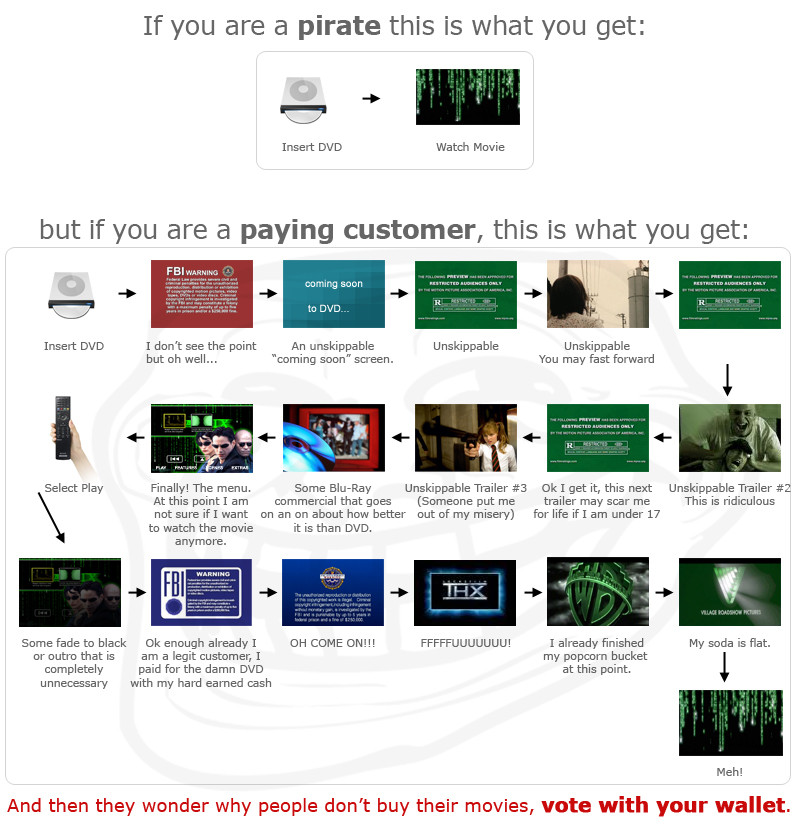
“The only people [DRM] annoys are the ones who have [acquired] legal copies”

Filed under: Business, Media, Technology — Tags: , , , , , — Nicholas @ 12:12

At Techdirt, Glyn Moody explains why the attempt to add DRM to the HTML5 standard is doomed to failure:

You would have thought by now that people would understand that DRM is not only a bad idea, but totally unnecessary: Apple dropped DRM from music downloads in 2009 and seems to be making ends meet. Despite these obvious truths, the stupidity that is DRM continues to spread. Here, for example, is a particularly stupid example of DRM stupidity, as revealed by Manu Sporny:

    A few days ago, a new proposal was put forward in the HTML Working Group (HTML WG) by Microsoft, Netflix, and Google to take DRM in HTML5 to the next stage of standardization at W3C.

After all, this is exactly what Web users have been crying out for: “just give us DRM for the Web, and our lives will be complete….”

[. . .]

That clearly implies that when people are not sharing their own content with family and friends, then they are indeed adversaries:

    This “user is not an adversary” text can be found in the first question about use cases. It insinuates that people that listen to radio and watch movies online are potential adversaries. As a business owner, I think that’s a terrible way to frame your customers.

    Thinking of the people that are using the technology that you’re specifying as “adversaries” is also largely wrong. 99.999% of people using DRM-based systems to view content are doing it legally. The folks that are pirating content are not sitting down and viewing the DRM stream, they have acquired a non-DRM stream from somewhere else, like Mega or The Pirate Bay, and are watching that.

This is the fundamental reason why DRM is doomed and should be discarded: the only people it annoys are the ones who have tried to support creators by acquiring legal copies. How stupid is that?

Pirates_vs_Paying_Customers_full

Sequestration cuts must be more likely to happen because the sob stories are getting traction

Filed under: Economics, Government, Media, USA — Tags: , , , , , — Nicholas @ 11:53

Tad Dehaven thinks the upsurge in horror stories about what sequestration will do to the US economy means it’s more likely that those cuts will actually take place:

The odds that $85 billion in “unthinkable, draconian” sequestration spending cuts will go into effect in March as scheduled are looking better. The odds must be getting better because, as if on cue, the horror stories have commenced.

A perfect example is an article in the Washington Post that details the angst and suffering being experienced by federal bureaucrats and other taxpayer dependents over the mere possibility that the “drastic” cuts will occur. You see, the uncertainty surrounding the issue has forced government employees to draw up contingency plans. Contingency plans? Oh, the humanity!

[. . .]

I certainly believe that Washington’s bouncing from one manufactured fiscal crisis to the next is detrimental to the economy, but my sympathy lies with the private sector – not the federal bureaucracy. It’s the private sector that has been suffering under the constant uncertainty surrounding federal tax and regulatory policy. And let’s not forget that there is no public sector without the private sector – the former existing entirely at the latter’s expense.

Yet, what follows in the Post article is boo-hoo after boo-hoo without the slightest regard to those who are paying for it or whether the whiner’s agency could use some belt-tightening

QotD: Confirmation-Bias Theatre Of The Absurd

Filed under: Bureaucracy, Cancon, Media, Quotations — Tags: , , — Nicholas @ 00:01

Unlike Andrew Coyne and Pierre Karl Péladeau, I am no expert on CRTC television policy. I couldn’t tell you the difference between a “must-carry” Class A license, a Class B carry-at-will, and a class X concealed-carry. But I do know a little about what makes for good journalism. And on that basis, I’d hate to see Sun News get taken off the air for want of revenue.

Sun’s enemies accuse the network’s hosts of being a bunch of haters. And it’s hard to deny the charge. Among the people they hate: Occupy protesters, fake hunger strikers and sanctimonious left-wing activists.

And Omar Khadr. Wow, do they hate Omar Khadr.

We know this because Sun News TV segments tend to go light on actual news, and heavy on middle-aged white guys shouting about people they don’t like. Sometimes, they sit around their Toronto studio interviewing each other. It’s a sort of performance art that might well be dubbed — by the surprisingly large number of left-wing Toronto hipsters who watch the channel ironically — as Confirmation-Bias Theatre Of The Absurd.

Jonathan Kay, “David Suzuki is poster boy for why Canada needs Sun’s brand of journalism”, National Post, 2013-01-29

January 29, 2013

NYC’s petty bureaucrats and the evolution of modern jazz

Filed under: Bureaucracy, Law, Media — Tags: , , , , , , — Nicholas @ 11:09

From the latest issue of Reason, Chris Kjorness outlines some of the pitfalls New York City thoughtfully put in the way of some of the greatest performers of Jazz:

For more than two decades musicians, comedians, and anyone else employed by a Gotham nightclub would be fingerprinted, photographed, and interviewed by police in exchange for a license to work. The card had to be renewed every two years, and it could be revoked at the whim of the police. The story of the cabaret card illustrates how small men with a little bit of power can inhibit creative expression, stifle artistic growth, and humiliate individual citizens, all in the name of the “public good.”

The cabaret card had its origins in the roaring ’20s. Prohibition made outlaws out of ordinary Americans, and the allure of booze, jazz, and debauchery brought the upper and lower classes together in clandestine after-hours spots. It was the height of the Harlem Renaissance, and white New Yorkers frequently made the trip uptown, looking for adventure and an escape from the tight moral constraints of downtown society.

[. . .]

More than just a barrier to work, the cabaret card for beboppers was an impediment to self-expression and artistic fulfillment. While originating in nightclubs, bebop represented something much more than bar music. The color line had not been broken in American symphony orchestras, so for a young black musician at a prestigious music conservatory — Miles Davis at Julliard, for example — sharing a cramped stage in a 52nd Street nightclub with someone like Charlie Parker was the highest realization of artistic ambition. But before he could do so, a musician would have to be judged not just by lauded masters and discerning aficionados but by the police.

Cops distrusted beboppers for three main reasons: The new breed of jazzmen were anti-establishment, they were confrontational in matters of race, and they had a fondness for heroin. The police had an unlikely ally in their crusade against the upstarts: older establishment jazz musicians who had their own reasons to dislike the beboppers.

In a 1951 Ebony article, Cab Calloway, a king of the 1930s jazz world, decried the widespread drug use in the current jazz scene. Though Calloway didn’t single anyone out by name, the magazine illustrated his essay with photos of bebop musicians, and the publication coincided with an upswing in police enforcement. One musician snared in this crackdown was Charlie Parker.

Next year’s calendars will be for the year “2013+1” to avoid paying the IOC a licensing fee

Filed under: Bureaucracy, Law, Media, Sports — Tags: , , — Nicholas @ 00:01

Just when you think the depths of idiocy have been fully plumbed, there’s the International Olympic Committee to prove you wrong:

Via the IPKat we learn that the IOC has already locked down next year in preparation for the Winter Olympics. No, seriously. A trademark on the number “2014,” which non-coincidentally happens to be a (lesser) Olympic year, has been granted by the UK’s Intellectual Property Office.

    The IPKat’s attention has been drawn to Community Trade Mark E3307444. The mark in question consists of the number “2014”, which no-one would ever imagine to be the appellation by which next year might just be known. Applied for in 2003 and registered in 2005, this mark is owned by none other than the Comité International Olympique of Château de Vidy, Lausanne.

So, with the kind of efficiency you only find in the most brutal of trademark bullies, the IOC has trademarked a number many people were planning to use starting next January, nine years in advance. And the IOC isn’t leaving anything to chance. It has staked a claim on all 45 of the possible registration classes, including (but good god, certainly not limited to) chemicals, pharmaceuticals, metals/alloys, machines, tools, scientific equipment, surgical instruments, lighting, heating, vehicles, firearms, musical instruments, furniture, ropes, tarps, string, textiles, toys, coffee, fresh fruits and vegetables, beer, other alcoholic beverages, tobacco, insurance, conferences and seminars, design and development of computer programs, restaurant services, asbestos and security.

Anything and everything possibly covered by a registered trademark has been nailed down by the Committee, making it very possible that anyone using the number “2014” in the year 2014 might find themselves dealing with the IOC’s trademark cops.

January 28, 2013

Anthropology of the hacker community

Filed under: Books, History, Media, Technology — Tags: , , , — Nicholas @ 09:17

ESR reviews a new book about hackers:

My usual audience is well aware why I am qualified to review Gabriella Coleman’s book, Coding Freedom, but since I suspect this post might reach a bit beyond my usual audience I will restate the obvious. I have been operating as the hacker culture’s resident ethnographer since around 1990, consciously applying the techniques of anthropological fieldwork (at least as I understood them) to analyze the operation of that culture and explain it to others. Those explanations have been tested in the real world with large consequences, including helping the hacker culture break out of its ghetto and infect everything that software touches with subversive ideas about open processes, transparency, peer review, and the power of networked collaboration.

Ever since I began doing my own ethnographic work on the hacker culture from the inside as a participant, I have keenly felt the lack of any comparable observation being done by outsiders formally trained in the techniques of anthropological fieldwork. I’m an amateur, self-trained by reading classic anthropological studies and a few semesters of college courses; I know relatively little theory, and have had to construct my own interpretative frameworks in the absence of much knowledge about how a professional would do it.

Sadly, the main thing I learned from reading Gabriella Coleman’s new book, Coding Freedom, is that my ignorance may actually have been a good thing for the quality of my results. The insight in this book is nearly smothered beneath a crushing weight of jargon and theoretical elaboration, almost all of which appears to be completely useless except as a sort of point-scoring academic ritual that does less than nothing to illuminate its ostensible subject.

[. . .]

Far too much of the book exhibits this kind of theory-induced blindness. I am inclined to blame not Coleman for it but rather the people who trained and indoctrinated her in how to think and write like a ‘real’ anthropologist. If Coding Freedom is really the sort of book anthropology wants its bright young things to emit, the field is in desperately bad shape — far too inward-looking, over-abstract, mired in self-reference and tail-chasing, obsessed with politicized modes of non-explanation. I would actually prefer the theory that Coleman is a dimwit who has emitted a sort of unintentional parody of real anthropology if I could make myself believe it, but I can’t — her best moments seem too lucid for that.

She is very perceptive, for example, about the central role of hacker humor in promoting social bonding and affirming the culture’s values (I’ve explored this theme myself). Her ground-level reporting about the emotional atmosphere of hacker conferences and demonstrations is acute. Her discussion of how hackers as a culture have bootstrapped themselves to a state of legal literacy in order to fight their corner of the intellectual-property wars gives one of the gifts that ethnography should — to help us see how remarkable and interesting are practices we might otherwise take for granted.

There is even one significant thing I learned from this book, or at least learned to see in a new way. I hadn’t noticed before how ritualized the practice of writing damning comments about bad code is. Coleman is right that they display a level of pointed and deliberate rudeness that their authors would not employ face-to-face, and she is right about how and why the culture gives permission for this behavior.

Let’s get real reform at the CRTC: eliminate “mandatory carriage” altogether

Filed under: Bureaucracy, Business, Cancon, Media — Tags: , , , — Nicholas @ 08:49

In the Toronto Star, Michael Geist calls for the CRTC to stop the “mandatory carriage” provision that forces cable providers to carry certain channels on their “basic” packages:

Canadians frustrated with ever-increasing cable and satellite bills received bad news last week with the announcement that the Canadian Radio-television and Telecommunications Commission will consider whether to require cable and satellite companies to include nearly two-dozen niche channels as part of their basic service packages. If approved, the new broadcast distribution rules would significantly increase monthly cable bills with consumers forced to pay for channels they may not want.

Two issues sit at the heart of the broadcast distribution rules. First, whether the CRTC should grant any broadcaster mandatory distribution across all cable and satellite providers such that all subscribers are required to pay for them as part of their basic packages. Second, in the absence of mandatory distribution, whether broadcast distributors should be required to at least offer the services so that consumers have the option of subscribing.

[. . .]

While the financial benefits for broadcasters are enormous, the policy represents a near-complete elimination of consumer choice for the channels at issue. Rather than convincing millions of Canadian consumers that their services are worth buying, the broadcasters need only convince a handful of CRTC commissioners that their service meets criteria such as making “an exceptional contribution to Canadian expression.” That is supposedly a high bar, yet it is surely far easier than convincing millions of people to pay for your service each month.

Last year, CRTC chair Jean Pierre Blais emphasized that the Commission’s top priority was to “put Canadians at the centre of their communications system.” The mandatory distribution rules do the opposite. Rather than focusing on consumer interests and choice, the rules place broadcasters at the centre of the communications system by offering up the prospect of millions in revenue without regard for what consumers actually want.

There are few, if any, broadcasters that can be considered so essential as to merit mandatory distribution. Niche cultural broadcasters have a myriad of distribution possibilities and should be forced to compete like any other content creator or distributor. In fact, even broadcasters that position themselves as “public services” can often be replicated by Internet-based alternatives.

I always find it interesting how cable providers usually manage to group their offerings so that you can’t get the group of channels you actually want in the same package. I doubt that this would change even if the regulator allowed the change from “must carry” to “must offer”, however: there’s too much potential profit to the cable companies in crafty packaging strategies. You’ll almost certainly not see the opportunity to pay for just the individual channels you want, as that would be too consumer friendly (and, we’re assured by cable company reps, would kill off lots of niche channels because they wouldn’t get enough subscribers).

Of course, if a TV channel can’t attract enough subscribers, that’s usually a pretty strong economic signal that they shouldn’t be broadcasting anyway.

January 25, 2013

Cartman Shrugged

The not-so-hidden libertarian streak in South Park:

The genius of Parker and Stone was to see that in our day a new frontier of comic transgression has opened up because of the phenomenon known as political correctness. Our age may have tried to dispense with the conventional pieties of earlier generations, but it has developed new pieties of its own. They may not look like the traditional pieties, but they are enforced in the same old way, with social pressure and sometimes even legal sanctions punishing people who dare to violate the new taboos. Many of our colleges and universities today have speech codes, which seek to define what can and cannot be said on campus and in particular to prohibit anything that might be interpreted as demeaning someone because of his or her race, religion, gender, disability, and a whole series of other protected categories. Sex may no longer be taboo in our society, but sexism now is. Seinfeld (1989–1998) was perhaps the first mainstream television comedy that systematically violated the new taboos of political correctness. The show repeatedly made fun of contemporary sensitivities about such issues as sexual orientation, ethnic identity, feminism, and disabled people. Seinfeld proved that being politically incorrect can be hilariously funny in today’s moral and intellectual climate, and South Park followed its lead.

[. . .]

This is where libertarianism enters the picture in South Park. The show criticizes political correctness in the name of freedom. That is why Parker and Stone can proclaim themselves equal opportunity satirists: they make fun of the old pieties as well as the new, ridiculing both the right and the left insofar as both seek to restrict freedom. “Cripple Fight” is an excellent example of the balance and evenhandedness of South Park and the way it can offend both ends of the political spectrum. The episode deals in typical South Park fashion with a contemporary controversy, one that has even made it into the courts: whether homosexuals should be allowed to lead Boy Scout troops. The episode makes fun of the old-fashioned types in the town who insist on denying a troop leadership to Big Gay Al (a recurrent character whose name says it all). As it frequently does with the groups it satirizes, South Park, even as it stereotypes homosexuals, displays sympathy for them and their right to live their lives as they see fit. But just as the episode seems to be simply taking the side of those who condemn the Boy Scouts for homophobia, it swerves in an unexpected direction. Standing up for the principle of freedom of association, Big Gay Al himself defends the right of the Boy Scouts to exclude homosexuals. An organization should be able to set up its own rules, and the law should not impose society’s notions of political correctness on a private group. This episode represents South Park at its best — looking at a complicated issue from both sides and coming up with a judicious resolution of the issue. And the principle on which the issue is resolved is freedom. As the episode shows, Big Gay Al should be free to be homosexual, but the Boy Scouts should also be free as an organization to make their own rules and exclude him from a leadership post if they so desire.

This libertarianism makes South Park offensive to the politically correct, for, if applied consistently, it would dismantle the whole apparatus of speech control and thought manipulation that do-gooders have tried to construct to protect their favored minorities. With its support for freedom in all areas of life, libertarianism defies categorization in terms of the standard one-dimensional political spectrum of right and left. In opposition to the collectivist and anticapitalist vision of the left, libertarians reject central planning and want people to be free to pursue their self-interest as they see fit. But in contrast to conservatives, libertarians also oppose social legislation; they generally favor the legalization of drugs and the abolition of all censorship and antipornography laws. Because of the tendency in American political discourse to lump libertarians with conservatives, many commentators on South Park fail to see that it does not criticize all political positions indiscriminately, but actually stakes out a consistent alternative to both liberalism and conservatism with its libertarian philosophy.

Even before “The internet is for porn”, mainframe computers were for cheesecake

Filed under: History, Media, Technology — Tags: , , — Nicholas @ 09:47

The very first human image displayed on a computer was a pinup girl:

First human image on a computer

During a time when computing power was so scarce that it required a government-defense budget to finance it, a young man used a $238 million military computer, the largest such machine ever built, to render an image of a curvy woman on a glowing cathode ray tube screen. The year was 1956, and the creation was a landmark moment in computer graphics and cultural history that has gone unnoticed until now.

Using equipment designed to guard against the apocalypse, a pin-up girl had been drawn.

She was quite probably the first human likeness to ever appear on a computer screen.

She glowed.

[. . .]

In early 1959, 21-year-old Airman First Class Lawrence A. Tipton snapped the only known photo of this pin-up program in action at Ft. Lee. The photo shows the tube of an SD console displaying the outline of woman with her arms held high, cradling her head while emphasizing her bosom. She reclines awkwardly, her legs splayed apart in an uncomfortable but provocative pose that smacks of mid-century pin-up art.

“One day I decided to take pictures for posterity’s sake,” recalls Tipton, “And those two Polaroids are the only ones that made it out of the building.” The other Polaroid is a self-portrait of Tipton himself sitting in front of the AN/FSQ-7’s Duplex Maintenance Console. “We used the Polaroid cameras to take pictures of anomaly conditions. When the computers would malfunction, you’d take pictures of those main consoles to diagnose the conditions.”

January 24, 2013

Is the media’s love affair with “extreme weather” just an elaborate insurance scam?

Terence Corcoran in the Financial Post:

All it takes these days is a little normal January Canadian cold spell and all of a sudden the nation is plunged into a frenzy of chatter about “extreme weather.” The CBC led the way, aided and abetted by climate alarmists in the Canadian insurance industry, with help from an apparently leaked data point from an Environment Canada report that supposedly will show that Canadian winters are now 3.2C warmer than they used to be. Get it? It’s really cold, but that’s because of climate change, which is making Canada’s winters warmer.

If you find this confusing, well, get used to it. That may even be part of the objective, which, judging by the sudden extreme flood of media reports, seems to be keep Canada’s population agitated about global warming, a cause that has so far failed to ignite voters.

If the theory of climate change doesn’t grab people, maybe “extreme weather” will. The media certainly love it. All News Radio in Toronto now has an “Extreme Weather Centre” that rouses itself every time weather happens — snow storms, cold spells, heat waves, rain, temperature anomalies. Alarmist weather forecasting and reporting is a media staple, but the concept now appears to have reached a new level of hypedom.

[. . .]

The insurance angle was cleverly juxtaposed with a leaked bit of data from an Environment Canada report that will not be released until May. It supposedly will show that Canadian winter temperatures have risen 3.2C since Canada began keeping systematic records in 1948. As a standalone bit of data, not much can be made of it. Even less can be made of it for popular consumption if current temperatures are approaching record cold. How can we have record warm and record cold at the same time?

That’s where “extreme weather” comes in. It’s also where the Canadian insurance industry, through a front group called the Institute for Catastrophic Loss Reduction, is actively promoting extreme weather as a major vehicle for business and policy development. With offices in Toronto and the University of Western Ontario, the institute’s membership is almost exclusively insurance companies, its eight-member board is stacked with five insurance executives, and the executive director is Paul Kovacs, is former head of the Insurance Bureau of Canada.

Dalton McGuinty, custom-tailored for Ontario politics

Filed under: Books, Cancon, Media, Politics — Tags: , , — Nicholas @ 09:59

Chris Selley discusses a new book on Dalton McGuinty, which raises more questions about the soon-to-be-former Premier than it answers. For example, I would never in a million years have guessed that McGuinty once held views like this:

And we learn that Mr. McGuinty, upon entering politics after his father’s death, was widely seen as cut from the same cloth: “the odd duck from Ottawa South with the socially conservative views [who] could have fit quite comfortably into the [Progressive Conservative] caucus,” as Mr. Coyle puts it. He was the guy who voted against same-sex spousal benefits in 1994, bemoaned Ontario’s soaring debt levels and preached self-reliant smaller government.

“Too many people today have come to view government as the first resort instead of the last resort,” he wrote in a 1994 op-ed. “Most forget that our first schools, universities, hospitals and all forerunners to our modern social programs were not run or even funded by government. These services were provided by individual volunteers and charitable organizations.”

To strongly disagree with the original author — someone with views like that would most certainly not have fit with the Progressive Conservative caucus of the day: Ontario PCs were almost interchangeable with Ontario Liberals and “self reliance” and “small government” were radical, beyond-the-pale notions that had no place in either caucus. Such heresies belonged out with the uncivilized cowboys of Alberta (or even Texas), not in the smug, comfortable centre-of-the-universe nexus of Ontario politics.

Mr. McGuinty finishes his journey as pretty much the opposite of all of the foregoing, as the paragon of a mushy Canadian progressive nanny statist. One former MPP suggests to Mr. Coyle that this is simple a matter of “growing up” — but this is an absurd dramatic licence we afford only to politicians. Normal people’s views don’t change that much between the ages of 40 and 60 without some epiphanous triggering event.

Ideology aside, the “evolution” Mr. Coyle describes will be interesting enough for political junkies, but it’s not very revelatory: At first Mr. McGuinty was an introverted and not-very-organized politician; he won the party leadership more or less by accident; and eventually, with some savvy backroom help, he developed into a well-organized, professional, bog-standard progressive Canadian politician with all the advantages that entails.

Had Mr. McGuinty been an evangelical, of course, he never would have gotten away with this: The less of a social-conservative agenda Stephen Harper & Co. pursue, the bigger government gets under their watch, the more they are accused of plotting a theocratic small-government revolution. But conservative Catholics can publicly transform into liberal Catholics entirely in less than two decades, and they will almost always get the benefit of the doubt.

Sun TV’s about-face on “making us all pay for it”

Filed under: Business, Cancon, Government, Media — Tags: , , , , , — Nicholas @ 09:12

Andrew Coyne makes some good points about Sun TV’s hypocrisy, he could have made a stronger case for getting the CRTC entirely out of the business of deciding what Canadians can watch on TV:

When the Sun News Network first loomed on the national horizon two years ago, before it had even begun broadcasting, sections of the Canadian left reacted as they do to most things: with hysterics.

A petition was launched — from the United States, as it happens — demanding the CRTC deny Sun the licence it sought, claiming “Prime Minister Harper is trying to push American-style hate media onto our airwaves, and make us all pay for it.”

[. . .]

Well, that was then: much has happened since. Teneycke lost his job, briefly, after questions were raised about how the bogus signatures found their way onto the petition. The network has mostly avoided peddling hate, unless you count that business about the Roma. And, less than two years since its launch, Sun is back before the CRTC, asking to be put on basic cable.

Well, asking is not quite the word. The network, never shy about self-promotion, seems almost an infomercial for itself these days. Network personalities have been drafted to explain the urgent public necessity of making Sun mandatory carriage, that is of taxing everyone with cable or satellite service. Viewers are directed to a website, where they can send an email to the CRTC in support of its application.

[. . .]

But if fairness is what we’re after, there’s another way to go about it. Rather than give every channel an equal chance to stick their hands in the public’s pockets — to force viewers to pay for channels they would not pay for willingly — it is to grant that privilege to no one: to leave viewers free to decide whether or not to subscribe to each channel, on its own merits. And yes, in case anyone’s wondering, that includes the CBC. (Notwithstanding the princely $500 a pop the corporation pays me to bloviate on At Issue, I have been rash enough to argue, publicly and often, for defunding the CBC.)

For goodness sake, it is 2013. The circumstances that might once have justified such regulatory micro-managing, in the days when there were only three channels and barely room for more on the dial, are long gone. Then, a new or special-interest channel might have made the case for market failure: since it was impossible for viewers to pay for channels directly, there was a built-in bias to the biggest audience, and the programming that tailored to it.

January 23, 2013

How easy would it be to fake the 1969 Apollo 11 moon landing?

Filed under: History, Media, Space — Tags: , , , , — Nicholas @ 11:13

H/T to Kathy Shaidle, who writes:

Remember: Conspiracy theories are history for stupid people. They provide idiots with the thrilling sensation that they’re smarter than everyone else, and are a seductive distraction from real problems.

As the (liberal) filmmaker says:

“They lead you to sell your soul for the comfort of being a rebel.”

That’s what Satan did.

« Newer PostsOlder Posts »

Powered by WordPress


