
Quotulatiousness

August 21, 2013

The Guardian gets a taste of the medicine it prescribed for the tabloids

Filed under: Britain, Government, Liberty, Media — Tags: , , , , — Nicholas @ 08:25

In sp!ked, Brendan O’Neill talks about the amazing double standards of Britain’s “chattering classes”:

If there was a Nobel Prize for Double Standards, Britain’s chattering classes would win it every year. This year, following their expressions of spittle-flecked outrage over the detention of Glenn Greenwald’s partner David Miranda by anti-terrorism police at Heathrow airport, they’d have to be given a special Lifetime Achievement Award for Double Standards.

For the newspaper editors, politicians and concerned tweeters now getting het up about the state’s interference in journalistic activity, about what they call the state’s ‘war on journalism’, are the very same people – the very same – who over the past two years cheered the state harassment of tabloid journalists; watched approvingly as tabloid journalists were arrested; turned a blind eye when tabloid journalists’ effects were rifled through by the police; said nothing about the placing of tabloid journalists on limbo-like, profession-destroying bail for months on end; said ‘Well, what do you expect?’ when material garnered by tabloid journalists through illegal methods was confiscated; applauded when tabloid journalists were imprisoned for the apparently terrible crime of listening in on the conversations of our hereditary rulers.

For these cheerleaders of the state’s two-year war on redtop journalism now to gnash their teeth over the state’s poking of its nose into the affairs of the Guardian is extraordinary. It suggests that what they lack in moral consistency they more than make up for with brass neck.

Everything that is now being done to the Guardian has already been done to the tabloid press, a hundred times over, and often at the behest of the Guardian. For all the initial depictions of Mr Miranda as ‘just Glenn Greenwald’s partner’, in fact he was ferrying encrypted information from the NSA leaker Edward Snowden on flights paid for by the Guardian. That is, he was detained and questioned over journalistic material acquired through illegal means. That’s already happened to the tabloids. Over the past two years of post-phone hacking, post-News of the World harassment of tabloid hacks by the state, 104 people have been arrested, questioned, usually put on unjustly elongated bail, and sometimes imprisoned. These include many journalists but also office secretaries and other non-journalist types, like Mr Miranda, who stand accused of handling illegally acquired material. The 104’s crimes include ‘disclosure of confidential information’ – not that dissimilar to what Greenwald and Miranda have done in terms of getting hold of and publishing Snowden’s illegally leaked confidential material. Yet while the redtop writers rot in legal limbo, Mr Miranda becomes a chattering-class cause célèbre.

[…]

But, believe it or not, the double standards run even deeper than that. For today’s outraged defenders of Greenwald, Miranda and the Guardian from a state war on journalism were the architects of the state’s far larger, far more destructive war on tabloid journalism. From the Guardian itself to Labour MP Tom Watson to various influential members of the Twitterati, many of those now shocked to find officials harassing journalists for doing allegedly dodgy things were at the forefront of demanding that officialdom harass redtop hacks for doing dodgy things. If you unleash and cheer a war on journalism by the state, you really cannot be surprised when the warmongers eventually put you and your journalism in the crosshairs, too.

August 20, 2013

“You’ve had your debate. There’s no need to write any more.”

Filed under: Britain, Law, Liberty, Media — Tags: , , , , , — Nicholas @ 10:29

Things are getting surreal at the Guardian:

A little over two months ago I was contacted by a very senior government official claiming to represent the views of the prime minister. There followed two meetings in which he demanded the return or destruction of all the material we were working on. The tone was steely, if cordial, but there was an implicit threat that others within government and Whitehall favoured a far more draconian approach.

The mood toughened just over a month ago, when I received a phone call from the centre of government telling me: “You’ve had your fun. Now we want the stuff back.” There followed further meetings with shadowy Whitehall figures. The demand was the same: hand the Snowden material back or destroy it. I explained that we could not research and report on this subject if we complied with this request. The man from Whitehall looked mystified. “You’ve had your debate. There’s no need to write any more.”

During one of these meetings I asked directly whether the government would move to close down the Guardian‘s reporting through a legal route — by going to court to force the surrender of the material on which we were working. The official confirmed that, in the absence of handover or destruction, this was indeed the government’s intention. Prior restraint, near impossible in the US, was now explicitly and imminently on the table in the UK. But my experience over WikiLeaks — the thumb drive and the first amendment — had already prepared me for this moment. I explained to the man from Whitehall about the nature of international collaborations and the way in which, these days, media organisations could take advantage of the most permissive legal environments. Bluntly, we did not have to do our reporting from London. Already most of the NSA stories were being reported and edited out of New York. And had it occurred to him that Greenwald lived in Brazil?

The man was unmoved. And so one of the more bizarre moments in the Guardian‘s long history occurred — with two GCHQ security experts overseeing the destruction of hard drives in the Guardian‘s basement just to make sure there was nothing in the mangled bits of metal which could possibly be of any interest to passing Chinese agents. “We can call off the black helicopters,” joked one as we swept up the remains of a MacBook Pro.

Update: Charlie Beckett at the LSE’s Polis blog:

The narrative of increasing totalitarian persecution has a few flaws. Firstly, I think it was entirely reasonable for security forces to question someone linked to security breaches. I just think that doing it under terror laws was wrong, especially as Miranda is part of a journalism team.

I am still a little unsure of the Greenwald/Guardian narrative. I am puzzled by why the team chose to fly Miranda through London at all. I am also unclear as to why the Guardian let security officials smash up their hard-drives without making them go down a legal path.* [Someone with more profound doubts about the Guardian and Greenwald is former Tory MP Louise Mensch — good piece by her here]

But those are details. Overall, it’s clear that US and UK officials, long-tortured by WikiLeaks and Julian Assange, are now losing patience with whistle-blowers and their accomplices in the news media. Whatever the absolute truth of the NSA/PRISM revelations it is clear that the security service are pushing the boundaries on what they can do with new technologies to increase their information and surveillance. They are also seeking to reduce scrutiny by journalists, as they told Rusbridger:

    “You’ve had your debate. There’s no need to write any more.”

That in itself may be worrying but it’s hardly surprising. That is what they are there for. We would all be very cross if there was an act of terror missed because of inadequate data collection by spooks or if a press leak endangered our safety. But it’s also journalism’s job to hold these people to account and let the public know the scope of what they are up to. That’s what worries me about the Miranda incident.

Another reason to stick with printed books – “undownloading”

Filed under: Books, Business, Law, Media, Technology — Tags: , , — Nicholas @ 10:22

At Techdirt, Glyn Moody has another word you need to know about those convenient ebooks you’ve been adding to your reader:

So, it seems that ebook users need to add a new word to their vocabulary: “undownloading” — what happens when you leave the authorized zone in which you may read the ebooks you paid for, and cross into the digital badlands where they are taken away like illicit items at customs. If you are lucky, you will get them back when you return to your home patch — by un-undownloading them.

What makes this tale particularly noteworthy is the way it brings together a host of really bad ideas that the publishing and distribution industries insist on deploying. There’s DRM that means you can’t make backups; there’s the country-specific usage that tries to impose physical geography on your digital ebooks; and there’s the update that spies on you and your system before deciding unilaterally to take away functionality by “undownloading” your ebooks. And copyright maximalists wonder why people turn to unauthorized downloads….

I have dozens of books stashed away on my iPhone … but they’re all public domain works. I doubt I’ll be adding any DRM-afflicted items to my library any time soon.

Everything Is A Remix

Filed under: Business, Law, Liberty, Media, Technology — Tags: , , , — Nicholas @ 10:09

Remixing is a folk art but the techniques are the same ones used at any level of creation: copy, transform, and combine. You could even say that everything is a remix.

H/T to American Digest for the link.

August 19, 2013

Jesse Walker on his new book, The United States of Paranoia

Filed under: Books, History, Media, USA — Tags: , , , — Nicholas @ 15:27

An interview by Tom Jackson:

What do you hope people will learn after reading The United States of Paranoia?

WALKER: I hope they’ll learn that conspiracy theories are not some new invention: that they’ve always been with us and that they aren’t going away. I hope they’ll learn that there isn’t a single all-purpose political or psychological explanation for why such stories take hold. I hope they’ll learn that the American establishment is prone to conspiracy thinking, no less than its critics on the left and the right are. I hope they’ll learn that these stories have something to teach us even when they’re entirely false — that a conspiracy theory doesn’t take hold with a lot of people unless it speaks to their anxieties or experiences.

And I hope that as they read about the things our ancestors believed, they’ll feel a little shock of recognition. The fears and folklore of modern times can sound a lot like the fears and folklore of earlier generations. We’re not as unique as we think.

It seems to me we are living in very paranoid times, akin to what the country went through in the 1970s. Do you think the timing of your book turned out to be good, perhaps by accident?

WALKER: Many people have said this to me. But as I say in the book, “it is always a paranoid time.” If this had come out last year, people would have looked around at all the election-year conspiracy chatter and told me how well-timed the book was. If it had come out the year before that, people would have pointed to the birthers or to the conspiracy theories about the death of bin Laden.

Do you hope some of your readers will become more tolerant? Much of the book seems to argue for tolerance of other peoples’ conspiracy theories, or at least an effort to understand where they are coming from.

WALKER: Well, I’m all for debunking claims that aren’t true, and that includes untrue claims about conspiracies. But I do hope the debunkers will approach their task with a little humility, an awareness that they’re capable of believing dubious tales too.

[…]

So, what do you think happened to JFK in Dallas?

Walker: Contrary to what you may have read in the Weekly World News, he died.

Glenn Greenwald’s partner detained by UK authorities

Filed under: Britain, Government, Media — Tags: , , , , , — Nicholas @ 08:49

The British government sends a message:

The partner of the Guardian journalist who has written a series of stories revealing mass surveillance programmes by the US National Security Agency was held for almost nine hours on Sunday by UK authorities as he passed through London’s Heathrow airport on his way home to Rio de Janeiro.

David Miranda, who lives with Glenn Greenwald, was returning from a trip to Berlin when he was stopped by officers at 8.05am and informed that he was to be questioned under schedule 7 of the Terrorism Act 2000. The controversial law, which applies only at airports, ports and border areas, allows officers to stop, search, question and detain individuals.

The 28-year-old was held for nine hours, the maximum the law allows before officers must release or formally arrest the individual. According to official figures, most examinations under schedule 7 — over 97% — last less than an hour, and only one in 2,000 people detained are kept for more than six hours.

Miranda was released, but officials confiscated electronics equipment including his mobile phone, laptop, camera, memory sticks, DVDs and games consoles.

Since 5 June, Greenwald has written a series of stories revealing the NSA’s electronic surveillance programmes, detailed in thousands of files passed to him by whistleblower Edward Snowden. The Guardian has also published a number of stories about blanket electronic surveillance by Britain’s GCHQ, also based on documents from Snowden.

Update: The opposition Labour party calls for an investigation into this use of anti-terrorism legislation (but as Charles Stross point out … they passed the laws themselves).

Labour has called for an urgent investigation into the use of anti-terror powers to detain David Miranda, the partner of a Guardian journalist who interviewed US National Security Agency whistleblower Edward Snowden.

Yvette Cooper, the shadow home secretary, said ministers must find out whether anti-terror laws had been “misused”, after Miranda was held for nine hours by authorities at Heathrow airport under the Terrorism Act.

His detention has caused “considerable consternation” and the Home Office must explain how this can be justified as appropriate and proportionate, she said.

[…]

“The independent reviewer of terrorism legislation, David Anderson, has already warned of the importance of using schedule 7 of the Terrorism Act appropriately and proportionately. The purpose of schedule 7 is to determine whether or not someone is involved in or associated with terror activity. The Home Office and police need to explain rapidly how they can justify using that purpose under the terrorism legislation to detain David Miranda for nine hours. This has caused considerable consternation and swift answers are needed.

“The police and security agencies rightly work hard to protect national security and prevent terrorism. But public confidence in security powers depends on them being used proportionately within the law, and also on having independent checks and balances in place to prevent misuse.”

August 17, 2013

Fracking and the environment

Filed under: Environment, Media, Technology — Tags: , , , , — Nicholas @ 09:03

Matt Ridley debunks five common myths about environmental issues with fracking:

The movie Gasland showed a case of entirely natural gas contamination of water and the director knew it, but he still pretended it might have been caused by fracking. Ernest Moniz, the US Energy Secretary, said earlier this month: “I still have not seen any evidence of fracking per se contaminating groundwater.” Tens of thousands of wells drilled, two million fracking operations completed and not a single proven case of groundwater contamination. Not one. It may happen one day, of course, but there’s few industries that can claim a pollution record that good.

Next comes the claim that shale gas production results in more methane release to the atmosphere and hence could be as bad for climate change as coal. (Methane is a more powerful greenhouse gas than carbon dioxide, but stays in the atmosphere for a shorter time and its concentration is not currently rising fast.) This claim originated with a Cornell biology professor with an axe to grind. Study after study has refuted it. As a team from Massachusetts Institute of Technology put it: “It is incorrect to suggest that shale gas-related hydraulic fracturing has substantially altered the overall [greenhouse gas] intensity of natural gas production.”

Third comes the claim that fracking uses too much water. The Guardian carried a report this week implying that a town in Texas is running dry because of the water used for fracking. Yet in Texas 1% of water use is for fracking, in the United States as a whole 0.3% — less than is used by golf courses. If parts of Texas run out of water, blame farming, by far the biggest user.

Fourth, the ever-so-neutral BBC in a background briefing this week described fracking as releasing “hundreds of chemicals” into the rock. Out by an order of magnitude, Auntie. Fracking fluid is 99.51% water and sand. In the remaining 0.49% there are just 13 chemicals, all of which can be found in your kitchen, garage or bathroom: citric acid (lemon juice), hydrochloric acid (swimming pools), glutaraldehyde (disinfectant), guar (ice cream), dimethylformamide (plastics), isopropanol (deodorant), borate (hand soap); ammonium persulphate (hair dye); potassium chloride (intravenous drips), sodium carbonate (detergent), ethylene glycol (de-icer), ammonium bisulphite (cosmetics), petroleum distillate (cosmetics).

As for earthquakes, Durham University’s definitive survey of all induced earthquakes over many decades concluded that “almost all of the resultant seismic activity [from fracking] was on such a small scale that only geoscientists would be able to detect it” and that mining, geothermal activity or reservoir water storage causes more and bigger tremors.

(more…)

Molly Crabapple in conversation with Warren Ellis

Filed under: Books, Humour, Media — Tags: — Nicholas @ 00:01

Any interview introduced with the line “Somewhere, on an NSA server in Utah, there sits an email from Warren Ellis threatening to strangle me to death with my own intestines” has to be worth reading:

You’re semi-crack-addicted to information. Whenever we talk, you have a podcast, the Economist, some ambient drone music, and a reader full of links open. Dead Pig Collector was inspired by an article you read on Chinese garbage disposal. Tell me about your information consumption.

This is going to be just another way for you to insist I listen to the sounds of insects having sex and calling it music while you pollute your apartment with the strains of some idiot with a ukulele wailing about consumption and sodomy.

We call that culture. As an Englishman, you wouldn’t understand.

What would you know about culture? You come from the town that gave the world the cronut.

Cronuts are tasty. As an Englishman, you wouldn’t know what that word means.

We have a joke in this country about American food. It goes like this: “American food.”

I’m sure my information diet isn’t that special. I check the overnight email and RSS feeds in bed, read the Guardian, BBC news, and the Foreign Policy dailies, and scan Twitter over coffee and juice while listening to a couple of podcasts (I subscribe to around fifty podcasts). I have digital subscriptions to the TLS, the LRB, The Economist, National Geographic, and The Wire magazine. I try to read a Kindle Single a week, but I’m getting bad at that. I usually have a few books on the go. I watch Instagram a lot — that service was on the verge of doing some really interesting stuff, and I have a feeling it might die of Facebook disease. You know people are not only running things close to “secret brands” on there, but also selling drugs? I get maybe a dozen email newsletters, maybe less. I live on my phone: I have a bunch of news and informational apps on there.

[…]

What’s the relationship between one’s ethics and their art?

I like to say “none” because you have to be able to wear other people’s ethics in order to write personalities other than your own. But the truth, I suspect, is that your own ethics dictate how that should be done, and for which purpose. It’s probably as indelible as a fingerprint. That actually kind of bothers me. If you can’t subsume yourself into an alien ethos, then you’re being caught writing, as it were, in the same way that actors fear being caught acting. I think it’s probably quite different to painting, in terms of expression of ethics in an artform.

Also, I only threatened to strangle you that one time.

Per hour. As a writer of graphic novels, you’re known for Transmetropolitan, which follows Spider Jerusalem, a gonzo journalist living in the twisted future. At a time when journalism is radically mutating, where do you see as medium going?

Oh, ask the small ones, why don’t you …

I remember Nick Davies saying, after his phone-hacking exposes, that even other investigative journalists at his own newspaper — the independent British newspaper the Guardian — were fighting him on the investigation. Not because they or the Guardian were culpable in any way, but because they were afraid of the boat being rocked. The field’s in a pretty dismal place.

People talk about journalism having been fatally disrupted by the Internet, but, honestly, it was coughing blood long before then. The only potentially good thing about the disruption of journalism is that it’s an ongoing process, and the people who’ve made bank on that disruption today will themselves be disrupted into the ground some time tomorrow.

August 16, 2013

That figures … Bills vs. Vikings to be blacked out tonight

Filed under: Football, Media — Tags: , , , — Nicholas @ 08:10

The second pre-season game isn’t usually all that exciting: teams are still trying to evaluate a lot of the players further down the depth chart before the first cut-down date, so you don’t expect to see too much of the starters. That being said, it’s been a long time since the last time I was able to watch the Vikings play, so I was really looking forward to tonight’s game in Buffalo. Until I saw this little piece of news:


And as I discovered last week, even radio feeds are territory-locked, so I can’t even listen to the stream over the web. Well, it’s not like I had important plans for Saturday night…

Update: The Daily Norseman‘s Arif Hasan (who has pretty much taken over as my preferred source of detailed Vikings information from Tom Pelissero) looks at how the Bills will test the Vikings tonight.

Anyone watching the Bills may eventually get tired of hearing about the high-tempo “no-huddle” offense that teams around the league have increasingly adopted. What’s interesting is that Doug Marrone and Nathaniel Hackett have decided not just to implement some of their Syracuse playbook, but dig into the K-gun that made Jim Kelly famous and quickly allowed the Bills to join the Vikings as having four unsuccessful Super Bowl appearances.

Hey, 0-4 is better than 0-0.

But it would be lazy to describe their offense as a no-huddle. That’s not an offense, it’s a tactic.

The Bills will bring a variety of offensive formations and tactics, but will likely keep a philosophy similar to Jim Kelly’s offense in Buffalo, which is fundamentally the Run and Shoot Offense that people think died in the 1980s. Somewhat similar to the scheme run in New York under former ‘Shoot coordinator Kevin Gilbride, I wouldn’t be surprised if the modern twist on the Buffalo offense is also designed to be entirely reactive.

Given that Marrone has spent some time with a heavy ‘Shoot offense like the Saints, don’t be shocked to see similar concepts.

August 15, 2013

Letting the public share in public domain works of art

Filed under: Law, Media, USA — Tags: , , — Nicholas @ 08:54

Techdirt‘s Glyn Moody on the Getty’s recent innovation in allowing (relatively) unfettered access to public domain artwork in their collection:

Techdirt has published a number of posts that explore the issue of whether art organizations can stop people sharing images of works in their collections when the latter are indisputably in the public domain. Even if museums might be able to claim copyright in their “official” photographic images, the more important question is whether they ought to. The good news is that some institutions are beginning to realize that using copyright monopolies in this way contradicts their basic reason for existing — to share the joy of art. Here, for example, is a wonderful statement of that principle from the Getty Museum entitled “Open Content, An Idea Whose Time Has Come“:

    Today the Getty becomes an even more engaged digital citizen, one that shares its collections, research, and knowledge more openly than ever before. We’ve launched the Open Content Program to share, freely and without restriction, as many of the Getty’s digital resources as possible.

    The initial focus of the Open Content Program is to make available all images of public domain artworks in the Getty’s collections. Today we’ve taken a first step toward this goal by making roughly 4,600 high-resolution images of the Museum’s collection free to use, modify, and publish for any purpose.

    These are high-resolution, reproduction-quality images with embedded metadata, some over 100 megabytes in size. You can browse all available images here, or look for individual “download” links on the Getty Museum’s collection pages. As part of the download, we’ll ask for a very brief description of how you’re planning to use the image. We hope to learn that the images will serve a broad range of needs and projects.

As that makes clear, the scheme is not strictly “freely and without restriction” since you are asked for a description of what you plan to do with the image; there’s also a request that attribution be given. However, these are minor restrictions.

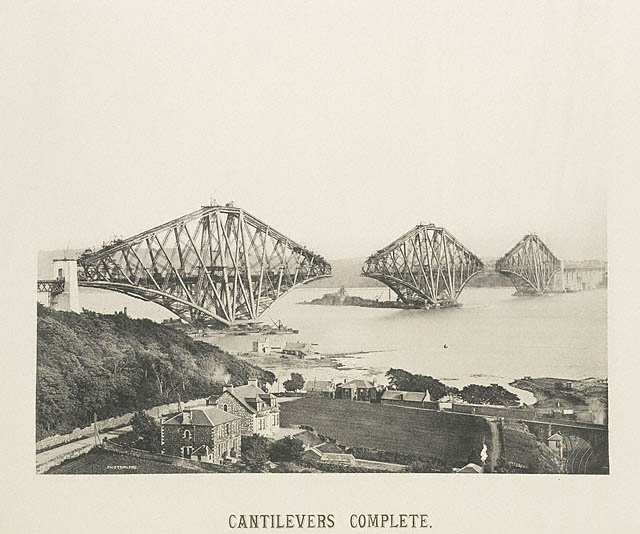
For example, the full-sized version of this photograph of the construction of the Forth bridge in Scotland is available for download:

Cantilevers Complete, 9th July 1889

Cantilevers Complete, 9th July 1889

This image is available for download, without charge, under the Getty’s Open Content Program.

John Fergus
Scottish, July 9, 1889
Photogravure

84.XB.874.3.1.34

Scotland’s Forth Bridge bridge was built to carry the two tracks of the North British Railway one and a half miles over the Firth of Forth between South Queensferry and North Queensferry, a hundred and fifty feet above high tide. This photograph shows the gargantuan structure’s recently completed cantilevers reaching across the firth like outstretched arms. The presence of this mighty bridge drastically altered both the landscape and the lives of nearby residents.

Requiring 55,000 tons of steel, 640,000 cubic feet of granite, and 8,000,000 rivets, the Forth Bridge remains one of the safest bridges in use today. Having witnessed the worst train disaster up to that time in the late 1800s, the Scottish public demanded an exceptionally sound structure. An earlier bridge had swayed and collapsed in the wind, killing seventy-five passengers and crew members on a passing night train. As a result the frightened public needed-and got-a bridge that looked as though it could never tumble down.

August 14, 2013

The “Indie Web” is the very definition of a fringe project

Filed under: Media, Technology — Tags: , , , , , — Nicholas @ 08:55

Wired‘s Klint Finley wants you to meet the indie hackers who want to jailbreak the internet (among other things):

One guy is wearing his Google Glass. Another showed up in an HTML5 t-shirt. And then there’s the dude who looks like the Mad Hatter, decked out in a top hat with an enormous white flower tucked into the brim.

At first, they look like any other gaggle of tech geeks. But then you notice that one of them is Ward Cunningham, the man who invented the wiki, the tech that underpins Wikipedia. And there’s Kevin Marks, the former vice president of web services at British Telecom. Oh, and don’t miss Brad Fitzpatrick, creator of the seminal blogging site LiveJournal and, more recently, a coder who works in the engine room of Google’s online empire.

Packed into a small conference room, this rag-tag band of software developers has an outsized digital pedigree, and they have a mission to match. They hope to jailbreak the internet.

They call it the Indie Web movement, an effort to create a web that’s not so dependent on tech giants like Facebook, Twitter, and, yes, Google — a web that belongs not to one individual or one company, but to everyone. “I don’t trust myself,” says Fitzpatrick. “And I don’t trust companies.” The movement grew out of an egalitarian online project launched by Fitzpatrick, before he made the move to Google. And over the past few years, it has roped in about 100 other coders from around the world.

August 13, 2013

The Gamers: Lodge’s Firefly Rant

Filed under: Media — Tags: — Nicholas @ 10:56

BONUS SCENE: Lodge tells Leo exactly how he feels about his favorite shows and the networks that cancelled them. Visit http://www.watchthegamers.com to watch all of The Gamers: Hands of Fate, beginning August 15th!

August 12, 2013

Online privacy and habitual oversharing

Filed under: Liberty, Media, Technology — Tags: , , , , — Nicholas @ 09:47

Cory Doctorow explains why so many of us have gotten into the habit of oversharing personal details in our social media activities:

Whenever government surveillance is debated, someone inevitably points out that it is no cause for alarm, since people already overshare sensitive personal information on Facebook. This means there’s hardly anything to be gleaned from state surveillance that isn’t already there for the taking on social media.

It’s true people overshare on social networks, providing information in ways that they later come to regret. The consequences of oversharing range widely, from losing a job to being outed for your sexual orientation. If you live in a dictatorship, intercepted social media sessions can be used by those in charge to compile enemies lists, determining whom to arrest, whom to torture, and – potentially – whom to murder.

The key reason for oversharing is that cause and effect are separated by volumes of time and space, so understanding the consequences can be difficult. Imagine practising penalty kicks by kicking the ball and then turning around before it lands; two years later, someone visits you and tells you where your kicks ended up. This is the kind of feedback loop we contend with when it comes to our privacy disclosures.

In other words, you may make a million small and large disclosures on different services, with different limits on your sharing preferences, and many years later, you lose your job. Or your marriage. Or maybe your life, if you’re unlucky enough to have your Facebook scraped by a despot who has you in his dominion.

August 11, 2013

Debunking the “Cameron’s gunboat diplomacy” meme

Filed under: Britain, Europe, Media — Tags: , , , — Nicholas @ 09:22

Sir Humphrey points out that the British media’s collective gasp about Royal Navy ships being sent to Gibraltar merely highlights what a slow news month it is:

It’s an amusing irony that the recent row in Gibraltar has suddenly given the Royal Navy more publicity about its forthcoming COUGAR deployment in one evening, than it may have got in several months of deployment. The news that the Response Force Task Group (RFTG) is deploying to the Med has been seen as a clear example of gunboat diplomacy by Fleet Street’s finest, many of whom seem terribly keen on starting a war in order to fill column inches during a slow news month…

Its perhaps worth noting that this deployment is extremely long standing — the sort of planning which goes into deploying a major Task Force will usually commence at around 12 months prior to the event, when the rough outline of a plan is put together on the objectives of the deployment, likely ports, aims and intended outcomes and so on. While maritime power is about flexibility, it’s often forgotten that most RN deployments these days are the end product of months of well co-ordinated planning and staffing to ensure that the UK gets the best possible value from its naval assets.

[…]

What we can perhaps draw from this is that firstly the RN has enjoyed an unexpected boon of coverage, tapping into the nation’s subliminal psyche which holds that sending a grey hull is a key means of solving a crisis, no matter what or where the crisis is. There is perhaps work for some analysts to understand why, almost alone among all major powers, the cries of ‘send a gunboat’ seem to resonate most strongly in the UK (albeit to a lesser extent the same applies with the ‘send a carrier’ debate in the US). While deployments of warships can be seen as a useful indicator of interest in situations, it appears to be held most strongly in the UK — there is, at times, a fervent belief that deploying vessels is akin to the legend of waving the ancient banner three times in order for Arthur and his knights to appear — it makes little practical sense, but is somehow strangely comforting to the people.

August 9, 2013

Greg Jennings trolls the Packers yet again

Filed under: Football, Media — Tags: , , , — Nicholas @ 08:40

Greg Jennings was Minnesota’s big name signing over the offseason. He was brought in from the Green Bay Packers (who have a surplus of good receivers) to at least partially fill the hole in the roster from the departure of Percy Harvin. Since he arrived in Minnesota, Jennings has been a veritable cornucopia of media-worthy gems of casual abuse directed at his former team (and Aaron Rodgers in particular). Jim Souhan says this is a good thing:

It began as a strange and unnatural occurrence, like one of those unverified online photos of a chimp hanging out with a bird. Now it’s threatening to become a bizarre tradition, or, as the kids so eloquently put it, “a thing.”

Every four years or so, the Vikings should steal one of the Packers’ best offensive players, just to create the kind of sideshow that can make even training camp interesting.

In 2009, and 2010, and into 2011, Brett Favre turned the already fascinating Vikings-Packers rivalry into something it had never before been on any meaningful level: incestuous.

In 2013, Greg Jennings is one-upping Favre, not in terms of existential angst and passive aggressiveness, but with new-age, self-aware, YouTube-able, Twitter-ready, Facebook-enflaming, border-crossing Scud missiles designed to invoke an emotional response even if they miss the target.

Jennings, the new Viking and former Packer receiver, is, as the kids say, “trolling” his former team. If you’re too young to know what “trolling” is, just listen to Jennings a few times, and you’ll get the idea.

In July, in an interview with the Star Tribune’s Dan Wiederer, he poked holes in the flawless image of Packers quarterback Aaron Rodgers, raising or confirming questions about Rodgers’ ego and leadership skills.

This week, Jennings told KFAN that the Packers had “brainwashed” him into believing that Green Bay was the land of milk and honey-flavored cheddar, that operations such as the Vikings were inherently flawed.

If true, that’s fascinating. If not, Jennings is fascinating.

« Newer PostsOlder Posts »

Powered by WordPress
