Quotulatiousness

September 5, 2013

Youth soccer without keeping score? Too competitive for our kids

Filed under: Cancon, Humour, Media, Soccer — Tags: , , , — Nicholas @ 08:16

While I’m pretty sure this is a fake news item that the CBC should have run on April 1st, it’s amusing enough to link:

With the growing concern over the effects of competition in youth sports programs this summer, many Canadian soccer associations eliminated the concept of keeping score. The Soccer Association of Midlake, Ontario, however, has taken this idea one step further, and have completely removed the ball from all youth soccer games and practices.

According to Association spokesperson, Helen Dabney-Coyle, “By removing the ball, it’s absolutely impossible to say ‘this team won’ and ‘this team lost’ or ‘this child is better at soccer than that child.'”

“We want our children to grow up learning that sport is not about competition, rather it’s about using your imagination. If you imagine you’re good at soccer, then, you are.”

For reference, a quick Google search for “Midlake, ON” only comes up with links to this story and random uses of “mid-lake” in unrelated posts.

H/T to Doug Mataconis for the link.

September 4, 2013

“Despite a rash of deadly train crashes…”

Filed under: Media, Railways — Tags: , , , , — Nicholas @ 09:15

Coyote Blog indulges in a good old-time fisking of an article built on the claim that there has been a “trend” of increasingly deadly railway accidents:

The best way to explain the phenomenon is with an example, and the Arizona Republic presented me with a great one today, in the form of an article by Joan Lowy of the Associated Press. This in an article that reads more like an editorial than a news story. It is about the Federal requirement for railroads to put safety electronics called Positive Train Control (PTC) on trains by a certain date. The author has a pretty clear narrative that this is an absolutely critical piece of equipment for the public good, and that railroads are using scheming and lobbying to unfairly delay and dilute this critical mandate (seriously, I am not exaggerating the tone, you can read it for yourself.)

My point, however, is not to challenge the basic premise of the article, but to address this statement in her opening paragraph (emphasis added).

    Despite a rash of deadly train crashes, the railroad industry’s allies in Congress are trying to push back the deadline for installing technology to prevent the most catastrophic types of collisions until at least 2020, half a century after accident investigators first called for such safety measures.

The reporter is claiming a “rash of deadly train crashes” — in other words, she is saying, or at least implying, that there is an upward trend in deadly train crashes. So let’s ask ourselves if this claimed trend actually exists. She says it so baldly, right there in the first seven words, that surely it must be true, right?

[…]

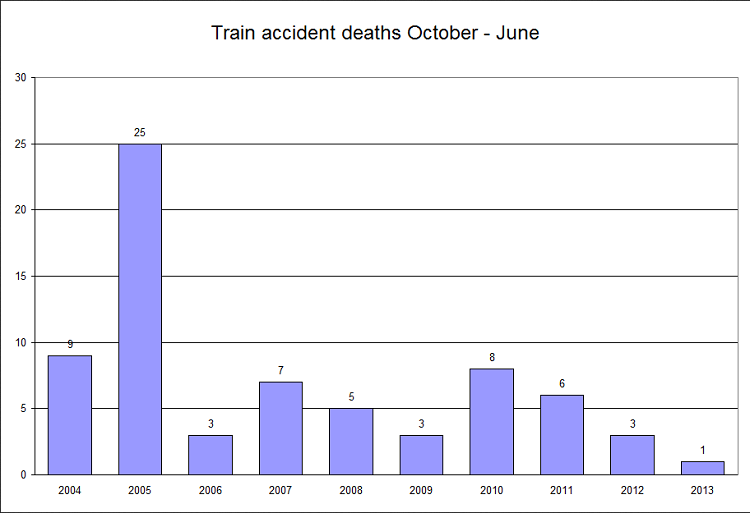
So let’s go to the data. It is actually very easy to find, and I would be surprised if Ms. Lowy did not actually have this data in her hands. It is at the Federal Railway Administration Office of Safety Analysis. 2013 data is only current through June and seems to be set up on an October -September fiscal year. So I ran the data only for October-June of every year to make sure the results were comparable to 2013. Each year in the data below is actually 9 months of data.

By the way, when one is looking at railroad fatalities, one needs to understand that railroads do kill a lot of people every year, but the vast, vast majority of these — 99% or more — are killed at grade crossings. People still do not understand that a freight train takes miles to stop. (see postscript below, but as an aside, I would be willing to make a bet: Since deaths at grade crossings outnumber deaths from collisions by about 100:1, I would be willing to bet any amount of money that I could take the capital the author wants railroads to invest in PTC and save far more lives by investing it in grade crossing protection. People like Ms. Lowy who advocate for these regulations never, ever seem to consider prioritization and tradeoffs.)

Anyway, looking at the data, here is the data for people killed each year in US railroad accidents (as usual click to enlarge any of the charts):

Train accident deaths Oct-Jun

So, rather than a “rash”, we have just the opposite — the lowest number of deaths in a decade. One. I will admit that technically she said rash of “fatal accidents” and this is data on fatalities, but I’m going to make a reasonable assumption that one death means one fatal accident — which certainly cannot be higher than the number of fatal accidents in previous years and is likely lower.

Most of you will agree that this makes the author’s opening statement a joke. Believe it or not — and this happens a surprising number of times — this journalist is claiming a trend that not only does not exist, but is of the opposite sign.

September 3, 2013

Social media and the new alienation problem

Filed under: Media, Technology — Tags: , , , — Nicholas @ 08:50

Russell Taylor went to a wedding recently, in a rural area outside the range of cell towers and wifi signals. Some of his fellow guests treated the lack of connectivity as if it were the end of the world. The constant need to be “connected” has other unhealthy aspects:

Where social media differs from telephone, radio or television is in turning its users into broadcasters. This makes it useful as a business tool and as a gazette for news of interest to family and loved ones; but it also enables bores and exhibitionists to publish their every passing thought. This self-absorbed waffling does little to bring people together. On the contrary, it appears to distort their perception of others, until they become mere abstractions: bit-part players in the story of their lives.

This phenomenon was seen in extremis in the reaction of onlookers to the murder of Drummer Lee Rigby earlier this year. Rather than running to his aid, finding a policeman or simply freezing in terror, dozens of bystanders whipped out their phones and started filming the horror show unfolding before them. Possibly they figured that by the time the police had done a risk assessment and checked their diversity training was in order, the killers would be at home with their feet up; in which case, capturing some incriminating video evidence was the responsible thing to do. But I doubt it. It’s far more likely that they saw someone being butchered and simply thought, “Wait until they see this on Facebook”.

When your first reaction to seeing someone murdered is to film it and post it online, you are no longer an active moral being; you’re a detached observer of the world around you. If this is a symptom of the always-connected age, so too is faux concern. Consider those Facebook posts that ask you to ‘like’ a sob story about a complete stranger. They have to be among the most pitiful and inauthentic expressions of human emotion ever devised, making the wearing of a charity wristband look like donating a kidney by comparison. When someone being hacked to death is an exciting ‘I was there’ moment and compassion is demonstrated by means of a mouse-click, something is seriously awry with our moral compass.

The big question is whether social media has contributed to this apparent atomisation of society, or if people’s use of it is merely a symptom. Or could the relationship between the two be dialectical? If so, habitual users of social media can expect to see their usage increase as their resemblance to well-adjusted human beings diminishes. Time will tell how much further they have to fall, but once you start treating murder as status update gold, you must already be somewhere near the bottom.

September 2, 2013

This month in moral panic watch – “rape porn”

Filed under: Britain, Government, Media — Tags: , , , , , — Nicholas @ 09:24

British PM David Cameron has decided that it’s the duty of his government to crack down on internet pornography. In particular, the British government will be attempting to stamp out violent pornography, aka “rape porn”. This may not be his best idea ever:

Lobby organisations like “End Violence Against Women” and sensationalist news rags like the Daily Mail repeatedly claim that watching violent pornography increases sexual abuse and rape by men.

However, the scientific evidence has stubbornly refused to play along with this view:

U.S. Commission on Obscenity and Pornography (1970) found no evidence of a causal link between pornography and rape

Pornography and rape: theory and practice? Evidence from crime data in four countries where pornography is easily available” (1991) B Kutchinsky

Examined what happened to the rape statistics in four countries (USA, Denmark, West Germany and Sweden) during periods where the availability of violent pornography went from extreme scarcity to relative abundance.

Quoting the report: “The results showed that in none of the countries did rape increase more than nonsexual violent crimes. This finding in itself would seem sufficient to discard the hypothesis that pornography causes rape

There’s also the problem that pornography is actually quite popular — with both male and female users — over 40% of all internet users view pornography voluntarily. In fact, large numbers of women admit to enjoying rape fantasies:

Whether the puritans or the feminists like it or not, it is a fact that many women enjoy rape fantasies as explained by this female journalist.

Erotic literature such as Fifty Shades of Grey featuring bondage, spanking, hair pulling, fisting and pinwheeling generated sales of over £10M in six months, to a predominantly female audience.

On a more scientific level, a 1988 study by Pelletier and Herold found that over half of their female respondents had fantasies of forced sex.

Nobody (quite rightly) suggests that women who expose themselves to this sort of “violent porn” literature, or who engage in sexual fantasies of rape are more likely to go out and put themselves into situations where they will be raped.

People clearly understand that there is a world of difference between enjoying rape as a sexual fantasy and the violent, painful reality of actual rape.

The same reasoning must logically apply to men who enjoy rape fantasy and rape porn. There is a world of difference between enjoying rape as a sexual fantasy and the violent reality of actual raping another human being.

To assert that women can enjoy rape fantasy, porn and violent BDSM literature without harm because they understand the difference between fantasy and reality, but men do not is nothing more than misandry.

September 1, 2013

Humans are both pattern-seeking and pattern-interpreting creatures

Filed under: Media, USA — Tags: , , — Nicholas @ 09:29

In the Wall Street Journal, Jesse Walker has another excerpt from his new book, this time on the phenomenon known as pareidolia:

This November will mark the 50th anniversary of two events that are of special interest to conspiracy buffs. One is the assassination of President John F. Kennedy, a killing that has spawned dozens of theories about the hidden forces that allegedly carried out the crime. The other is a lecture the historian Richard Hofstadter delivered at Oxford, which Harper’s later published under the title “The Paranoid Style in American Politics.” Half a century of scholarship has either built on or pushed back against Hofstadter’s conclusions, some of which don’t hold up very well. But it remains the most widely cited essay on American political paranoia.

Some conspiracies are real, of course, but even a conspiracy theory that is entirely false has truths to tell us about the anxieties and experiences of the people who believe it. More, it tells us something about the ways people perceive the world.

[…]

The faces are the result of apophenia, the process of projecting patterns onto data. More specifically, they are pareidolia, in which those patterns are perceived as meaningful shapes or sounds. It is pareidolia that allows us to see a man in the moon, to hear a satanic incantation when “Stairway to Heaven” is played backward, or to conjure the image of your subconscious choice while taking a Rorschach test. Indeed, pareidolia makes the whole world a Rorschach test. The Web is filled with delightful pareidolia-themed photo sets, in which unexpected forms appear in mountains, pasta, fire, clocks, clouds.

[…]

Human beings have a knack not just for finding patterns in chaos but for constructing stories to make sense of events, especially events that scare us. And a conspiracy story is especially enticing because it imagines an intelligence behind the pattern. It doesn’t just see a shape in the smoke; it sees a face in the smoke.

We will never stop finding patterns. We will always be capable of jumping to conclusions, particularly when we’re dealing with other nations, factions, subcultures or layers of the social hierarchy. And conspiracies, unlike many of the monsters that haunt our folklore, do exist sometimes, so we won’t always be wrong to fear them. As long as our species survives, so will political paranoia.

August 31, 2013

The leaders discuss the Syrian situation on Facebook

Filed under: Humour, Media, Middle East, USA — Tags: , , , — Nicholas @ 09:59

A rather amusing little squib from Best of Cain (via American Digest):

Cain - Facebook posts on Syria

August 29, 2013

Meet the Undercover Economist, Tim Harford

Filed under: Books, Economics, Media — Tags: , — Nicholas @ 08:36

A profile of economist and popular author Tim Harford in The Independent:

Tim Harford can’t help himself. We are navigating our way to lunch in an unfamiliar city and I am momentarily disorientated by the mass of visual paraphernalia at a busy crossing. My hesitation is his cue for a story about the Dutch traffic engineer who found that getting rid of excess street furniture forced car drivers to take more responsibility, dramatically slashing the number of accidents.

Welcome to the world as seen by Harford, a man who made his name explaining the economic rationale behind everything that we do. His tale about the late Hans Monderman is illustrative. Later, over a tableful of dim sum, he adds: “The world is a constant source of ideas for someone who thinks like an economist.”

His bestselling “Undercover Economist” books have made him a founding member of the new tribe popularising the dismal science; not before time given the circumstances, you might add. His latest volume, The Undercover Economist Strikes Back, subtitled How to Run — or Ruin — an Economy, is out this week. It tackles the recent “titanic” mess and is his first foray into macroeconomics, also known as the “bigger picture”.

“It’s my job to figure out an interesting way to talk about these things, and a different angle that’s fun and memorable and tells people something about how the economy works…. I’ve always been much more of a micro guy — individual behaviour and the psychological elements of game theory were always my thing, so when I started, it felt like a sense of duty. But halfway through, the subject had won me over.”

[…]

As it happens, Harford, who turns 40 next month, didn’t intentionally study economics. His undergraduate PPE degree (philosophy, politics and economics) was the “classic Oxford degree for people who don’t know what to do”, and he spent his first year intending to drop economics at the end of it. Pressed by his tutor, after doing “really well”, he changed his mind and thus his life, not least because he met his wife while working at Shell, in the scenario planning team for a certain Vince Cable.

Despite starting out in a job that required forecasting, Harford is defensive of his profession, which is much maligned for not predicting the global crash. “Economists have allowed themselves to walk into a trap where we say we can forecast, but no serious economist thinks we can,” he says, pointing again to a Keynes quote, this time aligning economists and dentists. “You don’t expect dentists to be able to forecast how many teeth you’ll have when you’re 80. You expect them to give good advice and fix problems. We’ve allowed ourselves to become really bad weather forecasters, which is a shame.”

August 27, 2013

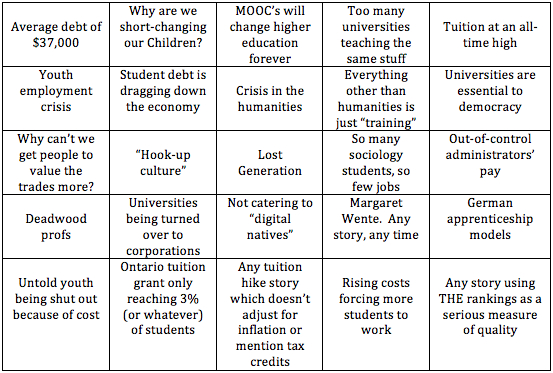
Hey, Kids! It’s time for back-to-school bad journalism bingo!

Filed under: Education, Humour, Media — Tags: , , — Nicholas @ 10:57

The slow news days of August have reached the traditional back-to-school phase of page filling:

I love back-to-school time: the joy, the energy, the sense of limitless possibilities. It’s almost enough to make you forget about the tsunami of dreadful journalism that accompanies it.

There are basically three reasons for bad back-to-school journalism. First, higher education is complicated; it doesn’t lend itself to the simplistic narratives required for 800-word articles. Second, there’s a serious lack of decent data about higher education in Canada, what with the Millennium Scholarship Foundation gone, HRSDC no longer funding any decent Statscan surveys, and provinces and universities holding on tightly to their own data on the grounds that someone might use it to compare them against other provinces/institutions (and that would never do!). In this data vacuum, interested parties with their own agendas find it easy to peddle all sorts of demented, half-true factoids to journalists; hence, the frequent appearance of stories based on “data” which simply aren’t true.

The third problem is the lack of outcome measures. Everyone wants “good” education, but no one knows what that is. So journalists tend to fall back on input measures: small classes, students per professors, etc., which inevitably lead to a weird mythologizing of university life in the 1970s. Nothing wrong with the 1970s of course, but it somehow never quite clicks with op-ed writers that a major reason life was so great for students back then was that access was restricted to a fairly small elite, and that the comparative “failures” of today’s universities are largely the result of expanded access.

Here’s the Bingo card for you to play along at home:

Back to school bingo

August 26, 2013

Stephen Harper’s media aversion

Filed under: Cancon, Media, Politics — Tags: , , , — Nicholas @ 09:01

Michael Den Tandt seems puzzled that Stephen Harper and his staff treat the media as though they were a bunch of rancid/poisonous/radioactive zombies that would love to eat their brains on live TV:

Stephen Harper, it will sadden some to learn, is not an ogre or a troll. Nor are the members of his staff orcs, goblins, hobgoblins or cave wights out of Tolkien. They are all, shockingly, human beings.

Having spent the last week locked up with them cheek by jowl — the staffers that is, not the prime minister, more on that later — in rattletrap buses, dingy hotel basements and in the belly of a flying tank, I can attest that they work very hard. Managing a tour of the Arctic, on a very tight schedule, observed and criticized at all times by a gaggle of touchy, tired, grumpy journalists, can’t be anyone’s idea of fun. Yet I saw Harper’s staff do that, with good nature, resilience and aplomb for the most part.

But for the incident Friday afternoon, in which a Chinese journalist from a state-owned newspaper was prevented from asking a question of the PM and shoved a female staffer, last week’s Arctic tour, Harper’s eighth as prime minister, went off without a hitch, from a Conservative standpoint. He hit all the thematic and policy notes he intended to, appeared in a series of photo ops that reinforced those themes and policies, and avoided any major missteps. Another job done, on to the next.

That said, they — meaning Harper and the Conservatives — could be doing so much better than this. To watch the PM in action, up close, is to see repeated opportunities missed, for reasons that make little sense. Much of this appears to stem from his aversion to, and discomfort with, the national media.

Why, it’s almost as though Harper has learned not to trust the media or to allow them to get too close. I wonder how he’d have come to that conclusion? It’s a mystery, sure enough.

August 24, 2013

It’s still August … media struggles to fill gaps between the ads

Filed under: Cancon, Media — Tags: , , , , , — Nicholas @ 12:16

In Maclean’s, Emily Senger goes after the biggest issue facing Canada today:

On Prime Minister Stephen Harper’s annual tours of the North, like the one he undertook this week, photographers know to be quick with their cameras whenever Harper mounts an ATV or gets down on the ground to fire a .303 Lee Enfield rifle. Whatever the photo opportunity, though, one thing is constant — the big, blaring CANADA brand frequently emblazoned across his chest or back.

The patriotic clothing line, from the Bay’s Olympic Collection, has become a staple for Harper at events where his go-to sport jacket and open-collar shirt are still too formal. During his 2011 election campaign, Harper wore the jacket for many a stump speech and to photo-ops, sporting it as he posed with preschoolers and bowled with seniors.

Apparently it’s now a big problem that the Prime Minister happens to like wearing a certain line of clothing. We’re back to our media’s sense of shame about anyone showing the slightest pride about Canada (see their collective whingeing about our Olympic teams, for example).

Then we’re treated to a quick review of how “proper” political leaders dress:

We don’t see U.S. President Barack Obama wearing a jacket emblazoned with a screaming bald eagle against a backdrop of stars and stripes (though, we wish he would). Instead, The U.S. president is known to clip a stars-and-stripes pin to his suit lapel. Likewise, U.K. Prime Minister David Cameron keeps his sartorial patriotism subtle, and has been spotted wearing Union Jack cufflinks.

See, rustic Canadians? Real leaders of real countries don’t need to advertise! You’re such yokels!

QotD: History and fiction

Filed under: Books, History, Media, Quotations — Nicholas @ 00:01

It’s possible to cut and slice history really any way you want to … That’s probably why history belongs more to the novelists and the poets than it does to the social scientists. At least we admit that we lie.

E.L. Doctorow, Essays and Conversations, 1983

August 23, 2013

The avant-garde is dead, dead, dead

Filed under: Books, History, Media — Tags: , , , , — Nicholas @ 09:03

In Salon, Tracy Clark-Flory talks to Camille Paglia about themes in her new book Glittering Images: A Journey Through Art From Egypt to Star Wars:

In Glittering Images, you argue that the avant-garde is dead. Are there any artists — be they painters or pop stars — who are making innovative work right now?

The avant-garde was a magnificent and revolutionary phase in the history of art, but it’s completely over. Artists and galleries must (in Ann Landers’ immortal words) wake up and smell the coffee! The avant-garde, whose roots were in late-18th-century Romanticism, was a reaction against a strong but suffocating classical tradition. The great modernist artists, from Picasso to James Joyce, were trained in that tradition, which gave audacity and power to their subversion of it.

But then modernism began to feed on itself, and it became weaker and weaker. As I argue in “Glittering Images,” there has been nothing genuinely avant-garde since Andy Warhol except for Robert Mapplethorpe’s luminous homoerotic images of the sadomasochistic underground. Everything that calls itself avant-garde today is just a tedious imitation of earlier and far superior modernist art. The art world has become an echo chamber of commercially inflated rhetoric, shallow ironies and monolithic political ideology.

In the past year, the only things that sparked my enthusiasm and gave me hope for an artistic revival were in pop music: Rihanna’s eerie “Pour It Up,” which uses a strip club as a hallucinatory metaphor for an identity crisis about sex and materialism, and the Savages’ slam-bang “City’s Full,” which channels the Velvet Underground and Patti Smith to attack (with gorgeously distorted, strafing guitars) the urban parade of faux-female fashion clones. The visual arts, in contrast, are being swamped by virtual reality.

Video games and YouTube.com are creatively booming, even though Web design, as demonstrated by the ugly clutter of most major news sites, is in the pits.

[…]

Earlier this year, you wrote a highly critical article about recent academic books on the world of kink. What do you wish that these academics would say about BDSM?

My principal complaint about those three books, all from university presses, was that their intriguing firsthand documentation of the BDSM community was pointlessly shot through with turgid, pretentious theorizing, drawn from the slavishly idolized but hopelessly inaccurate and unreliable Michel Foucault.

In this tight job market, young scholars are in a terrible bind. They have to cater to and flatter the academic establishment if they hope to survive. Furthermore, they have not been taught basic skills in historical investigation, weighing of evidence, and argumentation. There has been a collapse in basic academic standards during the theory era that will take universities decades to recover from. I was incensed that none of those three authors had read a page of the Marquis de Sade, one of the most original and influential writers of the past three centuries. Sade had a major impact on Nietzsche, whom Foucault vainly tried to model himself on. Nor had the three authors read The Story of O or explored a host of other crucial landmarks in modern sadomasochism. No, it was Foucault, Foucault, Foucault — a con artist who will one day be a mere footnote in the bulging chronicle of academic follies.

You’re such a beloved and divisive figure, I had to solicit questions from folks on Twitter. Here’s a funny one: “Why do you come down so hard on skinny white girls? Your views on sexuality leave so much room for individuality, so why is it so bad if I am attracted to Meg Ryan or Gwyneth Paltrow?”

When have I ever criticized anyone’s fetish? I am a libertarian. Go right ahead — set up plastic figurines of 1950s-era moppets to bow down to in the privacy of your boudoir. No one will scold! Then whip down to the kitchen to heat up those foil-wrapped TV dinners. I still gaze back fondly at Swanson’s fried-chicken entree. The twinkly green peas! The moist apple fritter! Meg Ryan — the spitting image of all those perky counselors at my Girl Scout camp in the Adirondacks. Gwyneth Paltrow — a simpering sorority queen with field-hockey-stick legs. I will leave you to your retro pursuits while I dash off to moon over multiracial Brazilian divas.

August 22, 2013

Exercises in “guerrilla ontology”

Filed under: Books, Humour, Liberty, Media — Tags: , — Nicholas @ 14:31

An excerpt from Jesse Walker’s new book The United States of Paranoia: A Conspiracy Theory has been posted at disinformation:

[Robert Anton] Wilson laid out the basic instructions for Operation Mindfuck in a memo sent to several friends (including [Paul] Krassner). Participants were “to circulate all rumors contributed by other members,” and they were “to attribute all national calamities, assassinations or conspiracies to the other member-groups.” The one great risk, he cautioned, was that “the Establishment might be paranoid enough to believe some wild legend started by one of us and thereupon round up all of us for killing Abraham Lincoln.”

So they sent a letter on Bavarian Illuminati stationery to the Christian Anti-Communist Crusade, just to confirm that “we’ve taken over the Rock Music business. But you’re still so naïve. We took over the business in the 1800s. Beethoven was our first convert.” Robert Welch of the John Birch Society got a letter informing him that Gary Allen was an Illuminati agent. When a New Orleans jury refused to convict one of the men Jim Garrison blamed for the JFK killing, Garrison’s booster Art Kunkin of the leftist Los Angeles Free Press received a missive from the “Order of the Phoenix Angel” revealing that the jurors were all members of the Illuminati. The telltale sign, the letter explained, was that none of them had a left nipple.

The Discordians planted stories about the secret society in various leftist, libertarian, and hippie publications, introducing the Illuminati to the counterculture. “We accused everybody of being in the Illuminati,” Wilson recalled. “Nixon, Johnson, William Buckley, Jr., ourselves, Martian invaders, all the conspiracy buffs, everybody.” But they

    did not regard this as a hoax or prank in the ordinary sense. We still considered it guerrilla ontology.

    My personal attitude was that if the New Left wanted to live in the particular tunnel-reality of the hard-core paranoid, they had an absolute right to that neurological choice. I saw Discordianism as the Cosmic Giggle Factor, introducing so many alternative paranoias that everybody could pick a favorite, if they were inclined that way. I also hoped that some less gullible souls, overwhelmed by this embarrassment of riches, might see through the whole paranoia game and decide to mutate to a wider, funnier, more hopeful reality-map.

Sixties TV – it was different if you were under 12

Filed under: Britain, Media — Tags: , , , , , — Nicholas @ 14:14

James Lileks looks at a few Gerry Anderson productions:

The Sixties - different under 12

Gerry Anderson! You’re going to get everything you need for crackerjack adolescent-satisfying sci-fi: spaceships, shuttlecrafts, computers, control rooms, crisp commanding officers, futuristic gadgets, and a big score. And none of it will work half as well as you hoped. The spaceships will look great, though. The computers will blink and there will be switches, but nothing makes Star Trek Sounds. The control rooms are clean but everyone is talking in a British accent for some reason, like they have their own NASA that’s just as big. The gadgets are okay. The score has a trademark echoey quality you found in soundtracks, particularly British ones, from the late 60s to the early 70s. It should be good! Why isn’t it great?

I’ve pondered that mystery for a long time. Sometimes you have a revelation — hey, the founding concept of “Space: 1999 was really stupid” — or you carp about the details, wondering why the UFO interceptors went hunting with one (1) missile that required a direct hit to be effective, instead of just blowing the hell out of the area. Then you realize it’s not great because it’s all the work of someone who made horribly grinning square-headed puppets, that’s why, and never stopping thinking he was making entertainment for 8 years olds.

[…]

The title theme is here, complete with oddly romantic piano interlude. It’s every Barry Grey piece that ever left me cold, right there. In general I just don’t feel Barry Grey’s music — except for the opening of the “Space 1999” theme before it goes full whacka-chicka, and of course that other theme. Here’s a guy who wrote miles and miles of scores for things like “Supercar,” for heaven’s sake, and he turns around and knocks off the tightest, sharpest theme of the 70s.

Still, Laurie Johnson was better.

Chinese government philosophy in the headlines

Filed under: China, Government, Media — Tags: , , , — Nicholas @ 12:57

Jon, my former virtual landlord, sent me this link and said “Does this sort of thing really matter any more? Aren’t all governments doing this?”

Under Tocqueville’s Influence, China Chooses Despotism
Paul A. Rahe

In the last few days, the national press has been full of reports suggesting that China’s new President, Xi Jinping, is orchestrating a revival of Maoism and a crackdown on those in China who would like to introduce within that country the procedures, practices, and institutions that distinguish the West: the rule of law, constitutionalism, freedom of the press, judicial independence, civil associations, and “universal values” – which is to say, a respect for human rights. The Wall Street Journal, which broke the story on Saturday, claims that Xi is receiving strong support from former President Jiang Zemin; and on Monday The New York Times filled in some of the details:

    Communist Party cadres have filled meeting halls around China to hear a somber, secretive warning issued by senior leaders. Power could escape their grip, they have been told, unless the party eradicates seven subversive currents coursing through Chinese society.

    These seven perils were enumerated in a memo, referred to as Document No. 9, that bears the unmistakable imprimatur of Xi Jinping, China’s new top leader. The first was “Western constitutional democracy”; others included promoting “universal values” of human rights, Western-inspired notions of media independence and civic participation, ardently pro-market “neo-liberalism,” and “nihilist” criticisms of the party’s traumatic past.

    Even as Mr. Xi has sought to prepare some reforms to expose China’s economy to stronger market forces, he has undertaken a “mass line” campaign to enforce party authority that goes beyond the party’s periodic calls for discipline. The internal warnings to cadres show that Mr. Xi’s confident public face has been accompanied by fears that the party is vulnerable to an economic slowdown, public anger about corruption and challenges from liberals impatient for political change.

[…]

The evidence now suggests the contrary — that Wang Qishan is by no means alone in his convictions, that Xi Jingpin and his lieutenants take quite seriously the possibility that China is in a pre-revolutionary situation, and that they are intent on putting a lid on everything. Where Tocqueville might have suggested that the way forward was for the country’s leaders to embrace the “seven subversive currents,” to carry out a revolution from above, and to gradually introduce into the country the rule of law, constitutionalism, freedom of the press, judicial independence, civil associations, and a respect for human rights, they have decided in this year — the 120th anniversary of Chairman Mao’s birth — to return to the path he charted more than 60 years ago.

« Newer PostsOlder Posts »

Powered by WordPress