
Before Auto-Tune, if you wanted to make money in pop music, you sort of had to be able to sing. It wasn’t absolutely necessary, of course. You used to be able to mumble into a microphone, then the producer would put all sorts of sturm und drang all around it, and you could have a hit; see: Don’t You Want Me Baby, by Human League. But crooners have an easier time of it, and have less trouble having more than one bite of the top forty apple.
Crowded House was one of those eighties bands — A Flock of Seagulls; ABC, The Bangles; Thompson Twins; Duran Duran; Escape Club; The Fixx; Simple Minds; Simply Red; Howard Jones; XTC; Dan Hartman; Icehouse; Level 42; Psychedelic Furs; Hair Cut 100; Tears for Fears; Wang Chung; World Party — bands that are growing interchangeable with the decades slipping by. If you put them all on the same bill, and they all wore matching suits, they could all play each other’s tunes and not many people would notice. But you always notice when people sing well.
Sippican Cottage, “Pure Pop For Then People — Crowded House”, Sippican Cottage, 2013-09-17
September 18, 2013
QotD: 80’s pop music
September 17, 2013
Revisiting “Sherlock Holmes and the case of public domain”
If you’ve been following along at home, the estate of Sir Arthur Conan Doyle has been conducting a remarkable rearguard campaign to ensure that the last ten Sherlock Holmes short stories do not enter public domain. Earlier this year, we looked at The case of the over-extended copyright and Sherlock Holmes and the case of public domain. The estate is now involved in a lawsuit where TechDirt‘s Mike Masnick says they are pushing a theory of copyright that might work to infinitely extend copyright protection to certain works:
For a few years now we’ve discussed a few times some of the confusion as to why Sherlock Holmes isn’t considered in the public domain in the US, even though he probably should be. As we’ve explained, all of Sir Arthur Conan Doyle’s Sherlock Holmes books except for one are in the public domain. The Conan Doyle estate claims that having that single book under copyright means that the entire character is covered by copyright. Earlier this year, we pointed out that a noted Sherlock Holmes scholar (such things exist!) named Leslie Klinger had decided to file for declaratory judgment that Sherlock Holmes is in the public domain, following a legal nastygram from the Estate, arguing that it needed a license fee for Klinger’s latest book.
The Conan Doyle Estate has now filed its response to the motion for summary judgment, and it’s an astounding study of ignorance concerning copyright law and the public domain. While it admits that there are only ten short stories (from that one remaining book) that are under copyright, it still argues that those ten stories lock up pretty much everything else. First, it argues that the characters of Sherlock Holmes and Dr. Watson continued to grow as personalities in those last ten stories, and that the stories were non-linear (i.e., some took place earlier in their fictional lives), it more or less encompasses everything, even those public domain works.
The facts are that Sir Arthur continued creating the characters in the copyrighted Ten Stories, adding significant aspects of each character’s background, creating new history about the dynamics of their own relationship, changing Holmes’s outlook on the world, and giving him new skills. And Sir Arthur did this in a non-linear way. Each of the Ten Stories is set at various points earlier in the two men’s lives—and even late stories create new aspects of the men’s youthful character. In other words, at any given point in their fictional lives, the characters depend on copyrighted character development.
Of course, if that’s true, it basically presents a way to make copyright on characters perpetual. You just need to have someone continue to release new works that have some minor change to the character, and they get to pretend you have a new starting point for the public domain ticker. That can’t be what the law intended.
Update, 3 January 2014: In a slight surprise, the court has ruled that the character is no longer protected under US copyright laws.
Update the second, 17 June 2014: The appeal has been heard, and the original decision has been confirmed and the characters of Sherlock Holmes and Doctor Watson are in the public domain in the United States.
It is legal to publish stories about Sherlock Holmes and Dr. Watson without the permission of their creator’s estate, because those characters are in the public domain. That’s a straightforward reading of current copyright law, and the Seventh Circuit confirmed it yesterday, upholding a lower court’s ruling that Holmes fan Leslie Klinger has the right to edit an anthology of Sherlock stories by contemporary writers.
It’s a welcome decision. The argument offered by Arthur Conan Doyle’s estate rested on the fact that 10 Sherlock stories were published after 1923 and therefore have not yet entered the public domain. Because those stories introduced new elements to Holmes’ and Watson’s fictional lives, the estate’s attorneys claimed that the characters were not fully created until after 1923 and therefore aren’t in the public domain after all. At a time when copyright terms are constantly being extended into the future, the estate was effectively attempting to enact a stealth extension into the past.
The flaw in “nudging”
Coyote Blog looks at the flourishing “nudge” sector of government activity and points out one of the biggest flaws:
The theory behind the idea that government should nudge (or coerce, as the case may be) us into “better” behavior is based on the idea that many people are bad at delay discounting. In other words, we tend to apply huge discount rates to pain in the future, such that we will sometimes make decisions to avoid small costs today even if that causes us to incur huge costs in the future (e.g. we refuse to walk away from the McDonalds french fries today which may cause us to die of obesity later).
There are many problems with this theory, not the least of which is that many decisions that may appear to be based on bad delay discounting are actually based on logical and rational premises that outsiders are unaware of.
But the most obvious problem is that people in government, who will supposedly save us from this poor decision-making, are human beings as well and should therefore have the exact same cognitive weaknesses. No one has ever managed to suggest a plausible theory as to how our methods of choosing politicians or staffing government jobs somehow selects for people who have better decision-making abilities.
September 15, 2013
Why “Breaking Bad: Canada” is a ludicrous meme
Megan McArdle is a fan of the TV show Breaking Bad, but she also is fairly well informed about the US healthcare system. This means that the idea that the TV show’s Canadian counterpart would look like this…
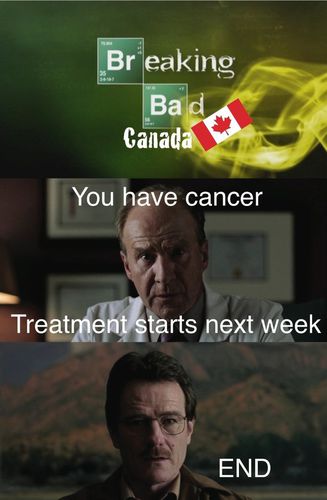
…depends on the audience for the real TV show not actually knowing much about the US system.
The series starts with Walter White, a high school chemistry teacher in Albuquerque, New Mexico, who is diagnosed with lung cancer. His lousy health maintenance organization won’t cover a decent doctor, or treatment. So Walter is forced to turn to crime just to pay his medical bills and … whoa, wait a minute. You know who has excellent benefits, compared with basically everyone else in the country? Teachers, firefighters and cops. Maybe they’re overworked and underpaid, but the one thing that you cannot say about them is that they’re forced to endure shoestring health-care plans. According to the Internet, Albuquerque school district employees are eligible for
Medical, Dental, Vision, Basic and Additional Life Insurance, Long Term Disability, Pre-tax Insurance Premium Plan (PIPP), Flexible Spending Accounts, Long Term Care Insurance, 403(b) and the 457(b) Deferred Compensation Plans.
That’s a generous package. Moreover, the Albuquerque school district self-insures, so any complaints about benefit levels should be directed at the city government, not your “lousy HMO.”
Later, after Walt’s actions accidentally result in the shooting of his brother-in-law, a Drug Enforcement Agency agent, Walt’s wife takes a bunch of the meth money to pay for Hank’s treatment. On his government salary, Hank can’t possibly afford the treatment he needs, because, of course, his lousy insurance policy won’t cover more than a few visits to the physical therapist … and whoa, we just went from “unrealistic” to “ludicrous.” You know who has even better benefits than employees enjoying a compensation package collectively bargained with a local government? Federal employees in a low-cost state such as New Mexico. Moreover, extra benefits are available to people injured in the line of duty.
In short, a number of key plot points hinge on the improbable assertion that people who actually enjoy some of the best health insurance in the country actually suffer some of the worst — so bad that we are expected to believe that Walt had no choice but to cook meth to cover the gaps. For an otherwise great show, this is incredibly silly.
September 14, 2013
Highlights of the 2013 Ig Nobels
At Ars Technica, Dean Burnett rounds up the wins and near-misses of the 2013 Ig Nobel awards:
This year’s Ig Nobel prizes were awarded on September 12 at a meeting of nerds at Harvard University. The prizes are given for genuine scientific research that “first makes people laugh and then makes them think.”
So, at first glance, the research may strike you as somewhat baffling, surreal or even downright ridiculous. But science is rarely frivolous. None of the experiments awarded an Ig Nobel will have been the result of casual whims or unplanned notions, like the cast of TV series Jackass being set loose in a laboratory. If any of the prize-winning experiments really are “mad,” it is a determined, dedicated, thorough sort of madness that is probably a lot more worrying in the long run.
Like the Nobels, the Ig Nobels are awarded for individual categories.
[…]
Psychology
The Ig Nobel for psychology went to Laurent Bègue and colleagues for showing through experiment that drunk people consider themselves more attractive. With alcohol such a common intoxicant the world over, analysis of its effects on human behavior is never not-relevant. People may think it’s obvious that drunk people find themselves more attractive, but that’s never been objectively demonstrated. And with alcohol having so many knock-on effects for society, assessing how it affects people’s behavior is always potentially useful.
This award must be doubly welcome after the original experiment about whether drunk people are more aggressive if you spill their drinks had to be abandoned due to the hospitalization of several post-docs.
[…]
Probability
Bert Tolkamp and colleagues showed that cows are not more likely to lie down if they have been standing up for a longer time. Ergo, cows don’t get tired. This could be useful data for the agricultural industry.
This study was chosen ahead of the other favorite, a study titled “The defecation habits of wild bears in areas of high forestation.”
September 12, 2013
September 11, 2013
L.Neil Smith responds to Allison Benedikt’s “manifesto”
In the latest Libertarian Enterprise, L. Neil Smith calls for “Public schools delenda est” in response to Benedikt’s paean to the glories of government-run schools:
Which brings us to the subject of today’s diatribe, an article I was directed to (hat-tip to Tatiana Covington) on Slate.com, awkwardly entitled, “If You Send Your Kid to Private School, You Are a Bad Person — A Manifesto”. This unintelligent but very revealing piece, posted Thursday, August 29, 2013, was written by somebody called Allison Benedikt, who slings a keyboard like some breathless high school cheerleader, but is apparently a movie critic for the Chicago Tribune.
As Joe-Bob would say, check it out.
What this little death-dealer proposes — “demands” would be more accurate — is that all private schools be outlawed (whoops there go the First, Fourth, Fifth, Ninth, and Tenth Amendments) and everybody forced to send their children to, and participate in the public school system. (Later in the essay she denies wanting to outlaw private schools, but, as we all know, consistency is the hobgoblin of small minds.)
This is, given the unignorable temper and tendency of our times, exactly like seeing the private structure of the Internet demolished, and then being compelled at bayonet-point (Why is it that liberals never seem to remember that the law, no matter how noble it may sound or high-minded its intentions, consists of nothing but brute force: guns, clubs, noxious sprays, and tasers?) to go back to the United States Postal System or the good old mercantilist Bell Telephone monopoly.
“Progressives”? I call them regressives.
What’s more, she issues this bizarre edict — which she labels a “manifesto” — not for the sake of your children, nor even for their children down the road. In words straight from an Ayn Rand villain’s mouth (what critic says real people don’t talk like this?), she says this: “Your children and grandchildren might get mediocre educations in the meantime, but it will be worth it, for the eventual common good.”
Yes, she openly admits that your progeny will probably suffer, educationally (and no doubt otherwise — look at the extracurricular activities she admits to), as a result of being forced back into the public system as it exists and operates today. she waxes positively lyrical over the egalitarian ecstasy of attending school with individuals more likely to knife somebody for a pair of shoes than she is.
She keeps congratulating herself on how well she turned out, even as she almost brags at how badly educated she is — and demonstrates it with her writing. Would she brag if she knew she’s an enabler of democide?
September 10, 2013
Julian Assange thinks Cumberbatch sounds nothing like him
Wired‘s Angela Watercutter on the amusing report that Julian Assange seems to be the only person who thinks Benedict Cumberbatch’s accent is wrong:
Going into the making of The Fifth Estate, Benedict Cumberbatch had a tough task ahead: Resembling Julian Assange – a complex figure with a well-known public persona. And while Cumberbatch’s final performance in the film does the WikiLeaks founder justice, there’s one person who took issue with his accent: Assange himself.
In a video interview with Marc Fennell that was posted just a few days before the film premiered at the Toronto International Film Festival, the WikiLeaks founder said that the Australian accent Cumberbatch – a Brit – uses in the film was “grating.” Only, in the video he sounds eerily similar to the man whose performance he’s saying sounds nothing like him – an irony not lost on Fifth Estate director Bill Condon.
“It is crazy, isn’t it? I heard it before I saw it, and they sounded identical, and I thought that was really funny,” Condon said in an interview with WIRED. “Who actually can hear their own voice, I guess, right? That proves that. Benedict hasn’t seen it yet, but we just talked about it over lunch and he’s dying to.”
In the video (above) Assange, who once called Condon’s film the “anti-WikiLeaks” movie, also calls out the director for instructing Cumberbatch to portray him as a “sociopathic megalomaniac.” (Assange doesn’t cite his source, but he may be referencing comments Cumberbatch recently made in Vogue, stating that when it came to the stage direction in an early version of the script, the actor and director “collided paths because Bill did seem to be setting him up as this antisocial megalomaniac.”) But Condon said that characterization doesn’t come through in the film.
September 9, 2013
Kafkatrapping
Christopher Taylor on the way to shut down an opponent’s argument by accusing them of a thoughtcrime:
Another nifty trick is to accuse someone of something because you don’t care for what they think or say, then if they deny it, call that proof of their evil. It’s called Kafkatrapping, and it works like this: “if you start anything with the words ‘I’m not racist’ well that’s proof you are.” Don’t like someone’s position but cannot factually or rationally refute it? Just Kafkatrap them.
The term Kafkatrapping comes from the book The Trial by Kafka in which the victim is accused of undefined crimes against humanity and destroyed by his denying them. It works like this:
Person A: Its sad that men are raped so much more than women in America.
Person B: You’re a sick sexist for even suggesting that.
Person A: but its true, see this report from the Obama administration? I’m not sexist, I’m just telling you the facts.
Person B: Your refusal to admit your sexist nature is proof of it.
Just denying your guilt is called proof of it and all rational discussion breaks down because it has become pointless. The argument is not based on facts, truth, reason, or intellectual inquiry, it is a schoolyard argument from the 5th grade which has nothing to do with truth. Its about destroying your opponent, keeping your position intact, and making the other person look bad.
And its inevitable that when people reject reason and objective truth, they’re reduced to childish arguments from emotion and strength. Its all you have left, and all you can use. The more this becomes predominant in a society, the more effective it becomes because people are less and less equipped to even begin to debate rationally.
September 7, 2013
Maybe the conspiracy theorists just aren’t paranoid enough
Bruce Schneier on the destruction of public trust in government agencies:
I’ve recently seen two articles speculating on the NSA’s capability, and practice, of spying on members of Congress and other elected officials. The evidence is all circumstantial and smacks of conspiracy thinking — and I have no idea whether any of it is true or not — but it’s a good illustration of what happens when trust in a public institution fails.
The NSA has repeatedly lied about the extent of its spying program. James R. Clapper, the director of national intelligence, has lied about it to Congress. Top-secret documents provided by Edward Snowden, and reported on by the Guardian and other newspapers, repeatedly show that the NSA’s surveillance systems are monitoring the communications of American citizens. The DEA has used this information to apprehend drug smugglers, then lied about it in court. The IRS has used this information to find tax cheats, then lied about it. It’s even been used to arrest a copyright violator. It seems that every time there is an allegation against the NSA, no matter how outlandish, it turns out to be true.
Guardian reporter Glenn Greenwald has been playing this well, dribbling the information out one scandal at a time. It’s looking more and more as if the NSA doesn’t know what Snowden took. It’s hard for someone to lie convincingly if he doesn’t know what the opposition actually knows.
All of this denying and lying results in us not trusting anything the NSA says, anything the president says about the NSA, or anything companies say about their involvement with the NSA. We know secrecy corrupts, and we see that corruption. There’s simply no credibility, and — the real problem — no way for us to verify anything these people might say.
QotD: Truth, rumour, and sketchy footnotes
In the Aeneid, Virgil wrote Fama, malum qua non aliud velocius alium, which tranlates as “Rumour, than whom no other evil thing is faster.” Fifteen centuries later, William Shakespeare expounded upon this at great length in Rumor’s prologue to Henry IV, part 2. Two centuries later, Jonathan Swift wrote “Falsehood flies, and the truth comes limping after it.” A century later C.H. Spurgeon said “Falsehood will fly from Maine to Georgia while truth is pulling her boots on,” but it would appear that he was quoting Fisher Ames, who said the same thing thirty years earlier.
Perhaps unhappy with having lifted the quote directly, in 1859 Spurgeon wrote “A lie will go ’round the world while the truth is pulling its boots on.” Eighty years or so after that, Winston Churchill slowed falsehood a bit, and then vastly improved the quote with a different article of clothing when he said “A lie gets halfway around the world before the truth has a chance to get its pants on.”
Within four hundred years, however, truth could not find the airlock. In a stroke of irony, the previous pedigree was lost, which means that not only did all copies of The Yale Book of Quotations go missing, but now falsehood spread throughout the galaxy while truth never left the house. Also, somebody deleted this footnote.
Howard Tayler, Schlock Mercenary, 2012-11-18
September 6, 2013
Yahoo goes out of its way to lose more long-term users
I moderate a few special interest groups on Yahoo Groups, and I’m subscribed to a couple of dozen others. There’s nothing flashy or exciting about the service: it’s been relatively stable for years, with few changes or disruptions. For most users, this has been ideal. This week Yahoo not only introduced a new logo, they also tossed a stink bomb into the placid Yahoo Groups with a new user interface called “Neo”. They apparently rolled out the changes to a few groups last month, but most users and list owner/moderators hadn’t been given any notice that the change was coming. The Register‘s Kelly Fiveash on the diabolical scheme to annoy long-term users of Yahoo Groups:
‘WTF! MORONS!’ Yahoo! Groups! redesign! traumatises! users!
‘Vile, unfriendly interface’ attacked by world+dog. But format staysYahoo! has told thousands of users who are complaining about the Purple Palace’s pisspoor redesign of its Groups service that it will not be rolled back to the old format — despite a huge outcry.
The Marissa Mayer-run company revamped Yahoo! Groups last week, but it was immediately inundated with unhappy netizens who grumbled that the overhaul was glitchy, difficult to navigate and “severely degraded”.
In response, Yahoo! told its users:
We deeply value how much you, our users, care about Yahoo! Groups … we launched our first update to the Groups experience in several years and while these changes are an important step to building a more modern Groups experience, we recognise that this is a considerable change.
We are listening to all of the community feedback and we are actively measuring user feedback so we can continuously make improvements.
But the complaints have continued to flood in since Yahoo! made the tweak by changing its “classic” (read: ancient) interface to one dubbed “neo” that appeared to have been quickly spewed on to the interwebs with little testing before going live.
And — while the company claimed it was listening closely to its users about the new look Yahoo! Groups — it has ignored pleas from thousands of people who want it to reverse the update.
For users who access Yahoo Groups through the website, the new design has completely befuddled many, hiding functions (and even group names) and making it far more difficult to search for older posts (you reportedly have to search by message number: no other searches are supported). Even for those who only receive email updates, the Neo redesign included odd and sometimes completely unreadable email formatting, broken links, and other highly irritating issues.
This is the real problem with “free” services: when things go wrong, as a user of the service, you don’t have much leverage to complain or to get things fixed.


