
I am convinced that if feminism is to have a positive future, it must reinvent itself as a gender equity movement advocating for both sexes and against all sexism. Focusing solely on female disadvantage was perfectly understandable when, whatever paternalistic benefits women might have enjoyed and whatever burdens men might have suffered, women were the ones lacking the basic rights of adult citizens. But today, there is simply no moral or rational justification for any fair-minded feminist to ignore (for instance) the more lenient treatment of female offenders in the justice system or the anti-father biases in family courts. The concept of feminism as equality of the sexes is increasingly on a collision course with feminism as a movement championing women.
In its present form — as a secular cult that should call itself the Sisters of Perpetual Grievance — feminism is far more a part of the problem than part of the solution. It clings to women’s wrongs and turns women’s rights into narcissistic entitlement. It is far too easily prone to bashing men while painting women as insultingly helpless and downplaying their human capacity for cruelty. (The notion that abuse and dominance would not exist without patriarchy is not only naively utopian but utterly sexist.) It is also deeply irrelevant to most women, only five percent of whom consider themselves “strong feminists” even though 82 percent believe that men and women should be social, political, and economic equals.
Of course the patriarchy — at least here in the West — is dead. Whether feminism deserves to survive it is up to the feminists.
Cathy Young, “Is The Patriarchy Dead?”, Reason, 2013-09-29
October 1, 2013
QotD: The Sisters of Perpetual Grievance
September 29, 2013
SWATting is not funny
Patterico on the “funny” SWAT raid at Corey Feldman’s home:
My usual admiration for the way TMZ gets these stories every time is negated by their sniggering. I don’t even feel like throwing them a link. You can Google it.
The headline of their post? “COREY FELDMAN SWATTED … But It’s Kinda Funny.”
[…]
TMZ calls the footage “hilarious.” I find that description not only callous but entirely inaccurate. But maybe it’s different for me, given my own experience. When I watched the clip, I got flashbacks. My heart started racing as I literally felt the adrenalin flow. I don’t see how anyone can watch this, imagine the events that preceded it, and find it “hilarious.”
The updated and noncomprehensive roll call of the SWATted: Corey Feldman; Paris Hilton (again); Miley Cyrus (again); Khloe Kardashian and Lamar Odom; Anderson Cooper; Magic Johnson; Mike Rogers; Wolf Blitzer; Ted Lieu; Erik Rush; Ryan Seacrest; Russell Brand; Selena Gomez; Justin Timberlake; Rihanna; Sean Combs; Paris Hilton; Brian Krebs; Clint Eastwood; Chris Brown; the Jenners and Kardashians; Tom Cruise; Simon Cowell; Justin Bieber; Ashton Kutcher; Miley Cyrus; Aaron Walker; Erick Erickson; Mike Stack; and me.
Whoever was doing this was quiet for a while, but they seem to have awakened.
This kind of “prank” is very likely to get someone killed. That’s something I could never refer to as “hilarious”.
September 28, 2013
“Stoking the star maker machinery behind the popular song”
If you'd like to make a radio-friendly hit song in our current music climate, you'll need the following three things:
— Chris Kluwe (@ChrisWarcraft) September 28, 2013
A kick drum on the quarter note. Some sort of clap/high snare on the two and four. Whiny lyrics. Congrats you've joined the corporate world.
— Chris Kluwe (@ChrisWarcraft) September 28, 2013
Yes yes, I didn't mention autotune. That's basically a given at this point. #cherwantsherroyalties
— Chris Kluwe (@ChrisWarcraft) September 28, 2013
September 26, 2013
Selling things by amping up the “numminess” factor
I think Ace is making a good point here … modern culture is being retuned to a younger, less adult-oriented default:
A moccachino, topped with lots of nummy whipped cream, is not a sophisticated taste. We emerge from the womb craving the sweetness of sugar, after all.
Again, it’s one thing to indulge in a treat. But it’s another thing to decide to simply revert to one’s childhood self.
Now when he was on this rant, I thought he was full of shit and just being annoyed because Being Annoyed is how Adam Carolla makes his rent.
He also, I’m sure, went off on his typical rant about adult men watching Super Hero Movies, which does in fact hurt my butt. And I’m sure he connected that to the New Nummy.
[…]
We are indeed becoming a more childlike people. We are more and more shirking the expected obligations of adulthood, such as marriage and procreation, and even more basically, we’re rejecting the obligation of adults to actually think, in terms of numbers, and of best outcomes, and so forth.
The national mode of thinking is now Nummy. “We” — and by we I mean Americans, not “we” meaning us here right now — increasingly think in terms of cute, and easy, and glib, and dumb, and fun.
[…]
Why, Yes, actually. Because having all of your trivial cultural preferences flattered by impersonal corporations at every turn is itself Very Nummy Indeed. All little girls want to be told that they’re the Best and Prettiest Little Girl there is, and all little boys want to be told they will play for the Yankees when they Get Big.
To have one’s head patted and cheeks pinched by Admiring Grown Ups at all possible times is the Nummiest Nummy Thing there is.
[…]
Now I have to caveat this: Prior to Tweener Girls becoming the default National Tastemakers, our national culture was determined by the tastes of 19 year old boys, per the Zanuck Postulate.*
So this isn’t just a sexist thing. It’s about losing at least those seven years of maturation, too.
We are drowning in nostalgia and crushing debt and we can’t see the latter because we’ve checked out into our Happy Place to chase the former.
I can’t blame the White House or BuzzFeed for these trends. They’re pushers, but they didn’t create the sad addiction. This stuff works in America.
But why? Why does it work?
When did we all check out of adulthood to revert to tweenerhood? And when did we stop thinking that might be a little indulgent and shameful?
Charles Mingus
In The Nation, Adam Shatz looks back at the turbulent and creative career of Jazz giant Charles Mingus:
Mingus rarely left his pieces alone when he took them on the road with his Jazz Workshop, as he began calling his bands in the mid-1950s. When the Workshop played “Fables of Faubus,” a dart of sarcasm aimed at Arkansas’s segregationist governor Orval Faubus, at the Concertgebouw in Amsterdam, the jaunty eight-minute tune swelled into a half-hour suite, punctuated by tart allusions to “When Johnny Comes Marching Home” and “God Bless America” and a bass clarinet solo of blistering intensity by Eric Dolphy. (The performance is one of five concerts included in The Jazz Workshop Concerts 1964–65, a seven-disc boxed set on Mosaic Records.) In the studio, Mingus was always splicing, dicing and overdubbing, enriching the texture of his music, increasing its density. He tinkered with titles, giving old pieces new and sometimes cryptic names: the tender portrait of a woman he loved, “Nouroog,” reappeared after their breakup as “I X Love”; “Better Get It in Your Soul,” a foot-stomping gospel tune that’s still played on jukeboxes, became “Better Get Hit in Yo’ Soul,” a message to junkies that they’d be better off with a boost from the Lord than one from the needle.
Mingus was always true to his ever-changing moods: he wanted to create music that, in his words, was “as varied as my feelings are, or the world is.” For sheer range of expression, his work has few equals in postwar American music: furious and tender, joyous and melancholy, grave and mischievous, ecstatic and introspective. It moves from the rapture of the church to the euphoria of the ballroom, from accusation to seduction, from a whisper to a growl, often by way of startling jump cuts and sudden changes in tempo. Vocal metaphors are irresistible when discussing Mingus. As Whitney Balliett remarked, music for him was “another way of talking.”
Though he wrote only a few songs with lyrics, his compositions — and his own bass playing, which revealed new dimensions of the instrument and helped liberate it from its traditional time-keeping role — were supremely vocal. He collaborated with poets in East Village coffeehouses and never hesitated to call out to his sidemen when the spirit caught him, as if he was leading a gospel choir. Each instrument in a Mingus tune evoked the voice, invariably in conversation with other voices; and each voice was an extension of his famously tempestuous personality. (“We don’t need a vocalist,” he told the trombonist Britt Woodman. “This band can have an argument with instruments.”) Philip Larkin was astonished by “how every Mingus band sounds like a great rabble of players, like some trick of Shakespearian production.” No matter how small the ensemble, he could create a sense of passionate, often combative dialogue: as one of his sidemen put it, Mingus “liked the sound of a struggle.” If his Workshop settled into a groove, he would suddenly change the time signature: he didn’t want anyone to get too comfortable. Struggle — against complacency, against the confinements of race and genre, against the record industry and the American government — inspired him; he depended on it to create. Though he dreamed of finding refuge on some “colorless island,” it wasn’t clear how he’d spend his time there. He needed something to fight against; his anger, in Geoff Dyer’s words, was “a form of energy, part of the fire sweeping through him.”
The Crazy Years – you’re soaking in it
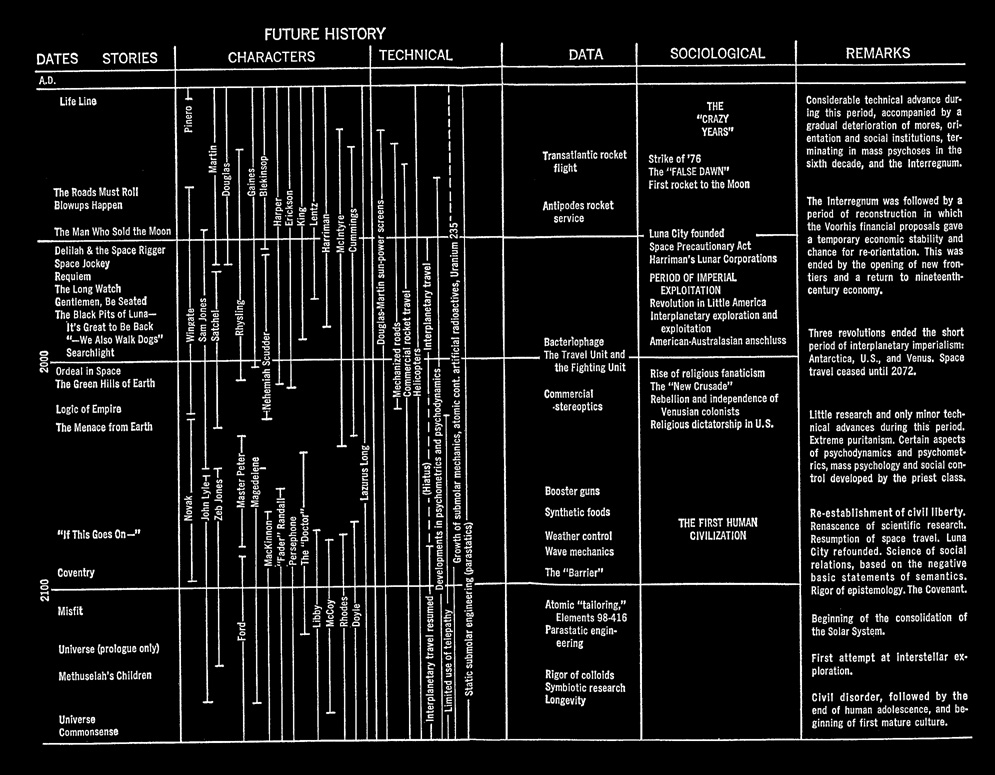
Robert Heinlein plotted out the entire arc of his “Future History” stories on a chart that included technological, social, and political events that either featured in or were key drivers for individual stories:
Click to view full size
While our actual technological advances haven’t matched Heinlein’s predictions, you could make a strong case that the sociological column got it right by calling the era from the late-sixties onwards “The Crazy Years”. Samizdata‘s Johnathan Pearce linked to this post by Charles Steele which makes the case quite well:
In his Past Through Tomorrow and other works, Robert A. Heinlein explored a possible future history for homo sapiens. One of things he foresaw was a period at the end of the 20th Century and beginning of the 21st that he called “the Crazy Years,” in which cultural fragmentation and decay in advanced countries generates political and economic decline and social disruption. He was prescient in recognizing what happens when commonly accepted principles such as an individual’s responsibility for self are forgotten and political correctness and multiculturalism run amok. As advancing technology places increasing power in human hands, human ethics fail to keep pace. In Heinlein’s world, humans do manage to navigate these shoals without destroying themselves and eventually do settle on a MYOB sort of libertarian ethic…but only narrowly averting nuclear self-destruction and environmental self-destruction, and not without going through periods of dictatorship as well as societal chaos.
Heinlein’s story isn’t just fiction. In the course of the development of the Soviet SETI program, astrophysicist Nikolai Kardeshev developed a theory of civilizations and what we might look for in trying to detect them. Kardeshev’s work — which has been further developed by others — gives a classification system based on the scale at which a planet-based civilization can harness energy. The lowest level of civilization, Type I, has the capability of harnessing the entirety of the energy of its planet. As a sort of corollary, it’s hypothesized that a species that is approaching Type I mastery potentially goes through a very dangerous period, akin to Heinlein’s “Crazy Years.” Their advanced level of technology gives them power capable of destroying the civilization if misused. If the species fails to develop behaviors, ethics, institutions, etc. that prevent this it can annihilate itself. I’m uncertain how much of this corollary is in Kardeshev’s original contribution, but physicist Michio Kaku suggests that one thing we could look for in SETI is the wreckage of civilizations that failed to make the transition to Type I. And of course, our civilization is our one example, so far, of a civilization entering this transition.
What’s the connection between Heinlein and Kardeshev? Think of just a few examples of the dangers we face today:
- Iranian or Al Qaeda religious fanatics obtaining nuclear weapons…
- An American federal government — especially the executive branch — working to acquire unlimited power, and already apparently having the power to spy on essentially all communications, everywhere…
- A growing segment of the population — some poor and some very rich (think Goldman Sachs) — who live as parasites on the productivity of others while creating nothing of values themselves…
- An intelligentsia that cannot bring itself to condemn Islamism for fear of being seen as insensitive or racist or ethnocentric, but which regularly denounces, in the most hateful terms, anyone who opposes the continued expansion of state power…
- An intelligentsia that praises socialism, hunter-gatherer economies, massive interventionism, anything but the one system that actually works, free market capitalism, a system they bitterly condemn…
- A “press,” our mainstream media, that sees its job as promoting political positions and readily lies when lies serve this goal better than truth, and spouts nonsense the remainder of the time, apparently because reasoned analysis is too hard.
Yes, we’re in the crazy years, for sure.
And yet, in spite of all this, he’s still optimistic about the future.
September 24, 2013
Reason.com banned from Reddit‘s /r/Politics subgroup
Nick Gillespie is puzzled that Reddit users are no longer allowed to submit links to Reason:
So I’m left wondering exactly what we did to incur the wrath of TheRedditPope. Reddit penalizes sites and users that scrape articles from original sources, try to game the system by submitting only material in which they have an publishing interest, and don’t add much information or analysis. As several of the commenters in the thread note, Reason.com is the biggest libertarian news site on the web and whether folks agree or not with our take on a given topic, they can’t seriously accuse us of ripping off other sites or not shooting our mouths off with our own particular POVs on any given topics.
Consider the attempted post that brought the ban to our attention. The user who contacted us had apparently tried to submit this story: “Do-Nothing Congress? Americans Think Congress Passes Too Many Laws, Wrong Kinds of Legislation.” Click on the link and you’ll be taken to an extended analysis of information drawn from the latest Reason-Rupe Poll, an original quarterly survey of American voters that has garnered praise from all over the political spectrum and has been cited in all sorts of mainstream and alternative outlets. If the Reason poll — which is designed by Reason Foundation, the nonprofit that publishes this site, and is executed in the field by the same group that conducts Pew Research — and that post in particular don’t meet the threshold of original content that is news-rich and original, then nothing does.
I am a huge admirer of Reddit, even in the wake of recent revelations about the /r/Politics ban. As I wrote last year in a Reddit thread,
Reddit is one of those rare sites that actually delivers on the potential of the Internet and Web to create a new way of creating community and distributing news, information, and culture that simply couldn’t exist in the past. Like wildly different sites ranging from slashdot to Arts & Letters Daily to Talking Points Memo to the late, lamented Suck, Reddit is precisely one of the reasons why cyberspace (or whatever you call it) continues to excite us and make plain old meatspace a little more tolerable.
A new “Laundry” story by Charles Stross
Charles Stross writes many things, but what first alerted me to his writing was The Atrocity Archives. TOR.com has a new story called “Equoid” online for your reading pleasure:
Charles Stross’s “Equoid” is a new story in his ongoing “Laundry” series of Lovecraftian secret-agent bureaucratic dark comedies, which has now grown to encompass four novels and several works of short fiction. “The Laundry” is the code name for the secret British governmental agency whose remit is to guard the realm from occult threats from beyond spacetime. Entailing mastery of grimoires and also of various computer operating systems, the work is often nose-bleedingly tedious. As the front-cover copy line for Ace’s edition of The Atrocity Archives noted, “Saving the world is Bob Howard’s job. There are a surprising number of meetings involved.” Previous “Laundry” stories on Tor.com are “Down on the Farm” and the Hugo Award finalist “Overtime.”
Like some other stories published on Tor.com, “Equoid” contains scenes and situations some readers will find upsetting and/or repellent. [—The Editors]
This novella was acquired and edited for Tor.com by senior editor Patrick Nielsen Hayden.
September 23, 2013
The inevitable late-night infomercial of the very near future
Zero Hedge peeks just a short distance into your insomniac TV watching future:
(A middle-aged man in an military uniform, loaded with medals, four stars on his epaulets, is sitting in a futuristic office setting on a chair occupying a command position. He puts down a folder he is reading and looks up at the camera.)
Do you know me? Well, I know you.
(He wags his finger as if counting)
Each and every one of you.
I know everything there is to know about you. But enough about that. I’m here today to tell you about a special offer, a first time offer never before available to the general public.
(Man assumes a more relaxed mien, stands and walks slowly toward camera)
Hi, I’m General Keith Alexander, coming to you from the flight deck of the starship… well, it’s just my office, but it’s The Bomb, no? Hey, don’t you repeat that or you might get some unwanted attention. I want to tell you today about something we call simply: The NSA Tapes. This is the greatest and most complete collection of audio and video recordings every assembled anywhere in one place. You cannot buy this in stores, or over the internet. Only here, at the NSA, does the technology exist to capture at this level and at this quality.
The Prism Collection, our basic model, has everything you’d expect in a surreptitious data grab. It has “Phone Sex America: The Connoisseur Series”. It has “Hollywood Sex-ting Kittens”.
(He pauses, looks over the top of his reading glasses, and speaks.)
And let me tell you, if you enjoyed Miley Cyrus twerking, you are going to love what she tells Liam Hemsworth about things he can do to that little booty of hers.
It also has one of my favorites, and I’m sure it will be a favorite of yours, too. Yes, from the Instagram Album we have “Buck Naked Coed Selfies of the Ivy League”. If you’re like me, you’ll know where you’d like to cram for that upcoming exam.
[…]
And if you order in the next ten minutes, we’ll also throw in, just to say thanks, a one year supply of bathroom tissue, each sheet embossed with the Fourth Amendment of the Constitution of this once great nation.
(Another voice breaks in and speaks rapidly)
Shipping and handling $4.95 per item, $7.95 by black van, and rush orders $11.95 by drone.)
(Alexander speaks again)
Call now. Our operators are already listening.
September 22, 2013
Statistical fail for political axe-grinding
Coyote Blog views with alarm a recent article in Rolling Stone which abuses statistics to make a point that apparently isn’t true:
What I want to delve into is the claim by the author that wildfires are increasing due to global warming, and only evil Republicans (who suck) could possibly deny this obvious trend […]
These are the 8 statements I can find to support an upward trend in fires. And you will note, I hope, that none of them include the most obvious data — what has the actual trend been in number of US wildfires and acres burned. Each of these is either a statement of opinion or a data point related to fire severity in a particular year, but none actually address the point at hand: are we getting more and larger fires?
Maybe the data does not exist. But in fact it does, and I will say there is absolutely no way, no way, the author has not seen the data. The reason it is not in this article is because it does not fit the “reporters” point of view so it is left out. Here is where the US government tracks fires by year, at the National Interagency Fire Center. To save you clicking through, here is the data as of this moment:
Well what do you know? The number of fires and the acres burned in 2013 are not some sort of record high — in fact they actually are the, respectively, lowest and second lowest numbers of the last 10 years. In fact, both the number of fires and the total acres burned are running a third below average.
The one thing this does not address is the size of fires. The author implies that there are more fires burning more acres, which we see is clearly wrong, but perhaps the fires are getting larger? Well, 2012 was indeed an outlier year in that fires were larger than average, but 2013 has returned to the trend which has actually been flat to down, again exactly opposite of the author’s contention (data below is just math from chart above)
In the rest of the post, I will briefly walk through his 8 statements highlighted above and show why they exhibit many of the classic fallacies in trying to assert a trend where none exists. In the postscript, I will address one other inconsistency from the article as to the cause of these fires which is a pretty hilarious of how to turn any data to supporting your hypothesis, even if it is unrelated.


“By far the worst thing about it is the title”
In the New Statesman, Felix Salmon reviews the latest book by Tim Harford:
Harford […] has a breezy writing style and an infectious sense of humour — but he doesn’t let himself go further than a sober, conservative economist would be comfortable going. He’s trustworthy in a way that most other commentators on economics aren’t. He is not particularly interested in political arguments or in imposing his views on others — instead, he just wants to explain, as simply and clearly as possible, the way in which the economics profession as a whole usually looks at the workings of the world.
Harford, like Levitt, is a microeconomist by training and by avocation; he is most comfortable when faced with questions such as: “Why does a return train ticket on British rail cost only £1 more than a single?” Hence his Undercover Economist franchise: the conceit is that he’s an economist spying on the world, explaining things — and answering readers’ questions — in a way that only an economist would.
With The Undercover Economist Strikes Back, however, Harford has taken a leap out of his microeconomic comfort zone. By far the worst thing about it is the title. There is none of the Undercover Economist about this book, unless you include the dialogue style of writing that Harford has perfected in his FT column. And he’s not striking back at anything at all: no entity was attacking him in the first place. Even the subtitle (How to Run — or Ruin — an Economy) is problematic. No one is going to come away from reading this book convinced that they know how to run an economy.
Instead, what Harford has achieved with his new book is nothing less than the holy grail of popular economics. While retaining the accessible style of popular microeconomics, he has managed to explain, with clarity and good humour, the knottiest and most important problems facing the world’s biggest economies today.
September 21, 2013
Michael Ignatieff on the aftermath of electoral defeat
The Toronto Star has an excerpt from Michael Ignatieff’s new book, Fire and Ashes:Success and Failure in Politics:
Zsuzsanna and I returned to Stornoway and disconsolately packed up our things. I remembered a photograph I’d seen of men in overalls carting belongings into a moving van at the back of 10 Downing Street after Margaret Thatcher defeated James Callaghan in 1979.
The arrival of the moving van is as momentous a symbol of the sovereignty of the people as the moment when a leader takes the oath of office. Now the moving vans were at our back door. The people had told us to pack our bags.
In an emptying house that had once felt like home, I pulled my books off the library shelves as the portrait of Laurier, our greatest prime minister, seemed to follow me with its eyes. Every leader of the party but two had become prime minister. Now I had become the third leader to fail.
The day before I’d had an airplane, a security detail, a staff of 100, a car and driver, a chef and housekeeper to welcome us home, and, most valuable of all, a political future. The day after, that future had vanished. I was unemployed and five and half months short of eligibility for the pension that usually goes with six years of service as an MP.
I was filling boxes while making phone calls to find myself a job. Rob Prichard, a friend of 30 years, came to the rescue, and after he’d made a few calls to John Fraser, master of Massey College, David Naylor, the president of the University of Toronto, and Janice Gross Stein, director of the Munk School of Global Affairs, I was back in my old life, teaching human rights and politics once again. Finding a new start was much harder for many of my defeated colleagues.
‘Defeated, disconsolate, forlorn’
I hadn’t driven for five years, and so I went to renew my licence the day after the defeat. The photograph they took that day shows a person I now barely recognize: defeated, disconsolate and forlorn. The eyes — my eyes — don’t focus.
September 20, 2013
The IPCC’s new, more cautious tone
In The Spectator, a muted tone of “we told you so” about the upcoming IPCC report:
Next week, those who made dire predictions of ruinous climate change face their own inconvenient truth. The summary of the fifth assessment report by the Intergovernmental Panel on Climate Change (IPCC) will be published, showing that global temperatures are refusing to follow the path which was predicted for them by almost all climatic models. Since its first report in 1990, the IPCC has been predicting that global temperatures would be rising at an average of 0.2° Celsius per decade. Now, the IPCC acknowledges that there has been no statistically significant rise at all over the past 16 years.
It is difficult to over-emphasise the significance of this report. The IPCC is not simply a research body making reports and declarations which are merely absorbed into political debate. Its word has been taken as gospel, and its research has been used to justify all manner of schemes to make carbon-based energy more expensive while subsidising renewable energy.
The failure of its predictions undermines the certainties which have been placed upon the science of climate change. Previous IPCC reports — and much of the debate over how to react to them — have appeared to treat the Earth’s climate as if it were a domestic central heating system, with carbon emissions analogous to the dial on the thermostat: a small tweak here will result in a temperature rise of precisely 0.2°C and so on. What is clear from the new IPCC report is that the science is not nearly advanced enough to make useful predictions on the future rise of global temperatures. Perhaps it never will be.
Some climate scientists themselves, to give them credit, have admitted as much. Their papers now incorporate a degree of caution, as you would expect from genuine scientists. The problems arise when the non-scientists leap upon the climate change bandwagon and assume that anything marked ‘science’ must be the final word. As the chemist and novelist C.P. Snow once warned in his lecture about the ‘two cultures’, you end up in a situation where non-scientists use half-understood reports to silence debate — not realising that proper science welcomes refutation and is wary of the notion of absolute truths.
September 19, 2013
Latest online piracy study shows the problem is Hollywood
Techdirt‘s Mike Masnick shows that the data in the most recent study of online piracy (funded by NBC Universal) clearly shows that the real reason for piracy is Hollywood’s unwillingness or inability to learn:
While we already discussed the MPAA’s questionable new study trying to pin the blame for infringement on Google, MPAA member NBC Universal has released its “Digital Piracy Universe” study as well. This study was done by NetNames, the company formerly known as Envisional, which basically released a very similar study two and a half years ago. Matt Schruers, over at CCIA, does a nice job explaining some of the more questionable aspects of the methodology. However, we’d like to focus on something a bit more basic: the study’s own numbers don’t seem to support what NBC Universal seems to think it does. More specifically, as we noted with the last study, the results actually suggest piracy is Hollywood’s own damn fault. This isn’t just our interpretation either. The guy who wrote both studies, David Price, basically said the same thing right before SOPA died (he argued that the bills were a bad idea).
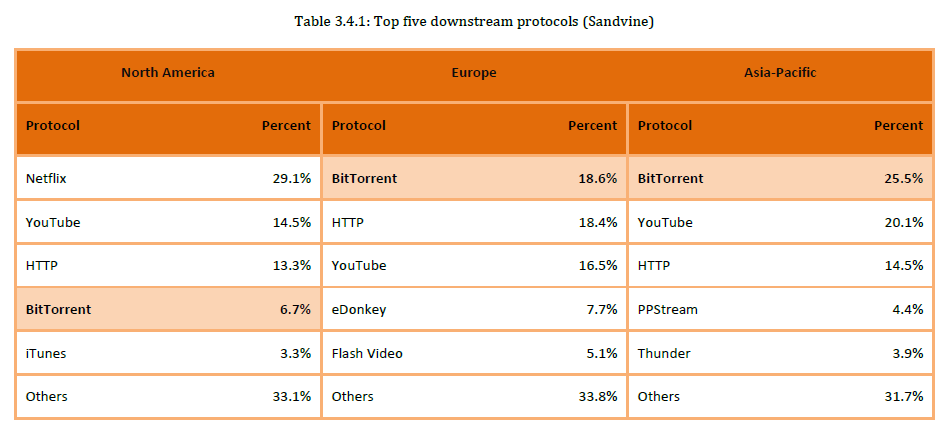
Once again, it’s not difficult to see why the problem is Hollywood’s with one simple chart:
Basically, in the US, where Netflix has come up with a model that many people find to be reasonably priced and convenient enough, the rate of things like BitTorrent usage falls in comparison.
After smartphones, genius machines?
In the Daily Beast, Robert Herritt reviews the latest book by Tyler Cowen, Average Is Over: Powering America Beyond the Age of the Great Stagnation.
Cowen’s main background assumption is that in the not-too-distant future various kinds of “genius machines” will be everywhere. In the workplace, business negotiations and client introductions “will be recorded, processed, and analyzed [and] … [e]ach party to the communications might receive a real-time report on when the other people are likely lying …” At the supermarket, “[y]our shopping cart will use GPS to track your moves through the store, including which aisles you visit most often.” As for our personal lives, “[a] woman might consult a pocket device in the ladies’ room during a date that tells her how much she really likes the guy. The machine could register her pulse, breathing, tone of voice … or whichever biological features prove to have predictive power.”
Even a few years ago, this forecast would have sounded silly, but that was before many of us trusted Match.com algorithms to suggest potential spouses and smartphones came with fingerprint scanners. Cowen’s not talking about flying cars (that futurist mainstay that always seems both just out of reach and comically unnecessary), but rather slightly more sophisticated versions of the technologies that many of us already use.
The bad news, he tells us, is that the rise of the machines will only worsen the wage polarization we are seeing today. Cowen predicts a situation where 10 percent to 15 percent of Americans are “extremely wealthy” with “fantastically comfortable and stimulating lives.” Most of the rest will see stagnant or falling wages but will benefit from plenty of “cheap fun and also cheap education.” For those wondering, this vanishing middle ground is where the book gets its catch-phrase title.
What will determine whether you end up a high earner or a low-wage left-behind will be, in large part, your answer to some variation on the following questions: “Are you good at working with intelligent machines or not? Are your skills a complement to the skills of the computer, or is the computer doing better without you?”


