
Quotulatiousness

October 11, 2013

Jonah Goldberg on Scooby Doo

Filed under: Humour, Media, USA — Tags: , , — Nicholas @ 11:53

For this week’s Goldberg File email, Jonah Goldberg ran an old piece from some time in the last few years, talking about the cultural implications of the TV show Scooby Doo:

So my daughter and I have been talking about Scooby Doo a lot. She thinks the show, in all its myriad incarnations, is riveting. She will interrupt conversations with “Oh, Daddy, did you know …” and I will expect to hear about something from school or from her daily life, and she will commence to tell me something about Shaggy or Velma or Scooby.

The show has gone through a lot of changes over the years (the Wikipedia entry is disturbingly interesting; one of these days I must remember to carve it into a great chain of toilet seats). In case you didn’t know, the show now features real monsters and ghosts quite often. Not always, but often enough. For decades, the monsters weren’t real, merely the attempts of hucksters and con men. Now the makers of the show teach little kids that there really are vampires and witches.

At first, I thought this scandalous. I always thought the point of the show was to teach little kids not to be scared of things that go bump in the night.

But this is actually the least offensive thing about the show. Bear with me.

Recently, I caught the tail end of one of the newer episodes, and I was dismayed to discover that the perpetrator of the scary hoax was not the bad guy. He was something of an environmentalist/historic preservationist who wanted to keep some greedy corporate fat cats from developing some land. It seemed like something close to an endorsement of ecoterrorism.

Obviously, I was going to turn this revelation into an NR cover story. But as I pondered it, I thought more deeply about the original series. The show starts in 1969. The kids of Mystery Inc., who seem to have absolutely no parental supervision, are clearly counter-cultural. Freddie may not be gay, but he wears an ascot, and, for anyone under the age of 60, that alone is an invitation to a beating. And given that the show was launched in 1969, he may just be dressing that way to duck the draft. (Indeed, why the heck aren’t Fred and Shaggy knee-deep in some rice paddy somewhere?) Velma, meanwhile, certainly looks like she runs a pottery shop in Burlington, Vt., if you know what I mean.

And Shaggy, well, he’s a filthy hippy who always has the munchies. ‘Nuff said.
Alice Munro’s Nobel a vote of confidence for other Canadian dissidents

Filed under: Cancon, Humour, Media — Tags: , — Nicholas @ 07:10

The Washington Post‘s Max Fisher plays it straight with this report on the recent Nobel Prize awarded to “dissident Canadian writer Alice Munro”:

Munro has long been celebrated by Western writers. American novelist Cynthia Ozick once described her as “our Chekhov,” comparing her to the Russian playwright known for challenging Russia’s restrictive Tsar-era social codes.

State media in Canada reacted positively to the news, calling it a great victory for the Canadian nation and the state ideology. Still, Munro is expected to come under intense pressure from Canadian exile communities, who are already calling on the author to use this moment to focus greater attention on the lack of political freedoms in Canada.

Rights groups such as Amnesty International are urging Ottawa to allow Munro permission to travel abroad to accept the prize in December. Though Canadian Nobel winners have been permitted to fly to Oslo to accept the prize in years past, the political nature of Munro’s work and recent Canadian tensions with the European Union have called this into question.

In the meantime, some of Munro’s admirers in the West have expressed hope that the author’s works may finally be fully translated into English.

QotD: Political memoirs

Filed under: Books, Humour, Media, Politics, Quotations — Tags: , — Nicholas @ 00:01

Any statement in a politician’s memoirs can represent one of six different levels of reality:
a. What happened.
b. What he believed happened.
c. What he would have liked to have happened.
d. What he wants to believe happened.
e. What he wants other people to believe happened.
f. What he wants other people to believe he believed happened.

Jonathan Lynn, “Yes Minister Series: Quotes from the dialogue”, JonathanLynn.com

October 8, 2013

Geddy Lee on old Rush videos

Filed under: Cancon, Media — Tags: , , — Nicholas @ 00:01

Rolling Stone digs deep into the video archives to come up with some particularly interesting (for certain values of “interesting”) Rush videos:

Geddy Lee is the first to admit that Rush do not have a great track record when it comes to making music videos, and their track record of picking stylish haircuts and outfits also leaves a bit to be desired. A few weeks ago, he sat down with Rolling Stone to discuss Rush’s new live DVD and their future plans. Towards the end, we took out an iPad and showed him 10 Rush videos on YouTube. Sometimes, he looked a little horrified at his videos and haircuts, but he had a lot to say about all of them. Click through to see the videos and hear Geddy’s memories. At the end, we also showed him a couple of Rush tribute videos by some super-fans.

The first video is a performance of “Working Man” in St. Catharines from 1974 … with their original drummer (John Rutsey) who was replaced by Neil Peart shortly afterwards:

“I haven’t seen this, ever. It’s not a bad recording, either. John was very much a mod, very much in the Paul Weller school of dressing. Alex and I were just long-hairs pretending that we were groovy.”

And commenting on a later video:

You can see the time period in everyone’s haircuts. . . Véronique Béliveau, the French singer, was awesome. . . This was bad, but it wasn’t my worst hairdo. My worst one was the coonskin hat period. That’s when I had my hair in a ponytail and this big poufy thing on the top. That was late 1980s/ early 1990s.

October 7, 2013

Harsanyi – Better openly partisan than “impartial” media

Filed under: Media, Politics, USA — Tags: , , , — Nicholas @ 10:22

David Harsanyi thinks the political scene would be better if more media outlets were up-front about their partisan stance rather than pretending to be objective and impartial:

As much as it pains me, let me take a few moments to defend MSNBC. Last week’s much-talked about testy exchange between anchor Thomas Roberts and Republican National Committee Chair Reince Priebus has been predictably negative. Media bias is a perpetual grievance of the Right — for obvious reasons. But maybe the only way to improve on the situation is to champion more openly ideologically driven political journalism? By any measure, it’s a lot less destructive than what we had for decades: a media feigning impartiality.

[…]

It can be uncomfortable watching a head-on collision of hackery, but the truth is the entire exchange is weirdly honest, entertaining and informative. It’s not often a TV anchor admits to viewers that he’s reading “directly from what the president just gave us.” Roberts is standing in for the president. Perfect. It’s not as if Reince Priebus was on MSNBC to offer his dispassionate impression of the situation, either. He should be challenged. And though the table-setting question is preposterously biased, it’s exactly the kind of question Priebus should be able to deflect. And he gets to do it in front of an audience that generally detests Republicans. I saw many people on Twitter wondering why Priebus does it to himself. They should be wondering why he doesn’t do it more often.

We all know where MSNBC or FOX News stand. It’s establishment media masquerading as impartial that has the real impact. This bias is rooted in insularity, showing a lack curiosity about the other side’s worldview — the ignorance about religion, guns or free-market economic ideas are the most glaring example — and, even worse, a lack of skepticism towards its own conceptions about how things work.

To the untrained eye, the Obamacare rollout may seem like an unmitigated disaster. But editors at Reuters (“Web traffic, glitches slow Obamacare exchanges launch”) or the Associate Press (“Rollout of ‘historic’ Obamacare in California hits some snags”) will try to dissuade people of this notion. Bias doesn’t only manifest in what you write but what you don’t, in what goes above the fold and what sort of delicate nouns and adjectives you sprinkle in your headlines.

October 6, 2013

Nostalgic Doctor Who fans rejoice

Filed under: Africa, Britain, Media — Tags: , , , , — Nicholas @ 10:01

According to a report in the Mirror, over 100 lost Doctor Who episodes have turned up in the most unlikely spot:

A group of dedicated Doctor Who fans tracked down at least 100 long-lost episodes of the show gathering dust more than 3,000 miles away in Ethiopia.

It was feared the BBC ­programmes from the 1960s — featuring the first two doctors William Hartnell and Patrick Troughton — had vanished for all time after the Beeb flogged off a load of old footage.

But after months of ­detective work the tapes have been unearthed at the Ethiopian Radio and Television Agency.

A television insider said: “It is a triumph and fans ­everywhere will be thrilled.

“This is a really big deal for the BBC and is set to make them millions from the sale of the DVDs.”

H/T to Tabatha Southey for the link.

October 5, 2013

Climate models, trust, and spin

Filed under: Environment, Media — Tags: , , — Nicholas @ 08:58

In Reason, Ronald Bailey asks whether we can trust the IPCC’s climate models:

On Monday, the U.N.’s Intergovernmental Panel on Climate Change (IPCC) released the final draft of Climate Change 2013: The Physical Sciences Basis. The report’s Summary for Policymakers flatly states: “Warming of the climate system is unequivocal, and since the 1950s, many of the observed changes are unprecedented over decades to millennia. The atmosphere and ocean have warmed, the amounts of snow and ice have diminished, sea level has risen, and the concentrations of greenhouse gases have increased.” Pretty much everyone concerned with this issue agrees that those are the facts. But what is causing the planet to warm up? Here is where it gets interesting.

[…]

The IPCC report acknowledges that almost all of the “historical simulations do not reproduce the observed recent warming hiatus.” Not to worry, it assures us; 15-year pauses just happen, and you can’t really expect the models to simulate these kind of random natural fluctuations in the climate. Once this little slow-down passes, “It is more likely than not that internal climate variability in the near-term will enhance and not counteract the surface warming expected to arise from the increasing anthropogenic forcing.” In other words, when the warm-up resumes it will soar.

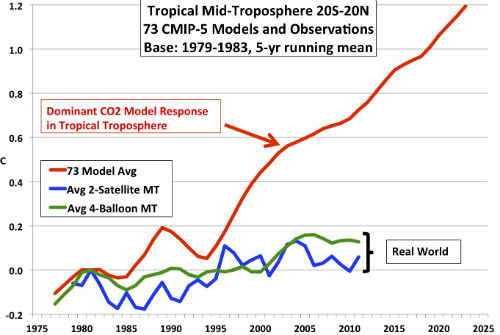
John Christy, a climatologist at the University of Alabama in Huntsville, has come to a different conclusion. Christy compared the outputs of 73 climate models for the tropical troposphere used by the IPCC in its latest report with satellite and weather balloon temperature trends since 1979 until 2030. “The tropics is so important because that is where models show the clearest and most distinct signal of greenhouse warming — so that is where the comparison should be made (rather than say for temperatures in North Dakota),” Christy explains in an email. “Plus, the key cloud and water vapor feedback processes occur in the tropics.” When it comes to simulating the atmospheric temperature trends of the past 35 years, Christy found, all of the IPCC models are running hotter than the actual climate.

[…]

Average of model results compared with temperature trends

Average of model results compared with temperature trends

To defend himself against any accusations of cherry-picking his data, Christy notes that his “comparisons start in 1979, so these are 35-year time series comparisons” — rather longer than the 15-year periods whose importance the IPCC disputes.

Why the discrepancy between the IPCC and Christy results? As Georgia Tech climatologist Judith Curry notes, data don’t speak for themselves; researchers have to put them into a context. And your choice of context — say, the year you choose to begin with — can influence your conclusions considerably. While there may be nothing technically wrong with the way the IPCC chose to display the comparison between model data and observation data, “Curry observes, it will mislead the public to infer that climate models are better than we thought.” She adds, “What is wrong is the failure of the IPCC to note the failure of nearly all climate model simulations to reproduce a pause of 15+ years.”

October 4, 2013

John Lanchester on the Guardian‘s GCHQ files

Filed under: Britain, Government, Liberty, Media — Tags: , , , , , — Nicholas @ 07:44

Novelist John Lanchester was invited to look at the trove of files the Guardian received from Edward Snowden:

In August, the editor of the Guardian rang me up and asked if I would spend a week in New York, reading the GCHQ files whose UK copy the Guardian was forced to destroy. His suggestion was that it might be worthwhile to look at the material not from a perspective of making news but from that of a novelist with an interest in the way we live now.

I took Alan Rusbridger up on his invitation, after an initial reluctance that was based on two main reasons. The first of them was that I don’t share the instinctive sense felt by many on the left that it is always wrong for states to have secrets. I’d put it more strongly than that: democratic states need spies.

And all’s well in the world and we’re worried over nothing?

My week spent reading things that were never meant to be read by outsiders was, from this point of view, largely reassuring. Most of what GCHQ does is exactly the kind of thing we all want it to do. It takes an interest in places such as the Horn of Africa, Iran, and North Korea; it takes an interest in energy security, nuclear proliferation, and in state-sponsored computer hacking.

There doesn’t seem to be much in the documents about serious crime, for which GCHQ has a surveillance mandate, but it seems that much of this activity is covered by warrants that belong to other branches of the security apparatus. Most of this surveillance is individually targeted: it concerns specific individuals and specific acts (or intentions to act), and as such, it is not the threat.

Few people are saying we don’t need intelligence-gathering organizations like GCHQ, but we do have a right to be concerned about what they are doing when they’re not watching actual, known threats. They have capabilities that we generally thought were just from the pages of James Bond novels or Tom Clancy thrillers … and they use them all the time, not just for keeping tabs on the “bad guys”.

In the case of modern signals intelligence, this is no longer true. Life has changed. It has changed because of the centrality of computers and digital activity to every aspect of modern living. Digital life is central to work: many of us, perhaps most of us, spend most of our working day using a computer. Digital life is central to our leisure: a huge portion of our discretionary activity has a digital component, even things which look like they are irreducibly un-digital, from cycling to cooking.

[…]

As for our relationships and family lives, that has, especially for younger people, become a digital-first activity. Take away Facebook and Twitter, instant messaging and Skype and YouTube, and then — it’s hard to imagine, but try — take away the mobile phone, and see the yawning gap where all human interaction used to take place. About the only time we don’t use computers is when we’re asleep — that’s unless we have a gadget that tracks our sleep, or monitors our house temperature, or our burglar alarm, or whatever.

This is the central point about what our spies and security services can now do. They can, for the first time, monitor everything about us, and they can do so with a few clicks of a mouse and — to placate the lawyers — a drop-down menu of justifications.

Looking at the GCHQ papers, it is clear that there is an ambition to get access to everything digital. That’s what engineers do: they seek new capabilities. When it applies to the people who wish us harm, that’s fair enough. Take a hypothetical, but maybe not unthinkable, ability to eavesdrop on any room via an electrical socket. From the GCHQ engineers’ point of view, they would do that if they could. And there are a few people out there on whom it would be useful to be able to eavesdrop via an electrical socket. But the price of doing so would be a society that really did have total surveillance. Would it be worth it? Is the risk worth the intrusion?

That example might sound far-fetched, but trust me, it isn’t quite as far fetched as all that, and the basic intention on the part of the GCHQ engineers — to get everything — is there.

October 3, 2013

Postwar horror – the misery didn’t stop with VE day or VJ day

Filed under: Books, Europe, Germany, History, Japan, Media, Pacific, WW2 — Tags: , , , — Nicholas @ 08:38

In the last couple of years, I’ve read several books about the aftermath of World War Two, including Tony Judt’s Postwar: A History of Europe Since 1945, Ronald Spector’s In the Ruins of Empire: The Japanese Surrender and the Battle for Postwar Asia, and David Stafford’s Endgame, 1945: The Missing Final Chapter of World War II. When you concentrate on the combat side of war, you can easily miss the destructive side-effects of that combat and it’s hard to imagine how long it can take for a city or a region to recover from being a battlefield. What is even more interesting is the complex interplay of humanitarian, political and social pressures on the winning side, too often leading to actions that we would have called war crimes if they’d happened just days or weeks earlier. In the New York Times, Adam Hochschild looks at an interesting new book covering the immediate postwar period:

Ian Buruma’s lively new history, Year Zero, is about the various ways in which the aftermath of the Good War turned out badly for many people, and splendidly for some who didn’t deserve it. It is enriched by his knowledge of six languages, a sense of personal connection to the era (his Dutch father was a forced laborer in Berlin) and his understanding of this period from a book he wrote two decades ago that is still worth reading, The Wages of Guilt: Memories of War in Germany and Japan. His survey rambles over a wide expanse of ground, from sexual behavior (imagine millions of Allied occupation troops in a Germany where women outnumbered men by eight to five), to British and American soldiers unintentionally killing thousands of liberated concentration camp inmates by feeding them more than their shriveled intestinal tracts could handle, to the Allies’ blindness to how much of their cornucopia of food and supplies found its way into the hands of Italian, French and Japanese gangsters, restoring some of their prewar power.

Despite the lofty democratic aura of World War II, Buruma points out that the Allies spent much of the latter half of 1945 reviving colonialism. After Algerian Arabs began an uprising on V-E Day, demanding equal rights, some of the troops the French governor general called in to suppress them included an elite infantry regiment that had just taken part in the final assault on Germany. Rebellious towns and villages were bombed, or shelled by naval vessels; in two months of fighting as many as 30,000 Algerians may have been killed. Thousands were made to kneel before the French flag and beg forgiveness.

On the other side of the world, inhabitants of the Dutch East Indies demanded freedom just after the Japanese surrender. But the Dutch government answered with troops, aided by soldiers from Britain’s large Indian Army, British battleships and abundant American military supplies. Fighting continued for four years. And in Vietnam, where a crowd of more than 300,000 gathered to hear Ho Chi Minh declare independence from France, the story would of course eventually become even bloodier. In 1945 British troops were crucial to restoring the colonial order in Vietnam, with help from French Foreign Legion detachments. These included many German volunteers, recruited from P.O.W. camps, who had recently been fighting the Allies in Europe or North Africa.

Meanwhile, the victorious Allies were uprooting some 10 million ethnic Germans from parts of Eastern Europe, where they had lived for generations, and forcing them to move to a shrunken Germany, with perhaps a half-million or more dying in the process from hunger, exposure or attacks by vengeful neighbors. Buruma, like others before him, notes the paradox of the Allied armies carrying out something that echoed “Hitler’s project . . . of ethnic purity.”

QotD: Biographies of Abraham Lincoln

Filed under: Books, History, Media, Quotations, USA — Tags: , , — Nicholas @ 00:01

… Lincoln is yet to be got vividly between the covers of a book. The Nicolay-Hay work is quite impossible; it is not a biography, but simply a huge storehouse of biographical raw materials; whoever can read it can also read the official Records of the Rebellion. All the other standard lives of old Abe — for instance, those of Lamon, Herndon and Weil, Stoddard, Morse and Miss Tarbell — fail still worse; when they are not grossly preachy and disingenuous they are trivial. So far as I can make out, no genuinely scientific study of the man has ever been attempted. The amazing conflict of testimony about him remains a conflict; the most elemental facts are yet to be established; he grows vaguer and more fabulous as year follows year. One would think that, by this time, the question of his religious views (to take one example) ought to be settled, but apparently it is not, for no longer than a year ago there came a reverend author Dr. William E. Barton, with a whole volume upon the subject, and I was as much in the dark after reading it as I had been before I opened it. All previous biographers, it appeared by this author’s evidence, had either dodged the problem, or lied. The official doctrine, in this as in other departments, is obviously quite unsound. One hears in the Sunday-schools that Abe was an austere and pious fellow, constantly taking the name of God in whispers, just as one reads in the school history-books that he was a shining idealist, holding all his vast powers by the magic of an inner and ineffable virtue. Imagine a man getting on in American politics, interesting and enchanting the boobery, sawing off the horns of other politicians, elbowing his way through primaries and conventions, by the magic of virtue! As well talk of fetching the mob by hawking exact and arctic justice! Abe, in fact, must have been a fellow highly skilled at the great democratic art of gum-shoeing. I like to think of him as one who defeated such politicians as Stanton, Douglas and Sumner with their own weapons — deftly leading them into ambuscades, boldly pulling their noses, magnificently ham-stringing and horn-swoggling them — in brief, as a politician of extraordinary talents, who loved the game for its own sake, and had the measure of the crowd. His official portraits, both in prose and in daguerreotype, show him wearing the mien of a man about to be hanged; one never sees him smiling. Nevertheless, one hears that, until he emerged from Illinois, they always put the women, children and clergy to bed when he got a few gourds of corn aboard, and it is a matter of unescapable record that his career in the State Legislature was indistinguishable from that of a Tammany Nietzsche.

But, as I say, it is hopeless to look for the real man in the biographies of him: they are all full of distortion, chiefly pious and sentimental. The defect runs through the whole of American political biography, and even through the whole of American history.

H.L. Mencken, “Roosevelt: An Autopsy”, Prejudices, part 2, 1920.

October 2, 2013

QotD: Day two

Filed under: Books, Food, Government, Humour, Media, Quotations — Tags: , , — Nicholas @ 09:38

I don’t know who’s more foolish: the greeter standing there, cheerfully helping shoppers, or the other customers who weren’t panicking and hoarding like I was. Don’t these idiots realize that the government is shut down?!?!

The lack of rioting at Petco encouraged me — might there still be actual human food on the shelves at other stores? Swung by Whole Foods where I saw canned goods … and large cuts of beef and pork on sale at $1.99 / lb. Remembering a trick from Lucifer’s Hammer, I bought all the meat I could fit in the shopping cart, took it home, sliced it thin, and dehydrated it.

As I stayed up until 4am slicing meat I couldn’t help but dwell on the fact that the customers at Whole Foods are just as deluded as those at Petco. Fools. Pathetic fools. The societal breakdown might not be that obvious yet, but by day three of the government shutdown they’ll be hammering at my door, looking for salted beef.

Sadly, I’ve realized that my preparations aren’t as far along as they should be. Ammunition will soon grow scarce, and I’ll need other weapons to defend myself from bikers and feral children once the government shutdown really hits. I recall from Dies the Fire that crossbows can be made from truck leaf springs. I’m going to go onto Craigslist to try to find a blacksmith or craftsman I can barter with, but I fear it may already be too late — has Craigslist survived this long?

Clark, “Government shutdown: day two”, Popehat, 2013-10-02

Bruce Schneier’s TEDx talk “The Battle for Power on the Internet”

Filed under: Media, Technology — Tags: , , , , — Nicholas @ 08:56

Published on 25 Sep 2013

Bruce Schneier gives us a glimpse of the future of the internet, and shares some of the context we should keep in mind, and the insights we need to understand, as we prepare for it. Learn more about Bruce Schneier at https://www.schneier.com and TEDxCambridge at http://www.tedxcambridge.com.

About TEDx, x = independently organized event
In the spirit of ideas worth spreading, TEDx is a program of local, self-organized events that bring people together to share a TED-like experience. At a TEDx event, TEDTalks video and live speakers combine to spark deep discussion and connection in a small group. These local, self-organized events are branded TEDx, where x = independently organized TED event. The TED Conference provides general guidance for the TEDx program, but individual TEDx events are self-organized.* (*Subject to certain rules and regulations)

Now we have the real reason for the decline in newspaper revenue

Filed under: Media, USA — Tags: , , , , — Nicholas @ 08:25

If you guessed “the internet” — particularly the internet sites that ate the classified ad business alive — you’re apparently wrong. The real culprit is … an amazingly old-fashioned racist and sexist stereotype:

For years, we’ve talked about the ridiculousness with which many old school journalists want to blame the internet (or, more specifically Google or Craigslist) for the troubles some in the industry have had lately. It is a ridiculous claim. Basically, newspapers have survived for years on a massive inefficiency in information. What newspapers did marginally well was bring together a local community of interest, take their attention, and then sell that attention. What many folks in the news business still can’t come to terms with is the fact that there are tons of other communities of attention out there now, so they can’t slide by on inefficiencies like they did in the past.

Either way, it’s always nice to see some in the industry recognize that blaming the internet is a mistake. However, Chris Powell, the managing editor for the Journal Inquirer in Connecticut’s choice of a different culprit doesn’t seem much more on target. Powell, who it appears, actually does have a journalism job (I can’t fathom how or why) published an opinion piece (found via Mark Hamilton and Mathew Ingram) that puts the blame squarely on… single mothers. Okay, not just any single mothers:

    Indeed, newspapers still can sell themselves to traditional households — two-parent families involved with their children, schools, churches, sports, civic groups, and such. But newspapers cannot sell themselves to households headed by single women who have several children by different fathers, survive on welfare stipends, can hardly speak or read English, move every few months to cheat their landlords, barely know what town they’re living in, and couldn’t afford a newspaper subscription even if they could read. And such households constitute a rising share of the population.

October 1, 2013

Coming features – The Hobbit: The Desolation of Smaug

Filed under: Media — Tags: , , — Nicholas @ 17:18

The Hobbit:The Desolation of Smaug opens nationwide across the UK on 13th December 2013

The second in a trilogy of films adapting the enduringly popular masterpiece The Hobbit, by J.R.R. Tolkien, The Hobbit: The Desolation of Smaug continues the adventures of the title character Bilbo Baggins (Martin Freeman) as he journeys with the Wizard Gandalf (Ian McKellen) and thirteen Dwarves, led by Thorin Oakenshield (Richard Armitage) on an epic quest to reclaim the lost Dwarf Kingdom of Erebor.

The Hobbit: The Desolation of Smaug is a production of New Line Cinema and MGM, with New Line managing production. Warner Bros Pictures is handling worldwide theatrical distribution, with select international territories as well as all international television distribution being handled by MGM.

Candy-coat my world and keep me safe from my trouble and pain

Filed under: Media, USA — Tags: , , , , , — Nicholas @ 15:04

I linked to an entertaining rant by Ace last week that talked about the “nummification” of modern life. At risk of being identified with the “get off my lawn you [26-year-old] kids” bracket, here’s another tale of western society’s almost complete flight from adulthood by Christopher Taylor:

But the culture has become a bit too childish and cutesy for me. If you look around you can see what’s happening easily enough. Adam Carolla recently went on a rant about Starbucks “coffee” and how childish its all become. I won’t link it here because it gets pretty foul and sexualized, but the basic gist is this: you didn’t have a coffee before work, you had a shake. That Caramel Moccachino with whipped cream and sprinkles on top wasn’t a coffee, it was candy in a cup.
You can extend this further. I saw an ad recently on TV for adult vitamins, clearly targeted at men. The selling point? They’re gummy vitamins. Multi-Vites! They’re chewable and sweet! Take a few of those in the morning before your coffee shake. And for lunch? A “power bar” which is a candy bar with vitamins in it.

This isn’t adult behavior, its Halloween all day long. Remember when you were 11 and mom wouldn’t let you gorge yourself out of the plastic pumpkin bucket you filled on Halloween night? And you kicked the side of the bed vowing that when you grew up you’d eat all the candy you wanted?

You’re supposed to grow out of that stage.

[…]

I’ve written about the annoyance of frat boy culture here many times, where men are perpetually the party boy they imagined themselves being in college. Never grow up, never get serious, always avoid responsibility. Your hair getting gray? Return it to your “natural” color with dye! Hey, idiot, gray is your natural color. Put away the Viagra, you’re old. Deal with it.

Except that’s not even the problem any more. We’re being told that adolescence now extends to age 25 by sociologists. Yes, I know sociology is about as much science as astrology, but this isn’t a suggestion, its a diagnosis.

Taylor also links to this BBC News Magazine article from last week, which advances the notion that expecting young people to become adults at 18 or even 25 is no longer realistic:

Frank Furedi, professor of sociology at the University of Kent, says we have infantilised young people and this has led to a growing number of young men and women in their late 20s still living at home.

“Often it’s claimed it’s for economic reasons, but actually it’s not really for that,” says Furedi. “There is a loss of the aspiration for independence and striking out on your own. When I went to university it would have been a social death to have been seen with your parents, whereas now it’s the norm.

“So you have this kind of cultural shift which basically means that adolescence extends into your late twenties and that can hamper you in all kinds of ways, and I think what psychology does is it inadvertently reinforces that kind of passivity and powerlessness and immaturity and normalises that.”

Furedi says that this infantilised culture has intensified a sense of “passive dependence” which can lead to difficulties in conducting mature adult relationships. There’s evidence of this culture even in our viewing preferences.

“There’s an increasing number of adults who are watching children’s movies in the cinema,” says Furedi. “If you look at children’s TV channels in America, 25% of the viewers are adults rather than children.”

He does not agree that the modern world is far more difficult for young people to navigate.

“I think that what it is, is not that the world has become crueller, it’s just that we hold our children back from a very early age. When they’re 11, 12, 13 we don’t let them out on their own. When they’re 14, 15, we hover all over them and insulate them from real-life experience. We treat university students the way we used to treat school pupils, so I think it’s that type of cumulative effect of infantilisation which is responsible for this.”

« Newer PostsOlder Posts »

Powered by WordPress


