
Metatron
Published 14 Dec 2024Link to the original video
• Historian Answers Google’s Most Popul…
Pompaia, on the River Sarnus — a river which both takes the cargoes inland and sends them out to sea — is the port-town of Nola, Nuceria, and Acherrae.
Strabone, Geografia, IV, 81 – Factors in the Establishment of Pompeii. Let’s begin by well what we know. How did it all start? Like many cities of the classical world, Pompeii also has its founding myth: according to Servius, the city was supposedly founded by none other than the demigod Hercules, and its name would have originated from “a Pompa Herculis”, meaning “from the triumph of Hercules”. However, the most recent archaeological discoveries confirm a foundation dating back to around the 8th century BC by the Oscan people, an Italic tribe, corroborating what Strabo reported in his Geography. The Oscans were part of the large linguistic family of Umbro-Sabellian or Osco-Umbrian peoples, distinct from the Latins, who probably arrived in Italy in the 12th century BC. While some Hellenists have proposed that the etymology of Pompeii should be sought in the Greek Πεμπo (Pempo), meaning “to send”, due to the thriving commercial activity, the original linguistic root is likely this Oscan word “pumpè“, from which comes the archaic name Pumpàiia. The Oscan “pumpè“, analogous to the Greek “penta” and Latin “quinque“, means “five”, and most likely refers to a proto-urban reality formed by the progressive fusion of five distinct residential centers, five small Oscan villages that were scattered on the southern slopes of mount Vesuvius, next to the course of the Sarno river.
2. Natural resources: Volcanic areas often provide access to valuable resources like obsidian, sulfur, and various minerals used in ancient crafts and trade.
3. Lack of geological understanding: Ancient people didn’t fully understand the mechanisms of volcanic eruptions or their potential for catastrophic destruction. The last major eruption of Vesuvius before 79 AD was likely prehistoric, so there was no living memory of its danger.
4. Infrequent eruptions: Many volcanoes, including Vesuvius, can remain dormant for long periods. This can create a false sense of security among nearby populations.
5. Strategic location: Pompeii was located in a prime spot for trade, with access to the sea and inland routes. The benefits of this location may have outweighed perceived risks.
6. Religious and cultural significance: Volcanoes were often seen as sacred in ancient cultures, associated with deities or supernatural forces. This could make living near them culturally desirable.
7. Limited mobility: Ancient societies were less mobile than modern ones. Once established, it was difficult to relocate entire cities, even if dangers became apparent.
8. Economic investments: As cities grew and prospered, the economic and social costs of abandoning them became increasingly high.
9. Adaptation and mitigation: Over time, societies living near volcanoes often developed strategies to cope with minor volcanic activity, like earthquakes or ash falls.
10. Lack of alternatives: In some regions, volcanic areas might have been among the best available locations for settlement, despite the risks.
It’s worth noting that while the destruction of Pompeii was catastrophic, the city had thrived for centuries before the eruption of 79 AD. From the perspective of the ancient inhabitants, the benefits of their location likely seemed to outweigh the potential for a disaster that might never occur in their lifetimes. This balance of risk and reward in choosing settlement locations is not unique to ancient times. Even today, many major cities are located in areas prone to natural disasters, demonstrating that humans often prioritize immediate benefits over long-term, uncertain risks
#pompeii #ancientrome #documentary
April 13, 2025
History Hit Expert BLEW My MIND On Ancient Roman History
April 12, 2025
A Basic Introduction To The Ancient Roman Political System
MoAn Inc.
Published 12 Dec 2024
(more…)
QotD: The changed role of the Dictatorship in the late Roman Republic
And then the dictatorship sleeps, for 119 years. The Romans don’t appoint any dictators at all during the second century, despite appointing, on average, one roughly every four years for the first three centuries of the republic. And then in 82, L. Cornelius Sulla Felix “revives” the dictatorship.
Now, precisely because we are now talking about the irregular dictatorship, there really is no way to lay out its features except to go through its uses. Fortunately, there aren’t that many.
In the spring of 83 BC, Sulla, who had been notionally serving in a proconsular command in the East to fight Mithridates, landed in Italy with his army; Rome had effectively come under the control of a military junta initially led by Gaius Marius (cos.107, 104-100, 86) and after his death by L. Cornelius Cinna, Gn. Papirius Carbo and Gaius Marius the younger (son of the former). Sulla openly fought the consuls of 83 (Gaius Norbanus and L. Cornelius Scipio), pushing towards Rome. As the year shifted over into 82, Carbo and Marius the Younger had themselves elected consuls. Marius was killed in 82 during the siege of Praeneste; Carbo fled to Sicily after Sulla took Rome (where he’d eventually be captured and killed by Pompey in 81).
Now this posed a problem, constitutionally: there were always to be two consuls and consular elections had to be presided over by a consul … but one consul was dead and the other fled. The customary solution to this problem was the appointment of an interrex, a five-day-long office which essentially only had the authority to hold elections for new consuls in the absence of consuls or an already appointed dictator. Prior to 82, the last confirmed interrex we know of was in 216, but there may have been another in 208, in either case this also a long-unused office. All the interrex is supposed to do is hold an assembly of the comitia centuriata which can elect new consuls; they did not have any further authority.
Sulla, sweeping into Rome, convened the Senate and directed them to select an interrex; one wonders if this was the same meeting of the Senate Sulla convened within hearing distance of his soldiers in the process of butchering six thousand captured Romans who had sided against him, in case the Senate imagined they were being given a choice (Plut. Sulla 30.1-3). In any event, the Senate selected Lucius Valerius Flaccus (its oldest member, App. BCiv 1.98) on the assumption he would hold elections; instead, Sulla directed him (with the obvious threat of violence) to instead convene the comitia centuriata and instead of holding elections, propose a law (the lex Valeria) to make Sulla dictator with the remit of rei publicae constituendae causa, “for reforming the constitution of the Republic” – an entirely new causa never used before. Of course with Sulla’s army butchering literally thousands of his political opponents, the assembly knew how they were to vote.
This is, to be clear, a thing that customarily the interrex cannot do. This is also not, customarily, how dictators are selected. The appointment of a dictator had not been recommended by the Senate and in any case has also chosen the wrong voting assembly (the comitia centuriata instead of the comitia curiata) and also the interrex doesn’t have the authority to nominate a dictator or propose a law that nominates a dictator. You may begin to see why I see this as a new political innovation and not a clear extrapolation from previous practice. None of this is how the customary dictatorship had ever worked.
The law also gave Sulla a lot of powers, which was important because most of these powers were not things that customarily a dictator could do. He could legislate by fiat without an assembly, something dictators could not do before. He was given the ability to alter the number of senators as well as choose new senators and expel current senators; a dictator had once been named, Fabius Buteo in 216, to enroll new senators, but had (according to Livy) openly noted he did not consider himself to have the authority to remove senators enrolled by the previous Censors (Liv. 23.23). Sulla rendered his authority immune to the acts of the tribunes, whereas that office had previously been the only office to exist outside of the dictator’s authority. Finally, his appointment had no time limit set to it, whereas previously all dictators had six months and no more.
What Sulla has done here is used new legislation (remember, Rome has no written constitution which could invalidate any new law) to create what was is effectively an entirely new office, which shared neither an appointment procedure, term limit, or set of authorities and powers with the previous version.
Sulla then made a lot of very reactionary changes to the Roman Republic we need not get into here, got himself elected consul in 80, and then resigned his dictatorship (after rather a lot longer than six months, making Sulla, by the traditional criteria, the worst dictator Rome had up until that point, though I doubt he saw it that way), and after that retired from public life. Sulla seems to have imagined the office he created out of thin air in 82 would be a thing sui generis, a unique office to him only, to that moment only. Which was incredibly foolish because of course once you’ve created the precedent for that kind of office, you can’t then legislate away your own example.
And so Caesar utilized the same procedure. M. Aemilius Lepidus (later to be triumvir with Octavian and Antony), the praetor in 49, put forward the legislative measure – once again, proposed as a law rather than through the normal process – to make Caesar dictator for that year (Dio 41.36.1-3), with the same sweeping powers to legislate by fiat that Sulla had. One of the first things Caesar did was openly threaten the tribunes with violence if they interfered with him; as noted the tribune’s powers were not at the discretion of the dictator in the customary system and tribunes were held to be sacrosanct and thus legally immune to any kind of coercion by other magistrates, so this too represented a continuation of Sulla’s massive increase in the dictator’s absolute authority (App. BCiv 2.41, Plut. Caes. 35.6-11).
Caesar’s dictatorship, rather than initially being without time limit, was renewed, presumably every six months, from 49 through February 44, when Caesar had himself instead appointed dictator perpetuo rei publicae constieundae causa, “Dictator forever for the reformation of the Republic”, at this point (if not earlier) reusing Sulla’s made-up causa and now making explicit his intention to hold the office for life. He was assassinated a month later, on March 15, 44 BC, so perpetuo turned out to not be so perpetual.
As an aside, Julius Caesar is sometimes given a rosy glow in modern teaching materials, in part because he got such a glow from the ancient sources (one could hardly do otherwise writing under the reign of his grand-nephew, Augustus, who had him deified). That glow was often reinforced by (early) modern writers writing with one eye towards their monarch – Shakespeare, for instance. This may be a topic for another time, but I think a fair assessment of Caesar strips away most of this glow (especially his “man of the people” reputation), except for his reputation as a gifted general, which is beyond dispute. Julius Caesar’s career was a net negative for nearly everyone he encountered, with the lone exception of Augustus.
Bret Devereaux, “Collections: The Roman Dictatorship: How Did It Work? Did It Work?”, A Collection of Unmitigated Pedantry, 2022-03-18.
April 11, 2025
Nazis and Communists Unite Against Weimar – Rise of Hitler 14, February 1931
World War Two
Published 10 Apr 2025February 1931 sees unprecedented chaos in Germany’s parliament as Nazis and Communists stage a dramatic walkout, ironically enabling democratic parties to pass reforms unopposed. Meanwhile, Hitler pushes eastward expansion, Berlin bans extremist newspapers — including Goebbels’ Der Angriff — and Röhm militarizes the Nazi SA. With democracy under strain and political extremes emboldened, what’s next for the Weimar Republic?
(more…)
Beretta 93R: The Best Machine Pistol?
Forgotten Weapons
Published 13 Dec 2024The Beretta 93R (“Raffica”) was developed in the 1970s by Beretta engineer Paolo Parola at the request of Italian military special forces. It took the basic Beretta 92 pistol design and added a well-thought-out burst mechanism under the right-side grip panel. It does not have a plain full-auto setting, but only semiauto and 3-round burst. To help keep the gun controllable, it has a heavier slide to reduce cyclic rate, a detachable shoulder stock, and a folding front grip to help control the muzzle. It uses extended 20-round magazines and is actually remarkably controllable (or so I am told; I have not had a chance to shoot one myself).
(more…)
April 10, 2025
HBO’s Rome – Ep 5 “The Ram has touched the wall” – History and Story
Adrian Goldsworthy. Historian and Novelist
Published 18 Sept 2024Continuing series looking at the HBO/BBC co production drama series ROME. We will look at how they chose to tell the story, at what they changed and where they stuck closer to the history.
QotD: Epicurus on death
Epicurus offered two things to battle the fear of death: an attitude and an argument. The attitude was one of mild contempt: the right sort of people, he implies, do not get in a tizzy about things, not even about death. The argument is equally compelling. “Get used to believing,” he says, “that death is nothing to us.”
Why?
Because all good and bad consist in sense experience. Death is the absence of sense experience. Therefore, “when we exist, death is not yet present, and when death is present, then we do not exist. Therefore it is relevant neither to the living nor to the dead, since it does not affect the former, and the latter do not exist.”
How convincing is this?
Not very. Even if one were to grant the materialism that Epicureanism assumes, one might object that what one resents about death is not the simple absence of sense experience but the loss of the world: one’s friends, engagements, duties, involvements, as well as the panoply of sense experience that attends living.
Death also brings with it the prospect of pain and suffering: few of us can count on a pain-free exit, and that fact also helps to account for the bad reputation death has among non-Epicureans.
Finally, Epicurus and his followers say “death is nothing to us,” but they leave out of account the fact that human beings exist not simply as individuals but as part of a network of family, friends, and a larger community.
Epicurus taught that “self-sufficiency is a great good”. But who, really, is self-sufficient? Let’s say you are married with young children. Your death, quite apart from the inconvenience it might be thought to cause you, would also gravely affect your spouse and children.
There is not much room from children or spouses in the Epicurean philosophy. Why? Because they threaten to compromise the ideal of self-sufficiency. At bottom, Epicureanism is a workable philosophy only for a small subset of people. You must be unafflicted by life’s tragedies: grave poverty or illness or oppression makes being an Epicurean difficult. You must also be largely unafflicted by deep passions. A profound love of life is incompatible with Epicureanism, as is a profound love of one’s children.
The true Epicurean is more of a spectator of than a participant in life. The Roman poet Lucretius (c. 99-c. 55 BC) was one of Epicurus’ greatest disciples. In his long paean to Epicureanism “De Rerum Natura” (“On The Nature of Things”), Lucretius extolled the great sweetness of disengagement, of becoming a spectator rather than a participant in life. In a famous passage, Lucretius warns that “medio de fonte leporum surgit aliquid amari quod in ipsis floribus angat” — “even in the midst of the fountain of pleasure there is something bitter that torments us in the midst of our flowering”. Hence it is better to step back, to watch “the clash of battle / Across the plains, yourself immune to danger”.
One is left with two questions. The first is whether the immunity that Lucretius (like Epicurus) promises is real or illusory. Can we really remain mere spectators of our lives? The second question is whether, even if possible, such disengagement is finally desirable. Perhaps some battles can only be won by engaging with the enemy.
Roger Kimball, “Coronavirus, Flynn and Epicureanism”, American Greatness, 2020-05-02.
April 9, 2025
The Korean War Week 42 – Seize Hwacheon Reservoir? A Dam Good idea – April 8, 1951
The Korean War by Indy Neidell
Published 4 Apr 2025Operation Rugged is in full swing, and it’s taking a decent amount of territory, but Matt Ridgway is worried about the possibility of the enemy blowing the dam at the Hwacheon Reservoir and flooding his army, so he gets set to try and soon take it. Meanwhile there’s an explosion in Congress in Washington DC, when the Minority Leader openly reads Douglas MacArthur’s letter of his plans for the war that are diametrically opposed to those of President Harry Truman. Truman realizes that he’s going to have to remove MacArthur from UN command.
Chapters
00:57 Recap
01:31 When to Fire MacArthur?
03:53 Joe Martin Speaks
07:11 Operation Rugged
09:23 The Hwacheon Reservoir Dam
13:35 Summary
13:51 Conclusion
(more…)
Battle of Saipan 1944: Total War in the Pacific
Real Time History
Published 15 Nov 2024In June 1944, an armada of warships and landing craft is getting ready for D-Day. Thousands of American soldiers are about to attack a prepared enemy with formidable defenses. But this isn’t Normandy, this is the island of Saipan. And the bloody battle there will bring total war to the Pacific.
Chapters:
00:00 Why the US Landed on Saipan
01:46 American Plan for Saipan
03:38 Japanese Defenses on Saipan
05:08 Preparations for D-Day on Saipan
06:39 D-Day on Saipan
08:46 Marine Combat Shotguns on Saipan
14:48 Japanese Counterattack
16:30 D-Day Plus 3 on Saipan
17:01 Battle of the Philippine Sea
20:45 D-Day Plus 7-9 on Saipan
22:33 D-Day Plus 11-15 on Saipan
24:10 Japanese Banzai Charge on Saipan
26:46 Civilian Casualties on Saipan
27:57 End of the Battle of Saipan
28:48 Battles of Tinian and Guam
30:04 Epilogue
(more…)
QotD: Legitimacy and revolution
But though the English Civil War produced the first truly revolutionary regime, they were able to effectively co-opt most of the old regime’s symbols …
Let’s back up for a sec: As you recall, a revolution seeks to replace a people’s entire mode of living, whereas rebellions are just attempted changes of government. England had faced many rebellions before 1642, some of them successful, by which I mean they replaced one ruling faction with another. The usurpation of Richard II’s throne by Henry IV was extremely problematic, political theory-wise, but nobody was openly challenging the institution of monarchy as such. So too with the Wars of the Roses, the Peasants’ Revolt, the Pilgrimage of Grace, and so on: Those were all about the person of the king and his methods of rule, not about the legitimacy of his government.
The English Civil War was different. Charles I wasn’t the first English king executed by rebels (the aforementioned Richard II was starved to death; Henry VI died under extremely suspicious circumstances in the Wars of the Roses), but he was the first one found guilty of treason. To the kingdom he was king of. That’s a far different thing than “oopsie, I guess we forgot His Majesty’s lunch for two months running” or “we sent a whole bunch of goons with knives to the Tower, only to find His Majesty dead of melancholy”. A king who is guilty of treason is necessarily somehow inferior to his own kingdom, which forces us to confront the questions of 1) what, exactly, IS the kingdom? and 2) where does its legitimacy come from?
That’s why the rule of first the Council of State, then Lord Protector Cromwell, was a true revolution. In both cases, it was all too obvious where their legitimacy came from: out of the barrel of a gun, as Mao would so pithily put it 300 years later. And thanks to that power, they were free to remake the “lifeways” (as anthropologists say) of the people how they saw fit. Puritan England was as close to a totalitarianism as 17th century technology and information velocity would allow …
… but that wasn’t very close at all, as it turns out, and so most people in most places could get on with their lives pretty much as before. And even for those people directly under the State’s gaze, the Protectorate looked enough like the old monarchy that if you squinted and tilted your head sideways, you couldn’t really see the difference.
Severian, “Repost: National Symbols”, Founding Questions, 2021-10-27.
April 8, 2025
Free trade, the once-and-future left wing cause
Let’s join Tim Worstall on a brief trip into economic history, when free trade was a pet issue for the left (because it helped the poor and the working class) and protectionism was the position of the right (because it helped the wealthy and the aristocracy):
The people who suffer here are the consumers in the US. The people who benefit are the capitalists in the US. Which is why free trade always has been a left wing position. True, many lefties in recent decades have somewhat strayed from the one true path but given that it’s Trump imposing them some seem to be coming back. Although how much of that is about TDS and how much about reality is still unknown.
We’ve also got that little point about what happened last time around:
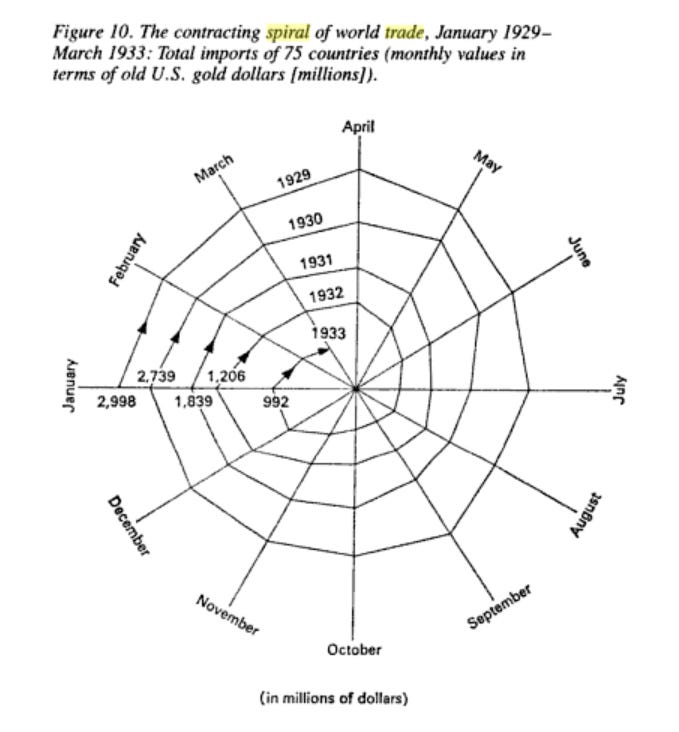
That all started with eggs. There’s fuss about eggs in the US at present. My, how history echoes, eh?
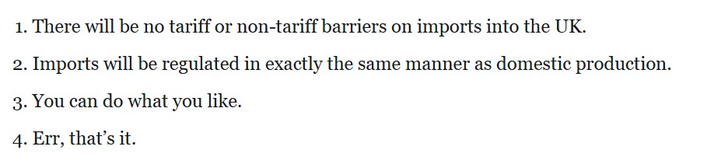
There’s only the one logical, moral or ethical position to have upon trade. As I’ve pointed out before with my model trade treaty:
Note that this applies to all ideas about tariffs — with the one exception of national security where we are indeed willing to give up direct economic benefit in order to keep the French at bay. To tariffs for industrial policy, tariffs for Green, tariffs for trade wars, tariffs as revenue raisers, tariffs, see?
We should remind ourselves that the opposition to Adam Smith and his ideas came from the conservatives. Cobden and the Manchester Liberals were the left wing betes noires of their day. The Guardian was actually set up as a newspaper to push their ideas including that dread free trade.
We did actually get free trade too, in 1846. Which, not by coincidence, is when the Engels Pause stopped happening. Which was, itself, the observation by Karl’s buddy that while the British economy had grown lots — industrialisation, capitalism, etc. — the living standards of the base people hadn’t, not very much. Of course, he was missing a bit — that ability to have a change of cotton underwear even for skivvies (aha, skivvies for skivvies even …) would only feel like an advance to those who had, previously, had to wear woollen knickers. This changed, living standards for the oiks began to rise, strongly, once we had free trade.
Now, there are a few of us still keepers of that sacred flame. But just to lay out the basic argument.
Average wages in an economy are determined by average productivity in that economy. Trade doesn’t, therefore, change wages — not nominal wages that is. Trade does change which jobs are done. That working out of comparative advantage means that we’ll do the things we’re — relative to our own abilities — less bad at and therefore are more productive at. Trade increases domestic productivity and thereby, in the second iteration, raises wages.
Trade also — obviously — gives us access to those things that J Foreigner is more productive at than we are — those things that are cheaper if Foreign, J, does them. This raises real wages again because we get more for our money. We’re better off. This is true whatever the tariffs our own exports face.
Finally, trade doesn’t affect the number of jobs in an economy — that’s determined by the balance of fiscal and monetary policy.
So, who benefits from trade restrictions? Well, the people who lose out from free trade are the domestic capitalists. Pre-1846 it was the still near feudal landlords in fact. What killed those grand aristocratic fortunes was not war nor tax — pace Piketty et al — it was free trade which destroyed agricultural rents.
The same is true today. The people who benefit from tariffs are the domestic capitalists who get to charge higher prices, make larger profits, as a result. The people who lose are all consumers plus, over time, all domestic workers as well. Tariffs increase the capitalist expropriation of the wages of the workers that is.
Tariffs are a right wing, neo-feudal, impoverishment of the people. Free trade is the ultimate leftypolicy to beat back the capitalists.
The Broken Promise of Free Palestine – W2W 19 – 1948 Q1
TimeGhost History
Published 6 Apr 2025By 1948, Britain’s conflicting promises in Palestine have created a powder keg ready to explode. Contradictory pledges made to Arabs and Zionists during WWI set the stage for rising tensions, violent uprisings, and ultimately civil war. As Britain prepares to withdraw and the UN votes for partition, violence escalates, and the hope for a peaceful, free Palestine shatters into chaos. How did the broken promises lead to such tragedy?
(more…)
What did Alexander the Great eat?
Tasting History with Max Miller
Published 26 Nov 2024Game hens roasted with a hazelnut and herb sauce
City/Region: Rome | Macedonia
Time Period: 1st CenturyThrowing lavish feasts was one foreign custom that Alexander the Great was all too happy to adopt. We don’t have any recipes from Alexander’s court, so I looked to the ancient Roman cookbook, De re coquinaria, to find a recipe that used ingredients that Alexander would have had.
The herbs and seasonings in the sauce combine to form a new complex flavor that is delicious. The hazelnuts are prominent and form a wonderful crust on the game hens, and the garum adds its distinctive savory umami note. You can either make the sauce and serve it forth with poultry that you’ve already cooked, or roast the birds with the sauce like I did.
Aliter Ius in Avibus, Another Sauce for Birds:
Pepper, parsley, lovage, dried mint, safflower, pour in wine, add toasted hazelnuts or almonds, a little honey with wine and vinegar, season with garum. Add oil to this in a pot, heat it, stir in green celery and calamint. Make incisions in the birds and pour the sauce over them.
— Apicius de re coquinaria, 1st century
April 7, 2025
Dambusters Part 1 – The Battle of the Ruhr
HardThrasher
Published 5 Apr 2025The background to the Dams raid; how it came into being and how it fitted into the assault on Nazi Germany. In which we discuss Banes Wallis, Arthur Harris and a man called Winterbotham.
THESE LINKS ARE ONLY FOR THE SERIOUSLY SEXY
Merch! – https://hardthrasher-shop.fourthwall.com
Patreon – https://www.patreon.com/LordHardThrasherBibliography
James Holland – Dambusters: the Races to Smash the Dams 1943
Max Hastings – Chastise – The Dambusters Story
Alan Cooper – The Battle of the Ruhr
Adam Tooze – The Wages of Destruction
Martin Millbrook and Chris Everett – The Bomber Command War Diaries
Edward Westerman – Flak German Anti Aircraft Defences [sic] 1914-1945
Tami Davis Biddle – Rhetoric and Reality in Air Warfare
Donald A Miller – Masters of the Air
Best of American and Europe: the Webley No5 Express New Army
Forgotten Weapons
Published 6 Dec 2024Webley introduced their No5 Express New Army model revolver in 1878. This was essentially a ruggedized and scaled up variation on the No5 RIC revolvers that was very popular with police forces. The RIC was chambered for just the .450 Adams cartridge, and its ejection system in particular was not suitable to serious military campaigning. Hoping for a military contract, Webley took that No5 double-action clockwork and put it into a much bigger frame, capable of handling all patterns of British service cartridge as well as the American .45 Colt powerhouse. It then proceeded to lose the military adoption to the Enfield MkI, a frankly not very good design.
However, British officers had their own choice of sidearms, and many opted for the No5 Army Express, as evidenced by significant sales through the Army & Navy CSL catalog. The model was well liked and popular, but only for a fairly brief span. In 1887 the British adopted the top-break Webley MkI, and the development of new technology like smokeless powder and tip-out cylinders quickly rendered the No5 obsolete. But for about a decade, this was a very compelling choice, offering a reliably double action system with a powerful cartridge.
(more…)


