
Elsewhere, the Guardian wonders why the Hitler-in-the-bunker scene from Downfall has become such a popular meme.
February 2, 2010
There’s more than one 3:54 length clip in Downfall?
Comments Off on There’s more than one 3:54 length clip in Downfall?
January 29, 2010
High taxes/low taxes, it’s all relative
Lorne Gunter finds that what were once considered “intolerable” rates of taxation are microscopic compared to what we pay today:
The American colonists, by comparison, felt they were groaning under a crippling tax burden. Many of their staples, they felt, were onerously taxed while they received little from England in return and had no say in how large the levies against them would be.
[. . .]
So out of curiosity, I asked the historian what the level of taxation was in 1776 that caused the U.S. to declare its independence.
I will always recall his answer: “the equivalent today of about 5% to 7% of their income.”
What?
Today, in Canada, all levels of government, through all their taxes, can confiscate as much as half or more of a taxpayer’s income, in total. Income taxes, pension claw-backs, the GST, gasoline excise taxes, import duties and tariffs, estate taxes, property taxes, capital gains and on and on and on.
And yet, like the abused spouse rushing back to an abuser, many Canadians continue to sing the praises of ever bigger and bigger government. They rush to it in any crisis looking to be saved, whether through “free” health care during times of personal crisis or through auto company bailouts that demonstrate solidarity with distant workers in distant communities during times of global crisis.
The problem has been that Canadians expect the government (at all levels) to do something any time there’s a real or perceived crisis. Governments are happy to oblige by (at least appearing) to do something. Inevitably, the scope of what the government does increases every year. As “Steve the Pundit” wrote in the comments to the original article:
It’s true that Canadians have become far too dependent on government to save us from any crisis, large or small, much in the same way that the citizens of Metropolis continually looked to “Superman” to save them from all of their ills, whether it be an irradiated mutant bent on mass destruction … or a purse snatcher. Any crisis, it seems, “… look(ed) like a job for Superman!”
Exactly.
January 26, 2010
“Involvement in counter-espionage cases induces in some a form of paranoia”
Gordon Corera briefly looks at the KGB penetration of Britain’s intelligence agencies:
For 30 years Stephen De Mowbray has maintained a self-imposed silence on a career that once took him to the heart of one of British intelligence’s most controversial episodes.
In 1979 he quit his job with the Secret Service (MI5) because he believed officials had failed to take seriously the claim that British intelligence had been further penetrated by its enemy — the Soviet Union’s KGB.
A number of spies had been discovered in the 1960s but De Mowbray believed there were more. But he found no-one at the top willing to listen.
“People thought I was either mad or bad because I was trying to do something,” he says of that time.
Three decades later, De Mowbray decided to tell his side of the story after reading the authorised history of the Security Service, published last October.
I’m currently reading Christopher Andrew’s Defence of the Realm and just got to the start of the relevant section the other night. Between De Mowbray’s concerns and the careful concealment of “The Laundry”1 in the coverage so far, it’s a wonder they managed to find enough that was considered safe to release to the public.
If you’re interested, MI5 discusses their policies on information disclosure here.
1 I kid, I kid. “The Laundry” is the fictional department of British intelligence in The Atrocity Archive and The Jennifer Morgue by Charles Stross.
January 22, 2010
London in the 1960s
I’m not from London, but the England I grew up in looked very similar to the typical street scenes here (except I grew up in Middlesbrough, so imagine looking at these scenes through a dark gray filter): Wasleso’s London 1960s slideshow.
Comments Off on London in the 1960s
January 19, 2010
The evolution of music
In spite of the portentious title, this is just an excuse to post an old James Lileks quote from a few years back talking about the difference between popular music of the early 20th century with the worst excesses of the 60’s (the “60’s” being defined for convenience as running from about 1965-1974):
Every note is simple and obvious but it still seems remarkable that no one had thought to arrange them in that particular order. It’s the countertheme, to invent a musical term, that gives it spice, and the middle section has a lovely expansive quality that makes you think of Frank Sinatra peeing off a balcony in Vegas. And of course the beat: bum / bum / bum / bumbum bum / bum / bum / bum / bumbum bum.
The name of the show was a callback to an old song from the early part of the 20th century — “I Dream of Jeannie with the Light Brown Hair.” I’ve only heard the first few bars, sung by Bugs Bunny with appropriate alterations: “I dream of Jeannie, she’s a light brown hare.” Old as the song was, audiences in the forties got the joke, just as people today recognize a reference to a song from the 60s.
The difference, of course, is that the 60s aren’t seen as The Past; the 60s are a Timeless Vault of Cultural Touchstones, the apotheosis of Western Civ. Sigh. Well. One of the future Diners will take place in the 60s — don’t ask why, it’ll be explained — and I will use many of the gutbustingly dreadful “psychedelic” records I have collected. It’s obvious from Note One that everyone involved in the effort had so much THC in their system you could dry-cure their phlegm and get a buzz off the resin, but instead of having the loose happy ho-di-hi-dee-ho cheer of a Cab Calloway reefer number, the songs are soaked with Art and Importance and Meaning. You can imagine the band members sitting down to hash out (sorry) the overarching themes of the album, how it should like start with Total Chaos man because those are the times in which we live with like war from the sky, okay, and then we’ll have flutes because flutes are peaceful like doves and my old lady can play that part because she like studied flute, man, in high school. The lyrics are all the same: AND THE KING OF QUEENS SAID TO THE EARTH THE HEIROPHANT SHALL NOW GIVE BIRTH / THE HOODED PRIESTS IN CHAMBERED LAIRS LEERED DOWN UPON THE LADIES FAIR / NEWWWW DAAAAY DAWNNNING!
Five years later it was obsolete. The Jeannie theme, however, will make toes tap in 2476 AD.
There’s more than enough evidence to support James in this notion . . . pick up a random 60’s Psychedelic album and this is what the lyrics are like.
Comments Off on The evolution of music
January 8, 2010
January 5, 2010
A decade of war
Strategy Page has an annotated list of the last decade’s wars, declared and undeclared, and armed confrontations just short of warfare:
It’s actually been a decade of less and less war. There’s also been a lot of déjà vu, with many wars seeming to be endless. Some wars are like that. So what were all the current hot spots like a decade ago, and what happened to them? Below is a list, with the short version of what happened (check out archives for the much longer version).
Afghanistan was sort of under the control of the Pakistani backed Taliban in 2000. But the civil war, that began in the late 1970s, was still going on. The Taliban were winning, slowly, fueled by taxes on the heroin trade. But the Taliban were increasingly unpopular, mainly for trying to impose lifestyle rules on a hostile population. September 11, 2001 brought in the Americans to help the factions still fighting the Taliban, and within three months, the Taliban were out of power, and fleeing to Pakistan. A democracy was established, but corruption and tribal rivalries crippled it from the start. The Pushtun tribes resented the domination of the non-Pushtun tribes (60 percent of the population), and this enabled the Taliban to rebuild and undertake a terror campaign to regain control of the country. It’s a suicide mission (even most Pushtuns oppose them), but that’s pretty normal for Afghanistan.
[. . .]
Iraq- Saddam Hussein was under siege at the beginning of the decade, refusing to comply with the terms of his defeat in the 1991 war over Kuwait. Saddam, as he later admitted, had no weapons of mass destruction, but did not want the Iranians (who wanted to kill him for invading in 1980) to know. It was a successful deception, so much so that all the world’s intel agencies agreed that Saddam had these weapons, and that was used to justify the U.S./British invasion of 2003. There followed five years of terrorism, as the Sunni Arab minority (which Saddam had led) tried to murder their way back into power. That didn’t work, and Iraq ends the decade with a booming, not shrinking, economy, and a bloody resolution to some long time political disputes.
Comments Off on A decade of war
December 16, 2009
QotD: The importance of markets
America debated three strategies during the Cold War. The Right wanted “roll back” — dreams of Patton driving his tank into Red Square. The Left wanted détente — which is French for “surrender.” The country loosely followed containment, a program outlined by George Kennan in 1946, which argued that the political contradictions of the Soviet state would eventually cause its own demise. America had but to be patient.
Kennan may have been the first to realize that a society based on Communism would not survive politically, but it was Ludwig von Mises, in his 1922 work Socialism, who demonstrated that any such society could not survive economically.
When a collection of free individuals — the market — is willing to pay a price for a product that creates “excess” profits, it signals producers to provide more of that product. If the market does not support a given price, producers are forced to redeploy their assets for more pressing social needs. Similarly, if a factor of production, such as labor or capital, changes in price, producers instantly react, sending signals — through the prices of intermediate goods — down to the consumer. Prices effortlessly allocate society’s assets to reflect consumer preference and adjust to accommodate the ever-changing availability of scarce resources.
Mises argued that governmental interference in prices, through taxation, subsidies, and regulation, complicates this process — affecting not only the consumption of final goods, but also the economic calculations that are necessary to provide intermediate goods and services. Higher-order division of labor fails. Poverty results. For example, while Chinese and Russian central planners were busy setting quotas for steel mills, there was no method for consumers to signal that they preferred food — and millions starved to death.
Dan Oliver Jr., “Socialism in Stages: Even soft, incremental expansions of government produce poverty”, National Review, 2009-12-15
Comments Off on QotD: The importance of markets
December 14, 2009
QotD: BC does a sneaky anti-PC move
Don’t tell anybody, but I’m rather tickled that the Queen Charlotte Islands have been given back the name of the slaveholding empire that was once centred there. Such a cheeky gesture! So politically incorrect! So contrary to the stifling liberal spirit of our age! It is almost literally as if Mississippi got renamed Whitetopia; and yet the progressives are simply falling over themselves with naïve praise. I raise a glass to you and shoot you a sly wink, Government of British Columbia!
Colby Cosh, “Come to think of it, why use ‘volunteers’ to run the Olympics?”, Macleans, 2009-12-11
Comments Off on QotD: BC does a sneaky anti-PC move
December 9, 2009
“There is no app for that”
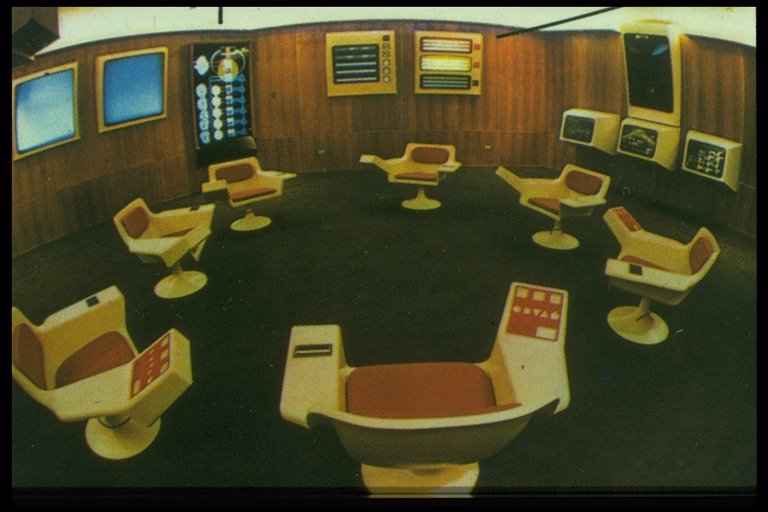
Alex Tabarrok looks at the Chilean “Cybersyn” project:
Cybersyn was a project of the socialist government of Salvador Allende (1970-1973) and British cybernetic visionary Stafford Beer; its goal was to control the Chilean economy in real-time using computers and “cybernetic principles.” The military regime that overthrew Allende dropped the project and probably for this reason when the project is periodically rediscovered it is often written about in a romantic tone as a revolutionary “socialist internet,” decades ahead of its time that was “destroyed” by the military because it was “too egalitarian” or because they didn’t understand it.
Although some sources at the time said the Chilean economy was “run by computer,” the project was in reality a bit of a joke, albeit a rather expensive one, and about the only thing about it that worked were the ordinary Western Union telex machines spread around the country. The IBM 360 two computers supposedly used to run the Chilean economy were IBM 360s (or machines on that order). These machines were no doubt very impressive to politicians and visionaries eager to use their technological might to control an economy [. . .] Today, our perspective will perhaps be somewhat different when we realize that these behemoths were far less powerful than an iPhone. Run an economy with an iPhone? Sorry, there is no app for that.
[. . .] The control room is like the bridge of the Starship Enterprise in another respect–both are stage sets. Nothing about the room is real, even the computer displays on the wall are simply hand drawn slides projected from the other side with Kodak carousels.
December 5, 2009
Henry 8.0
H/T to Michael O’Connor Clarke, who said “Forget about the Tudors – BBC’s “Henry 8.0″ is much more historically accurate”.
November 26, 2009
Saxon treasure trove valued at more than $6M
The recently discovered Saxon treasure (first mentioned here) has been valued at £3.285m by the British Museum and the money will be split between the owner of the land and the man who discovered it:
The value of the 7th century hoard, the largest Anglo-Saxon gold hoard found, was set by a committee of experts.
The haul comprises 1,600 items including sword pommels, helmet parts and processional crosses.
It was discovered by 55-year-old Mr Herbert, of Burntwood, in Staffordshire, in July.
He found it on land owned by Mr Johnson, who said he had not decided how to spend the money yet.
The initial reports seemed to indicate that neither man would be allowed to benefit from the find, so it’s very good to see that this is not the case.
Comments Off on Saxon treasure trove valued at more than $6M
November 11, 2009
In memorium
A simple recognition of some of our family members who served in the First and Second World Wars:
The Great War
- Private William Penman, Scots Guards, died 1915 at Le Touret, age 25
(Elizabeth’s great uncle) - Private David Buller, Highland Light Infantry, died 1915 at Loos, age 35
(Elizabeth’s great grandfather) - Private Walter Porteous, Northumberland Fusiliers, died 1917 at Passchendaele, age 18
(my great uncle) - Corporal John Mulholland, Royal Tank Corps, died 1918 at Harbonnieres, age 24
(Elizabeth’s great uncle)
The Second World War
- Flying Officer Richard Porteous, RAF, survived the defeat in Malaya and lived through the war
(my uncle) - Able Seaman John Penman, RN, served in the Defensively Equipped Merchant fleet on the Murmansk Run (and other convoy routes), lived through the war
(Elizabeth’s father) - Private Archie Black (commissioned after the war and retired as a Major), Gordon Highlanders, captured at Singapore (aged 15) and survived a Japanese POW camp
(Elizabeth’s uncle)
In Flanders fields the poppies blow
Between the crosses row on row,
That mark our place; and in the sky
The larks, still bravely singing, fly
Scarce heard amid the guns below.We are the Dead. Short days ago
We lived, felt dawn, saw sunset glow,
Loved and were loved, and now we lie
In Flanders fields.Take up our quarrel with the foe:
To you from failing hands we throw
The torch; be yours to hold it high.
If ye break faith with us who die
We shall not sleep, though poppies grow
In Flanders fields.Lieutenant Colonel John McCrae, MD (1872-1918)
Comments Off on In memorium
November 9, 2009
Beware of Ostalgia, both left and right
Steve Chapman warns about the dangers of indulging in too much nostalgia one both sides of the divide:
Communism was the greatest catastrophe of the 20th century, and one of the greatest in human history. Twenty years ago, suddenly and improbably, it fell into its death throes.
The end began the night of Nov. 9, 1989, when the Berlin Wall was opened, allowing East Germans to leave the prison that constituted their country. Throughout Eastern Europe, one Communist regime after another disintegrated. Within two years, the Communist Party of the Soviet Union was not only out of power but banned by law. A system soaked in the blood of millions was gone.
It was the most dramatic, life-affirming, and miraculous event of our time. And for those of us in the West, it is one from which we have yet to recover.
The Cold War was often grim and scary. For four decades, we had to maintain vast defenses against a numerically superior enemy that threatened the freedom of our allies and, by extension, ourselves. We lived with the daily reality that, with the push of a button in the Kremlin, we would all be dead in half an hour.
But the “long twilight struggle,” as John F. Kennedy called it, was also inspiring. It gave us a purpose greater than ourselves. In those days, most Americans understood it was our national duty to prevent the spread of the most malignant force on earth, lest it enslave us all.
That may sound absurd to anyone who has grown up since 1989. But there were serious people who feared the worst. British Prime Minister Margaret Thatcher thought that in the 1970s, the West was “slowly but surely losing.”
Our unequivocal victory brought joy, but it also created something else: a void in our lives. If upholding freedom and democracy against a global enemy was not our purpose, what was?
Comments Off on Beware of Ostalgia, both left and right


