
Published on 23 Apr 2015
After experiments on the Eastern Front, the German Army is using poison gas for the first time on the Western Front. At the beginning of the 2nd Battle of Ypres, the wind blows in a favourable direction; the wide spread use of chlorine gas has a devastating effect on the French troops. Even the Germans are surprised by it. The incredible sacrifice of the Canadian troops make it possible to defend Hill 60 in the end.
April 24, 2015
Gas On The Western Front – Baptism of Fire for Canada I THE GREAT WAR Week 39
Comments Off on Gas On The Western Front – Baptism of Fire for Canada I THE GREAT WAR Week 39
Relative and absolute poverty
We in the west are so rich, in historical terms, that we are losing our grasp on what poverty really has been for the majority of humankind for the majority of our recorded history:
People generally just don’t get what poverty actually means. This is a charge often enough aimed at me and people like me, well off white guys who pontificate upon economics. But those making that charge often enough don’t actually understand what real poverty means. So, here’s a nice example of it. There’s a campaign in New York to insist that SNAP (ie, food stamps) should not be cut. Views on that can vary either way: I’m generally in favour of a larger welfare state than the one the US has at present so I’m probably against such a cut. But that’s a political point and not the one I’m interested in here. Rather, I want to point out just quite how rich someone getting food stamps is on any global or historical basis.
Yes, you did read that right: how rich someone getting food stamps is. As one example, the food stamp allocation in New York State appears to be $29 per person per week in a family receiving the full possible allocation. That, on its own, is a yearly income of $1,508 and that’s an amount that puts you, on its own, in the top 50% of all income recipients in the world. No, really, you can look that up with this little calculator. More than half of humanity is poorer than someone who only gets the New York food stamp allocation.
All of which gives us an interesting little look into the difference between absolute poverty and relative poverty. For, obviously, the people who are receiving food stamps in New York are those we consider to be poor in our own society. And in our own society, they are indeed poor, as Adam Smith pointed out with his linen shirt example. It’s not necessary for a working man to have a linen shirt, he’s not poor because he cannot afford one. But if you live in a society where you are considered to be poor if you cannot afford a linen shirt, and you cannot afford one, then in that society you are of course poor. This is relative poverty, more usefully known not as a measure of poverty but of inequality.
Comments Off on Relative and absolute poverty
April 23, 2015
Kicking Neville Chamberlain while he’s dead
Poor old Neville … he’s become such a byword for failure that they’re even comparing Barack Obama to Chamberlain. This is hardly fair to either party:
One of the hardest things to do in history is to read history in context, shutting out our foreknowledge of what is going to happen — knowledge the players at the time did not have.
Apparently Neville Chamberlain is back in the public discourse, again raised from the dead as the boogeyman to scare us away from any insufficiently militaristic approach to international affairs.
There is no doubt that Neville Chamberlain sold out the Czechs at Munich, and the Munich agreement was shown to be a fraud on Hitler’s part when he invaded the rest of Czechoslovakia just months later. In retrospect, we can weep at the lost opportunity as we now know, but no one knew then, that Hitler’s generals planned a coup against him that was undermined by the Munich agreement.
But all that being said, let’s not forget the historic context. World War I was a cataclysm for England and Europe. It was probably the worst thing to happen to Europe since the black death. And many learned folks at the time felt that this disaster had been avoidable (and many historians today might agree). They felt that there had been too much rush to war, and too little diplomacy. If someone like Britain had been more aggressive in dragging all the parties to the bargaining table in 1914, perhaps a European-wide war could have been avoided or at least contained to the Balkans.
If you’ve read my Origins of WW1 posts, you’ll probably agree that Britain alone could not have averted the First World War, although they could have stayed out of the war (which would probably have guaranteed a German victory by 1916). Unlike the attitudes in 1914, few Europeans wanted any kind of war in the late 1930s, having learned too well what the casualties of modern war could be. The idea that Chamberlain and Édouard Daladier could somehow have deterred Hitler requires an amazing lack of awareness of the political realities in Britain and France at the time … and of the state of the respective armed forces of the two nations. Neither politician could have survived the reaction if they’d forced Hitler’s hand … which might well have served Hitler’s purposes just as well as the “scrap of paper” did in the end.
In a postscript, Warren also points out that FDR could just as easily take the place of Neville Chamberlain for his own “sell out” of Poland and the rest of what became the Warsaw Pact “allies”:
Years ago in my youth I used to excoriate FDR for caving into Stalin at Yalta, specifically in giving away most of Eastern Europe. I still wish he hadn’t given his moral authority and approval to the move, but even if we stood on the table and screamed at Stalin in opposition, what were we going to do? Was there any appetite for extending the war? Zero. That is what folks who oppose the dropping of the atomic bombs on Japan get wrong in suggesting there were alternatives. All those alternatives involved a longer war and more American deaths which no one wanted.
Comments Off on Kicking Neville Chamberlain while he’s dead
April 22, 2015
Dog breeds in danger of extinction
Rosie Cima looks at the complex relationship between humans and dogs … dog breeds, that is:

Skye Terrier (via Wikipedia)
Meet the Skye terrier. Named after the Scottish Isle of Skye, he’s one of the oldest terriers in the world — with a lineage tracing back to the Middle Ages. He’s also been a very popular dog in his day. Queen Victoria kept several as pets starting a fashion trend. Mary, Queen of Scots kept one, which hid under her skirt at her execution. Famously loyal, “plucky but dignified”, and an important cultural icon, this is the kind of dog people erect statues of. In fact, they have.
Want one? Better act fast: the breed could go extinct in your lifetime.
Skye terrier breeders are doing their best to change the tide, but things don’t look good. The global population is between 3,500 and 4,000, making the once-common breed one of the rarest in the world. Skye terriers are rarer than red pandas. In the UK, there were only 17 puppies of the Skye terrier breed registered in 2013. Breeders say they need 300 births a year to maintain a healthy population and avoid complications from inbreeding.
How did this happen?
For most of human/canine history, dog breeds evolved gradually, alongside human society, to fill different functional roles as they were needed. If a society or economy shifted, and the role was no longer needed, the breed ceased to exist. Those dogs were either bred for a different purpose or were subsumed into the general dog population.
Comments Off on Dog breeds in danger of extinction
April 21, 2015
The Religious Leaders During WW1 I OUT OF THE TRENCHES
Published on 20 Apr 2015
Indy sits in the chair of wisdom again to answer your questions about World War 1. This week, he is explaining the role of the religious leaders during the war and what role the South American countries played.
Comments Off on The Religious Leaders During WW1 I OUT OF THE TRENCHES
April 20, 2015
Twice-nuked aircraft carrier sunk 80 km from San Francisco
If you’d ever wondered what happened to the ships that were used in the Bikini Atoll nuclear tests, here’s one that might surprise you:
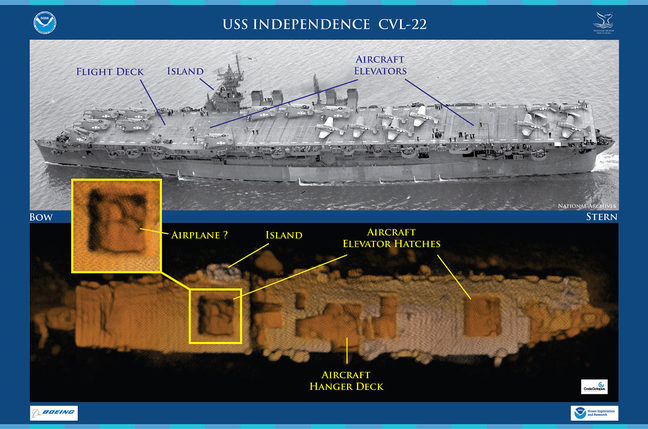
The sonar image with oranges color tones (lower) shows an outline of a possible airplane in the forward aircraft elevator hatch opening. Credit: NOAA, Boeing, and Coda Octopus
The Independence (CVL-22) was commissioned as cruiser, but adapted to become a light carrier as the demands of the Pacific war made mobile air power desirable. The ship served in the Pacific from November 1943 to August 1945, but by 1946 was deemed fit for duty as a test vessel at an atomic bomb test near Bikini Atoll. Independence was stationed less than half a mile from ground zero on a July 1st test, survived that ordeal without sinking so was nuked again on the 25th.
The US Navy then brought the vessel back to San Francisco to assess the damage, and to try nuclear decontamination techniques. By 1951 Independence was felt to be at risk of sinking, so with a colossal radioactive carcass not the sort of thing one wants near a major city it was sunk.
And so the Independence passed into history, its fate largely forgotten … until the NOAA decided to embark on a mission to “to locate, map and study historic shipwrecks in Gulf of the Farallones National Marine Sanctuary and nearby waters.” As part of that effort, Independence was found “in 2,600 feet of water off California’s Farallon Islands”, which one can find here, at what looks to be a distance of about 80kms from San Francisco.
Comments Off on Twice-nuked aircraft carrier sunk 80 km from San Francisco
April 17, 2015
Viking Greenland during the Little Ice Age
Charlotte Persson looks at what happened to the Viking settlers in Greenland as the Little Ice Age set in:
In the middle of the 13th century the Vikings who had settled in Greenland encountered no less than ten years of harsh and cold winters and summers. The Norsemen, who were living as farmers, bid farewell to many of their cattle during that period.
The Greenland Vikings were also prevented from setting sail to fetch supplies from their homelands in Europe because they didn’t have enough timber to build trading ships. So when Scandinavian traders didn’t happen to pass by they were left entirely on their own.
But this didn’t knock them out; on the contrary they lived with the worsening climate for almost 200 years during what we later would call the Little Ice Age. This is the conclusion of a new Ph.D. thesis.
“The stories we have heard so far about the climate getting worse and the Norsemen disappearing simply don’t hold water. They actually survived for a long time and were far better at adapting than we previously thought,” says the author of the new study, Christian Koch Madsen, Ph.D. student at the National Museum of Denmark.
Comments Off on Viking Greenland during the Little Ice Age
Hubris – A General’s Worst Enemy I THE GREAT WAR Week 38
Published on 16 Apr 2015
This week, generals on three different fronts show that they are not able to realise their mistakes. Basra falls to the British, the quick victory at the Dardanelles is getting more and more unlikely and the Russians are loosing their advantage in the Carpathians. But not the commanders have to pay the price for their mistakes, the soldiers have to.
Comments Off on Hubris – A General’s Worst Enemy I THE GREAT WAR Week 38
Grant and Lee at Appomattox
In The Federalist, John Daniel Davidson posted an article earlier this month marking the 150th anniversary of Appomattox:
If ever the vanquished had reason to be bitter, or a victor had cause to be punitive, it was Lee and Grant. Yet their comportment at Appomattox stands today as a testament to the ideals of national reconciliation, goodwill, and honor and respect for one’s enemy. In his epic narrative history of the Civil War, Shelby Foote recounts two instances from Appomattox that suggest Lee and Grant were both thinking of the greater good, keenly aware that an enduring peace depended in part on their humility and generosity.
Early on the morning of April 9, Lee called a conference with his generals so they could give their opinions on surrender. All of them concurred that under the circumstances surrender was the only option, except the young Brigadier General Edward Alexander, who, writes Foote, “proposed that the troops take to the woods, individually and in small groups, under orders to report to the governors of their respective states. That way, he believed, two thirds of the army would avoid capture by the Yankees.”
Lee gently rebuked Alexander, reminding him, “We must consider its effect on the country as a whole.” The men, he said, “would be without rations and under no control of officers. They would be compelled to rob and steal in order to live. They would become mere bands of marauders, and the enemy’s cavalry would pursue them and overrun many sections that may never have occasion to visit. We would bring on a state of affairs it would take the country years to recover from.” Alexander would later write: “I had not a single word to say in reply. He had answered my suggestion from a plane so far above it that I was ashamed of having made it.”
Grant’s terms of surrender were remarkable for their leniency on the Confederate Army. Although the rebels would be required to turn over their arms, artillery, and private property, Grant added an impromptu final sentence: “This will not embrace the side arms of the officers, nor their private horses or baggage.” At Lee’s request, he also allowed Confederate cavalrymen and artillerists who owned their own horses and mules to keep them, reasoning that most were small farmers and would not be able to put in a crop “to carry themselves and their families through the next winter without the aid of the horses they are now riding.”
At this crucial moment, it was most important to Grant and Lee that the soldiers return home safely and get on with civilian life as soon as possible. Returning to his men, Lee told them, “I have done the best I could for you. Go home now, and if you make as good citizens as you have soldiers, you will do well, and I shall always be proud of you.” En route back to his headquarters, Grant heard salutes and cheering begin to rise up from nearby Union batteries. He sent orders to have them stopped. “The war is over,” he said. “The rebels are our countrymen again.”
Comments Off on Grant and Lee at Appomattox
April 16, 2015
An alliance of monsters – Hitler and Stalin, 1939-1941
In The New York Review of Books, John Lukacs reviews a new book from Roger Moorhouse documenting the brief alliance between the Nazi and Soviet regimes:
In the vast literature about Stalin and Hitler during World War II, little is said about their being allies for twenty-two months. That is more than an odd chapter in the history of that war, and its meaning deserves more attention than it has received.
Two factors were involved in this neglect. One was that after Hitler chose to conquer Russia he did not succeed; Stalin emerged as one of the supreme victors of World War II. The other was the Western Powers’ relative lack of interest in Eastern Europe. Yet the war broke out in 1939 because of Eastern Europe, as a result of the British (and French) decision to oppose the German conquest of Poland. The political earthquake of the Nazi–Soviet Pact of August 23, 1939, nine days before the outbreak of war on September 1, did not deter Britain and France from declaring war on Germany upon its invasion of Poland. This is one of the few—very few—decisions in their favor at the time. That they were reluctant in the months that followed to wage war seriously against Germany is another story.
Three quarters of a century have now passed since 1939. A fair amount has been written about the Nazi–Soviet Pact since then, mostly by Eastern European writers and historians. The Devil’s Alliance is a good account by the British historian Roger Moorhouse of what the pact meant for Hitler and Stalin—and, worse, for its victims. Perhaps the book’s most valuable part deals with the immediate consequences of the pact in 1939. Before then, obviously and stridently, Nazism and communism were outright enemies. From the very beginning of his political rise Hitler described Judaism and communism as his principal enemies. Stalin, by that time, was less of an ideologue. Like Hitler, he was a nationalist; he had little interest in international communism.
Comments Off on An alliance of monsters – Hitler and Stalin, 1939-1941
QotD: Emperor Franz Joseph
At the heart of the grandeur was a man who liked plain food, predictable routines, and, for relaxation, hunting and shooting. He was a good Catholic without thinking much about it. Like his fellow sovereigns Nicholas II and Wilhelm II, Franz Joseph loved the military life and almost always appeared in uniform. Like them too he was sent into a rage when the details of army uniforms were wrong. Apart from that, he was invariably courteous to everyone although always conscious of rank. He only shook Margutti’s hand once, to recognize that he had been promoted. (Margutti regretted ever after that no one else at court had seen this momentous gesture.) Franz Joseph found modern art puzzling but his sense of duty took him to public art exhibitions and the opening of important new buildings, especially if they were under royal patronage.” His taste in music ran to military marches or Strauss waltzes and, while he liked the theater and from time to time the prettier actresses, he preferred the old favorites. He did not like unpunctuality, loud laughter or people who talked too much. He had a sense of humor, of a rather basic sort. He had climbed the Great Pyramid in Egypt, he wrote to his wife, Empress Elisabeth, with the help of Bedouin guides. “As they mostly only wear a shirt, when they are climbing, and that must be the reason why English women so happily and frequently like to scale the pyramids.”
Margaret MacMillan, The War That Ended Peace: The Road to 1914, 2013.
Comments Off on QotD: Emperor Franz Joseph
April 15, 2015
Operation Sealion, wargamed by some of the original commanders
Strategy Page has a great summary of the German plan to invade Britain and the most likely outcome if the invasion had ever been attempted:
Operation Sealion, or, in the original German Unternehmen Seelöwe, is one of the most famous “what ifs” of the Twentieth Century.
On July 16, 1940, following the collapse of France, the Dunkerque evacuation, and the rejection of his peace overtures, Adolf Hitler issued Führer Directive No. 16, which initiated preparations for an invasion of Britain. At the time, it seemed to many that if Hitler had tried an offensive across the English Channel a defenseless Britain would inevitably fall. But was it so? What were Hitler’s chances?
In 1973 historian Paddy Griffith, just beginning his career as an instructor at the Royal Military Academy Sandhurst, decided to evaluate the chances of a successful German invasion of Britain by using a wargame.
Organization. Griffith’s wargame was much more than a board with a set of counters, a rule booklet, and some dice. It was a massive multiplayer game, which Griffith later wrote about in Sprawling Wargames. Based on traditional kriegsspiel methodology, the game involved several dozen players and umpires, all isolated from each other except by means of simulated signaling. Many of the players and umpires were veterans of the war from both sides. Among them were former wartime senior German officers such as Luftwaffe fighter Generalleutnant Adolf Galland and Kriegsmarine Vice Admiral Friedrich Ruge, as well as several men from both sides who had been lower ranking offices and later risen higher, including Christopher Foxley-Norris, who had commanded a fighter squadron during the Battle of Britain and rose to air chief marshal, Sir Edward Gueritz, a junior naval officer at the time who became a rear admiral, Heinz Trettner, who had served on the staff of the German airborne forces in 1940, rose to command a parachute division by war’s end, and later served as Inspector General of the post-war German air force, and Glyn Gilbert, a junior officer in one of the defending infantry battalions in 1941, who later rose to major general.
Each side was given the same forces, operational plans, and intelligence as it had in 1940. The game was based on the assumption that the Luftwaffe had still not won the battle for air supremacy over the Channel and southern England by the time the landings were scheduled to take place, in early September, which was in fact the case. The intelligence picture greatly favored the British, who had proven much better at securing information about the enemy’s plans and force than the Germans had on their own.
There’s even a mention of the (significant) Canadian contribution to the defence of Britain after Dunkirk:
The defending forces included the 1st Canadian Division (the most well-prepared division available, full strength and fully equipped, though without combat experience), plus the less-well prepared 2nd Canadian division and partial divisions from Australia and New Zealand.
Although I haven’t read Griffith’s book, my other readings on the subject align with the eventual outcome of the wargame:
Following the game the participants took part in a general analysis. Some interesting observations and conclusions were made. The British GHQ mobile reserve had not been engaged at all. In addition, casualties to the Royal Navy had been serious, but hardly devastating; of about 90 destroyers on hand, only five had been sunk and six seriously damaged, and only three of the three dozen cruisers had been lost, and three more heavily damaged.
Compare that to the actual Royal Navy losses during the evacuation of Crete — with little to no air support from the RAF, due to extreme distance from friendly airbases:
Attacks by German planes, mainly Ju-87s and Ju-88s, destroyed three British cruisers (HMS Gloucester, Fiji, and Calcutta) and three destroyers (HMS Kelly, Greyhound and Kashmir) between 22 May and 1 June. Italian bombers from 41 Gruppo sank one destroyer (Juno on 21 May and damaged another destroyer (Imperial) on 28 May beyond repair. The British were also forced to scuttle another destroyer (Hereward) on 29 May, that had been seriously damaged by German aircraft, and abandoned when Italian motor torpedo boats approached to deliver the coup de grâce.
Damage to the aircraft carrier HMS Formidable, the battleships HMS Warspite and Barham, the cruisers HMS Ajax, Dido, Orion, and HMAS Perth, the submarine HMS Rover, the destroyers HMS Kelvin and Nubian, kept these ships out of action for months. While at anchor in Suda Bay, northern Crete, the heavy cruiser HMS York was badly damaged by Italian explosive motor boats and beached on 26 March 1941. She was later wrecked by demolition charges and abandoned when Crete was evacuated in May. By 1 June the effective eastern Mediterranean strength of the Royal Navy had been reduced to two battleships and three cruisers to oppose the four battleships and eleven cruisers of the Italian Navy
And back to the Operation Sealion summary from Strategy Page:
All participants, German as well as British, agreed that the outcome was an accurate assessment of the probable result of an actual invasion.
Oddly, the Sandhurst wargame was designed on the basis of inaccurate information. Some time after the game, additional hitherto secret documents came to light, which revealed that the Germans probably had even less chance of success than they did in game. At the time the game was designed, the true extent of British “stay behind” forces, intended to conduct guerrilla operations in the rear of the invasion forces, and the sheer scale of defensive installations that had been erected across southern England in anticipation of an invasion were still classified; there were some 28,000 pill boxes, coastal batteries, strong points, blockhouses, anti-aircraft sites, and some other installations.
So assuming Hitler had for a time been serious about invading England, his decision to call it off was probably wise.
Comments Off on Operation Sealion, wargamed by some of the original commanders
The Last Tsar – Nicholas II I WHO DID WHAT IN WW1?
Published on 13 Apr 2015
Nicholas II was the last tsar of Russia and the last ruler of the Romanov dynasty. His reign and his command are considered especially inauspicious today. Everything you need to know about Nicholas II of Russia in portrait.
Comments Off on The Last Tsar – Nicholas II I WHO DID WHAT IN WW1?
Samizdata on the causes of World War 1
Actually, the title is somewhat misleading, as part 1 of Patrick Crozier’s article concentrates on the (rather Anglo-centric) events of 1915:
But at the time, the British in particular, were short of everything. This would come to a head soon afterwards when Repington, again, claimed that the Battle of Neuve Chapelle could have gone much better had the British had enough shells. This would lead almost immediately to the creation of the Ministry of Munitions under Lloyd George.
By this time food prices were beginning to rise. Some foods were already up by 50%. Given that a large proportion of the average person’s income went on food this was inevitably causing hardship. Worse still, this rise took place before the Germans declared the waters around the UK a warzone. I must confess I don’t entirely understand the ins and outs of this but essentially this means that submarines could sink shipping without warning. The upshot was that rationing would be introduced later in the war.
Government control also came to pubs with restricted opening hours. It would even become illegal to buy a round.
So far the Royal Navy had not had a good war. It had let the German battle cruiser Goeben slip through its fingers in the Mediterranean and into Constantinople where it became part of the Ottoman navy which attacked Russia. An entire squadron was destroyed off the coast of Chile and even the victories were hollow. At the Battle of Dogger Bank the chance to destroy a squadron of German battle cruisers was lost due to a signalling error.
[…]
In Britain we tend to think of the First World War as being worse than the Second. This is because, almost uniquely amongst the participants, British losses in the First World War were worse. It is also worth bearing in mind that Britain’s losses in the First World War were much lower than everyone else’s. France lost a million and a half, Germany 2 million. Russia’s losses are anyone’s guess. For all the talk of tragedy and futility, the truth is that Britain got off lightly.
For many libertarians the First World War is particularly tragic. They tend to think (not entirely correctly) of the period before it as a libertarian golden age. While there was plenty of state violence to go around, there were much lower taxes, far fewer planning regulations, few nationalised industries, truly private railways and individuals were allowed to own firearms. If you were in the mood for smoking some opium you needed only to wander down to the nearest chemist.
In part 2, we actually get to some of the proximate causes that triggered the fighting:
So, what caused this catastrophe? If any of you are unfamiliar with the story it might be an idea to get out your smart phones out and pull up a map of Europe in 1914. When you do so you will notice that although western Europe is much the same as it is today, central Europe is completely different. There are far fewer borders and a country called Austria-Hungary occupies a large part of it.
As most of you will know on 28 June 1914, Archduke Franz Ferdinand, heir presumptive to the Austrian throne was assassinated in Sarajevo the capital of Bosnia which he was visiting while inspecting army manoeuvres. Bosnia at the time was a recently-acquired part of the Austrian Empire having been formally incorporated in 1908. Although the Austrians didn’t know this at the time – though they certainly suspected it – Gavrilo Princip, the assassin, and his accomplices had been armed and trained by Serbia’s rogue intelligence service. I say “rogue” because the official Serbian government seems to have had little control over the service run by one Colonel Apis. Apis, as it happens, was executed by the Serbian government in exile in Greece in 1917 and there’s a definite suspicion that old scores were being settled.
Oddly enough, the Austrians weren’t that bothered by the assassination of Franz Ferdinand the man. Apart from his family no one seems to have liked him much. His funeral was distinctly low key although there was a rather touching display by about a 100 nobles who broke ranks to follow the coffin on its way to the station. More importantly, Franz Ferdinand was one of the few doves in a sea of hawks. Most of the Austrian hierarchy wanted war with Serbia. Franz Conrad von Hötzendorf, the Chief of Staff had advocated war with Serbia over 20 times. Franz Ferdinand did not want war with Serbia. He felt that Slav nationalism was something that had to be accepted and the only way of doing this was to give Slavs a similar status to that Hungary had obtained in 1867. So his death changed the balance of power in Vienna. Much as the hierarchy were not bothered by the assassination of Franz Ferdinand the man, they were bothered by the assassination of Franz Ferdinand the symbol – the symbol of Austria’s monarchy and Empire, that is. The Serbs wanted to unite all the South Slavs: that is Slovenes, Croatians, Bosnians, Montenegrins and Macedonians in one state. However, most of these peoples lived in Austria. Now, if the South Slavs left there was no reason to think that the Czechs, Poles, Ruthenes or Romanians who were also part of the Austrian Empire would want to stay. Therefore, it was clear that Serbia’s ambitions posed an existential threat to Austria (correctly as it turned out). The solution? crush Serbia. And now the Austrians had a pretext.
For a longer look at the causes of WW1, I modestly point you to my (long) series of posts from last year on the subject.
Update: About an hour after this post went up, Patrick posted the third part of his series at Samizdata.
April 14, 2015
Strategies of the Sri Lankan civil war
In The Diplomat, Peter Layton looks back at the strategies that eventually ended the twenty-five year civil war in Sri Lanka:
How to win a civil war in a globalized world where insurgents skillfully exploit offshore resources? With most conflicts now being such wars, this is a question many governments are trying to answer. Few succeed, with one major exception being Sri Lanka where, after 25 years of civil war the government decisively defeated the Liberation Tigers of Tamil Eelam (LTTE) and created a peace that appears lasting. This victory stands in stark contrast to the conflicts fought by well-funded Western forces in Iraq and Afghanistan over the last decade. How did Sri Lanka succeed against what many considered the most innovative and dangerous insurgency force in the world? Three main areas stand out.
First, the strategic objective needs to be appropriate to the enemy being fought. For the first 22 years of the civil war the government’s strategy was to bring the LTTE to the negotiating table using military means. Indeed, this was the advice foreign experts gave as the best and only option. In 2006, just before the start of the conflict’s final phase, retired Indian Lieutenant General AS Kalkat in 2006 declared, “There is no armed resolution to the conflict. The Sri Lanka Army cannot win the war against the Lankan Tamil insurgents.”
Indeed, the LTTE entered negotiations five times, but talks always collapsed, leaving a seemingly stronger LTTE even better placed to defeat government forces. In mid-2006, sensing victory was in its grasp, the LTTE deliberately ended the Norwegian-brokered ceasefire and initiated the so-called Eelam War IV. In response, the Sri Lankan government finally decided to change its strategic objective, from negotiating with the LTTE to annihilating it.
To succeed, a strategy needs to take into account the adversary. In this case it needed to be relevant to the nature of the LTTE insurgency. Over the first 22 years of the civil war, the strategies of successive Sri Lankan governments did not fulfill this criterion. Eventually, in late 2005 a new government was elected that choose a different strategic objective that matched the LTTE’s principal weaknesses while negating their strengths.
The LTTE’s principal problem was its finite manpower base. Only 12 percent of Sri Lanka’s population were Lankan Tamils and of these it was believed that only some 300,000 actively supported the LTTE. Moreover, the LTTE’s legitimacy as an organization was declining. By 2006, the LTTE relied on conscription – not volunteers – to fill its ranks and many of these were children. At the operational level some seeming strengths could also be turned against the LTTE, including its rigid command structure, a preference for fighting conventional land battles, and a deep reliance on international support.
Comments Off on Strategies of the Sri Lankan civil war


