
Tasting History with Max Miller
Published 20 May 2025Nutmeg and brandy pound cake with roast beef sandwiches, lemonade, and berries
City/Region: United States of America
Time Period: 1824In the beginning of the American Civil War, no one expected the fighting to go on for very long. Not wanting to miss out on any of the action, a crowd of spectators gathered a couple of miles from the battlefield at the First Battle of Bull Run. They enjoyed the boom of cannon fire and picnic lunches of sandwiches, pies, and cakes, before fleeing for their lives in a mad dash when the battle turned against the Union.
This pound cake is denser than modern versions because it contains no chemical leavener, but it’s not stodgy and is delicious. The nutmeg comes through and you get the flavor of the brandy without it being boozy.
To complete your picnic and recreate some simple sandwiches from 1857, butter slices of white bread, layer on sliced roast beef and Dijon mustard, then trim off the crusts. I don’t usually put butter on my sandwiches, but it was really nice.
Pound Cake.
Wash the salt from a pound of butter and rub it till it is soft as cream, have ready a pound of flour sifted, one of powdered sugar, and twelve eggs well beaten; put alternately into the butter, sugar, flour and the froth from the eggs; continuing to beat them together till all the ingredients are in, and the cake quite light; add some grated lemon peel, a nutmeg, and a gill of brandy; butter the pans and bake them.
— The Virginia House-Wife by Mary Randolph, 1824.Sandwiches for travelling may be made of the lean of cold beef, (roast or boiled,) cut very thin, seasoned with French mustard, and laid between two slices of bread and butter.
— Miss Leslie’s New Cookery Book, 1857
October 24, 2025
The Picnic at the Battle of Bull Run
October 17, 2025
The Original Kaiserschmarrn of the Austrian Empire
Tasting History with Max Miller
Published 13 May 2025Scrambled pancake with raisins and plum compote
City/Region: Austria
Time Period: 1858Like many food origin stories, the ones for kaiserschmarrn are varied and no one knows which, if any, are true. What is true is that Kaiser Franz Joseph I did really enjoy this dish, and as a result kaiserschmarrn became popular throughout the Austrian Empire and is still served in many restaurants today.
This kaiserschmarrn isn’t as sweet as modern versions I’ve had, but it’s still delicious. The vanilla sugar caramelizes and adds a pleasant bit of crunch, the cream makes for a richer pancake, and the plum compote is a lovely addition.
Kaiser-Schmarren.
Whisk 4 decilitres of sweet cream with 4 egg yolks, 2 decilitres flour, and a little salt, add 4 egg whites, beaten to snow, and raisins. Pour the whole thing into hot beef fat or butter, let it get nicely brown like Mehl-Schmarren, prepare it in the dish and sprinkle it with vanilla sugar.
Mehl-Schmarren.
… Place it in the oven so it rises nicely. Then remove it and place it on a rapid heat. When it’s stiff and browned on the bottom, you turn it over with the pancake spatula, let it brown again on the bottom, then tear it into large pieces with a fork and serve it quickly so it doesn’t dry out.
Plum Compote.
Plums are either halved or left whole and peeled. They are placed in hot water where the skin can easily come off. They are then simmered with a little sugar, water, and cinnamon.
— Die Süddeutsche Küche by Katharina Prato, 1858
October 10, 2025
Feeding the Papal Conclave
Tasting History with Max Miller
Published 6 May 2025Marinated baby back ribs served with a garlic and sapa sauce and roasted onions
City/Region: Italy
Time Period: 1570We actually know a fair bit about what was served at the 1549 papal conclave thanks to one of the first celebrity chefs, Bartolomeo Scappi, who was in charge of the food. In his incredible book, Opera dell’arte del cucinare, or Opera di Bartolomeo Scappi, he includes not only recipes that would have been served to the cardinals, but illustrations showing the many steps for preparing and transporting the food.
Dishes like these ribs would have been tested for poison, inspected for secret messages, put in special containers, and delivered via a sort of turntable.
A lot of hassle, but these ribs would be worth it. They’re so tender and the flavors of the rub and sauce are complex and delicious. It’s not as sweet as a modern barbecue sauce, but strikes a lovely balance between the sweetness of the sapa (reduced grape must) and the sharp and savory flavors of the vinegar, garlic, and coriander seeds. You could certainly make more sauce, but I think this amount is really nice.
Different ways to cook the back ribs of a domestic pig
If the pig is young, the ribs can be roasted on the spit with the rind, or without, and with onions split in the pan, which are cooked with the fat that drips from the meat as it cooks … and before it is put on the spit, it is sprinkled with salt and ground coriander seed. You could also let the ribs stand in a marinade of vinegar, grape must syrup, garlic cloves and coriander, and then cook it on the spit in the above way, serving it hot with a sauce on top made of the same seasoning …”
— Opera di Bartolomeo Scappi, 1570
October 3, 2025
Mulligan “Hobo” Stew from the Great Depression
Tasting History with Max Miller
Published 29 Apr 2025Soup with canned peas, canned corned beef, onion, and ketchup
City/Region: United States of America
Time Period: 1940Today the word “hobo” is usually used in a derogatory manner, but back in the time between the end of the Civil War and the end of the Great Depression, it referred to a specific group of migrant workers and their culture.
Part of that culture was mulligan stew, which was basically a stew of any meat and vegetables that were thrown together. The ingredients would be made up of things that keep well, mostly food that was canned or bottled.
The flavor of this soup is surprisingly good, but it’s maybe a little too sweet, even for me. The prodigious amount of ketchup is the dominant flavor, and maybe 1940 ketchup was less sweet than modern versions.
Mulligan Stew (Serves 6)
1 medium size can corned beef — minced
1 onion — minced fine
1 No. 2 can peas with liquid
1 medium size bottle tomato catsup
1 cup water
Salt and pepper to tastePut all ingredients in saucepan and simmer gently over low flame for about one hour. The flavor improves with the length of cooking time.
— The Brookshire Times, August 2, 1940
September 26, 2025
School Cafeteria Sloppy Joe from the 1980s & ’90s
Tasting History with Max Miller
Published 22 Apr 2025Ground beef in a delicious tomato-based sauce on a hamburger bun, part of a classic 90s American school lunch
City/Region: United States of America
Time Period: 1988Today we know sloppy joes as a saucy ground beef sandwich, but the term sloppy joe has referred to many things over the years. A sloppy joe could be other kinds of sandwiches, a nickname for a messy friend, or women’s fashion from the 1940s and 50s that included pants and looser fitting styles.
For me, though, it is this style of sandwich. Really, it is this version of this sandwich. Sloppy joes were a larger part of my adolescent diet than was healthy, and these taste exactly like the ones I remember from middle school.
Be sure to get the cheapest hamburger buns possible to authentically recreate this nostalgic lunchtime favorite.
Sloppy Joe on a Roll (50 servings)
Raw ground beef (no more than 24% fat) … 17 lb 4 oz
Dehydrated onions … 2 1/4 oz … 2/3 cup
OR Fresh onions, chopped … 1 lb 2 oz … 3 cups
Garlic powder … 2 Tbsp
Tomato paste … 3 lb 8 oz … 1/2 No. 10 can
Catsup … 3 lb 9 oz … 1/2 No. 10 can
Water … 2 qt 3 1/2 cups
Vinegar … 2 1/4 cups
Dry mustard … 1/4 cup
Black pepper … 2 tsp
Brown sugar, packed … 5 1/2 oz … 3/4 cup
Hamburger rolls…100
— Quantity Recipes for School Food Service by the United States Department of Agriculture, 1988
September 22, 2025
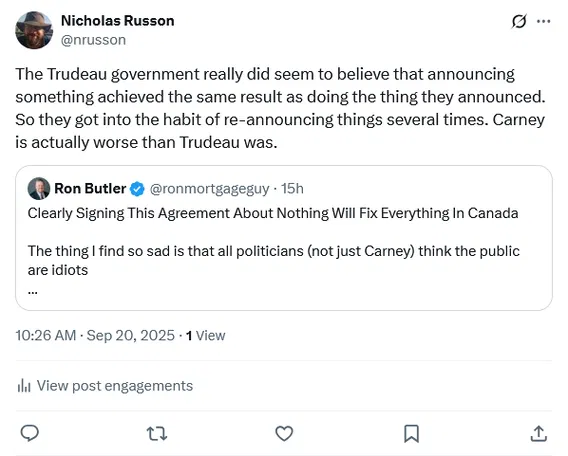
The Liberals fervently believe that saying something is the same as doing something
One of the most irritating aspects of Justin Trudeau’s long reign of error was his evident joy in making announcements about this or that topic. It got to the point that even the pro-Liberal media started to notice that the same policy would be announced several times over a few months but no actual progress was made (except where they could start setting up a new government program … they’d hire the staff very quickly, but little or nothing would get done beyond that). Mark Carney was supposed to be a clean break from the Trudeau years — even though most of his ministers were Trudeau retreads — but Carney may actually be worse than Trudeau in that he just loves photo ops with pretty props for the cameras. As Dr. Sylvain Charlebois notes, we need a lot fewer photogenic Potemkin Villages in how our federal government operates:
In recent weeks, we have witnessed politicians lean on powerful visuals to make their case on food and trade. But these staged moments rarely serve the public interest. Worse, they often deepen food illiteracy in a country where understanding how our system works is already fragile.
Take Ontario Premier Doug Ford’s stunt. Upset with Diageo’s decision to close its bottling plant in Ontario, he theatrically dumped a bottle of Crown Royal and urged Ontarians to boycott the brand. What he didn’t mention is that the bottle in question was made in Manitoba and bottled in Quebec by unionized Canadian workers — jobs unaffected by the Ontario closure. The Windsor facility mainly serviced the U.S. market, and Diageo’s decision was years in the making. Ironically, the boycott risks punishing Canadian workers who will continue producing Crown Royal for Canadians. And for future investors, the message is chilling: why put capital into Ontario if a government will trash your brand on television for a corporate restructuring decision?
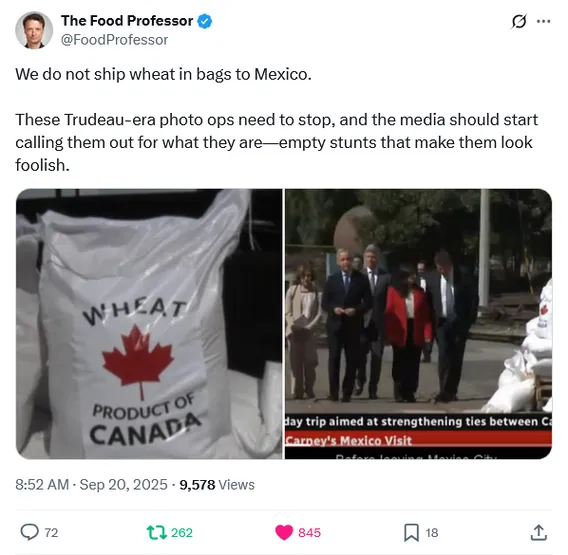
The federal stage brought us another head-scratcher. During a trade visit to Mexico, Prime Minister Mark Carney posed with bags of Canadian wheat stamped with a maple leaf. The problem? Canada doesn’t export wheat in bags. We are among the most efficient bulk grain exporters in the world, shipping millions of tonnes through rail networks and ocean vessels designed for efficiency, safety, and traceability. Bagged wheat is a relic of less mechanized economies. For Canada to present itself this way trivializes our status as a modern agri-food powerhouse. Beyond being misleading, the image suggests to global partners that our system is less advanced than it truly is — a dangerous misrepresentation for a nation that depends on reputation as much as price.
Even I didn’t realize how bad it got until the feds paid contractors to put up a fake building site for Mark Carney to pose in front of, then tore it all down:

September 19, 2025
What Medieval Fast Food Restaurants Were Like
Tasting History with Max Miller
Published 15 Apr 2025Golden brown fried pastries filled with a fruit and spice paste
City/Region: Paris
Time Period: c. 1393Fast food has been around since the Middle Ages, and while a lot has changed in food production and cooking in the last six hundred years or so, then, as now, you could get a fried apple pie.
Rissoles were fried filled pastries (modern versions are usually some kind of filling rolled in breadcrumbs and fried), and they could be made savory or sweet. These ones are made with roasted apples, raisins, figs, and sweet spices. I chose cinnamon, ginger, and nutmeg, but you can choose whatever spices you like.
It is common that rissoles are made of figs, raisins, roast apples, and nuts peeled to imitate pine nuts, and powder of spices [and a little fine salt]; and let the paste be well saffroned and then let them be fried in oil [and sugar them].
— Le Ménagier de Paris, c. 1393
September 12, 2025
Ancient Roman Table Manners & Etiquette
Tasting History with Max Miller
Published 8 Apr 2025Spiral-shaped fritters drizzled with honey and sprinkled with white poppyseeds
City/Region: Rome
Time Period: 2nd Century B.C.E.These fritters are kind of like a mix between globi and jalebi. The batter is simple like the globi, made of just spelt flour and ricotta, but they’re piped into hot fat in spiral shapes like jalebi. The technique can be a little tricky to get right so that the spirals hold together, but you should get about 12 to 15 tries out of the amount of batter this recipe makes.
The encytum are delicious and kind of remind me of a healthy pancake, but with honey instead of maple syrup. They don’t stay crispy for very long, so plan on serving them right away if you’d like to retain maximum crispness.
Make encytum the same way as globi, except that you use a vessel with a hole in the bottom which you can stream through into hot fat, and shape like the spira, coiling and turning it with two sticks. Spread and color with honey while still warm. Serve with honey or mulsum.
— De Agri Cultura by Cato the Elder, 2nd century B.C.E.
September 11, 2025
The Archbishop of York misunderstands a recent child poverty report
Tim Worstall knows that it’s unrealistic to expect a prelate of the Church of England to believe in anything, but in this case His Grace Stephen Cottrell, the Most Reverend and Right Honourable Archbishop of York appears to believe that child poverty in Britain is a very serious problem:

His Grace Stephen Cottrell, Archbishop of York since July, 2020.
Photo 2014 via Wikipedia Commons.
So we’ve the Archbishop of York here telling us all how it should be. Of course, given that that prelacy is Church of England he doesn’t actually believe anything, of course not. But he does roll out what he considers to be facts. Which, sadly, are not.
With all children across the UK back in school as of this week, I am reminded that almost one in three are in poverty. That statistic is shocking enough – but behind every number is a child, and what this statistic means is children arriving at school hungry, living in insecure housing, and missing out on the activities that help them thrive.
Well, no. His near one in three comes from this JRF report. Which is not measuring poverty at all. It’s measuring inequality — the number of people living in a household on less than 60% of median household income. Which is not, in fact, poverty.
No, think on it. If we doubled the — real — income of everyone in the country then clearly we’d have less poverty. But by this measure, the one of inequality of incomes, the number in poverty would change by not one single person nor child. Equally, if we halved everyone’s incomes — real incomes that it — there would be a lot more poverty. But by this measure there would be no change at all.
There’s also this:
I visited a school in the north-east of England a couple of years ago where many of the pupils turned up with empty lunchboxes. There was a breakfast club that fed them on arrival. They were eligible for free school meals, so got a hot lunch. After school, trestle tables were set up in the playground laden with food donated from the local food bank. As they went home, they filled up their lunchboxes so that they could have some tea.
I have rarely been so shocked. This is the reality of child poverty.
Kids are packed to the gunwales with food and this is a sign of poverty? Eh? Sure, sure, I know consubstantiation is pretty heady stuff but really, a little contact with reality please? Kids get two full meals and tuck to take home. This is all free. So, logically, their parents send them to school with empty tuck boxes so that they get two free meals and stuff to take home. I mean, free stuff, who wouldn’t?
Who goes to the pub to pay £7 a pint when booze is flowing free from the town fountain?
Update, 12 September: Welcome, Instapundit readers! Please do have a look around at some of my other posts you may find of interest. I send out a daily summary of posts here through my Substack – https://substack.com/@nicholasrusson that you can subscribe to if you’d like to be informed of new posts in the future.
September 5, 2025
How To Host An Ancient Roman Dinner
Tasting History with Max Miller
Published 1 Apr 2025Roast duck basted with defrutum and served with a sweet and savory dipping sauce atop a bed of herbs
City/Region: Rome
Time Period: 1st CenturyFirst off, this is not a flamingo. While they’re still eaten in some parts of the world, where I live is not one of those parts. I’m using a duck instead, and it’s absolutely delicious.
The real star of this dish is the sauce, which I think would go well with pretty much anything. It’s sweet at first, then you get the savoriness and complexity of the herbs and spices along with a luxurious richness from the duck drippings. It might just be my favorite Roman sauce that I’ve made (and I’ve made quite a few).
For flamingo:
Pluck the flamingo wash, tie, and put it in a pot; add water, salt, dill, and a little vinegar. Half-way through cooking, add a bundle of leek and cilantro and cook. When it is nearly done add defrutum to give it color. Pound in a mortar pepper, cumin, coriander, silphium, mint, rue; moisten with vinegar, add dates, pour over some of the drippings. Put it in the pot, thicken with starch, pour the sauce over the bird, and serve. The same recipe can be used for parrot.
— Apicius De re coquinaria, 1st Century
August 29, 2025
The History of Hungarian Goulash
Tasting History with Max Miller
Published 25 Mar 2025Hungarian goulash with beef, paprika, potatoes, and tomato
City/Region: Hungary
Time Period: Late 19th Century, written down in 1935The development and history of goulash mirrors the history of Hungary in a really interesting way, and the story goes something like this:
800s: A group of people from the Ural Mountains called the Magyars settled the area. Being herdsmen, they brought with them a dish of boiled meat or stew.
1400s: The Hungarian king imported Italian ingredients, like onions, and hired Italian chefs to please his new wife, who was from Naples.
1500s: Hungary becomes part of the Ottoman Empire, and thus ingredients like coffee and paprika enter Hungarian cuisine.
1800s: Two brothers invent a machine to remove the seeds and ribs from hot peppers in order to make sweet paprika.
This recipe from the late 19th century reflects all of these developments, with the meat, onions, and sweet paprika. It is so delicious and really easy to make. If you’ve never had real Hungarian goulash (which is a soup, not a thick stew), give this a try!
Bográcsgulyás
1 kg (2 1/4 lb) beef
80 g (5 Tbs) lard
300 g (1 3/4 cups) onion
20 g (4 tsp) paprika
salt, caraway seeds, garlic
1 kg (2 1/4 lb) potato
140 g (1 cup) green pepper
60 g (1 small) fresh tomato
6 portions of soup paste (csipetke, Recipe 14)
Use meat rich in gelatine (shin-beef, blade or neck). Cube the meat into 1.5-2 cm (1/2-3/4 in) pieces. Fry the chopped onion in the melted lard (shortening) until it is golden yellow. Lower the heat, then add the paprika, stir it rapidly, add the meat, keep on stirring, add salt. When the meat is browned and all the liquid is evaporated, add the caraway seeds, finely chopped garlic and a small amount of cold water, cover, and braise the meat slowly. Stir it occasionally and add small quantities of cold water, cover, and braise the meat slowly. Stir it occasionally and add small quantities of water if necessary. The meat should be braised, not boiled. While the meat is cooking, cube the potatoes, green pepper and tomatoes into pieces 1 cm (1/3 in) in size and prepare the dough for the soup pasta (csipetke). Just before the meat is completely tender, reduce the pan juices, add the cubed potatoes, let them brown slightly, add the stock, green pepper and tomato. When the potato is almost cooked and the soup is ready to be served, add the pasta (csipetke), and adjust quantity by the addition of stock or water.
— Károly Gundel, late 19th century
August 22, 2025
History’s Oldest Dessert – 4,000 Year Old Mersu
Tasting History with Max Miller
Published 18 Mar 2025Short pastry filled with pistachios and dates
City/Region: Mari, Mesopotamia
Time Period: c. 1800 B.C.E.In the ancient ruined Mesopotamian city of Mari, a clay tablet receipt from 4,000 years ago was found that mentioned dates and pistachios for making mersu for the king. We don’t know exactly what mersu was or if there were other ingredients in it, but I think there was more to it than just dates and pistachios. The king employed eight specialists who made mersu, so my guess is that it was at least as complicated as this pastry, possibly much more so.
The flavor combination in this interpretation is wonderful. The pastry is a little crumbly, and the filling is chewy, rich, and quite sweet, with the added texture of the nuts.
I made my pastry dough unsweetened and I really liked the contrast between the unsweetened dough and the very sweet filling, but you can add some date syrup or honey to your dough if you’d like.
1 gur of dates
And 10 sila of pistachios
For making mersu
Meal of the king
— Receipt from Mari, c. 1800 BCE
August 18, 2025
Canadian grocers are “maple-washing” products to hide their actual origin
Sylvain Charlebois on the new phenomenon of grocery stores going to great lengths to pretend that items for sale are Canadian when they’re not — “maple-washing”:
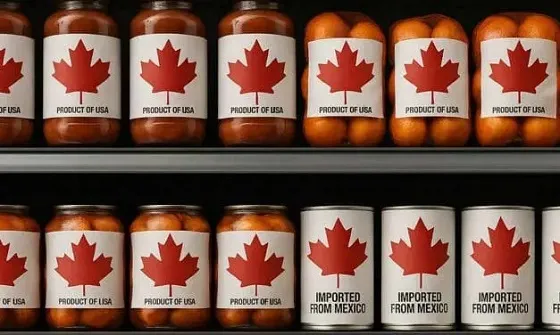
Image by Troy Media via Todayville
Canadian grocery retailers are misleading shoppers about where their food really comes from. Behind the patriotic packaging lies a growing problem: “maple-washing” — using Canadian symbols to suggest products are homegrown when they’re not. It’s eroding consumer trust and must end.
That’s why more Canadians are paying closer attention to what labels actually mean. Awareness around origin labelling has grown as people learn the difference between “Product of Canada”, “Made in Canada”, and “Prepared in Canada”. The Food and Drugs Act requires labels to be truthful and not misleading. A “Product of Canada” must contain at least 98 per cent Canadian ingredients and processing. “Made in Canada” applies when the last substantial transformation happened here, while “Prepared in Canada” covers processing, packaging or handling in Canada regardless of ingredient source.
The differences may seem technical, but they matter. A frozen lasagna labelled “Prepared in Canada”, for example, could be made with imported pasta, sauce and meat — packaged here but not truly Canadian. These rules give consumers the clarity they need to make informed choices.
Armed with this clarity, many Canadians have become more selective about what they buy. That vigilance has emerged alongside a surge in consumer nationalism, spurred partly by geopolitical tensions and anti-American sentiment. Even with U.S. giants like Walmart, Costco and Amazon dominating Canadian retail, many shoppers are deliberately avoiding American food products. The impact has been significant: NielsenIQ reports an 8.5 per cent drop in sales of American food products in Canada over just a few months. In an industry where sales usually shift by fractions of a per cent, such a drop is extraordinary. It shows how quickly Canadians are voting with their wallets.
That kind of shift, rare outside of crises, caught many grocers off guard. The sudden change left supply chains long dependent on U.S. products under pressure, and store-level labelling grew inconsistent. Early missteps — like maple leaves displayed beside imported goods — were excused as logistical oversights. But six months later, those excuses no longer hold. Persisting with misleading displays and false origin claims has crossed the line into misrepresentation. Instances of oranges or almonds labelled as Canadian, with prices quietly adjusted after complaints, show the problem is systemic, not accidental.
August 15, 2025
The History of Pancit in the Philippines
Tasting History with Max Miller
Published 11 Mar 2025Rice and egg noodles cooked with shrimp and pork belly, and garnished with calamansi and hard-boiled egg
City/Region: Manila
Time Period: 1919Pancit, a distinctly Filipino dish, has its roots in the food brought and cooked by Chinese immigrants who began moving to the Philippines in significant numbers by the 15th century. Like many immigrant communities, the Chinese in the Philippines cooked and sold food from, or close to, that of their homeland.
The flavor in this dish is so wonderful and complex and I really like the texture of the thin rice noodles and thicker egg noodles. The homemade shrimp liquor not only reduces waste, but adds so much flavor.
A note on ingredients: Some of the Filipino ingredients may be hard to come by, so I’ve included some substitutions in the ingredients list that may be easier to find.
1/8 kilo miki
1/8 kilo bijon
1/8 kilo pork
25 shrimps
3/4 cup water
1/2 head garlic
1 tablespoon kinchay
1/2 onion
1 cake bean cake
1 hard-boiled egg
1 tablespoon patis
6 calamansis
Cut the bean cake in small pieces. Peel the shrimps; pound the shells in a mortar; strain the juice and save it. Cook the pork; add the bean cake. Sauté the shrimps; when cooked, remove them and the bean cake from the carajay. Fry the onion and the garlic; remove from the carajay. Put the pork, the shrimps, and the bean cake in the carajay; add the patis; cook a few minutes. Soak the bijon in water 4 minutes. Wash the miki. Add the miki and the bijon to the mixture in the carajay; add the shrimp liquor. Cover and cook slowly 10 minutes. Serve with fried garlic and with slices of boiled egg. Cut the calamansis in halves and serve with pansit.
— Housekeeping: A Textbook for Girls in the Public Intermediate Schools of the Philippines by Susie M. Butts, 1919
August 7, 2025
War Rationing on the Italian Home Front during WWII
Tasting History with Max Miller
Published 4 Mar 2025Dry, dense wartime version of a traditional chestnut cake with lemon zest and no sugar
City/Region: Italy
Time Period: 1942Food shortages in Italy began years before WWII broke out, and cookbooks that focused on food scarcity had been published as early as 1935. They included recipes for things like soup made from vegetable peels and, like this recipe’s cookbook, instructions for cleaning when soap was rationed.
Castagnaccio is a traditional Tuscan chestnut cake, and this sugarless version is, I imagine, a far cry from what it should be. The cake is very dry, then turns gummy when you chew it, and I definitely recommend having something to wash it down (though you should probably just make a non-wartime version). The flavor isn’t bad, and the lemon really comes through, but it could really use some kind of sweetener.
Chestnut flour cake (without sugar).
What a sweet and lucky surprise to find in your pantry, still in its bag, some chestnut flour which you had completely forgotten about (an incredible thing, indeed, in these times!). Well, such a surprising and lucky circumstance happened to me, in these days, and since you must immediately take advantage of every piece of luck, I…measured 200 grams of the sweet flour; I poured it in a small bowl; I added half a tablespoon of oil, a pinch of salt and only the grated yellow part of a lemon zest; I mixed everything with as much milk as needed (I would have used water if I didn’t have milk at home); I added a whole sachet of yeast; I mixed everything well again; I poured everything in an oiled cake pan; I put the pan in the oven (not too hot); and…when I saw that the cake was swollen and baked…when I put it on the table in front of my family…insatiable gluttons…when the cake was celebrated…
“how lucky we were, mom, since you forgot about the flour” (the kids);
“today’s sweet cake is truly delicious” (the husband);
“what a pity the cake is so small” (the servant girl in her mind)
“it’s lucky that I was able to find such a good remedy for my unforgivable forgetfulness” (me, in my heart).”
— 200 Tips for…these times by Petronilla, 1942


