
World War Two
Published 17 Jan 2025This episode of Out of the Foxholes dives deep into your WWII questions. From LGBTQ+ persecution during and after the war, to the potential impact of diverting Battle of the Bulge troops to the Eastern Front, and Ukrainian collaboration with the Germans, we unravel the complexities of war. Join us as we tackle the secrets, strategies, and untold stories of WWII.
(more…)
January 18, 2025
The Battle of the Bulge, LGBTQ+ Victims & Atomic Secrets – WW2 – OOTF 038
Comments Off on The Battle of the Bulge, LGBTQ+ Victims & Atomic Secrets – WW2 – OOTF 038
January 9, 2025
Forgotten Armies of the Vietnam War: Australia, Korea, China, USSR
NR: Sorry about this … RTH must have taken this video down at some point between me scheduling it to appear and today.
Real Time History
Published 16 Aug 2024The Vietnam War is mainly remembered as a conflict between the Vietnamese and the United States. But both sides received direct and indirect support from other countries.
(more…)
Comments Off on Forgotten Armies of the Vietnam War: Australia, Korea, China, USSR
January 5, 2025
Four Waffen SS Tigers vs 50 T-34s – Prokhorovka Part 4
World War Two
Published 4 Jan 2025A mass of Soviet armour charges at the Leibstandarte Division, it looks like they might smash through the German lines. Then, Michael Wittmann’s Tiger tanks go into action. Will the Waffen SS be able to turn the tide at Prokhorovka? Indy reveals all.
(more…)
Comments Off on Four Waffen SS Tigers vs 50 T-34s – Prokhorovka Part 4
December 31, 2024
QotD: Pre-revolution Russia satirized by Dostoevsky
The opening of Demons tries to fool you into thinking it’s a comedy of manners about liberal, cosmopolitan Russian aristocrats in the 1840s. The vibe is that of a Jane Austen novel, but hidden within the comforting shell of a society tale, there’s something dark and spiky. Dostoevsky pokes fun at his characters in ways that translate alarming well into 2020s America. Everybody wants to #DefundTheOkhrana and free the serfs, but is terrified that the serfs might move in next door. Characters move to Brookl … I mean to St. Petersburg to start a left-wing magazine and promptly get canceled by other leftists for it. Academics endlessly posture as the #resistance to a tyrannical sovereign (who is unaware of their existence), and try to get exiled so they can cash in on that sweet exile clout. There are polycules.1
As the book unfolds, the satire gets more and more brutal. The real Dostoevsky knew this scene well — remember he spent his early years as a St. Petersburg hipster literary magazine guy himself — and he roasts it with exquisite savagery. As a friend who read the book with me put it: the men are fatuous, deluded about their importance, lazy, their liberal politics a mere extension of their narcissism. The woman are bitchy, incurious about the world except as far as it’s relevant to their status-chasing, viewing everyone and everything instrumentally. Nobody has any actual beliefs, and everybody is motivated solely by pretension and by the desire to sneer at their country.
But this is no conservative apologia for the system these people are rebelling against either, Dostoevsky’s poison pen is omnidirectional. Many right-wing satirists are good at showing us the debased preening and backbiting, like crabs in a bucket, that surplus elites fall into when there’s a vacuum of authority. But Dostoevsky admits what too many conservatives won’t, that the libs can only do this stuff because the society they despise is actually everything that they say it is: rotting from the inside, unjust, corrupt, and worst of all ridiculous. Thus he introduces representatives of the old order, like the conceited and slow-witted general who constantly misses the point and gets offended by imagined slights. Or like the governor of the podunk town where the action takes place, who instead of addressing the various looming disasters, sublimates his anxiety over them into constructing little cardboard models.2 If there’s a vacuum of authority, it’s because men like these are undeserving of it, failing to exercise it, allowing it to slip through their fingers.
All of this is very fun,3 and yet not exactly what I expect from a Dostoevsky novel. It’s a little … frivolous? Where are the agonizingly complex psychological portraits, the weighty metaphysical debates, the surreal stroboscopic fever-dreams culminating in murder, the 3am vodka-fueled conversations about damnation? Don’t worry, it’s coming, he’s just lulling you into a false sense of security. After a few hundred pages a thunderbolt falls, the book takes a screaming swerve into darkness, and you realize that the whole first third of this novel is like the scenes at the beginning of a horror movie where everybody is walking around in the daylight, acting like stuff is normal and ignoring the ever-growing threat around them.
John Psmith, “REVIEW: Demons, by Fyodor Dostoevsky”, Mr. and Mrs. Psmith’s Bookshelf, 2023-07-17.
1. In an incredible bit of translation-enabled nominative determinism, the main cuckold is a character named Virginsky. I kept waiting for a “Chadsky” to show up, but alas he never did.
2. Look, the fact that he’s sitting there painting minis while the world burns makes the guy undeniably relatable. If you transported him to the present day he would obviously be an autistic gamer, and some of my best friends, etc., etc. Nevertheless, though, he should not be the governor.
3. For some reason, there are people who are surprised that Demons is funny. I don’t know why they’re surprised, Dostoevsky is frequently funny. The Brothers Karamazov is hilarious!
Comments Off on QotD: Pre-revolution Russia satirized by Dostoevsky
December 29, 2024
Armies of the Soviet Union, Charge! – Prokhorovka Part 3
World War Two
Published 28 Dec 2024On the morning of July 12, 1943, the Battle of Prokhorovka begins! Pavel Rotmistrov’s 5th Guards Tank Army charges into a storm of anti-tank fire from Paul Hausser’s Waffen SS divisions. As vehicles clash and burn, fierce hand-to-hand combat rages all around. In this episode, Indy takes you into the heart of the action as one of history’s most ferocious battles unfolds hour by hour.
(more…)
Comments Off on Armies of the Soviet Union, Charge! – Prokhorovka Part 3
December 22, 2024
Tanks Prepare for Battle! The Greatest Ever? Prokhorovka Part 2
World War Two
Published 21 Dec 2024In the early hours of July 12, 1943, the Waffen SS and the Red Army are ready for battle. SS General Paul Hausser has his armoured spearheads ready to strike at Prokhorovka while Soviet commander Pavel Rotmistrov’s 5th Guards Tank Army readies his counterattack. Today, Indy walks you through the enormous armoured fleets deployed for the coming fight.
(more…)
Comments Off on Tanks Prepare for Battle! The Greatest Ever? Prokhorovka Part 2
December 18, 2024
QotD: Western shaming – the grass is always greener overseas
Once Japan’s economy ossified, the new utopia of the 1990s was supposedly the emerging European Union. Americans were supposed to be awed that the euro gained ground on the dollar. Europe’s borderless democratic socialism and its “soft power” were declared preferable to the reactionary U.S.
By 2015, the EU was a mess, so China was preordained as the inevitable global superpower. American intellectuals pointed to its high-speed rail transportation, solar industries and gleaming airports, in contrast to the hollowed-out and grubby American heartland.
Now the curtain has been pulled back on the interior rot of the Chinese Communist Party, its gulag-like re-education camps, its systematic mercantile cheating, its Orwellian surveillance apparatus, its serial public health crises and its primitive hinterland infrastructure.
After the calcification of the Soviet Union, Japan Inc., the EU and the Chinese superpower, no one quite knows which alternative will next supposedly bury America.
Victor Davis Hanson, “The Cult of Western Shaming”, Townhall.com, 2020-01-29.
Comments Off on QotD: Western shaming – the grass is always greener overseas
December 15, 2024
Nazi Tanks Advance on Kursk: Prokhorovka Part 1
World War Two
Published 14 Dec 2024German tanks advance on Kursk, smashing through Soviet defences and setting the stage for one of history’s most legendary tank battles — The Battle of Prokhorovka. In this six part miniseries we will cover the fierce fighting, the strategies, and the men and machines that take part in this battle.
(more…)
Comments Off on Nazi Tanks Advance on Kursk: Prokhorovka Part 1
December 14, 2024
Matt Gurney’s final thoughts from the Halifax International Security Forum
One of the things I regret about being totally broke is that I can’t pay for a full subscription to The Line, which is one of Canada’s best sources of (relatively) unbiased commentary on current events both in Canada and around the world. This is the third instalment of Matt Gurney’s report from the recent Halifax International Security Forum (earlier parts linked here and here):

This next one is going to be very brief, since it’s really just an observation. There was very little discussion of Israel. As I noted at the top, there was discussion of the situation in the Middle East. But it was mostly in the context of “The world is currently a mess”. Parts of the Forum involve breaking into smaller groups for more focused discussion on specific issues, and some of those might have focused on Israel or the Middle East more broadly. I can’t speak to what I didn’t see. But I was surprised by a relative lack of focus on the ongoing fighting around Israel in the main events.
A notable exception was the presence of Dr. Cochav Elkayam-Levy on one of the on-record panels. An international law expert, she has spent the months since the October 7th attacks documenting the mass sexual violence that was such an awful feature of Hamas’s attack. Her comments were brief but powerful and can be seen here starting at around the nine-minute mark. I’d like to zoom in on one comment in particular. Dr. Elkayam-Levy told the audience how the invaders were able to capture the personal devices of many of their victims, and use those devices to broadcast the abuse and sometimes murder of these victims via the victims’ own social media apps. This was something that was discussed shortly after the October 7 attacks but not much after: by seizing the victims’ phones, the invaders were able to spread terror and traumatize the loved ones of the victims by showing their friends and family, via photos and videos and live streams, exactly what the victims were being made to suffer.
“I thought I had seen the worst,” the doctor told the assembled audience. “But really, if there is hell, this is what it looks like. Someone abusing your kin. Someone killing your loved ones in front of your eyes.”
Though it was only a small part of the official agenda, Dr. Elkayam-Levy’s comments left an outsized impression on me, and I suspect on many others.
He also discussed his own professional path which he regrets didn’t include a lot of traditional on-the-spot reporting on tragedies and interviewing survivors, as he feels he doesn’t have a good “game face” for those times when he now finds himself doing that kind of work:
I am 100 per cent on side with Ukraine in its war with Russia. I’m not blind to flaws in Ukraine today or in Ukraine’s history, but I have absolutely no doubt who’s the good guy and the bad guy in that ongoing war. I’ve had wonderful opportunities to speak with many Ukrainians since their country was invaded. I have heard their stories and tried to share them on my platforms. I’ve also had opportunities to meet and talk to many Ukrainians who are living now in my own hometown, mostly women with young children, who fled the fighting or once lived in parts of the country that are now occupied by Russia.
I feel so profoundly that these people have been wronged, and tremendously wronged. I believe so sincerely that they should have our full backing as they try and drive back the invaders and liberate their country. That their cause is not just in the West’s strategic interests, and I very much think that it is, but also that it is morally just.
But I have concluded that they’re screwed. We’ve lost interest, and Ukrainians are about to get the Kurd treatment, if I can be so crass. And I just didn’t have the heart to tell them that. I don’t even know how I’d begin to say that to them. I write and speak for a living. And words still failed me.
During a meal in Halifax, a woman who’d flown in to give a presentation on the work her organization does in Ukraine assisting displaced people told me a story of her own experience with the war. The original Russian invasion in 2014 hadn’t been anywhere near where she lived. She was somewhat shocked, she told me, when in 2022, her hometown came under attack. She described the first time she heard air raid sirens. The first time she heard a bomb blast. The first time she could hear the gunfire of advancing ground troops. She told me about the first person from her small community to die, a paramedic who was on her way to collect wounded when their ambulance was hit. And then she told me how, months later, she realized she couldn’t remember any of those things anymore, except for the first time, because they’d happened so much. Constant sirens. Constant bombings. Constant gunfire. The deaths of more people she personally knew than she could even remember.
And as she told me this story, I found myself near tears. I was able to cover it up, I think. I wish I had better game face, but I have some. But my tears weren’t even of sympathy. I wasn’t overwhelmed by her sad story, though it was awfully goddamned sad. No, the tears I felt were tears of shame. I knew that at the end of the conference, I’d get to go home. Toronto is a bit rougher than it was when I was growing up, but it ain’t a war zone.
This woman doesn’t get to go home, assuming her home is even still standing. She knew it, I think. I knew it. I think we both knew that the other knew. But we talked around it.
History is going to judge us harshly for our failure to do more, faster, to help Ukrainians defend themselves.
And alas, we’ll deserve it.
Comments Off on Matt Gurney’s final thoughts from the Halifax International Security Forum
December 10, 2024
QotD: Nuclear deterrence and the start of the Cold War
It’s important, I think, for us to be clear-eyed here about what the USSR was during the Cold War – while the USSR made opportunistic use of anti-imperialist rhetoric against western powers (which were, it must be noted, also imperial powers), the Soviet Union was also very clearly an empire. Indeed, it was an empire of a very traditional kind, in which a core demographic (ethnic Russians were substantially over-represented in central leadership) led by an imperial elite (Communist party members) extracted resources, labor and manpower from a politically subordinated periphery (both the other Soviet Socialist Republics that composed the USSR and the Warsaw Pact countries) for the benefit of the imperial elite and the core. While the USSR presented itself as notionally federal in nature, it was in fact extremely centralized and dominated by a relatively small elite.
So when Western planners planned based on fears that the highly militarized expansionist territorial empire openly committed to an expansionist ideology and actively trying to lever out opposing governments from central (not eastern) Europe might try to expand further, they weren’t simply imagining things. This is not to say everything they did in response was wise, moral or legal; much of it wasn’t. There is a certain sort of childish error which assumes that because the “West” did some unsavory things during the Cold War, that means that the threat of the Soviet Union wasn’t real; we must put away such childish things. The fear had a very real basis.
Direct military action against the USSR with conventional forces was both politically unacceptable even before the USSR tested its first nuclear weapons – voters in Britain, France or the United States did not want another world war; two was quite enough – and also militarily impossible as Soviet forces in Europe substantially outnumbered their Western opponents. Soviet leaders, by contrast, were not nearly so constrained by public opinion (as shown by their strategic decision to limit demobilization, something the democracies simply couldn’t do).
This context – a west (soon to be NATO) that is working from the assumption that the USSR is expansionist (which it was) and that western forces would be weaker than Soviet forces in conventional warfare (which they were) – provides the foundation for how deterrence theory would develop.
Bret Devereaux, “Collections: Nuclear Deterrence 101”, A Collection of Unmitigated Pedantry, 2022-03-11.
Comments Off on QotD: Nuclear deterrence and the start of the Cold War
November 29, 2024
Why the Communists subjugated half of Europe
World War Two
Published 28 Nov 2024From the Bolshevik Revolution to post-war dominance, Stalin’s plans forever changed Europe’s political landscape. Discover how the Soviet Union used ideology, diplomacy, military power, and ruthless suppression to control Eastern Europe and establish a new world order.
(more…)
Comments Off on Why the Communists subjugated half of Europe
November 28, 2024
Town-class destroyers – Guide 400
Drachinifel
Published Aug 3, 2024The Town class destroyers, old Wickes, Clemson and Cadwell class vessels of the US Navy, transferred to the British Royal Navy and others, are today’s subject.
(more…)
Comments Off on Town-class destroyers – Guide 400
November 25, 2024
Looking toward the first order effects of 47
At Postcards From Barsoom, John Carter is delighted that his pessimistic election forecast turned out to be wrong and considers what the incoming Trump administration will be doing in the short-term:
There are obvious parallels between the 2024 election, the 2016 election, and the Brexit vote, all of which are a bit awkward for elite theory maximalists. Their position, taken to its extreme, seems to be that only the elite can actually do things, that all political phenomena are ultimately a consequence of elite machinations. Which makes elite theory in many ways the highbrow version of conspiracy theory, the main difference being that they talk about the Cathedral’s systems of power instead of the Illuminati, the Freemasons, and smoky backrooms. And yet, the elite clearly don’t always get their way. In the case of Brexit, the elite were absolutely unanimous in their support for Remain … and the elite lost. Similarly in the case of the 2016 US election. Elite preferences carry an enormous amount of weight; it’s generally much better for a cause to have elite support than suffer elite opposition. But elites are not actually decisive. They can be beaten.
It’s obviously much too early to judge the 47th US presidency, which hasn’t started yet. Cynics expect a repeat of 2016: just as Trump’s promises to drain the swamp and build the wall came to, if not nothing, then very little, so will his promises to deport them all, replace the income tax with tariffs, reign in the universities by going after their accreditation and endowments, drain the swamp for real this time, and so on prove to be so much hot air. So far all we know are Trump’s cabinet picks and other appointments, which suggest that this cynicism might be premature. […]
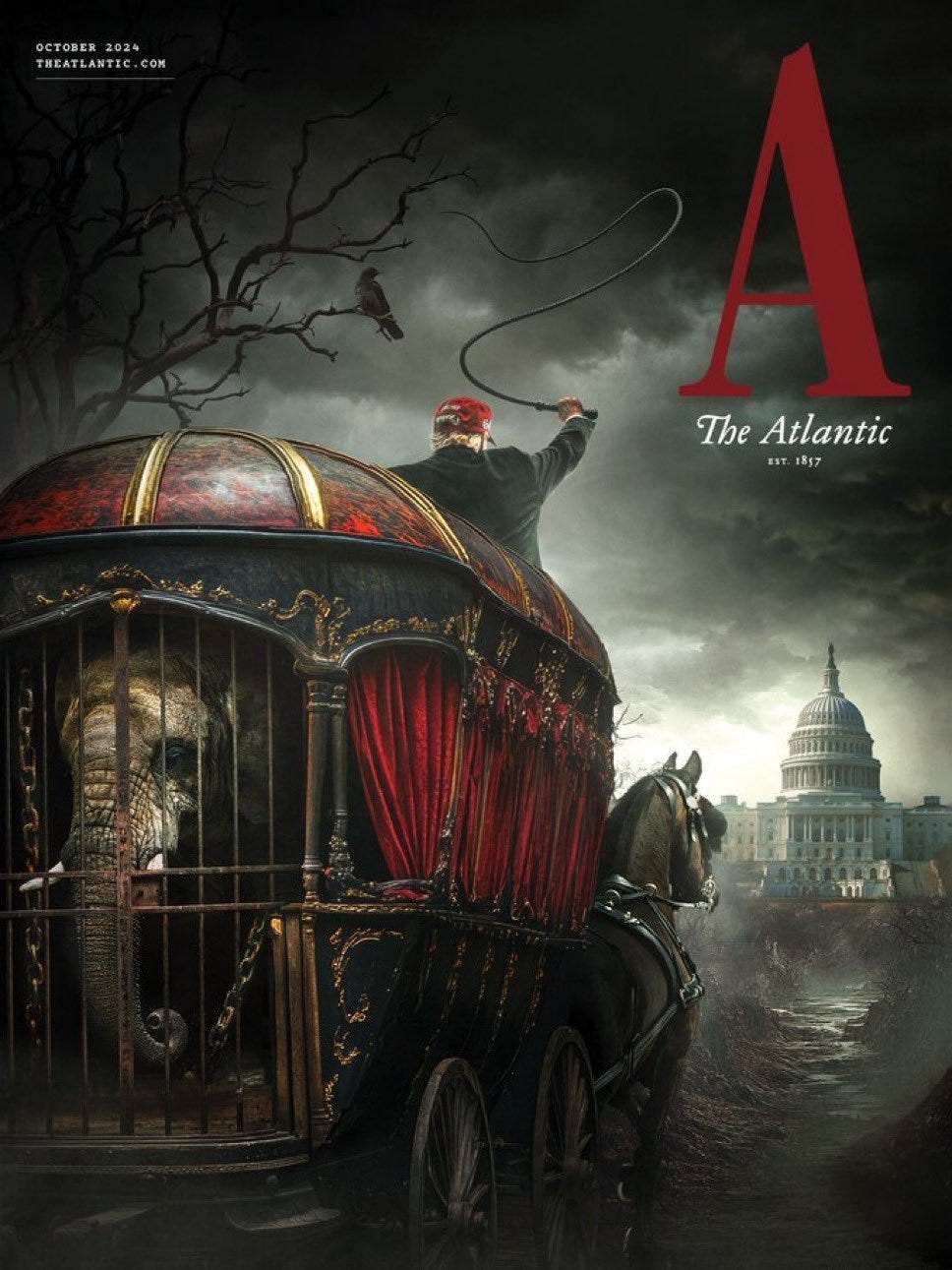
The new Trump admin shows every sign of gearing up for a Dark MAGA rampage through the Beltway.
If you’re curious about where Dark MAGA came from, why yes it was memed into reality. Aristophanes
tells the wild saga: from in-joke to shitcoin to the hat on Elon Musk’s head.They aren’t going to just drain the swamp. They’re going to drain it, dry it, soak it in gasoline, and set it on fire. They are going to purge the US government of the useless, the incompetent, the subversive, and the criminal. At least, that seems to be the intention … and given the way the rats are scrambling to escape the ship before it sinks, the regime’s minions, at least, seem to think that plan has a good chance of succeeding. […]
Of course, a lot could happen between now and January. The Democrats might find some convoluted legal pathway to deprive The Insurrectionist of the Oval Office, as Tree of Woe suggested, which of course would initiate a constitutional crisis and probably a civil war. They could assassinate him, which would also probably start a civil war, and which is probably why Trump has been holed up in Mar-a-Lago since the election. Either of these outcomes would probably place JD Vance in the presidency, which is probably much worse for the regime than Trump: Vance is marine corps combat vet who reads Curtis Yarvin and is fluent enough in meme that he probably has a frog alt on Twitter.
[…]
News that suicides spiked after the election is apparently fake, though crisis call centres catering to the Pronoun Jugend did experience a massive increase, and one guy apparently unalived his entire family. They’re still in a state of shock: shaving their heads, vowing to start a sex strike, fleeing to Canada (I do not recommend).
The left are religious fanatics, and religious fanatics don’t give up just because it looks hopeless. It’s also worth recalling that the last time Trump won, the riots didn’t start until inauguration. There’s plenty of time yet, and there are a lot of very wealthy and very influential people who probably feel they have nothing to lose as their precious oxen are in danger of being lethally gored by Dark MAGA on the Washington Mall as a sacrifice to America’s Founding gods, after which they themselves will be hanged from Wotan’s Tree of Liberty. Note that it doesn’t matter if Trump will really follow through with all of this; what matters is if the other side thinks that he will. Ruling out a dramatic escalation in civil violence in the US is almost certainly hasty.
[…]
Another play the regime could make is to just start World War III before Trump takes office, either in order to justify a military coup d’etat, or just to dump a catastrophe in Trump’s lap so that he’ll be too busy dealing with that to drain the swamp. They definitely seem to be ramping things up in Ukraine, with the new strategy of long-distance missile strikes deep into Russian territory. The idea is probably to provoke the bear so badly that it starts mauling NATO countries directly, rather than just chewing through their exhausted national arsenals in the mud of the Donbass. That might work; then again, Putin knows full well that all he has to do is wait a couple months and he’ll be dealing with Trump directly, and Trump is on record as wanting to wind down hostilities as a top priority as soon as he’s in office. Vlad may be a bad man, but he is a very patient bad man.
Assuming that the regime is unsuccessful in baiting Russia into a direct attack on Europe, Trump’s victory probably has very big, tumultuous, and positive implications for European politics. Positive, at least, for anyone who doesn’t hate Europe … and therefore very bad implications for the people currently running the civilizational centre of the human species into the dirt.
The Germans, at least, seem to think so.
Yes, it’s real.
Chancellor Scholz’ unstable “traffic light” coalition disintegrated almost immediately after Trump was elected, sending Germany into its own election … in which the AfD is poised to do very well for itself, much to the consternation of Germany’s political class. eugyppius has been doing invaluable work covering Germany’s politics for the anglosphere audience; he provides an excellent overview of the reasons for the coalition’s collapse in this recent interview on the J Burden show.


Comments Off on Looking toward the first order effects of 47
November 24, 2024
“… if Russia were found to have had its own troops assemble a long-range missile and help launch it into the United States, do you think a US president would feel able to let it slide?”
It probably tightened a lot of already tight sphincters when it was announced that President Biden had authorized the Ukrainian government to use US-supplied long-range missiles to attack targets on Russian soil:
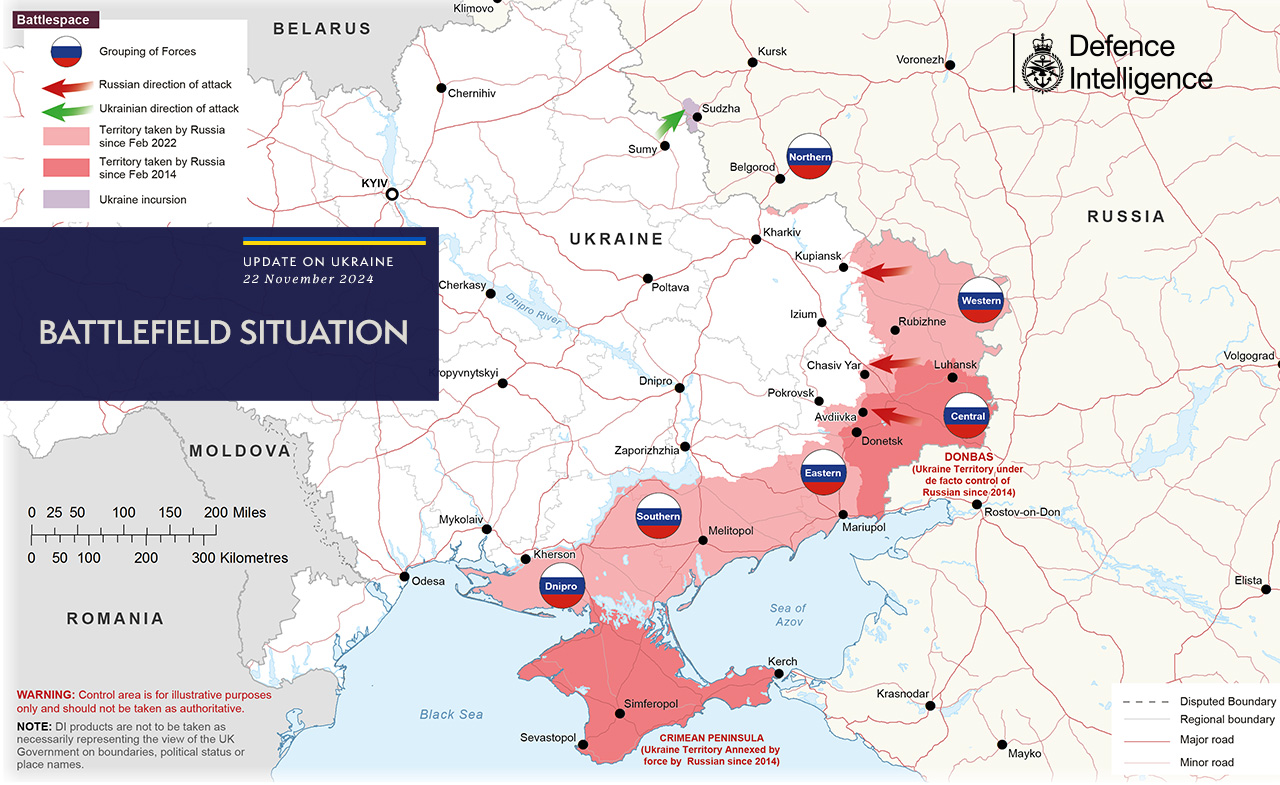
There was something truly surreal about President Biden suddenly changing course and agreeing to give Ukraine advanced long-range missiles to attack deep inside Russian territory in the last two months of his administration. There was no speech to the nation; no debate in the Senate; just a quiet demonstration of unilateral presidential fuck-you power. You know: the kind we’ve long worried about with Donald Trump. The missiles up the ante considerably against a nuclear power for a simple reason. As Putin noted:
experts are well aware, and the Russian side has repeatedly emphasized this, that it is it is impossible to use such weapons without the direct involvement of military specialists of the countries producing such weapons.
The tiny tsar continued:
We consider ourselves entitled to use our weapons against the military facilities of those countries that allow to use their weapons against our facilities. And in case of escalation of aggressive actions we will respond also decisively and mirrored.
And he looked on edge, bedraggled and belligerent, his arms and hands not moving a millimeter in what sure looks like AI.
There was a time when a NATO missile strike on Russian territory, followed by a Russian threat to attack NATO “military facilities” in response, would have caused the world to stop dead, paralyzed by the fear of nuclear armageddon. Yet here we are, blithely preoccupied by Pete Hegseth’s sexual exploits and Congressional bathrooms.
Others are not so sanguine. “I believe that in 2024 we can absolutely believe that the Third World War has begun,” Ukraine’s former military chief, Valery Zaluzhny, warned yesterday, noting both the new involvement of NATO troops and the involvement of North Korea. Our own president, having brought us much closer to the brink as a lame duck, seemed unconcerned. He was last seen wandering off-stage in the vague direction of the Brazilian rainforest. Not optimal.
The UK prime minister, Keir Starmer, was even punchier, and pledged to allow Ukraine to use British long-range missiles as well: “We need to double down. We need to make sure Ukraine has what is necessary for as long as necessary, because we cannot allow Putin to win this war”. When asked if he was prepared to risk the UK forces or Ukraine or a third country like Poland being nuked in response, as Putin has threatened, Starmer simply ignored the question.
Meanwhile, just to keep things from escalating, the deputy chief of the British defense staff told a parliamentary committee yesterday:
If the British Army was asked to fight tonight, it would fight tonight. I don’t think anybody in this room should be under any illusion that if the Russians invaded Eastern Europe tonight, then we would meet them in that fight.
There seems to be a general impression that Putin is of course bluffing, that NATO can keep lobbing missiles into Russian territory with minimal consequences, and nothing could possibly go wrong.
But Putin has responded by launching a long-range missile that could be used to carry a nuke but didn’t, as well as lowering the bar for the use of nukes in his military “doctrine“. And ask yourself: if Russia were found to have had its own troops assemble a long-range missile and help launch it into the United States, do you think a US president would feel able to let it slide? Here’s what the British missile, the Storm Shadow, did in hitting an underground military facility in Kursk, according to unverified Russia media sources:
[The strike] resulted in the Death of 18 Russian Officers, including a Senior Commander, as well as 3 North Korean Officers. In addition, a Dozen other Soldiers and Officers were Wounded in the Attack, including one of North Korea’s most Senior Generals.
I can’t verify that, but it’s perfectly possible. To have NATO’s fingers on the targeting and launch of that missile puts us in a whole new category of conflict.
The job of a president is to keep us far, far away from any risk of nuclear conflict, as Biden seemed to understand until now. And any student of history will know that blithe complacency as two sides trade military escalations is often exactly the precursor to something going very, very wrong. Accidents happen; misjudgments occur; the point of never getting to this point is that this point contains a host of unknowables, some of them globally existential.
I assume that this is all about strengthening Kyiv’s hand in what will be grueling negotiations to end the conflict once Donald Trump gets back into office. Or the intelligence is worse than we know and it’s about avoiding an Ukraine collapse before Biden leaves office — which, after Afghanistan, would be a final, damning verdict on his foreign policy. Or the intelligence is better than we know and the Russian economy is so weak and his military so depleted that NATO thinks this extra pressure will force Putin to crack. Or it’s a norm-defying attempt from an outgoing administration to derail any peace process the incoming one might want to start. The latter possibility — with Biden rolling the dice because he thinks someone else will have to face the music — is not a minimal risk.
How Allied and Nazi Generals Created the Clean Wehrmacht Myth
World War Two
Published 23 Nov 2024After the fall of the Third Reich, many of Hitler’s generals are convicted as war criminals by the Allies and condemned to prison and disgrace. Yet, within a few years, the Western Powers embrace them Cold War partners against the Soviet Union. In this new alliance, they rewrite history and create the enduring myth of the “clean Wehrmacht“.
(more…)
Comments Off on How Allied and Nazi Generals Created the Clean Wehrmacht Myth


