
World War Two
Published 21 Nov 2024Elizabeth Bentley’s defection in 1945 didn’t just expose a Soviet spy network — it fueled America’s second Red Scare and a wave of anti-communist paranoia. Her revelations about Soviet infiltration within the U.S. government became a catalyst for McCarthyism, reshaping American politics and society in an era defined by fear and suspicion.
(more…)
November 23, 2024
How the US Paranoia of Leftism was Born
Comments Off on How the US Paranoia of Leftism was Born
November 15, 2024
The Final Solution to the German Question
World War Two
Published 14 Nov 2024Millions of Germans continue to be expelled from their homes in Central and Eastern Europe. They run a gauntlet of violence, robbery, and even murder before arriving in the shattered remains of Berlin. By the end of 1945, the Allied Powers have at least agreed that further expulsions must be “orderly and humane”. But isn’t that a contradiction in terms?
(more…)
Comments Off on The Final Solution to the German Question
QotD: Battles are over-rated
Take another look at the conventional narrative. Almost every key event involves a battle, a period of time in a relatively localized area where combatants slugged it out to see who would occupy some bit of land or sea. To [How the War Was Won author Phillips Payson] O’Brien, this focus is silly, a relic of long-ago wars in ages with far less industrial capacity.
Start with theory. States fight to impose their will on another state in pursuit of some political goal. To do that requires that they achieve sufficient local military superiority that the other state can’t stop them from achieving their political goal.
Nazi Germany wanted to be the new administrators of the agricultural area of the western Soviet Union. To do that, they had to evict the Soviet military, whether through direct destruction or forcing the Soviet government to withdraw their armed forces. Individual battles for control of a localized area only matter if they are a means to that end.
Does the occupation or non-occupation of that point on the map affect the ability of a combatant to keep fighting?
In some limited cases, yes. Battlefield victory enabled Germany to overrun France before France could really focus its productive effort on the war. After their surrender, the French could not produce weapons, and they functionally could not organize their manpower to fight the Germans. But if the German army conquered, say, a random city in the Soviet Union, like Stalingrad, Soviet production and manpower was barely affected. The war goes on.
In theory, the German army could destroy so much of the Soviet military in one battle (or even a few discrete battles) that the Soviets run out of men or weapons. If there was ever a time this could have happened, it would have been the German invasion of the Soviet Union in 1941, when the Germans basically won a series of crushing victories.
The problem for the Germans was that by World War II, people in the combatant countries were good at building stuff in vast quantities, and the major combatants of World War II generally had access to sufficient natural resources. Even massive armies could not destroy produced weapons systems (e.g., tanks, airplanes) on the battlefield fast enough to remove the other side’s ability to continue fighting. What could (and did) happen was the destruction of the other side’s ability to produce and distribute weapons.
Sure enough, if you look at the actual data from even the largest battles, neither side really destroys a hugely significant amount of stuff. Take the Battle of Kursk — the largest tank and air battle of World War II. Wikipedia will dazzle you with the numbers of soldiers involved (millions), tanks deployed (in the ballpark of 10,000), and aircraft in the sky (in the ballpark of 5,000).
In this entire vast battle that supposedly dictated the outcome of the Eastern Front, the Germans lost approximately 350 armored fighting vehicles (AFVs) during the most intense 10 days of fighting. In the two months around when the battle took place, the Germans lost 1,331 AFVs on the entire Eastern Front. In the year of the battle, 1943, the Germans built more than 12,000 AFVs. Also worth noting: they disproportionately lost older, obsolete tanks at Kursk, and built new, capable tanks. The Germans lost a very manageable amount of equipment at Kursk — less than a month’s worth of AFV production.
If modern war means you cannot realistically destroy enough weapons in one battle to matter — if the largest battle of all time didn’t really matter — what did?
Anonymous, “Your Book Review: How the War Was Won“, Astral Codex Ten, 2024-08-09.
Comments Off on QotD: Battles are over-rated
November 14, 2024
Trump’s position and likely options on Ukraine
In his weekly commentary, Niccolo Soldo considers what the incoming Trump administration might do about the war in Ukraine:
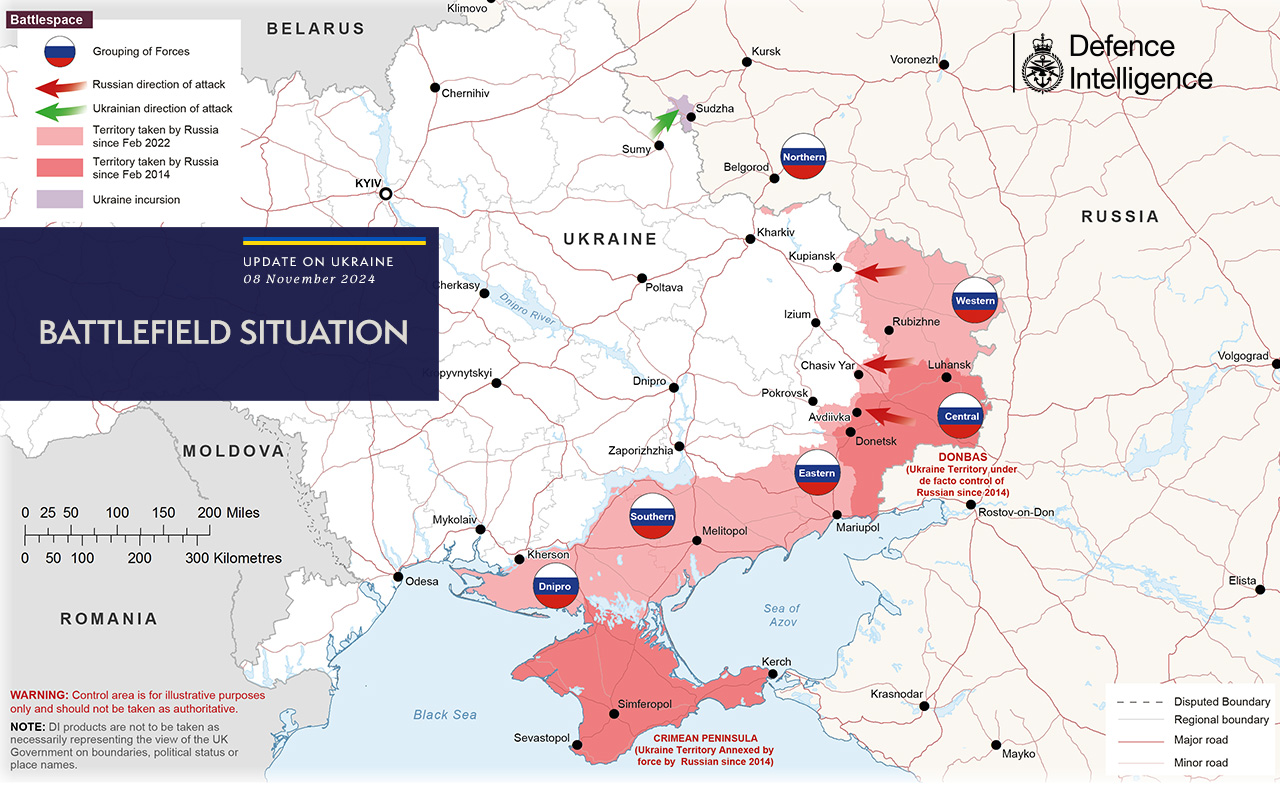
The situation in Ukraine as of 8 November, 2024.
Map from the UK Ministry of Defence via X.
… Ukraine is losing the war, and is losing it at a faster pace than before. Time is not on Kiev’s side, and there is no magic wand that anyone can wave to turn the tide in its favour. The question is: how much is Kiev willing to give up in order to save as much as it can?
The foreign policy blob is on tenterhooks, waiting to see what Trump will do regarding this conflict:
Like in Trump’s first term, different factions are set to compete to influence the Republican’s foreign policy. More traditionally minded allies such as Mike Pompeo, the former secretary of state now in contention to lead the Pentagon, are likely to push for a settlement that doesn’t appear to give a major win to Moscow. Other advisers, particularly Richard Grenell, a top candidate to lead the State Department or serve as national-security adviser, could give priority to Trump’s desire to end the war as soon as possible, even if it means forcing Kyiv into significant concessions.
Pompeo is out, but that doesn’t mean that those like him are entirely out either, as he has DoD officials sharing his views. No doubt that there are certain elements in the State Department, CIA, and in Congress as well who take the same position.
The proposals all break from Biden’s approach of letting Kyiv dictate when peace talks should begin. Instead, they uniformly recommend freezing the war in place — cementing Russia’s seizure of roughly 20% of Ukraine — and forcing Ukraine to temporarily suspend its quest to join the North Atlantic Treaty Organization.
One idea proposed inside Trump’s transition office, detailed by three people close to the president-elect and not previously reported, would involve Kyiv promising not to join NATO for at least 20 years. In exchange, the U.S. would continue to pump Ukraine full of weapons to deter a future Russian attack.
Under that plan, the front line would essentially lock in place and both sides would agree to an 800-mile demilitarized zone. Who would police that territory remains unclear, but one adviser said the peacekeeping force wouldn’t involve American troops, nor come from a U.S.-funded international body, such as the United Nations.
“We can do training and other support but the barrel of the gun is going to be European,” a member of Trump’s team said. “We are not sending American men and women to uphold peace in Ukraine. And we are not paying for it. Get the Poles, Germans, British and French to do it.”
“Pumping” Ukraine full of weapons would be attractive to Trump, as it means steady cash flow. He is a businessman after all.
The last bit is the most important, as it conforms to US policy trends in which the dumpster fire that they started is left to the Europeans to extinguish while the Americans go deal with the Chinese.
That proposal in some respects echoes comments made by Vice President-elect JD Vance during a September interview, when he suggested a final agreement between Ukraine and Russia could involve a demilitarized zone “heavily fortified so the Russians don’t invade again.” Russia, Vance continued, would get to keep the land it has taken and be assured of Ukraine’s neutrality.
“It doesn’t join NATO, it doesn’t join some of these sort of allied institutions,” he said on “The Shawn Ryan Show,” a podcast.
“No NATO, no stealth NATO”, is music to Moscow’s ears. The problem here is that the Russians do not trust the Americans to keep up their end of any deal. Russian Foreign Minister Lavrov has famously described the Americans as “agreement non-capable”.
Also, why would the Russians even agree to negotiate at this point?
For one, Ukraine and Russia still have vastly differing war aims and little desire to alter them. With Russian troops advancing slowly but steadily in Ukraine, the Kremlin has shown little inclination to negotiate, and has shown its willingness to escalate the conflict with hybrid attacks outside its borders, such as sabotage operations in Europe.
“The objectives of the special military operation remain unchanged and will be achieved,” Dmitry Medvedev, a top Russian official, posted Wednesday to X after learning of Trump’s victory over Vice President Kamala Harris, the Democratic presidential nominee.
Zelensky is over a barrel:
Zelensky, whose country is heavily dependent on the U.S. for military and financial assistance, could — more easily than Putin — be forced by Trump to negotiate, but the Ukrainian leader would have to contend with a public that views ceding territory as capitulation to Moscow.
Trump has said that Ukraine’s survival is important to the U.S., but has repeatedly criticized Zelensky, calling him the “greatest salesman”, a stance that has worried some officials in Kyiv that a Trump-led U.S. might push for a settlement that favors Russia.
Zelensky on Wednesday congratulated the president-elect on his victory, appealing to their September meeting in New York and praising his “‘peace through strength’ approach in global affairs”.
Forcing Zelensky to concede land would open up the possibility of a coup d’etat in Kiev, and even civil war. Even if a deal were hammered out, Zelensky would be forced to try to sell it at home. There are may factions in Ukraine that have no desire to budge even one inch, and would happily take his head off of the rest of his body to make sure that no one signs away any Ukrainian land.
Comments Off on Trump’s position and likely options on Ukraine
November 10, 2024
WW2 in Numbers
World War Two
Published 9 Nov 2024World War II wasn’t just the deadliest conflict in history — it was a war of unprecedented scale. From staggering casualty numbers to military production and economic costs, this episode breaks down the biggest statistics that defined the global conflict.
(more…)
Comments Off on WW2 in Numbers
November 9, 2024
Did US Indecision Encourage Stalin in Korea?
The Korean War by Indy Neidell
Published 8 Nov 2024In March 1950, Stalin finally approves Kim Il-sung’s plans for an invasion of South Korea. But why now? Today Indy looks at the wider Cold War context that fed into Stalin and Mao Zedong’s decision making. He also examines whether the lack of a clear and public commitment from the US to defend the Asian theatre helped to invite the invasion.
(more…)
Comments Off on Did US Indecision Encourage Stalin in Korea?
October 27, 2024
The Great Demobilization: How the Allied Armies Were Sent Home
World War Two
Published 26 Oct 2024After the war, the Allies face the new challenge how to bring home the tens of millions of troops they have deployed across the globe. Today Indy examines this massive logistical effort, looking at the American Operation Magic Carpet, the British government’s slow but steady approach, and the devastation that Soviet troops returned home to.
(more…)
Comments Off on The Great Demobilization: How the Allied Armies Were Sent Home
October 25, 2024
How a Soviet Clerk Took Down a Spy Network
World War Two
Published 24 Oct 2024Igor Gouzenko, a Soviet cipher clerk in Canada, defected in 1945, bringing with him documents that revealed a massive Soviet espionage network in the West. His actions forced the world to confront Soviet infiltration, shifting global politics and igniting early Cold War tensions. This episode uncovers how one man’s bravery exposed a hidden war.
(more…)
Comments Off on How a Soviet Clerk Took Down a Spy Network
October 18, 2024
Operation Keelhaul: The Allies’ Final War Crime
World War Two
Published 17 Oct 2024After the war, millions of Soviet citizens are left over in Germany. Some of them are traitors, some are prisoners, some women and children. Stalin wants them back and the Western Allies are happy to help.
(more…)
Comments Off on Operation Keelhaul: The Allies’ Final War Crime
October 16, 2024
QotD: Technical differences between ground-attack and air-defence missiles
To help everybody not get fooled again, I’m going to explain some basic differences between ground-attack and air-defense missiles, and why nobody should have been fooled by this propaganda for a second.
The top-line thing here is that ground attack missiles can be large and have heavy warheads, while air defense missiles have to be smaller and have lighter warheads.
Air defense missiles have to intercept a target traveling at high speed. They have to be as fast and agile as possible in order to do that; every gram of weight is a penalty. That means you’re going to make the warhead no heavier than you have to in order to kill a plane. And it doesn’t take much kaboom to kill a plane.
Even if we didn’t have footage of the missile and wreckage to examine, it would be obvious that the damage to that hospital wasn’t done by an air defense missile because there’s too much of it. You can’t get that much blast shock out of the smallish warheads they put in those things.
The weight penalty for a big warhead is much less in something like a KH-101. It’s not designed to be agile, it’s designed to get from point A to point B on a least-time course and then blow up real good.
You can use an air defense missile for ground attack with some hacking of the guidance software, but you can’t use a ground-attack missile for air defense; the physics are against you.
The problem with using an AD missile for ground attack is it it won’t give you much of a kaboom when it gets there. They’re just not very effective.
Nevertheless, the Russians have actually been doing this in Ukraine, throwing S-300s and S-400s at ground targets. Only because they were short on ground attack missiles to start with, and their capacity to manufacture them is limited by Western sanctions on the electronics they need.
So the next time the Russians try to deflect blame for one of their missile strikes on civilian cities by claiming the explosion was from a failed Ukrainian intercept, treat the assertion with the contempt it deserves. If whatever went boom actually was an air defense missile, it was almost certainly a repurposed Russian one.
Eric S. Raymond, X(the social media platform formerly known as Twitter, 2024-07-11.
Comments Off on QotD: Technical differences between ground-attack and air-defence missiles
October 13, 2024
The Soviet Union’s surplus of math nerds
The most recent review from Mr. and Mrs. Psmith’s Bookshelf is John Psmith’s musings on Math from Three to Seven: The Story of a Mathematical Circle for Preschoolers by Alexander Zvonkin, and he starts by talking about something the Soviets did better than the west:
To me, one of the greatest historical puzzles is why the Cold War was even a contest. Consider it a mirror image of the Needham Question: Joseph Needham famously wondered why it was that, despite having a vastly larger population and GDP, Imperial China nevertheless lost out scientifically to the West. (I examined this question at some length in this review.) Well, with the Soviets it all went in the opposite direction: they had a smaller population, a worse starting industrial base, a lower GDP, and a vastly less efficient economic system. How, then, did they maintain military and technological parity1 with the United States for so long?
The puzzle was partly solved for me, but partly deepened, when those of us who grew up in the ‘90s and ‘00s encountered the vast wave of former Soviet émigrés that washed up in the United States after the fall of communism. Anybody who played competitive chess back then, or who participated in math competitions, knows what I’m talking about: the sinking feeling you got upon seeing that your opponent had a Russian name. These days, the same scenes are dominated by Chinese and Indian kids. But China and India have large populations — the Russians were punching way above their weight, demographically speaking. Today, those same Russians are all over Wall Street and Silicon Valley and Ivy League math departments, still overrepresented in technical fields. What explains it? Are Russians just naturally better at math and physics?
When I related these questions to an Ashkenazi-supremacist friend of mine, he immediately suggested that “maybe it’s because they’re all Jewish”. (I’ve noticed that the most philosemitic people and the most antisemitic people sometimes have curiously similar models of the world, they just disagree on whether it’s a good thing.) My friend’s question wasn’t crazy, since there are definitely times when asking “were they all Jewish?” yields an affirmative answer. But in this case I had to disappoint him with the knowledge that many of these Russian math and chess superstars were gentiles.2 What’s more, by the ’60s and ’70s the Soviets had an entire discriminatory apparatus dedicated to keeping Jews out of the scientific establishment, so it would be impressive indeed if they were the foundation of its success.
Another possible explanation actually hinges on the relative poverty of the Soviet Union. Assume there are a lot of people out there with natural mathematical talent, but who given their druthers would major in underwater basket-weaving instead. The United States, because it’s so wealthy, can afford to “waste” a huge proportion of our talented population on humanities, arts, and other stuff that doesn’t involve you sitting in the school library until 3am. In other words, not going into a technical field is a form of luxury, which America can afford to consume. The Soviets, rather like the Chinese today, were forced by their underdog status to allocate human capital more efficiently (and had the authoritarian means to do so by force if necessary). This theory is related to the curious fact that, on average, the more feminist your society, the fewer women there are in math and science — which makes total sense if you assume that on average women are good at math but uninterested in it.
The thing is, the émigré superstars I encountered didn’t seem at all grudging or resentful about their studies. If anything it was the opposite. I’ve previously complained about how much I hate Russian mathematician Edward Frenkel’s3 book, but one thing it gets across well is just how important passion is to being a great mathematician, and passion was the thing the émigrés seemed to have a surfeit of. In college, the joke was that seminars by American professors would last an hour, whereas seminars by Russian professors would turn into boisterous debates lasting all night. People have been writing for centuries about Russians having a tendency towards “maximalism” — whether aesthetic or ideological or anything else. Maybe a culture-wide commitment to not doing anything by half-measures explains it?
1. There are scientific sub-disciplines where even at the end the Soviets had a clear lead, including several fields of math. Even crazier, there are sub-disciplines where we have not yet gotten back to where the Soviets were (for instance phage therapy).
2. Undeterred, my friend pointed out that many modern Russian gentiles have significant Jewish ancestry. The Soviets actively promoted mixed marriages, to the point where in some cities the average urban gentile Russian is as much as 25% Jewish. I still don’t think this explains Soviet scientific prowess, but it’s an interesting data point because the most highly urbanized areas are the ones where most of the mathematicians (and most of the émigrés) came from.
3. Before you ask, I looked it up and Frenkel is half Jewish, half gentile. I will leave it to you whether you count that as evidence for or against my friend’s theory.
October 5, 2024
Did South Korea Provoke the Korean War?
The Korean War by Indy Neidell
Published 4 Oct 2024Was South Korea on the verge of invading North Korea in 1949? Today Indy looks at the bloody fighting across the Korean border in the years leading up to war. Then he asks the question, why did Kim finally decide to invade South Korea in the early months of 1950?
(more…)
Comments Off on Did South Korea Provoke the Korean War?
October 3, 2024
QotD: Historical echoes in the American left and right
The Trump movement does have some real [historical Nazi] characteristics. Many low-level people feel remarkably empowered to do things, to get creative to help the cause (and also make some coin; how many Trump medals, flags, and coffee cups does one buy?), and to get out there and just stir the pot for the Orange guy. Then we saw The Donald at the top not exercising real power, other than to exhort others to get shit done, whatever unnamed shit that needed doing.
My first run-through suggests that calling the Juggs and their minions “filthy commies” actually is not just a kneejerk response, but it lands mostly true, in the ways that matter. The Jugg argument that Trump and his people are a bunch of Nazis also has some real truthy elements to it as well (though the true elements are generally probably far afield from the Nazi stuff the Juggs have in mind).
Commies and Nazis gain traction when the basic job of governance is found lacking, and the caliber of people tasked with getting things back in line is not up to the task. Then the various totalitarian solutions become more popular. Even when the intentions are pure (I will give most of the Trump people that assumption), unfettered ambitions, allowed to flower, will go bad if the normal checks and balances of the system are all out of whack. It is just human nature.
Our systems are all out of whack. That is why AOC can call for impeachment of [six US Supreme Court justices] with a straight face, and there is no broadly based “hey, wait a minute, Bucko” response. Things might be too far gone, and there is no way to pull back into a system that actually well serves the average American (think of what constituencies the typical elected official actually serves — the deep state apparat, the ultra-rich guys, and the corporate lobbyists). It all means the Trump movement is a tool, not to restore something, but to accelerate the “get through it and start afresh”. With that in mind, the November results tend to be more of “six of one, half a dozen of the other” than people think they are.
“Dutch”, commenting on “How Juggs Think the World Works”, Founding Questions, 2024-07-02.
Comments Off on QotD: Historical echoes in the American left and right
October 2, 2024
QotD: Alternative history Operation Barbarossa
Knowing full well how dumb it is to bring up World War II on the Internet, consider that a pretty reasonable case can be constructed for Operation Barbarossa. Having purged all their competent, experienced officers, the Red Army had just gotten their clocks cleaned by the Finns in the Winter War. Yeah, the Soviets “won” in the end, but with that disparity of forces, there’s pretty much no possible “win” that doesn’t look like a loss … and the Soviets, to put it mildly, were nowhere near that best-case scenario. Moreover, even if you took the show trials for exactly that — kangaroo courts — their very existence showed there was a deep rift at the very top of the Soviet leadership. Anyone, not just Hitler, could be forgiven for thinking that the Soviet Union would collapse under one big sledgehammer blow.1
It works the other way, too. If we accept the “Suvorov Thesis”, that Hitler only attacked Stalin because Stalin was gearing up to attack Hitler, then we can easily construct a similar case from The Boss’s perspective: The Wehrmacht can’t play defense. The one time they came up against anything approaching a real opponent with technological parity (the Battle of Britain), it was at best a bloody draw, more than likely a stinging defeat. And the Hitler regime was reeling, internally. No show trials for der Führer, but Rudolf Hess, who was at least the number three man in the Reich and at the time Hitler’s heir apparent, had just defected to the British. Anyone, not just Stalin, could be forgiven for thinking that the Third Reich would collapse under one big sledgehammer blow.
See what I mean? Both of those cases are quite plausible, and fit with most known historical facts … and yet, they’re retcons. “Rationalizations” might even be a better word, because the thing is, even though those arguments are “logical”, and might indeed have been convincing to important people at the time, that’s not why Hitler did what he did, or why Stalin would’ve done what he would’ve done under the Suvorov Thesis. No, the truth is simpler, and much more horrifying: They would’ve done it anyway, because that’s who they were.
That’s what the Castle Wolfenstein people got right about the Nazis. Same deal with that Amazon show (which was interesting for a season) The Man in the High Castle. In the real world, there’s no possible way the Nazis could’ve invaded the USA, no matter how it turned out on the Eastern Front …
… but in the real world they would’ve tried nonetheless, somehow, because that’s just who they were. Everything Stalin, Khrushchev, et al did during the Cold War here in the real world, Hitler, Heydrich, and the gang would’ve done in the Castle Wolfenstein world where the Battles of Stalingrad and Kursk went the other way.2 They couldn’t have done any different, without being different people, and while it’s fun to speculate on questions like “who would’ve been the Nazi Gorbachev, who self-destructed the Reich by attempting however you say ‘perestroika‘ in German”, it’s not really germane.
Severian, “The Man in the High Chair”, Rotten Chestnuts, 2021-07-05.
1. And Soviet losses were stupendous, utterly mind-boggling, in the first few months of Barbarossa. Tanks and planes destroyed in their tens of thousands, prisoners captured in millions. Even as it became clear that OKW had underestimated Red Army strength by orders of magnitude, it was still almost inconceivable that they had anything left to fight with. Just one more push …
2. This is actually the world of a fun novel, Robert Harris’s Fatherland.
Comments Off on QotD: Alternative history Operation Barbarossa
October 1, 2024
QotD: Napoleon Bonaparte and Tsar Alexander I
the houseRussia! — but even without knowing how horribly that turns out, you feel sorry for the guy. Napoleon thinks they have something important in common, and Alexander thinks Napoleon’s very existence is the enemy of the entire old world of authority and tradition and monarchy that he represents.Good thing the Russian Empire never gets decadent and unknowingly harbors the seeds of its own destruction!
John: Yeah, I think you’ve got the correct two finalists, but there’s one episode in particular on St. Helena that edges out his time bro-ing out with Tsar Alexander on the raft. It’s the supremely unlikely scene where old, beaten, obese, dying Napoleon strikes up a bizarre friendship with a young English girl. It all begins when she trolls him successfully over his army freezing to death in the smoldering ruins of Moscow, and after a moment of anger he takes an instant liking to her and starts pouring out his heart to her, teaching her all he knows about military strategy, and playing games in her parents’ yard where the two of them pretend to conquer Europe. Call me weird, but I think this above all really showcases Napoleon’s greatness of soul. That little girl later published her memoirs, btw, and I really want to read them someday.
Jane and John Psmith, “JOINT REVIEW: Napoleon the Great, by Andrew Roberts”, Mr. and Mrs. Psmith’s Bookshelf, 2023-01-21.
Comments Off on QotD: Napoleon Bonaparte and Tsar Alexander I


