
The Korean War by Indy Neidell
Published 20 Sep 2024The United Nations plan is to reunite the divided Korean peninsula into a single state. But soon the USA and USSR have installed their own leaders, neither of whom are willing to compromise. By the end of 1948 Kim Il-Sung and Syngman Rhee stand at the head of separate North and South Korean states.
(more…)
September 21, 2024
The Dramatic Birth of Two Korean States
Comments Off on The Dramatic Birth of Two Korean States
September 15, 2024
The Occupation of Japan Begins – a WW2 Epilogue Special
World War Two
Published 14 Sep 2024The war is over and the occupation of Japan has begun. The country has largely been destroyed by Allied bombs, and shall be rebuilt, physically, economically, and even governmentally. But what will the new government be? What shall become of the Emperor? Who is to actually do the occupation? Today we look at all this and more.
(more…)
Comments Off on The Occupation of Japan Begins – a WW2 Epilogue Special
September 3, 2024
The End of World War Two – WW2 – Week 314B – September 2, 1945
World War Two
Published 2 Sep 2024The Japanese sign the official document of surrender and the Second World War is over. There are still some Japanese garrisons yet to surrender, but they begin doing so one after the other. However, war is not over — and there is serious foreboding for future events in places like Vietnam and China — where Mao Zedong is meeting with Chiang Kai-Shek, even as Josef Stalin lurks in the background to secure Soviet interests no matter which Chinese regime comes out on top.
00:00 Intro
00:59 Vietnam Declares Independence
04:04 The Importance Of Manchuria
06:28 Japan’s Surrender
11:22 The Final Surrenders
13:18 Casualties
15:50 The End
(more…)
Comments Off on The End of World War Two – WW2 – Week 314B – September 2, 1945
September 1, 2024
Can Chiang and Mao Unite China? – WW2 – Week 314 – August 31, 1945
World War Two
Published 31 Aug 2024Mao Zedong takes his first ever journey by plane to go and meet with Chiang Kai-Shek. They begin what will be several weeks of talks and negotiations. However, Chiang is not aware that Josef Stalin is lurking in the background. And the Soviet Red Army is lurking in Manchuria, having defeated the Japanese there, and are giving tacit support to the Chinese Communists, whose power base is very strong in the north. As for Japan, a motley collection of Allied fleets arrives in Tokyo Bay, for Japan’s surrender document is to be officially signed two days from now.
(more…)
Comments Off on Can Chiang and Mao Unite China? – WW2 – Week 314 – August 31, 1945
August 27, 2024
QotD: Who were the good guys?
The Valkyrie plot was really a thing that happened (the cognoscenti call it the Schwarze Kapelle), and it’s got all the makings of a great spy thriller … except one: There’s no good guy. Claus von Stauffenberg was a better guy than Hitler, I suppose, but that’s a bar so low it’s subterranean. Von Stauffenberg was a Wehrmacht colonel who’d seen action in pretty much every theater up to that point, including the invasions of Poland and Russia. It’s safe to say that one does not rise to the rank of colonel via combat in the Nazi armed forces without being involved in some shady shit. Indeed, as Wiki informs us, von Stauffenberg was fine with the way things ran in Poland, and initially declined to participate in the resistance out of a sense of personal loyalty to the Führer.
A movie can get away with showing mostly shades of gray, but in the case of the Valkyrie plot, both shades are pretty damn close to black.
Nor was the 2008 movie, starring Tom Cruise, an isolated case. A few years earlier, Jude Law and Ed Harris squared off as dueling snipers in Enemy at the Gates … set during the Battle of Stalingrad. Who do you root for, the Nazi or the Commie? The producers opt for “commie”, obviously, but their attempts to humanize the Jude Law character are embarrassing — even if we accept Law’s character as totally apolitical, no movie featuring a political commissar in a vital supporting role, not to mention “cameos” by Khrushchev and Stalin himself, can fail to remind viewers that everyone involved was awful. Even the most gripping battle scenes (and to be fair, some of them were pretty good) can’t make up for the fact that the world would be a far, far better place if they somehow both could’ve lost.
Those are high-level failures, conceptual mistakes, the kind that professional storytellers simply shouldn’t make. Not only that, though, both movies have unforgivable mistakes in the execution, at almost every level. Tom Cruise, for instance, is comically miscast as Stauffenberg. I’ve written before about how weird it is that casting directors seem to obsess over finding actors who look like even obscure historical figures. Cruise looks a bit like Stauffenberg, I guess, but there’s simply no way a guy with his … ummm … distinctive acting style should be anywhere near a historical drama. Tom Cruise only ever really plays Tom Cruise, so “Tom Cruise dressed up as a Nazi” is really jarring.
And that’s before you consider the accents. Maybe Tom Cruise can’t do a German accent, I dunno. I seem to recall he did an Irish accent in a movie once, and that turned out ok, but again, whatever character he was playing was just “Tom Cruise with an Irish accent.” So maybe if you feel you must cast him as a German, letting him use his “natural” American accent is the way to go. But if you’re going to do that, please, for pete’s sake, make everyone else do an American accent, too. I know Kenneth Branagh can do one. So either cast guys who can do the right accent, or, failing that, who can do each other’s accent. Otherwise you get a huge, distracting mess.
Enemy at the Gates was actually worse: Law, Joseph Fiennes (the commissar), and Rachel Weisz (the love interest) all used their native British accents … but they’re different kinds of British accent, at least in Law’s case. Meanwhile, Ed Harris (the Nazi antagonist) uses the “neutral” American accent, while supporting player Ron Perlman, who is American, does a comically over-the-top Russian … as do the guys playing Khrushchev and Stalin. It’s just weird. In both movies, you’ve got supposedly tight groups of friends (or, at least, co-conspirators) talking to each other in wildly different accents. That kind of thing is bad enough in a movie like Robin Hood, Prince of Thieves, which made no pretenses to historical accuracy; it’s movie-destroying in a supposedly serious, historically-based thriller.
Severian, “Storytelling Fail”, Rotten Chestnuts, 2021-07-13.
Comments Off on QotD: Who were the good guys?
August 25, 2024
Soviet Victory in Manchuria – WW2 – Week 313 – August 24, 1945
World War Two
Published 24 Aug 2024The Soviet Red Army completes its conquest of Manchuria and the northern half of Korea this week, although Japanese Emperor Hirohito announced Japan’s surrender already last week. Behind the scenes are machinations going on by Josef Stalin and Mao Zedong that they hope will lead to a Communist China in future. Vietnam might well be going communist right now, though, for the August revolution continues with the Viet Minh taking ever more control.
00:00 Intro
00:34 Recap
00:49 Chiang, Mao, and Stalin
07:32 Soviet victory in Manchuria
09:08 Viet Minh taking control
11:45 Summary
12:31 Conclusion
13:20 Julius Poole memorial
(more…)
Comments Off on Soviet Victory in Manchuria – WW2 – Week 313 – August 24, 1945
August 18, 2024
Hirohito Announces Surrender – War Continues – WW2 – Week 312 – August 17, 1945
World War Two
Published 17 Aug 2024Hirohito broadcasts Japan’s surrender to the world- despite an attempted to coup to prevent it from happening, and much of the world celebrates, but the war isn’t really over. The Soviets are busy invading Manchuria, and there’s revolution in Vietnam and Indonesia.
00:00 Intro
00:22 Recap
00:49 Attempted Coup In Japan
04:12 Hirohito Surrenders
08:54 Japanese Surrender In China
12:05 Soviets In Manchuria
17:52 Revolution In Vietnam
20:33 Summary
21:07 Conclusion
(more…)
Comments Off on Hirohito Announces Surrender – War Continues – WW2 – Week 312 – August 17, 1945
August 15, 2024
Yet another revisionist history of World War II
In the latest anonymous review at Astral Codex Ten, the book to be considered is How the War Was Won by Phillips Payson O’Brien:
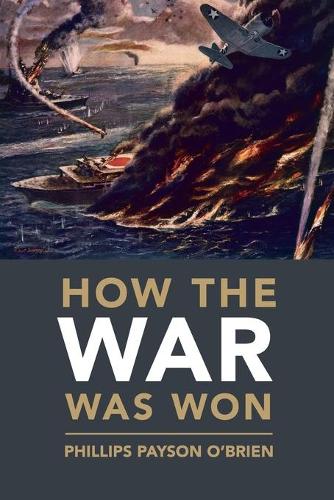
To a first approximation, there are a million books about World War II. Why should you care about How the War Was Won (hereinafter “HtWWW”) by Phillips Payson O’Brien?
- It provides a new, transformative view of the conflict by focusing on production of key goods and what affected that production instead of the ups and downs of battles at the front.
- That particular lens used can (and should) be applied outside of just World War II, and you can get a feel for how that might be done by reading HtWWW.
- I have lectured about World War II and read many, many books about it. I have never texted friends more excerpts of a book than this one.
I have some criticisms of HtWWW, but if the criticisms dissuade you from reading the book, I will have failed. These complaints are like tut-tutting Einstein’s penmanship.
The Wikipedia-Level Story of World War II (and O’Brien’s Counterargument)
To understand why O’Brien’s argument is so novel, you need to know the modern-day conventional understanding of the story of World War II. Here is my summary of the conventional narrative of World War II:
- Germany conquered Poland and France. It tried to bomb the UK into submission/maybe enable an invasion. That effort failed when Germany was defeated in the Battle of Britain, thanks largely to the plucky efforts of British airmen (memorably summarized by Winston Churchill: “Never in the field of human conflict was so much owed by so many to so few”.)
- Stymied in the West, Germany invaded the Soviet Union, won a bunch of crushing victories, but then got turned back at the gates of Moscow. The Soviets moved all of their factories east of the Ural Mountains and produced a vast tide of T-34 tanks that overpowered the Germans.
- The Germans suffered a catastrophic defeat at Stalingrad and a bloody strategic defeat at Kursk, after which the Soviets relentlessly pounded Germany to defeat.
- The US and the UK sent a lot of material help and eventually fought the Germans too, most notably in the D-Day invasion and the Battle of the Bulge. However, most of the fighting was done by the Soviets.
- It is very difficult to say how important the aerial bombing campaigns of the Western Allies were in defeating Germany. The Germans moved much of their production underground, insulating them from truly disastrous effects.
- The U.S. mostly fought alone against Japan, which won a series of impressive early victories (e.g., Pearl Harbor, the conquest of Singapore) until the decisive Battle of Midway, after which the vastly larger US industrial base outproduced Japan into oblivion.
- The US bombed the Japanese into submission by destroying Japanese cities, ultimately by dropping atom bombs on Hiroshima and Nagasaki.
By examining where the Axis focused their productive capacities and how the Allies disrupted those capacities, O’Brien challenges virtually every part of that narrative:
- The Battle of Britain was not a close-run thing. The fact that British fighter planes were flying over their own territory meant their attrition rate of pilots and aircraft were far lower than the Germans’.
- American and British bombing mattered far more to the war’s outcome than the battles of the Eastern Front, which consumed a much smaller portion of German expenditures.
- American and British airpower made German battlefield victories on the Western Front virtually impossible and dramatically limited the force Germany could bring to bear in the East.
- Japan (really, Japan plus the giant empire it conquered at the beginning of the war) was an industrial behemoth to rival the Soviet Union. However, the destruction of the Japanese merchant fleet by American air and sea forces wrecked Japan’s economy.
- The firebombing of Japanese cities and the atomic bombings of Hiroshima and Nagasaki had an ambiguous strategic effect. American air power played a much more important role in severing Japan from the natural resources it had conquered in the early part of the war.
Comments Off on Yet another revisionist history of World War II
August 11, 2024
The US drops two atomic bombs on Japan – WW2 – Week 311 – August 10, 1945
World War Two
Published 10 Aug 2024This week atomic bombs are for the first time in history dropped on cities — Hiroshima and Nagasaki in Japan. The bombs kill over 100,000 people and flatten large parts of the urban area. The Japanese government is actually meeting while the second bomb is dropped to consider their response to the first and to the demands for unconditional surrender. The response is not just to that first bomb, though, for on the 8th the Soviets tell the Japanese not only that they will not help them negotiate some sort of settled peace with the other Allies, they too are declaring war on Japan, and indeed invade Manchuria. With two atomic bombs and an invasion instead of mediating help, Japanese Emperor Hirohito cuts off any debate and says that Japan will surrender. This could happen next week.
00:00 Intro
00:17 Recap
00:44 Hiroshima Bombing
02:35 The Bombing Mission
04:19 Descriptions Of The Blast
06:38 The Nagasaki Bomb
07:37 The Tactics
08:31 The Japanese Response
12:55 Soviets Invade Manchuria
16:18 Splitting Korea
18:07 Operation Zipper
19:31 End Notes
20:08 Summary
20:30 Conclusion
(more…)
Comments Off on The US drops two atomic bombs on Japan – WW2 – Week 311 – August 10, 1945
August 4, 2024
Mokusatsu! – WW2 – Week 310 – August 3, 1945
World War Two
Published 3 Aug 2024The Japanese reaction to the Allied ultimatum for unconditional surrender is … mokusatsu. This can be translated several ways, but all involve not giving a response. Meanwhile, materials for atomic bombs to be dropped on Japan are delivered to Tinian, though the ship making the delivery is sunk by a Japanese submarine days afterward. The active war continues in Burma and China, and the Potsdam Conference ends in Germany with the map of Poland very much re-drawn.
00:00 Intro
00:56 Mokusatsu
05:47 Delivering Atomic Material
07:22 Sinking The Indianapolis
09:26 Bombing Japan
12:22 The War In Burma And China
14:07 Potsdam Confernece Ends
17:02 Conclusion
(more…)
Comments Off on Mokusatsu! – WW2 – Week 310 – August 3, 1945
July 28, 2024
Allies Issue Potsdam Declaration – WW2 – Week 309 – July 27, 1945
World War Two
Published 27 Jul 2024China, Britain, and the US issue a Declaration demanding Japan’s unconditional surrender, and promising complete destruction if this does not happen and happen soon. The plan is to for the Americans to use their atomic bombs on Japan if she does not comply, but by the end of the week the Japanese have not replied. They still have hopes for the Soviets to mediate some sort sort of peace. What they don’t have is a navy, as its final destruction comes this week.
00:00 Intro
00:50 Recap
01:32 The Potsdam Conference
04:41 Japanese Hopes
05:56 The Potsdam Declaration
10:53 The Initial Reaction
14:48 The End Of The Japanese Navy
15:05 The War On Land
19:10 Summary
19:30 Conclusion
(more…)
Comments Off on Allies Issue Potsdam Declaration – WW2 – Week 309 – July 27, 1945
July 24, 2024
Chieftain V T-62 | Operation Nasr, Iran – Iraq War, 1981
The Tank Museum
Published Apr 13, 2024Two tanks designed to fight each other in Northern Europe would face each other during the Iran-Iraq war in 1981. On one side, the British built Chieftain MBT. On the other, the Soviet-built T-62.
In this video, we examine what happened during Operation Nasr to find out which tank came out on top …
00:00 | Intro
01:19 | Meet the Tanks
02:15 | The T-62
03:26 | The Chieftain
06:21 | From Paper to the Battlefield
09:25 | The Outcome and Findings
(more…)
Comments Off on Chieftain V T-62 | Operation Nasr, Iran – Iraq War, 1981
July 23, 2024
Claim – “Everybody wants Gaza’s gas”
Tim Worstall explains why the popular idea that it’s demand for the natural gas reserves that sit under Palestine that is driving much of the situation in the Middle East is utter codswallop:
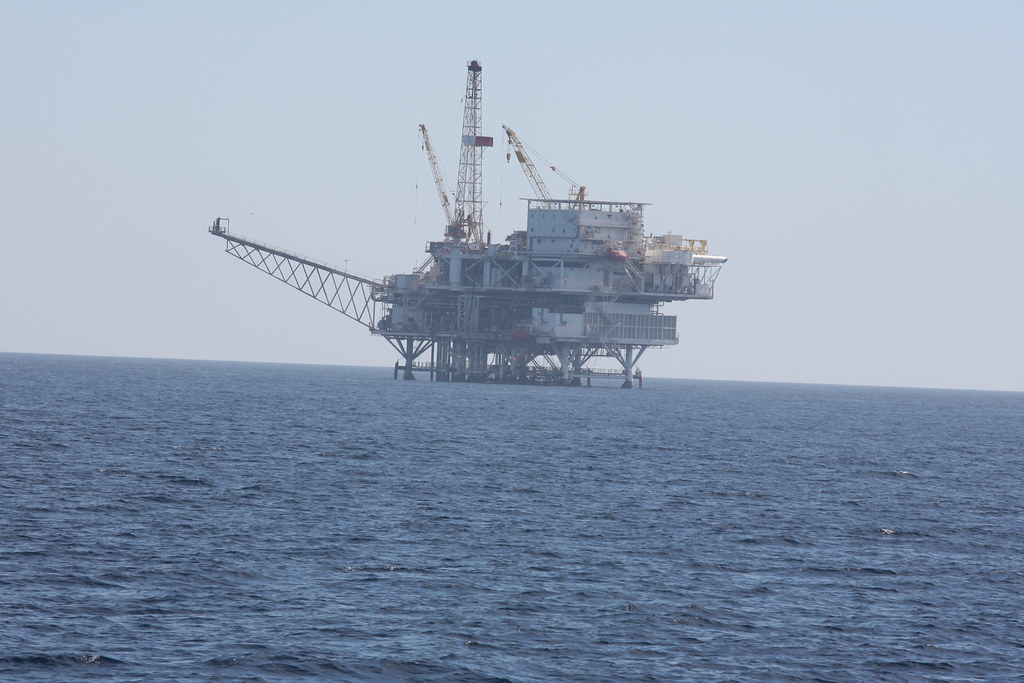
“Oil Platform in the Santa Barbara Channel, California” by Ken Lund is licensed under CC BY-SA 2.0 

 .
.
So we’ve a big thing about how all this fighting in Gaza is really about fossil fuels. @JamesMelville seems to think it’s true:
“Everybody wants Gaza’s gas.”
Oil and gas reserves – that’s the real proxy war in the Middle East.
This video provides a really succinct summary of the situation.
This “really succinct” summary includes the idea that the invasion of Iraq was all about access to that country’s oil. Which is very silly indeed. Before the war people paid Iraq for the oil. During the war people paid Iraq for the oil. After the war people are paying Iraq for the oil. The war hasn’t changed Iraq’s oil price — the global oil price has changed it, but not the war — and so the effect of the war upon access to Iraq’s oil has been, well, it’s been zero.
No, it’s not possible to then go off and say that Iraq wouldn’t sell to Americans and that’s why or anything like that. The US didn’t buy much Middle East oil anyway — mainly West African instead. But more than that, this is idiocy about how commodity markets work.
This is something we can test with a more recent example. So, there are sanctions on Russian oil these days over Ukraine. Western Europe, the US, doesn’t buy Russian oil. Russia is still exporting about what it used to. Because it’s a commodity, oil is.
What’s happening is that the Russian oil that used to come to Europe now goes to — say — India. And the Far East, or Middle East, whatever, oil that used to go to India now comes to Europe (the US is now a net exporter itself). Because that’s what happens with commodities. The very name, commodity, means they are substitutable. So, if one particular source cannot sell to one particular user then there’s a bit of a reshuffle. The same oil gets produced, the same oil gets consumed, it’s just the consumption has been moved around a bit and is now by different people. The net effect of sanctions on Russian oil has been, more or less, to increase the profits of those who run oil tankers. Ho Hum.
We’re also treated to the revelation that the US wants everyone to use liquefied natural gas because the US is the big exporter of LNG (well, it’s one). Therefore the US insists that Israel must develop the LNG fields off Gaza. Which is insane. If you’re an exporter you don’t want to start insisting on the start up of your own competition. The US demanding that the LNG not be produced at all would make logical sense but that’s not how conspirazoid ignorance works, is it? It has to be both a conspiracy and also a ludicrous one.
And a third claim. That this natural gas off Gaza is really worth $500 billion. That’s half a trillion dollars. We’ve looked at this value of gas off Gaza claim before and it’s tittery. $4 billion (that’s four billion, not five hundred billion) might be a reasonable claim and that’s just not enough to go to war over.
Comments Off on Claim – “Everybody wants Gaza’s gas”
July 22, 2024
Chinese Type 50 PPSh: Founding “Gun City” in Manchuria
Forgotten Weapons
Published Apr 12, 2024One of the first new weapons adopted and used by the Chinese Peoples’ Liberation Army after the Communist victory in the Chinese civil war was the Type 50, a copy of the Soviet PPSh-41. The story of its manufacture begins at the Japanese-occupied Mukden Arsenal. It was briefly occupied by the Soviets in 1945 before coming under control of the CCP. It was a huge manufacturing complex at the time, making artillery, small arms, ammunition, and more. A Nationalist bombing raid in 1949 led to the production being distributed among three separate smaller facilities, and the small remote town of Bei’an was chosen to become the new small arms factory site.
The town became so heavily focused on weapons manufacture that it gained the nickname of “Gun City”. The factory was formally named #626, and given the cover name of Qinghua Tool Company. It initially began with production of the Type 38 Arisaka, Type 24 Mauser (the Chiang Kai Shek rifle), the M1 Carbine (a failed project), and the Type 50 copy of the PPSh. In the spring of 1951 in response to UN advances northward in Korea, production was ordered to scale up on the Type 50, to 7500-9000 per month. This took a couple of months to achieve, but in June 1951 the first large shipment of the guns left the factory, and by December 1953 a total of 358,000 had been made. At that point, production shifted to the Type 54, a copy of the PPS-43.
The Type 50 is a close copy of the Russian Shpagin, but differs in a couple of details. The Chinese used a rear aperture sight, and the sights were placed slightly farther forward than on Russian guns. They are also generally very well made — better than most Russia wartime examples.
For many more cool small arms stories, check out WWII After WWII:
https://wwiiafterwwii.wordpress.com
(more…)
Comments Off on Chinese Type 50 PPSh: Founding “Gun City” in Manchuria
July 21, 2024
The Atomic Age Begins! – WW2 – Week 308 – July 20, 1945
World War Two
Published 20 Jul 2024This week the Americans explode a nuclear bomb at the Trinity Test in New Mexico. The plan is to possibly use more such bombs against targets in Japan. US President Harry Truman is meanwhile in Germany for the Potsdam Conference with other Allied leaders to hammer out some details of the postwar global order. The active war continues, of course, in Burma, Borneo, the Philippines, and China, with the Japanese being defeated everywhere.
00:00 Intro
00:22 Recap
00:51 The Trinity Test
02:46 The Potsdam Conference Begins
04:09 Bretton Woods Agreement
05:38 The Active War Continues
09:39 Summary
11:00 Conclusion
(more…)
Comments Off on The Atomic Age Begins! – WW2 – Week 308 – July 20, 1945


