
The Great War
Published 13 Sept 2024The First World War is often seen as futile and pointless. Millions of men fought and died for years, but no one was satisfied with the outcome, which did not bring a lasting peace. But that is not how governments and many people saw the war as it was being fought. So what did the countries fighting actually want to achieve? In other words, what was the purpose of the First World War?
(more…)
January 24, 2025
Was WW1 Pointless? – War Goals Of Every Major Nation
Comments Off on Was WW1 Pointless? – War Goals Of Every Major Nation
January 23, 2025
The Google of the early modern era
Ted Gioia compares the modern market power of the Google behemoth to the only commercial enterprise in human history to control half of the world’s trade — Britain’s “John Company”, or formally, the East India Company which lasted over 250 years growing from an also-ran to Dutch and Portuguese EICs to the biggest ever to sail the seas:
No business ever matched the power of the East India Company. It dominated global trade routes, and used that power to control entire nations. Yet it eventually collapsed — ruined by the consequences of its own extreme ambitions.
Anybody who wants to understand how big businesses destroy themselves through greed and overreaching needs to know this case study. And that’s especially true right now — because huge web platforms are trying to do the exact same thing in the digital economy that the East India Company did in the real world.
Google is the closest thing I’ve ever seen to the East India Company. And it will encounter the exact same problems, and perhaps meet the same fate.
The concept is simple. If you control how people connect to the economy, you have enormous power over them.
You don’t even need to run factories or set up retail stores. You don’t need to manufacture anything, or create any object with intrinsic value.
You just control the links between buyers and sellers — and then you squeeze them as hard as you can.
That’s why the East India Company focused on trade routes. They were the hyperlinks of that era.
So it needed ships the way Google needs servers.
The launch of the massive East India merchant ship, the Edinburgh — which brought tea from China.
The seeds for this rapacious business were planted when the British captured a huge Portuguese ship in 1592. The boat, called the Madre de Deus, was three times larger than anything the Brits had ever built.
But it was NOT a military vessel. The Portuguese ship was filled with cargo.
The sailors couldn’t believe what they had captured. They found chests of gold and silver coins, diamond-set jewelry, pearls as big as your thumb, all sorts of silks and tapestries, and 15 tons of ebony.
The spices alone weighed a staggering 50 tons — cinnamon, nutmeg, cloves, pepper, and other magical substances rarely seen in British kitchens.
This one cargo ship represented as much wealth as half of the entire English treasury.
And it raised an obvious question. Why should the English worry about military ships — or anything else, really — when you could make so much money trading all this stuff?
Not long after, a group of merchants and explorers started hatching plans to launch a trading company — and finally received a charter from Queen Elizabeth in 1600.
The East India Company was now a reality, but it needed to play catchup. The Dutch and the Portuguese were already established in the merchant shipping business.
By 1603, the East India Company had three ships. A decade later that had grown to eight. But the bigger it got, the more ambitious it became.
The rates of return were enormous — an average of 138% on the first dozen voyages. So the management was obsessed with expanding as rapidly as possible.
They call it scalability nowadays.
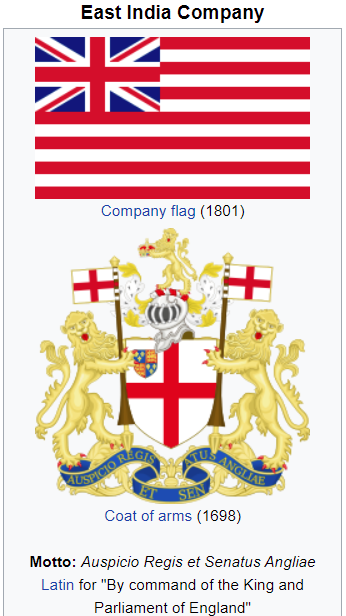
But even if they dominated and oppressed like bullies, these corporate bosses still craved a veneer of respectability and legitimacy — just like Google’s CEO at the innauguration yesterday. So the company got a Coat of Arms, playacting as if it were a royal family or noble clan.

As a royally chartered company, I believe the EIC was automatically entitled to create and use a coat of arms. Here’s the original from the reign of Queen Elizabeth I:

Comments Off on The Google of the early modern era
Guycot 40-shot Chain Pistol
Forgotten Weapons
Published 19 Dec 2016The Guycot chain pistol was the development of two Frenchmen, Henri Guenot and Paulin Gay in 1879. It is chambered for a unique 6.5mm caseless rocket ball type cartridge in which the base of the projectile is hollowed out and contains the propellant powder and a primer. Upon firing, the entirely of the projectile exits, leaving nothing to be extracted or ejected from the chamber. Unfortunately for the Guycot’s military aspirations, this cartridge was far too small and underpowered to attract and serious interest and only a few hundred at most were made. These were divided between several models, including a 25-shot pistol, a 40-shot pistol like this one, and an 80-shot carbine.
QotD: The origins of strategic airpower
In my warfare survey, I have a visual gag where for a week and a half after our WWI lecture, every lecture begins with the same slide showing an aerial photograph (Wiki) of the parallel trenches of the First World War because so much of the apparatus of modern warfare exists as a response, a desperate need to never, ever do the trench stalemate again. And that’s where our story starts.
Fighting aircraft, as a technology in WWI, were only in their very infancy. On the one hand the difference between the flimsy, unarmed artillery scout planes of the war’s early days and the purpose-built bombers and fighters of the war’s end was dramatic. On the other hand the platforms available at the end of the war remained very limited. Once again we can use a late-war bomber like the Farman F.50 – introduced too late to actually do much fighting in WWI – as an example of the best that could be done. It has a range of 260 miles – too short to reach deep into enemy country – and a bomb load of just 704lbs. Worse yet it was slow and couldn’t fly very high, making it quite vulnerable. It is no surprise that bombers like this didn’t break the trench stalemate in WWI or win the war.
However, anyone paying attention could already see that these key characteristics – range, speed, ceiling and the all-important bomb-load – were increasing rapidly. And while the politicians of the 1920s often embraced the assumption that the War to End All Wars had in fact banished the scourge of war from the Earth – or at the very least, from the corner of it they inhabited such that war would now merely be a thing they inflicted on other, poorer, less technologically advanced peoples – the military establishment did not. European peace had always been temporary; the Peace of Westphalia (1648) and the Congress of Vienna (1815) had not ended war in Europe, so why would the Treaty of Versailles (1919)? There had always been another war and they were going to plan for it! And they were going to plan in the sure knowledge that the bombers the next war would be fought with would be much larger, faster, longer ranged and more powerful than the bombers they knew.
One of those interwar theorists was Giulio Douhet (1869-1930), an Italian who had served during the First World War. Douhet wasn’t the only bomber advocate or even the most influential at the time – in part because Italy was singularly unprepared to actually capitalize on the bomber as a machine, given that it was woefully under-industrialized and bomber-warfare was perhaps the most industrial sort of warfare on offer at the time (short of naval warfare) – but his writings exemplify a lot of the thinking at the time, particularly The Command of the Air (1921). But figures like Hugh Trenchard in Britain or Billy Mitchell in the United States were driving similar arguments, with similar technological and institutional implications. But first, we need to get the ideas.
Like many theorists at the time, Douhet was thinking about how to avoid a repeat of the trench stalemate, which as you may recall was particularly bad for Italy. For Douhet, there was a geometry to this problem; land warfare was two dimensional and thus it was possible to simply block armies. But aircraft – specifically bombers – could move in three dimensions; the sky was not merely larger than the land but massively so as a product of the square-cube law. To stop a bomber, the enemy must find the bomber and in such an enormous space finding the bomber would be next to impossible, especially as flight ceilings increased. In Britain, Stanley Baldwin summed up this vision by famously quipping, “no power on earth can protect the man in the street from being bombed. Whatever people may tell him, the bomber will always get through.” And technology seemed to be moving this way as the possibility for long-range aircraft carrying heavy loads and high altitudes became more and more a reality in the 1920s and early 1930s.
Consequently, Douhet assumed there could be no effective defense against fleets of bombers (and thus little point in investing in air defenses or fighters to stop them). Rather than wasting time on the heavily entrenched front lines, stuck in the stalemate, they could fly over the stalemate to attack the enemy directly. In this case, Douhet imagined these bombers would target – with a mix of explosive, incendiary and poison gas munitions) the “peacetime industrial and commercial establishment; important buildings, private and public; transportation arteries and centers; and certain designated areas of civilian population”. This onslaught would in turn be so severe that the populace would force its government to make peace to make the bombing stop. Douhet went so far as to predict (in 1928) that just 300 tons of bombs dropped on civilian centers could end a war in a month; in The War of 19– he offered a scenario where in a renewed war between Germany and France where the latter surrendered under bombing pressure before it could even mobilize. Douhet imagined this, somewhat counterintuitively, as a more humane form of war: while the entire effort would be aimed at butchering as many civilians as possible, he thought doing so would end wars quickly and thus result in less death.
Clever ideas to save lives by killing more people are surprisingly common and unsurprisingly rarely turn out to work.
Bret Devereaux, “Collections: Strategic Airpower 101”, A Collection of Unmitigated Pedantry, 2022-10-21.
Comments Off on QotD: The origins of strategic airpower
January 22, 2025
The Korean War 031 – Operation Wolfhound – January 21, 1951
The Korean War by Indy Neidell
Published 21 Jan 2025Matt Ridgway sends forth the US 27th Infantry Regiment, known as the Wolfhounds, into the no-mans-land between the UN and Chinese lines to sniff out and hunt down their enemy. The success or failure of his first few operations in Korea could be crucial, as confidence in the UN mission from generals, politicians, and the US’ allies continues to teeter on a knife edge. A strong showing here could finally put the uncertainty to rest.
Chapters
00:00 Intro
00:45 Recap
01:11 Meeting at Taegu
04:19 Operation Wolfhound
07:44 Collins Reports
09:35 Trouble in Paradise
12:59 Wonju
14:54 Summary
15:18 Conclusion
(more…)
Comments Off on The Korean War 031 – Operation Wolfhound – January 21, 1951
QotD: The Who
But I’ll tell you right now, there ain’t no Moon over there. I mean, good Lord: OF COURSE Keith Moon and John Entwistle were a difficult rhythm section for a guitarist to play in front of. Have you listened to those records? Professionals have talked about how watching Moon play up close was an exercise in constant suspense — you would see him take off at the start of the bar and go roaming around the drum kit and wonder how he could possibly make it back in time. He usually did make it — when he wasn’t so zonked he was falling off his stool, which is also a thing that happened sometimes.
This intricate, frantic quality is what made Moon the most inimitable of the great rock drummers — someone whose style you could recognize in a matter of seconds if he were playing on biscuit tins — but the difficulty of playing in front of a notional “timekeeper” so adventurous, and particularly doing it in concert, ought to be self-evident.
The standard advice for a rock guitarist in this predicament would be to make sure he had a very steady, unadventurous bass player to anchor the group. And the bassists for many excellent groups do, in fact, secretly stick to four or five notes they’re real comfortable with. But Entwistle offered Moon-like challenges as part of a rhythm section, albeit without inducing the same terror. At any moment his left hand might start leaping like a salmon on the fretboard, and if he played half notes in one bar, this was no guarantee he wouldn’t be doing startling, blinding sixteenths in the next.
That’s what makes Who records Who records; that’s what lifts the best ones above even the empyrean level of Townshend’s songwriting. But it meant, as Pete explained in his apology, that he could never step out and “shred” as a guitarist. The entire structure of the traditional rock group was topsy-turvy with the Who, and Townshend, whose ego is at least as big as the next fellow’s (spoiler: it’s bigger), was forced in some regard to be the responsible one, the custodian of the rhythm.
Colby Cosh, “Leave Pete Townshend alone!”, National Post, 2019-11-29.
Comments Off on QotD: The Who
January 21, 2025
January 20, 2025
Campo-Giro M1913 – Spain’s First Domestic Selfloader
Forgotten Weapons
Published 31 May 2015The Campo-Giro was Spain’s first indigenous self-loading military pistol, adopted in 1912 to replace the Belgian 1908 Bergmann-Mars. Only a small number were made of the original M1913 variety, with the vast majority being the later and slightly more refined M1913/16. This particular example is an early one, and particularly interesting to look at for that reason. The gun is a straight blowback design in 9mm Largo, and only lasted as Spain’s standard pistol until its descendent, the Astra 400, was adopted in 1921.
Comments Off on Campo-Giro M1913 – Spain’s First Domestic Selfloader
QotD: Brainwashing
Like Robert Jay Lifton’s Thought Reform and the Psychology of Totalism (another must-read), I read Meerloo years ago, so my recall of the details is fuzzy, but the upshot is obvious: The techniques of “brainwashing” have been known since at least the Middle Ages, and they’re still the same. Suspected witches in the Early Modern period, for instance, got Der Prozess, and though the witch hunters also had recourse to the rack and thumbscrews and all the rest, none of it was really necessary — isolation, starvation, and sleep deprivation work even better, provided you hit that sweet spot when they’re just starting to go insane …
I’m being deliberately flip about a horrible thing, comrades, because as no doubt distasteful as that is to read, the fact is, we’re doing it to ourselves, everywhere, all the time. Not the starvation part, obviously, but we eat such horribly unnatural diets that our minds are indeed grossly affected. Want proof? Go hardcore keto for a week and watch what happens. Or if that’s too much, you can simulate the experience by going cold turkey off caffeine. I promise you, by the end of day two you’d give the NKVD the worst dirt on your own mother if they sat a steaming hot cup of java in front of you.
Severian, “Kickin’ It Old Skool”, Founding Questions, 2021-10-04.
Comments Off on QotD: Brainwashing
January 19, 2025
Dozens of Dead Tiger Tanks at Prokhorovka? – Prokhorovka Part 6
World War Two
Published 18 Jan 2025As the dust settles on the fields of Prokhorovka, Indy takes a look at the losses suffered by the Red Army and the Waffen-SS. But we soon see that Rotmistrov and the Soviets have launched a calculated propaganda operation to distort the numbers and paint the battle as a crushing victory.
(more…)
Comments Off on Dozens of Dead Tiger Tanks at Prokhorovka? – Prokhorovka Part 6
January 18, 2025
The Battle of the Bulge, LGBTQ+ Victims & Atomic Secrets – WW2 – OOTF 038
World War Two
Published 17 Jan 2025This episode of Out of the Foxholes dives deep into your WWII questions. From LGBTQ+ persecution during and after the war, to the potential impact of diverting Battle of the Bulge troops to the Eastern Front, and Ukrainian collaboration with the Germans, we unravel the complexities of war. Join us as we tackle the secrets, strategies, and untold stories of WWII.
(more…)
Comments Off on The Battle of the Bulge, LGBTQ+ Victims & Atomic Secrets – WW2 – OOTF 038
January 17, 2025
“… most of them can do simple low-IQ jobs like manual labor, basic retail, or writing for the New York Times“
At Astral Codex Ten, Scott Alexander discusses the highly controversial national IQ estimates of Richard Lynn … I’m sure I don’t need to spell out exactly why they were (and continue to be) controversial:

Lynn’s national IQ estimates (source)
Richard Lynn was a scientist who infamously tried to estimate the average IQ of every country. Typical of his results is this paper, which ranged from 60 (Malawi) to 108 (Singapore).
People obviously objected to this, and Lynn spent his life embroiled in controversy, with activists constantly trying to get him canceled/fired and his papers retracted/condemned. His opponents pointed out both his personal racist opinions/activities and his somewhat opportunistic methodology. Nobody does high-quality IQ tests on the entire population of Malawi; to get his numbers, Lynn would often find some IQ-ish test given to some unrepresentative sample of some group related to Malawians and try his best to extrapolate from there. How well this worked remains hotly debated; the latest volley is Aporia‘s Are Richard Lynn’s National IQ Estimates Flawed? (they say no).
I’ve followed the technical/methodological debate for a while, but I think the strongest emotions here come from two deeper worries people have about the data:
First, isn’t it horribly racist to say that people in sub-Saharan African countries have IQs that would qualify as an intellectual disability anywhere else?
Second, isn’t it preposterous and against common sense to compare sub-Saharan Africans to the intellectually disabled? You can talk to a Malawian person, and talk to a person with Down’s Syndrome, and the former is obviously much brighter and more functional than the latter. Doesn’t that mean that the estimates have to be wrong?
But both of these have simple answers, which IMHO defuse the worrying nature of Lynn’s results. These answers aren’t original to me, but as far as I know, nobody has put them together in one place before. Going over each in turn:
1: Isn’t It Super-Racist To Say That People In Sub-Saharan African Countries Have IQs Equivalent To Intellectually Disabled People?
No. In fact, it would be super-racist not to say this! We shouldn’t conflate advocacy with science. But if we did, Lynn’s position would make better anti-racist advocacy than his detractors’.
The “racist” position is that all IQ differences between groups are genetic. The “anti-racist” position is that they’re a product of environment — things like nutrition, health care, and education.
We know that in the US, where we do give people good IQ tests, whites average IQ 100 and blacks average IQ 85.
If IQ was 100% genetic, we should expect Africans to have an IQ of 85, since American and African blacks have similar genes. This isn’t exactly right — US blacks have some intermixing with whites, and only some of Africa’s staggering diversity reached the US — but it’s close enough.
Comments Off on “… most of them can do simple low-IQ jobs like manual labor, basic retail, or writing for the New York Times“
Schwarzlose 1898 Semiauto Pistol
Forgotten Weapons
Published 4 May 2015The model 1898 Schwarzlose was a self loading pistol definitely ahead of its time. It was simple, powerful (for the period; it was chambered for 7.63mm Mauser), and remarkably ergonomic. It used a short recoil, rotating bolt mechanism to operate, and very cleverly had one single spring which did the duties of primary recoil spring, striker spring, trigger spring, and extractor spring. Why it failed to become a commercial success is a question I have not been able to definitively answer — I suspect it must have been due to cost. Edward Ezell theorizes that it was unable to compete with the Borchardt/Luger and Mauser pistols because those were able to be made with much more economy of scale. It is really a shame, because the Schwarzlose 1898 is the best of all the pre-1900 handguns I have encountered.
Comments Off on Schwarzlose 1898 Semiauto Pistol
QotD: Foraging for supplies in pre-modern armies
We should start with the sort of supplies our army is going to need. The Romans neatly divided these into four categories: food, fodder, firewood and water each with its own gathering activities (called by the Romans frumentatio, pabulatio, lignatio and aquatio respectively; on this note Roth op. cit. 118-140), though gathering food and fodder would be combined whenever possible. That’s a handy division and also a good reflection of the supply needs of armies well into the gunpowder era. We can start with the three relatively more simple supplies, all of which were daily concerns but also tended to be generally abundant in areas that armies were.
For most armies in most conditions, water was available in sufficient quantities along the direction of march via naturally occurring bodies of water (springs, rivers, creeks, etc.). Water could still be an important consideration even where there was enough to march through, particularly in determining the best spot for a camp or in denying an enemy access to local water supplies (such as, famously at the Battle of Hattin (1187)). And detailing parties of soldiers to replenish water supplies was a standard background activity of warfare; the Romans called this process aquatio and soldiers so detailed were aquatores (not a permanent job, to be clear, just regular soldiers for the moment sent to get water), though generally an army could simply refill its canteens as it passed naturally occurring watercourses. Well organized armies could also dig wells or use cisterns to pre-position water supplies, but this was rarely done because it was tremendously labor intensive; an army demanded so much water that many wells would be necessary to allow the army to water itself rapidly enough (the issue is throughput, not well capacity – you can only lift so many buckets of so much water in an hour in a single well). For the most part armies confined their movements to areas where water was naturally available, managing, at most, short hops through areas where it was scarce. If there was no readily available water in an area, agrarian armies simply couldn’t go there most of the time.
Like water, firewood was typically a daily concern. In the Roman army this meant parties of firewood forages (lignatores) were sent out regularly to whatever local timber was available. Fortunately, local firewood tended to be available in most areas because of the way the agrarian economy shaped the countryside, with stretches of forest separating settlements or tended trees for firewood near towns. Since an army isn’t trying to engage in sustainable arboriculture, it doesn’t usually need to worry about depleting local wood stocks. Moreover, for our pre-industrial army, they needn’t be picky about the timber for firewood (as opposed to timber for construction). Like water gathering, collecting firewood tends to crop up in our sources when conditions make it unusually difficult – such as if an army is forced to remain in one place (often for a siege) and consequently depletes the local supply (e.g. Liv. 36.22.10) or when the presence of enemies made getting firewood difficult without using escorts or larger parties (e.g. Ps.-Caes. BAfr. 10). Sieges could be especially tricky in this regard because they add a lot of additional timber demand for building siege engines and works; smart defenders might intentionally try to remove local timber or wood structures to deny an approaching army as part of a scorched earth strategy (e.g. Antioch in 1097). That said apart from sieges firewood availability, like water availability is mostly a question of where an army can go; generals simply long stay in areas where gathering firewood would be impossible.
Then comes fodder for the animals. An army’s animals needed a mix of both green fodder (grass, hay) and dry fodder (barley, oats). Animals could meet their green fodder requirements by grazing at the cost of losing marching time, or the army could collect green fodder as it foraged for food and dry fodder. As you may recall, cut grain stalks can be used as green fodder and so even an army that cannot process grains in the fields can still quite easily use them to feed the animals, alongside barley and oats pillaged from farm storehouses. The Romans seem to have preferred gathering their fodder from the fields rather than requisitioning it from farmers directly (Caes. BG 7.14.4) but would do either in a pinch. What is clear is that much like gathering water or firewood this was a regular task a commander had to allot and also that it often had to be done under guard to secure against attacks from enemies (thus you need one group of soldiers foraging and another group in fighting trim ready to drive off an attack). Fodder could also be stockpiled when needed, which was normally for siege operations where an army’s vast stock of animals might deplete local grass stocks while the army remained encamped there. Crucially, unlike water and firewood, both forms of fodder were seasonal: green fodder came in with the grasses in early spring and dry fodder consists of agricultural products typically harvested in mid-summer (barley) or late spring (oats).
All of which at last brings us to the food, by which we mostly mean grains. Sources discussing army foraging tend to be heavily focused on food and we’ll quickly see why: it was the most difficult and complex part of foraging operations in most of the conditions an agrarian army would operate. The first factor that is going to shape foraging operations is grain processing. [S]taple grains (especially wheat, barley and later rye) make up the vast bulk of the calories an army (and it attendant non-combatants) are eating on the march. But, as we’ve discussed in more detail already, grains don’t grow “ready to eat” and require various stages of processing to render them edible. An army’s foraging strategy is going to be heavily impacted by just how much of that processing they are prepared to do internally.
This is one area where the Roman army does appear to have been quite unusual: Roman armies could and regularly did conduct the entire grain processing chain internally. This was relatively rare and required both a lot of coordination and a lot of materiel in the form of tools for each stage of processing. As a brief refresher, grains once ripe first have to be reaped (cut down from the stalks), then threshed (the stalks are beaten to shake out the seeds) and winnowed (the removal of non-edible portions), then potentially hulled (removing the inedible hull of the seed), then milled (ground into a powder, called flour, usually by the grinding actions of large stones), then at last baked into bread or a biscuit or what have you.
It is possible to roast unmilled grain seeds or to boil either those seeds or flour in water to make porridge in order to make them edible, but turning grain into bread (or biscuits or crackers) has significant nutritional advantages (it breaks down some of the plant compounds that human stomachs struggle to digest) and also renders the food a lot tastier, which is good for morale. Consequently, while armies will roast grains or just make lots of porridge in extremis, they want to be securing a consistent supply of bread. The result is that ideally an army wants to be foraging for grain products at a stage where it can manage most or all of the remaining steps to turn those grains into food, ideally into bread.
As mentioned, the Romans could manage the entire processing chain themselves. Roman soldiers had sickles (falces) as part of their standard equipment (Liv. 42.64.2; Josephus BJ 3.95) and so could be deployed directly into the fields (Caes. BG 4.32; Liv. 31.2.8, 34.26.8) to reap the grain themselves. It would then be transported into the fortified camp the Romans built every time the army stopped for the night and threshed by Roman soldiers in the safety of the camp (App. Mac. 27; Liv. 42.64.2) with tools that, again, were a standard part of Roman equipment. Roman soldiers were then issued threshed grains as part of their rations, which they milled themselves (or made into a porridge called puls) using “handmills”. These were not small devices, but roughly 27kg (59.5lbs) hand-turned mills (Marcus Junkelmann reconstructed them quite ably); we generally assume that they were probably carried on the mules on the march, one for each contubernium (tent-group of 6-8; cf. Plut. Ant. 45.4). Getting soldiers to do their own milling was a feat of discipline – this is tough work to do by hand and milling a daily ration would take one of the soldiers of the group around two hours. Roman soldiers then baked their bread either in their own campfires (Hdn 4.7.4-6; Dio Cass. 62.5.5) though generals also sometimes prepared food supplies in advance of operations via what seem to be central bakeries. This level of centralization was part and parcel of the unusual sophistication of Roman logistics; it enabled a greater degree of flexibility for Roman armies.
Greek hoplite armies do not seem generally to have been able to reap, thresh or mill grain on the march (on this see J.W. Lee, op. cit.; there’s also a fantastic chapter on the organization of Greek military food supply by Matthew Sears forthcoming in a Brill Companion volume one of these years – don’t worry, when it appears, you will know!). Xenophon’s Ten Thousand are thus frequently forced to resort to making porridge or roast grains when they cannot forage supplies of already-milled-flour; they try hard to negotiate for markets on their route of march so they can just buy food. Famously the Spartan army, despoiling ripe Athenian fields runs out of supplies (Thuc. 2.23); it’s not clear what sort of supplies were lacking but food and fodder seems the obvious choice, suggesting that the Spartans could at best only incompletely utilize the Athenian grain. All of which contributed to the limited operational endurance of hoplite armies in the absence of friendly communities providing supplies.
Macedonian armies were in rather better shape. Alexander’s soldiers seem to have had handmills (note on this Engels, op. cit.) which already provides a huge advantage over earlier Greek armies. Grain is generally (as noted in our series on it) stored and transported after threshing and winnowing but before milling because this is the form in which has the best balance of longevity and compactness. That means that granaries and storehouses are mostly going to contain threshed and winnowed grains, not flour (nor freshly reaped stalks). An army which can mill can thus plunder central points of food storage and then transport all of that food as grain which is more portable and keeps better than flour or bread.
Early modern armies varied quite a lot in their logistical capabilities. There is a fair bit of evidence for cooking in the camp being done by the women of the campaign community in some armies, but also centralized kitchen messes for each company (Lynn op. cit. 124-126); the role of camp women in food production declines as a product of time but there is also evidence for soldiers being assigned to cooking duties in the 1600s. On the other hand, in the Army of Flanders seems to have relied primarily on external merchants (so sutlers, but also larger scale contractors) to supply the pan de munición ration-bread that the army needed, essentially contracting out the core of the food system. Parker (op. cit. 137) notes the Army of Flanders receiving some 39,000 loaves of bread per day from its contractors on average between April 1678 and February of 1679.
That created all sorts of problems. For one, the quality of the pan de munición was highly variable. Unlike soldiers cooking for themselves or their mess-mates, contractors had every incentive to cut corners and did so. Moreover, much of this contracting was done on credit and when Spanish royal credit failed (as it did in 1557, 1560, 1575, 1596, 1607, 1627, 1647 and 1653, Parker op. cit. 125-7) that could disrupt the entire supply system as contractors suddenly found the debts the crown had run up with them “restructured” (via a “Decree of Bankruptcy”) to the benefit of Spain. And of course that might well lead to thousands of angry, hungry, unpaid men with weapons and military training which in turn led to disasters like the Sack of Antwerp (1576), because without those contractors the army could not handle its logistical needs on its own. It’s also hard not to conclude that this structure increased the overall cost of the Army of Flanders (which was astronomical) because it could never “make the war feed itself” in the words of Cato the Elder (Liv 34.9.12; note that it was rare even for the Romans for a war to “feed itself” entirely through forage, but one could at least defray some costs to the enemy during offensive operations). That said this contractor supplied bread also did not free the Army of Flanders from the need to forage (or even pillage) because – as noted last time – their rations were quite low, leading soldiers to “offset” their low rations with purchase (often using money gained through pillage) or foraging.
Of course added to this are all sorts of food-stuffs that aren’t grain: meat, fruits, vegetables, cheeses, etc. Fortunately an army needs a lot less of these because grains make up the bulk of the calories eaten and even more fortunately these require less processing to be edible. But we should still note their importance because even an army with a secure stockpile of grain may want to forage the surrounding area to get supplies of more perishable foodstuffs to increase food variety and fill in the nutritional gaps of a pure-grain diet. The good news for our army is that the places they are likely to find food (small towns and rural villages) are also likely to be sources of these supplementary foods. By and large that is going to mean that armies on the march measure their supplies and their foraging in grain and then supplement that grain with whatever else they happen to have obtained in the process of getting that grain. Armies in peacetime or permanent bases may have a standard diet, but a wartime army on the march must make do with whatever is available locally.
So that’s what we need: water, fodder, firewood and food; the latter mostly grains with some supplements, but the grain itself probably needs to be in at least a partially processed form (threshed and sometimes also milled), in order to be useful to our army. And we need a lot of all of these things: tons daily. But – and this is important – notice how all of the goods we need (water, firewood, fodder, food) are things that agrarian small farmers also need. This is the crucial advantage of pre-industrial logistics; unlike a modern army which needs lots of things not normally produced or stockpiled by a civilian economy in quantity (artillery shells, high explosives, aviation fuel, etc.), everything our army needs is a staple product or resource of the agricultural economy.
Finally we need to note in addition to this that while we generally speak of “forage” for supplies and “pillage” or “plunder” for armies making off with other valuables, these were almost always connected activities. Soldiers that were foraging would also look for valuables to pillage: someone stealing the bread a family needs to live is not going to think twice about also nicking their dinnerware. Sadly we must also note that very frequently the valuables that soldiers looted were people, either to be sold into slavery, held for ransom, pressed into work for the army, or – and as I said we’re going to be frank about this – abducted for the purpose of sexual assault (or some combination of the above).
And so a rural countryside, populated by farms and farmers is in essence a vast field of resources for an army. How they get them is going to depend on both the army’s organization and capabilities and the status of the local communities.
Bret Devereaux, “Collections: Logistics, How Did They Do It, Part II: Foraging”, A Collection of Unmitigated Pedantry, 2022-07-29.
Comments Off on QotD: Foraging for supplies in pre-modern armies
January 16, 2025
The allegations against author Neil Gaiman
I haven’t read the article in question, but it certainly looks ugly if even a few of the allegations turn out to be true:

New York magazine has just published a very long investigative piece on alleged sexual misconduct by the author Neil Gaiman, both contextualizing previously-known allegations and introducing new ones. Writer Lila Shapiro, who clearly did an awful lot of legwork, found several new women who allege various forms of bad sexual behavior against Gaiman. It’s all very serious and disturbing, obviously. I have nothing to contribute and no one cares what I think about such things, so we can leave that story there.
But I’m afraid that Shapiro’s piece does again force me to think about New York‘s story last year about Andrew Huberman. You could be forgiven for thinking “New York‘s SIMILAR story last year about Andrew Huberman,” but this would not be a correct characterization; where Gaiman is accused of many acts that, if true, rise to the level of sexual misconduct, including rape, the Huberman piece contains no such allegations. Huberman is accused of dating multiple women at the same time without the knowledge of all involved, of infidelity generally, and there’s a bizarre fixation on his regular tardiness. It is not a MeTooing piece. And the trouble, I’m afraid, is that the piece was written, edited, packaged, and promoted in a way that inevitably gave audiences the impression that such allegations were included — that Andrew Huberman had been MeToo’d.
The fact that the piece contains no allegations of that type, but seems to have been very deliberately associated by New York, its author Kerry Howley, the magazine’s social media channels, and their many media kaffeeklatsch allies with MeToo stories, was a terrible error in editorial judgment. The Gaiman story helps underline why: this shit is so serious that we can’t afford to play around with these types of narratives. The Rolling Stone University of Virginia gang rape fraternity initiation story, a narrative that fell apart under the barest scrutiny and should never have survived even an amateur journalistic investigation, did a lot of damage in our ongoing efforts to take sexual assault on campus seriously. There’s a higher bar to clear with this stuff for that reason, and the Huberman story utterly failed to clear it.
The story’s presentation in the magazine was draped with innuendo, with as many leading terms and dark implications as can be stuffed in. The image on the cover is styled and colored to make him look sinister. People associated with New York tweeted about the piece as if it was a nuclear bomb, using the kind of language that we’ve grown accustomed to when a MeToo story is published and kills a career. I would argue that the story is deliberately written in the slow-burn reveal style that is typically deployed in MeToo stories — that’s deployed, in fact, in the Gaiman story. (There it makes sense, because the slow burn leads to actual accusations.) At every opportunity, the story exaggerates the implication of a man who, yes, was a shithead to some women he dated. The article is forever presenting quotidian-if-unfortunate behaviors and acting as though we should interpret those behaviors as worthy of the kind of censure that has been brought to bear by men guilty of sexual misconduct in the MeToo era. “I experienced his rage,” says one of Huberman’s exes, suggesting some sort of domestic violence situation, when in fact that’s a reference to a verbal argument — again, maybe unfortunate, but simply not in the world of misconduct.
The magazine’s internal references to the piece, and their social media, played up the usual teasing manner of such publicity, broadly hinting at bad behavior in the realm of sex and romance. The repeated phrase used was “manipulative behavior, deceit, and numerous affairs”. I don’t need to tell you that many people, trained by six-plus years of reading about sexual misconduct, are going to assume that a vast cover story in one of the country’s biggest magazines about a man’s bad behavior and deceit towards his partners is going to be a MeToo story. As many would go on to say, the fanfare and length and publicity about the piece themselves implied that it was a MeTooing. After all, what else would justify that level of attention?
Comments Off on The allegations against author Neil Gaiman


