
Published on 26 Mar 2013
London’s King’s Cross station in the age of steam. Soon diesels would replace steam power and Mr Hammond, General Manager of British Railways Eastern Region, explains how he will reduce his fleet of locomotives by a factor of four. You can also learn how to swing a buckeye coupler. They are very heavy, but the shunter in this film makes it look easy.
December 7, 2014
Kings Cross, 1956
Comments Off on Kings Cross, 1956
December 5, 2014
Mission Accomplished? – The Austro-Hungarian Empire Conquers Belgrade l THE GREAT WAR Week 19
Published on 4 Dec 2014
During the first week of December, Austria manages to capture Belgrade. Thereby Austria is the first nation to achieve one of its war aims. The victorious Austrians are joyful, but the Serbs strike back and the Austrian euphoria takes a sudden end. Meanwhile, the Russians fight against the German and Austrian troops in front of Cracow. But the Austrians are able to stop the Russian offensive and achieve yet another victory.
The atrocities, the Austrians committed in Serbia, were part of our episode from August 28, in which we are also talking about the so called Rape of Belgium, a series of atrocities committed by German troops in Belgium: http://bit.ly/1BhsysW
Comments Off on Mission Accomplished? – The Austro-Hungarian Empire Conquers Belgrade l THE GREAT WAR Week 19
December 4, 2014
“Hiram Maxim’s business was secure”
Paul Richard Huard has another in his series of blog posts on the weapons of the 20th century:
During the early morning of Oct. 25, 1893, a column of 700 soldiers from the British South African Police camped in a defensive position next to the Shangani River.
While they slept, the Matabele king Lobengula ordered an attack on the column, sending a force of up to 6,000 men — some armed with spears, but many with Martini-Henry rifles.
Among its weapons, the column possessed several Maxim machine guns. Once a bugler sounded the alert, the Maxims spun into action — and the results were horrific.
The Maxim gunners mowed down more than 1,600 of the attacking Matabele tribesman. As for the British column, it suffered four casualties.
The British military not only measured the Maxim gun’s success by the number of Matabele killed in action. They could gauge the Maxim’s potential as a weapon of psychological warfare.
In the aftermath, several Matabele war leaders committed suicide either by hanging themselves or throwing themselves on their spears. That is how Earth-shattering a weapon the Maxim gun was.
“The round numbers are suspicious,” C.J. Chivers wrote in The Gun, his history of automatic weapons. “But the larger point is unmistakable. A few hundred men with a few Maxims had subdued a king and his army, and destroyed the enemy’s ranks. Hiram Maxim’s business was secure.”
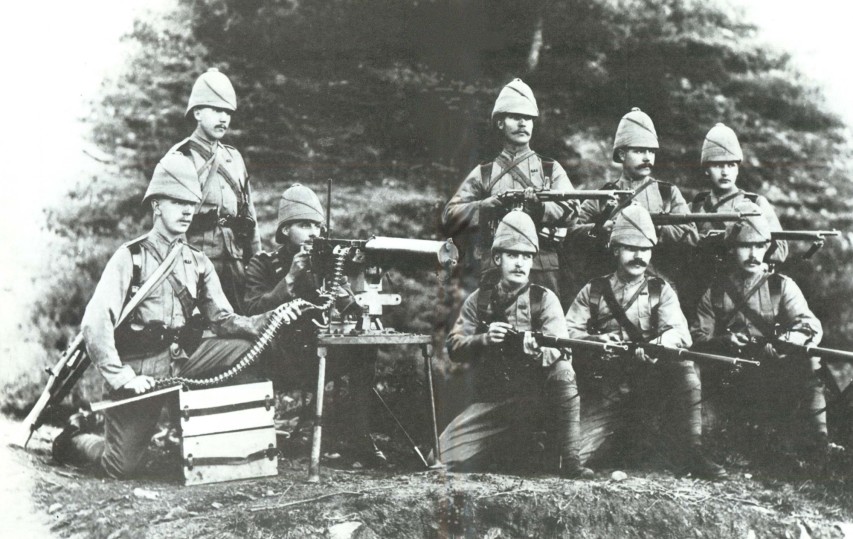
A British Maxim gun section that took part in the Chitral Relief Expedition of 1895. Public domain photo
Comments Off on “Hiram Maxim’s business was secure”
Fully Fitted Freight (1957)
Published on 29 Nov 2013
How freight was moved around Britain by rail in the 1950s, although in reality a lot of it was unfitted.
Comments Off on Fully Fitted Freight (1957)
If you think your mortgage is bad, here’s a bit of perspective
Britain is deeply in debt, like most western countries, but some of the debt is much longer term than usual:
Britain will pay off all of its debt used to fund World War One next March, when it redeems a government bond first issued more than 80 years ago to help pay for the conflict.
The finance ministry said on Wednesday that it would redeem the 1.9 billion pound ($3 billion), 3.5 percent War Loan — a perpetual bond which means it has no fixed maturity date — on March 9 next year.
Issued in 1932, the War Loan was used to refinance debt accumulated during World War One, which ended in 1918.
Some market experts said they would miss the bond as a rare historical curiosity in modern finance.
“For those of us who’ve been looking at the gilt market for a long time, a little bit of magic has fallen out of the market,” said Barclays fixed income strategist Moyeen Islam.
What needs to be pointed out however, is that they’re not actually paying off the WW1 debt: they’re eliminating that particular interest-bearing bond (because it’s now paying a higher rate of interest than the UK government’s other debt instruments). The money to pay off the current holders of those bonds will be borrowed on the market at current market rates. That’s the government equivalent of paying off one credit card with another … you still have a debt, it’s just being held by a different lender now. Tim Worstall explains:
As background, yes, Britain ran up big debts in WWI. Those were those National War Bonds. And interest rates changed a bit, finances moved around, and in 1927 it was decided that those National War Bonds should be changed. And the change was to turn them into perpetual bonds: the capital would never be paid off, there would just be a stream of interest off into the indefinite future. The government retained the right to buy them in at any point (a “call option” on them) which is what Osborne is exercising now. One more thing: there were other bits and pieces of debt lying around. Odd bits and pieces from the 19th century, debt from the Crimean War, from those (not large enough) attempts to deal with the Great Famine in Ireland, bits and pieces relating to the Napoleonic Wars and even, would you believe it, some parts that related all the way back to the South Sea Company and the South Sea Bubble of the 1720s (although that connection is pretty remote).
All of these pieces were dumped into the same pot and “consolidated” into these perpetual bonds. They were and are thus known as “Consols”.
What Osborne is going to do is exercise that call option and bring those bonds back in. But he’s not actually “paying off” those debts. He’s going to issue other, more conventional, gilts in order to have the money to give to those sending in their Consols. He must be doing that: the government really is borrowing £100 billion a year and change at present. This is no more “paying off” those debts than my taking out a bank loan to pay off my credit card is paying off debts. It might well be a very good idea to do that, given the difference in the terms of the debts and the interest rates, but it’s still not paying off, is it?
H/T to Elizabeth for the original link.
Comments Off on If you think your mortgage is bad, here’s a bit of perspective
QotD: Roman medical advice
Before I forget it, I must record two valuable health hints that I learned from Xenophon. He used to say: “The man is a fool who puts good manners before health. If you are troubled with wind, never hold it in. It does great injury to the stomach. I knew a man who once nearly killed himself by holding in his wind. If for some reason or other you cannot conveniently leave the room — say, you are sacrificing or addressing the Senate — don’t be afraid to belch or break wind downwards where you stand. Better that the company should suffer some slight inconvenience than that you should permanently injure yourself. And again, when you suffer from a cold, don’t constantly blow your nose. That only increases the flow of rheum and inflames the delicate membranes of your nose. Let it run. Wipe, don’t blow.” I have always taken Xenophon’s advice, at least about nose-blowing: my colds don’t last nearly so long now as they did. Of course, caricaturists and satirists soon made fun of me as having a permanently dripping nose, but what did I care for that? Messalina told me that she thought I was extremely sensible to take such care of myself: if I were suddenly to die or fall seriously ill, what would become of the City and Empire, not to mention herself and our little boy?
Robert Graves, Claudius the God, 1935.
Comments Off on QotD: Roman medical advice
December 3, 2014
Wilhelm II German Emperor I WHO DID WHAT IN WW1? – Portrait
Published on 1 Dec 2014
Kaiser Wilhelm II (1859-1941), Germany’s last Kaiser, was born in Potsdam in 1859, the son of Frederick III and Victoria, daughter of Queen Victoria. Wilhelm became emperor of Germany in 1888 following the death of Frederick II. During his rule, Germany’s relations with Britain, France and Russia became strained. William was forced to abdicate on 9th November, 1918. He fled the country with the rest of his family and lived in Holland for the rest of his life. Who was Wilhelm II the last emperor of Germany and what was his political and military influence on the Germans decisions during World War I?
Comments Off on Wilhelm II German Emperor I WHO DID WHAT IN WW1? – Portrait
December 2, 2014
Joanna Williams talks to the author of Stand By Your Manhood
Joanna Williams talks to Peter Lloyd about his recent book and the ongoing vilification of all things masculine in the popular press:
Lloyd, who somehow combines writing for both the Daily Mail and the ‘women in leadership’ section of the Guardian, was prompted to write Stand By Your Manhood in response to the ‘dismissive, patronising and skewed narrative about heterosexual men’, which he suggests is apparent in the mainstream media. He argues that it has become normal to consider masculinity as entirely negative and problematic, and to present boys as ‘defective girls, damaged by default’ who need to be medicated, educated and socialised out of their masculinity. Whereas once manhood was celebrated in all its stiff-upper-lipped glory, it is now considered threatening. Lloyd welcomes the progress society has made in recent years, and he is happy that homosexuality is no longer so stigmatised. However, he warns that there is a danger that things have gone too far in the other direction, and that shame is now attached to masculinity, with heterosexual men, in particular, being made to feel guilty if they don’t frequently display a more feminine side to their personalities.
Lloyd suggests today’s men’s movement is a response to strains of feminism that first appeared in the late 1970s — these strains were far more explicitly anti-men than pro-equality. He claims today’s feminists perpetuate the idea that women are oppressed and ‘refuse to let go of old arguments’ despite the changes that have taken place in the real world. Often, Lloyd argues, there are monetary incentives for feminist campaigning groups, such as the Fawcett Society, continuously to propagate an image of women as victims of a non-specific patriarchy. He cites the case of Erin Pizzey, who established one of the first refuges for female victims of domestic violence, but who later received death threats for suggesting that women were also capable of violence. Certainly it is not in the financial interests of groups like Hollaback and FCKH8 to question the facts promoted in their campaigns against sexism. Lloyd blames the media for unthinkingly picking up on such campaigns and escalating an anti-male sentiment. As a result, he says, feminism can seem like a ‘hate movement’ and men have not had a voice to challenge these newly dominant perceptions.
[…]
While it may seem either naive or disingenuous of Lloyd to suggest that the men’s rights movement won’t embrace victimhood and a crusading ethos, he does follow his own arguments to their logical conclusion. Success for the men’s rights movement, he argues, will be when it is no longer needed — that is, when there is true equality, and people are judged according to merit rather than gender. It’s a long time since I’ve heard feminists arguing anything similar. However, until such a point in the future, the inescapable fact is that both the men’s rights movement and feminism continue to cast people as victims of their gender identity.
Feminism today is premised on the assumption that women are persecuted by an oppressive patriarchy; the men’s rights movement considers men to be equally as persecuted by feminists. Both sides need a reality check. Arguing the toss over who is the most oppressed serves only to pitch men and women into battle against each other. It fails to look at what people have in common and how society can be made to work in the best interests of everyone. To achieve individual emancipation today, it’s not feminism or men’s rights that we need — it’s a movement to liberate us all from the stifling constraint and moral authoritarianism of being defined by our biology rather than by what we have the potential to become.
Comments Off on Joanna Williams talks to the author of Stand By Your Manhood
December 1, 2014
The Soviet tank that won the war in the East
Paul Richard Huard looks at the tank that took away the Panzer’s reputation for invincibility, the T-34:

T-34/85 at musée des blindés de Saumur (via Wikipedia)
The T-34 had its problems — something we often forgotten when discussing a tank with a legendary reputation. The shortfalls included bad visibility for the crew and shoddy Soviet workmanship.
“They were good, but they were not miracle weapons and they had their faults,” writes Philip Kaplan in Rolling Thunder: A Century of Tank Warfare. “But the T-34, for all its faults, is now often referred to by tank experts and historians as possibly the best tank of the war.”
World War II German Field Marshall Ewald Von Kleist was more succinct. “The finest tank in the world,” is how he described the T-34.
The origins of the T-34 are simple enough. The Red Army sought a replacement for the BT-7 cavalry tank, which was fast-moving and lightly armored for use in maneuver warfare. It also had Christie suspension, one reason for the tank’s increased speed.
But during a 1938-to-1939 border war with Japan, the BT-7 fared poorly. Even with a low-powered gun, Japanese Type 95 tanks easily destroyed the BT-7s. Tank attack crews also assaulted the BT-7s with Molotov cocktails, reducing the Soviet tank to a flaming wreck when ignited gasoline dripped through chinks between poorly welded armor into the tank’s engine compartment.
[…]
By the end of the war, the Soviet Union had produced nearly 60,000 T-34 tanks — proving the point that quantity does have a quality all of its own.
At first, the Germans were at a loss when it came to countering the threat the T-34 posed. The Germans’ standard anti-tank guns, the 37-millimeter Kwk36 and the 50-millimeter Kwk 38, couldn’t put a dent in the Soviet tank with a shot to its front.
That left the Germans with a limited set of tactics. German tankers could attempt flank shots with their guns. The Wehrmacht could lay mines. Soldiers risked their lives in close assaults employing satchel charges and Molotov cocktails.
In what could be called an act of desperation, the Germans even used modified 88-millimeter anti-aircraft guns to stop attacking T-34s with direct fire.
Comments Off on The Soviet tank that won the war in the East
November 30, 2014
Medium.com goes all “Rathergate” on a 1970s LEGO letter
I managed to miss the initial controversy about a typographical hoax that might not have been so hoax-y:
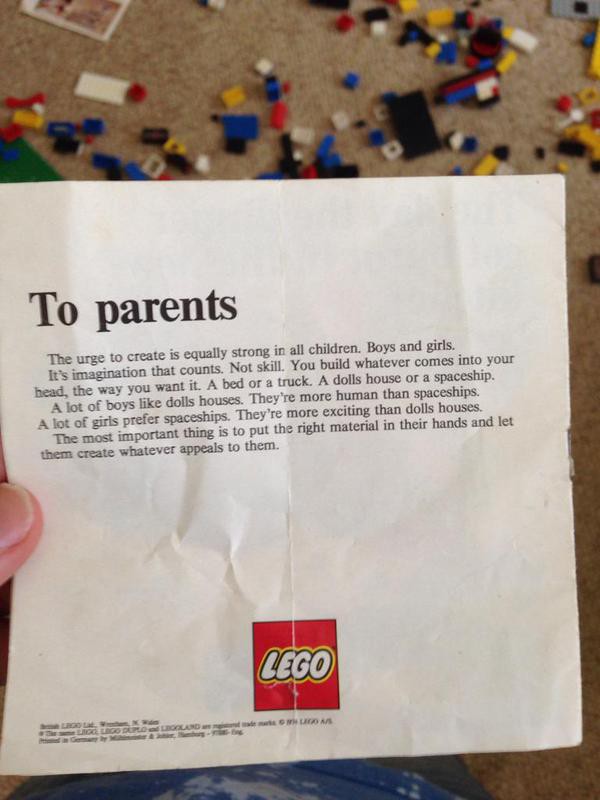
According to the website of the Independent newspaper, LEGO UK has verified the 1970s ‘letter to parents’ that was widely tweeted last weekend and almost as widely dismissed as fake. Business as usual in the Twittersphere — but there are some lessons here about dating type.
‘The urge to create is equally strong in all children. Boys and girls.’ It’s a sentiment from the 1970s that’s never been more relevant. Or was it?
Those of us who produce or handle documents for a living will often glance at an example and have an immediate opinion on whether it’s real or fake. That first instinct is worth holding on to, because it comes from the brain’s evolved ability to reach a quick conclusion from a whole bunch of subtle clues before your conscious awareness catches up. It’s OK to be inside the nearest cave getting your breath back when you start asking yourself what kind of snake.
But sometimes you will flinch at shadows. Why did this document strike us as wrong when it wasn’t?
First, because the type is badly set in exactly the way early consumer DTP apps, and word processor apps to this day (notably Microsoft Word), set type badly — at least without the intervention of skilled users. I started typesetting on an Atari ST, the poor man’s Mac, in 1987. The first desktop publishing program for that platform was newly released, running under Digital Research’s GEM operating system. It came with a version of Times New Roman, and almost nothing else. Me and badly set Times have history.
In the LEGO document, the kerning of the headline is lumpy and the word spacing excessive. The ‘T’ seems out of alignment with the left margin, even after allowing for a lack of optical adjustment. The paragraph indent on the body text has been applied from the start, contrary to modern British typesetting practice; the first line should be full-out. The leading (vertical space between lines of text) is not quite enough for comfort, more appropriate to a dense newspaper column than this short blurb.
There’s also an error in the copy: ‘dolls houses’ needs an apostrophe. Either before or after the last letter of ‘dolls’ would be fine, depending on whether you think you mean a house for a doll or a house for dolls. But it definitely needs to be possessive.
It wasn’t just that the type looked careless. It was that it stank of the careless use of tools that shouldn’t have been available to its creators.
Comments Off on Medium.com goes all “Rathergate” on a 1970s LEGO letter
QotD: A German “comic” song
We were a fashionable and highly cultured party. We had on our best clothes, and we talked pretty, and were very happy — all except two young fellows, students, just returned from Germany, commonplace young men, who seemed restless and uncomfortable, as if they found the proceedings slow. The truth was, we were too clever for them. Our brilliant but polished conversation, and our high-class tastes, were beyond them. They were out of place, among us. They never ought to have been there at all. Everybody agreed upon that, later on.
We played morceaux from the old German masters. We discussed philosophy and ethics. We flirted with graceful dignity. We were even humorous — in a high-class way.
Somebody recited a French poem after supper, and we said it was beautiful; and then a lady sang a sentimental ballad in Spanish, and it made one or two of us weep — it was so pathetic.
And then those two young men got up, and asked us if we had ever heard Herr Slossenn Boschen (who had just arrived, and was then down in the supper-room) sing his great German comic song.
None of us had heard it, that we could remember.
The young men said it was the funniest song that had ever been written, and that, if we liked, they would get Herr Slossenn Boschen, whom they knew very well, to sing it. They said it was so funny that, when Herr Slossenn Boschen had sung it once before the German Emperor, he (the German Emperor) had had to be carried off to bed.
They said nobody could sing it like Herr Slossenn Boschen; he was so intensely serious all through it that you might fancy he was reciting a tragedy, and that, of course, made it all the funnier. They said he never once suggested by his tone or manner that he was singing anything funny — that would spoil it. It was his air of seriousness, almost of pathos, that made it so irresistibly amusing.
We said we yearned to hear it, that we wanted a good laugh; and they went downstairs, and fetched Herr Slossenn Boschen.
He appeared to be quite pleased to sing it, for he came up at once, and sat down to the piano without another word.
“Oh, it will amuse you. You will laugh,” whispered the two young men, as they passed through the room, and took up an unobtrusive position behind the Professor’s back.
Herr Slossenn Boschen accompanied himself. The prelude did not suggest a comic song exactly. It was a weird, soulful air. It quite made one’s flesh creep; but we murmured to one another that it was the German method, and prepared to enjoy it.
I don’t understand German myself. I learned it at school, but forgot every word of it two years after I had left, and have felt much better ever since. Still, I did not want the people there to guess my ignorance; so I hit upon what I thought to be rather a good idea. I kept my eye on the two young students, and followed them. When they tittered, I tittered; when they roared, I roared; and I also threw in a little snigger all by myself now and then, as if I had seen a bit of humour that had escaped the others. I considered this particularly artful on my part.
I noticed, as the song progressed, that a good many other people seemed to have their eye fixed on the two young men, as well as myself. These other people also tittered when the young men tittered, and roared when the young men roared; and, as the two young men tittered and roared and exploded with laughter pretty continuously all through the song, it went exceedingly well.
And yet that German Professor did not seem happy. At first, when we began to laugh, the expression of his face was one of intense surprise, as if laughter were the very last thing he had expected to be greeted with. We thought this very funny: we said his earnest manner was half the humour. The slightest hint on his part that he knew how funny he was would have completely ruined it all. As we continued to laugh, his surprise gave way to an air of annoyance and indignation, and he scowled fiercely round upon us all (except upon the two young men who, being behind him, he could not see). That sent us into convulsions. We told each other that it would be the death of us, this thing. The words alone, we said, were enough to send us into fits, but added to his mock seriousness — oh, it was too much!
In the last verse, he surpassed himself. He glowered round upon us with a look of such concentrated ferocity that, but for our being forewarned as to the German method of comic singing, we should have been nervous; and he threw such a wailing note of agony into the weird music that, if we had not known it was a funny song, we might have wept.
He finished amid a perfect shriek of laughter. We said it was the funniest thing we had ever heard in all our lives. We said how strange it was that, in the face of things like these, there should be a popular notion that the Germans hadn’t any sense of humour. And we asked the Professor why he didn’t translate the song into English, so that the common people could understand it, and hear what a real comic song was like.
Then Herr Slossenn Boschen got up, and went on awful. He swore at us in German (which I should judge to be a singularly effective language for that purpose), and he danced, and shook his fists, and called us all the English he knew. He said he had never been so insulted in all his life.
It appeared that the song was not a comic song at all. It was about a young girl who lived in the Hartz Mountains, and who had given up her life to save her lover’s soul; and he died, and met her spirit in the air; and then, in the last verse, he jilted her spirit, and went on with another spirit — I’m not quite sure of the details, but it was something very sad, I know. Herr Boschen said he had sung it once before the German Emperor, and he (the German Emperor) had sobbed like a little child. He (Herr Boschen) said it was generally acknowledged to be one of the most tragic and pathetic songs in the German language.
It was a trying situation for us — very trying. There seemed to be no answer. We looked around for the two young men who had done this thing, but they had left the house in an unostentatious manner immediately after the end of the song.
That was the end of that party. I never saw a party break up so quietly, and with so little fuss. We never said good-night even to one another. We came downstairs one at a time, walking softly, and keeping the shady side. We asked the servant for our hats and coats in whispers, and opened the door for ourselves, and slipped out, and got round the corner quickly, avoiding each other as much as possible.
I have never taken much interest in German songs since then.
Jerome K. Jerome, Three Men in a Boat (to say nothing of the dog), 1889.
Comments Off on QotD: A German “comic” song
November 28, 2014
Iron, Steel and Oil – The Fight For Resources I THE GREAT WAR Week 18
Published on 27 Nov 2014
Four months after the outbreak of the war, a new fight develops: the fight for the most valuable resources. The modern warfare and its war machines need one thing more than anything: oil. The influence is immense – on the battles and the life of the soldiers. Oil, iron, steel or cole resources can be a matter of life and death. Meanwhile, the situation at the Front is gridlocked, especially in the trenches of the Western Front. The Britain’s advance into the Ottoman Empire and conquer the city Basra. Their goal is to secure their drilling facilities at the Arab Gulf.
Comments Off on Iron, Steel and Oil – The Fight For Resources I THE GREAT WAR Week 18
A visit to an Earthbound L5 colony
Charles Stross visits the closest thing to an O’Neill L5 colony:
To the eternal whine of the superannuated free-range SF geek (“dude, where’s my jet pack? Where’s my holiday on the moon? Where are my food pills? I thought this was supposed to be the 21st century!”) can be added an appendix: “and what about those L5 orbital space colonies the size of Manhattan?”
Well, dude, I’ve got your L5 colony right here. In fact, they turned it into a vacation resort. I just spent a day checking it out, and I’m back with a report.
[…]
So here’s what happens. One morning you get up early in your hotel or apartment in Berlin. You collect your swimming gear, flip-flops, beach towel, and sundries. Then you wrap up warm, because of course it’s November in Prussia and while it’s not snowing yet the wind has a sharp edge to it. You head for Zoologischer Garten station (or maybe the Ostbahnhof if you’re on that side of the city) and catch a train, which over the next hour hums through the pancake-flat forests and villages of East Germany until it stops at a lonely (but recently modernized) platform in a forest in the middle of nowhere.
You’re wondering if you’ve made some sort of horrible mistake, but no: a shuttle bus covered in brightly colored decals depicting a tropical beach resort is waiting for you. It drives along cracked concrete taxi-ways lined with pine trees, past the boarded-up fronts of dispersal bay hangers and hard stands for MiG-29 interceptors awaiting a NATO attack that never came. The bus is raucous with small children, chattering and screeching and bouncing off the walls and ceiling in a sugar-high — harried parents and minders for the large group of schoolgirls in the back of the bus are trying to keep control, unsuccessfully. Then the bus rumbles and lurches to a standstill, and the doors open, and you see this:
Click to embiggen
It’s hard to do justice to the scale of the thing. It’s one of those objects that is too big to take in at close range, and deceptively small when viewed from a distance. It’s like an L5 space colony colony that crash-landed in on the West Prussian plains: a gigantic eruption from the future, or a liminal intrusion from the Gernsbackian what-might-have-been.
[…]
Welcome to Tropical Islands, Germany.
You can get the history from the wikipedia link above: in a nutshell, the Zeppelin hangar was bought from the liquidators by a Malaysian resort operator, who proceeded to turn it into an indoor theme park. They stripped off a chunk of the outer cladding of the hangar and replaced it with a high-tech greenhouse film: it’s climate-controlled, at 26 celsius and 64% humidity all year round. (That’s pretty chilly by Malaysian standards, but nice and comfortable for the German and Polish customer base.) There’s an artificial rainforest, with over 50,000 plants and a 5km long walking trail inside. There are about a dozen different saunas, hot tubs, and a swimming pool complex: there’s a 200 metre long artificial beach with sun-loungers for you to work on your tan wrapped around an artificial tropical lagoon — a 140 metre swimming pool with waves. There are bars, shops, restaurants, hotels, even a camp ground for tents: and of course the usual beachside resort song and dance show every evening.

Comments Off on A visit to an Earthbound L5 colony
QotD: Sex on the western front, 1914-1918
… while the soldiers on other fronts had to make do with the usual assortment of camp followers, local girls and any brothels which survived the operations that brought the lines to that spot, both sides on the Western Front were able to avail themselves of the services of established brothels in the towns near the front on each respective side. Well, the officers could, at least; proper brothels which had existed before the war generally displayed blue lamps, signifying that they were forbidden to enlisted men by military regulations. Lower ranks had to content themselves with makeshift red-lamp facilities, sometimes the new French Bordels Mobiles de Campagne, but more often just commandeered pubs or other buildings whose facilities might consist of little more than, as one soldier reported, “a stretcher, with a very thin sheet and blanket.”
In 1914, Western civilization had not yet sunk into the modern madness of pretending that healthy young men can simply “just say no” to sex without ill effect (or that they should); with rare exception, absolutely nobody in military leadership imagined that they could really stop men from visiting brothels by ordering them not to. Of course, the British tried to anyway; unlike the Germans (who issued the troops both condoms and disinfectant) and the French (who issued entire brothels), British military officials issued only the epigrammatic advice from Lord Kitchener while quietly allowing the troops to visit French brothels under the excuse that they didn’t want to offend their allies and hosts. Since blue lamp facilities were established houses staffed by experienced professionals with a supply of condoms, they had no problem with sexually transmitted disease. The same, however, could not be said for the red lamps, and since the troops were issued neither prophylactics nor proper information, STIs ran rampant. Over 400,000 cases were recorded among British or Commonwealth troops during the course of the war, 150,000 of them on the Western Front alone; altogether roughly 5% of the men were infected at least once, three and a half times the infection rate among French troops and fully seven times the German rate.
By 1915 nurse Ettie Rout persuaded the New Zealand authorities to begin issuing prophylactic kits to their troops, and Canada soon followed suit; Britain’s response was to garnish the pay of soldiers who contracted STIs and treat them in separate, second-rate hospital facilities in order to punish and shame them. Considering that an English Tommy’s pay was a scant one-fifth that of his counterparts from Canada and Australia (sixpence a day vs. two and a half shillings), it’s hardly surprising that infected troops preferred to hide their infections and/or treat them with ineffective patent medicines or folk remedies.
Maggie McNeill, “Red Lamp”, The Honest Courtesan, 2014-11-11.
Comments Off on QotD: Sex on the western front, 1914-1918
November 27, 2014
Hitler’s “buzz saw”, the MG42
In one of a series of posts on the weapons of the 20th century, Paul Richard Huard looks at the remarkable MG-42 used by German troops during the Second World War:
During World War II, American G.I.s called the German MG42 machine gun “Hitler’s buzz saw” because of the way it cut down troops in swaths.
The Soviet Red Army called it “the linoleum ripper” because of the unique tearing sound it made—a result of its extremely high rate of fire. The Germans called the MG42 Hitlersäge or “Hitler’s bone saw”—and built infantry tactics around squads of men armed with the weapon.
Many military historians argue that the Maschinengewehr 42 was the best general-purpose machine gun ever. It fired up to 1,800 rounds per minute in some versions. That’s nearly twice as fast as any automatic weapon fielded by any army in the world at the time.

“It sounded like a zipper,” Orville W. “Sonny” Martin, Jr., who was a second lieutenant with the U.S. Army’s 13th Armored Division, said in an oral history of infantry and armor operations in Europe. “It eats up a lot of ammunition and that makes for a logistical problem, but it eats up a lot of people, too.”
When the war began in 1939, the Germans had a solid, reliable general-purpose machine gun—the MG34. But it was expensive and difficult to manufacture.
The German high command wanted front-line troops to have more machine guns. That meant a weapon designed to deliver a high rate of fire like the MG34, but which was cheaper and quicker to produce.
Mauser-Werke developed a machine gun that fired a 7.92-millimeter Mauser cartridge fed into the gun from either a 50-round or 250-round belt. What’s more, the company manufactured the machine gun from stamped and pressed parts, welding the components together with a technique that reduced production time by 35 percent.
Comments Off on Hitler’s “buzz saw”, the MG42


