
Published on 17 Apr 2014
Tanks were invented by the British during the First World War. Historian Dan Snow traces their development, from prototype to battlefield fixture.
January 30, 2016
Tanks – WW1 Uncut: Dan Snow – BBC
Comments Off on Tanks – WW1 Uncut: Dan Snow – BBC
January 29, 2016
The Kaiser’s Birthday – Hypocrisy in Greece I THE GREAT WAR – Week 79
Published on 28 Jan 2016
Even though Britain went to war over the violation of the Belgian neutrality by the Germans, the neutrality of Greece seems to be of no concern to the Entente. The military presence on Corfu and Salonika is growing and growing. And even though there is no fighting there, the soldiers have to suffer since general Malaria is taking his toll. In the week of the Kaiser’s birthday, the diplomatic tensions between the USA and Germany are increasing and on the Western Front Trench Foot is becoming a real problem.
Comments Off on The Kaiser’s Birthday – Hypocrisy in Greece I THE GREAT WAR – Week 79
January 27, 2016
Justinian & Theodora – VII: The Cracks Begin to Spread – Extra History
Published on 23 Jan 2016
Belisarius had broken the siege around Rome. Now he wanted to push on to the Ostrogothic capital in Ravenna, so Justinian sent fresh troops with new commanders: Narses and John. Belisarius ordered John to take his cavalry north and secure the route the Ravenna, but John bypassed several cities that seemed too difficult until he was offered a willing surrender by the people of Ariminum. When Belisarius ordered him to return to the main army, John refused, and soon found himself surrounded by the same forces he’d declined to fight earlier. Narses insisted that they rescue him, so Belisarius devised a plan and tricked the Ostrogoths into thinking his force was larger than it really was, so they fled without joining battle. John gave all the credit for his rescue to Narses, and a divide grew between the old guard loyal to Belisarius and the new troops loyal to Narses. Even though Belisarius had a letter from Justinian giving him sole control of the army, Narses argued over the semantics of the order and continued to do as he liked. He roped Belisarius into besieging Urbinus, then decided to abandon his own plan and return to Ariminum. Belisarius took Urbinus by a stroke of luck and wanted to send reinforcements to the Ostrogoth-besieged city of Mediolanum, supposedly under Roman protection, but John would only accept orders from Narses and stalled until after the city fell. When Roman troops finally arrived in Mediolanum, they found the entire city butchered and burned to the ground.
Comments Off on Justinian & Theodora – VII: The Cracks Begin to Spread – Extra History
January 26, 2016
The Entente On The Run I THE GREAT WAR WW1 Summary Part 4
Published on 25 Jan 2016
The end of the year 1915 and early 1916 don’t look good for the Entente powers. Stalemate on the Western Front, no progress on the Eastern Front, Serbia overrun, defeat after defeat at the Isonzo, under siege at Kut, Gallipoli evacuated and even a new war zone in Libya. How would they turn the tide against the Central Powers?
Comments Off on The Entente On The Run I THE GREAT WAR WW1 Summary Part 4
January 24, 2016
What was the Food like at the Front?I OUT OF THE TRENCHES
Published on 23 Jan 2016
Indy sits in the chair of wisdom again to answer your questions. This time we tell you how the food was like in the trenches and what role Andorra and Iceland had in World War 1.
Comments Off on What was the Food like at the Front?I OUT OF THE TRENCHES
Arming the Royal Navy’s new aircraft carriers
Last month, Save the Royal Navy looked at the aircraft that will fly off the decks of HMS Queen Elizabeth and HMS Prince of Wales:
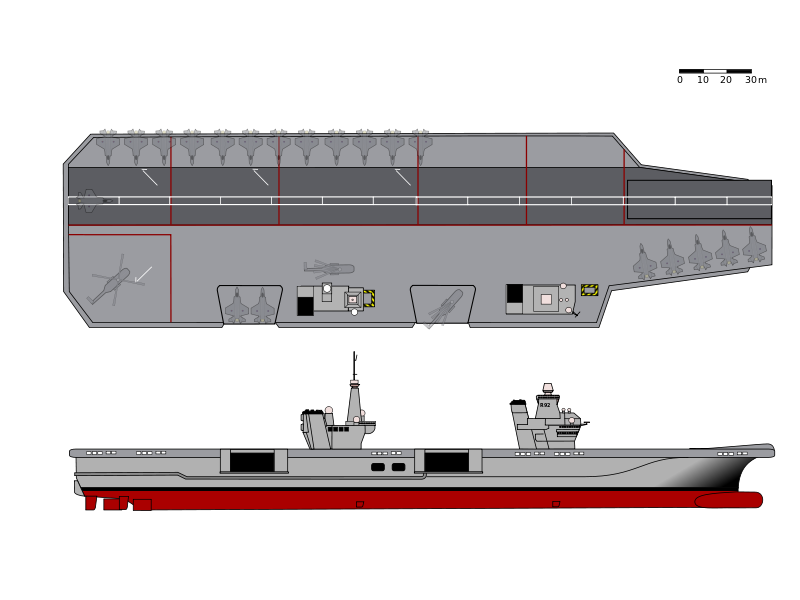
Queen Elizabeth class side and overhead views
The SDSR stated that 42 F35-B Lightning aircraft will be delivered by 2023. These 42 aircraft form the carrier’s main armament. A foolish political fudge has given the RAF control of the Lightnings, to be jointly manned and operated with the RN. For Government, this conveniently boosts the RAF’s ORBAT while allowing the same aircraft to be counted again as part of the carrier’s equipment. Although the RAF may not like it, the needs of the carriers will have to dictate their operation. There is simply no place for the “part time carrier aviator” The aircrew need as much time at sea as possible to develop their own skills, the skills of aircraft handlers, the ship’s company and the fleet as a whole. Like all RN vessels the carriers will operate at a demanding operational tempo and need aircraft embarked for much of the time. Any RAF inclination to use the aircraft in the land-based deep strike role will have to be second priority.
The initial 42 Lightnings will be split between 2 frontline squadrons. 809 Naval Air Squadron and RAF 617 Squadron with around 15-20 aircraft each, building up to the full strength of 24 per squadron. There will also be a requirement for at least 5 aircraft to form an OCU (Operational Conversion Unit for training). An OEU (Operational Evaluation Unit for testing and trials) will also require a few aircraft. Allowing for a sustainment fleet of aircraft in deep maintenance etc, then it is clear that many more than 42 aircraft are needed to form just 2 full-strength squadrons. Between 2010 and 2014 the received wisdom was that the UK would only ever purchase a maximum of 48 F35-B but the SDSR announced a planned eventual purchase of as many as 138. This is good news which should give some strength-in-depth, potentially providing 2 more squadrons. Both the RN and the RAF should be able to fulfil their ambitions for the Lighting. Whether the RAF will push for a purchase of the conventional F35-A which would not be compatible with the carrier, but has slightly better range and performance than the VSTOL variant is a discussion for the future.
Of course the caveat to all this good news is the actual performance of the F35. There are armies of armchair F-35 critics and many of their concerns are valid. Although it may prove to be a poor “within visual range” fighter, its networking, sensors, stealth and strike capabilities will be a giant advance over any previous UK military aircraft. Furthermore the RN has a fine track record of taking equipment with many apparent deficiencies and turning them into a great success. (Fairy Swordfish anyone?)
On the other hand, Ben Ho Wan Beng argues that the carriers will not actually be able to project much power:
A tactical combat aircraft complement of 12, or even 15-20, is rather small for traditional carrier operations, especially force-projection ones that are likely to predominate considering the SDSR’s expeditionary-warfare slant. Indeed, it is worth considering the fact that the two British small-deck carriers involved in the Falklands War carried 20-odd Harrier jump jets each, and they were about three times smaller than the Queen Elizabeth-class ships.
In fact, each new carrier might even be operating with a much fighter complement fewer than 15-20 in the years leading up to 2023, giving lie to the phrase “in force” used by George Osborne when he spoke of equipping the carriers with significant airpower.
In any case, the small fighter constituent means that if the Queen Elizabeth carrier were to get involved in a conflict with an adversary with credible anti-access/area-denial (A2/AD) capabilities, the vessel would be hard-pressed to protect itself, let alone project power. With a displacement of over 70,000 tons and costing over three billion pounds each, the new British carriers will be the crown jewels of the Royal Navy; indeed, HMS Queen Elizabeth is slated to be the RN’s flagship when she comes into service. The protection of the ship would hence be of paramount importance in an era that has witnessed the proliferation of A2/AD capabilities even to developing nations. Hence for a Queen Elizabeth carrying 20 or less Lightnings in such circumstances, it remains to be seen just how many of the aircraft will be earmarked for different duties.
Should a F-35B air group of that size put to sea, at least half of them will be assigned to the Combat Air Patrol (CAP), leaving barely 10 for offensive duties. It is worth noting that of the 42 Harrier VSTOL jets deployed on HMS Hermes and HMS Invincible during the Falklands War, 28 of them – a substantial two-thirds – had CAP as their primary duty. It is also telling that of the 1,300-odd sorties flown in all by the Harriers, about 83 per cent of them were for CAP.
Faced with modern A2/AD systems such as stand-off anti-ship missiles, how likely then would the carrier task force commander devote more resources to offense and risk having a vessel named after British royalty attacked and hit? Having said that, having too many planes for defense strengthens the argument made by various carrier critics that the ship is a “self-licking ice cream cone,” in other words, an entity that exists solely to sustain itself.
The task force commander would thus be caught between a rock and a hard place. Allocate more F-35Bs to strike missions and the susceptibility of the task force to aerial threats increase. Conversely, set aside more aircraft for the CAP and its mother ship’s ability to project power decreases. All in all, with a significantly understrength F-35B air wing, the Queen Elizabeth flat-top would be operating under severe constraints, making it incapable of the traditional carrier operations it could have carried out with a larger tactical aircraft complement. Indeed, one naval commentator is right on the mark when he argues that two squadrons with a total of 24 aircraft should be a “sensible minimum standard” for each carrier.
Comments Off on Arming the Royal Navy’s new aircraft carriers
January 22, 2016
The Fight for Montenegro & The Disaster Of Kut I THE GREAT WAR Week 78
Published on 21 Jan 2016
The Russians try to take Czernowitz, the Capital of Austrian Bukovina but thousands upon thousands of Russians were killed in action. While in Montenegro, Austro-Hungarian troops under commander in chief Franz Conrad von Hotzendorf take control of the Balkan state of Montenegro. A relief force led by Lieutenant-General Fenton Aylmer had to return to base after a big loss against the Turks, while in South Cameroon, so the Germans retire into Spanish territory.
Comments Off on The Fight for Montenegro & The Disaster Of Kut I THE GREAT WAR Week 78
January 20, 2016
German Uniforms of World War 1 I THE GREAT WAR Special
Published on 18 Jan 2016
From the iconic Pickelhaube to the almost legendary Stahlhelm and the field grey colour, German military uniforms of World War 1 are instantly recognisable. But there is more to them than just the spiky leather helmet that was often used in enemy propaganda. In our new special episode we are talking about the details of the German uniforms in the First World War.
Comments Off on German Uniforms of World War 1 I THE GREAT WAR Special
January 19, 2016
Inventing the English countryside
Matt Ridley on the legacy of Capability Brown:
Next year marks the 300th birthday of Lancelot Brown at Kirkharle, in Northumberland, the man who saw “capability” in every landscape and indefatigably transformed England. In his 280 commissions, Capability Brown stamped his mark on some 120,000 acres, tearing out walls, canals, avenues, topiary and terraces to bring open parkland, with grassy tree-topped hills and glimpses of sinuous, serpentine lakes, right up to the ha-has of country houses.
Brown was not the first to design informal and semi-naturalistic landscapes: he followed Charles Bridgeman and William Kent. But he was by far the most prolific and influential. His is a type of landscape that is now imitated in parks all round the world, from Dubai to Sydney to Europe: it’s known as “jardin anglais” and was admired by Catherine the Great and Thomas Jefferson.
Frederick Law Olmsted laid out Central Park in New York in conscious emulation of Brown — as John Nash did with St James’s Park (Hyde Park is by Bridgeman). Golf courses nearly always pay unconscious homage to Brown. There is something deeply pleasing about a view of rolling grassland punctuated with clumps of low-branching trees and glimpses of distant water.
Mountains may have more majesty, forests more fear, deserts more danger, townscapes more detail, fields more fruitfulness, formal gardens more symmetry — but it is the informal English parkland of Capability Brown that you would choose for a picnic, or for a visit with a potential lover. It feels natural.
And yet of course it is wholly contrived. One of Tom Stoppard’s characters explains to another in his play Arcadia, as they contemplate the view of a park from a country house:
BERNARD: Lovely. The real England.
HANNAH: You can stop being silly now, Bernard. English landscape was invented by gardeners imitating foreign painters who were evoking classical authors. The whole thing was brought home in the luggage from the grand tour. Here, look — Capability Brown doing Claude, who was doing Virgil. Arcadia!
Hannah’s right. Claude Lorrain’s paintings of scenes from Virgil were all the rage in the 1730s. By the 1740s, when Brown started work at Stowe under William Kent, prints of 44 of Claude’s landscapes were on sale in London. The landscape at Stourhead (not by Brown), with its Grecian temples seen across lakes, is little more than a copy of Claude’s Aeneas at Delos. Kent’s genius, inspired by Lord Burlington and Alexander Pope, was to supply this craving for classical rural Arcadia.
[…]
The satirist Richard Cambridge joked that he wanted to die before Capability Brown so that he could see heaven before it was “improved”. In 2016 — the date of Brown’s birth is unknown; we have only the date of his baptism, August 30 — I shall raise a glass to a humbly born county boy, who mixed Northumberland with the Serengeti to produce Arcadia and gave us the archetypical English landscape.
Comments Off on Inventing the English countryside
January 18, 2016
Battle of Mojkovac & The Biggest Artillery Gun in World War 1 I Out Of The Trenches
Published on 16 Jan 2016
Check out War History Online: https://www.warhistoryonline.com/
Indy sits in the chair of wisdom again to answer your questions about World War 1. This week we are talking about the Battle of Mojkovac and the Paris Guns.
Comments Off on Battle of Mojkovac & The Biggest Artillery Gun in World War 1 I Out Of The Trenches
The craft beer movement infiltrates the land of vodka
In The Guardian, Alec Luhn reports on the rise of craft brewing in the heart of vodka-swilling Russia:
It is a drizzly Monday night, but Craft rePUBlic is boisterous with the chatter of brewers and beer aficionados. Those just walking in are greeted with a half pint of Red Nelson, a saison beer made with hibiscus tea and orange peel by local brewer Alexei Sazonov, who is celebrating his birthday at the craft beer bar.
Sazonov works at Bottle Share, one of a growing number of microbreweries driving what has been dubbed the “craft revolution” here, but he created Red Nelson at home under his nickname, Big Hedgehog. Sazonov says of the major Russian beer brands, whose bland lagers dominate store shelves and taps: “They boil it quickly, ferment it quickly and sell it quickly. A microbrewer brews beer he wants to drink himself.”
Russia, of course, is known for vodka rather than beer, and a popular saying holds that “beer without vodka is throwing money to the wind”. According to the latest World Health Organisation data from 2010, 51% of alcohol consumed in Russia was spirits and only 38% was beer. This vodka culture has had deadly consequences for Russian men, whose average life expectancy of just 64 years lags behind that in European countries due mainly to heavy drinking and tobacco use.
Now a new generation of “beer geeks”, as they dub themselves, is working to change Russians’ approach to beer – and to drinking in general. With a focus on savouring the taste rather than drinking to get drunk, at least two dozen craft bars have opened in Moscow since the summer of 2014, serving Russian and foreign microbrews. They’re getting so numerous that the cultural magazine Afisha declared in August that it was “refusing to write reviews of the craft beer bars that are opening every week”.
Few expect beer to displace vodka as the national drink, especially after the government reduced the minimum price of the spirit in 2015 amid economic troubles. But there’s a long tradition of homebrewing in Russia, and the growth potential of craft beer is huge thanks to its relative affordablity; local craft brews typically sell for between 200 and 300 roubles (£2-3) a pint. Moreover, it’s easy to start a craft bar: no liquor licence is required if an establishment serves only beer, and startup costs are minimal, since a large staff, kitchen and lavish interiors aren’t typically necessary. As a result, craft bars are spreading from Moscow and St Petersburg to the regions.
Comments Off on The craft beer movement infiltrates the land of vodka
January 17, 2016
WW2 anti-aircraft towers to be re-purposed as luxury resort
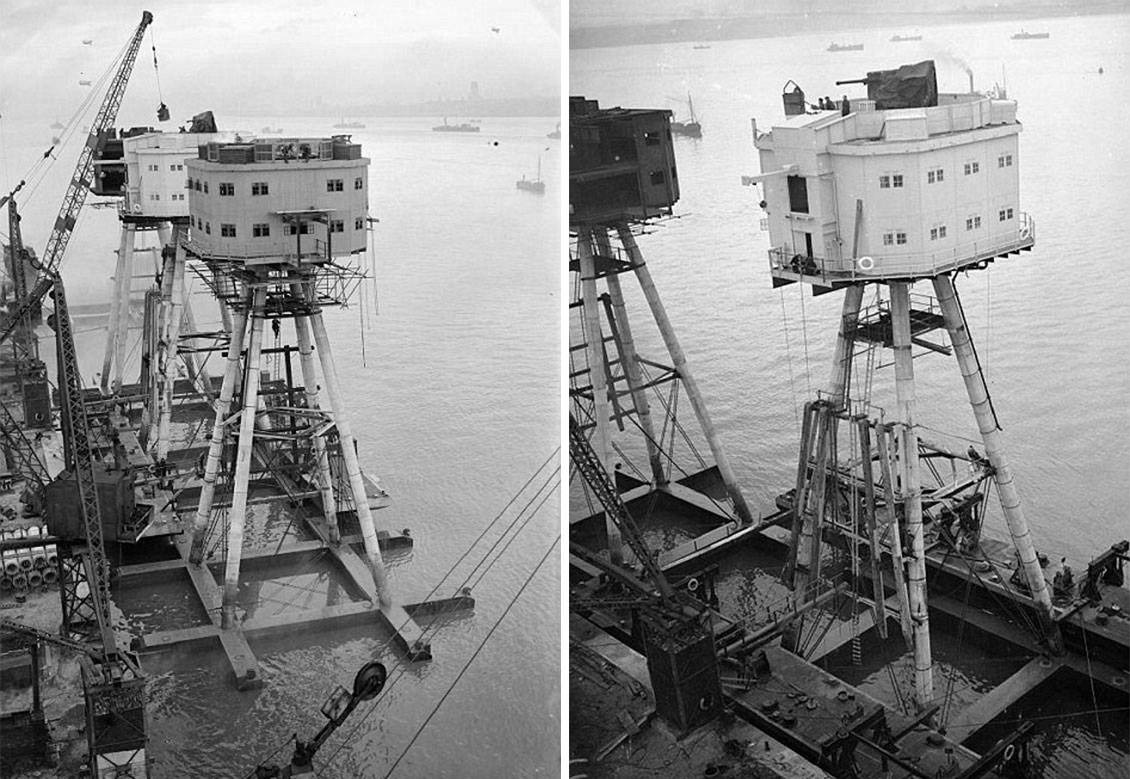
During the Second World War, the British government constructed offshore anti-aircraft installations to extend protection beyond the range of land-based guns and radar. One of these forts is reportedly going to be converted into a luxury resort:
The Maunsell Forts built to defend the British Isles from Nazi invasion are in line for an upmarket make-over.
Billed as the next top-notch luxury resort, the forts will come complete with executive apartments, a helipad and even a spa at sea.
The Second World War era forts off the coast of Kent were constructed in 1943, and operated by both Army and Navy personnel.
The huge metal Maunsell gun towers, also known as Red Sands, were constructed in 1943 during the Second World War
Comments Off on WW2 anti-aircraft towers to be re-purposed as luxury resort
Tabatha Southey is getting nostalgic for plates
Perhaps I’ve been lucky to have (mostly) avoided this restaurant serving trend:
I’ve been away seven weeks now, travelling, working, researching a book, seeing friends, but it’s time to come home; I miss plates.
I’ve been staying in London mostly, visited other cities from there, and then I was in Dublin for a while. In all these places I ate out a lot, and I can report that the restaurant industry is in the midst of a tableware crisis. There’s barely a plate to be found any more, and the first time you’re served a dry-aged rump of beef with celeriac gratin, chanterelles and red wine jus on a cutting board, it’s possible to be charmed.
After all, you are not a tablecloth, but soon the tide of things being served on other things that were just not meant to be served on starts to wear on you.
I have a high whimsy-tolerance. Doctors have often remarked upon it. Sometimes half an hour into a puppet show involving a talking reflex hammer and a musical stethoscope, a doctor will say, “This is very unusual,” and make a note on my chart, but recently my whimsy-tolerance has been tested.
I miss plates. Why, in one day on this trip, I was served breakfast on a chalk slate, lunch on a clip-board and dinner on a wooden cutting board shaped like a clover leaf. I’ve been served frites in a beer stein, and the ones I could reach were delicious, and so my verdict was a resolved “Fun!” – until my slow-baked quince, wild honey ewe’s yoghurt, bee pollen and almonds arrived in a vintage teacup balanced on a strip of artfully weathered barn board, and then the next morning at breakfast, I was served a waffle on another waffle with maple syrup in a stem vase.
What was under that waffle I do not care to know, but everything I’ve been served of late suggests that that non-plate waffle presenting item was handcrafted from a substance that Dwell magazine would call “reclaimed ash flooring from a demolished church in Ohio,” and the rest of us would call “wood.”
I miss plates.
Comments Off on Tabatha Southey is getting nostalgic for plates
January 16, 2016
David Bowie was not the “trans messiah”
Brendan O’Neill on the attempt to portray David Bowie’s career as something other than music, showbiz, and a set of unevenly brilliant self-marketing abilities:
Poor David Bowie. Barely 72 hours dead and he’s already being misremembered. Turn on the TV and you’ll see cultural talking heads telling the world he was the granddaddy of transgenderism. Open a newspaper and you’ll come across 800-word PhD theses masquerading as op-eds, informing us Bowie paved the way for the “gender fluidity” of the 21st century, the fashion for declaring oneself neither male nor female, but rather non-binary, or genderqueer, and whatever the other post-gender labels are. (It’s easy to lose track. Last year Facebook increased its gender options from 50 to 71, overnight. Presumably some professor suddenly discovered 21 hitherto unknown genders.)
It is a blot on Bowie’s good name to link him with the politics of transgenderism. Just because in the early Seventies he rocked the cultural world by coating himself in makeup and donning dayglo jumpsuits with vertigo-inducing platform shoes, that doesn’t mean he was transgender, far less that he facilitated modern transgenderism. On the contrary, there’s a stark difference between Bowie’s cross-dressing antics and today’s seemingly catching gender dysphoria: Where Bowie and other queens and freaks in the Sixties and Seventies were flipping a beautifully manicured finger at authority, modern transgenderism seeks to become its own form of authority, chastising and censoring those who dare dissent from its theology. The glam crowd broke boundaries; the trans elite enforces new ones.
Bowie’s death had barely been tweeted before people were hailing him the trans messiah. A British newspaper said that 40 years ago Bowie had flown “the flag for the non-binary movement.” Which is patent nonsense, since nobody — certainly not this contrarian lad from Brixton in South London — was using the turgid phrase “non-binary” in the early 1970s.
January 15, 2016
The Invasion Of Montenegro – The End of Gallipoli I THE GREAT WAR – Week 77
Published on 14 Jan 2016
It already started around Christmas but this week the evacuation of Gallipoli is complete. While the evacuation was a success, the overall defeat is inarguable for the British. On top of that the Ottomans can now send 40.000 soldiers to the siege of Kut in Mesopotamia where the British are still awaiting relieve. At the same time the Austro-Hungarian Army starts its invasion of Montenegro and the Western Front is still quietly awaiting the offensive at Verdun.
Comments Off on The Invasion Of Montenegro – The End of Gallipoli I THE GREAT WAR – Week 77


