
We know almost nothing of the merchants who made ancient Greece rich enough to spawn an unprecedented culture, but we know lots about the deeds of those who squandered that wealth in war. “The history of antiquity resounds with the sanguinary achievements of Aryan warrior elites,” wrote the historian of antiquity Thomas Carney. “But it was the despised Levantines, Arameans, Syrians, and Greeklings who constituted the economic heroes of antiquity.”
Matt Ridley, “Waterloo or railways”, Matt Ridley Online, 2015-06-18.
January 5, 2017
QotD: Warriors and (mere) merchants
January 3, 2017
Ottoman Uniforms of World War 1 I THE GREAT WAR Special
Published on 2 Jan 2017
The Ottoman Army underwent considerable reforms after the losses on the Balkans. And under German influence, the military tried to bring the whole army up to the standards of modern war. In a lot of way, the results were decent or even good but supply problems led to a great variety in uniform quality across the 400 year old Empire.
Comments Off on Ottoman Uniforms of World War 1 I THE GREAT WAR Special
QotD: The “best” tank
I actually just finished a book that will be out in May next year called Armored Champion which is a general look at tank warfare in World War 2 that puts it into a broader context. One of the things I did in the new book Armored Champion is try to distinguish between what I call “tankers choice” and “commanders choice.” And what I mean by that is the tankers choice is what the tanker wants, the individual tank crew wants. The individual tank crew obviously wants a tank that is extremely powerful, very well armored, had a very powerful gun. So if you compare a Tiger or a Panther or a Sherman, the tanker is going to want the most powerful tank available. The commanders choice is very different, because the commander wants combat power. And combat power doesn’t necessarily come from the best technology because in many cases the best technology has issues.
So the Tiger during World War 2 cost the Germans something in the neighborhood of 300,000 Reich marks. You can buy a Stug III assault gun for about 70,000 Reich marks or a Panzer IV tank for about 100,000 Reich marks. So in other words you can get three Panzer IV tanks for every Tiger that you buy. And on top of it, the Tiger, because it was so big it was extremely unreliable. Things like the Stug III and Panzer IV had about double the reliability of Tiger. So if you’re a German senior commander, it’s an open question whether you want a force built up entirely of Tigers because they are unreliable and expensive so you are not going to get a lot of them. You’re going to get a lot more Panzer IV or Stug III vehicles for your Reich marks. So in that book I’m trying to compare those type of issues. And you know, that comes up with the Sherman. One reason there is 11,000 US tanks and tank destroyers In Germany in April 1945 is because the US decided to concentrate on a tank that was extremely reliable and relatively economical to build. And I don’t think anyone would claim that the Sherman was the best tank from the perspective of the tank crew, it didn’t have the best armor, it didn’t have the best gun, but from commanders perspective it was an excellent weapon. There were just lots and lots of them, so they gave the commander a lot of battlefield power. That can’t be said for a lot of the better German tanks because they simply were too expensive to be built in large numbers and they weren’t reliable enough, you couldn’t count on them. So it depends on the perspective that you are looking at it from.
“Interview with Steven Zaloga”, Tank and AFV News, 2015-01-27.
Comments Off on QotD: The “best” tank
January 2, 2017
January 1, 2017
Absurd Trivia About King Zog – How Italy Prepared To Attack France I OUT OF THE ETHER
Published on 31 Dec 2016
The Italian military prepared to join the Central Powers in 1914 but that didn’t happen. Learn how it all went down and get some cool stories about King Zog of Albania on top of that.
Comments Off on Absurd Trivia About King Zog – How Italy Prepared To Attack France I OUT OF THE ETHER
December 30, 2016
Turmoil in Russia – The Assassination of Rasputin I THE GREAT WAR Week 127
Published on 29 Dec 2016
The chaos within Russia, especially Petrograd, is getting more and more severe. In the centre of much controversy is the Tsarina herself and her trusted mystic and healer Grigori Rasputin. His influence over the Tsar and his wife are actively frowned upon and this week 100 yeas ago he is assassinated. At the same the Russians are facing the German Army on the Romanian Front.
Comments Off on Turmoil in Russia – The Assassination of Rasputin I THE GREAT WAR Week 127
December 28, 2016
QotD: The importance of fabric as a technological driver
The ancient Greeks worshiped Athena as the goddess of technē, the artifice of civilisation. She was the giver and protector of olive trees, of ships and of weaving (without which there would be no sails). When she and Odysseus scheme, they ‘weave a plan’. To weave is to devise, to invent – to contrive function and beauty from the simplest of elements. Fabric and fabricate share a common Latin root, fabrica: ‘something skillfully produced’. Text and textile are similarly related, from the verb texere, to weave. Cloth-making is a creative act, analogous to other creative acts. To spin tales (or yarns) is to exercise imagination. Even more than weaving, spinning mounds of tiny fibres into usable threads turns nothing into something, chaos into order.
‘The spindle was the first wheel,’ explains Elizabeth Barber, professor emerita of linguistics and archeology at Occidental College in Los Angeles, gesturing to demonstrate. ‘It wasn’t yet load-bearing, but the principle of rotation is there.’ In the 1970s, Barber started noticing footnotes about textiles scattered through the archaeological literature. She thought she’d spend nine months pulling together what was known. Her little project became a decades-long exploration that turned textile archaeology into a full-blown field. Textile production, Barber writes in Prehistoric Textiles (1991), ‘is older than pottery or metallurgy and perhaps even than agriculture and stock-breeding’.
Of course, pottery and metal artifacts survived the centuries much better than cloth, which is rarely found in more than tiny fragments. That’s one reason we tend to forget how important textiles were in the earliest economic production. We envision an ancient world of hard surfaces much as we imagine the First World War in black and white.
But before there was gold or silver currency, traders used cloth. In the 20th century BC, the Minoan kingdom on resource-poor Crete swapped wool and linen for the metals that its famed craftsmen, represented by the mythical Daedalus, used to create their wares. In the pre-monetary trade of the ancient Aegean and Anatolia, writes the archaeologist Brendan Burke in From Minos to Midas (2010), textile production was of ‘greater value and importance … than the production of painted clay pots, metal tools, and objects carved from precious metals: everyone depended on cloth’.
Archaeologists often track fabric production by what is left behind. Huge numbers of spindle whorls (usually of clay) survive, as do the clay loom weights that held vertically hung warp threads in tension. By counting the clay weights left from his workshops’ looms, writes Barber, ‘we can calculate that King Midas of Gordion could have kept over 100 women busy weaving for him, which makes him more than twice as rich as Homer’s fabulous King Alkinnoos [Alcinous, from the Odyssey], who had 50. No wonder the Greeks viewed Midas as synonymous with gold!’
Virginia Postrel, “Losing the Thread: Older than bronze and as new as nanowires, textiles are technology — and they have remade our world time and again”, Aeon, 2015-06-05.
Comments Off on QotD: The importance of fabric as a technological driver
December 27, 2016
Rasputin – The Man Behind The Tsarina I WHO DID WHAT IN WW1?
Published on 26 Dec 2016
Grigori Rasputin is as much a man as he is a legend. The mystic behind the Tsar and the Tsarina who apparently made no decision without consulting him. The healer that could perform miracles. The man who was killed for his influence in a time ripe for revolution.
Comments Off on Rasputin – The Man Behind The Tsarina I WHO DID WHAT IN WW1?
When New York Times articles “switch to passive voice, they are covering up a lie”
Robert Graham has a handy tip for understanding newspaper stories, the New York Times in particular:
Here’s a trick when reading New York Times articles: when they switch to passive voice, they are covering up a lie. An example is this paragraph from the above story [*]:
The Russians were also quicker to turn their attacks to political purposes. A 2007 cyberattack on Estonia, a former Soviet republic that had joined NATO, sent a message that Russia could paralyze the country without invading it. The next year cyberattacks were used during Russia’s war with Georgia.
Normally, editors would switch this to the active voice, or:
The next year, Russia used cyberattacks in their war against Georgia.
But that would be factually wrong. Yes, cyberattacks happened during the conflicts with Estonia and Georgia, but the evidence in both cases points to targets and tools going viral on social media and web forums. It was the people who conducted the attacks, not the government. Whether it was the government who encouraged the people is the big question — to which we have no answer. Since the NYTimes has no evidence pointing to the Russian government, they switch to the passive voice, hoping you’ll assume they meant the government was to blame.
It’s a clear demonstration that the NYTimes is pushing a narrative, rather than reporting just the facts allowing you to decide for yourself.
Comments Off on When New York Times articles “switch to passive voice, they are covering up a lie”
December 25, 2016
Starving For Total War – Turnip Winter 1916 I THE GREAT WAR Special
Published on 24 Dec 2016
While 1916 still looked good for the Central Powers militarily, the civilian population at home, especially in the cities, was starving to death. The British Naval Blockade, harvest failure, a desolate supply situation and the demands of the army created a situation in which the people were forced to eat turnips, a crop usually reserved for farm animals.
Comments Off on Starving For Total War – Turnip Winter 1916 I THE GREAT WAR Special
December 24, 2016
QotD: Getting NATO nations’ attention
How to make some NATO members move in the right direction? Here’s an idea. Let me pull one of my “NATO Motivator” concepts out of my goodie-bag.
You learn quickly in NATO that one of the most critical and important things to many in the alliance is a thing called Flags-to-Post.
It is when NATO decides which nations will get which senior uniformed and senior civilian adviser billets. Trust me on this; the conflict in AFG, refugee crisis, etc – none of that stuff goes in front of anything related to Flags to Post.
If you’d like to bring attention to the “Press allies on defense spending” point, do this; the minute an Estonian General (pop. 1.3 million, percent of GDP on defense, 2.04%) take a position usually held by say, a Belgian General (pop. 11.2 million, percent of GDP on defense, 1.05%), then you will get people’s attention.
Just an idea.
CDR Salamander, “Make NATO Great Again”, CDR Salamander, 2016-11-14.
Comments Off on QotD: Getting NATO nations’ attention
December 23, 2016
They Did Not Pass – The Battle Of Verdun Ends I THE GREAT WAR Week 126
Published on 22 Dec 2016
The Battle of Verdun ended after 299 days. With a final French offensive the Germans lose Vacherauville and Louvemont. This means that the front line is basically back to where it was in February 1916. 300,000 men were killed and another 700,000 were wounded or missing in an area roughly equal to the size of all the London parks combined.
Comments Off on They Did Not Pass – The Battle Of Verdun Ends I THE GREAT WAR Week 126
Repost – Kate Bush – Christmas Special 1979 (Private Remaster)
Published on 5 Oct 2013
I know there’s a good few copies of this out on YouTube, but here it is, again! The other copies were either split up into individual tracks, the best complete one (from BBC Four’s rebroadcast in 2009) had the wrong aspect ratio, which annoyed the hell out of me! So, here this is…
Video and audio have been tidied up very slightly, not much was needed!
Kate Bush – Christmas Special
Tracklist:
(Intro) 00:00
Violin 00:29
(Gymnopédie No.1 – composed by Erik Satie) 03:44
Symphony In Blue 04:44
Them Heavy People 08:20
(Intro for Peter Gabriel) 12:52
Here Comes The Flood (Peter Gabriel) 13:22
Ran Tan Waltz 17:02
December Will Be Magic Again 19:43
The Wedding List 23:35
Another Day (with Peter Gabriel) 28:05
Egypt 31:41
The Man With The Child In His Eyes 36:21
Don’t Push Your Foot On The Heartbreak 39:24“I was recently asked about this BBC TV special and I thought I’d share my comments here. Kate: Kate Bush Christmas Special is a stage performance by Kate Bush with her special guest Peter Gabriel. Though most of the songs are not holiday ones, they come from Bush’s first three albums (Never for Ever her third album would be released in 1980 after this 1979 TV special was taped). The performances include costumes, choreographed dances and a wind machine, creating an eclectic music TV special to say the least.
This is one of the programs that makes my research quite difficult — because it calls itself a Christmas Special yet it contains only one performance of a Christmas song “December Will Be Magic Again” (a song that wouldn’t be released as a single by Bush until the following year, in 1980). TV programming that calls itself a Christmas Special and yet contains little to no Christmas entertainment is actually quite common — especially on the BBC.
Between the end of November and the end of December each year, there is quite a bit of special programming on television. Remember Elvis’ 1968 Comeback Special — it aired in December that year and includes only one holiday song, a performance of “Blue Christmas.” Is it considered a Christmas special? No, not really. And so, despite its title, the lack of holiday programming in Kate Bush’s 1979 TV special means it shouldn’t be considered a Christmas special either. But the Kate Bush Christmas Special is certainly worth watching!”
H/T to Ghost of a Flea for the link.
December 22, 2016
QotD: “History provides lessons for the present, not spoilers for the future”
The other issue with historical analogy is that it ignores, well, history. Before World War I, an alliance system had never resulted in such catastrophic outcomes. The very fact of the war — the knowledge every actor in the drama now carries — changes the calculation every player makes. In 1914, no one knew something like the Great War, with its destructive, devastating results, could happen. Now, everyone does.
We are in a season rife with historical analogy, with many Americans glancing fretfully toward Germany in the 1930s and 1940s, drawing on the experience of those decades to illuminate this one. But historical analogies can often obscure rather than enlighten, assert rather than explain. Easy historical analogies lead us to think we understand more about the world and the future than we do.
The truth is, we don’t know what will happen next, nor the best way to respond. History provides lessons for the present, not spoilers for the future. As such, it should inform our understanding, not dictate it. Those who fail to learn from the past may be doomed to repeat it, but those who over-learn are doomed, as well.
Nicole Hemmer, “The Ankara shooting isn’t 1914. And historical analogies can often lead us astray”, Washington Post, 2016-12-20.
Comments Off on QotD: “History provides lessons for the present, not spoilers for the future”
December 21, 2016
The western press has been colonized by ISIS/al Qaeda
Brendan O’Neill on the way western media have been trained to report certain events to benefit terrorist organizations:
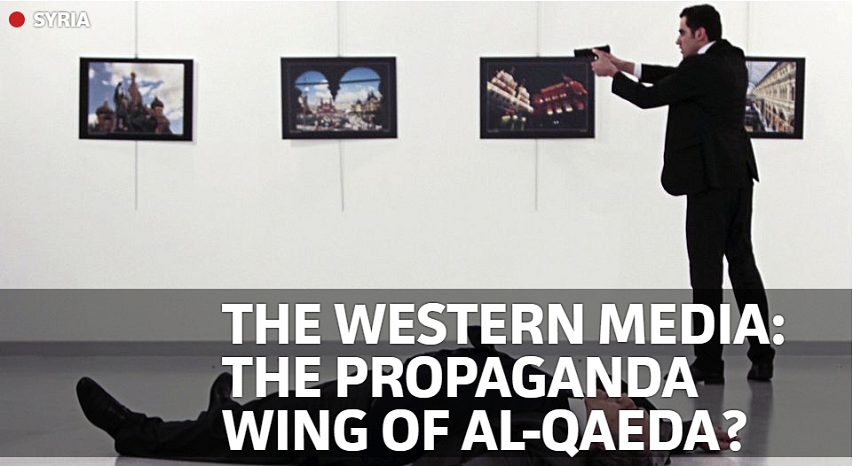
The British press is morphing into a mouthpiece for al-Qaeda. Consider its coverage of yesterday’s assassination of Andrei Karlov, the Russian ambassador to Turkey. It is borderline sympathetic. The killer’s words — or rather, certain of the killer’s words — have been turned into emotional headlines, into condemnations of Russia’s actions in Syria. That the killer’s first and loudest cry was ‘Allahu Akbar’ — the holler of the modern terrorist — has been downplayed, and in the case of at least one newspaper, the Express, completely ignored. Instead the papers upfront the killer’s other cries, about Aleppo. ‘This is for Aleppo’, says The Times. ‘Remember Aleppo’, says the Mirror’s headline, but with no quote marks, because these were not the exact words spoken by the gunman — they’re more like the Mirror’s own sympathetic echo of the killer’s sentiment.
To get a sense of how disturbing, or at least unusual, this coverage is, imagine if the 2013 murder of British soldier Lee Rigby by two Islamists had led to headlines like ‘This is for Afghanistan’ or ‘Remember Basra’ (those two knifemen, like Karlov’s killer, justified their action as a response to militarism overseas). Or if the 7/7 bombings had not given rise to front pages saying ‘Terror bombs explode across London’ or ‘BASTARDS’ but rather ‘While you kill us in Iraq, we will kill you here’. Reading the early coverage of Karlov’s killing, and noting how different it is to British press coverage of other acts of Islamist terror, one gets the impression that the media think this killing is justified, or at least understandable. ‘Remember Aleppo’: they’re saying this as much as the killer is — a perverse union of terrorist and editorial intent.
But the killer said, first, ‘Allahu Akbar’. Which perhaps suggests that his sympathy was not with Syria as such but with certain forces in Syria. Forces likely to shout ‘Allahu Akbar’ as they kill people. Islamist forces. Something peculiar has happened in British media and political circles in recent weeks. Having spent years telling us al-Qaeda-style groups are the greatest threat to our way of life, these people have lately become spectacularly uncritical about, and even weirdly supportive of, the existence and influence of al-Qaeda-style groups in Syria. The press coverage of Karlov’s killing is in keeping with the superbly reductive, highly moralised media coverage of events in Aleppo over the past fortnight, in which there are apparently only two sides: defenceless civilians and evil Russia and Assad. The militants in Aleppo, which include some grotesquely illiberal and misanthropic groups, have been airbrushed out of the coverage as surely as some reporters airbrushed away, or at least demoted to paragraph six, the Turkish assassin’s cry of ‘Allahu Akbar’.


