
Published on Jul 29, 2017
Where did the alphabet come from? How did it develop, and why? The writing systems first developed in Sumer provided a basis for the written word, but their system of characters also inspired a shift to single phoneme systems where each letter represents a distinct sound.
August 5, 2017
History of Writing – The Alphabet – Extra History
Comments Off on History of Writing – The Alphabet – Extra History
August 4, 2017
The Battle of Passchendaele – Mutiny in the German Navy I THE GREAT WAR Week 158
Published on 3 Aug 2017
Douglas Haig had been busy since the Battle of Arras came to an end. He amassed huge artillery concentration, got his hands on the new British Mark IV tanks and had a cunning plan that even involved a naval landing along the Belgian coast. And the opening of the battle was definitely more promising than the Battle of the Somme one year earlier. In Germany, a small naval mutiny is put down at the same time.
G.J. Meyer – A World Undone: http://bit.ly/WorldUndoneWW1
Comments Off on The Battle of Passchendaele – Mutiny in the German Navy I THE GREAT WAR Week 158
Experimental Lightweight Browning High Power
Published on 3 May 2017
One of the handguns that resulted from the post-WW2 interest in standardizing arms among the future members of NATO was a lightweight version of the Canadian produced Browning High Power. Experiments began in 1947 to create first a lightened slide by milling out unnecessary material, and then additionally with the use of machined and cast aluminum alloy frames. The first major batch of guns consisted of six with milled alloy frames, with two each going to the Canadian, American, and British militaries for testing.
This would reveal that the guns were in general quite serviceable, except that the locking blocks tended to distort their mounting holes in the alloy frames under extended firing. The cast frames were generally unsuccessful, suffering from substantial durability problems. The program was cancelled in 1951 by the Canadian military, and the last United States interest was in 1952. The example in today’s video is one of the two milled frame guns sent to the US for testing.
Comments Off on Experimental Lightweight Browning High Power
QotD: Shakespeare’s sonnets
The Sonnets were published late in Shakespeare’s career (1609) — by a clever and unscrupulous man. His name was Thomas Thorpe. He ran what was for the times a unique publishing business, playing games with “copyright” that were often unconscionable but, usually, this side of the law. He owned neither a printing press, nor a bookstall — two things that defined contemporary booksellers — subcontracting everything in his slippery way. Indeed, I would go beyond other observers, and describe him as a blackguard; and I think Will Shakespeare would agree with me. Though Shakespeare would add, “A witty and diverting blackguard.”
He collected these sonnets, quite certainly by Shakespeare, but written at much different times and for quite various occasions, from whatever well-oiled sources. Thorpe had a fine poetic ear, and knew what he was doing. He arranged the collection he’d amassed in the sequence we have inherited — 154 sonnets that seem to read consecutively, with “A Lover’s Complaint” tacked on as their envoi — then sold them as if this had been the author’s intention.
We have sonnets not later than 1591, interspersed with others 1607 or later. In one case (Sonnet 145), we have what I think is a love poem Shakespeare wrote about age eighteen, to a girl he was wooing: one Anne Hathaway. (She was twenty-seven.) It is crawling with puns, for instance on her name, and stylistically naïve, but has been placed within the “Dark Lady” sonnets (127 to 152) in a mildly plausible way. It hardly belongs there.
Indeed, once one sees this it becomes apparent, surveying the whole course, that there is rather more than one “Dark Lady” in the Sonnets, and that like most red-blooded men, our Will noticed quite a number of interesting women over his years. But Thorpe has folded them all into one for dramatic effect.
David Warren, “Dark gentleman of the Sonnets”, Essays in Idleness, 2015-05-11.
Comments Off on QotD: Shakespeare’s sonnets
August 3, 2017
Not the Nine O’Clock News – Monty Python worshipers
Published on 21 Jan 2009
A sketch from the british series Not the nine o’clock news commenting on the controversy created by the Monty Python’s film – Life of Brian.
Comments Off on Not the Nine O’Clock News – Monty Python worshipers
August 2, 2017
Some troubling early signs from Finland’s UBI experiment
Dan Mitchell says we can’t draw definite conclusions from these early (anecdotal) points, but that it may point toward UBI (universal basic income) not being the panacea it’s been touted to be:
The New York Times published an in-depth preview of Finland’s experiment late last year. Here’s a description of the problem that Finnish policymakers want to solve.Map of Finland (Suomen kartta) by Oona Räisänen. Boundaries, rivers, roads, and railroads are based on a 1996 CIA map, with revisions. (via Wikimedia)
… this city has…thousands of skilled engineers in need of work. Many were laid off by Nokia… While entrepreneurs are eager to put these people to work, the rules of Finland’s generous social safety net effectively discourage this. Jobless people generally cannot earn additional income while collecting unemployment benefits or they risk losing that assistance. For laid-off workers from Nokia, simply collecting a guaranteed unemployment check often presents a better financial proposition than taking a leap with a start-up.
For anyone who has studied the impact of redistribution programs on incentives to work, this hardly comes as a surprise.
Indeed, the story has both data and anecdotes to illustrate how the Finnish welfare state is subsidizing idleness.
In the five years after suffering a job loss, a Finnish family of four that is eligible for housing assistance receives average benefits equal to 73 percent of previous wages, according to data from the Organization for Economic Cooperation and Development. That is nearly triple the level in the United States. … the social safety net … appears to be impeding the reinvigoration of the economy by discouraging unemployed people from working part time. … Mr. Saloranta has his eyes on a former Nokia employee who is masterly at developing prototypes. He only needs him part time. He could pay 2,000 euros a month (about $2,090). Yet this potential hire is bringing home more than that via his unemployment benefits. “It’s more profitable for him to just wait at home for some ideal job,” Mr. Saloranta complains.
So the Finnish government wants to see if a basic income can solve this problem.
… the Finnish government is exploring how to change that calculus, initiating an experiment in a form of social welfare: universal basic income. Early next year, the government plans to randomly select roughly 2,000 unemployed people — from white-collar coders to blue-collar construction workers. It will give them benefits automatically, absent bureaucratic hassle and minus penalties for amassing extra income. The government is eager to see what happens next. Will more people pursue jobs or start businesses? How many will stop working and squander their money on vodka? Will those liberated from the time-sucking entanglements of the unemployment system use their freedom to gain education, setting themselves up for promising new careers? … The answers — to be determined over a two-year trial — could shape social welfare policy far beyond Nordic terrain.
The results from this experiment will help answer some big questions.
… basic income confronts fundamental disagreements about human reality. If people are released from fears that — absent work — they risk finding themselves sleeping outdoors, will they devolve into freeloaders? “Some people think basic income will solve every problem under the sun, and some people think it’s from the hand of Satan and will destroy our work ethic,” says Olli Kangas, who oversees research at Kela, a Finnish government agency that administers many social welfare programs. “I’m hoping we can create some knowledge on this issue.” … Finland’s concerns are pragmatic. The government has no interest in freeing wage earners to write poetry. It is eager to generate more jobs.
As I noted above, this New York Times report was from late last year. It was a preview of Finland’s experiment.
[…]
Maybe I’m reading between the lines, but it sounds like they are worried that the results ultimately will show that a basic income discourages labor supply.
Which reinforces my concerns about the entire concept.
Yes, the current system is bad for both poor people and taxpayers. But why would anyone think that we’ll get better results if we give generous handouts to everyone?
- We already know that unemployment benefits discourage people from working.
- We already know that food stamps discourage people from working.
- We already know that Obamacare discourages people from working.
- We already know that disability payments discourage people from working.
So if we replace all those handouts with one big universal handout, is there any reason to expect that somehow people will be more likely to find jobs and contribute to the economy?
Again, we need to wait another year or two before we have comprehensive data from Finland. But I’m skeptical that we’ll get a favorable outcome.

Comments Off on Some troubling early signs from Finland’s UBI experiment
Argentina vs United Kingdom: Falklands War 2017
Published on 9 Dec 2016
How would Argentina fare if it tried to take the Falklands again? Does UK have enough forces stationed there to defend itself? Watch the video and find out!
Comments Off on Argentina vs United Kingdom: Falklands War 2017
August 1, 2017
Burial and Identification Of The Dead in WW1 I THE GREAT WAR Special
Published on 31 Jul 2017
The millions of dead soldiers of World War 1 needed and often still need a proper burial place. But modern war, waged with artillery and poison gas, made even the retrieval, let alone the identification of bodies very difficult.
Comments Off on Burial and Identification Of The Dead in WW1 I THE GREAT WAR Special
July 31, 2017
Byzantine religion – not a joking matter
When Tamara Keel isn’t talking about guns, she apparently relaxes by talking about Byzantine history:
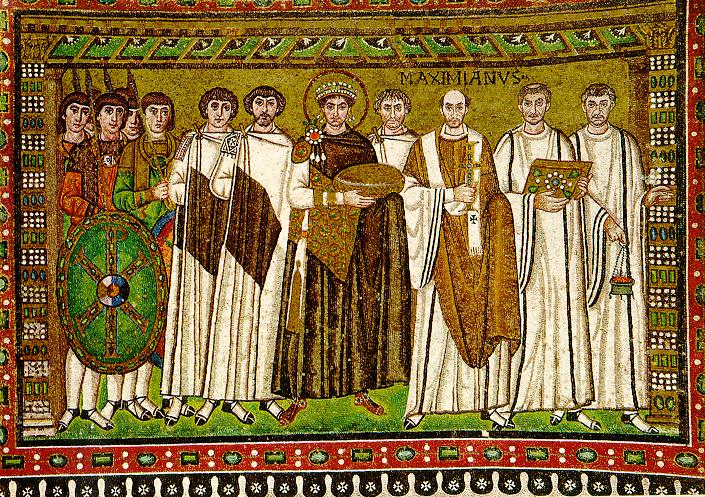
Court of Emperor Justinian with (right) archbishop Maximian and (left) court officials and Praetorian Guards; Basilica of San Vitale in Ravenna, Italy. The dark-haired bearded man to Justinian’s right is believed to be Belisarius. (via Wikimedia)
So, this Maximus dude was a bureaucrat in the Byzantine Empire who apparently had religion as a hobby, as did everybody in Constantinople back then. All the Byzantines did was watch chariot races, debate arcane theological matters, and riot and/or kill each other over differences of opinion on chariot races or arcane theological matters. (Oh, and they engaged in so much intra-governmental intrigue that they went in the dictionary for it.)
At some point, Maximus dropped out of government service and took up religion as a full-time occupation, leaving the city of Constantinople for a monastery in Anatolia. Skipping town ahead of the invading Persians, he landed in Carthage, in Eastern Roman hands for the nonce, thanks to Justinian and Belisarius’s ruinously expensive Mediterranean campaigns.
The big argument in the Church (there was just the one, back then) at the time was between guys who thought Jesus had two natures, human and divine, but only one divine will, and other guys who thought that Jesus had not only two natures, but also a human will and a divine will. Seriously. This was a very big deal and dudes were killing each other over it.
Well, the first view, Monothelitism, was the official view at the time, but Maximus was a believer in the second, or Dyothelitism. And he and the new Pope, Martin I, called a religious council in Rome to debate on the matter without bothering to ask the Emperor. When the council turned out a Dyotheletic verdict, Emperor Constans II (a Monotheletist) had both Pope Martin I and Maximus arrested.
The Pope got de-Poped and banished to the Crimea, where he died. Maximus was tried and sentenced to exile. However, he would not shut up about Dyothelitism and wound up having a great big show trial a few years later, following which he got his tongue cut out and his right hand cut off so he couldn’t tell people that Jesus had two wills anymore or even write it very legibly. Then he got banished to Georgia. (The one on the Black Sea, not the one you drive through on the way to Florida.)
He died in exile there in 662 AD. Nineteen years later, at the Third Council of Constantinople, the Church (still just the one) decided that maybe Jesus did have two wills after all. Maximus received a posthumous pardon, sort of a more official version of “Whoops! Hey, sorry about the tongue and the hand and the whole exile-and-dying-in-prison thing. No hard feelings, okay? Here, have a feast day.”
I told you they took their religion seriously in Constantinople, didn’t I?
Comments Off on Byzantine religion – not a joking matter
July 30, 2017
“… sooner or later, and usually sooner, the British will be blamed”
In Pragati, Alex Tabarrok reviews Shashi Tharoor’s 2016 book history of the British Raj, An Era Of Darkness:
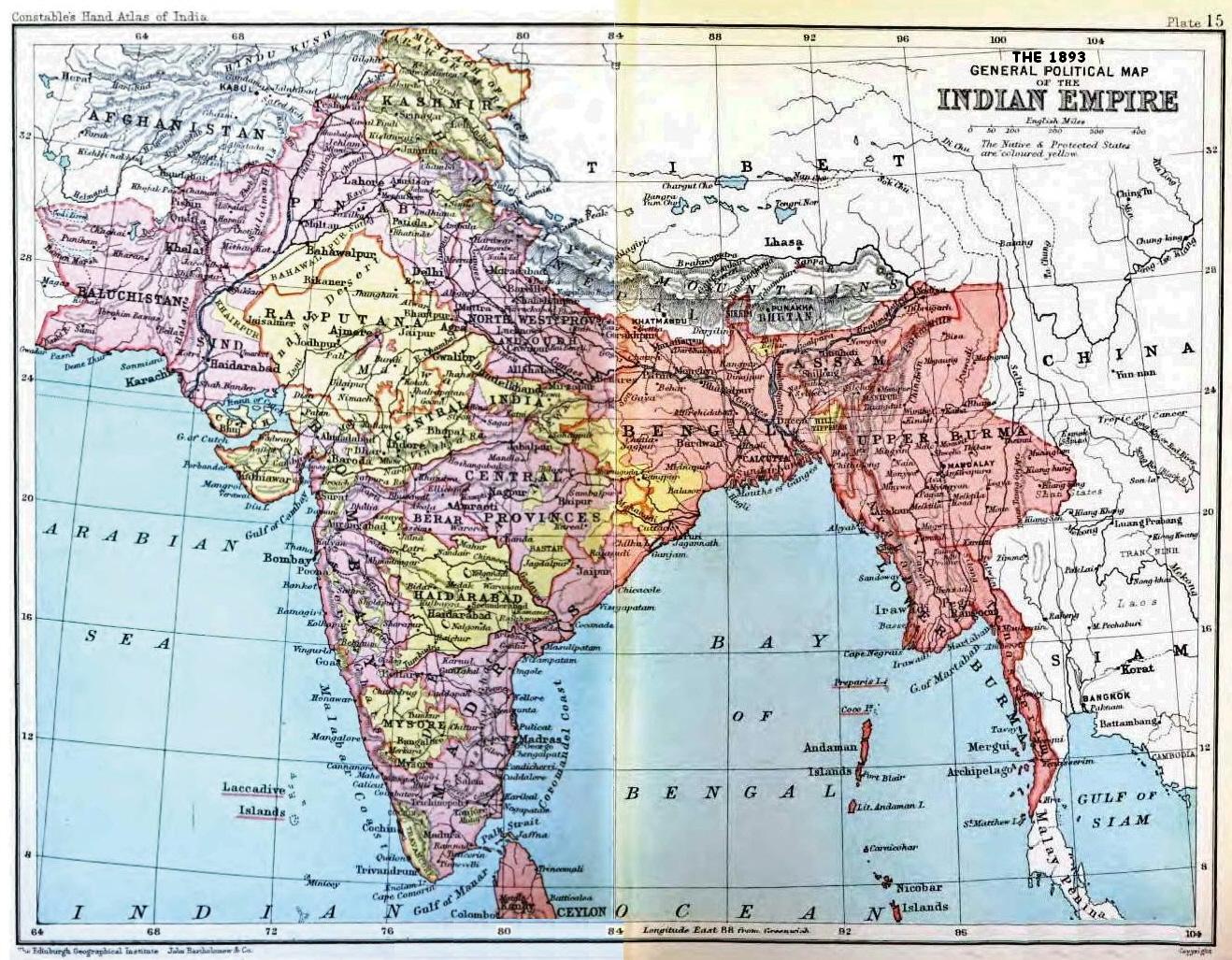
“Political Map of the Indian Empire” from Constable’s Hand Atlas of India, 1893.
(via Wikimedia)
At sophisticated dinner parties in Delhi, Calcutta, or Chennai, whenever the discussion turns to politics, one can be sure that sooner or later, and usually sooner, the British will be blamed. It’s a fine parlor game, and clever players can usually find a way to cast blame for whichever side of the debate they favor. Is India’s traditional family falling apart due to internet porn? Blame the British! Are the laws against homosexuality too strong? Blame the British! The British are an easy target because much of what they did was reprehensible. But blaming British imperialism for contemporary Indian problems is also an easy way to let India’s political class off the hook.
An excellent case against the British comes from Shashi Tharoor, bestselling author, former Under-Secretary-General at the United Nations, and current member of the Indian parliament, in his 2016 book An Era of Darkness: The British Empire in India (also published this year under the title Inglorious Empire[UK title]).
Tharoor makes three claims:
- The British empire in India, from the seizure of Bengal by the East India Company in 1757 until the end of British government rule in 1947, was cruel, rapacious, and racist.
- India would be much better off today had it not been for British rule.
- Britain’s success and the Industrial Revolution were due to British depredation of India.
The first claim is true, the second uncertain, the third false.
The first claim is the heart of Tharoor’s book: the British empire in India was cruel, rapacious and racist. All true. But who would expect otherwise? Power corrupts and absolute power corrupts absolutely. The theft, the famines, the massacres, the formal and casual racism, the utter hypocrisy of suppressing independence while using hundreds of thousands of Indian soldiers to fight for democracy and freedom in two World Wars — on all this Tharoor stands on solid ground. The ground is solid in part because it has been well-trod. Tharoor brings the case against the East India Company and Britain, initiated by Edmund Burke (1774-1785) and continued by the likes of Indian nationalist Dadabhai Naoroji [PDF] (1901) and American historian Will Durant (1930), to its conclusion and climax with the Indian independence movement. In this, Tharoor is entirely successful and his work deserves to be widely read.
In his eagerness to blame Britain, however, Tharoor reaches for every possible argument in ways that are sometimes misleading and sometimes absurd.
Comments Off on “… sooner or later, and usually sooner, the British will be blamed”
US Preparation – Alien Enemies Act – Franco-Prussian War I OUT OF THE TRENCHES
Published on 29 Jul 2017
It’s time for the Chair of Wisdom again and this week Indy talks about US Preparations before reaching the battlefield, the Alien Enemies Act for German citizens in the US and the length of the Franco-Prussian War.
Comments Off on US Preparation – Alien Enemies Act – Franco-Prussian War I OUT OF THE TRENCHES
Tank Chats #14 Canal Defence Light
Published on 5 Feb 2016
Mark II A12, Matilda Canal Defence Light (CDL)
Night fighting always presents problems but searchlights had been tested on tanks as early as 1919. The idea of turning them into an offensive weapon is credited to a Mr A V M Mitzakis, who devised his scheme before the war but the British authorities did not take it up until about 1940. The idea was to use a light of such power that it would dazzle the opposition, leaving them temporarily blind and disorientated.
Five British and two American battalions were trained on CDL and two of the British units went out to Egypt. In fact the CDL was never employed as intended. A few tanks were used to cover the Rhine Crossing and there were incidents in India after the war but that is all.
Comments Off on Tank Chats #14 Canal Defence Light
QotD: Orwell on climate change since Shakespeare’s day
To the lovers of useless knowledge (and I know there are a lot of them, from the number of letters I always get when I raise any question of this kind) I present a curious little problem arising out of the recent Pelican, Shakespeare’s England. A writer named Fynes Morrison, touring England in 1607, describes melons as growing freely. Andrew Marvell, in a very well-known poem written about fifty years later, also refers to melons. Both references make it appear that the melons grew in the open, and indeed they must have done so if they grew at all. The hot-bed was a recent invention in 1600, and glass-houses, if they existed, must have been a very great rarity. I imagine it would be quite impossible to grow a melon in the open in England nowadays. They are hard enough to grow under glass, whence their price. Fynes Morrison also speaks of grapes growing in large enough quantities to make wine. Is it possible that our climate has changed radically in the last three hundred years? Or was the so-called melon actually a pumpkin?
George Orwell, “As I Please”, Tribune, 1944-11-03.
Comments Off on QotD: Orwell on climate change since Shakespeare’s day
July 28, 2017
Three Years of World War 1 I THE GREAT WAR Week 157
Published on 27 Jul 2017
Christmas 1914 – that’s when the war was supposed to be over. And now, in the summer of 1917, it entered its fourth year and there was no end in sight. The British Army was about to launch a new offensive near Ypres, Russia drowned in chaos and the central powers’ defences were still holding. Though in Romania, the combined Russian and Romanian attack put a few cracks into the German self esteem.
Comments Off on Three Years of World War 1 I THE GREAT WAR Week 157
1177 BC: The Year Civilization Collapsed (Eric Cline, PhD)
Published on 11 Oct 2016
From about 1500 BC to 1200 BC, the Mediterranean region played host to a complex cosmopolitan and globalized world-system. It may have been this very internationalism that contributed to the apocalyptic disaster that ended the Bronze Age. When the end came, the civilized and international world of the Mediterranean regions came to a dramatic halt in a vast area stretching from Greece and Italy in the west to Egypt, Canaan, and Mesopotamia in the east. Large empires and small kingdoms collapsed rapidly. With their end came the world’s first recorded Dark Ages. It was not until centuries later that a new cultural renaissance emerged in Greece and the other affected areas, setting the stage for the evolution of Western society as we know it today. Professor Eric H. Cline of The George Washington University will explore why the Bronze Age came to an end and whether the collapse of those ancient civilizations might hold some warnings for our current society.
Considered for a Pulitzer Prize for his recent book 1177 BC, Dr. Eric H. Cline is Professor of Classics and Anthropology and the current Director of the Capitol Archaeological Institute at The George Washington University. He is a National Geographic Explorer, a Fulbright scholar, an NEH Public Scholar, and an award-winning teacher and author. He has degrees in archaeology and ancient history from Dartmouth, Yale, and the University of Pennsylvania; in May 2015, he was awarded an honorary doctoral degree (honoris causa) from Muhlenberg College. Dr. Cline is an active field archaeologist with 30 seasons of excavation and survey experience.
The views expressed in this video are those of the speaker and do not necessarily reflect the views of the National Capital Area Skeptics.
Comments Off on 1177 BC: The Year Civilization Collapsed (Eric Cline, PhD)


