
Ich sitze in dem kleinsten Zimmer in meinem Hause. Ich habe Ihre Kritik vor mir. Im nächsten Augenblick wird sie hinter mir sein! (“I am sitting in the smallest room of my house. I have your review before me. In a moment it will be behind me!”).
Max Reger, responding to a review of his work by Rudolf Louis in the Münchener Neueste Nachrichten, 1906-02-07, as reported by Nicolas Slonimsky, Lexicon of Musical Invective, 1965.
May 16, 2019
QotD: Reacting appropriately to criticism
Comments Off on QotD: Reacting appropriately to criticism
May 15, 2019
1984 – Dystopias and Apocalypses – Extra Sci Fi
Extra Credits
Published on 14 May 2019What makes 1984 still relevant to modern readers is that it serves as a warning against fascism in all its possible forms. George Orwell’s service fighting in the Spanish Civil War led him to see that the heart of totalitarianism is about xenophobia and nationalism no matter which kind of government it came from.
The idea that Orwell presents us in 1984 is that people subtle enough and brutal enough can take the undirected dissatisfaction and anger of a society and point it at whatever they will, using us to damn ourselves.
Comments Off on 1984 – Dystopias and Apocalypses – Extra Sci Fi
Mussolini and D’Annunzio On The Rise – Allies in Crisis Over Italy I THE GREAT WAR April 1919
The Great War
Published on 14 May 2019» SUPPORT THE CHANNEL
Patreon: https://www.patreon.com/thegreatwar
Merchandise: https://shop.spreadshirt.de/thegreatwar/Italy joined World War 1 in 1915 after it had been promised territorial gains in the Treaty of London. Now that the Central Powers had been defeated, the Italian government and the Italians themselves expected that their contribution would be honored at the Paris Peace Conference. But France, Great Britain and the US had other plans and so the Italian government was caught between the new realities at Paris and the nationalists at home.
» SOURCES
Gerwarth, Robert. The Vanquished. Why the First World War Failed to End, 1917-1923 (Penguin, 2017).Leonhard, Jörn. Der überforderte Frieden. Versailles und die Welt 1918-1923 (CH Beck, 2018)
Macmillan, Margaret. The Peacemakers: Six Months that Changed the World (London: John Murray, 2001).
Report: Disorders Inquiry Committee 1919-1920 (Calcutta: Superintendent of Government Printing, India: 1920)
Sullivan, “Vittoria Mutilata” in 1914-1918 online. International Encyclopedia of the First World War https://encyclopedia.1914-1918-online…
Thompson, Mark. The White War: Life and Death on the Italian Front 1915-1919 (London: Faber, 2008).
» SOCIAL MEDIA
Twitter: https://twitter.com/WW1_Series
Reddit: https://reddit.com/r/TheGreatWarChannel»CREDITS
Presented by: Jesse Alexander
Written by: Jesse Alexander
Director: Toni Steller & Florian Wittig
Director of Photography: Toni Steller
Sound: Toni Steller
Editing: Toni Steller
Mixing, Mastering & Sound Design: http://above-zero.com
Motion Design: Christian Graef – GRAEFX
Maps: Daniel Kogosov (https://www.patreon.com/Zalezsky)
Research by: Jesse Alexander
Fact checking: Florian WittigChannel Design: Alexander Clark
Original Logo: David van StepholdA Mediakraft Networks Original Channel
Contains licensed material by getty images
All rights reserved – Real Time History GmbH 2019
Comments Off on Mussolini and D’Annunzio On The Rise – Allies in Crisis Over Italy I THE GREAT WAR April 1919
Modern architecture as a generations-long art crime spree
Theodore Dalrymple is clearly quite a fan of Making Dystopia: The Strange Rise and Survival of Architectural Barbarism by James Stevens Curl, as this is at least the third review of the book I’ve seen by him (and you can probably tell I agree with much of his viewpoint that I’m blogging it yet again…)

In a recent debate in Prospect magazine on the question of whether modern architecture has ruined British towns and cities, Professor James Stevens Curl, one of Britain’s most distinguished architectural historians, wrote as his opening salvo:
Visitors to these islands who have eyes to see will observe that there is hardly a town or city that has not had its streets — and skyline — wrecked by insensitive, crude, post-1945 additions which ignore established geometries, urban grain, scale, materials, and emphases.
This is so self-evidently true that I find it hard to understand how anyone could deny it, but modern architects and hangers-on such as architectural journalists do deny it, like war criminals who, for obvious reasons, continue to deny their crimes in the face of overwhelming evidence.
This is true not only of Britain but of many, perhaps most, other countries that have or had any towns or cities to ruin. Anyone who rides into the center of Paris from Charles de Gaulle Airport, for example, will be appalled at the modernist visual hell that scours his eyes as he goes.
Nor is this visual hell the consequence of the need to build cheaply. Where money is no object, contemporary architects, like the sleep of reason in Goya’s etching, bring forth monsters. The Tour Montparnasse (said to be the most hated building in Paris), the Centre Pompidou, the Opéra Bastille, the Musée du quai Branly, the new Philharmonie, do not owe their preternatural ugliness to lack of funds, but rather to the incapacity, one might say the ferocious unwillingness, of architects to build anything beautiful, and to their determination to leave their mark on the city as a dog leaves its mark on a tree.
Professor Curl’s magnum opus is both scholarly and polemical. He has been observing the onward march of modernism and its effects for sixty years and is justifiably outraged by it. British architects have managed to reverse the terms of the anarchist Bakunin’s dictum that the urge to destroy is also a creative urge: Their urge to create is also a destructive urge. I could give many concrete examples (no pun intended).

Philharmonie at the Parc de la Villette, Paris.
Photo by Zairon via Wikimedia Commons.
Curl knows that he is arguing not against an aesthetic, but against an ironclad ideology. The architectural Leninists have been determined so to indoctrinate the public that they hope and expect a generation will grow up knowing nothing but modernism, and therefore will be unable to judge it. (All judgment is comparative, as Doctor Johnson said.) In Paris recently, I saw an advertisement on the Métro (a few days before the fire in Notre-Dame) to the effect that Paris would not be Paris without the Centre Pompidou — which, of course, has a good claim to be the ugliest building in the world. In the face of such an advertisement promoted by the cultural elite, what ordinary person would dare demur?
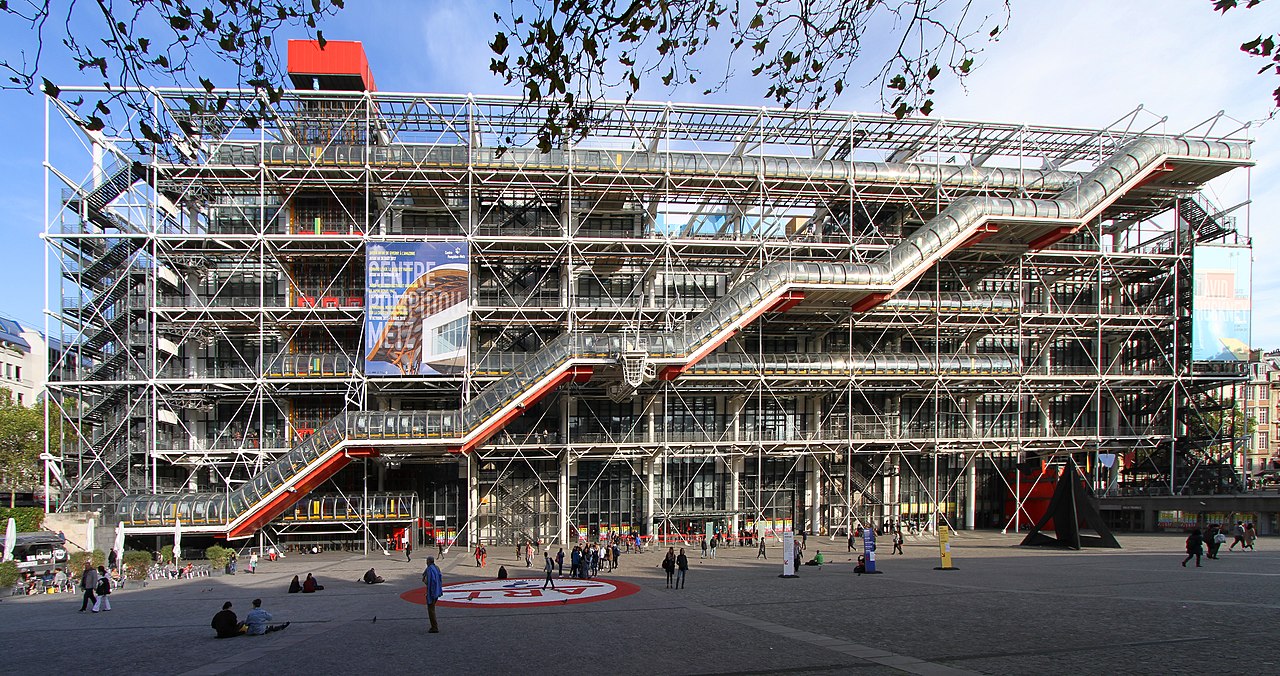
Centre Georges-Pompidou (no, this isn’t an under construction image … it’s from 2017 and the construction was technically complete in 1977)
Gerd Eichmann photo via Wikimedia Commons.
Could anyone imagine a worldwide outpouring of genuine and heartfelt grief, such as that which greeted the burning of Notre-Dame de Paris, if any building of the last seventy years burnt down? Indeed, the destruction of many would be a cause almost for rejoicing. Modernist buildings will never age as Notre-Dame aged; they will merely deteriorate, and usually do deteriorate even before completion.
Comments Off on Modern architecture as a generations-long art crime spree
May 14, 2019
The Broad Fourteens – Royal Navy Motor Torpedo Boats In WWII
PeriscopeFilm
Published on 20 Sep 2017Support Our Channel : https://www.patreon.com/PeriscopeFilm
Made in 1945, THE BROAD FOURTEENS is one of the excellent, dramatized accounts of WWII made by the Ministry of Information for morale purposes. The film shows the first posting, and eventual first action, of a newly-trained motor torpedo boat (MTB) crew. (‘The Broad Fourteens’ is the name given to a patrol area of the North Sea off the Dutch coast.) The film joins the boat and crew at the end of their training (probably HMS Bee, the Coastal Force working up base at Weymouth). The boats featured include 70’ Vosper 1942 class boats, 70’ British Power Boat motor gunboats and MTB 210 — a J Samuel White-built 70’ Vosper which later joined the 13th MTB Flotilla at Dover. The fictional MTB 181 is probably MTB 352, commanded by Lieutenant John M Moore RNVR which joined the 11th MTB Flotilla at Felixstowe after completing her work up. Also featured is MTB 354, commanded by Lieutenant Roland Plugge RN which was the SO’s boat, 5th MTB Flotilla, at Dover. The German flak trawler is in fact an RN Isles Class trawler standing in.
(0:48) Introduces the viewer to how the “broad fourteens” came to exist. Navy training is depicted (2:15). At the training commander’s office (2:25) the film shows the commander and the captain conversing about torpedo and battle experiences and strategies. [Note that they emphasize that Lieutenant Howard is Canadian, although clearly serving in the Royal Navy, as he doesn’t have a “Canada” patch on the shoulder of his uniform.] The crew is shown going through their regular activities. They discuss the previous battles as they are called together. The commander and the captain (5:10) discuss the boat’s impending departure. 5:40 shows the operational base as crews and the commander busily arrive the base. (6:48) operation room as a crew brings a report to the commander. The captain talks about his crew alongside another (7:28). At mark 8:00 the film shows the crew’s residential life. The crew are shown prepping for the first operation as their boats head offshore (9:15) and into the deep sea. The captain is shown calculating the boat’s navigation on his map (10:20). A communication link is established (11:18) and the captain discusses how much longer it is till they get to the operation site. Back at the base (12:20) the crews left converse. The crews are seen at the starmouth arms (14:30), they enjoyed listening to their music at (15:00). The crew takes care of their ship (16:05).
The commander converses with the captain (16:45). The crew are shown in their rooms (17:18). (17:27) is the Starmouth Arms where the crew talk among themselves. The Starmouth Arms manager receives a call which got all crews back to their base (18:40). The commander gives a report (19:20) on the mission and key targets. The meeting closes (20:00) as all crew member are set as they start their engine and move on (21:15). On the deep sea is the navigation map (21:50). At mark 22:20, the crews stops for awhile and takes a break. They move on (22:53). The key target is seen (23:10) and the troops get ready for firing. All crew on set as they wait on the captain to give the go ahead to shoot (23:50). The captain makes the key calculations as the crew stands by for the torpedo release. He gives the go (24:47) and the torpedo is launched out. The torpedo engages the target (25:06). Reports about the operation are documented (25:30) as they proceed to rendezvous point. Two German gun boats are sighted (25:47) as they appear and fire at the crew (26:03). Firing continues till 26:45. There is alarm about fire at the cargo base as a crew is injured (27:00). The fire is attended to as firing continues (27:50). The report about the casualty and the op is documented (28:30). Explosives are launched across the sea towards the enemy gun boats (29:15) as they cool down the heat on them.
Meanwhile back at the base, the film shows the commander (30:00) receiving a visit from his superior, who asks about the mission report as he looks towards the map (30:40). At the battle front, the captain asks about news on the gun boats (31:11) as his underlings all wait in anxiety. The gun boats are sighted (31:38) as they closes on fast towards the crew. At mark 31:53, they opened fire against the boat. A crew is hit (32:15). A gun boat comes in their rescue (33:00) and defeats the enemy boat. Gregory and Johnny are shown wounded. The gun boat (34:00) makes reports and request the course as they depart for home port.
This film is part of the Periscope Film LLC archive, one of the largest historic military, transportation, and aviation stock footage collections in the USA. Entirely film backed, this material is available for licensing in 24p HD, 2k and 4k. For more information visit http://www.PeriscopeFilm.com
Comments Off on The Broad Fourteens – Royal Navy Motor Torpedo Boats In WWII
Hotchkiss Revolving Cannon from San Juan Hill
Forgotten Weapons
Published on 9 Apr 2019This Hotchkiss cannon and its accessories are lot #1116 in the upcoming April 2019 Morphy auction:
https://www.forgottenweapons.com/hotc…
Benjamin Hotchkiss was an American artillery designer who moved to Paris in 1867 in hopes of building a business for his improvements in artillery shells. He experienced the Franco-Prussian War in 1870, and understood the failure of the French Mitrailleuse multi-barrel volley guns. In his opinion, an effective rapid-fire weapon needed to fire explosive projectiles to have a real effect at extended range (unlike the Mitrailleuse which fired simple rifle bullets). So being the inventive sort, he went ahead and designed just such a gun. His revolving cannon was sized for 1-pound (450g) 37mm explosive shells (although he would also produce armor-piercing and canister ammunition). The gun looks like a Gatling gun at first glance, but its mechanical operation is quite different.
The Hotchkiss cannon would become quite popular, with major purchases by the French and American navies as well as many other nations. They would serve into World War One, including some use repurposed as antiaircraft weapons. This particular example was captured by American forces in Cuba during the Spanish-American War, most likely from San Juan Hill. It is a magnificent example of the type, and with a fantastic historical provenance to match.
http://www.patreon.com/ForgottenWeapons
Cool Forgotten Weapons merch! http://shop.bbtv.com/collections/forg…
Contact:
Forgotten Weapons
PO Box 87647
Tucson, AZ 85754
Comments Off on Hotchkiss Revolving Cannon from San Juan Hill
May 12, 2019
History-Makers: Homer
Overly Sarcastic Productions
Published on 10 May 2019Visit PhilosophicalPhridays.com to learn more about Blue’s BOOK!
“History-Makers” is a new series from Blue, digging into the backstories of history’s most influential writers and their great works. We begin at the beginning, with the Greek poet Homer, trying to figure out how exactly he wound up with the Iliad and Odyssey!
Let me know which History-Maker you’d like me to cover in the comments below!
PATREON: https://www.Patreon.com/OSP
Comments Off on History-Makers: Homer
Hitler Strikes in the West – WW2 – 037 – May 11 1940
World War Two
Published on 11 May 2019As the Allied troops in central Norway are evacuated and the Norwegian troops there surrender to the Germans, the Allied position around Narvik is still quite strong. With the addition of roughly 5000 Polish soldiers, the French, British and Norwegian force will prove to be a formidable foe for the Germans up North. This week however, the war drastically changes as not three but four Neutral countries are invaded. The Phoney War is ultimately over.
Join us on Patreon: https://www.patreon.com/TimeGhostHistory
Or join The TimeGhost Army directly at: https://timeghost.tvFollow WW2 day by day on Instagram @World_war_two_realtime https://www.instagram.com/world_war_t…
Join our Discord Server: https://discord.gg/D6D2aYN.
Between 2 Wars: https://www.youtube.com/playlist?list…
Source list: http://bit.ly/WW2sourcesWritten and Hosted by: Indy Neidell
Produced and Directed by: Spartacus Olsson and Astrid Deinhard
Executive Producers: Bodo Rittenauer, Astrid Deinhard, Indy Neidell, Spartacus Olsson
Creative Producer: Joram Appel
Research by: Indy Neidell
Edited by: Ben Ollerenshaw and Wieke Kapteijns
Map animations: EastoryColorisations by Norman Stewart and Julius Jääskeläinen https://www.facebook.com/JJcolorization/
Sources: IWM (A 7644), IWM (A 7637), IWM HU 55505, Bundesarchiv, Photos from the Jonatan Myhre Barlien photo collection.
Eastory’s channel: https://www.youtube.com/channel/UCEly…
Archive by Screenocean/Reuters https://www.screenocean.com.A TimeGhost chronological documentary produced by OnLion Entertainment GmbH.
From the comments:
World War Two
The Phoney War is over. This is the week that many have been anxiously waiting for (how did they know something big was going to happen). We have some great episodes coming up, which are like this one only as great as they are because of the amazing effort that our team puts in creating them. As is very apparent in this episode, Eastory’s maps take these videos to the next level. Every week we’re stunned by his level of detail and the amazing value that is added by these maps. As the war enters a new phase, so do we. Next week will see the first of our roadtrip to France specials going live as well as the longest weekly episode we have written up until now.Cheers,
Joram
Comments Off on Hitler Strikes in the West – WW2 – 037 – May 11 1940
QotD: The British Army between the wars
In the nineteenth century the British common soldier was usually a farm labourer or slum proletarian who had been driven into the army by brute starvation. He enlisted for a period of at least seven years – sometimes as much as twenty-one years – and he was inured to a barrack life of endless drilling, rigid and stupid discipline, and degrading physical punishments. It was virtually impossible for him to marry, and even after the extension of the franchise he lacked the right to vote. In Indian garrison towns he could kick the “niggers” with impunity, but at home he was hated or looked down upon by the ordinary population, except in wartime, when for brief periods he was discovered to be a hero. Obviously such a man had severed his links with his own class. He was essentially a mercenary, and his self-respect depended on his conception of himself not as a worker or a citizen but simply as a fighting animal.
Since the war the conditions of army life have improved and the conception of discipline has grown more intelligent, but the British army has retained its special characteristics – small size, voluntary enlistment, long service and emphasis on regimental loyalty. Every regiment has its own name (not merely a number, as in most armies), its history and relics, its special customs, traditions, etc., etc., thanks to which the whole army is honey-combed with snobberies which are almost unbelievable unless one has seen them at close quarters. Between the officers of a “smart” regiment and those of an ordinary infantry regiment, or still more a regiment of the Indian Army, there is a degree of jealousy almost amounting to a class difference. And there is no question that the long-term private soldier often identifies with his own regiment almost as closely as the officer does. The effect is to make the narrow “non-political” outlook of the mercenary come more easily to him. In addition, the fact that the British Army is rather heavily officered probably diminishes class friction and thus makes the lower ranks less accessible to “subversive” ideas.
But the thing which above all else forces a reactionary view-point on the common soldier is his service in overseas garrisons. An infantry regiment is usually quartered abroad for eighteen years consecutively, moving from place to place every four or five years, so that many soldiers serve their entire time in India, Africa, China, etc. They are only there to hold down a hostile population and the fact is brought home to them in unmistakeable ways. Relations with the “natives” are almost invariably bad, and the soldiers – not so much the officers as the men – are the obvious targets for anti-British feeling. Naturally they retaliate, and as a rule they develop an attitude towards the “niggers” which is far more brutal than that of the officials or business men. In Burma I was constantly struck by the fact that the common soldiers were the best-hated section of the white community, and, judged simply by their behaviour, they certainly deserved to be. Even as near home as Gibraltar they walk the streets with a swaggering air which is directed at the Spanish “natives.” And in practice some such attitude is absolutely necessary; you could not hold down a subject empire with troops infected by notions of class-solidarity. Most of the dirty work of the French empire, for instance, is done not by French conscripts but by illiterate Negroes and by the Foreign Legion, a corps of pure mercenaries.
To sum up: in spite of the technical advances which do not allow the professional officer to be quite such an idiot as he used to be, and in spite of the fact that the common soldier is now treated a little more like a human being, the British army remains essentially the same machine as it was fifty years ago.
George Orwell, “Democracy in the British Army”, Left, 1939-09.
Comments Off on QotD: The British Army between the wars
May 11, 2019
Balkans, Bazookas, and Bunkers – WW2 – OOTF 002
World War Two
Published on 9 May 2019Out of the Foxholes is back to answer your questions about the war. In this episode, we take a look at anti-tank weaponry for infantry, the German defensive lines of the Westwall, the never-finished German aircraft-carrier Graf Zeppelin and the Balkans. The Chieftain, who has his own YouTube channel about tanks and armored vehicles, joins us to answer some of your technical questions. Do you have any questions of your own? You can submit them here: https://community.timeghost.tv/c/Out-…
Join us on Patreon: https://www.patreon.com/TimeGhostHistory
Or join The TimeGhost Army directly at: https://timeghost.tvCheck out The Chieftain on Youtube: https://www.youtube.com/user/TheChief…
Follow WW2 day by day on Instagram @World_war_two_realtime https://www.instagram.com/world_war_t…
Join our Discord Server: https://discord.gg/D6D2aYN.
Between 2 Wars: https://www.youtube.com/playlist?list…
Source list: http://bit.ly/WW2sourcesWritten and Hosted by: Indy Neidell
Produced and Directed by: Spartacus Olsson and Astrid Deinhard
Executive Producers: Bodo Rittenauer, Astrid Deinhard, Indy Neidell, Spartacus Olsson
Creative Producer: Joram Appel
Research by: Joram Appel
Edited by: Wieke Kapteijns and Spartacus OlssonArchive by Screenocean/Reuters https://www.screenocean.com.
A TimeGhost chronological documentary produced by OnLion Entertainment GmbH.
From the comments:
World War Two
Out of the Foxholes is back! While we can’t make this into a regular thing yet, releasing one on set days and stuff, we love doing them and will publish one whenever we find some time to make them. In this edition, The Chieftain joins us to tackle some of the technical questions we have received. Did you know that the Chieftain has made several special episodes about tanks and tactics leading up to World War Two on his own channel? You can find that right here: https://www.youtube.com/user/TheChieftainWoT
If you want to submit a question of your own, you can do that right here: https://community.timeghost.tv/c/Out-of-the-Foxholes-QsPlease consider supporting us on Patreon, as this project is almost fully driven by the financial support we receive on there. You can find our Patreon page right here: https://www.patreon.com/TimeGhostHistory
Cheers,
Joram
Comments Off on Balkans, Bazookas, and Bunkers – WW2 – OOTF 002
May 10, 2019
Operation Pedestal: The Convoy That Saved Malta
Historigraph
Published on 6 Apr 2019If you enjoyed this video and want to see more made, consider supporting my efforts on Patreon: https://www.patreon.com/historigraph
Join the Historigraph Discord: https://discord.gg/vAFTK2D
#OperationPedestal #Historigraph
► Twitter: https://twitter.com/historigraph
► Patreon: https://www.patreon.com/historigraph
► Discord: https://discord.gg/vAFTK2D
► My Twitch: https://www.twitch.tv/addawaySources:
Jonathan Dimbleby, The Battle of the Atlantic.
Correlli Barnett, Engage the Enemy More Closely
James Holland, The War In the West Volume 2
naval-history.netMusic:
“Rynos Theme” Kevin MacLeod (incompetech.com)
Licensed under Creative Commons: By Attribution 3.0 License
http://creativecommons.org/licenses/b…
Comments Off on Operation Pedestal: The Convoy That Saved Malta
May 9, 2019
QotD: Respect for the law
Here one comes upon an all-important English trait: the respect for constitutionalism and legality, the belief in “the law” as something above the State and above the individual, something which is cruel and stupid, of course, but at any rate incorruptible.
It is not that anyone imagines the law to be just. Everyone knows that there is one law for the rich and another for the poor. But no one accepts the implications of this, everyone takes it for granted that the law, such as it is, will be respected, and feels a sense of outrage when it is not. Remarks like “They can’t run me in; I haven’t done anything wrong”, or “They can’t do that; it’s against the law”, are part of the atmosphere of England. The professed enemies of society have this feeling as strongly as anyone else. One sees it in prison-books like Wilfred Macartney’s Walls Have Mouths or Jim Phelan’s Jail Journey, in the solemn idiocies that take place at the trials of conscientious objectors, in letters to the papers from eminent Marxist professors, pointing out that this or that is a “miscarriage of British justice”. Everyone believes in his heart that the law can be, ought to be, and, on the whole, will be impartially administered. The totalitarian idea that there is no such thing as law, there is only power, has never taken root. Even the intelligentsia have only accepted it in theory.
George Orwell, “England Your England”, 1941-02-19.
Comments Off on QotD: Respect for the law
May 7, 2019
The Suez Crisis reconsidered
Jordan Chandler Hirsch reviews a new book on what is now a somewhat forgotten international crisis that shook the Atlantic alliance, Philip Zelikow’s Suez Deconstructed:
Zelikow encourages readers to assess Suez by examining three kinds of judgments made by the statesmen during the crisis: value judgments (“What do we care about?”), reality judgments (“What is really going on?”), and action judgments (“What can we do about it?”). Asking these questions, Zelikow argues, is the best means of evaluating the protagonists. Through this structure, Suez Deconstructed hopes to provide “a personal sense, even a checklist, of matters to consider” when confronting questions of statecraft.
The book begins this task by describing the world of 1956. The Cold War’s impermeable borders had not yet solidified, and the superpowers sought the favor of the so-called Third World. Among non-aligned nations, Cold War ideology mattered less than anti-colonialism. In the Middle East, its champion was Egyptian President Gamal Abdel Nasser, who wielded influence by exploiting several festering regional disputes. He rhetorically — and, the French suspected, materially — supported the Algerian revolt against French rule. He competed with Iraq, Egypt’s pro-British and anti-communist rival. He threatened to destroy the State of Israel. And through Egypt ran the Suez Canal, which Europe depended on for oil.
Egypt’s conflict with Israel precipitated the Suez crisis. In September 1955, Nasser struck a stunning and mammoth arms deal with the Soviet Union. The infusion of weaponry threatened Israel’s strategic superiority, undermined Iraq, and vaulted the Soviet Union into the Middle East. From that point forward, Zelikow argues, the question for all the countries in the crisis (aside from Egypt, of course) became “What to do next about Nasser?”
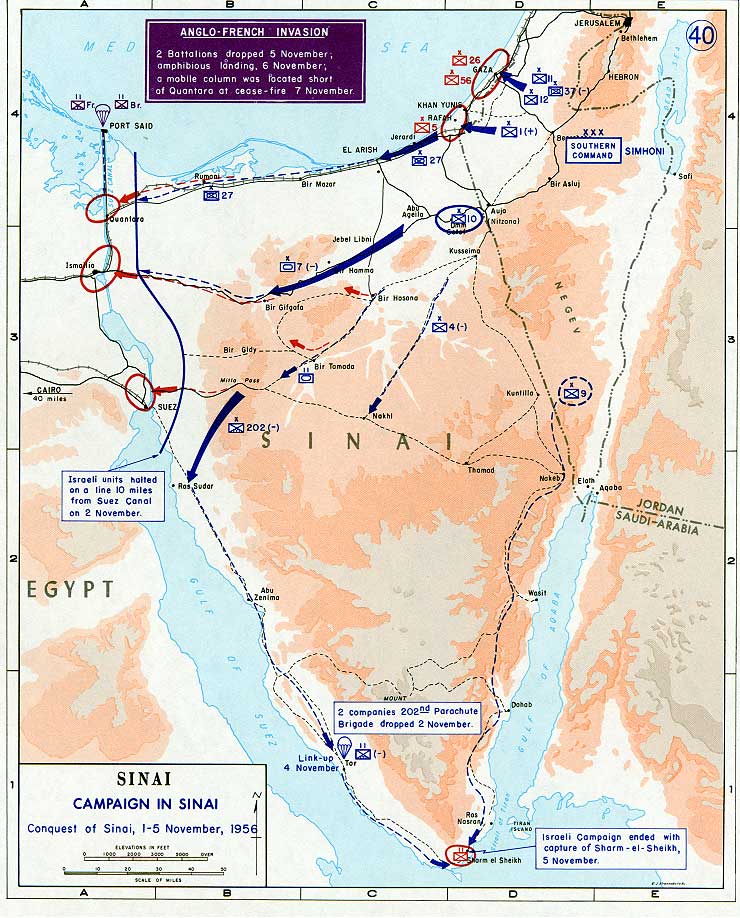
Israel responded with dread, while, Britain, France, and the United States alternated between confrontation and conciliation. Eventually, the United States abandoned Nasser, but he doubled down by nationalizing the Suez Canal. This was too much for France. Hoping to unseat Nasser to halt Egyptian aid to Algeria, it concocted a plan with Israel and, eventually, Britain for Israel to invade Egypt and for British and French troops to seize the Canal Zone on the pretense of separating Israeli and Egyptian forces. The attack began just before the upcoming U.S. presidential election and alongside a revolution in Hungary that triggered a Soviet invasion. The book highlights the Eisenhower administration’s anger at the tripartite plot. Despite having turned on Nasser, Eisenhower seethed at not having been told about the assault, bitterly opposed it, and threatened to ruin the British and French economies by withholding oil shipments.
Throughout, Suez Deconstructed disorients. As the story crisscrosses from terror raids into Israel to covert summits in French villas, from Turtle Bay to the Suez Canal, names and places, thoughts and actions blur. Venerable policymakers scramble to comprehend the latest maneuvers as they struggle with the weight of history: Was Suez another Munich? Could Britain and France still project power abroad? Would a young Israel survive?
If you’re not familiar with the Suez Crisis and want more than just the Wikipedia article for background, here’s the coverage of the military side of things from the British perspective (Operation Musketeer) from Naval History Homepage.
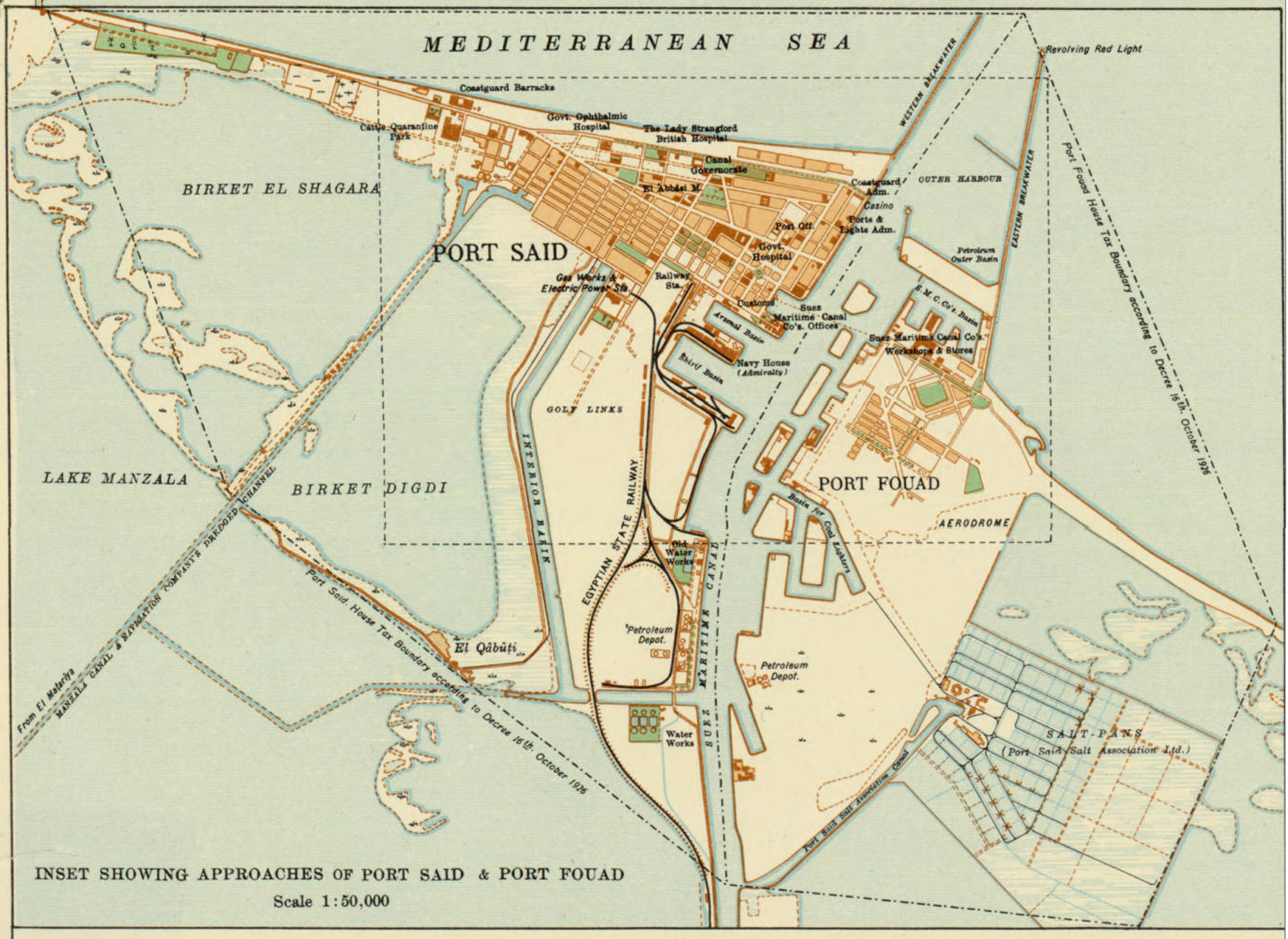
A detailed map of Port Said in 1936 (American Geographical Society Library). Changes by 1956 are not known.
Map via Naval History Homepage.
Comments Off on The Suez Crisis reconsidered
Tale of the Golden Tree – Nart Sagas – Russian Myth #1 – Extra Mythology
Extra Credits
Published on 6 May 2019Join the Patreon community! http://bit.ly/EMPatreon
“If our lives be short let our fame be great!” The legends of the Nart people still echo across the Caucasus, but that echo is getting fainter, so to honor that cry from long ago, it’s only fitting that we tell one of their tales today. We’ll start with an old one, perhaps one of the first to be told. The tale of a golden tree.
The Nart people pursued the apples of a golden tree which bore a strange red and white pattern — eating from either side of it would allow the conception of a child with beautiful white hair. However, the apples kept mysteriously vanishing during the night — so two mighty brothers were set on the case of the vanishing apples.
Comments Off on Tale of the Golden Tree – Nart Sagas – Russian Myth #1 – Extra Mythology
Arthur Chrenkoff relates his own economic “a-ha!” moment
He says he’s never had a religious or spiritual revelation, but he did have one that was pure economics:
By way of background, you have to remember that I grew up under declining communism. As someone has once wryly remarked, in a planned economy everything is planned except for the economy. In Poland of my childhood and early teenage years virtually everyone was employed by the state and so virtually all the income was derived from the state, except, of course, for the rampant black market. Shops were few and generally poorly stocked. Some goods were unobtainable, others required queuing and a lot of luck (or connections) to get, and either way most were of inferior quality to that in the West. Even if you have managed to save enough money, you had to get onto a waiting list to acquire an apartment, car, or household goods. The wait could take decades. Life’s necessities were more widely available but quite haphazard in their distribution. During the crisis years of the 1980s, most food items required ration cards. People literally had to scheme and plot to get their hands on toilet paper. Sure, the Eastern European socialism for most part managed to provide everyone with a bare minimum of subsistence so that no one starved anymore, but beyond that the economic system was shambles, never managing to produce the sufficient quantity and quality of what people needed and wanted. We all knew that the West, by comparison, was a kingdom of plenty, thanks the workings of that scary capitalism, but as a kid I wouldn’t be able to explain to you how, by contracts to our socialism, it somehow managed to produce in abundance all those cars, toys and oranges and bananas. We were told by the authorities that it was all a sham, built on exploitation of workers and resulting in widespread poverty. But we knew enough to know that everything is relative. When the Jaruzelski regime in the early 80s trumpeted in the government-run media (there were no other legal ones) its charity initiative to send sleeping bags to the homeless of New York, an anonymous wag somehow managed to place and ad in one of the papers “Will swap a two bedroom apartment in Warsaw for a sleeping bag in New York”.
I was 15 when I left, unbeknownst to me two years before the fall of the Wall, and spent 16 months in Italy before finally arriving to start a new life in Australia. For a kid from Eastern Europe, Italy was a revelation; I didn’t know enough about anything then to realise that the country we thought was a paradise has always in reality been somewhat of a hot mess. Australia at the end of the decade of wide-ranging economic reforms, which really opened the country to the world and unleashed its creative potential, was even more of contrast to the drabness, shortages and absurdity of the “real socialism” I grew up under.
The story of my economic experience is very brief: one day, not long after settling in Australia, I was in a car, being driven somewhat off the beaten path, through what can be described as a light industrial area. Then, all of a sudden, among all the rather anonymous sheds and buildings I saw a large, free standing store. I can’t remember its name but I remember it was selling carpets. And that’s all. I grew up with few shops around, which, no doubt in part because European cities tend to be a lot more condensed, occupied the same space as the living. But here, here was a whole store, a very large store that specialised in one product only – floor coverings – and it was, relatively speaking, sitting in the middle of nowhere. That it was in business, that it somehow managed to operate, indicated to me that people, many people, actually drove over here, from some distances away, for no other purpose than just to buy one thing – a carpet. So strange. So peculiar. This was my revelation, my economic epiphany in a back seat: this whole capitalist system must truly be incredibly complex and magnificent – and superior to all the alternatives – if it means a shop like this can thrive selling one particular type of product to people who don’t live anywhere near it.
Comments Off on Arthur Chrenkoff relates his own economic “a-ha!” moment


