Quotulatiousness

August 26, 2019

Russia attempts to retroactively “normalize” the Molotov-Ribbentrop Pact

Filed under: Germany, History, Military, Russia, WW2 — Tags: , , , , , , , — Nicholas @ 05:00

Just before the outbreak of World War II on the Polish-German frontier, the Soviet Union concluded a non-aggression pact with Hitler’s Germany that included a large slice of Polish territory and a free hand in the Baltic for Soviet expansion (only the early Finnish success prevented total Soviet domination of the eastern Baltic region). The current Russian government is conducting a public relations (propaganda) campaign to recast this pact as being unexceptional diplomatic activity by attempting to cast Britain, France, and all the other countries that had active diplomatic arrangements with Germany as being “just the same” as the infamous Molotov-Ribbentrop Pact. Wikipedia sums up the fate of the two chief diplomats:
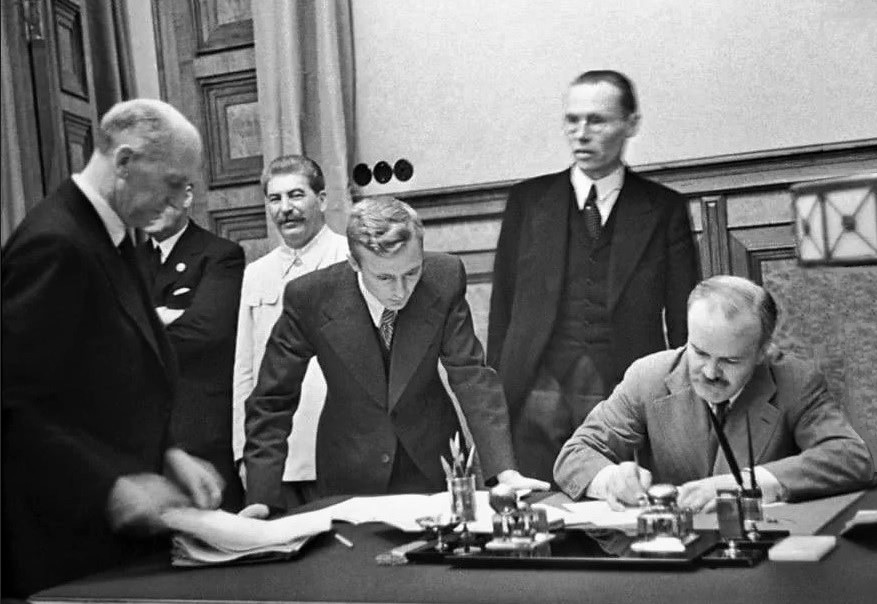
Translation of the Russian caption for this image:
People’s Commissar of Foreign Affairs of the USSR V.M. Molotov signs a friendship and border treaty between the USSR and Germany. Among those present: I.V. Stalin, translator of the Ministry of Foreign Affairs V.N. Pavlov, German diplomat G. Hilger (“truncated” version of the photograph of M. Kalashnikov distributed on the net)
Photograph attributed to Mikhail Mikhaylovich Kalashnikov (1906-1944) via Wikimedia Commons.

The Pact was terminated on 22 June 1941, when Nazi Germany launched Operation Barbarossa and invaded the Soviet Union (thus as well executing the ideological goal of Lebensraum). After the war, von Ribbentrop was convicted of war crimes and executed. Molotov died aged 96 in 1986, five years before the USSR’s dissolution. Soon after World War II, the German copy of the secret protocol was found in Nazi archives and published in the West, but the Soviet government denied its existence until 1989, when it was finally acknowledged and denounced. Vladimir Putin, while condemning the pact as “immoral”, has also defended the pact as a “necessary evil”, a U-turn following his earlier condemnation
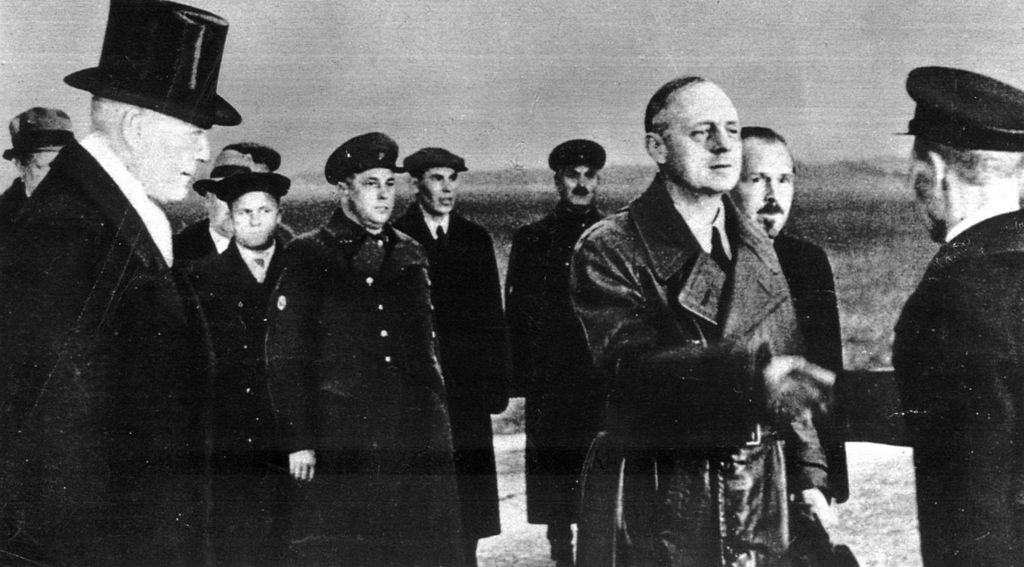
Ribbentrop arrives at Moscow airport, August 1939.
Photograph via Wikimedia Commons.

Arthur Chrenkoff explains why we should vigorously resist this attempt to “normalize” Molotov-Ribbentrop:

1. While the shameful Western appeasement of Hitler, culminating in the infamy of Munich, allowed the Reich to bloodlessly dismember the sovereign and democratic Czechoslovakia, neither Great Britain nor France participated in or benefited from Germany’s cannibalism of this “faraway country of which we know little”. The difference is that while the West remains ashamed of Munich (a name which quickly become synonymous with a craven sell-out), a few years back, Russia’s culture minister Vladimir Medinsky called the Ribbentrop-Molotov pact “a great achievement of Soviet diplomacy”.

2. Unlike all the other agreements signed with Germany during the 1930s, it was the Ribbentrop-Molotov pact that green-lit the armed German aggression and led to the outbreak of the deadliest war in human history. It’s difficult to blame Germany’s neighbours or countries threatened by the Soviet Union (like Poland, Romania and the Baltic states) for trying to stay on Germany’s good side. It was naive and in any case it didn’t work in the end, as they all later found out to their detriment and downfall. Soviet Union, on the other hand, not only climbed into bed with Nazi Germany but it fully and enthusiastically consummated this marriage of convenience.

3. Unlike other agreements cited above, thanks to the “secret protocols” attached to the Ribbentrop-Molotov pact, the Soviet Union was both a co-aggressor in and a co-beneficiary of the start of World War Two. Stalin has relatively bloodlessly acquired the by-then (mid-September) almost defenseless eastern Poland (subsequently incorporated into Belarussian and Ukrainian Soviet Republics; these historically Polish areas remain today parts of Belarus and Ukraine), Bessarabia from Romania (incorporated into the Moldovan Soviet Republic), the Baltic States of Lithuania, Latvia and Estonia, as well as being given a free hand in the invasion of Finland, a country which otherwise might have counted on German friendship and support. All these aggressive territorial gains were the consequence of the Ribbentrop-Molotov division of Eastern Europe between the Reich and the Soviet Union into the respective spheres of interest, soon confirmed as the “facts on the ground” by Wehrmacht and Red Army.

4. While Britain and France, their empires and their allies, fought Germany for almost two years after September 1939, first through the period of the “phony war”, then through the Blitzkrieg in the West and the Battle of Britain, the Soviet Union remained a de facto Nazi ally, continuing to cooperate in security matters and supplying Germany with food and raw materials. Grain trains were still rolling west across the border with the Reich as Wehrmacht was launching Operation Barbarossa in the morning of 22 June 1941. During the period of Nazi-Soviet cooperation, Germany conquered Poland, Norway, Denmark, Belgium, the Netherlands, Luxembourg, France, Yugoslavia and Greece. Soviet exports helped to feed and build up the German war machine before it was unleashed against the West in 1940; German troops surging into the Low Countries walked on their stomachs (to borrow from Napoleon) full of bread baked from Russian wheat or were carried on the tanks and trucks made with Russian coal and ores. Never forget that for Russia, World War Two – or the Great Patriotic War as it is called there – begins only in June 1941, not September 1939, as it does in all Western history books.

5. It’s true that the Ribbentrop-Molotov pact was partly defensive in nature as far as the Soviet Union was concerned, aiming to postpone the inevitable armed clash between the two rival totalitarianisms and in the meantime give Russia some essential breathing space to build up its army and strategic reserves (the top leadership of the Soviet armed forces was decapitated by Stalin during the purges in 1937-8, leaving them even more unprepared to face Germany than would have otherwise been the case). But as I pointed out above, it was also offensive and directly benefited Stalin’s territorial ambitions while it lasted. In some ways, the legacy of the pact lives on in the shape of Poland’s post-war borders, which have nothing to do with its thousand-year history. This is the real #TruthAboutWWII and this is why the Ribbentrop-Molotov pact remains singled out in the infamy of the interwar European democracy.

Belgian GP35: The First Military Browning High Power

Filed under: Europe, History, Military, Weapons, WW2 — Tags: , , , , — Nicholas @ 02:00

Forgotten Weapons
Published on 29 Jul 2019

http://www.patreon.com/ForgottenWeapons

Cool Forgotten Weapons merch! http://shop.bbtv.com/collections/forg…

The Grande Puissance — High Power — was John Browning’s last firearms design. In fact, he only began the design; it was taken to completion by his protege Dieudonné Saive at FN in Belgium. It was the best military handgun of the time, with a double-stack 13-round magazine capacity, and chambered for the 9x19mm cartridge. Belgium was the first nation to adopt it for military service, purchasing 1,000 guns for field trials and approving them in 1935 for standard issue as the GP-35.

The Belgian trials guns have a distinctive oval ejection port, which would be changed on production models. They were also fitted with flat board shoulder stocks and tangent sights adjustable up to 500 meters. These features would last until German occupation of the FN factory complex during World War Two, when the guns were simplified under German occupation production.

Contact:
Forgotten Weapons
PO Box 87647
Tucson, AZ 85754

August 25, 2019

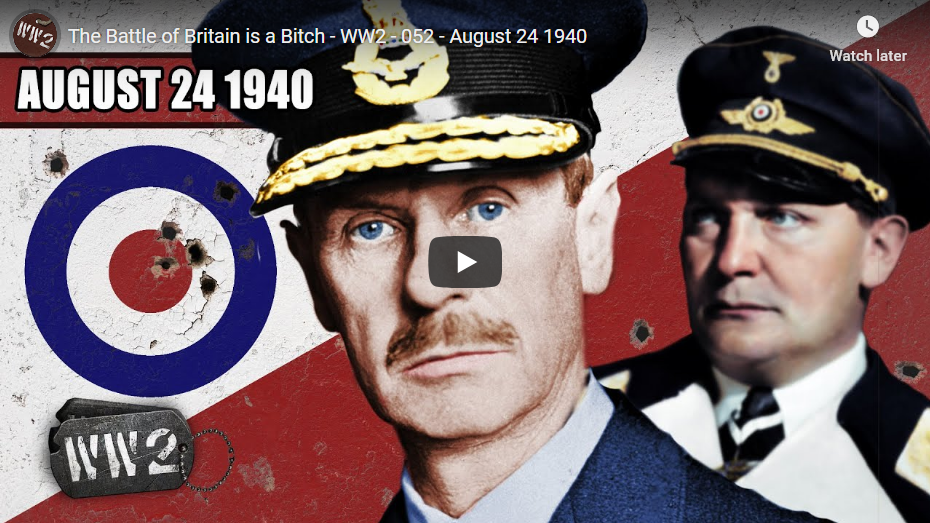
The Battle of Britain is a Bitch – WW2 – 052 – August 24 1940

World War Two
Published on 24 Aug 2019

This week, the communists attack the Japanese in the Battle of 100 Regiments. Meanwhile in Europe, the Battle of Britain enters phase three with the Luftwaffe actively targeting British airfields.

Join us on Patreon: https://www.patreon.com/TimeGhostHistory
Or join The TimeGhost Army directly at: https://timeghost.tv

Follow WW2 day by day on Instagram @World_war_two_realtime https://www.instagram.com/world_war_t…
Join our Discord Server: https://discord.gg/D6D2aYN.
Between 2 Wars: https://www.youtube.com/playlist?list…
Source list: http://bit.ly/WW2sources

Written and Hosted by: Indy Neidell
Produced and Directed by: Spartacus Olsson and Astrid Deinhard
Executive Producers: Bodo Rittenauer, Astrid Deinhard, Indy Neidell, Spartacus Olsson
Creative Producer: Joram Appel
Post-Production Director: Wieke Kapteijns
Research by: Indy Neidell
Edited by: Iryna Dulka
Map animations: Eastory

Colorisations by Norman Stewart and Julius Jääskeläinen https://www.facebook.com/JJcolorization/

Sources:
IWM: H7019, H005772, Q 7928
Color of Trotsky and Soviet leaders by Klimbim
Mercader picture from a public mural by Grahame Miller Ware, Wikimedia Commons
Icons by Sergey Tikhonov, Ely Wahib and Ivan Boyko from iconfinder.com

Eastory’s channel: https://www.youtube.com/channel/UCEly…
Archive by Screenocean/Reuters https://www.screenocean.com.

A TimeGhost chronological documentary produced by OnLion Entertainment GmbH.

From the comments:

World War Two
2 days ago
Last Sunday, we had our one year anniversary livestream in which we talked about the last year, our current challenges and the plans for the road ahead, and answered a lot of your questions. We explained how we want to increase our Patreon income to be able to travel to the known and unknown locations of World War Two. To do so, you can help us by supporting us on https://www.patreon.com/TimeGhostHistory or https://timeghost.tv. Literally every dollar counts. If you’d like to see the livestream I mentioned, you can check that out right here -> https://youtu.be/EKws1jNIAmE

Cheers,
Joram

August 24, 2019

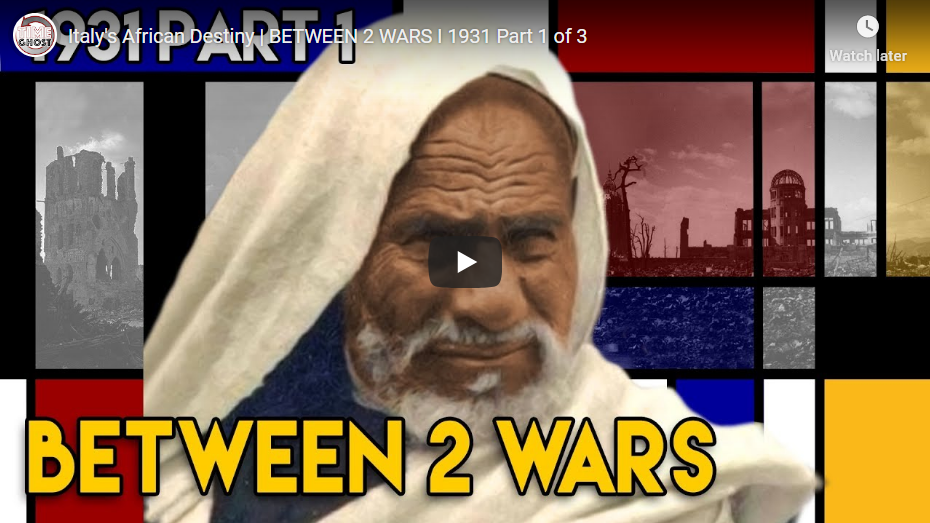
Italy’s African Destiny | BETWEEN 2 WARS I 1931 Part 1 of 3

Filed under: Africa, Europe, History, Italy, Military — Tags: , , , , , , — Nicholas @ 05:00

TimeGhost History
Published on 23 Aug 2019

When Mussolini wants to solidify Italy’s North African colonies, he faces massive opposition by one man: Omar Mukhtar, the Lion of the Desert.

Join us on Patreon: https://www.patreon.com/TimeGhostHistory

Subscribe to our World War Two series: https://www.youtube.com/c/worldwartwo…

Hosted by: Indy Neidell
Written by: Spartacus Olsson
Directed by: Spartacus Olsson and Astrid Deinhard
Executive Producers: Bodo Rittenauer, Astrid Deinhard, Indy Neidell, Spartacus Olsson
Creative Producer: Joram Appel
Post-Production Director: Wieke Kapteijns
Research by: Naman Habtom
Edited by: Daniel Weiss
Sound design: Iryna Dulka

Archive by Reuters/Screenocean http://screenocean.com

Sources:

Online:
https://www.politico.com/blogs/ben-sm…
Muslim Fascist Party and Youth Wing
http://countrystudies.us/libya/21.htm (Library of Congress)
https://www.nam.ac.uk/explore/senussi…
https://awayfromthewesternfront.org/c…
https://www.brookings.edu/blog/order-…
https://trove.nla.gov.au/newspaper/ar…

Journal Articles:
Arielli, Nir. “Italian Involvement in the Arab Revolt in Palestine, 1936-1939.” British Journal of Middle Eastern Studies, vol. 35, no. 2, 2008, pp. 187–204. JSTOR, www.jstor.org/stable/20455584.

Bussotti, L. (2016) “A History of Italian Citizenship Laws during the Era of the Monarchy (1861-1946)”. Advances in Historical Studies, 5, 143-167. doi: 10.4236/ahs.2016.54014.

Cooke, James J. “Destino Affricano De Popolo Italiano: Franco-Italian Controversy Over Tunisia, 1936-1940.” Proceedings of the Meeting of the French Colonial Historical Society, 13/14, 1990, pp. 203–216. JSTOR, www.jstor.org/stable/42952205.

Collins, Carole. “Imperialism and Revolution in Libya.” MERIP Reports, no. 27, 1974, pp. 3–22. JSTOR, www.jstor.org/stable/3011335.

KOPANSKI, ATAULLAH BOGDAN. “ISLAM IN ITALY AND IN ITS LIBYAN COLONY (720-1992).” Islamic Studies, vol. 32, no. 2, 1993, pp. 191–204. JSTOR, www.jstor.org/stable/20840121.

Pankhurst, Richard. “Education in Ethiopia during the Italian Fascist Occupation (1936-1941).” The International Journal of African Historical Studies, vol. 5, no. 3, 1972, pp. 361–396. JSTOR, www.jstor.org/stable/217091.

Pretelli, Matteo. “Education in the Italian colonies during the interwar period.” Modern Italy, Vol. 16, No. 3, August 2011, 275–293

Books:
Mark I. Choate: Emigrant nation: the making of Italy abroad, Harvard University Press, 2008, ISBN 0-674-02784-1, page 175.

Peter Bandella The Eternal City: Roman Images in the Modern World, Chapter 7 – The University of North Carolina Press, 1987, ISBN 0-8078-6511-7

Ahmad Hassanein Bey The Lost Oases (read a Swedish translation by Ulla Ericson), American University of Cairo, reprinted 2006 (original 1925), ISBN 978-91-87771-41-5

A TimeGhost chronological documentary produced by OnLion Entertainment GmbH.

From the comments:

TimeGhost History
1 hour ago
As we approach one year of WW2 In Real Time we cannot express our gratitude for your support enough. It is the financial and spiritual involvement of the TimeGhost Army at https://www.patreon.com/TimeGhostHistory and https://timeghost.tv that has made it possible for us to do all of this – so thank you, once again!

This episode comes out as our WW2 series is covering the first battles in the North African theatre. The Second World War there will have major impact on world events between 1940 and 1944. And this is the second episode covering the background to the conflict in North Africa and the Middle East. We will return to Africa again, but before that we will look at what is going on in Germany, Japan and the USSR in the early 1930s – as some of you might already guess or know, those are dramatic times in those places and it is in these years that the world takes its first concrete steps towards the conflict that erupts into world war in 1939.

August 23, 2019

Sterling S11: Donkey in a Thoroughbred Race

Filed under: Britain, History, Military, Technology, Weapons — Tags: , , , , — Nicholas @ 02:00

Forgotten Weapons
Published on 26 Jun 2019

http://www.patreon.com/ForgottenWeapons

Cool Forgotten Weapons merch! http://shop.bbtv.com/collections/forg…

In the 1960s, the Sterling company began to worry about the prospects of continued sales of the Sterling (Patchett) SMG, especially in light of new competitors like the H&K MP5. Its chief design engineer, Frank Waters, created the S11 as a gun to replace the classic Sterling. The S11 was based on a simple stamped/folded steel receiver, and was intended to have a lower unit cost than the Sterling. It kept the excellent Patchett magazine, but had a barrel and sights offset to the left side, and offered two separate bayonet lugs – one for the No5 rifle and one for the L1A1/FAL.

Unfortunately for Sterling, it was determined that the tooling cost would have made the S11 actually more expensive than the existing guns, whose tooling costs had been long since covered. Also, the S11 was just not a very good or very reliable design – a “donkey in a thoroughbred race” to quote one Sterling manager. This one prototype was the only example ever made, and the project was shelved in 1967 in favor of expanding into more civilian models of the original Sterling.

Many thanks to the Royal Armouries for allowing me to film and disassemble this one of a kind submachine gun! The NFC collection there – perhaps the best military small arms collection in Western Europe – is available by appointment to researchers:

https://royalarmouries.org/research/n…

You can browse the various Armouries collections online here:

https://royalarmouries.org/collection/

Contact:
Forgotten Weapons
PO Box 87647
Tucson, AZ 85754

QotD: The ego of Salvador Dali

Filed under: Books, Europe, History, Quotations — Tags: , , , , , — Nicholas @ 01:00

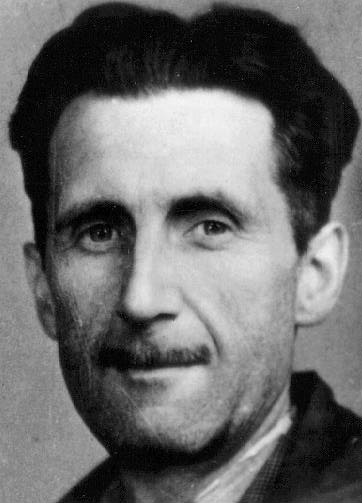
Orwell’s press card portrait, 1943

[Dali’s] aberrations are partly explicable. Perhaps they are a way of assuring himself that he is not commonplace. The two qualities that Dali unquestionably possesses are a gift for drawing and an atrocious egoism. “At seven”, he says in the first paragraph of his book, “I wanted to be Napoleon. And my ambition has been growing steadily ever since.” This is worded in a deliberately startling way, but no doubt it is substantially true. Such feelings are common enough. “I knew I was a genius”, somebody once said to me, “long before I knew what I was going to be a genius about.” And suppose that you have nothing in you except your egoism and a dexterity that goes no higher than the elbow; suppose that your real gift is for a detailed, academic, representational style of drawing, your real métier to be an illustrator of scientific textbooks. How then do you become Napoleon?

There is always one escape: into wickedness. Always do the thing that will shock and wound people. At five, throw a little boy off a bridge, strike an old doctor across the face with a whip and break his spectacles — or, at any rate, dream about doing such things. Twenty years later, gouge the eyes out of dead donkeys with a pair of scissors. Along those lines you can always feel yourself original. And after all, it pays! It is much less dangerous than crime. Making all allowance for the probable suppressions in Dali’s autobiography, it is clear that he had not had to suffer for his eccentricities as he would have done in an earlier age. He grew up into the corrupt world of the nineteen-twenties, when sophistication was immensely widespread and every European capital swarmed with aristocrats and rentiers who had given up sport and politics and taken to patronising the arts. If you threw dead donkeys at people, they threw money back. A phobia for grasshoppers — which a few decades back would merely have provoked a snigger — was now an interesting “complex” which could be profitably exploited. And when that particular world collapsed before the German Army, America was waiting. You could even top it all up with religious conversion, moving at one hop and without a shadow of repentance from the fashionable salons of Paris to Abraham’s bosom.

That, perhaps is the essential outline of Dali’s history. But why his aberrations should be the particular ones they were, and why it should be so easy to “sell” such horrors as rotting corpses to a sophisticated public — those are questions for the psychologist and the sociological critic. Marxist criticism has a short way with such phenomena as Surrealism. They are “bourgeois decadence” (much play is made with the phrases “corpse poisons” and “decaying rentiers class”), and that is that. But though this probably states a fact, it does not establish a connection. One would still like to know why Dali’s leaning was towards necrophilia (and not, say, homosexuality), and why the rentiers and the aristocrats would buy his pictures instead of hunting and making love like their grandfathers. Mere moral disapproval does not get one any further. But neither ought one to pretend, in the name of “detachment”, that such pictures as Mannequin rotting in a taxicab are morally neutral. They are diseased and disgusting, and any investigation ought to start out from that fact.

George Orwell, “Benefit of Clergy: Some Notes on Salvador Dali”, Saturday Book for 1944, 1944.

August 21, 2019

Summer Stupidity: GLADIATOR (Media Review!)

Filed under: Europe, History, Humour, Media — Tags: , , , — Nicholas @ 04:00

Overly Sarcastic Productions
Published on 20 Aug 2019

The first time I saw Gladiator (2000) was in Latin class, and I have maintained since that first viewing that this movie rules.

Just pretend it’s historical fiction and the emperors are named literally anything else, and you’re set.

PATREON: https://www.Patreon.com/OSP

DISCORD: https://discord.gg/sS5K4R3

MERCH LINKS: https://www.redbubble.com/people/OSPY…

OUR WEBSITE: https://www.OverlySarcasticProductions.com
Find us on Twitter https://www.Twitter.com/OSPYouTube
Find us on Reddit https://www.Reddit.com/r/OSP/

British-EU negotiations under Boris Johnson

Filed under: Britain, Europe, Government, Politics — Tags: , , , , , , — Nicholas @ 03:00

In a speech to Slovak journalists, Sean Gabb outlines what he expects the British government to be doing about Brexit now that May has been put out to pasture and Boris Johnson is in charge:

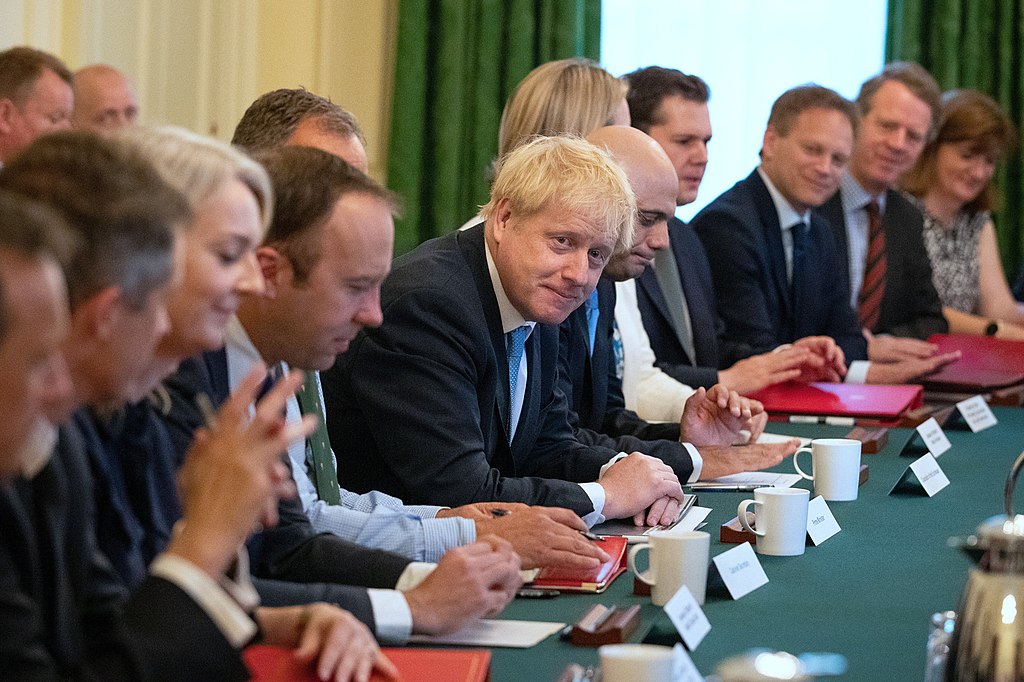
Prime Minister Boris Johnson at his first Cabinet meeting in Downing Street, 25 July 2019.
Official photograph via Wikimedia Commons.

Here, I come to a digression on the nature of how Britain is governed. My country is not particularly democratic. At the same time, there is no cabal of evil persons directing all events and appointments from behind the scenes. This is generally not how ruling classes operate. A more realistic model can be taken from Ian Kershaw’s analysis of the National Socialist revolution in Germany. This proceeded with limited central direction. Before 1939, the leaders were concerned mostly with foreign policy, after that with fighting a big war. Instead, the revolution was decentralised. Reliable men were put in key positions and told to “work towards the Fuhrer” – that is, to act in any situation as they might imagine Hitler himself would act. The result was often administrative chaos. The benefit was that the leadership could concentrate on what it saw as the essentials, and more local knowledge could be used in the overall revolution than would otherwise have been possible.

This is largely how things work in Britain. Our own Transformation is not driven by detailed orders from the Shadowy-Ones-on-High, but by creating a bias within every useful institution to those who are broadly in favour of the Transformation. The benefit is a constrained diversity of approaches that can be presented as a genuine diversity of opinion. The disadvantage is that executive power lies in this country where it has since 1701 – that is, in the hands of the Ministers of the Crown, who are accountable to the House of Commons. If the Prime Minister turns out to be a fool, and the other ministers are too cowardly to stab him in the back, there is no easy way to remove him.

I come at last to the Brexit strategy of the new Government. These people are not right-wing extremists who can eventually be forced to give in. Just like Theresa May, they see Brexit as a problem that needs to be solved. If they could wave a magic wand, they would roll back the calendar to 2016 and make sure that Remain won the Referendum. Or they would roll it back a little farther and make sure the Referendum was not called that year, or at all. But they cannot. Instead, they have to deal with the effects of leaving a political fool in charge for three years of the Brexit process.

Theresa May had one job after 2016. This was to produce the minimal departure I have mentioned. Instead, she negotiated a Withdrawal Agreement that caused a storm of outrage among the English. The details of what this Withdrawal Agreement contained are, again, unimportant. What does matter is that the Withdrawal Agreement was published in English on the European Commission website, and millions of us read its 585 pages. We may not have been that interested in the details of our membership. But the details of our “withdrawal” were unacceptable. She tried three times to force it through the House of Commons. Each time, a majority of some very trashy people were terrified to be seen supporting it. Anyone else less stupid would have tried something else. Instead, Theresa May treated us with open contempt. Whether or not we really cared about it, we had been asked if we wanted to remain in the European Union. Having voted “No!” we expected some show of respect for our clear instructions. We did not welcome a Brexit-in-Name-only.

At first, the damage was confined to the possibility of a Labour Government. Then, with the rise of the Brexit Party, the system as a whole moved towards a crisis of legitimacy. The European elections of the month before last were seen as the second Referendum the Remainers had demanded. It was won by the Leavers. The Conservative were crushed. Labour was humiliated. It seemed that a general election would, for the first time, produce a bloc in the House of Commons of Members opposed not only to the peripheral issue of the European Union, but also to the Transformation.

So Theresa May had to go, and she was replaced by Boris Johnson. His own inclination, I have no doubt, is to get a few cosmetic changes to the existing Withdrawal Agreement, and then tell us he is a diplomatic genius. His problem is that this will no longer do. Theresa May has left too much poison in those waters. Brexit must now be more meaningful than was at first projected. Last week, there was an election in Wales to fill a vacancy in the House of Commons – a bye-election. This should have been won by the Conservatives. Instead, the Brexit Party took enough Conservative votes to give the seat to one of the opposition parties – not the Labour Party, which did badly. The political arithmetic is that anything less than a No-Deal Brexit or a diplomatic triumph will mean a collapse of the Conservative vote at the next general election. And this will not mean a Labour Government, but political chaos and a crisis of legitimacy.

In a post at the Continental Telegraph, Alex Noble shows the quite different political trajectories of Change UK (or whatever they’re calling themselves this week) and the Brexit Party:

[Simon Jenkins in the Guardian claims that] the majority of Britain want to stay in the EU.

Is he right?

Well, the recent defectors from the main parties clearly believed he was – Chuka Umunna, Anna Soubry et al abandoned their positions to form the CUKs and provide the disenfranchised British masses with the staunch Remainer party they had all been failing to demand for so long.

They came out of the blocks fast, called in favours with journalists to get favourable press coverage, and burst upon the political consciousness of Great Britain like a glitter-filled Zeppelin of cross-party europhilia.

And then … oh the humanity.

Whereas Brexit geezer Nigel Farage sauntered out of the blocks under withering crossfire from the establishment and its pet churnalists, and immediately went hypersonic – from 0% to 20% before the establishment pollsters could unlimber their clipboards and stutter their leading questions.

Up and down the country, the British voter was encouraged to overlook the Brexit Party by an establishment still traumatised by the referendum, with pollsters snidely relegating the party to the column entitled “Other” during their obfuscatory enquiries.

And the British voter seized them by the lapels and yanked them into a ferocious Brexit headbutt.

The desperate EU stooges in the Tory party, realising their puppet Treason May was fatally wounded, threw her under the bus and began their Stop Boris campaign, but all the manufactured scandalettes failed to prevent the Johnson Juggernaut from roiling over them and into Downing Street.

For now, the Brexit Party have stalled on 20% – they hold their position now like a lioness crouched in the long grass, waiting for Boris Johnson to reveal the slightest Remainer tendencies. And if he does, the catastrophic injuries he and his party will suffer will make Theresa May’s mauling look like the amuse bouche at the Marquis de Sade’s final soundproofed basement party.

August 20, 2019

QotD: Autobiography

Filed under: Books, Europe, History, Quotations — Tags: , , , — Nicholas @ 01:00

Orwell’s press card portrait, 1943

Autobiography is only to be trusted when it reveals something disgraceful. A man who gives a good account of himself is probably lying, since any life when viewed from the inside is simply a series of defeats. However, even the most flagrantly dishonest book (Frank Harris‘s autobiographical writings are an example) can without intending it give a true picture of its author. Dali’s recently published [The Secret Life of Salvador Dali] comes under this heading. Some of the incidents in it are flatly incredible, others have been rearranged and romanticised, and not merely the humiliation but the persistent ordinariness of everyday life has been cut out. Dali is even by his own diagnosis narcissistic, and his autobiography is simply a strip-tease act conducted in pink limelight. But as a record of fantasy, of the perversion of instinct that has been made possible by the machine age, it has great value.

George Orwell, “Benefit of Clergy: Some Notes on Salvador Dali”, Saturday Book for 1944, 1944.

August 19, 2019

The Peterloo Massacre

Filed under: Britain, History, Liberty, Military, Politics — Tags: , , , — Nicholas @ 05:00

In Spiked on Friday, Brendan O’Neill marked the 200th anniversary of a brutal suppression of thousands of protestors demanding the right to vote in Britain:

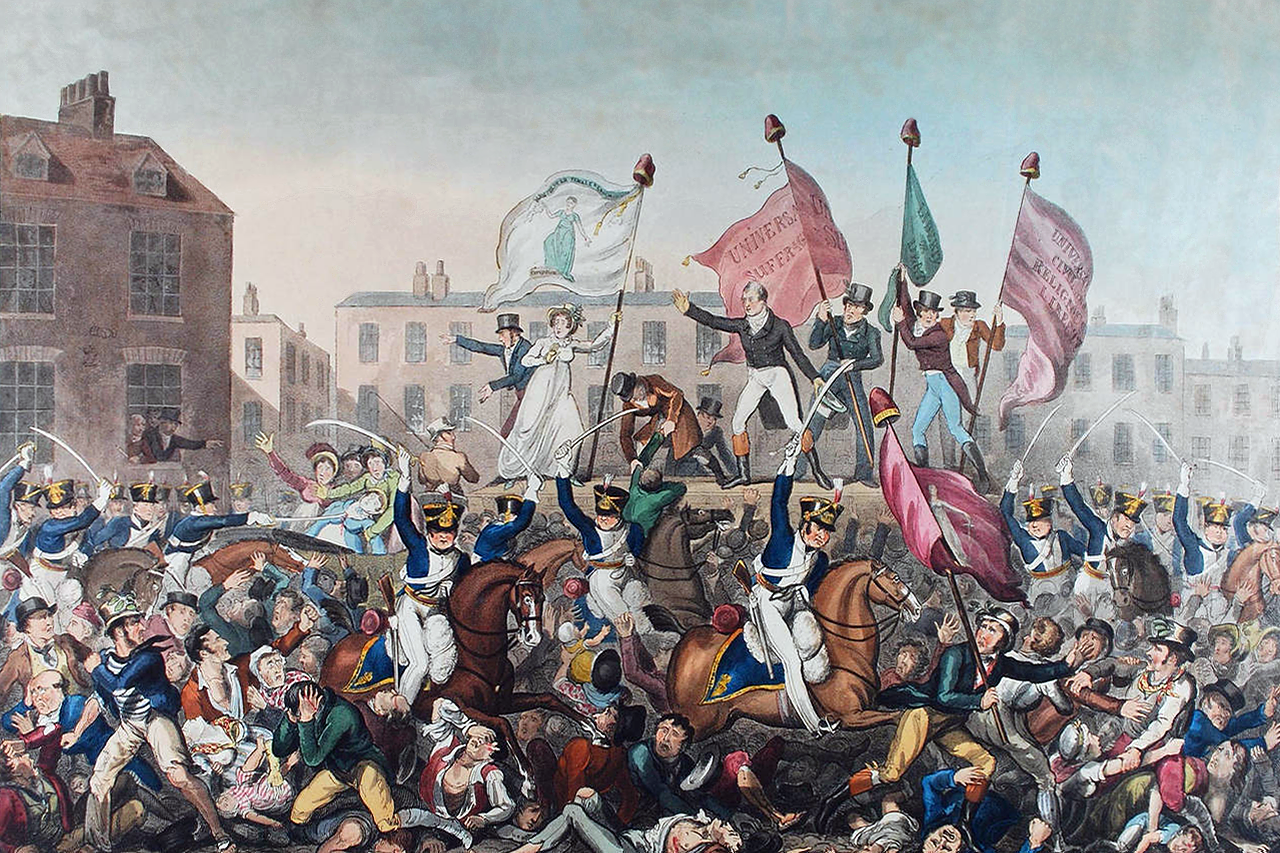
The Peterloo Massacre by Richard Carlile (1790-1843)
To Henry Hunt, Esq., as chairman of the meeting assembled in St. Peter’s Field, Manchester, sixteenth day of August, 1819, and to the female Reformers of Manchester and the adjacent towns who were exposed to and suffered from the wanton and fiendish attack made on them by that brutal armed force, the Manchester and Cheshire Yeomanry Cavalry, this plate is dedicated by their fellow labourer, Richard Carlile: a coloured engraving that depicts the Peterloo Massacre (military suppression of a demonstration in Manchester, England by cavalry charge on August 16, 1819 with loss of life) in Manchester, England.

All the poles from which banners are flying have Phrygian caps or liberty caps on top. Not all the details strictly accord with contemporary descriptions; the banner the woman is holding should read: Female Reformers of Roynton — “Let us die like men and not be sold like slaves”.
Manchester Library Services via Wikimedia Commons.

Today is the 200th anniversary of the Peterloo Massacre, when working people in Manchester were attacked and murdered by cavalry forces for daring to demand the right to vote. And what is our political class doing on this anniversary of such an important event in British political history? They are plotting, tirelessly, to overthrow something that millions of working-class people, and others, voted for: Brexit. They are doing what the Peterloo butchers did, only by political means and court cases rather than with bayonets and sabres. Our current political rulers may not physically attack the masses for having the temerity to use their democratic voices — not yet, anyway — but they view us with the exact same seething, elitist contempt as those who did attack the masses in St Peter’s Field on 16 August 1819.

Around 60,000 men, women and children gathered in St Peter’s Field in Manchester 200 years ago to demand parliamentary representation. They wanted that most basic and essential democratic right: the right to vote. The teeming industrial city of Manchester had no elected MPs in parliament. The old “rotten boroughs” system meant that often sparsely populated rural areas sent MPs to the Commons, involving much patronage and sometimes even the buying of votes by wealthy aspiring politicians, while newly industrialised cities full of the growing urban working classes had little to no political representation. Against a background of post-Napoleonic Wars economic depression and a fast-spreading radical desire for meaningful democratic change, the tens of thousands of marchers arrived in St Peter’s Field with a clear demand: let us vote, let us speak.

What happened next is well known. They were attacked by cavalry forces. Troops on horseback wielded sabres against the democratic crowd. They slashed and stabbed, killing 18 people. Around 500 were injured. The slaughter was given the name “Peterloo” as an ironic comparison to the Battle of Waterloo that took place four years earlier, in 1815. The bourgeoisie’s assault on the working-class democrats of Manchester had a deep impact on the radical psyche. New movements emerged in subsequent years, including the Chartists, the working-class movement for democratic representation. But it would be decades before the right to vote had been established across society. In 1867 some working-class men got the right to vote. In 1918, all men and some women got the right to vote. In 1928, finally all women got the vote. The General Election of 1929, 110 years after the march to St Peter’s Field, was the first election in which all adults had the right to vote.

The 200th anniversary of this bloody assault on working-class democrats ought to be a major occasion. It should be a reminder of the incredible, heroic sacrifices earlier generations made to secure people’s right to express themselves, to vote, and to see their votes be enacted. And yet while some in the political and media class will today pay lip service to the heroes of St Peter’s Field and express regret about the massacre of 18 of them, most of the elites will be too busy to do anything of the kind. Busy doing what? Trying to override and crush the votes of 17.4million people, which includes millions of working-class people and eight million women. It is a genuinely alarming and revealing moment: the 200th anniversary of the Peterloo Massacre arrives and the political set is engaged in an effective coup against the people; in a war against “No Deal Brexit” (which really just means a war against Brexit); in a concerted effort to force the ignorant public, as they see us, to vote for a second time and to give the “right” answer on this occasion.

Joan of Arc – Lies – Extra History

Filed under: Britain, France, History, Religion — Tags: , , , , — Nicholas @ 04:00

Extra Credits
Published on 17 Aug 2019

Writer Rob Rath talks about all the cool stories and facts we didn’t get to cover in our recent series on the hated and beloved Joan of Arc.

Join us on Patreon! http://bit.ly/EHPatreon

From the comments:

Extra Credits
2 days ago

Recommended reading:

Joan of Arc: A History, by Helen Castor

Joan of Arc by Herself and Her Witnesses, by Régine Pernoud

Orléans, 1429: France Turns the Tide, by David Nicolle

4:01 – really cool side characters that didn’t make the final video script (but did show up in Game of Thrones??)

8:12 – multiple versions of Joan’s meeting with Charles

10:48 – all the other famous people we didn’t mention, including Gilles de Rais

13:11 – Joan really did have excellent tactical acumen, which we had to gloss over in her later battles

19:55 – what’s next on Extra History

21:17 – Six Degrees of Walpole

QotD: Hitler’s “wonder weapons”

Filed under: Germany, History, Military, Quotations, Technology, WW2 — Tags: , , , , , , — Nicholas @ 01:00

Historians have generally thought of the Type XXI [submarine] — along with other systems like the Me 262, V-1 and V-2 rockets, and the Tiger tank — as an example of Wunderwaffen, wonder weapons. Since 1945 many have fixated on the revolutionary military technologies that the Third Reich developed in the last two years of the war. The cultural impetus behind the concept, as implicitly or explicitly acknowledged by historians in the uneven and largely enthusiastic literature on the subject, was an irrational faith in technology to prevail in operationally or strategically complex and desperate situations — a conviction amounting to a disease, to which many in the Third Reich were prone in the latter years of the Second World War. To the extent that it shaped decision making, faith in the Wunderwaffen was a special, superficial kind of technological determinism, a confidence in the power of technology to prevail over the country’s strategic, operational, and doctrinal shortcomings. To the extent that leaders, officers, engineers, and scientists after 1943 believed innovation to be the answer to Germany’s strategic dilemmas, they displayed a naive ignorance of how technology interacts with cultural and other factors to influence the course of events. In particular, they reflected a willful ignorance of the extent to which even substantial technological superiority has proved indecisive in human conflict throughout history.

Marcus Jones, “Innovation For Its Own Sake: The Type XXI U-boat”, Naval War College Review, 2014-04.

August 18, 2019

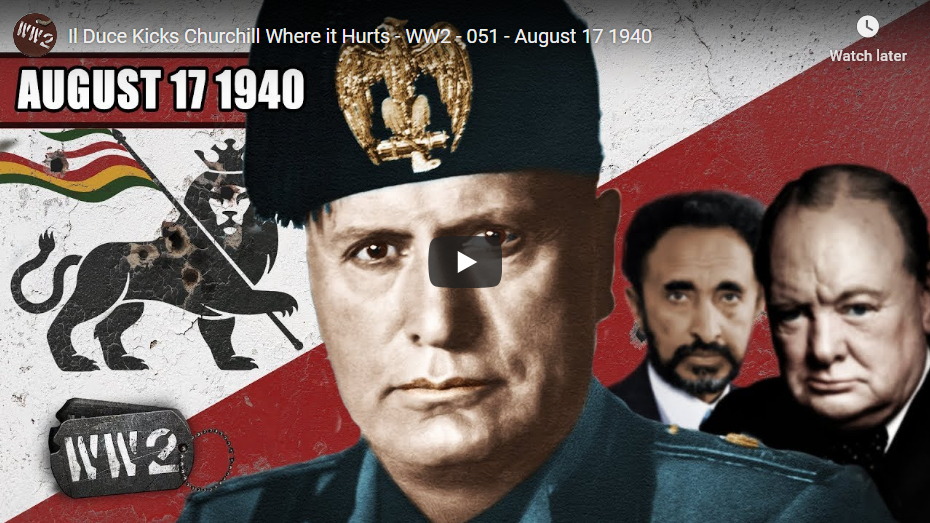
Il Duce Kicks Churchill Where it Hurts – WW2 – 051 – August 17 1940

Filed under: Africa, Britain, Europe, History, Italy, Military, WW2 — Tags: , , , , — Nicholas @ 04:00

World War Two
Published on 17 Aug 2019

As the Battle of Britain reaches not seen before levels of intensity, one of the British colonies is lost to the Italians.

Join us on Patreon: https://www.patreon.com/TimeGhostHistory
Or join The TimeGhost Army directly at: https://timeghost.tv

Follow WW2 day by day on Instagram @World_war_two_realtime https://www.instagram.com/world_war_t…
Join our Discord Server: https://discord.gg/D6D2aYN.
Between 2 Wars: https://www.youtube.com/playlist?list…
Source list: http://bit.ly/WW2sources

Written and Hosted by: Indy Neidell
Produced and Directed by: Spartacus Olsson and Astrid Deinhard
Executive Producers: Bodo Rittenauer, Astrid Deinhard, Indy Neidell, Spartacus Olsson
Creative Producer: Joram Appel
Post-Production Director: Wieke Kapteijns
Research by: Indy Neidell
Edited by: Iryna Dulka
Map animations: Eastory

Colorisations by Norman Stewart and Julius Jääskeläinen https://www.facebook.com/JJcolorization/

Eastory’s channel: https://www.youtube.com/channel/UCEly…
Archive by Screenocean/Reuters https://www.screenocean.com.

Sources:
– Banda groups scan by Localcivis
– Freepngimg.com
– Original photograph of Simon Gauleiter by Mykemalone on Wikimedia Commons
– Membership card photo Photograph by Zinneke on Wikimedia Commons
– IWM: E 1168, E 4350, NA 1670

A TimeGhost chronological documentary produced by OnLion Entertainment GmbH.

August 17, 2019

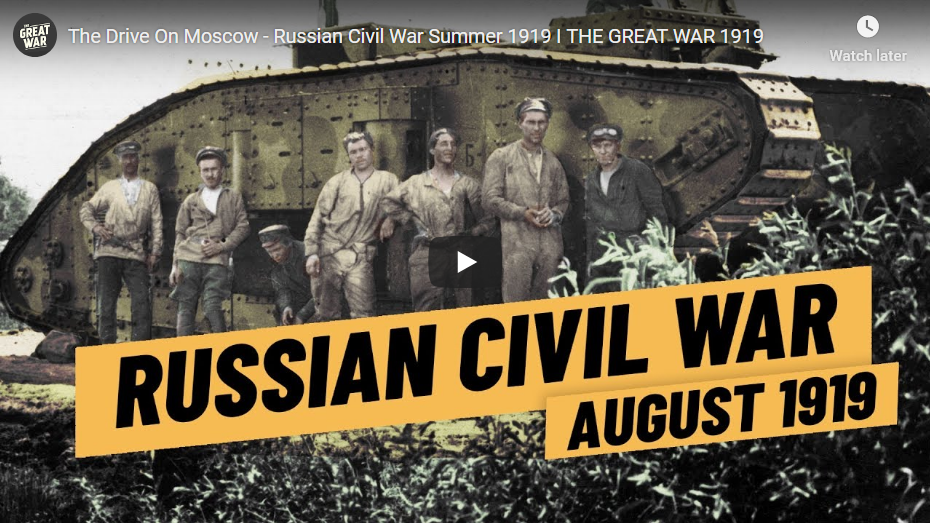
The Drive On Moscow – Russian Civil War Summer 1919 I THE GREAT WAR 1919

Filed under: History, Military, Russia — Tags: , , , , , — Nicholas @ 06:00

The Great War
Published on 16 Aug 2019

Register for our free newsletter: https://realtimehistory.net/subscribe

The summer of 1919 was a pivotal moment in the Russian Civil War. Backed with Allied support the White movement went on the offensive in the East under Alexander Kolchak and in the South under Anton Denikin. However, the Bolsheviks were not wasting time either. They consolidated their power and got the Red Army into shape to crush the enemy once and for all.

» SUPPORT THE CHANNEL
Patreon: https://realtimehistory.net/patreon
Merchandise: https://realtimehistory.net/spreadshirt
Become a member: https://realtimehistory.net/join

» BUY OUR SOURCES IN OUR AMAZON STORES
https://realtimehistory.net/amazon

» SOURCES
Smele, Jonathan. The “Russian” Civil Wars 1916-1926 (London: Hurst, 2015).

Makhno, Nestor. The Struggle Against the State and Other Essays. AK Press: Edinburgh & San Francisco, 1996.

Mawdsley, Evan. The Russian Civil War (New York: Pegasus Books, 2005).

Robert Gerwarth, The Vanquished. Why the First World War Failed to End, 1917-1923 (Penguin, 2017)

Sumpf, Alexandre. “Russian Civil War”, in 1914-1918 online. International Encyclopedia of the First World War. https://encyclopedia.1914-1918-online.

Mawdsley, Evan. “International Responses to the Russian Civil War”, in 1914-1918 online. International Encyclopedia of the First World War. https://encyclopedia.1914-1918-online…

Leonhard, Jörn. Der überforderte Frieden. Versailles und die Welt 1918-1923 (CH Beck, 2018).

Figes, Orlando. A People’s Tragedy. The Russian Revolution (London: The Bodley Head, 2017 [1996]).

Gilley, Christopher: “Makhno, Nestor Ivanovich”, in: 1914-1918-online. International Encyclopedia of the First World War, ed. by Ute Daniel, Peter Gatrell, Oliver Janz, Heather Jones, Jennifer Keene, Alan Kramer, and Bill Nasson, issued by Freie Universität Berlin, Berlin 2014-10-08 https://encyclopedia.1914-1918-online…

»CREDITS
Presented by: Jesse Alexander
Written by: Jesse Alexander
Director: Toni Steller & Florian Wittig
Director of Photography: Toni Steller
Sound: Toni Steller
Editing: Toni Steller
Mixing, Mastering & Sound Design: http://above-zero.com
Maps: Daniel Kogosov (https://www.patreon.com/Zalezsky)
Research by: Jesse Alexander
Fact checking: Florian Wittig

Channel Design: Alexander Clark
Original Logo: David van Stephold

A Mediakraft Networks Original Channel

Contains licensed material by getty images
All rights reserved – Real Time History GmbH 2019

From the comments:

The Great War
7 hours ago
Register for our free newsletter and win $250 worth of our recommended history books: https://realtimehistory.net/win *

*Instead of paying Facebook, Twitter & Co. money for the possibility to reach you with our content, we’d rather get in touch with you directly and spend the money on history books and the production of the show.

History Summarized: Malta

Overly Sarcastic Productions
Published on 16 Aug 2019

Go to https://NordVPN.com/overlysarcastic and and use code OVERLYSARCASTIC to get 75% off a 3 year plan and an extra month for free. Protect yourself online today!

Malta, the Island of A Dozen Empires, chilling in the middle of the Mediterranean Sea, is one of the most social butterflies in History. Having played host to or fought against every major power in the Mediterranean, this island bears a gorgeous architectural and linguistic record of its past, and is still a treasure to behold in the modern day. I’ve covered a lot of nations and empires in my time here, but between the rich cultural blends, the overflowing artistic treasures, and the Still-In-One-Piece-ness of it all, Malta may have one of the strongest claims to being the Winner of History in my book. What’s so special about Malta? Watch and find out!

NOTE on 7:00 – 7:08 — I’m cheating the time-scales a little here. This church, the Rotunda of Mosta, was actually built mid 1800s. Malta’s lavish church construction continued nearly unabated from C. 1565 to the modern day, so I use this example here — but St Paul’s Co-Cathedral in Valletta, shown from 6:27-6:33 is a better example of pure original Baroque construction. Honestly, all of the churches in Malta deserve a look if you’re curious.

PATREON: https://www.Patreon.com/OSP

DISCORD: https://discord.gg/sS5K4R3

« Newer PostsOlder Posts »

Powered by WordPress