
Real Time History
Published 25 May 2022Sign up for the CuriosityStream + Nebula Bundle: https://curiositystream.com/realtimeh…
When Napoleon took Moscow, he expected victory over Russia was just a matter of time. But six weeks later he has to flee the city as his entire Russia campaign collapses. The strengthened Russian Army is attacking from three sides, winter is coming and in far away Paris a coup is underway.
» SUPPORT US ON PATREON
https://patreon.com/realtimehistory» THANK YOU TO OUR CO-PRODUCERS
John Ozment, James Darcangelo, Jacob Carter Landt, Thomas Brendan, Kurt Gillies, Scott Deederly, John Belland, Adam Smith, Taylor Allen, Rustem Sharipov, Christoph Wolf, Simen Røste, Marcus Bondura, Ramon Rijkhoek, Theodore Patrick Shannon, Philip Schoffman, Avi Woolf,» SOURCES
Boudon, Jacques-Olivier. Napoléon et la campagne de Russie en 1812. 2021.
Chandler, David. The Campaigns of Napoleon, Volume 1, New York 1966.
Lieven, Dominic. Russia Against Napoleon. 2010.
Maag, Albert. Die Schicksale der Schweizerregimente in Napoleons I. Feldzug nach Russland 1812. 1900.
Rey, Marie-Pierre. L’effroyable tragédie: une nouvelle histoire de la campagne de Russie. 2012.
Zamoyski, Adam. 1812: Napoleon’s Fatal March on Moscow. 2005.» OUR STORE
Website: https://realtimehistory.net»CREDITS
Presented by: Jesse Alexander
Written by: Jesse Alexander
Director: Toni Steller & Florian Wittig
Director of Photography: Toni Steller
Sound: Above Zero
Editing: Toni Steller
Motion Design: Toni Steller
Mixing, Mastering & Sound Design: http://above-zero.com
Digital Maps: Canadian Research and Mapping Association (CRMA)
Research by: Jesse Alexander
Fact checking: Florian WittigChannel Design: Simon Buckmaster
Contains licensed material by getty images
Maps: MapTiler/OpenStreetMap Contributors & GEOlayers3
All rights reserved – Real Time History GmbH 2022
May 26, 2022
Why Napoleon’s Invasion of Russia Imploded in Moscow
The Banshee | Artifacts Interview Series
Legion Magazine
Published 15 Mar 2019Legion Magazine‘s Stephen J. Thorne sat down with Andrew Burtch, the Post-1945 historian at the Canadian War Museum, to discuss what was the crown jewel of the Royal Canadian Navy’s air fleet – the Banshee. Video edited by Adam Tindal.
For more information, visit: www.legionmagazine.com/artifacts

May 25, 2022
British lack-of-flair in naming things
Ed West wonders why the Brits come up with such boring names for, well, everything:
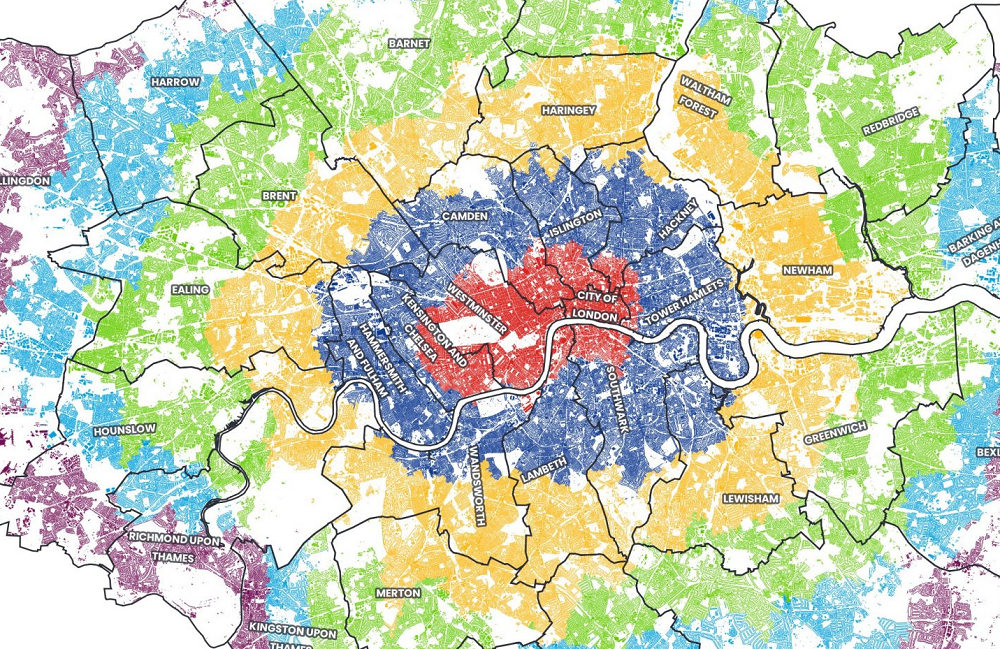
A detail from the Mapping London Tube Zones map – https://mappinglondon.co.uk/2021/tube-zones/
Back in the 1850s, when London was getting its first proper government, the authorities had a problem with street names – they were just so boring that it was actually confusing.
According to Judith Flanders’s The Victorian City: “In 1853, London had twenty-five Victoria Streets, thirty-seven King and twenty-seven Queen Streets, twenty-two Princes, seventeen Dukes, thirty-four Yorks and twenty-three Gloucesters – and that was without counting the similarly named Places, Roads, Squares, Courts, Alleys or Mews, or even the many synonyms that designated squalid backcourts: Rents, Rows, Gardens, Places, Buildings, Lanes, Yards and Walks. One parish alone had half a dozen George Streets.”
Bearing in mind how small London was at the time, no more than zone 1 and bits of zone 2, it’s quite impressive that they managed to have so many Victoria Streets. Impressive, and obviously stupid. The Metropolitan Board of Works forced parishes to rename duplicates; but even as the capital expanded, borough councils continued the practice, so that dozens of new Victoria roads and streets were created (many of which have since been changed).
Perhaps it reflects a deeply content and loyal public, but it’s more a testimony to how dull and unimaginative the British are about naming things. And it’s a fine tradition we continue today with the Elizabeth Line.
[…]
Although the new Elizabethans are in many ways the anti-Victorians – declinist, slow to get things built, filled with civilisational self-hatred – in our naming patterns we are recognisably the same people.
A few years back, when Britain launched its biggest ever warship, weighing in at 65,000 tons, they named it HMS Queen Elizabeth. This came after it was decided we needed a new name for our part of Antarctica – with huge originality, they went for “Queen Elizabeth Land”. Even Big Ben was renamed the Queen Elizabeth Tower in 2012.
The Queen, bizarrely, has twenty hospitals named after her, which led to a small revolt when the South Glasgow University Hospital became the latest. Considering how many brilliant scientists Scotland has produced, you might think they could have found someone else. Alexander Fleming, one of the alternatives suggested, grew up not far away in Ayrshire and saved literally hundreds of millions of lives.
Edward Jenner, meanwhile, has the Viale Edoardo Jenner in Milan named in his honour, and a town in Pennsylvania. While there is a Jenner Road in Stoke Newington, you wouldn’t necessarily know it was in tribute to the man who discovered vaccinations. That is because, when we honour someone with a street, the British shyly only feature their surname; the only time we follow the continental pattern of including the full name is, bizarrely, with local councillors. The people who run local government in Britain are not against honouring heroes in theory, they just think the real heroes aren’t explorers, scientists or military leaders, but the people who run local government.
M1915 Villar Perosa
Forgotten Weapons
Published 5 Aug 2016http://www.patreon.com/ForgottenWeapons
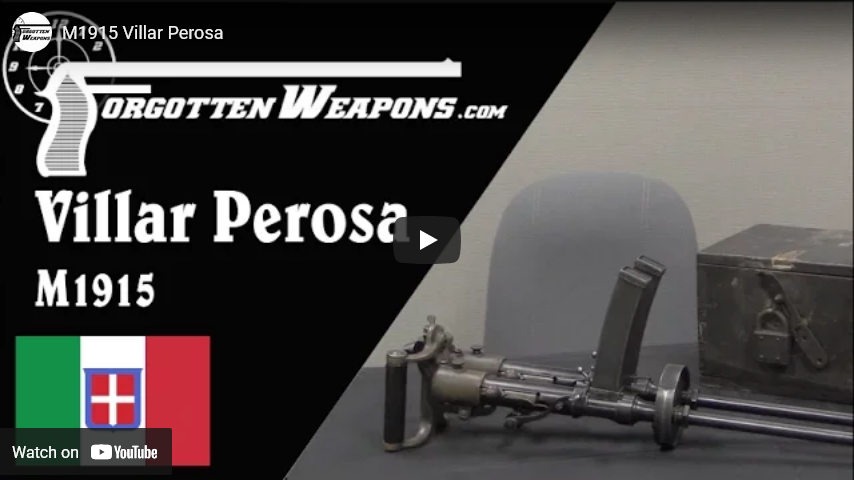
The Villar Perosa is one of the first small machine guns developed and used by a military force. It was designed in Italy and introduced in 1915 as an aircraft weapon, to be used in a flexible mount by an airplane’s observer. The gun consists of two independent firing actions mounted together. Each fires from an open bolt as a rate of 1200-1500 rounds/minute, feeding from a 25 round magazine of 9mm Glisenti cartridges. This allowed the maximum possible volume of fire in an aerial combat situation, where in 1915 ballistic power was not particularly important.
As aircraft armaments improved and synchronized, belt-fed machine guns became practical, the Villar Perosa was quickly made obsolete in aerial use. The Italian military experimented with several applications of the weapon in ground combat, including slings and belt fittings for walking fire, tripods, mounts with integral armor shields, and bicycle mounts. None of these proved particularly successful, as the elements that made the gun well adapted to early aerial use (high rate of fire with a small cartridge) made it relatively ineffective for infantry use.
Ultimately, the best use of the Villar Perosa was to break them up and convert the actions into shoulder-fired submachine guns. Designs to do this were developed by both the Beretta company and Villar Perosa themselves, and in 1918 these guns entered service in the same approximate period as the first German MP-18 submachine guns. Because of this recycling, intact M1915 Villar Perosa guns are quite rare today.
May 24, 2022
History of Rome in 15 Buildings 10. Santa Sabina
toldinstone
Published 2 Oct 2018Through some combination of military disasters, barbarian migrations, social change, and dynastic bad luck, the Western Roman Empire collapsed in the fifth century. In this tenth episode of our History of Rome, focused on the church of Santa Sabina, we will consider some of the implications of this crisis.
If you enjoyed this video, you might be interested in my book Naked Statues, Fat Gladiators, and War Elephants: Frequently Asked Questions about the Ancient Greeks and Romans. You can find a preview of the book here:
https://toldinstone.com/naked-statues…
If you’re so inclined, you can follow me elsewhere on the web:
https://www.reddit.com/r/AskHistorian…
https://www.instagram.com/toldinstone/To see the story and photo essay associated with this video, go to:
https://toldinstone.com/santa-sabina/Thanks for watching!

QotD: Portuguese art and creative genius
If Portugal weren’t such an old nation (but maybe it’s a second childhood) I’d call them the college kid of Europe. They can’t quite get their act straight, but they can be startlingly, amazingly creative. One of the things I’ve talked about here is how many of my brother’s cohort, coming of age at a time when there were NO jobs took up some kind of craft work, from making jewelry to (I used to covet them) making elaborate, hand painted wooden dragon mobiles and selling all of this. Looking back at that pre-EU time when it was relatively easy to set up a stall (illegal, of course) in downtown Porto, I realize most of the stuff on offer was downright artistic, and often incredibly creative when you realized what materials they were working with.
Then the economy recovered, they got jobs, a lot of them connected to or linked to government and all of that stopped. And of course with the EU there are no illegal stalls. I mean Papiere, bitte and all that.
And somehow, perhaps because the new generation knows they have all sorts of “benefits” and “support” coming to them and have never felt the bite of chaos, the crafts and arts in the stores are either startlingly mundane or bizarre. I’m still rather puzzled by entire “scenes from life” (including one that was an operating room) sculpted with penises instead of humans. I mean … who even buys that? Okay. We know who buys that. But do the German tourists and their nostalgie de la boue think they’re tapping into something uniquely “uninhibited and free”, some kind of wild Portuguese sexuality? Raises eyebrow. The Portuguese have been civilized land long before the Germans traded their furs for a place as Roman soldiers. And sure, the Romans could be startlingly and inappropriately sexual (I call to mind a mural, not out of place in a Roman middle class home that had monkeys copulating with children) but it didn’t mean that the culture was “free”, rather that they had different rules. Frankly, the sixties attempt to erase history has corrupted real art and … well, everything else.
Which is kind of the college student thing. Chaos and free time allows you to be very creative, but then you’re not organized enough to parlay that into a career. (I mean, if they’re destined to be the touristic “warm port” of Europe, perhaps they should consider letting real art flourish. Or even encouraging it. Grants for small businesses and young people. It beats the jobs that don’t exist. Just demand they be actually creative and accomplished, instead of giving grants for art that my kids could do at age two and about as interesting.
Sarah Hoyt, “The Ancient Enemy”, According to Hoyt, 2019-04-05.
May 23, 2022
Drowning Germans, Burning Jews – WAH 061 – May 22, 1943
World War Two
Published 22 May 2022When Air Marshal Arthur Harris and Reichspropagandaminister Joseph Goebbels agree that a lot of death and destruction is not enough death and destruction, the world is in trouble.
(more…)
QotD: The adoption of Astrology by the Greeks and Romans
This portability is not restricted merely to divination. Herodotus’ suspicion that quite a bit of Greek religion might have come from somewhere else has merit, though Anatolia, not Egypt, appears to be the main source (see: M.L. West, The East Face of Helicon (1999); and for the person already writing this comment, yes I am aware of Bernal’s Black Athena and no I am not convinced, nor are many specialists in the field). The Romans were open about importing gods from Greece and make a clear distinction between gods worshiped in traditional Roman manner and those imported from Greece (a quite small number) and thus whose rituals followed ritus graecus – rituals in Greek fashion.
In other cases, the foreign practice was modified to fit the culture it arrived in. The Romans adopted the cult of Cybele, an Anatolian goddess, during the dark days of the Second Punic War (the Senate made that decision based on a consultation with the Sibylline books, a written source of oracular prophecy we can talk about another day). Cybele was called Magna Mater (“Great Mother”) in Rome, and it seems made some modifications to her rituals, in particular possibly limiting the role of the Galli (eunuch priests) whose rituals and style seemed decidedly “unRoman” (though I should note that the scholarship here is contested and the issue and evidence complex).
The normal technical term for this kind of religious borrowing is syncretism, and it is a sort of interweaving of religious traditions that polytheisms both ancient and modern are exceptionally capable of. It is simply not hard to add one more god or one more ritual into a religious system that already assumes the existence of innumerable gods.
Bret Devereaux, “Collections: Practical Polytheism, Part III: Polling the Gods”, A Collection of Unmitigated Pedantry, 2019-11-08.
May 22, 2022
Axis Prisoners Face French Wrath – WW2 – 195 – May 21 1943
World War Two
Published 21 May 2022The Allies have won the battle for Africa, but now they have nearly 250,000 POWs to care for, and do not have the facilities to do so. The Trident Conference continues in Washington to try and decide the direction of the Allied war effort, but they launch the Dambuster Raids this week in Germany to try and cripple German water power — and thus, industry — with a new type of bomb.
(more…)
May 21, 2022
Ukraine & T-72: The death of the tank? | The Tank Museum
The Tank Museum
Published 20 May 2022Tank Museum Curator David Willey explores the current conflict in Ukraine and the performance of the T-72 tank; putting it into historical context and exploring other times during the last hundred years when the death of the tank has been predicted.
Consider becoming a Patreon Supporter today: https://www.patreon.com/tankmuseum
00:00 | Intro
00:40 | Wider context
11:01 | Tanks in History
(more…)
May 20, 2022
The Crusades: Part 7 – The Third Crusade
seangabb
Published 5 Mar 2021The Crusades are the defining event of the Middle Ages. They brought the very different civilisations of Western Europe, Byzantium and Islam into an extended period of both conflict and peaceful co-existence. Between January and March 2021, Sean Gabb explored this long encounter with his students. Here is one of his lectures. All student contributions have been removed.
(more…)
The Cold War Legend That Delivered SAUSAGES To Tanks | Forces TV
Forces News
Published 26 Apr 2018To British troops based in north Germany in the last two decades of the Cold War, he was a legend. But this was no commando or member of the special forces.
Check out our website: http://forces.net
Twitter: https://twitter.com/ForcesNews
May 18, 2022
Trident: The Allied Plan to Win the War – Time Ghost News Flash
World War Two
Published 17 May 2022Washington, May 1943. It was the largest Anglo-American conference of the war so far. With the Axis being defeated in North Africa, the Mediterranean, and New Guinea, the need to agree on new strategic goals arose inside the Combined Chiefs of Staff. A new course of action was to be set against Italy, Japan, and Germany to capitalize on the recent successes. But debates and old dilemmas heated up when it came to resources, manpower, and the question “where to attack next”.
(more…)
For the Canadian government, announcing new programs is far more important than implementing them
It often appears that the Liberal government in Ottawa operates almost exclusively on an “appearance only” basis: whatever the situation, it’s the “optics” that matter the most and actual delivery on announcements barely counts at all. It doesn’t help at all that the media generally has the same set of priorities, because they need things to talk about on news shows and the headlines don’t write themselves in the newspapers — and legacy media’s social media concerns are even more about flash and clickbait than their primary product.
Canada has been quick to announce new initiatives to help Ukrainian refugees, but true to form, very slow to actually make any of these initiatives happen, as Joti Heir discusses in The Line:
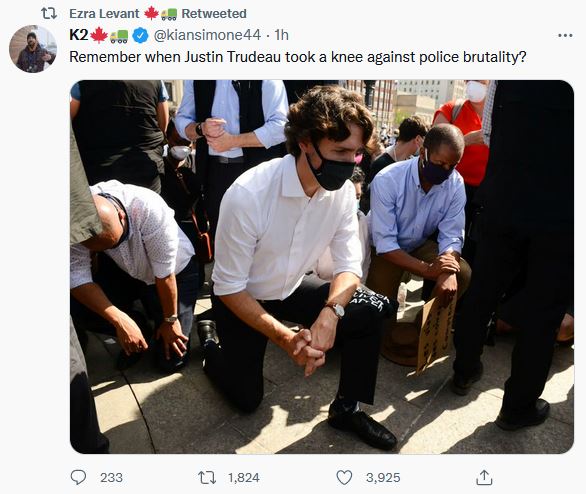
Justin Trudeau has always had a strong affinity for the symbolic gesture, especially when the media are around to record it.
It’s almost as though the Canadian federal government is working buttocks-backward when it comes to the Ukrainian refugee file. After Russia invaded Ukraine on February 24, helping Ukrainian refugees get to a safe place fast was the biggest concern. However, now, close to three months later, the bigger concern is how to help the refugees that are in Canada or making their way here.
“We are seeing an increasing amount of frustration within our community about the pace with which programs and announcements are being implemented,” says Orest Zakydalsky, senior policy analyst with the Ukrainian Canadian Congress (UCC).
“For example, a month ago, the prime minister announced income support when he co-hosted the [StandWithUkraine] telethon with the European Council president, he announced there would be income support for people coming to Canada. A month later, they’re not available.”
The announcement on April 9 indicated that Ukrainian refugees would be able to access $500 per week for a period of up to six weeks. At the same time, it was also announced that housing support in the form of two-week hotel stays would be provided. Both programs do not appear to have been implemented.
“We appreciate this is a very difficult situation for governments, this is a crisis that emerged very suddenly,” says Zakydalsky.
“On the other side, the other problem is that the people that are in Europe, that have left Ukraine, that are looking to come to Canada, see these announcements and quite reasonably think that when a program is announced it is available.”
L119A2: The New British SOF Rifle
Forgotten Weapons
Published 24 Jan 2022http://www.patreon.com/ForgottenWeapons
https://www.floatplane.com/channel/Fo…
Cool Forgotten Weapons merch! http://shop.forgottenweapons.com
Around 2013, the UK MoD began looking for a new rifle to replace the Special Forces’ L119A1. Those A1 rifles were getting old, and something new was needed — and there was some thought that a new rifle could improve on some shortcomings of the A1 model. The new rifle was produced by Colt Canada (formerly Diemaco), and it was procured in both 10″ and 15.7″ barrel lengths (note that the rifle in this video has a 16″ barrel to avoid being an SBR).
The most distinctive feature of the new L119A2 was the licensed LMT monolithic upper receiver. This was used because it allowed solid mounting of devices like lasers on the side rails. However, it had major shortcomings in terms of heat retention and cleanability. The A2 also now used a MagPul CTR stock, and Geissele triggers (an excellent improvement from the A1’s MILSPEC trigger). The same Surefire suppressors were used, as were the optics from the A1s — the new A2 tender did not include new optics (nor funding for them).
Very few photos are known showing the L119A2. It came into service around 2016 or 2017, and entered public awareness after Christian Craighead was photographed using one in the Nairobi Westlands mall siege in 2019.
Contact:
Forgotten Weapons
6281 N. Oracle 36270
Tucson, AZ 85740



