
World War Two
Published 17 Nov 2022Hitler forces Himmler to betray his promise of independence for the Baltic states, despite giving the Waffen-SS 40,000 of their young men. Ion Antonescu of Romania decides to save the remaining Romanian Jews to save his own ass.
(more…)
November 18, 2022
Baltic Peoples Join the SS – War Against Humanity 087
Comments Off on Baltic Peoples Join the SS – War Against Humanity 087
The Model SS41 – A Czech Bullpup Anti-Tank Rifle for the SS
Forgotten Weapons
Published 23 Jun 2017The SS41 was a bullpup, bolt-action antitank rifle manufactured in small numbers by CZ for the SS. Contrary to common assumption, the SS were not a part of the standard German military arms procurement system, and were forced to scrounge for their weapons from other sources. Czech factories were one of the more popular sources, as smaller production lines could escape being integrated into Wehrmacht oversight and were able to contract privately with groups like the SS (the ZK383 as used by the SS is another example of this).
The Model 41 had been in development by the Czech military when the Germans occupied, and it was adapted to the German Patrone 318 cartridge for this production run. That cartridge was also used in the PzB-39, and fired a 220 grain tungsten-cored bullet at 4000 fps — although even this extremely high velocity only allowed it to defeat 30mm of vertical armor at 100m. As with the other antitank rifles of WW2, it would obsolete almost as soon as it was introduced, although it did remain useful for attacking emplaced positions and light armored vehicles (much like the Soviet PTRD and PTRS rifles).
Only a few thousand of the SS41 were manufactured, and they served primarily on the Eastern Front. As a result very few exist in American collections, and this is a particularly excellent example. Thanks to the Institute of Military Technology for allowing me to have access to this very cool AT rifle and bring it to you! Check them out at:
Comments Off on The Model SS41 – A Czech Bullpup Anti-Tank Rifle for the SS
November 17, 2022
The Pornstars of World War Two – Pin-Ups – On the Homefront 017
World War Two
Published 16 Nov 2022How do you motivate men to leave home and go fight in a foreign land? Send them packing with Betty Grable, Rita Hayworth, and Irene Manning, of course! It helps if you include an Esquire magazine and girlie cartoons from the infamous Alberto Vargas.
(more…)
Comments Off on The Pornstars of World War Two – Pin-Ups – On the Homefront 017
November 16, 2022
The Real Reason for Hitler’s War – WW2 Specials
World War Two
Published 15 Nov 2022The murder of the Jews of Europe is not simply conducted alongside the military and political war aims of the Third Reich. For Hitler and the Nazis, the murder of the Jews of Europe is the military-political aim of the war. It confounds all logic, but in the twisted worldview of Nazi ideology, it makes perfect sense. This is a war on the Jewry.
(more…)
Comments Off on The Real Reason for Hitler’s War – WW2 Specials
QotD: Did Sparta actually aspire to supremacy in Greece?
It is hard to say to what degree Sparta ever really pursued this goal. Several Spartan leaders – kings like Cleomenes I, the regent Pausanias, Agesilaus II, along with men like Lysander – once on campaign outside Sparta seemed to have envisaged a much wider sphere of Spartan control over Greece and worked to achieve it. At the same time, the ever cautious Gerousia (along with the Ephors) almost always worked to restrain and eventually destroy such men. This should remind us that no state – not even Sparta – is really a unitary entity with one set of goals held by everyone; within the state there is a complex set of competing interests. For the Spartan kings and influential commanders, success outside of Sparta was an alluring way to potentially build power outside of the systems which restricted them within Sparta; for the Gerousia and the Ephors – who were that system – success abroad was a threat to stability at home.
Given Sparta’s inherent resources, the goal was not unrealistic: Sparta was by land area, if not by population, the largest polis in Greece. But Spartan hegemony lasted less than a decade, primarily because of the ineptness of Spartan diplomacy. While victory over Athens in 404 BC made Sparta the preeminent Greek state, the mistakes started almost immediately: the occupation/collaboration government (the “Thirty Tyrants”) in Athens was so cruel and unpopular that Sparta was forced to acquiesce to its removal after just eight months. Meanwhile, Spartan imperiousness – including a refusal to share the spoils of victory, as well as military activity against little Elis and big Persia unsanctioned by the Peloponnesian League – turned Sparta’s allies against them. Sparta’s efforts to restore their alliance militarily led to the Corinthian War in 395, which would prove that while Sparta was still strong, it was not strong enough to enforce its alliances by force of arms. If any of the Spartans ever aimed for hegemony or preeminence among the Greeks, it is safe to say they failed.
Bret Devereaux, “Collections: This. Isn’t. Sparta. Part VII: Spartan Ends”, A Collection of Unmitigated Pedantry, 2019-09-27.
Comments Off on QotD: Did Sparta actually aspire to supremacy in Greece?
November 15, 2022
How Was The Soviet Union Founded?
The Great War
Published 11 Nov 2022Vladimir Lenin had led the Bolshevik movement through the October Revolution and the Russian Civil War but by 1922 his health was failing and infighting among Bolshevik leadership caused friction. In the end Josef Stalin was able to prevail over Leon Trotsky and lead the newly founded Soviet Union until his death in 1953.
(more…)
Comments Off on How Was The Soviet Union Founded?
Look at Life — Moving Day (1967)
PauliosVids
Published 20 Nov 2018How the headquarters of NATO was moved from France to Belgium.
Comments Off on Look at Life — Moving Day (1967)
November 14, 2022
The Auschwitz Business Model – War Against Humanity 086
World War Two
Published 10 Nov 2022Hitler commemorates the twentieth anniversary of the failed Beer Hall Putsch, in Auschwitz 50 men are shot in celebration, and Arthur Liebehenschel replaces Rudolf Höss as commandant.
(more…)
Comments Off on The Auschwitz Business Model – War Against Humanity 086
Two Variants of the French RSC 1917 Semiauto WW1 Rifle
Forgotten Weapons
Published 2 Apr 2017The RSC 1917, aka FSA1917, has the distinction of being the only true semiautomatic service rifle to see significant frontline infantry use during World War One. It was introduced in 1917 as a long rifle, and about 75,000 were made in that configuration. An improved carbine model was developed in in 1918 right at the end of the war, with only a few thousand of those made. However, what we are looking at today are a pair of 1917 rifles which show a couple of differences.
One of these is a standard RSC 1917 as originally produced, and the other has been updated to a 1918 standard in two ways: the bolt handle/disassembly and the bolt holdopen mechanism. I do not know if these changes were actually implemented during the war, or in the years afterward, but they make the rifles substantially easier to field strip.
If you know of details relevant to these changes, please let me know in the comments!
(more…)
Comments Off on Two Variants of the French RSC 1917 Semiauto WW1 Rifle
QotD: The first modern revolution
One of the dark little secrets of my past is my teenage membership of the English Civil War Society. I spent weekends dressed in 17th-century costumes and oversized helmets, lined up in fields or on medieval streets, re-enacting battles from the 1640s. I still have my old breeches in the loft, and the pewter tankard I would drink beer from afterwards with a load of large, bearded men who, just for a day or two, had allowed themselves to be transported back in time.
I was a pikeman in John Bright’s Regiment of Foote, a genuine regiment in the parliamentary army. We were a Leveller regiment, which is to say that this part of the army was politically radical. For the Levellers, the end of the monarchy was to be just the beginning. They aimed to “sett all things straight, and rayse a parity and community in the kingdom”. Among their varied demands were universal suffrage, religious freedom and something approaching modern parliamentary democracy.
The Levellers were far from alone in their ambitions to remake the former Kingdom. Ranters, Seekers, Diggers, Fifth Monarchists, Quakers, Muggletonians: suddenly the country was blooming with radical sects offering idealistic visions of utopian Christian brotherhood. In his classic study of the English Revolution, The World Turned Upside Down, historian Christopher Hill quotes Lawrence Clarkson, leader of the Ranters, who offered a radical interpretation of the Christian Gospel. There was no afterlife, said Clarkson; only the present mattered, and in the present all people should be equal, as they were in the eyes of God:
“Swearing i’th light, gloriously”, and “wanton kisses”, may help to liberate us from the repressive ethic which our masters are trying to impose on us — a regime in which property is more important than life, marriage than love, faith in a wicked God than the charity which the Christ in us teaches.
Modernise Clarkson’s language and he could have been speaking in the Sixties rather than the 1640s. Needless to say, his vision of free love and free religion, like the Leveller vision of universal equality, was neither shared nor enacted by those at the apex of the social pyramid. But though Cromwell’s Protectorate, and later the restored monarchy, attempted to maintain the social order, forces had been unleashed which would change England and the wider world entirely. Some celebrated this fact, others feared it, but in their hearts everyone could sense the truth that Gerard Winstanley, leader of the Diggers, was prepared to openly declare: “The old world … is running up like parchment in the fire”.
Paul Kingsnorth, “The West needs to grow up”, UnHerd, 2022-07-29.
Comments Off on QotD: The first modern revolution
November 13, 2022
Carrying on about the Carry On movies
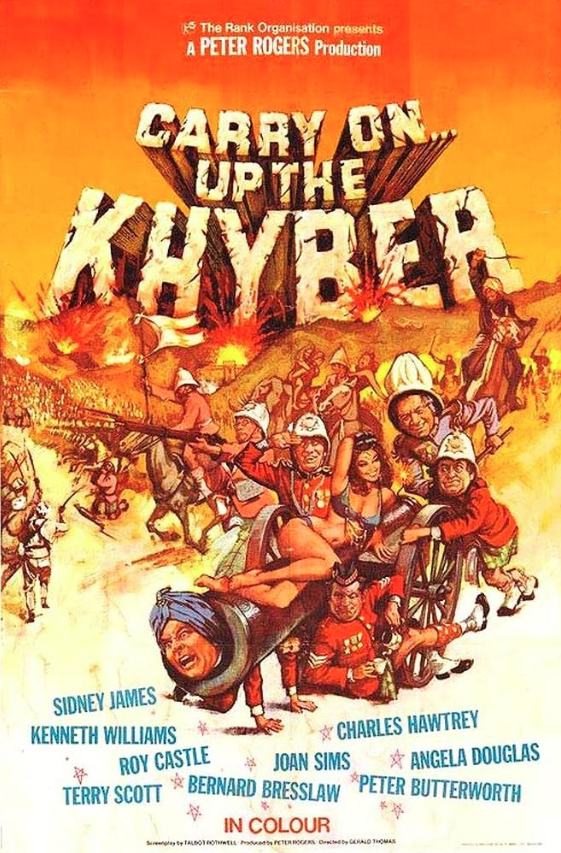
In The Critic, Alexander Larman looks back at one of the longest-running film series beginning with 1958’s Carry On Sergeant (not to be confused with the earlier — and reputedly terrible — interwar Canadian film of the same name) and continuing with many more until the filmic disaster of Carry On Emmanuelle in 1978 (there was also a 1992 attempt to revive the franchise, which failed):
In Alan Bennett’s The History Boys, it is decreed by the contrarian history master, Irwin, that “if George Orwell had lived, nothing is more certain than that he would have written an essay on the Carry On films”.
We are invited to take Irwin’s instructions that the Carry On films represent a valuable insight into British social history with suitable detachment. (The precise, suitably pompous quote is that “while they have no intrinsic merit, they acquire some of the permanence of art simply by persisting, and acquire an incremental significance if only as social history”.)
Yet Irwin (or Bennett) was almost certainly right that, had Orwell survived into the Sixties and Seventies, he would have found the Carry On film series both repellent and fascinating. It is literature’s, and history’s, loss that we do not have an account of Orwell’s thoughts on the antics of Charles Hawtrey, Kenneth Williams, Barbara Windsor et al.
In 1941, Orwell wrote of postcards by the cheerfully lowbrow artist Donald McGill that “your first impression is one of overpowering vulgarity” and that “what you are really looking at is something as traditional as Greek tragedy, a sort of sub-world of smacked bottoms and scrawny mothers-in-law which is a part of Western European consciousness”. He goes on to say that “jokes barely different from McGill’s could casually be uttered between the murders in Shakespeare’s tragedies”.
[…]
The joy of watching the Carry On films, then, is twofold. On the one hand, the hackneyed stories, two-dimensional characterisation and laboured puns and innuendo can be enjoyable, on a purely basic level, but hardly threaten to aspire to the levels of great art.
Yet on the other, the cheerfully Rabelaisian sentiments of the pictures — in which all men and women are defined purely in sexual and scatological terms — exist on a level of reductio ad absurdum.
It is no coincidence that the best Carry On films contain a vein of social satire in their mocking of great British institutions, whether it be the NHS, MI5, the army or the Raj, and the final set piece of Carry On Up The Khyber — in which the stiff-upper-lip British occupiers ignore the Afghan invaders while taking formal dinner in black tie — rises to a level of surrealist genius that would have made Buñuel proud.
There is occasional talk of making another Carry On film, but with all the principal cast (save the ever-sprightly Dale) now dead and with the world a very different place, it is impossible to imagine that we will ever see, say, Carry On Tweeting or the like.
There is every possibility that a really top-notch cast could be assembled, if there was any serious intent behind it — I would love to see Andrew Scott, for instance, offer a more dynamic take on the kind of roles that Williams essayed, because he would do so brilliantly, and if the script could be written by the award-winning likes of Patrick Marber or Richard Bean, it could be a thing of innuendo-heavy beauty.
But then the Carry On series never was a thing of beauty. In its grim and hilarious way, it took every British national stereotype, pulled its trousers down, and gave it a hearty slap on its bare buttocks. Some might find this offensive; others might mourn its loss from public life.
In either case, we shall not look upon its like again. Dr Nookey, Francis Bigger, Professor Inigo Tinkle, Vic Flange: your services are no longer required. To which unkind cut we must solemnly say: “Ooh, matron.”
Comments Off on Carrying on about the Carry On movies
Kiev Liberated! Celebrations in Moscow! – WW2 – 220 – November 12, 1943
World War Two
Published 12 Nov 2022The Red Army has driven the Axis forces out of Kiev, the third largest city in the USSR. The Allies are also advancing, albeit slowly and at great cost, in Italy, but in the South Pacific, they launch a massive air strike against Rabaul … and what is the result?
(more…)
Comments Off on Kiev Liberated! Celebrations in Moscow! – WW2 – 220 – November 12, 1943
November 12, 2022
Climate imperialism
Michael Shellenberger on the breathtaking hypocrisy of first world nations’ rhetoric toward developing countries’ attempts to improve their domestic energy production:
What’s worse, global elites are demanding that poor nations in the global south forgo fossil fuels, including natural gas, the cleanest fossil fuel, at a time of the worst energy crisis in modern history. None of this has stopped European nations from seeking natural gas to import from Africa for their own use.
Rich nations have for years demanded that India and Pakistan not burn coal. But now, Europe is bidding up the global price of liquified natural gas (LNG), leaving Pakistan forced to ration limited natural gas supplies this winter because Europeans — the same ones demanding Pakistan not burn coal — have bid up the price of natural gas, making it unaffordable.
At last year’s climate talks, 20 nations promised to stop all funding for fossil fuel projects abroad. Germany paid South Africa $800 million to promise not to burn coal. Since then, Germany’s imports of coal have increased eight-fold. As for India, it will need to build 10 to 20 full-sized (28 gigawatts) coal-fired power plants over the next eight years to meet a doubling of electricity demand.
This is climate imperialism. Rich nations are only agreeing to help poor nations so long as they use energy sources that cannot lift themselves out of poverty.
Consider the case of Norway, Europe’s second-largest gas supplier after Russia. Last year it agreed to increase natural gas exports by 2 billion cubic meters, in order to alleviate energy shortages. At the same time, Norway is working to prevent the world’s poorest nations from producing their own natural gas by lobbying the World Bank to end its financing of natural gas projects in Africa.
The IMF wants to hold hostage $50 billion as part of a “Resilience and Sustainability Trust” that will demand nations give up fossil fuels and thus their chance at developing. Such efforts are working. On Thursday, South Africa received $600 million in “climate loans” from French and German development banks that can only be used for renewables. The Europeans hope to shift the $7.6 billion currently being invested by South Africa in electricity infrastructure away from coal and into renewables.
Celebrities and global leaders say they care about the poor. In 2019, the Duchess of Sussex, Meghan Markle, Prince Harry’s wife, told a group of African women, “I am here with you, and I am here FOR you … as a woman of color.” Why, then, are they demanding climate action on their backs?

Comments Off on Climate imperialism
The Final Bloody Chapter of Operation Reinhard – War Against Humanity 085
World War Two
Published 9 Nov 2022The genocide of the Jews of Eastern Europe concludes with Operation Harvest Festival — Aktion Erntefest when 42,000 are murdered in the Lublin district.
(more…)
Comments Off on The Final Bloody Chapter of Operation Reinhard – War Against Humanity 085
Long distance communication in the pre-modern era
In the latest Age of Invention newsletter, Anton Howes considers why the telegraph took so long to be invented and describes some of the precursors that filled that niche over the centuries:
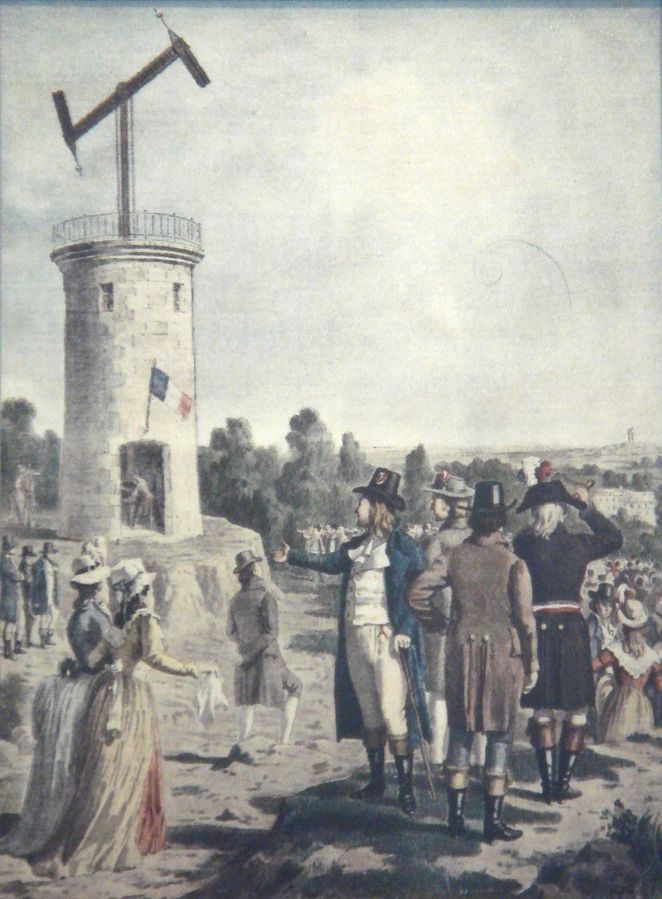
Early 19th century demonstration of Claude Chappe’s semaphore.
Wikimedia Commons.
… I’ve also long wondered the same about telegraphs — not the electric ones, but all the other long-distance signalling systems that used mechanical arms, waved flags, and flashed lights, which suddenly only began to really take off in the eighteenth century, and especially in the 1790s.
What makes the non-electric telegraph all the more interesting is that in its most basic forms it actually was used all over the world since ancient times. Yet the more sophisticated versions kept on being invented and then forgotten. It’s an interesting case because it shows just how many of the budding systems of the 1790s really were long behind their time — many had actually already been invented before.
The oldest and most widely-used telegraph system for transmitting over very long distances was akin to Gondor’s lighting of the beacons, capable only of communicating a single, pre-agreed message (with flames often more visible at night, and smoke during the day). Such chains of beacons were known to the Mari kingdom of modern-day Syria in the eighteenth century BC, and to the Neo-Assyrian emperor Ashurbanipal in the seventh century BC. They feature in the Old Testament and the works of Herodotus, Aeschylus, and Thucydides, with archaeological finds hinting at even more. They remained popular well beyond the middle ages, for example being used in England in 1588 to warn of the arrival of the Spanish Armada. And they were seemingly invented independently all over the world. Throughout the sixteenth century, Spanish conquistadors again and again reported simple smoke signals being used by the peoples they invaded throughout the Americas.
But what we’re really interested in here are systems that could transmit more complex messages, some of which may have already been in use by as early as the fifth century BC. During the Peloponnesian War, a garrison at Plataea apparently managed to confuse the torch signals of the attacking Thebans by waving torches of their own — strongly suggesting that the Thebans were doing more than just sending single pre-agreed messages.
About a century later, Aeneas Tacticus also wrote of how ordinary fire signals could be augmented by using identical water clocks — essentially just pots with taps at the bottom — which would lose their water at the same rate and would have different messages assigned to different water levels. By waving torches to signal when to start and stop the water clocks (Ready? Yes. Now start … stop!), the communicator could choose from a variety of messages rather than being limited to one. A very similar system was reportedly used by the Carthaginians during their conquests of Sicily, to send messages all the way back to North Africa requesting different kinds of supplies and reinforcement, choosing from a range of predetermined signals like “transports”, “warships”, “money”.
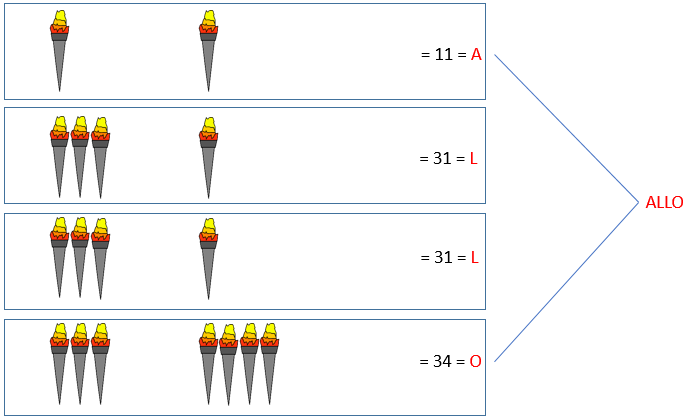
Diagram of a fire signal using the Polybius cipher.
Created by Jonathan Martineau via Wikimedia Commons.By the second century BC, a new method had appeared. We only know about it via Polybius, who claimed to have improved on an even older method that he attributed to a Cleoxenus and a Democleitus. The system that Polybius described allowed for the spelling out of more specific, detailed messages. It used ten torches, with five on the left and five on the right. The number of torches raised on the left indicated which row to consult on a pre-agreed tablet of letters, while the number of torches raised on the right indicated the column. The method used a lot of torches, which would have to be quite spread out to remain distinct over very long distances. So it must have been quite labour-intensive. But, crucially, it allowed for messages to be spelled out letter by letter, and quickly.
Three centuries later, the Romans were seemingly still using a much faster and simpler version of Polybius’s system, almost verging on a Morse-like code. The signalling area now had a left, right, and middle. But instead of signalling a letter by showing a certain number of torches in each field all at once, the senders waved the torches a certain number of times — up to eight times in each field, thereby dividing the alphabet into three chunks. One wave on the left thus signalled an A, twice on the left a B, once in the middle an I, twice in the middle a K, and so on.
By the height of the Roman Empire, fire signals had thus been adapted to rapidly transmit complex messages over long distances. But in the centuries that followed, these more sophisticated techniques seem to have disappeared. The technology appears to have regressed.
Comments Off on Long distance communication in the pre-modern era


