
Forgotten Weapons
Published 18 Nov 2022During 1944, the US and UK cooperatively ran a major effort to drop arms and equipment to French Resistance forces in preparation for the Allied landings in France. It began as Operation Carpetbagger with night drops from B24 Liberators in January 1944, and escalated into the summer. Eventually a number of massive daytime drops were made, totally more than 800 sorties and dropping 2.7 million pounds of equipment. The single most common firearm dropped was the MkII Sten, but containers also included Brens, handguns, M1 Carbines, bazookas, and No4 Enfields (along with ammunition).
After the country was liberated, the new government tried to collect up as many of the weapons as possible. They didn’t get them all (not by a long shot, actually), but many were put into government storage, including this No4 Lee Enfield. It was marked with a “PP” property mark and inventory number, and stashed away until being sold as surplus recently and imported by Navy Arms.
(more…)
March 24, 2023
Operation CARPETBAGGER: French Resistance No4 Enfield
March 23, 2023
History Summarized: Rome After Empire
Overly Sarcastic Productions
Published 11 Nov 2022“It’s gonna take more than killing me to kill me” – Rome, constantly.
Rome “Fell” in 476 … but we still have Rome. How’d that happen, and what does the Pope have to do with it?
(more…)
QotD: “Slave societies” and “societies with slaves”
Historian Ira Berlin distinguished between “slave societies” and “societies with slaves”, according to the institution’s place in the culture. It could be a large part of the economy of a “society with slaves” — e.g. the northern American colonies circa the Revolution — but it didn’t dominate social, cultural, and institutional life the way it did in a “slave society” (e.g. the Southern colonies). If you’re wondering where this “racist Southerners invented slavery” nonsense that’s been making the rounds on social media came from, look no further, since Berlin’s distinction really only applies to the Antebellum United States — un-free labor* being either effectively unknown, or central, to every even remotely “Western” society well into the modern period.**
So, taking the Antebellum South in particular: Could its economy have survived without slavery? Sure. You don’t have to be a historian to see it, either. Some quick back-of-the-envelope math will suffice. An “agricultural laborer” — surely we agree slaves were that? — in 1860 made, on average, 97 cents a day. Round that up to a dollar, multiply by six days a week, and you get $6 a week. Multiply that by 50 (let’s give everyone two weeks’ vacation) and you get $300 per year. A “prime field hand” in 1860 cost $1600, purchase price. Plus all his “maintenance and upkeep,” year-round, for life. It’s grossly inefficient, what with agriculture being a largely seasonal occupation and all. And that’s before you factor in the mechanization trend that was already well underway at the time of the Civil War.***
Could the South have survived culturally without slavery? Of course not. That’s the whole point of Berlin’s distinction. Neither could any other slave society. The Roman Empire, all of it, is inconceivable without slavery. Here’s the proof: There were lots of freedmen in the Roman Empire. The first thing they did, pretty much without exception, is buy as many slaves as they could afford. Even Athens, the “birthplace of democracy”, depended on slave labor.
* Just to placate any field specialists who want to argue that medieval villeinage wasn’t merely slavery by another name.
** With the (admittedly large) exception of Great Britain, which in true British Imperial style managed to profit hugely from slavery without consciously admitting it. See, for example, Eric Williams’ Capitalism and Slavery, which manages the neat trick of being a Marxist polemic that is (mostly) factually accurate and (largely) argued in good faith. Published in 1944, natch, by a scholar way out on Western Civ’s fringes, but such a thing was possible even for White folks back then — see e.g. the work of Christopher Hill). They’re the other “society with slaves”, and since we’re talking about their spiritual descendants in places like Boston and Providence it’s a distinction without a difference.
*** The fact that Antebellum Northerners thought they couldn’t economically compete with slave labor has nothing to do with the economic reality of slave labor. “Free Soil, Free Labor, Free Men” is a nice piece of campaign rhetoric (it was the Republican Party slogan in their first election, 1856), but that’s all it is. And again, you don’t have to be a professional historian to see it. France’s economy was ok after the loss of Saint-Domingue (at one time the most valuable piece of real estate in the world). Great Britain did pretty good, economically, after freeing their slaves in places like Bermuda, Barbados, and Jamaica (again, some of the most valuable real estate in the world in the 18th century).
Severian, “On Slavery”, Rotten Chestnuts, 2020-06-18.
March 22, 2023
First Class Breakfast on the RMS Titanic
Tasting History with Max Miller
Published 21 Mar 2023
(more…)
What happened to Colour Sergeant Frank Bourne after Rorke’s Drift?
The History Chap
Published 20 Jul 2022Colour Sergeant Frank Bourne was the senior NCO at the Battle of Rorke’s Drift during the Zulu War of 1879. Superbly played by actor Nigel Green in the 1964 film Zulu, many have wondered why he was never awarded a Victoria Cross when 11 others were. This is the story of what happened to Colour Sergeant Frank Bourne after Rorke’s Drift.
He was actually awarded Britain’s second highest military medal (at the time), the Distinguished Conduct Medal, and ultimately rose from the ranks to become an officer. His military career continued all the way to the First World War, where he was promoted to the rank of Lt. Colonel. Frank Bourne, the last surviving defender of Rorke’s Drift, died in 1945, one day after the Germans surrendered.
(more…)
QotD: “[T]he Conservatives were a party whom its enemies need not fear and its friends did not trust”
The Conservative Party, led (or at least, headed) by the highly intellectual Arthur Balfour, was deeply divided on the question. It appeared not to be able to make up its mind; as one brilliant young Conservative Member of Parliament, Harry Cust put it, “I have nailed my colours to the fence”. Balfour, the Prime Minister, refused to express himself clearly on the subject, for fear of alienating one or other of the factions of his own party, and thereby bringing the government down. Intellectually brilliant as he was, he proved incapable of exercising any leadership.
In the election that followed Chamberlain’s conversion to protectionism, the Conservatives were swept from power. Neither free-traders nor protectionists trusted them, and the opposition Liberal Party, which at least was clear on this question, soon became a government of reforming zeal. For many years, the Conservatives were a party whom its enemies need not fear and its friends did not trust.
Theodore Dalrymple, “On Brexit, Remember that Politics Is Not a Dinner Party”, New English Review, 2018-03-11.
March 21, 2023
The musical anomaly that was 2022 – when classical music suddenly became much more popular
Ted Gioia looks at some surprising numbers for the music industry showing that of all genres, classical music suddenly became much more popular in 2022:
Last year, I went viral with an article about the rising popularity of old music. But I focused on old rock songs. Many of these songs are 40 or 50 years old. And in the world of pop culture, that’s like ancient history.
But if you really want old music, you can dig back 200 or 300 years — or even more, if you want. But does anybody really do that?
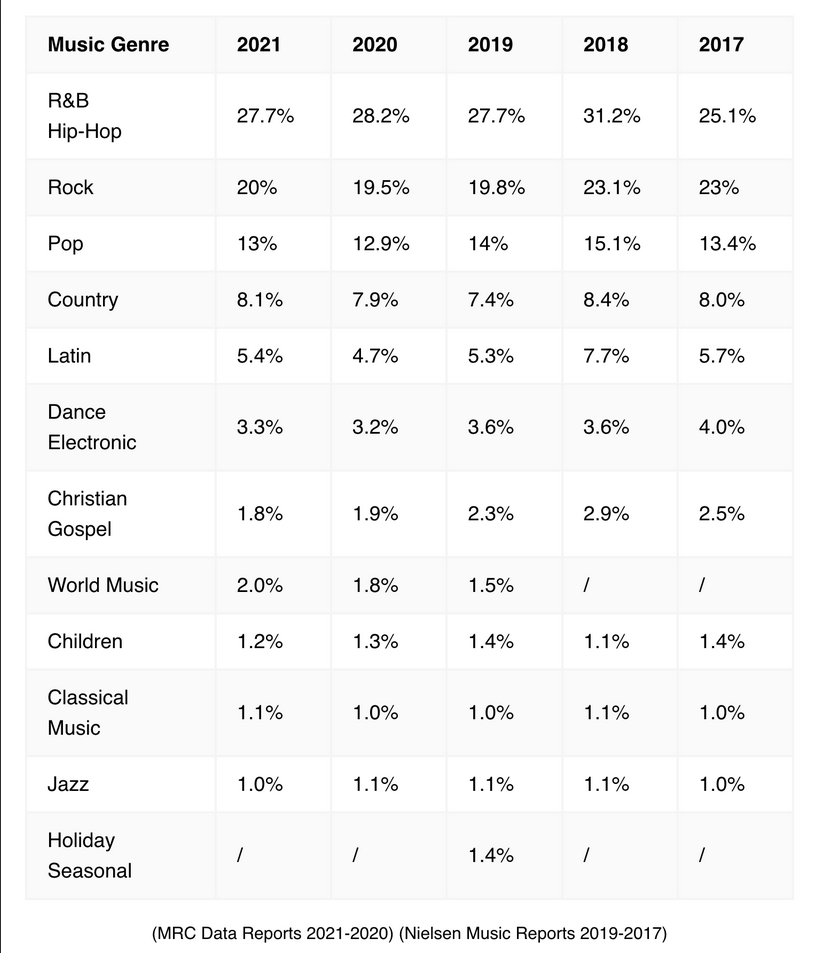
Conventional wisdom tells us that only around 1% of the public cares about classical music. And it doesn’t change much from year to year.
For proof, just take a look at this chart:
If you love concerts at the philharmonic, you read these figures with much weeping and gnashing of teeth. If classical music were any smaller, it would be a rounding error. Or — even sadder — it would be like jazz.
But that data only covers the period up to 2021. And 2022 was different.
In fact, it was remarkably different.
Over the last 12 months, I’ve started to see surprising signs of a larger audience turning to classical music. Last year, I wrote about the amazing saga of WDAV, the first classical music radio station in US history to take the top spot in its city.
I analyzed the numbers, and tried to get to the bottom of this unexpected success story. At the time, I wrote:
Women are the key drivers here. The station boasts a double-digit share in the female 35-44 category. But this probably is tilted heavily toward mothers, at least if we factor in the next bit of evidence — which reveals that WDAV has a mind-boggling 38% share among young children.
But then a few weeks later, this research report was issued:
I need to point out that respondents were allowed to mention multiple genres — but even given that loophole, who would expect classical music to rank ahead of country music, hip-hop, or folk?
This can’t be true. The numbers must be wrong. Or, maybe, people are lying to pollsters.
But then a survey of holiday listening trends in the UK revealed the unprecedented popularity of orchestral music — especially among younger listeners.

Born in the Heart of Besieged Leningrad: the PPS-42
Forgotten Weapons
Published 11 Nov 2022One would think that the Shpagin PPSh-41 was as simple as a submachine gun could get, but that wasn’t the case in World War Two USSR. Barely had the PPSh gotten into real production than the Army was looking for something even simpler. An answer came from young designer Aleksey Sudaev with a completely-stamped gun that used about half the raw material and a third the machine time to produce as the PPSh. After winning the competitive trials, Factory 828 in Moscow was chosen as the lead production facility. They produced a series of drawings and preproduction guns in the summer of 1942.
Sudaev took those drawings into besieged Leningrad with orders to et up production in three factories within the city. The main one was Factory 209, and after fixing a few minor design flaws, the gun went into production in the spring of 1943. Sudaev PPS-42 SMGs pretty much went out the doors of the factory and right into combat trying to break the siege of the city. In total, about 46,000 would be produced before that siege was finally broken.
Meanwhile, Factory 828 in Moscow put a higher priority on policing the design than on immediate production. They implemented a substantial number of improvements, although the lack of communication into Leningrad prevented them from being used in the production going on there. Instead, the improvements culminated in the PPS-43 design, of which more than a million were made by the end of the war.
(more…)
QotD: The elephant as a weapon of war
Elephants are – all on their own – dangerous animals. Elephants account for several hundred fatalities per year in India even today and even captured elephants are never quite as domesticated as, say, dogs or horses. Whereas a horse is mostly a conveyance in battle (although medieval European knights greatly valued the combativeness of certain breeds of destrier warhorses), a war elephant is a combatant in his own right. When enraged, elephants will gore with tusks and crush with feet, along with using their trunks as weapons to smash, throw or even rip opponents apart (by pinning with the feet). Against other elephants, they will generally lock tusks and attempt to topple their opponent over, with the winner of the contest fatally goring the loser in the exposed belly (Polybius actually describes this behavior, Plb. 5.84.3-4). Dumbo, it turns out, can do some serious damage if prompted.
Elephants were selected for combativeness, which typically meant that the ideal war elephant was an adult male, around 40 years of age (we’ll come back to that). Male elephants enter a state called “musth” once a year, where they show heightened aggressiveness and increases interest in mating. Trautmann (2015) notes a combination of diet, straight up intoxication and training used by war elephant handlers to induce musth in war elephants about to go into battle, because that aggression was prized (given that the signs of musth are observable from the outside, it seems likely to me that these methods worked).
(Note: In the ancient Mediterranean, female elephants seem to have also been used, but it is unclear how often. Cassius Dio (Dio 10.6.48) seems to think some of Pyrrhus’s elephants were female, and my elephant plate shows a mother elephant with her cub, apparently on campaign. It is possible that the difficulty of getting large numbers of elephants outside of India caused the use of female elephants in battle; it’s also possible that our sources and artists – far less familiar with the animals than Indian sources – are themselves confused.)
Thus, whereas I have stressed before that horses are not battering rams, in some sense a good war elephant is. Indeed, sometimes in a very literal sense – as Trautmann notes, “tearing down fortifications” was one of the key functions of Indian war elephants, spelled out in contemporary (to the war elephants) military literature there. A mature Asian elephant male is around 2.75m tall, masses around 4 tons and is much more sturdily built than any horse. Against poorly prepared infantry, a charge of war elephants could simply shock them out of position a lot of the time – though we will deal with some of the psychological aspects there in a moment.
A word on size: film and video-game portrayals often oversize their elephants – sometimes, like the Mumakil of Lord of the Rings, this is clearly a fantasy creature, but often that distinction isn’t made. As notes, male Asian (Indian) elephants are around 2.75m (9ft) tall; modern African bush elephants are larger (c. 10-13ft) but were not used for war. The African elephant which was trained for war was probably either an extinct North African species or the African forest elephant (c. 8ft tall normally) – in either case, ancient sources are clear that African war elephants were smaller than Asian ones.
Thus realistic war elephants should be about 1.5 times the size of an infantryman at the shoulders (assuming an average male height in the premodern world of around 5’6?), but are often shown to be around twice as tall if not even larger. I think this leads into a somewhat unrealistic assumption of how the creatures might function in battle, for people not familiar with how large actual elephants really are.
The elephant as firing platform is also a staple of the pop-culture depiction – often more strongly emphasized because it is easier to film. This is true to their use, but seems to have always been a secondary role from a tactical standpoint – the elephant itself was always more dangerous than anything someone riding it could carry.
There is a social status issue at play here which we’ll come back to […] The driver of the elephant, called a mahout, seems to have typically been a lower-status individual and is left out of a lot of heroic descriptions of elephant-riding (but not driving) aristocrats (much like Egyptian pharaohs tend to erase their chariot drivers when they recount their great victories). Of course, the mahout is the fellow who actually knows how to control the elephant, and was a highly skilled specialist. The elephant is controlled via iron hooks called ankusa. These are no joke – often with a sharp hook and a spear-like point – because elephants selected for combativeness are, unsurprisingly, hard to control. That said, they were not permanent ear-piercings or anything of the sort – the sort of setup in Lord of the Rings is rather unlike the hooks used.
In terms of the riders, we reach a critical distinction. In western media, war elephants almost always appear with great towers on their backs – often very elaborate towers, like those in Lord of the Rings or the film Alexander (2004). Alexander, at least, has it wrong. The howdah – the rigid seat or tower on an elephant’s back – was not an Indian innovation and doesn’t appear in India until the twelfth century (Trautmann supposes, based on the etymology of howdah (originally an Arabic word) that this may have been carried back into India by Islamic armies). Instead, the tower was a Hellenistic idea (called a thorkion in Greek) which post-dates Alexander (but probably not by much).
This is relevant because while the bowmen riding atop elephants in the armies of Alexander’s successors seem to be lower-status military professionals, in India this is where the military aristocrat fights. […] this is a big distinction, so keep it in mind. It also illustrates neatly how the elephant itself was the primary weapon – the society that used these animals the most never really got around to creating a protected firing position on their back because that just wasn’t very important.
In all cases, elephants needed to be supported by infantry (something Alexander (2004) gets right!) Cavalry typically cannot effectively support elephants for reasons we’ll get to in a moment. The standard deployment position for war elephants was directly in front of an infantry force (heavy or light) – when heavy infantry was used, the gap between the two was generally larger, so that the elephants didn’t foul the infantry’s formation.
Infantry support covers for some of the main weaknesses elephants face, keeping the elephants from being isolated and taken down one by one. It also places an effective exploitation force which can take advantage of the havoc the elephants wreck on opposing forces. The “elephants advancing alone and unsupported” formation from Peter Jackson’s Return of the King, by contrast, allows the elephants to be isolated and annihilated (as they subsequently are in the film).
Bret Devereaux, “Collections: War Elephants, Part I: Battle Pachyderms”, A Collection of Unmitigated Pedantry, 2019-07-26.
March 20, 2023
When 1 Ship Saved 30 others – The Sacrifice of Jervis Bay
Historigraph
Published 25 Nov 2022On the morning of November 5th 1940, the British merchant convoy HX84 was spotted and attacked by a German pocket battleship. Faced with the destruction of 37 merchant ships and a heavy blow against Britain’s survival, it fell to HMS Jervis Bay, the convoy’s only escort, to charge the enemy ship head on and at all costs buy some time for the merchant ships to escape.
(more…)
QotD: The world of “Plum”
The maestro also knew a thing or two about politics. This is strange, for few of his nearly one hundred novels, short stories or plays betray more than a nodding acquaintanceship with the great upheavals of the 20th century. Enquiring deeper, the connoisseur will find that his eternal creation, Jeeves — the discreet, silent, valet-cum-butler extraordinaire — was named in honour of a popular English cricketer who died on the Somme in 1916. The subject himself, in a post-1945 volume, admitted to his employer Bertie Wooster that he had “dabbled somewhat in the Commandos” during the Second World Conflagration.
War and turmoil are there, lurking in the background, if successfully banished from much of his writing. Sadly, Pelham Grenville (forenames he hated, so adopted the moniker “Plum” instead) was naïve. Loafing professionally in France when the Wehrmacht knocked on his door for tea and crumpets in 1940, he and his wife were interned as enemy aliens. In 1941, Plum agreed to record five broadcasts to the USA, then neutral. Entitled How to be an Internee without previous Training, they comprised playful anecdotes about his experiences as a prisoner of the folk in field grey. I’ve read them. They are rib-tickling and harmless, and his American readers lapped them up. Alas, his British fan club took a different view.
The devotees of Bertie Wooster, Reginald Jeeves, the Earl of Emsworth, Sir Roderick Glossop and Co. were at first stunned, then vexed and finally branded the poor author a traitor. Although a post-war MI5 investigation exonerated him, a hurt Wodehouse thereafter lived in exile on Long Island. Fortunately for us, the flow of humour continued unabated, but Plum’s hard-earned Knighthood for conjuring up the essence of Bottled Englishness was long delayed until the New Year’s Honours of 1975. He died soon after, on St Valentine’s Day, aged ninety-three.
This lapse of judgement was all the more extraordinary given his ability to spot a scoundrel at one hundred paces. Threats to the serene, ordered nature of English society in which he resided — indeed helped to create — were few. In Wodehouse’s Garden of Eden, there is a definite hierarchy of earls and aunts, bishops, baronets and young blades, stationmasters and policemen.
The majority of his tales are set in country houses, replete with conservatories, libraries, gun rooms, stables and butler’s pantries. Letters arrive by several posts a day, telegrams by the hour. Trains run on time from village stations. Other than the pinching of policemens’ helmets, there is order and serenity. Necklaces are filched, silverware is purloined, butlers snaffle port, chums are impersonated, romances develop in rose gardens, but nothing lurks to fundamentally reorder society.
Peter Caddick-Adams, “Coups and coronets”, The Critic, 2022-12-13.
March 19, 2023
The Japanese Invade India! – WW2 – Week 238 – March 18, 1944
World War Two
Published 18 Mar 2023Operation U-Go, Renya Mutaguchi’s invasion of India, is in full swing this week, as his men aim at Imphal and Kohima; three Soviets Fronts batter their way through the Axis positions all over Ukraine; and there is a huge Allied bombing campaign at Cassino in Italy, which mistakenly kills a lot of Allied soldiers. That’s one busy week.
(more…)
Inside An M4 Sherman Tank With Historian James Holland
History Hit
Published 21 Nov 2022‘Inside An M4 Sherman Tank With Historian James Holland’
In this video, military historian James Holland gets inside the most iconic tank of the Second World War — the ubiquitous US M4 Sherman Tank.
With over 50,000 having produced between 1942 and 1945, the Sherman was the most widely used medium tank by the United States and Western Allies in World War II.
Easily produced, maintained and equipped with a 75mm gun as well as a single hatch-mounted .50 caliber machine gun (plus two lighter .30 cals positioned in the turret and forward hull), the Sherman proved extremely effective against soft targets. It still lacked the range and firepower of the German Panther and Tiger tanks, but its speed, manoeuvrability and fast rate of fire made it ideal wartime workhorse.
More recently, the M4 Sherman has risen to stardom with the release of Hollywood blockbuster Fury (2014), starring Brad Pitt and Shia LaBeouf.
(more…)
QotD: Are we re-enacting the “Crisis of the Third Century” or “Fall of the Roman Empire” this time?
Again, my knowledge of the topic is pretty weak, but y’all know that in general I believe inertia is one of the strongest forces in human affairs (just behind accident and error). What can’t continue, won’t … eventually, but there’s a lot of give in “can’t”. The “collapse” of the 5th century looked an awful lot like the “crisis” of the 3rd century, and not only did the Empire survive the third century crisis, in many ways it came back stronger than ever (one wonders what golden age might’ve been born had Aurelian lived).
It certainly does seem like we’re heading into a major crisis (yeah yeah, I know, thanks Nostradamus). Is it The End, or “merely” the Third Century Crisis? One wonders how it’s going down there in Brazil, and if there are any cagey young officers in the AINO Imperial Garrisons taking notes. The guys who grabbed the purple in the Third Century Crisis were called “the barracks emperors” for a reason, and we know (from the comments yesterday) that there are cabals of perverts alive and well in the officer corps.
2023 is shaping up to be really interesting. Ace of Grillers has done some reporting on the fossil fuel-intensive “Green” private jet flights of our beloved Transportation Secretary, Anal Pete. AOG thinks this is pretty obviously the butt bandit announcing his 2024 presidential run, and it’s hard to argue against it. Frankly I’m amazed Brandon has survived this long — is Dr. Jill that canny a political infighter, or is it just dumb luck that no one has felt the need to finish him off? — but it’s hard to see him making it too far into 2024. Veep Throat is of course running; we have yet to see Z Man’s predicted replacement of her with Gavin Hairgel, but I’m sure he’s in, too …
Frankly, I’m rooting for the Russians. You really want the wheels to come off, then start cheering for a big winter offensive from Ivan. Provided AINO doesn’t start cracking off nukes — a big, big IF — nothing would force the crisis like our “victory or death!” Juggalos getting their asses handed to them in the Donbas. The Z Man thinks they’ll pull a Ngo Dinh Diem on the Jewish Comedian here before too long; I wonder if they’ll even get the chance, or if it would matter if they did. I’m pretty sure Vlad’s done talking, if for no other reason than that he knows whatever faction of Juggalos he cuts a deal with will be betrayed by some other Juggalo faction. Unless the AINO peace proposals come written in the still-hot blood of a shitload of Kagans, he has zero reason to negotiate. And since The Media is still all in on their “total Ukrainian victory is just around the corner!” narrative …
Severian, “Friday Mailbag”, Founding Questions, 2022-12-16.
March 18, 2023
The US Adopts A Maxim: The Colt Model 1904
Forgotten Weapons
Published 9 Nov 2022The US Army spent nearly 16 years languidly testing the Maxim gun, but was never willing to actually make a decision until a final trial in 1903 finally settled the matter. The Maxim was deemed the best available machine gun and a contract was signed with Vickers, Sons, & Maxim to purchase 50 (later increased to 90). Eventually a total of 287 were procured; 90 from VSM and a further 197 made by Colt in the US. The first British guns were chambered for .30-03, with the Colts all made for the later .30-06 (and the VSM guns updated to that standard).
The Model 1904 was the heaviest Maxim gun ever made, weighing in at 62 pounds for the gun and another 80 for its tripod. Despite excellent reliability and durability, it was so heavy and unwieldy that it was pretty universally hated by American soldiers. The final order for 1904 Maxims was placed in 1908 and just the following year the M1909 Benet Mercie light Hotchkiss pattern was was adopted. By the time World War One arrived, half the Maxims had already been relegated to long-term storage. They were pulled out of the warehouses for training troops prior to their deployment to Europe, but they never saw any more significant military use.
(more…)


